
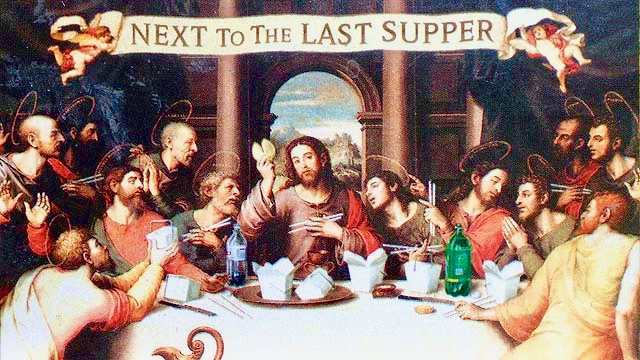
This Christmas day I’m picking my sister-in-law up at the airport. She has insisted that upon her arrival I take her to a Chinese restaurant so she can buy takeout to bring for dinner for everyone else at our home.
Yes, it’s true of all the restaurants likely to be open on Christmas the odds are heavily weighted that they’ll be Chinese and yes, it’s also true that of all the customers buying and eating Chinese food on Christmas the odds are also heavily weighted that they’ll be Jewish. We are. So, you can accompany the rest of what I’m about to write with Zero Mostel wailing Tradition from Fiddler on the Roof. But how did this happen?
My favorite explanation for why Jews eat Chinese on Christmas and at many other times during the year involves a debate between two old men.
“Chinese culture is at least 4,000 years old and we are the civilization that has been in the world the longest,” said Zhang.
“I’m sorry but the Jews have been around for over 5,000 years so we have been here at least a 1,000 more,” replied Abraham.
“Ok”, said Zhang. “But if that’s true, I need you to answer one question.”
“So, ask.”
“What did your people eat to survive for that extra 1,000 years?”
The real answer is actually pretty logical. In the early 20th century Jews and Chinese were the two largest non Christian immigrant peoples in America. Many from both groups lived in close proximity especially in urban centers like New York and Philadelphia. For Jews Chinese restaurants were conveniently located and affordable and— and this was most important —they didn’t use dairy products.
Jews who keep kosher won’t eat dairy and meat at the same time— that’s the most defining feature of the kosher laws which also rule out shrimp, clams and lobster —but if the wontons had pork filling, they sure resembled kreplach (dumplings) from the old country and hey, does God have X-ray vision? Many Jews were becoming flexible in their new country. Many still kept kosher in their homes but weren’t going to ask about what might be in the fried rice when they ate out.
As Jews moved to the suburbs Chinese restaurants moved with them and I grew up eating takeout from the only Chinese restaurant in Reading, PA on nearly every Sunday night. In fact a woman I know who grew up orthodox and kosher told me her family had four sets of dishes. One was for dairy, one for meat, one especially for the week of Passover and a fourth for their weekly Chinese. I’ve known more than a few Jews who will fearlessly eat bacon for breakfast at home but are terrified by the thought of ham in their refrigerators. Bacon is a threshold that can be crossed. Ham is a bridge too far.
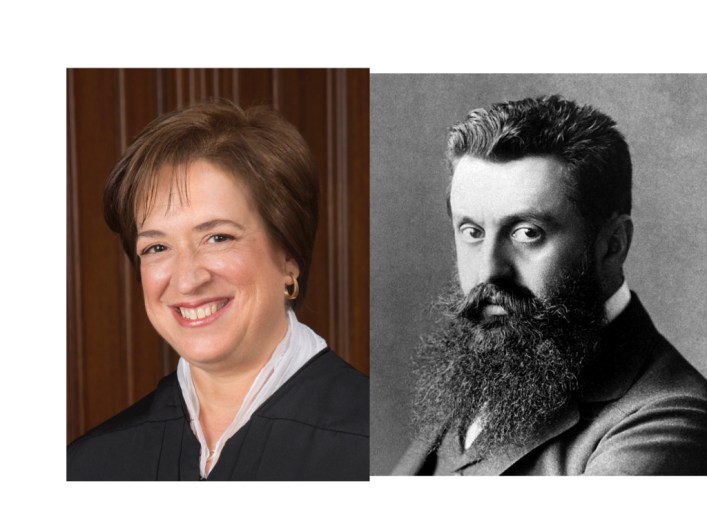
The matter of Jews and Christmas, however is more complex than just food. Take the issue of having or not having a Christmas tree. The founder of Zionism himself, Theodore Herzl, lived in Austria and had a Christmas tree in his house and this was before anybody thought of calling it a Hanukkah bush. After the chief rabbi of Vienna once came to visit him during the holidays he is alleged to have written in his diary, “I hope the rabbi doesn’t think less of me because of this. Then again what do I care what he thinks?” Herzl was a secular Jew like the majority of Jews in the United States today.
And herein lies the question, is having a tree or sitting on Santa’s lap an indication of Jews’ security or insecurity in their identity? Is it a sign of assimilation that’s harmless or harmful. I’m not sure many of us grapple with divining the answers. We do what feels right and that can be different for everyone. As a kid I got to sit on Santa’s lap but my son never did. My parents didn’t have a tree but instead scattered blue and silver ball ornaments meant to hang from a tree in bowls around our house. As a parent myself there were no Christmas decorations. As I said we all do what feels right.
In the meantime many of us can give the same answer that Supreme Court Associate Justice Elena Kagan did when asked at her confirmation hearing where she had spent Christmas.
“You know, like all Jews, I was probably at a Chinese restaurant.”


 pawnedaccordion