


All alone and feeling blueMe and my Roomba
Not a soul to show our clean digs toI own the stock
A lot of shares
It’s doing well
But really who caresJust me and my Roomba
Hangin’ out til COVID’s through

I’d like to see President Trump visit a public school classroom. One can only imagine the extent of the coronavirus testing that would precede his arrival. Unless the site and the students were disinfected beyond the standards of a neurosurgery operating room or a NASA cleanroom the visit would never happen and no doubt it won’t even if those criteria are met.
Although Trump has been leaning hard on schools around the country to reopen, neither his son nor his daughter’s children will be in a classroom at their private schools when the school year starts. That won’t happen until October at the earliest if it happens at all. If Melania and Ivanaka feel uncomfortable sending their kids back, I understand and support such prudent caution.
That of course won’t stop Donald Trump and Betsy DeVos from threatening the nation’s public schools with the withholding of federal money unless they open their doors. This double standard for the rich and powerful isn’t anything new. To quote the late Jim Croce, “Isn’t that the way they say it goes?”
For years I have been angered by the hypocrisy and callousness of elected officials who pass laws and regulations and implement policies that are hoisted on the public but exempt or advantage them. Congress has better health care insurance, better pensions and other perks they have legislated or just given themselves. Their annual salaries are $174,000 and although they haven’t taken a raise in a decade, the average median household income in America is less than half that at $75,000.
Having a government that puts its own self-interest before that of its average citizens is really a failing for any country. I know it’s expecting a lot of human nature to do otherwise and it’s almost always been this way. It’s the rare individual who puts him or herself at the end of the line when they are the ones forming it.
But of all the things our government has done that I believe have harmed the nation, getting rid of the draft ranks as the most consequential for me. Not requiring young Americans to serve the country in some capacity has been a terrible mistake.
Sure, there were always abuses of the “system”when there was a draft. From televangelist Pat Robertson (whose father was a senator) to former president George W. Bush, sons of politicians have frequently avoided combat duty due to the position of their fathers.
It was Vietnam that blew the doors off of the system’s fairness for all to see. It’s estimated that over 15 million baby boomers tried to avoid military service during that war. Many of us did successfully. If you found a doctor who was sympathetic to helping, you could get a letter attesting to a physical or psychological reason to receive a deferment.
I got one along with former vice president Dick Chaney who got five and Donald Trump. Over half of us eligible to go to Vietnam attempted not to. With all the deferments that were handed out, future historians may look back on our generation as the most physically impaired and mentally unsound in the country’s history.
In my case I had a second draft physical when I got to Israel. There the bar was much higher. When I described my back problems the army doctor asked me if I had had surgery to fix them. When I said no, he told me to walk across the exam room and by the time I got back I was in an artillery unit facing the Suez Canal.
Unlike Israel, America had the luxury of not needing every man to be a soldier and as a result service in Vietnam was largely avoided by the privileged. It was an unpopular and misguided war but it was also one fought disproportionately by boys from inner city ghettos, the sons of factory workers and the poor from regions like Appalaccia. We may have income inequality today but during the Vietnam era we had draft inequality.
What we call an “all-volunteer army” has now been around for almost 50 years. At this point two generations have not even had to think about serving the country if they chose not to. It’s as if they have been vaccinated from having to consider any obligation to America or maybe we should say that at this point they have acquired herd immunity from having to do so?
In any event we’ve gone to war without our leaders having to think very hard about how much protest the public might mount against it. As long as their own and our own kids didn’t have to serve we have gotten used to just looking the other way. The wars in Iraq and Afghanistan have gone badly just as Vietnam did. The estimate of how much we have spent on the first two misadventures in this century is $6.5 trillion. Again, historians will look back at that sum and shake their heads.
Unwise as our wars have been in lives and money, we’ve missed another opportunity by ending conscription and not enlisting our youth to help to truly make America better. A draft that would have allowed them to choose to work in hospitals, build infrastructure and teach in schools could have been of great benefit in tackling the country’s most pressing needs while providing experiences and forging relationships that could have cemented a bond to the nation for a lifetime.
I have no illusions about our having the will or the support to change and attempt that now.
Since World War ll and the height of American sacrifice, that word– sacrifice –itself has all but disappeared from the vocabulary of any politician. I actually make bets with friends that if they hear it uttered by their candidate of choice– Republican or Democrat –I will buy them a nice dinner out. I haven’t had to pay up yet.
“What you see too often in Washington and elsewhere around the country is a system of government that seems incapable of action. You see a Congress twisted and pulled in every direction by hundreds of well-financed and powerful special interests.
You see every extreme position defended to the last vote, almost to the last breath by one unyielding group or another. You often see a balanced and a fair approach that demands sacrifice, a little sacrifice from everyone, abandoned like an orphan without support and without friends.
We are at a turning point in our history. There are two paths to choose.
One is a path I’ve warned about tonight, the path that leads to fragmentation and self-interest. Down that road lies a mistaken idea of freedom, the right to grasp for ourselves some advantage over others. That path would be one of constant conflict between narrow interests ending in chaos and immobility. It is a certain route to failure.”
July 15, 1979 (The Malaise Speech)
President Jimmy Carter
History hasn’t been kind to Carter as a president but it just might remember him as a prophet.
—————–

—————–




 —————–
On some occasions my work took me to amazing places I surely otherwise would have never gotten to see. But I’ve seen a lot that I’ve loved. I’m still missing a few states in America I haven’t been to, also several continents– Africa, Australia and Antarctica. In retirement Jo and I have made wonderful trips to Europe, Asia and South America and across and around the United States. And like everyone we hope to have the opportunity to travel again someday without worrying about COVID-19. Getting on a plane and even eating inside a restaurant still seem a long way off and because of our failed response so far to the pandemic, that wall that President Trump so wants to build to keep people out has now been created by other countries to keep us here.
I have been thinking about a Top Ten List of the places I’ve been that have stories attached to them. Since I’ve discovered it’s easier to come up with a cartoon every day than an accompanying piece of writing to go along with it, I’m going to present my list today and share the stories on those days when I can’t come up with anything else to say.
So, here it is and maybe you’ve been to some of them yourself:
The Moss Garden in Kyoto
The Concertgebouw in Amsterdam
The synagogue in Belmonte, Portugal
The Paintings of Pieter Breugel the Elder in Vienna
The Cruden Bay Golf Club in Scotland
Two tour guides named Muhammad (Jordan) and Dvir (Israel)
The One Dim Sum restaurant in Hong Kong
The Pont du Gard Roman aqueduct in Provence
The Monarch Butterfly Sanctuary in Michoacan, Mexico
The Hubbard Glacier in Alaska
I intend to tell you about each of them as time goes by but until then here’s Ella Fitzgerald bemoaning her and our own present predicament…
https://www.youtube.com/watch?v=fZ73TJd5338
—————–

I have taken two lie detector tests in my life and I passed both but someone else I knew passed one and I’m very certain he shouldn’t have. Let me explain.
In addition to managing an apartment building, I worked part time at a Radio Shack in Sherman Oaks when I was in film school at UCLA. I don’t know if I’d call it the Radio Shack to the stars but among those who I rang up at the cash register were Michael Jackson– he needed a replacement light bulb for his View-Master stereoscope and told me he had a large collection of reels– the white disks with the little pictures which may still be in thousands of attics.
Steve Allen was impatient when I told him how much I enjoyed his show on TV growing up and stopped what I guess he thought was my fawning admiration with a curt, “Just show me the microcassette recorder that’s on sale.”
Others included Annette Funicello, who I have mentioned waiting on before, musician Herbie Hancock, astronaut Gordon Cooper… All bought stuff, plus a guy I didn’t recognize who purchased an item that had been sitting on the shelf forever.
Remember the phone number you used to be able to call to get the precise time? “At the tone the time will be 7:17 and 20 seconds.” And there would be the tone and another, “At the tone the time will be…” ad infinitum. Radio Shack had a clock that did this but offered the Greenwich Mean Time version. From his accent the man who wanted the only clock like this we had in the store was a Brit so it sort of made sense although he seemed so laid back that I wondered why he’d even be interested in what time it was.
Me: “I got to tell you, we’ve never sold one of these. Can I ask you why you’re buying it?
Customer: “I’m on the road a lot and I don’t need it but I like to know what time it is at home.”
Me: “What do you do?”
Customer: “I’m in a band.”
Radio Shack had a policy of always asking for the name and address of its customers and have them write that information on their receipt. The store carbon copies generated a gigantic mailing list that allowed Radio Shack flyers to reach millions back in the pre internet era. When this fellow wrote down his name I had seen it before. First name: John. Last name: McVie. Band: Fleetwood Mac.
But back to the lie detector. Radio Shack made all prospective employees take a lie detector test. I had imagined it was going to be like in the movies, you get hooked up to a slew of wires and asked a bunch of yes or no questions. You’re either as cool as a cucumber or you squirm. Uh-uh. The questions come before you’re connected to anything and you rehearse. For example since I was going to work in a store I was asked if I had ever stolen anything. I thought about it and remembered I used to take change off my father’s bureau without him knowing to buy baseball cards. That was certainly stealing. Then came a follow up…
Lie detector guy: “Other than the change is there anything else you ever stole?”
Just then I thought of something else.
Me: “I used to work in New York and realized I had a company stopwatch in one of my sportcoats months after I had left there.”
Indeed, it’s one of the CBS stopwatches that 60 Minutes displays on the screen every week and is so iconic that one has been in the Smithsonian since 1998. I used mine for work at ABC until I dropped it.
Lie detector guy: “Ok, is that it?”
There were a number of other germane pre test questions and the process was to prepare you for the same questions when you were attached to those wires so you wouldn’t be uncertain during the real deal. The polygraph records your pulse, blood pressure, respiration and registers if you’re sweating. So call the prelim an exercise in conscience cleansing although I wouldn’t put it in the same category as Catholic confession or Yom Kippur atonement.
Several months later we had a problem at my store. Some big thefts of valuable merchandise had occurred but there were no indications that there had been any break ins. The store had a manager and two part time sales people. I was one, the other came on shortly after I’d started. There were hours and even occasional days when only one of the three of us was in the store. I couldn’t imagine the thefts had occurred on my shifts although I was victimized by some classic retail scams that inflicted less damage and showed me that grifters are quite canny.
My co part timer, like me, often closed the store alone. The manager was able to figure out that all the thefts had probably taken place between those evenings when he was the last person to leave and lock up and the next day. Open and shut case? No. We all took lie detector tests and we all passed. A short time later my partner, who couldn’t be pinned down for the crime, quit.
Mark Twain may have said, “If you tell the truth, you don’t have to remember anything.” But what about those who are able to remove a memory like they’re using an eraser on a blackboard? Can they con a polygraph? I’d contend the answer is yes.
According to the Washington Post’s Fact Checker database in over a thousand days as president, Donald Trump has told over 20,000 lies. It’s for others to determine whether or not he actually knows he lies with such abandon or has a mind so strangely wired that he actually has convinced himself he never does.
The irony is that an enduring legend about America’s first president is the story about his chopping down a cherry tree and confessing– “I cannot tell a lie. I did it with my hatchet.” That story was invented by one of Washington’s first biographers and the book, published in 1800, became an instant bestseller.
Nobody is going to have to make up anything when the sad history of the Trump era is recalled centuries from now. I only hope he will be remembered as the president who could not tell the truth.
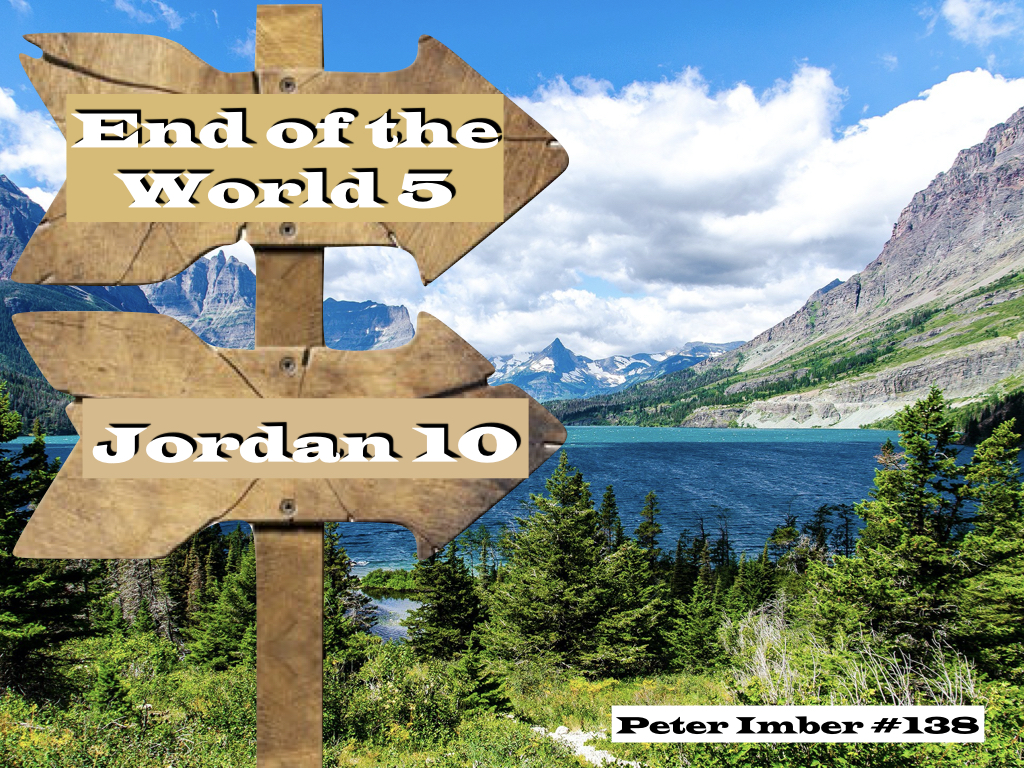
Where is the most isolated town in the lower 48? I had no idea but when I found out, I wasn’t surprised. It’s Glasgow, Montana. That’s according to Ken Jennings, who in addition to having won a ton of money on Jeopardy, wrote a book titled Maphead, and as a kid slept with a Hammond atlas next to his pillow.
Jennings has calculated that 98% of us live less than an hour’s drive from an urban area of more than 75,000 other people. Montana’s Glasgow is four and a half hours from a city that size in any direction. I haven’t been there, but I spent a lot of time nearby— well, sort of nearby. Jordan, Montana is only 60 miles from Glasgow as the crow flies, but if you’re not a crow and have to drive, it’s 137 miles and a five hour trip without a bathroom break.
No doubt Jordan is a close runner up in the “Middle of Nowhere” sweepstakes and in 1996 there was a standoff there between a group known as the “Montana Freemen” and the FBI. The Freemen were right wing zealots who believed no government had sovereignty over them beyond the county level. They didn’t pay their taxes and had also committed bank fraud, mail fraud and wire fraud— if you’re counting, that’s a fraud trifecta. At one point they had also offered million dollar bounties on local officials and a federal judge who they wanted captured dead or alive.
After a series of confrontations with local law enforcement and federal agents, the Freemen holed up in a farmhouse on a foreclosed property outside of Jordan to avoid arrest.
ABC News considered this a big story because three years earlier the FBI had been involved in a siege in Waco, Texas. That bungled standoff had resulted in the deaths of nearly 80 members of a religious sect called the Branch Davidians. So, I was sent with a crew to Montana to be in place in the event history was going to repeat itself.
Our arrival in Jordan coincided with the sheep shearing season and the town’s two motels were booked full with the shearers. At one of them I noticed a room behind the front desk that was filled with furniture and other junk. We needed it.
Me: “Does the room behind the front desk have a bathroom and a shower?”
Motel Manager: “Yes.”
Me: “I’ll pay you $100 if you move that stuff out and give me the room.”
I probably overpaid but the space was emptied in an hour and way too many of us spent several nights in it. Sharing the bathroom was especially ugly and when I saw one of the crew was rinsing his mouth with Snapple after brushing his teeth, it was apparent it was time to move out. We upgraded our accommodations after some of the locals accepted our offers to rent their trailer homes.
According to the last census the population of Jordan, Montana was 343. We were the only network that had shown up for the story and became, I’m sure, a welcome source of income for the town.
There was really only one restaurant in Jordan and it was Ok but with a limited menu. It had a salad bar and once, when there was nothing left on its cart, a woman emerged from the kitchen with an industrial size can of peas. That became the salad offering for the evening.
After a couple of weeks the correspondent who had been with me was rotated out and another from the ABC News bureau in D.C. replaced him. I had never worked with this guy before and as I drove him to his first dinner, it was clear he was not happy about being drafted for Jordan duty. It seemed possible that he would make life for the rest of us unpleasant. When we got to the restaurant he quickly was taught the lay of the land.
Our teenage waitress came to the table and our new arrival asked her if he could see a wine list. Here’s how that exchange went and I remember it word for word.
Waitress: “We don’t have a wine list?”
Reporter: “Well, what kind of wines do you have?”
Waitress: ” We have rose and chablis.
She pronounced rose as you would the flower and chablis as if it rhymed with cannabis. Our reporter was undaunted.
Reporter: “So, bring me the bottles.”
Waitress: “I can’t.”
Reporter: “Why not?”
Waitress: “Because they’re in boxes.”
It was like seeing a bucking horse get broken and it was certainly an appropriate howdy do to Jordan for a snobby city dweller. After that I was less worried that he was going to be trouble.
It didn’t take long to figure out that if I wanted to know who or where somebody was, I could just ask at the post office. It was unlikely you could take a leak in Jordan without everybody knowing about it. And I gained some useful information by chance one day when I just happened to be using the laundromat at the same time as a couple of FBI agents. Found out the director himself was coming to Jordan the next day.
For the locals Jordan was a place where if you got into a fight at the Hell Creek Bar and were bloodied, you kept drinking because there was no physician residing in town and whoever was going to stitch you up would come from Glasgow for all I know.
After a few months and much negotiation the Freemen surrendered and so, my stint in Montana had been babysitting for a potential disaster that didn’t happen.
I haven’t been back however I doubt Jordan has changed a lot in a quarter century. Unless its kids want to be ranchers, I don’t imagine there’s much to keep them there. But before any wistful reminiscing about the demise of rural life in America, let me relate a conversation of my own with that same high school waitress.
Me: “You must have a pretty small high school.”
Waitress: “Yes, too small.”
Me: “Really, why?”
Waitress: “Because I hardly have anyone I can date.”
Me: “That’s too bad, but I guess it’s to be expected, this is a small place.”
Waitress: “Small is one problem. The other is I’m related to over a third of my class.”
If it feels like I’ve been taking pot shots at Jordan, well, up until very recently
it was the town that would have had the last laugh. Jordan is the county seat of Garfield County, Montana— population 1,268. Garfield County didn’t report it’s first case of COVID-19 until less than a month ago. But as of this past week it now has recorded over 40.
Pour me another glass of rose or chablis please.
—————–

The Democratic Convention begins tonight and to say it’s being held in Milwaukee where it was scheduled to be is not accurate or possible in the time of COVID-19. It’s taking place in cyberspace and it’s actually about time. Political conventions haven’t played a role in deciding who would be their party’s candidate in quite a while.
The last time there was real doubt about who a convention would nominate was in 1976, when Gerald Ford was seriously challenged by Ronald Reagan for the Republican nomination in Kansas City. And the last time a leading candidate came to a convention with less than a majority of delegates was 1984, when Walter Mondale was just a few short.
So, for years conventions have pretty much been boring television in terms of drama and news value for the legacy networks– ABC, CBS and NBC –while the partisan cable channels– Fox and MSNBC –have increasingly become the place to view them for the parties’ faithful.
I got to go to several of these withering extravaganzas and the one I enjoyed the most was the Republican convention in 1988. It was in New Orleans and I did my best to avoid working too hard so I could EAT! The Big Easy was paradise for a big appetite– muffuletta and po boy sandwiches, red beans and rice, gumbo, crawfish etouffee, beignets, bananas foster… I had them all.
The New Orleans convention was also the first time I ever worked with Sam Donaldson, ABC’s legendary White House correspondent. Someone called him the serrated knife of Washington reporters and I can attest that in Donaldson’s case blunt can be sharp.
My favorite story about him actually took place in California when he was covering President Reagan. When Reagan stayed at his ranch, the press filed from the Biltmore Hotel in nearby Santa Barbara. It wasn’t tough duty but presidents make news even when they’re just riding horses or clearing brush and Donaldson would get on the air more evenings than not. He was great at his job and it was my experience that he was also as hyper and high strung off the air as he appeared to be when you saw him at home.
Typically, a White House correspondent’s piece would start with him or her live on camera setting up the taped body of the story and then close with the correspondent back live on camera at the end. Outside on the lawn at the Biltmore, the Pacific ocean made for a beautiful backdrop.
At one point Donaldson’s abundance of energy caused a problem that had nothing to do with his reporting. In fact it was about to jeopardize his getting on the air at all. After he would finish his live shots Donaldson would literally throw his microphone on the ground and dart off. The more vigorous the toss, the more likely the microphone would be trashed. Microphone mortality was precarious until a sound person had an ingenious solution. He got a mattress from the hotel and placed in front of Donaldson and the problem was solved.
And P.S. I don’t know the date when what I’ve pasted below was published by change.org but they certainly got their wish…
Change.org
No Confetti or Balloons at the 2020
Democratic National Convention
The Democratic National Committee has chosen the Fiserv Forum in Milwaukee to host the 2020 Democratic National Convention.
In 2016, the DNC marked the close of their convention with a balloon and confetti drop. For over five minutes, 100,000 plastic balloons and streams of confetti dropped from the Wells Fargo Center ceiling while party leaders playfully slapped at them. Spoiler – they still lost the 2016 election.
Campaigns last a few months, the plastic in those balloons could wreak havoc in our environment for years.
Let’s encourage the DNC to walk the walk and forgo this wasteful and excessive celebration and show Republicans that they mean business when it comes to environmental policy, who themselves used 125,000 balloons and over 1,000 pounds of confetti at their convention.
And double P.S. Here’s a link to a story I did about confetti after meeting the couple who owned a confetti company that inspired it. There’s a story almost everywhere if you keep your eyes and ears open…

Alex Trebek: “The most dangerous bar in America.”
Contestant: “Who is Attorney General William Barr.”
—————–

— Senator Bernie Sanders
Thanks to John, the former news editor of the local newspaper where we both grew up in Pennsylvania for the idea for today’s cartoon. I’m pretty sure Fear and Loathing in Las Vegas written by the late Hunter Thompson inspired both of us when we were fledgling journalists. I’ve certainly tried to be a “gonso” disciple now but sans the hard drinking and drug abuse.
—————–

The Moss Garden
“Layla, you’ve got me on my knees
Layla, I’m begging, darling please…”
— Eric Clapton
I was in a hurry and ripped off my clothes…
That should have gotten your attention and maybe I’ll just leave that sentence hanging in the air for a bit. Let me start over.
I’m going to blow my own horn and claim that I’m a pretty good photographer. I’ve had photographs of mine selected to be in the annual Maine Photography Show three times. I haven’t won any awards but it’s nice to have a reason to frame a picture so it can be exhibited. I’ve also been putting together a desktop calendar of photos I’ve taken that I’ve given to friends for a number of years now and nobody has sent one back yet. But at the Moss Garden in Kyoto my camera and I met our match and not just once but twice.
The Moss Garden surrounds a Buddhist temple known as Saiho-ji that was built about 1200 years ago. It’s less than an acre in size but has over a hundred different varieties of moss that cover everything that isn’t water. I can’t adequately convey in words the effect it had on me both times I’ve been there and although I took a lot of pictures, none of them captured the experience sufficiently either.
Let me put it this way, when I was there it felt transcendent, but when I looked at my pictures later it was as if they were almost as unremarkable as those of the astroturf lining of a miniature golf course. Here, take a look…

This just doesn’t capture it and the best I can come up with to explain why is simply because I’m not there. A photograph can only reveal an instant and freeze it and even if I took the picture with the vintage 3D Kodak Stereo Camera I inherited from my grandfather, it’s missing a lot of other dimensions– physical and sensory, spiritual and ephemeral –that enveloped me in the experience.
Movie studios reintroduce 3D motion pictures every 20 years or so and then they disappear again. They’re a gimmick because ultimately, you can’t make people believe they replicate what so far can’t be replicated. Maybe someday this will be possible. Maybe someday people will see and hear Billie Holiday sing “live and in person” again. I can’t imagine I’ll be around for that and I wouldn’t want to be actually– too confusing. Handling real life can be daunting enough and being as we’re all now gingerly navigating our existence through cyberspace, let’s move on before one of us gets lost.
My first trip to Japan was in 1974 and aside from sightseeing, my ex wife and I witnessed American history, watching Richard Nixon announce his resignation on a television in our hotel. A Little League baseball team from the States watched with us, they’d be in their mid 50s now and I wonder what they remember and if it affected their lives afterward in some way.
Forty six years ago visiting the Moss Garden was easy. We just showed up. Forty years later in 2014 when Jo and I made our trip to Japan, things were different. We had planned our own self guided tour of the country and in the process I learned that admittance to the Moss Garden now had to be requested a month in advance. The place had become that popular as well as a UNESCO World Heritage site.
I got our reservation arranged before we left the States only to discover when we arrived at Saiho-ji there were other additional new rites of passage. Before being permitted to enter the garden, attending a Buddhist ceremony was mandatory as well as completing a calligraphy exercise. I got through the ritual– the chanting was loud, intense and fascinating –but trying to sit on my heels to copy Japanese characters with a quill pen was both painful and impossible. A priest ended my suffering by motioning for me to go outside where I could sit on a cushion at a higher desk and continue with my handwriting assignment.
I wasn’t the only one to have been granted this privilege or, depending on your cultural point of view, kicked out of class. Another American had beaten me there.
Me: “Boy, I just couldn’t sit in there.”Other Guy: “You’re not kidding, that was brutal.” Me: “I’m a little worried. On the rest of our trip I’ve booked us into three ryokans where we’re going to be sitting on the floor a lot”Other Guy: “Good luck! My wife and I were in one.”Me: “How was it?”Other Guy: “We left after one night and checked into a Hilton. I’ve been waiting to have knee replacement surgery back home.”
He was in worse shape than I, but this was not what I wanted to hear.
A ryokan is a traditional Japanese inn and if Saiho-ji was hard on my knees I knew I was in trouble. My cartoon today is not an exaggeration. There are no western style beds, chairs or tables in a ryokan. There is nothing in a guest room that is as high AS your knee. What you’re paying for, if you’re not Japanese, is the experience. From the moment you enter a ryokan you take off your shoes and switch to wooden clogs and then go to your room and take off your clothes and change into a yukata– a Japanese robe. You have entered a different world.
Yes, now we’ve caught up to my opening sentence. I was in a hurry and I did rip off my clothes. I put on a yukata and headed to what for me was the main attraction, the onsen. An onsen ryokan is one that has a hot spring and this ryokan in the mountain town of Hakone did. Japan is volcanically active and a benefit of that is the country has thousands of hot springs. Onsens are like public baths and since I’ve never spent much time in a Jacuzzi, immersing myself in the onsen was a luxurious new sensation and I loved it.
However, when I got back to our room afterward Jo and her sister Lynn, who was traveling with us, were shaking their heads. I had grabbed the first yakata I saw hanging in our closet. The girls brought out the other two to show me and continued shaking their heads. One was much bigger than the other and I immediately understood why the one I was wearing felt so snug and didn’t reach below my imperiled knees. Also, my obi, the Japanese waist sash, was bright gold like the other smaller one Lynn was holding whereas the larger yakata that Jo was holding was paired with a blue one. I’m not sure the girls thought this was funny but I did.
Me: “Ok, so I’m betting I’m not the first crossdresser to stay here.”
Meals at this ryokan were served to us in our room and we sat, or at least tried to, around a table less than the height of a bowling pin. There were many courses and each dish was beautiful to look at but at the same time often unidentifiable, especially the vegetables. We tasted everything brought to us but enthusiasm for our repast was waning when Lynn provided the best line of the entire trip.
“I think this is a little too authentic.”
We stayed at three different ryokans for a total of six days. It was tough bedding. The futons supplied to us were much thinner– by four inches –than what is sold as a futon in America. We were not just sleeping barely above the floor, we were sleeping on the floor. But other than that and having bitten off more than we could chew– and I mean that literally, the meals at the ryokans were huge –we had a great time in Japan.
Oh, and we didn’t pay anything remotely like $1400 a night (which is entirely possible) for the privilege of sleeping an inch off a tatami mat and having no place to sit down when we weren’t. If we had, I think I would have asked the management for a mattress and a chair. As a crossdresser, they might have thought I was a famous kabuki actor who couldn’t shake playing female roles and stayed permanently in character. They might have been honored to have me staying at their inn. Or not.
—————–

Today marks the date exactly 10 years since Jo and I moved to Maine. It’s 3,201 miles from Studio City, CA to Camden, ME and according to my favorite directions giver website at the time, the trip could have taken us just two days and four hours by car if we had worn adult diapers and did that other type of speeding. Instead, we took three weeks and used bathrooms in 14 American states and one Canadian province and slept normally.
It was a journey home for Jo who was born and grew up in Maine and had lived in Los Angeles for 24 years, feeling for most of that time like she was in a diaspora. At one point I even got her a t-shirt that was imprinted with “Born in Maine. Living in exile.” I had been in California even longer and after a career that had been mutually dissolved by my employer and me in the spring of 2010 was ready and able to get back closer to where I once belonged myself which is Pennsylvania.
Jo and I had dreamed of making our cross-country trip for a while. We’d bought our Maine house in the fall of 2009 and had moved most of our things there right away with the intention of moving ourselves there permanently in 2011 at the end of my contract with ABC News. An offer of the remaining money and time left on my contract from Disney/ABC moved up our timetable. It was a no brainer to accept a buyout. ABC News shed roughly 25% of it’s staff in 2010 and not everybody left with as much as I was able to. I guess if farmers can get subsidies for not planting crops, journalists can get paid for not reporting stories. However, in my opinion we are increasingly going to learn, if we haven’t already, that food and reporting are mutually important to our well being.
The plan for our travel route was simple. Jo had never been to Oregon nor Montana and had never seen Mt. Rushmore nor Niagara Falls. We both wanted to explore Michigan’s two peninsulas. The dots were not going to be difficult to connect and I had a list of golf courses I hoped to play and some offbeat attractions I wanted us to visit along the way.
A good friend of ours threw us a wonderful going away party and since there was a substantial gap between it and our actual departure date we kept saying goodbye to the same people who had been there until we felt embarrassed we were still around.
We finally departed LA on July 30th and as we traveled across the northern edge of the United States, I sent daily dispatches, much like I’m doing now with my cartoons, to those who were interested in hearing about our progress. My travel log in its entirety can be found in five parts on my blog at pawnedaccordion.com
It was entitled Whose America is It Anyway? and in 2010 I’d say that was prescient although not very hard to have envisioned.
Below is an excerpt from a day spent in Montana…
Day 8
Friday, August 6
Missoula to Bozeman
“What you’ve done becomes the judge of what you’re going to do — especially in other people’s minds. When you’re traveling, you are what you are right there and then. People don’t have your past to hold against you. No yesterdays on the road.”
–William Least Heat Moon in Blue Highways “Blue Highways” was written in the 70s by a guy who, after leaving his wife and losing his job, set out on a trip across America traveling by back roads and avoiding Interstates and cities. It’s one of my favorite books, although Jo might tell you that’s not much of a claim since I read so few.
Although Interstates might make it easy to think you’re seeing the country, much of what’s wonderful to discover isn’t near them. Today we were fortunate because we got off I-90 to take the road less traveled. We stopped in Philipsburg, which we thought was just another tiny Montana mining town that had seen better days, and while drinking my morning coffee I learned that Philipsburg has been making a comeback because of a candy store.
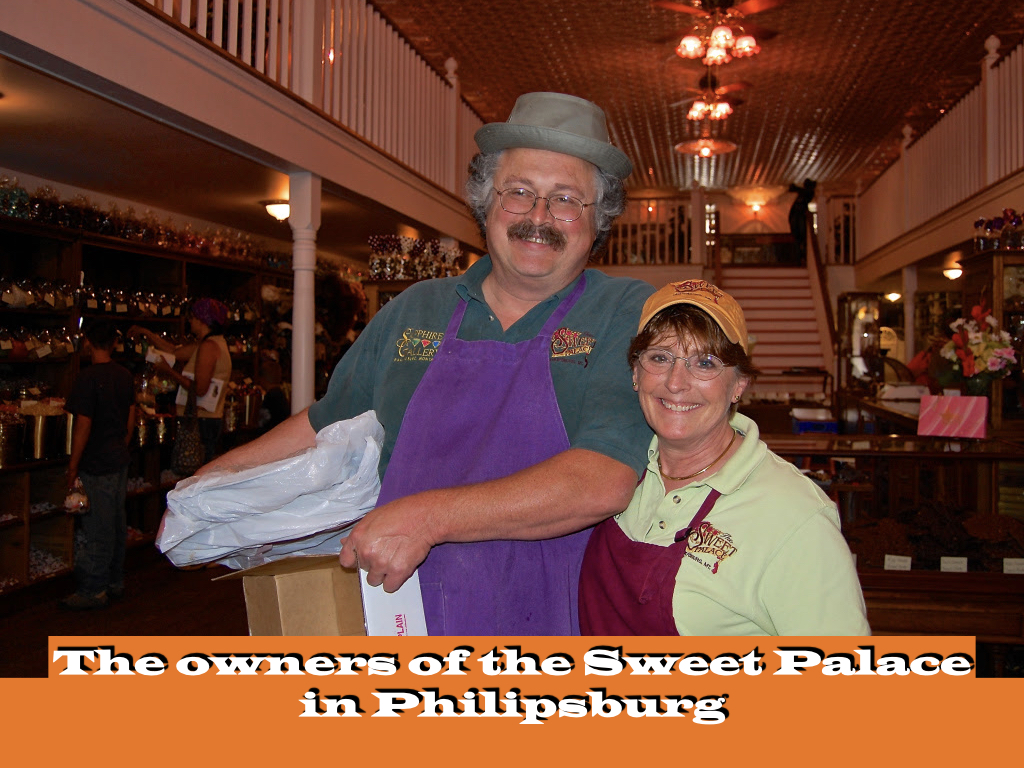
We met the owners of the Sweet Palace who had come to town about a decade ago. They started a candy store figuring people on vacation eat stuff they wouldn’t at home and, point taken, Jo and I left their store with a purchase of nearly $20 worth of chocolate. Apparently, candy lovers from around the world make pilgrimages to this sweet spot which does over a half million dollars of business a year in the middle of nowhere.
As we were making the walk to the car with our chocolate motherlode something happened that we had both bet never would on this journey, we bumped into people we knew. A friend of Jo’s of many years from Rockland, ME was on a fishing trip with three other guys. One of them turned out to be a college classmate of mine at Dartmouth who now lives in Camden which I hadn’t known. There was a moment of mutual shock among all of us and as we drove away and saw some lightning we decided we’d better not get out of the car and risk getting hit twice.
We made two other stops later in the afternoon at Superfund sites. Yes, call me the environmental accident(al) tourist. One was in Anaconda to see a golf course that Jack Nicklaus designed on the scarred remains of a mineral smelter. The sand traps don’t have sand, they contain finely ground black slag. Our federal government paid for the construction of the course and then gave it to the city. I happen to think this is a pretty cool way to put an exclamation point on cleaning up after man’s doing harm to his environment. I know golf isn’t usually associated with that but at least here it is.
The other polluted wonder wasn’t cool at all and you actually pay $2 to look down on an unquestioned and unremediated environmental disaster. The Berkeley Pit was an open pit copper mine right beside downtown Butte. It was productive to say the least. A billion tons of copper and other minerals were extracted from it before it was closed in 1982. At that point the water pumps that kept groundwater from seeping into it were turned off and the pit started to fill up. Some years later a flock of migrating geese were found dead in the pit’s water and the consequences of its mining became clear. Heavy metals and dangerous chemicals had turned it into a toxic cesspool.
The pit is a mile long, a half a mile wide, 900 feet deep and so poisonous that the life forms that survive in it are thought to possibly provide clues to cures for cancers– the theory being that the bad can be destroyed by the even worse. I’d seen the Berkeley Pit before when I did a story about this place and its warped potential. It never aired on World News Tonight and I don’t think it was because the story wasn’t worthy. What I suspect was the reason was ageism. The correspondent with me was in his 50s and had fallen out of favor. We had done three good stories in Montana on that trip and none of them were ever broadcast. At the time I realized my own age had also become a liability in my workplace.
It was early evening when Jo and I got to Bozeman and walked from our motel to the rodeo that was the main attraction for us tonight. It featured calf roping and bull riding accompanied by a stiff wind that by itself almost knocked you off your stride. Jo noticed that nearly all the kids were blond and as I surveyed the stands I couldn’t find a single Black, Latino or Asian face. Jo and I looked at each other and she said what I was thinking, that we were likely the only Jews there as well. I added that it was also Friday night and Shabbat. We certainly didn’t feel unwelcome, just aware that we had left behind the diversity of the big city here in the Big Sky.
I saw two kids in cowboy outfits and got permission from their parents to take their picture. Afterward I said to Jo that I thought I’d taken the best picture I’d have from the entire trip. It is.

—————–

After reading in this morning I had to change the cartoon for today… Trump apparently also said about Steve Bannon, “He did it to make me look bad.” The length of Pinocchio’s nose has prevented the poor guy from being able to stand up for a long time already. Let’s all wish upon a star for an end to this nightmare.
—————–

His skin was orange as a prison jumpsuit
And everything cruel and despicable her brother did
Most Republicans didn’t give a hoot
They followed him no matter what
They loved that he obeyed no rules
It made the rest of us hope and pray
We can take back our country from these fools
—————–


Neither snow nor rain nor heat nor gloom of night stays these couriers from the swift completion of their appointed rounds. — Motto of the U.S. Postal Service
But politics just might. Could the United States Post Office’s reducing the number of mailboxes and sorting machines affect kids’ letters to Santa this year?I asked a simple question and I got way more of an answer than I expected.
First, let me add that not everyone agrees– from the current Trump appointed head of the Postal Service Louis DeJoy to the Wall Street Journal editorial board –that the changes that have occurred are damaging to the functioning of our mail service or that they are anything more than cost saving measures needed to make the Postal Service, which is hemorrhaging money and receives no taxpayer dollars for its operations, more efficient.
But my question led me to the history of children’s letters to Santa and I discovered it’s pretty interesting. Back in the 1800s parents actually were the ones who wrote the letters in Santa’s voice and often they were evaluations of their kids’ behavior during the year with admonishments of how they might need to improve it– “You need to be kinder to your brother.” As gift giving became more of a feature of the holiday, the writers and recipients reversed roles and children began authoring their own wish lists to Santa Claus.
At first the letters weren’t mailed and were left at Santa’s vertical entryway by the fireplace. Some more original thinkers attached theirs to balloons they watched drift off in the sky with the hope that they’d reach the North Pole. The cartoon I’ve inserted below is considered a major reason the practice of writing Santa became so widespread.

Poor Shirley Temple!
The cartoon was published in 1871 but until 1912 all of Santa’s mail ended up in the Dead Letter Office, since opening a person’s letter addressed to someone else was illegal. Since then approved individuals and organizations can answer Santa’s mail but with a caveat. The letter must be addressed to Santa Claus, if the name on the envelope is Kringle or Nicholas, you can’t touch it since these are both family names whose letters might possibly have been wrongly addressed. I sort of doubt that but I understand the requirement as the need to be postally correct.
Every year millions of letters are mailed by children and even some adults addressed to Santa Claus and many get answered by something else created in 1912 called Operation Santa which authorized local postmasters to write back to children they determined were in need.
For others who want Santa to answer them there’s an easy process that will even get you a North Pole postmark. Along with your child’s letter, you simply include your own with Santa’s response and a stamped envelope with your return address and send both of them to the Postmaster in Anchorage, Alaska. I can vouch for the postmark being an accurate facsimile. I was in Alaska in the winter several times during my career, and it felt like the North Pole to me.
So, despite the assurances of the current Postmaster General– a Trump fundraiser and the first Postmaster General in 20 years with no prior experience in the United States Postal Service –should kids be concerned that their letters to Santa might not make it to his workshop in time this Christmas?
Well, it should come as no surprise at all that Santa Claus now has an address in cyberspace. In fact he has a bunch of them, and if your child is worried about reaching him, all she or he has to do is send an email to any one of his multiple email addresses. I’m sure those opening his electronic mail for him will be delighted to get your kids’ addresses and thrilled to be able to get back to them with some exciting ideas for enhancing their wish lists.


—————–

81% of NBA players are people of color
70% of NFL players are people of color
62% of MLS players are people of color
43% of MLB players are people of color
Is it any wonder that these players would stage a wildcat strike after the latest questionable police shooting of a Black man?
We root for our teams because sports matter to us whether their rosters are white, black, brown, yellow and would still do so even if they had green players from mars. Just as it’s easy to connect to a team we support, it’s easy to disconnect from the lives and concerns of those who play for it.
I understand Black players’ anger and their fear. I hope I understand all racial, religious and gender minorities’ fears at a time when a large percentage of Americans perceive them as a threat and would walk back their gains and rights in an instant.
As a country we have a lot of work to do.
—————–

Is there anybody else out there who grew up thinking the Dutch Masters were cigars? Ok, I’m better informed now. I do realize Rembrandt isn’t just a brand of toothpaste and Vermeer isn’t only a manufacturer of farm equipment, but a Dutch artist’s name Frans Hals would still have been the home of Kukla and Ollie’s nice human friend on TV Fran Allison if you pronounce the name Frans Hals with a Pennsylvania Dutch accent.
So, a couple days ago thieves broke into a museum in the Netherlands and stole a 400 hundred year old Hals painting said to be worth 18 million dollars. That’s certainly news, not earth shattering by any means in these times but news. There’s a twist though and the kind of head scratching one that makes me want to know more about the heist. This particular painting has now been stolen three times, most recently in 2011 and before that in 1988.
If I were leading the investigation, I’d put Peter Falk’s Columbo on the case.This is a tailor made crime for a disheveled nudnik detective who always pesters and nudges his suspects straight to jail. I’d check out all theories of course. Could it be that this particular art theft has become a college fraternity initiation rite in Holland? The painting’s title is Two Laughing Boys with a Mug of Beer. That could be a clue.
The first two thefts were solved when the thieves tried to sell the painting and it’s logical that the more famous the work, the harder it probably is to find a buyer unless they have no compunction about shielding something akin to a human fugitive.
After doing a little research it turns out other famous paintings have also been stolen multiple times, Poppy Flowers by Vincent Van Gogh, The Scream by Edvard Munch for example. The Van Gogh is still missing but The Scream was recovered both times. Munch’s work has been described as representing “the universal anxiety of modern humanity.” Munch painted four of them between 1893 and 1910. Over a century later I’m afraid we have even more to scream about.



Great museums, great food, great day trips by train to other towns… but I wanted most of all to go to the Concertgebouw, a concert hall with a reputation for having the finest acoustics for music in the world. After our first of three visits I understood why. I’ve never heard classical music sound better anywhere.
The Concertgebouw opened in 1888 and it’s widely agreed that there are only two concert halls in the world that rival it for the quality of its sound– theMusikerein in Vienna and Symphony Hall in Boston. The hall’s extraordinary sound turns out to have been an accident. It was built when acoustics weren’t really understood. The architect who designed it was described by his grandson as being, “As musical as a cow.”
What’s the Concertgebouw’s secret? Until recently it was a mystery but researchers now think they know. The hall’s shape is rectangular and it’s been called a “shoebox.” A few years ago acoustics experts determined that the sound is so special because of the Concertgebouw’s side walls. Here’s what they concluded:
“The sound you hear comes to you from three different sides. One, right at you from the orchestra, and two reach you one-tenth of a second later because they bounce off the walls. But your brain doesn’t register it as an echo because it’s just one-tenth of a second. This reflection gives the sound its character.”
From the first moment I heard the orchestra play I was awed. This was indeed music, that in this space, felt richer and unique. I didn’t know about the miniscule delay in how I was hearing it. The Concertgebouw’s secret turned out to be simply a lesson in the speed of sound.
I never took physics but I do remember when I was first aware of how much slower sound travels than light. I was in 4th grade and stuck in my classroom during recess taking a flutophone lesson– remember those? They looked like toy clarinets –while the rest of my friends were outside playing softball. The field was far enough away from the classroom window that when someone hit the ball it was a split second later that the crack of the bat reached my ears. The effect of that miniscule delay in the Concertgebouw made it one of those rare times when an experience surpassed my highest expectations.
And there’s more that made going to the Concertgebouw a rare experience. Included with our concert tickets were additional ones for free public transportation to and from the concert plus a free glass of wine at intermission. With more than 700 music concerts a year and over 700,000 visitors who attend them, that’s a lot of bottles of wine and tram tickets and if you think the government funds the operation to make it possible, you’d be right but more wrong than right. The Concertgebouw gets only a 10% subsidy of its budget from the national and local government. It’s a privately owned company that at a time when classical music orchestras and venues are struggling is doing very well.
And maybe there’s a lesson here. In every survey I have checked that ranks the best countries in the world to live in today, the Netherlands is near the top and its citizens among the happiest. If music be a patron of the mood of life, play on!
——————

But now the days are short
I’m in the autumn of the year
And now I think of my life as vintage wine
From fine old kegs
From the brim to the dregs
It poured sweet and clear
It was a very good year
For whatever reason I thought It Was a Very Good Year was a Kurt Weil and Bertold Brecht song. Turns out it was written by someone I’d never heard of named Ervin Drake and further more he wrote it for The Kingston Trio in 1961 and not Frank Sinatra, who won a Grammy a few years later for his rendition.
And if you think the songs on my nursing home juke box are too dark and would never lead you to part with your quarters, there’s this. That Kingston Trio album on which It Was a Very Good Year was includedwas titled Goin’ Places!
Well, of course we all are eventually and over the weekend there was a lesson in the relativitiy of aging for me from baseball. The Red Sox traded a player named Mitch Moreland. It’s his birthday in a few days and he’ll turn 35. He was moved to another team for two players ages 20 and 21. The younger players are called “prospects”, Moreland is a “veteran.” In baseball he’s in the autumn of his years.
Since most of you are about my age let me ask you a question. What do you remember thinking when you heard the Beatles sing When I’m Sixty-Four? The song was released in 1967 when I was 20 and for me at the time 64 meant you were like my grandparents who went to Miami Beach in the winter and stayed in what are now the beautifully restored art deco buildings in South Beach, once referred to as God’s waiting rooms. My grandfather died there.
As I got older When I’m Sixty-Four stood for the music I used to love to listen to but hoped that if I ever ended up sitting motionless with a towel draped around my neck on the porch of a retirement home, the Beatles and Rolling Stones wouldn’t be rattling my hearing aids..
I thought the reason for my wanting to abandon the “oldies” soundtrack was about energy– I mean not having it physically at the level anymore that matches the music. But maybe energy isn’t the issue. Maybe the music is too tied to the memories.
I stopped playing basketball in my 40s because I snapped a tendon in my lower leg and not once but twice. I got the hint and moved on. And that’s how I think about the music I used to listen to. I’ve moved on and one of the great things about music is that there is always something new to find that’s in tune with how you perceive your stage of life. Billy Strayhorn for example. Strayhorn was a collaborator, composer and arranger for Duke Ellington. He wrote Take the A Train and many other songs for Ellington.
Jo and I have started listening to Strayhorn and added him to our new soundtrack. These and other artists we now love, like Johnny Hartman and Dinah Washington, are ones who were more popular with my parents’ generation than mine. They fit our energy but are also wonderful new discoveries. Now, if every generation seems to reject things about the one that raised them could that mean that my parents might have been listening to the Supremes and the Beach Boys in their golden years and I just didn’t know about it? I know that’s the opposite of going retro like I have but who knows? My mother once asked me to bring her some pot. Turned out she wanted to see it, not try it.
Here’s a link to Ella Fitzgerald with Duke Ellington’s orchestra performing Billy Strayhorn’s Something To Live For which Strayhorn composed in 1939.https://www.youtube.com/watch?v=ZMOtcqIQG9U
_________________

 pawnedaccordion