

On November 3rd only we can solve it.

You can get anything you want at Alice’s restaurant…
Arlo Guthrie
A few years ago the song Alice’s Restaurant was selected for preservation by the Library of Congress as being “historically significant.” I guess that doesn’t make this cartoon much clearer but stick with me.
They paved paradise and put up a parking lot…
Joni Mitchell
Hmmm… I’m not sure this helps that much either but sometimes coming up with the first sentence of a story can be the toughest part.
When I lived in Los Angeles I was a Costco member and just how serious a Costco shopper I was became clear to me one day when I called Costco’s headquarters to speak to an executive about a news story I was working on. Before I even asked any questions myself this fellow had a couple of his own.
Costco: “Do you shop at our stores?”Me: “Yes I do.”Costco: “So, tell me are you wearing anything right now you bought from us?”
Now, this call occurred a long time before the “Me, too” movement but if I’d been a woman, I would have thought this both weird and inappropriate, but I’m a guy and I didn’t at the time.
Me: “Ok, I have on a shirt I bought at Costco and my pants I think, and my socks and underwear and… and oh yeah, my watch.”
I don’t know what the guy’s point was other than he got some positive customer feedback and I proved my Costco bonafides. Yes, I was indeed a Costco shopper but not much of a fashionably dressed individual. In fact it was so apparent to one of my coworkers at the ABC News Bureau that he came up with the “Peter Imber Dress Code” in an effort to better the impression I was undoubtedly making to those who believed that clothes make the man.
I’m looking at that Dress Code right now. It’s in a frame on the wall in front of me. I don’t think my good friend Brian will mind if I share it with you.
–Wear good clothes.
–Never wear blue jeans to work unless you’re going to get dirty.
–Never wear jeans and a denim shirt together for any reason.
–Buy four new shirts a year and throw away four.
–Wear a sport coat on shoots.
–Pay more for good shoes that last.
–Buy two pairs of shoes, throw two away.
–Wear three different pairs of shoes a week.
–Don’t wear anything with writing on it.
–Never wear to work anything you bought because it was on sale.
–If you’ve had it ten years, throw it away.
–Be comfortable, but look good.
The good shoes edict was the one I’ve really adhered to ever since and am most grateful for. The others… eh, I did my best.
But this is still a long way from Tel Aviv so let me get us there…
So I had a Casio watch I’d purchased at Costco and its watch band broke. I couldn’t find the same one anywhere to replace it and tried a few others but I wanted the original. At this point in my life in the 1980 and 90s I was traveling to Israel to visit my ex wife’s family and the kibbutz where I had lived for seven years. I was confident that on an upcoming trip to the land of milk and honey and humus and falafel my elusive watch band was waiting for me in the promised land.
Calling the old Central Bus Station in Tel Aviv dilapidated or ramshackle when I lived in Israel is accurate but by no means the whole picture of what it was, what surrounded it, what was there. The area was indeed gritty but it was a bazaar with carts in its alleyways and a commercial district with stores on its streets. Delicious ice cold watermelon might be had for a few shekels in front of a window filled with vacuum cleaners.
I didn’t know where my watch band might be but I knew it was there somewhere. The streets were narrow and crowded and you were just as likely to be dodging a Vespa as a Volvo. The store that looked to be a good prospect for me was only a slightly wider than its doorway. I showed the elderly man who I assumed was the owner my watch and he took it with him behind a curtain. When he returned he put a small box of watch bands on the counter and in it was mine. In fact there were several dozen of mine. The watches in the tiny shop may or may not have been knockoffs but I’m certain my replacement watch band was authentic. How was I sure? It had Casio imprinted on it.
I was thrilled but not surprised that I had accomplished my mission. I guess I saw it as sort of a pilgrimage, although the Tel Aviv Central Bus Station was anything but a sacred place. After a new bus station was built to replace it the abandoned area became a center for prostitution.
When I got back to the States I called my parents and told my mother the story of the watchband that I’ve just told you. I thought I had shown myself to be a tenacious and resourceful shopper and I was proud of myself. When I had finished reciting my tale there was a long pause at the other end of the line and then my mother spoke.
“So, did you buy two?”
I hadn’t.
—————–


I’m lucky. I’m enjoying my pandemic Groundhog Days more than enduring them. How many people can say that?
Our new normal lifestyle began a day before my birthday in March. So far that’s been a big part of our luck since, even though it was still winter here in Maine, we were moving toward the reward we get for spending that longest of our seasons here. We’ve had a good summer with our outdoor life. No, make that a very good summer. Not enough rain but so many nice days I think I have taken them for granted which is not something I would usually feel.
However, as the first signs of fall are now visible in the treetops, Jo and I have begun thinking about how our lives will increasingly be more indoors and how our social distancing meet ups with others will need adjusting or maybe become impossible. Outdoors has been easy. Golf for me with good friends I’ve made here, walking and kayaking for Jo with her friends.
The small dinner parties that are such a wonderful part of life in winter seem unlikely as are activities like going to the movies at the Strand in Rockland, the symphony and theater we subscribe to in Portland and the gym at the Y just up the street. To replace that last one we’ve bought our own elliptical machine that will arrive next week– all 300 pounds of it –and exercising at home will become part of our routines.
In the movie Groundhog Day Bill Murray is stuck in time reliving the same day over and over again. The pandemic undoubtedly can feel that way but I’ve been happy with my routine so far. Perhaps one reason why is that I once had a job that was so mind numbing that Bill Murray’s predicament was my own.
The job was working in a wood products factory and the task was operating a machine that made handles for pickaxes– you know the tool you see prisoners wielding to split rocks in the movies.
The machine could make four handles at a time. I would put the rough wood forms in place with my gloved fingers just a few inches away from sets of spinning blades that didn’t know or care that my hands were there. When those four were done I’d take them off and set up another four and do this over and over again.
I knew exactly how long the process took for one set and how many handles I could make in an hour. Factoring in changing the sanding belt a couple of times plus breaks for coffee and food, I knew exactly how many pickaxe handles I could make every day if there were no interruptions or mechanical problems. There was an absolute maximum number that was possible and no more than that.
This was my Groundhog Day until I no longer had the job. I truly disliked it and it depressed me but at least I wasn’t under any pressure to produce a quota and I didn’t have to keep the job to support myself or a family. I was working on the kibbutz in Israel where I was a member for seven years.
I believe I acquired some understanding of the workday life of someone with a blue collar factory job that is repetitive and makes you feel like you’re merely part of the machine you’re serving. I learned then that I wanted to create and control my own routine to whatever extent I could. Although very few of us actually get to achieve that goal totally, COVID-19 has presented a new awareness for me of the need to keep doing it. Many don’t have that opportunity. I’m one of the lucky ones that does.

The American commendation for being wounded in war is the Purple Heart. The seven veterans I have included in the cartoon today all received one and are and were from both of America’s major political parties.
The last president of the United States to have actually served in combat was George H.W. Bush in World War ll. No president since served in the Korean, Vietnam, Gulf or Afghanistan War.
Lip service to the military has replaced active service for most American politicians. Below are brief descriptions of some of those who have been the exceptions…
Tammy Duckworth— Army National Guard Lieutenant Colonel Duckworth lost both her legs in Iraq when the helicopter she was co-piloting was hit by a rocket-propelled grenade.
Max Cleland— Army Captain Cleland lost both his legs and an arm from a grenade in Vietnam.
Daniel Inouye-– Army Second Lieutenant Inouye lost his arm in Italy during WW ll in a battle in which he was wounded five times. He was a recipient of the Medal of Honor for extraordinary heroism.
Bob Kerrey— Navy Lieutenant Kerrey lost part of his leg from a grenade in Vietnam and while seriously wounded still directed his troops in a counterattack. He received the Medal of Honor for courageous leadership and devotion to duty.
Bob Dole— Army Second Lieutenant Dole was wounded by German machine gun fire in Italy in World War ll. He was operated on seven times and suffered limited use of an arm.
John F. Kennedy— After being medically disqualified from Army Officer Candidate School in 1941 because of chronic back pain, Kennedy joined the Naval reserve. Two years later he took command of a Patrol Torpedo (PT) boat in the Pacific theater. Lieutenant Kennedy injured his back when his boat was rammed and sunk by a Japanese destroyer and he was hospitalized for six months.
John S. McCain lll— Navy Lieutenant Commander McCain was taken prisoner of war in 1967 when his plane was shot down on his 23rd bombing mission over North Vietnam. He broke both his legs and an arm ejecting from the plane and his captors seriously beat and tortured him. When his father, John McCain, Jr., was named commander of all U.S. forces in Vietnam, the North Vietnamese offered to release his son. McCaine lll refused to be released unless all other soldiers taken prisoner before him were also. He remained a prisoner of war in Vietnam for five and a half years. His injuries made it impossible for him to raise his arms above his head.

—————–

Happy Labor Day! For thirteen and a half million Americans who are unemployed, according to the latest numbers released by the Bureau of Labor Statistics, it’s obviously not a day to celebrate.
But do we really celebrate workers and labor unions on Labor Day anymore? I think Memorial Day and Labor Day have both become more like seasonal goalposts than the occasions they were originally intended to be. Now, we’re likely to think first about swimming pools and school supplies rather than war dead and unions.
The Memorial Day we celebrate began In 1868 and was called Decoration Day. It came into being shortly after the end of America’s Civil War to commemorate the more than 600,000 soldiers who’d been killed. By 1890 every state of the Union– north and south –had adopted it as an official holiday but I didn’t know until looking it up that Memorial Day didn’t become an official federal holiday until 1971.
Labor Day’s origins were in the 1880s, beginning with parades in industrial centers across America to extol workers’ achievements. It became a legal holiday in 1894 during the presidency of Grover Cleveland.
The United States is such a large country and our recent wars have been fought by the few and not the many. Today, it’s entirely possible that we might not have a relative or a close friend to recall and honor who died in a war. If we say to someone, “Have a great Memorial Day weekend” we don’t even realize how far off that sentiment is from the initial intent of Memorial Day.
“Have a great Labor Day weekend” on the other hand can certainly be wished by anyone for anyone but again the holiday’s original purpose was to honor the American worker and the unions that had made its members’ lives better. There will be little acknowledgement of that today.
I have belonged at one time or another to three different American labor unions in addition to one other during the seven years I lived in Israel. I saw their strengths and weaknesses and witnessed their decline, which during my life and the nearly three decades of a career in television news was dramatic.
At ABC News I was a member of NABET which stands for the National Brotherhood (there were a few sisters but not many) of Broadcast Engineers and Technicians. In 1983 I was hired as what was called a vacation relief employee. That was exactly as it sounds, I was a temporary fill in during the summer while the permanent employees took their vacations. It was a great opportunity and I took advantage of it by learning new skills quickly and performing well and it turned into a full time position.
Five years later I was laid off. The television business was changing rapidly. The three major networks– ABC, CBS and NBC –were feeling the impact of competition from an expanding alternate TV universe called “cable.” The ownership of ABC had changed, too and my layoff was strictly an issue of cost cutting and union seniority– last hired, first fired.
Losing a job is pretty devastating but in my case I was fortunate. After being laid off on a Friday, I was editing the lead piece on the CBS Evening News on Sunday and a new member of another union. I continued to work at the CBS News Bureau in Los Angeles until I was called back and reinstated at ABC a year later.
After I became a producer I was still a union employee at ABC News and in 1998 all members of my union were locked out by a second new owner, the Disney Company. Despite Disney’s wholesome image as the benign guardian of family entertainment, my experience permitted me to see its other side. It’s a pretty ruthless company which had a lousy reputation with those who worked for it or did business with it during the time I was there.
But the lockout is where things get sticky when I relate to you my personal union history. In my union at ABC news producers were really the odd men out. We weren’t operating cameras or sound equipment– although that would come later. Disney succeeded in separating us from the union. Those producers ABC News wanted to keep were offered contracts, those they didn’t were let go.
The end result for me was a considerably more lucrative contract than the hourly union scale I was making as a union member. The pay had been good before but was also dependent on my working 60 hours a week on average. With a contract I no longer felt the pressure to have to do that.
When I arrived at the ABC lot in Hollywood in 1983 there were over 500 NABET employees. The ABC News Bureau was only a tiny part of the programming that was produced there that included a daytime soap– General Hospital, a quiz show– Family Feud and prime time series like Grey’s Anatomy. When I left in 2010 there were fewer than 100 NABETs left.
In the new contract after the lockout the union made a momentous miscalculation. In order to hold on to its members’ seniority pecking order it sacrificed their futures by giving up its sole jurisdiction to operate digital television equipment. That’s when it became possible for producers to shoot and edit their own stories. Fortunately, we weren’t totally burdened with that responsibility during my remaining years at ABC News but the means of gathering television news changed forever.
With no intention to rub salt in the wounds of my former union, I’m including a link below to the first story I did where I had my own camera to supplement the one used by the real cameraman who was on the shoot with me. It was on a story I did at my alma mater– Dartmouth College. I had an idea and climbed a ladder to place and leave the camera for a shot that turned out to work pretty well… Truly beginner’s luck.
Happy Labor Day!
https://www.youtube.com/watch?v=ut9ZZU6lqwQ&t=5s
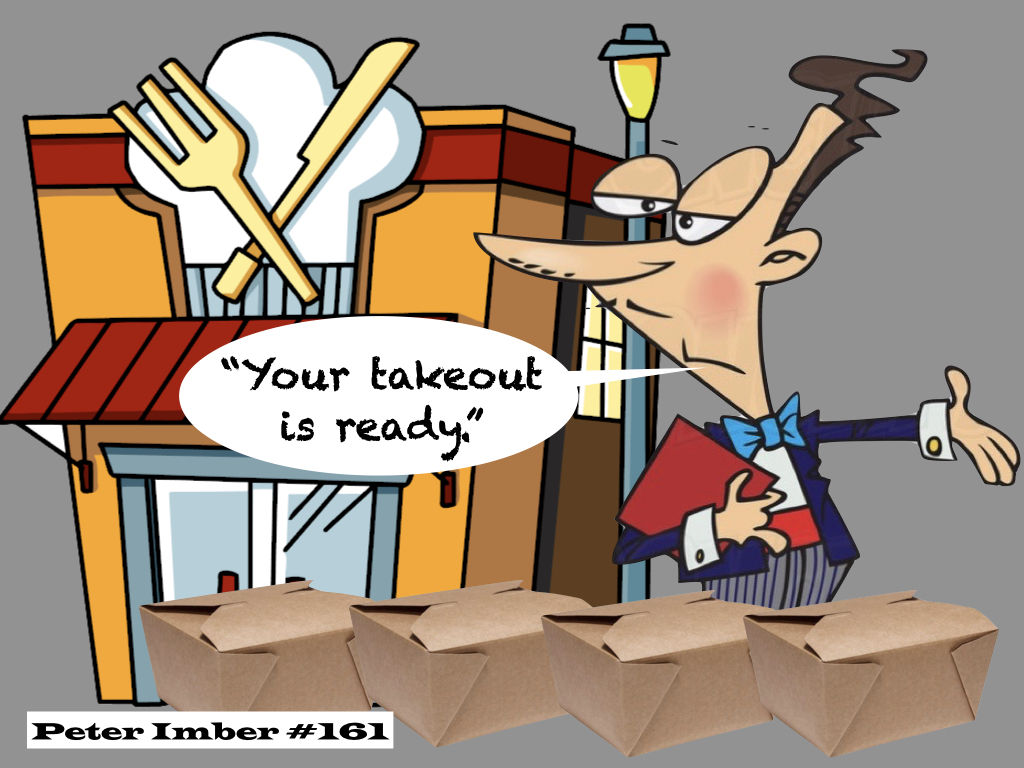
On the short list of things that we won’t be doing until that day comes when COVID-19 is no longer something we fear, Jo and I include eating inside a restaurant.
Since our pandemic lifestyle began nearly six months ago we have done takeout and mostly just the meals we would normally order– pizza, Thai food –but we haven’t done it that often and our most daring food adventures have been a few trips to nearby lobster shacks with outdoor picnic tables an acceptable distance from each other. Eating at home has been just fine. Jo has been a magnificent chef and I’ve grilled more than ever.
For several years I’ve been in a men’s cooking group that until last March met nearly every month. That’s where I did my most ambitious dishes and I miss those meals and the guys.
My standard go-to kitchen repertoire admittedly, is rather limited. Highlights include a shrimp and pasta entrée which came about from my trying to emulate the one I loved eating at a restaurant called Caffe Sport in San Francisco. I do a chili that my mother used to make and that I’m overly proud of according to some of our friends who have sampled it. My mother actually liked mine better than her own and we discovered that was because I inadvertently failed to completely follow her recipe.
A spécialité de la maison of my family was spaghetti with tomato sauce and tuna fish. No, I’m not kidding but let me correct any unappetizing image you may be imagining. The spaghetti and tomato sauce and the tuna fish were not mixed together, they were separated like men and women in an ultra orthodox synagogue. Of course once you started eating, the two mushed together. I do still make this on occasion but it’s when I’m dining by myself.
My crowning culinary achievement is my chicken schnitzel. Although it’s a favorite in the Pennsylvania Dutch country where I grew up, it wasn’t until I lived in Israel that I became a schnitzel lover.
Germans may eat theirs with spaetzle (noodles) and red cabbage on a plate but another way that works for me is the Israeli street food version. That’s when the schnitzel is in a pita with finely chopped up tomatoes, cucumbers, green peppers, pickles and onions along with hummus, tahina and a topping of french fries. Does that qualify as covering all the food groups?
How important has food been in my life? Well, it’s up there with golf, movies, music and the internet. In fact it’s up there on a bookshelf in our house. When I asked Jo to marry me I needed to come up with a way to do it that was going to surprise and impress her.
After we met we’d often go to the movies on the weekend at a multiplex in Pasadena. It became sort of a ritual. Next to the theaters was Vroman’s bookstore and attached to it was a coffee place. We’d browse the book aisles, have frozen mochas and then go see our film.
Before the movie and before the preview trailers there was a slideshow of ads for local businesses and I found out that a company in the Midwest created and supplied them. I got in touch and ordered these three slides…

On the night they were scheduled to be displayed I told Jo we needed to make sure we got to Pasadena a little earlier than usual. I hustled us through the bookstore and the frozen mochas and had us seated in front of our theater screen in plenty of time. I don’t know what Jo thought the reason was for the rush or if she noticed that I was a little nervous.
As designed the slides appeared one after the other and my marriage proposal was accepted and then we both realized that the dozen or so people in the theater with us had given no indication that they had even seen them. There were no smiling glances toward the lucky couple and no applause. And certainly there wouldn’t have been since I hadn’t gotten down on a knee and Jo didn’t cry out or break into tears of joy. We were both too old for that.
What I later learned was that my slides had run in all of the seven theaters at the Laemmle Playhouse before each showing of each movie that night. I figure I proposed about 25 times.

The quote in today’s cartoon is attributed to Robert Frost. He was anything but an instant success and knew of hard work. I’m not a devotee of poetry but I like the poem of his I’ve included below entitled Mowing. It was one of his earliest and a reflection on his time as a farmer– he wasn’t a success at that. He also failed to get the woman he truly loved to marry him and failed as well to get through college, trying once at Dartmouth and a second time at Harvard. Things were going so poorly for him he even left the country and tried living in England for a while.
Our house doesn’t sit on a big lot. I don’t have a lot of grass to mow but I enjoy the stretch of the year when I get to do it. When we arrived in Maine I started accumulating the tools one needs to deal with its seasons. I had no idea there were so many of them that begin with the word snow as in: shovels, rakes, blowers, tires, melt…
I also bought a lawn mower– a cheap one. It did the job for a number of years and then one “spring” (I put the word in commas because it’s debatable as to whether Maine actually qualifies as having one.) it would not wake up from it’s long winter’s nap. I bought a new one, a more expensive one, a better one. It was as if I had ditched a rickshaw for a Rolls-Royce.
I enjoy mowing even more now and as the number of times I’m going to still get to do it this year are dwindling down to a precious few, despite the catastrophe of the pandemic, despite the tragedy of Trump, despite the drought we have experienced this summer, at least when I think about my mowing it’s been a very good year.
Mowing
BY ROBERT FROST
There was never a sound beside the wood but one,
And that was my long scythe whispering to the ground.
What was it it whispered? I knew not well myself;
Perhaps it was something about the heat of the sun,
Something, perhaps, about the lack of sound—
And that was why it whispered and did not speak.
It was no dream of the gift of idle hours,
Or easy gold at the hand of fay or elf:
Anything more than the truth would have seemed too weak
To the earnest love that laid the swale in rows,
Not without feeble-pointed spikes of flowers
(Pale orchises), and scared a bright green snake.
The fact is the sweetest dream that labor knows.
My long scythe whispered and left the hay to make.
—————–
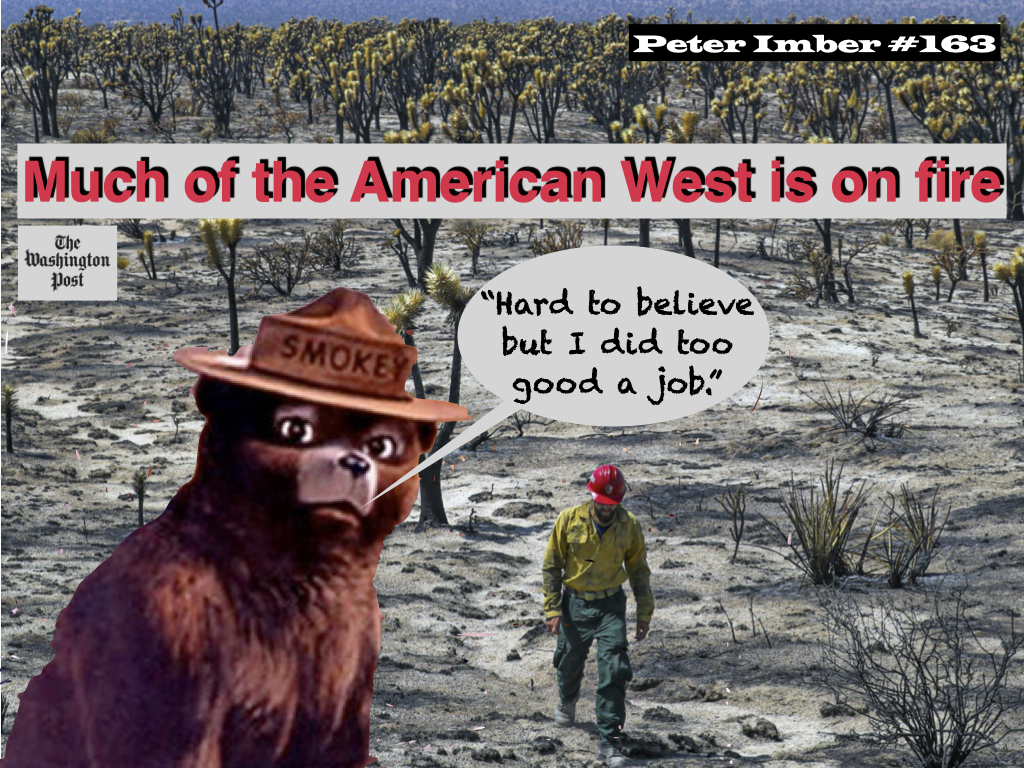
Call me a pessimist but I don’t think I’m an alarmist when I tell you I believe the city of Santa Barbara is going to burn down one day. The last fire I covered there for ABC News in 2009 convinced me of that.
Santa Barbara sits below the Santa Ynez mountains. It’s a beautiful backdrop but in summer and fall the hills are alive at times with high winds and a potential for devastation. Like the Santa Anas to the south these, too have a name– sundowner –because they occur in late afternoon and early evening.
The destruction a sundowner can produce happens fast. In 1990 a fire in nearby Goleta destroyed 400 homes and structures in less than six hours. The flames spread so rapidly that when I arrived to cover the story the next day there was virtually no video of the fire burning to be found, only its aftermath.
In 1996 I came across an intriguing article that I was able to turn into a story. It was a confession by the U.S. Forest Service that Smokey Bear’s (There is no “the” in his official name.) mantra– “Only you can prevent forest fires!” –had done its job too effectively.
The article reported that the policy of suppressing all fires on federal lands which had begun in the 1940s had led to an actual worsening of forest health. Smokey is 76, only a few years older than I am, and when he was created (Bambi had been the government’s first choice but only lasted a year because Walt Disney wouldn’t extend her licensing) fires annually burned 30 million acres nationally. By the late 1980s that total was down to a little over seven million. For Smokey and the Forest Service it appeared that their mission had been accomplished.
But upon further examination it turned out that the admonition “Only you can prevent forest fires” had been supplanted by a different one, namely “Don’t mess with mother nature.” Left alone nature had done the important work of thinning forests with naturally occurring fires from lightning strikes cleaning out underbrush and small trees. Left to grow this vegetation produced large fuel loads that allow fire to spread on the ground and jump into the larger trees, creating the catastrophic wildfires that have now plagued the American West for decades.
So, what did I see in Santa Barbara more than once that led to my assessment of its vulnerability? According to a paper published by the National Academy of Sciences, houses built close to forests pose two problems. One, there will be more wildfires simply due to increased human presence near and in them and two, those wildfires that occur will be a greater risk to lives and homes, harder to fight, as well as being all but impossible to be left to to burn naturally.
The extreme weather events we’re having, especially those generating record heat and disastrous winds, can no longer be thought of as atypical. Climate change is now a driving factor in the frequency, damage and expense caused by wildfires.
Californians have lived waiting for the Big One– a massive earthquake along the San Andreas fault that seismologists say is overdue. But the Big One may take place above ground first. Years ago I saw a chilling interview with a Los Angeles fire captain. When the strong winds blow and the humidity is low he said all bets are off. He wasn’t referring to Santa Barbara, he was talking about LA.
Below is a link to that story I did in 1996 in New Mexico about Smokey Bear’s unforeseen blunder. It’s not that we didn’t know what was coming.
https://www.youtube.com/watch?v=aC2dC5_mb8Y
—————–

Jo and I had never heard of the Sturgis Motorcycle Rally in South Dakota until we were headed right for it. In 2010 we drove across America from Los Angeles to our new home in Camden, ME. We took the northern route and it was either in Montana or Wyoming that we noticed a lot of motorcycles going in the same direction that we were traveling.
By the time we crossed into South Dakota we knew about Sturgis. Attendance that year by bikers from everywhere in the world turned out to be close to a half a million. Sturgis is about 30 miles from Rapid City and that was a planned stop for us so that Jo could see Mt. Rushmore. I had been there several times before but it had been years since my last visit and when I saw that the old visitors’ facility had been replaced I was dumbstruck.
What had been an unpretentious structure built in the style of the 1950s (and a Hollywood recreation of it famously used in a scene in Alfred Hitchcock’s North by Northwest) was now an ugly concrete edifice with a flag lined promenade that to me looked like something more evocative of what a dictator might erect in a banana republic.
The motorcycles and their riders were everywhere and that didn’t bother us but there were so many that it seemed like we were in the middle of a swarm of locusts. It wasn’t until we had driven further east and into South Dakota’s Badlands that we had our first extended interaction with any of the rally’s participants and when we did it was surprising.
The guys we met were from Long Island– two lawyers and a dentist and he’s the one who is standing proudly in the montage below and who asked that I take his picture and send it to him.

We learned that he and many others who come to Sturgis– an event that has been held since 1938 –don’t ride from their homes to take part, they have their bikes shipped ahead, even flown ahead.
In normal times Sturgis would hardly be noticed anymore as a news story but like everything else about the period we are living in, that’s changed this year. I saw the first headlines a few days ago about the rally being responsible for over a quarter of a million new cases of COVID-19. I wasn’t skeptical. My own stereotyping kicked in. Why sure! These people must all be Trumpers and totally ignored any precautions– no masks, no social distancing. For them the pandemic was academic. They weren’t going to hide, they were there to ride.
Now, I hope that if I had been assigned to report this story I would have found as Slate, the Wall Street Journal and Snopes.com have, that ascribing hundreds of thousands of new COVID cases to this singular event so quickly might not have been accurate or responsible. In fact many news outlets got this one wrong and published very misleading information. The study in question was quantifying the maximum potential for the Sturgis rally to spread the virus and not citing factual evidence of confirmed cases that could be traced to the rally although there have been some. That various news reports inflated the numbers so dramatically is lamentable and harmful. All journalism pays a price for it and that price is the loss of credibility and trust.
In my career in television news, especially in my final years, I felt we didn’t like to deal with gray. Ratings were so important that most often we wanted stories that were black and white and easy to affix right and wrong, good and bad, or a hero and a villain to. That’s more than misguided, it’s dishonest.
Computers operate in a binary world but humans don’t. Of course right now we’re in a muddle of an anti-truth era and if computers were suddenly to become people I think they’d have fascinating nervous breakdowns. Remember HAL in Stanley Kubrick’s 2001: A Space Odyssey?
For the time being Americans don’t agree anymore on what truths are self evident. Even two hundred and fifty years ago the signers of the Declaration of Independence didn’t get that right. All men may have been created equal in their eyes, but for them apparently, all men weren’t men.
We get lied to enough these days, in fact how about every day but the nation no longer agrees on what’s even unequivocally true or false. We need a new declaration, let’s call it a Declaration of Common Sense– We hold these lies to be self-evident! And what we surely don’t need is what’s left of our respected news sources to be hasty and careless.
—————–

So, I’m working on a Broadway show, a musical and it’s entitled Trump: The Musical. As I progress I will share with you the songs and some context for their inclusion. Let me take you now to the theater of my imagination and the opening scene and number…
Curtain opens… It’s election night and at Trump election night headquarters there is delirium that’s turning into an increase in the pander-monium that is usually demanded around Donald Trump. To his own and the world’s shock he has been elected to be the 45th president of the United States of America and his running mate Mike Pence has been elected as his vice president.
As Trump and Pence stand before the crowd and the cameras, Pence’s attempts to get the president-elect to clasp his hand and raise their arms together in victory are rebuffed. It’s not the first time for Pence that evening.

The jubilation is not universal. Both Melania Trump and Karen Pence may barely know each other but appear to be equally distraught. A spotlight illuminates Melania Trump sitting stage left. She is crying. She knows her New York City life of privilege and privacy is about to end– well, not the privilege part. A second spot reveals Karen Pence stage right and she is fuming. An audio recording of an earlier conversation with her husband plays over the hubbub that continues at the election night headquarters…
“What are we going to do, Mike? We don’t have any money! Who’s going to pay for my inaugural gown? Don’t you dare kiss me. Leave me alone. You got what you wanted.”
As Melania continues to cry and Karen to fume Michael Cohen rises from below the stage floor. As the president’s fixer he knows that Melania knows that disappointment with her husband is what she signed up for just as Cohen did to do Donald’s dirty work. He begins singing the opening number…
Gray skies are gonna clear up,
Put on a happy face.
Brush off the clouds and cheer up,
Put on a happy face.
Take off the gloomy mask of tragedy,
It’s not your style.
You’ll look so good that you’ll be glad
You decided to smile.
Pick out a pleasant outfit,
Stick out that noble chin.
Wipe off that full of doubt look,
Slap on a happy grin.
And spread sunshine all over the place,
Just put on a happy face…
After Cohen gets through the first stanza another figure is elevated to the stage floor. It’s Pope Francis and he continues…
And if you’re feeling cross and bickerish,
Don’t sit and whine.
Think of the end of Roe v. Wade and licorice
And you’ll feel fine.
I knew a girl so gloomy,
She’d never laugh or sing.
She wouldn’t listen to me,
Now she’s a mean old thing.
So spread sunshine all over the place,
Just put on a happy face.
Cohen and the Pope then break into a soft shoe routine as the music continues but the two women are not cheered up, in fact their tears and scowls turn into expressions of horror, as if they see an asteroid heading toward them. The music ends and the stage fades to black…
Today’s re-purposed song Put on a Happy Face is from Bye Bye Birdie with music composed by Charles Strouse and lyrics by Lee Adams. It was originally sung on Broadway by Dick Van Dyke.
TO BE CONTINUED
—————–

Scene Tw0
The lights come back up and we’re in the Oval Office. We see the just inaugurated President Trump but he’s not behind the Resolute desk, he’s in front of it because the big screen television he wants on one of the office’s walls has become an unforeseen problem. The Oval Office is an oval. TVs are not. So for now there’s a large television on top of the Resolute desk.

And you’ll see who you’re not
On a clear day
How it will astound you
That the sum of your lies
By the enemies I abhor
Like no one’s ever seen before
On a clear day
I can lie forever and ever and evermore
I’ll break the law you’ll be in awe
So many bridges left to burn
I’ll crush the weak make strong men meek
My foolish base will never learn
On a clear day
I can lie forever and ever and evermore

Scene Three
Outside the windows in the White House Cabinet Room snow is falling but the atmosphere inside is even more chilly. President Trump and Nancy Pelosi and their staffs have just finished up a contentious meeting– does it really matter what issues were discussed?
As the others leave, the President asks the Speaker of the House to stay and have a private conversation with him. But it’s quickly apparent that he isn’t interested in talking policy and certainly not compromise, Trump wants to engage in verbal arm wrestling with Pelosi and he believes his will be the upper hand…

The song they perform is a duet. Trump’s lines are in italics, Pelosi’s are normal…
Anything you will do it cannot stop me
I have many enablers and what can you do?
I will try
Just you try
I will try
Just you try
I will try, I will try, I will try
I can shoot anyone and be elected
All of the country just love who I am
No, they don’t
Yes, they do
No, they don’t
Yes, they do
No, they don’t, no they don’t, no they don’t
I can mock a hero, call anyone a zero
You’re a soulless conman, lacking any game plan
I may not be a reader but I can bribe a leader
You continue to divide us but sure can’t fight the virus
I can live on cheeseburgers and sleaze
And only that?
Yes
So can a rat
Anything you will tweet I can tweet better
I can tweet anything and my base thinks it’s true
That’s really sad
No it’s not
It’s so sad
No it’s not
They’ve been had, they’ve been had, they’ve been had
I’m better than Obama and the Dalai Lama
Men who you despise because they have a Nobel Prize
I can’t believe your meanness toward me a stable genius
You’ve been called a moron, your IQ is that of boron
I can remember five words, can you?
Yes, you…don’t…have…a…clue!
That’s five…
Pelosi is out the door and Trump fumes as the stage goes dark.
Anything You Can Do (I Can Do Better) was composed by Irving Berlin for the 1946 musical Annie Get Your Gun and was originally sung on Broadway byEthel Merman and Ray Middleton. In 1976 Merman did the duet with Miss Piggy on Sesame Street.
And I was remiss yesterday when I failed to include information about the song On a Clear Day You Can See Forever. The song was written by Burton Lane (music) and Alan Jay Lerner (lyrics) for the musical of the same name which opened on Broadway in 1965. John Cullum originally sang it but when the show was made into a movie in 1970 Yves Montand, who was cast in Cullum’s role, did. Later in the film it was reprised by Barbra Streisand.
—————–


The pit orchestra begins playing and a more mellow Mitch performs his solo– Send in the Clones
Just call me Mitch
I don’t claim to be fair
My dream was stacking the courts
I’m nearly there
Send in the clones
I love that you’re pissed
I feel no chagrin
I completely screwed Garland
Got Kavanaugh in
And there are more clones
Send in the clones
Just when you though
I wouldn’t dare
I’ll bend the rules
So there’s nothing left that we share
Knowing our moral standing is shot
Sure of my course
Why would I not?
Washington’s cruel
Trump’s just my tool
My party’s a cesspool of wing nuts
Who only I rule
Send in the clones
Quick, get me more clones
We have to have clones
There have to be clones
We still have this year
Send in the Clowns was in the show A Little Night Music, a Broadway adaptation of Ingmar Berman’s film Smiles of a Summer Night, that opened in 1973. Stephen Sondheim wrote both the music and words for the actress Glynis Johns. Since then it has become one of Sondheim’s most popular and most recorded songs.
Here’s a link to Glenn Close singing it and I was surprised at how well she does…https://www.youtube.com/watch?v=vufO2FZY6XQ
—————–


A museum, because Ivanka’s brand is now defunct. At one time it flourished. In 2013 her line did $75 million worth of business but after her father announced his run for president in 2015, things went south quickly. Within a few months her only remaining store was in Beijing.
Someday perhaps, we might learn if at the time Ivanka blamed her father for her enterprise folding. No doubt after Donald Trump’s election all was forgiven. Ivanka landed a new job and surely, trying to get women to wear your shoes, can’t come close to holding power over so many suitors and ass-sordid synchopants of the president. Her song is in the key of privilege…
All I want is a room somewhere
In the White House near Daddy’s hair
My siblings know who’s the heir
Oh, I’m entitled utterly
Lots of bigwigs for me to meet
Lots of ways to feel more elite
State secrets I can tweet
Oh, I’m entitled utterly
Oh, I’m so freakin entitled utterly
No way I’ll chill
Watch me rise so high they’ll put
My face on a dollar bill
All those minions under my heel
Don’t dis Daddy or I will squeal
That’s my art of the deal
Oh, I’m entitled utterly
Utterly, utterly, utterly, utterly…
Wouldn’t It be Loverly was written by Alan Jay Lerner and Frederick Loewe for the 1956 musical My Fair Lady. Julie Andrews sang it and I was wrong to assume it was her Broadway debut. She had appeared in The Boy Friend two years earlier when she was 19.
—————–

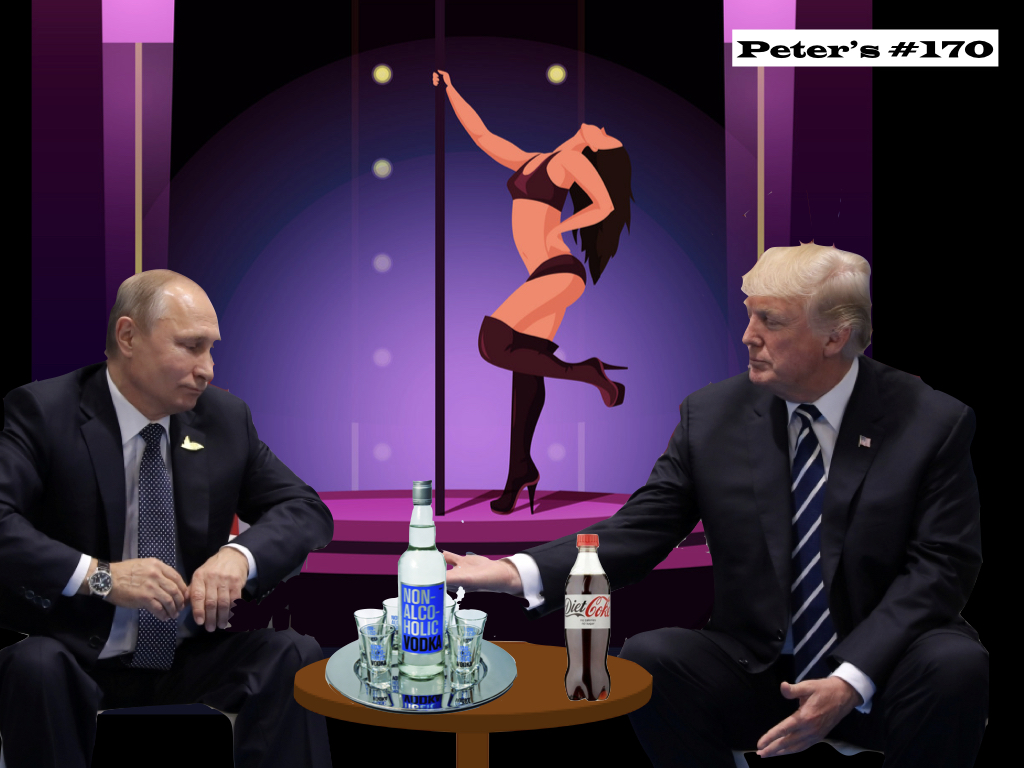


Scene 2
The lights come up and we’re in the most secure space in the Pentagon. The Joint Chiefs have called an urgent meeting among themselves to discuss President Trump’s latest order for the U.S. military to prepare for an October surprise. Trump has provided a list of targets and the generals are discussing their options for striking them…

General #1: “I can’t believe this. We’ve never been ordered to draw up plans for such an attack.”
General #2: “Yeah, we’re ready to bomb just about anyplace in the world but this is lunacy.”
General #3: “My God, The White House is calling this “Operation Blueberry but berry is spelled b-u-r-y.”
General #1: “California, New York, Massachusetts, Illinois… They’re all states Trump didn’t carry in 2016.”
General #2: “Hawaii’s on the list! I have a timeshare there.”
General #3: “I wish I’d gotten out when ‘Mad Dog’ Mattis did.
General #2: “He shares my timeshare!”
General #1: “We’re not going to bomb your timeshare or anything else this president decides he wants us to.
General #3: “From now on the only boots on the ground for this guy will be Melania’s.”
The song begins and the three generals share the lines…
Did you foresee to what degree
He’d be such a nightmare
He’s ignorant, belligerent
And prickly as a pear
And underneath bravado
There is nothing but hot air
I even saw him tanning and he’s flabby
He’s phoniness incarnate
But his anger’s very real
He’s full of hate for everything
Except for every meal
It’s late to have to say it
But I very strongly feel
He’s a real danger to the country
We did as he ordered as his chiefs of staff
He calls us suckers when he dodged the draft
How do we solve a problem like our leader
How do we catch a clown and bring him down
Is there a way to get him to North Korea
That guy is his friend…But it would depend…if Kim’s still around
There’s nothing Trump thinks he’s not the expert
But hardly a thing Trump actually understands
So how do we make headway
And save us from doomsday
How do we keep the jerk out of quicksand
Oh. how do we solve a problem like our leader
How do we stop a moron in command

The setting is a nondescript office building in suburban Washington, D.C. Vice President Mike Pence is alone on an empty floor and flummoxed when he sees his own campaign sign for president in 2024 is not the only one on the wall of the large empty room.

Everything is just duck—y
As long as he precedes me
You’ve got to grovel so
And do it with gusto
With me it’s just for show
As long as he precedes me
I know he sins as I look on
But when he’s near me
I don’t let on
The way I feel inside
All ambition must hide
He doesn’t say the things he should.
As long as he precedes me…
I know where I must be.
It’s clear we’ve got no guts
As long as he precedes us.


Democrats are scowling, I’m not fair, everyday…
I’ll keep them howling, I don’t care


To all the rules and ideals
That I’ve been disposing of
Who won’t resist?
Who owe their seats to me
They’re toast if I get pissed.
You let me get in here
You see I can’t behave
Like any decent man
They’d hate me if I did
That’s not the ghoul I am.
The kind of life I’ve led
What do I know of woe
Why can’t I empathize and realize
So much I will never know
But I won’t ever change
And show I give a damn,
You see I’ll only be
The sham and fool I am

Act ll


Continue reading “More Cartoons in the Time of COVID-19 for September 2020”
 pawnedaccordion