
Trump Paid $3 Million For Wisconsin Recount –
Biden Has Netted Votes From It
“Sometimes you need to quit when you’re behind.”
—————–

During the Great Depression Americans turned to movies and sports for an escape from their hardships. COVID-19 has prevented us from going to see either outside of our homes but inside them we are consuming more entertainment than ever. We can’t go to the movie theater or the sports venue but some 90 years later they can certainly come to us. Some companies have been more successful than others in managing to do that. Netflix, Prime Video, Hulu and HBO are continuing to stream shows that even before the pandemic created a new golden age of “Television.”
Professional basketball, hockey and baseball played truncated seasons in 2020 and employed “bubbles” for their teams to locate to and pretty much avoided disruption due to the coronavirus. But football has been a different story. Football teams have more players and staff both on the field and on the sidelines. A National Football League roster is about 50 players, which makes it roughly twice as large as a Major League Baseball team and about four times larger than one in the National Basketball Association.
The NFL does play fewer games than the other sports– only one game a week in the course of a five month season –so it has that going for it but so far COVID outbreaks have caused nearly 20 NFL games to be postponed and rescheduled. Will there be a Super Bowl? Vegas will gladly take a bet on your favorite team, if you have one, and the NFL is ready to stage its trophy game as late as March. But it may have a rough time getting there and I for one don’t care if it does or not.
I played competitive football for a while as a kid. I was a halfback and the only touchdown I made was in junior high school one day at practice. It was on a long run over 50 yards and afterward the coach was so impressed he ordered the entire team, including me, to take a lap around the running track that encircled the field.
I’m not much of a football fan. I watch UCLA play if they have a good team. I went to graduate school there. I might watch Dartmouth if they have a good team. I went to undergraduate college there. I don’t watch Penn State anymore since the child abuse scandel that happened there with a coach who is now in prison. Penn State is where my father went to college. Honestly, I haven’t watched a professional football game other than the Super Bowl in years but I’ve been to several. In my job at ABC I worked those Super Bowls that were in California when it was the network’s turn to broadcast them.
In 1988 I had a sideline pass for a Super Bowl played in San Diego. That was really the end of an era for ABC. Roone Arledge had revolutionized the coverage of the Olympics at ABC Sports and the Winter Olympics that year would turn out to be the last Olympic games– winter or summer –that ABC carried. It was also the end of ABC News being considered a prestigious enough unit that during the weeklong preparation for the game in San Diego ABC paid for me to fly back and forth to Los Angeles for an evening to attend a Lamaze class.
But my lasting impression of pro football remains to this day my experience standing just a few feet away from the actual game on the field. The players were huge, they were agile and quick and when they collided the sound was loud. I was stunned by how hard they hit each other and most of the time were able to get up and continue.
Baseball may have been called our “National Pastime” for a long time but in the 1960s thanks to television football took off. It’s a game made for TV and especially for selling things through commercials. Sponsors have them every time the ball changes hands and at every timeout– a serendipitous shotgun marriage with the shotgun offense.
And perhaps just as significantly, the game of football itself fits America, it’s like our society writ small. Quarterbacks are the biggest stars and actually the most protected from injury and thus often able to have the longest and most celebrated careers. Most other players’ careers are short. Only a designated number of them are allowed to run or catch the ball and have the opportunities to score touchdowns. The lineman are the grunts– a lower class –whose names most fans don’t even know. Football clearly has a class system and it takes its toll on many of those who play the game.
Growing up there was a former professional player who lived with his family down the street from us. I overheard his wife tell my mother that she often had to help her husband to get out of bed in the morning.
It sure sounds like I’m anti-football. Yes, I’m critical of the sport but I wouldn’t advocate for it being banned. Cage fighting and boxing top that list. But there is one quote immortalized by a football coach that has always bothered me. It’s attributed to Vince Lombardi who coached the Green Bay Packers and whose teams won five National Football League championships in seven years.
“Winning isn’t everything; it’s the only thing” is associated with Lombardi but was reportedly first uttered by a UCLA football coach to his team in the late 1940s.
Lombardi is said to have been an admirable man who didn’t care if his players were black or white or even straight or gay in an era when those enlightened attitudes for a football coach were as rare as a dropkicked extra point. But, maybe it’s because I’m a golfer and because golf is the only sport I know where a player imposes a penalty on himself when he violates a rule that I prefer a different quote when it comes to sports and to life.
“It’s not whether you win or lose but how you play the game.” A sportswriter named Grantland Rice said that. We’ve hardly if ever seen Rice’s belief paid much attention to in the history of our nation’s politics but I’m certain we’ve been closer than what we’ve been through in recent times.
On the golf course it’s a different matter. I can usually judge a person’s character by how he or she behaves there. There are little and big tip offs– clandestine attempts at or outright blatant disregard for the rules can be observed and present you with telling clues. A few years ago another sportswriter named Rick Riley wrote a book about golfing with Donald Trump. Its title should come as no surprise– Commander in Cheat.
—————–

—————–

—————–

A woman was in charge of the chickens on the kibbutz where I lived. She was smart and competent and when she walked she looked like a chicken. No, she didn’t peck and she didn’t flap her arms but I thought she had a bit of a twitch and when she moved, her head bobbed.
I worked with another person when I was a dairyman who cared for the newborn calves. When she was attired in her work clothes– milking boots and a long plastic apron –her outfit restricted her and she moved slowly. Her gait became like that of a cow. Cows rarely hoof it anywhere. You may think I’m exaggerating but I believe that it is possible that people can adopt the traits of the animals they work with.
It’s different when it comes to the relationship between people and their pets, however. The pet and the owner may take on a similar appearance but the relationship can even go in a different direction when the pet exhibits the personality traits of its owner.
We had a dog growing up. My parents purchased it for my brother and me but it clearly became my mother’s dog. My favorite example of how this miniature poodle channeled my mother would occur in the winter when there was snow covering the ground. Our dog would not put its butt on the snow to do its business until you grabbed a shovel and cleared off a patch and our little prima donna could shimmy down onto terra firma.
As far as sightings of owner-pet look-alikes, the most memorable one I’ve ever experienced was when I took my parents on a ride through the Malibu Colony. It’s a community where Hollywood stars will actually outnumber the celestial ones on most evenings unless metropolitan Los Angeles is experiencing a massive power outage. That afternoon during my parents sightseeing tour a grumpy looking bulldog was being led on a leash by its frumpy looking owner. Want to guess who?
I haven’t had a pet since I was a kid. Jo and I like dogs but the idea of leaving it alone in the house for long periods of time has discouraged us from having one. We both have no interest in getting a cat. I want a dog who might need me, not a cat who couldn’t care less. I do keep a small plastic Holstein cow on my desk and have named it rumen. The rumen is the first part of a cow’s stomach and yes, it and the word ruminate are from the Latin ‘to chew over.’ The other three parts of a cow’s stomach are the reticulum, the omasum and the abomasum. Milk comes out the bottom when you recite all four stomach’s names three times and slap your knee.
And Bill Barr really looks like a sad pooch to me. In this season to be thankful I’m grateful the pooch and his buddies haven’t been able to pull off the putsch they would have liked to but as they say down on the farm let’s not count the chickens before they hatch. January 20th can’t come fast enough.
Still want to know who was walking the bulldog? Here’s a clue: skoorB leM
—————–
Winter Has Arrived
Yesterday and overnight we had strong winds here in Camden and lost our internet until just a little while ago. Also, I realize I have doubled up on my deliveries to some of you on my distribution list and slighted others in the past few days. That’s entirely my screw up. If you wish to see what you missed, you can go to pawnedaccordion.com or if you now want to permanently unsubscribe just let me know. And now back to our regularly scheduled cartoons…


What do Mike Pence and Dan Quayle have in common aside from the fact that the two of them are from Indiana? Answer: Both are going to be remembered as VPs for one term presidents. While during his stint Quayle got mashed for misspelling potato. Pence, as far as I know, hasn’t been asked to spell obsequious but I think he needs to be ready.
Quayle has never been heard from again and what happens to Pence after he hightails it back to the Hoosier State seems unclear. Will he have a future in politics? Well, his new book deal is not likely to help although it’s lucrative. He’s signed with a publishing house and is getting a $2 million advance. There’s only one problem. The money is contingent on his not writing a book.
In a way that’s a shame. Mike Pence may be the only vice president who wasn’t a heartbeat away from the top job because the guy holding it didn’t have one.
—————–

Yes, this really happened the other night in Vancouver, British Columbia and reminded me that I’ve actually seen a few Teslas– unadorned with ornaments –in our neck of the woods. L.L. Bean’s flagship store in Freeport, Maine has had a bunch of charging stations for some time and both the numbers of electric cars and places to charge them are increasing exponentially around the state. Maybe it’s time for us to think about an electric car. We just installed heat pumps and feel good about having done so.
There’s no way around it. I now measure my mortality by thinking about cars. Will the next one we buy be my last? Presently, we have two– a Volvo station wagon we purchased from Jo’s parents and a Pruis which has become my favorite car I’ve ever owned.
The Volvo is 12 years old and has just over 100,000 miles on it. It’s in good shape. The 2014 Pruis is closing in on 120,000 and I’ve begun to consider the cost of replacing its battery and whether we’d want to.
It would be nice to have a Tesla or any other electric car but we have a problem. Although we have a garage, we have no room to park a car in it. There’s tons of stuff in there and now that we’ve added an elliptical machine, it would be impossible. I guess putting the vehicle charger outside is the workaround so maybe I shouldn’t rule out making our next car an electric one.
Mortality is a flexible concept, too. Will I outlive our roof? is another question I ask myself. And this morning it’s become clear that Maine’ s COVID-19 infection rate is skyrocketing. Forget the presents this year. Santa, you and your reindeer are being commandeered. Elves! Load up that vaccine.
—————–
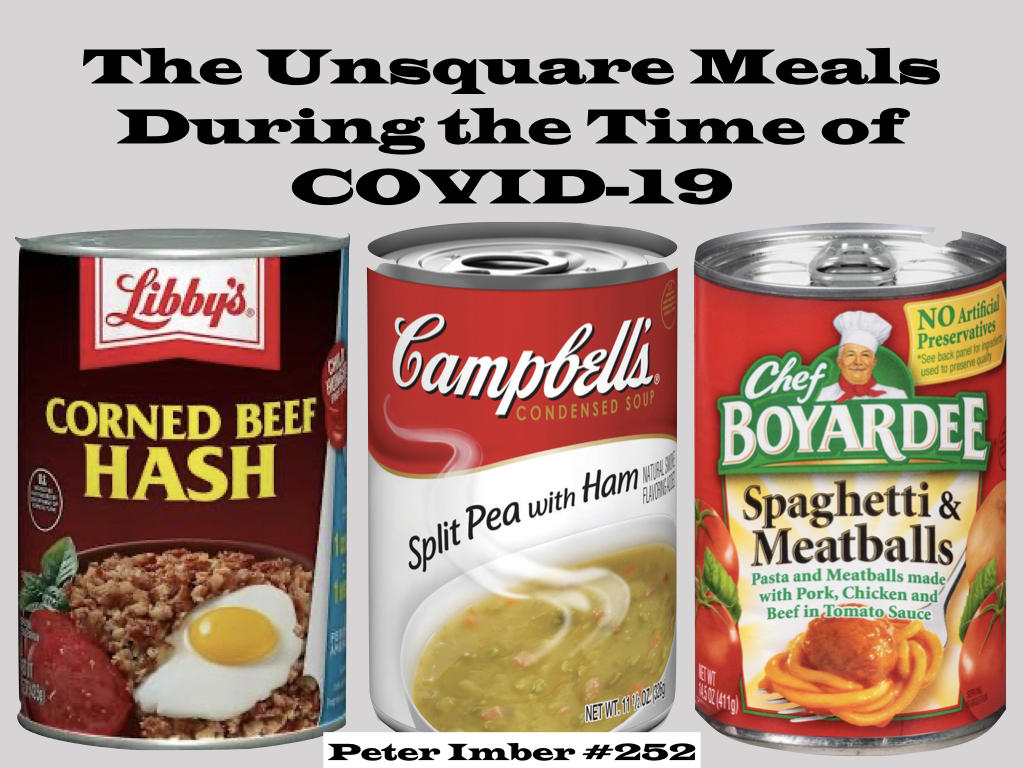
I went virtual shopping yesterday for the most unhealthy food I could find at the supermarket. The three cans in today’s cartoon can be considered candidates. Before I go any further I need to ask if alliteration is as groan inducing as punning? Didn’t think so.
My mother never got up with us for breakfast. She was a night person and so her role in breakfast preparation was completed in the evening when she’d put a cereal box– often Wheaties –on our kitchen table along with a bowl and a spoon. In all fairness after my brother and I went off to college she became a terrific cook.
But when I was a kid the cereal box often went untouched. There were cupcakes and potato chips, even ice cream easily at hand. When I was in an actual breakfast mood there was bacon. The fact that I didn’t have time to fry it wasn’t an obstacle. I would take raw slices from the package and chew on them and spit out the fat. Oscar Meyer may still be cringing if you’re not.
Through childhood into adulthood, middle age and until recently I was a nutritionist’s nightmare but just before the onset of the pandemic my oncologist issued a warning that I heeded. I was heading toward diabetes and with my lymphoma another morbidity to have to deal with is not a good idea. Since then I’ve eaten less and differently and I exercise a lot more.
Although my reformation began earlier, according to multiple reports I’ve read, COVID-19 has changed Americans’ eating habits at least spatially. It’s apparent we’re eating at home more but whether or not as a nation we’re eating healthier isn’t clear. I’m sure more studies will be done and maybe we’ll find out that we’ve opted for more fruits and vegetables than hamburgers and french fries for good. It’s hard for me to imagine that we have because fast food chains are awfully successful at getting people to eat what they’re selling. Even in a small town like Rockland, Maine there are a McDonald’s and a Burger King across the street from each other and a Kentucky Fried Chicken just down the road from them.
We’ve been sold and sold on fast food for a long time.
I have always applied a simple guideline about commercials on television. What’s being advertised on a certain program tells you who’s watching. If it’s network news where I spent my career and the audience has skewed older and older, there are enough commercials about pharmaceuticals that if you were to buy them all you’d need to turn your food pantry into your medicine cabinet. If it’s sports, you’re going to see more ads for beer, deodorant and video games than you can fit in the bed of the pickup truck that you’ll also be urged to purchase.
And there will be fast food commercials for those burgers with cheese and bacon, pizza with pepperoni hidden in the crust, fried chicken and all the fixins and burritos stuffed with Fritos. All these things are unhealthy but they taste good and so they’re offered and gobbled up. Occasionally, a chain will push a healthier something which I find akin to its doing a public service spot to get critics off their backs but the Big Macs and the Whoppers are always going to be the very reason for their success, irresistible to their customers and essential to company profits.
Fast food chains are almost universally fat food dispensaries. We know they have had a major role in making us an obese nation but unlike refusing to wear a mask to protect others, eating this stuff is a choice that only hurts the individual consumming it unless you consider the burden obesity and the diseases it can cause puts on the healthcare system.
A friend told my wife that she likes my writing but that it’s dark. I guess today, I plead no contest. Until recently I was obese and I know how hard it is to tackle that challenge. I’m still overweight for my height and a work in progress. But in a world where so many things seem to be out of one’s control one’s diet and fitness are still things we have the power to affect.
Forget Richard Simmons or Jenny Craig, I’ve used the modified George Brett diet. Brett was a baseball player and a good one. Years ago he was my inspiration when I lost a bunch of weight that I eventually put back on and never stopped. Brett had reported to Spring Training having lost 40 pounds. He explained how he did it by eliminating three things: red meat, dessert and alcohol. It worked for me then but this time I haven’t cut out the red meat and the alcohol. I just have less of them.
Losing 55 pounds to this point hasn’t been just a cakeless walk and when given the occasional opportunity to pig out I still find it hard not to. I gained four pounds over Thanksgiving that I have since lost again and thanks to a supportive wife who has adjusted what she eats along with me, I believe I’ve changed my eating and exercise behavior for good. The icing on that cake I’m not eating is when somebody doesn’t recognize me now. How sweet it is!
—————–

Maine is the largest producer of wild blueberries in the world and harvests the most lobsters of any state. It’s tenth in potato production and second in maple syrup. In a place where L.L. Bean boots are a Christmas tree ornament, marijuana seems like an unlikely fit to now apparently be its most valuable crop.
College was where I did the majority of my own marijuana smoking. I contnued for a few years afterward but haven’t taken a toke since the early 1970s. Obviously, I haven’t missed it but if I had a medical issue and pot was recommended to relieve pain, restore appetite or reduce anxiety, I’d be happy to use it again.
On the issue of whether the legalization of pot is a good or a bad thing I’m of the mind that it is what it is. Is it in some way contributing to our country’s decline? Does it lead to addiction to other drugs? I’m not a critic of or an advocate for weed. But alcoholism appears to me to be a much larger problem with more serious impacts on society than marijuana. Drunk drivers kill a lot more people than stoned ones.
I’ve been looking for a good marijuana quote and have come across the usual suspects– Willie Nelson, Bob Marley –and some surprising ones– Kurt Vonnegut, Carl Sagan.
But my favorite…
“Of course I know how to roll a joint!”
— Martha Stewart
Did she ever do a show devoted to making roach clips?
—————–

Jewish holidays begin at sundown and tonight is the first of the eight nights of Hanukkah. It’s not a religious observance. There will be no special services at synagogues and because of the pandemic there won’t be parties there either except perhaps among the ultraorthodox who have flouted COVID-19 safety measures and been hit hard by outbreaks both in New York City and Jerusalem where they comprise large communities.
Hanukkah is an historical event but not a Biblical one like Moses splitting the Red Sea and leading the Jews out of bondage in Egypt. That story is told in the Book of Exodus. The Hanukkah legend is in the Book of the Maccabees and although Jews don’t consider these writings as part of the Old Testament, the Catholic and Eastern Orthodox churches do.
Hanuukah’s allure today, and especially in America, has a lot to do with its proximity on the calendar to Christmas. It has its own games and songs and the candle lighting ritual, but for Jewish kids and their parents it’s arguably more about presents than the Maccabees defeating the Syrian Greeks and their emperor Antiochus and reclaiming the temple in Jerusalem.
In Israel Jewish kids don’t get presents, at least they didn’t when I lived there nearly 50 years ago. Gift giving only happened on one’s birthday. However, there is one Hanukkah tradition that made its way from Europe to Israel and now to the United States and is the reason some Dunkin’ Donuts might be out of their Jelly variety for the next week.
You likely have heard of latkes, potato pancakes that are to Hanukkah what turkey is to Thanksgiving. Jelly donuts, pronounced soof—gan-ee-oat in Hebrew, are now the equivalent of Thanksgiving’s apple and pumpkin pies.
The celebration of Hanukkah is about a minuscule amount of oil that miraculously kept the Jerusalem temple’s eternal light burning for eight days after it had been ransacked. So, it’s fitting that frying potatoes and dough has become the holiday’s traditional food. Fitting into your pants after eight days of this is another matter.
The donut idea was brought here from Israel in the 1980s. How do I know this? I lived in Los Angeles after returning from Israel in 1979. If the Israelis who live in LA were by themselves a city in Israel, that city would be the third largest in the country then and now.
In the early 1980s you couldn’t find a jelly donut in Los Angeles at Hanukkah until the donut places wised up to why they were selling out every day for over a week. American Jews followed suit and now are buying or making their own, too. I expect somebody who reads this will tell me that at Hanukkah their bubbe made them jelly donuts when they were a kid. Let’s see.
—————–
The first movie I ever saw was Pinocchio. It was in a high school gym and I was probably in kindergarten. I haven’t been able to find any research to verify this, but I’ll bet for Baby Boomers the odds are that the first film many of us ever saw was a Disney movie– Bambi, Snow White and the Seven Dwarfs, Cinderella, Peter Pan…
By the time my son saw his first movie Disney had a batch of new ones– Aladdin, Beauty and the Beast, The Little Mermaid, The Lion King… There is a lot of scary stuff going on in these films. Aside from having a telescopic nose, Pinocchio winds up in jail, Bambi is orphaned and Snow White is offered a poison apple. Scary stuff.
What I have found is that studying the impact of Disney movies across the generations can lead to some really esoteric findings. Here’s one from Colorado State:Despite being the title characters, women speak just 32% of the time in The Little Mermaid, while they have just 24% of lines in Pocahontas and 23% in Mulan. In Aladdin, female characters have just 10% of the dialogue.
Here’s another from the University of Calgary:85% of Disney’s 34 animated features released before 2004 contained references to mental illness.”
I don’t remember the last time I went to a Disney film but In all fairness it appears that in its recent works the studio is drawing some new conclusions about the world it wants to reveal to today’s children. Women are empowered and no longer need Prince Charming to save them, the battles between good and evil continue but the stereotyping on the two sides of that coin has been less apparent if not erased.
I think parental behavior is far more consequential than movies in forming a child’s view of the world. There was a famous movie director whose father punished him when he was very young by taking him to the police and having them lock him behind bars for a few hours. At least that’s what he claimed throughout his adult life. The director’s name was Alfred Hitchcock. We know how that turned out.

Yes, that’s me with the accordion– the one my parents were suckered into buying so many years ago by Reading’s own “Music Man” who I described in Homemade Cartoon #99. Sometimes when I come up with the idea for a cartoon, I’ll add something and then ask myself, “What were you thinking? What’s the connection between the imagery and the idea?” This is one of those times.
The idea seemed simple enough. I may have mentioned before that riding out the pandemic has been the closest I imagine I’ll ever get to spending time in the depths of the ocean in a submarine. Ok, with that as the concept I thought of the song and the movie Yellow Submarine. I hardly remember what it was about but like Disney’s Fantasia it was a theatrical adventure that in the late 1960s some of us got stoned to experience. Add that to Donovan’s song Mellow Yellow and I was prepared to delve into how I’m actually enjoying my COVID-19 “Groundhog Days” and thinking that life aboard a submarine might have been something I’d have been able to handle.
I added the picture of myself and the accordion but then I realized I was all tangled up in an octopus’s garden in the shade. The octopus is a hell of a wrestler and almost had me pinned but getting off the mat I decided to actually find something out about actually serving on a submarine and guess what? It ain’t what I thought.
Back in the earliest days of our sheltering in place, quarantining, not opening our mail immediately, washing off all our vegetables, canned goods and our hands every few minutes a number of reporters were pursuing the same analogy as I and interviewing submarine veterans. Guess what? Life on a submarine turns out to be anything but mellow. Here are a few insights…
“Life on a submarine is a quarantine on steroids.
Buy all the groceries and supplies you think you’ll need for 2 months, with the following exceptions: no milk, cereal, fruits, vegetables or alcohol. Take what you buy home and bring it one item at a time into the house. You may not keep any food in your cabinets or closets as these will be set aside to store spare parts. You may not use the refrigerator as this will be turned into a freezer. Any pre-made candies, cookies, or snacks must be kept in bed with you.
Lock the door, close the windows, draw the shades and tear out the phone.
You have one week to study the instruction manuals for every appliance, utility and piece of equipment in your house. At the end of this week you must be able to quote any passage out of these from memory and pass a written exam. Until you can do this, you may not have access to TV or radio and you may not sleep for more than 3 hours at a time, with 9 hours awake between sleeping.
Each Monday through Friday morning whether you would normally be awake or not, you must pretend to start a fire in your house, put on a gas mask, and pretend to put the fire out. Wear the gas mask for at least one additional hour each time.
Each Monday through Friday afternoon whether you would normally be awake or not, you must study the same instruction manuals for 2 hours that you studied the first week.
Continue the above for 3 months even though you have only 2 months’ worth of food.
The most junior sailor has the power of life and death over the entire crew.”
Yeah, I think I’ll stop making comparisons between my cushy deal and the USS anything that spends time underwater. But there is a valuable takeaway. If the order came down to wear a mask on a submarine, everyone would do it!

I can thank a number of college professors for inspiring me to think for myself or in an equally important instance become aware that someone else’s ideas could substantially revise my own. But there was this art teacher in elementary school…
Miss Storch didn’t like me and I guess she had her reasons. Once when given a sheet of construction paper and asked to draw something from the circus, I outlined a person’s body on my paper. I then invited the kids sitting around me to play tic-tac-toe. All games were purposefully inside the lines of the figure’s torso. The appraisal of my work in progress was blunt.
Miss Storch: “What are you doing?”
Me: “We’re making a tattooed man for the sideshow.”
An exasperated Miss Storch snatched my creation and took my crayons. I was well on my way to earning a C in art on my report card. I did no better at handwriting. I blamed that on being left handed. I blamed Miss Storch for my never taking an art class in college.
Jo asked me yesterday as we were hiking the 18 holes of my hibernating golf course, if I remembered the first time I played golf and if my father, a golfer himself, had encouraged me to take up the sport. I don’t remember either but I do remember the day my attitude toward art changed. It happened in Vienna, which sounds like it should be the title of an Ernst Lubitsch movie. His The Shop Around the Corner is sure to be on TCM’s Christmas movie schedule. You may be familiar with You’ve Got Mail which was adapted from it. But as I often do here, I digress.
In Vienna my reconciliation with art happened on the day I visited a museum in the Belvedere Palace. In it hung the painting Bob Dylan is standing beside in today’s cartoon. The portrait of a woman named Adele Bloch-Bauer was commissioned by her husband and painted by Gustav Klimt. Today, it is known as The Lady in Gold and is on display at the Neue Galerie in New York City. You may have heard of it. Its saga has spawned books, documentaries, a play and a feature film starring Helen Mirren.
When I saw the painting in 1969 it was already known as one of Klimt’s master works along with The Kiss, but it wasn’t until 30 years later that the battle over its ownership began when a niece of Adele filed a claim against the Austrian government. The Bloch-Bauers had their art collection looted by the Nazis during World War ll. The Portrait of Adele Bloch-Bauer ended up in the Belvedere Palace and to erase any connection to the family’s Jewishness was given the German title The Dame Gold.
I had no awareness of any contested provenance of any of the paintings I saw that day and probably most people who viewed the works there of Klimt and another artist named Egon Schiele did either a half century ago. One of Schiele’s portraits of a man sitting in a chair and encircled by books has stuck in my mind ever since.
The other museum I visited in Vienna housed the largest collection of work by Pieter Bruegel the Elder. His paintings connected with me for a different reason. Some of them reminded me of comic books. I just looked at them again now and one called
Children’s Games appears definitely to be a harbinger to the
Where’s Waldo books
. What do you think?

But back to why Bob Dylan is on my mind. This past week he reportedly sold his catalogue of 600 hundred songs for $300 million. That’s a lot of songs and a lot of money obviously, but I’ve always been puzzled by the monetary value of music compared to art. Yes, the worth of almost anything material can be reduced to the simple “the value of anything is what someone is willing to pay for it.” But when it comes to music and art there’s a glaring difference.
We buy copies of music. The composer, the singer, the band are remunerated in relation to the number of copies they sell of their recordings. There’s no The Times They Are a-Changin’ that exists that’s worth more than the one on the vinyl album, the audio cassette, the CD or the iTunes download that I have or can purchase. Dylan made $300 million last week for all those millions of copies that can be made of him or anyone else playing or singing his songs.
Copies of paintings are worth next to nothing compared to an original if that piece is coveted. Leonardo de Vinci’s Salvator Mundi was bought at auction in 2017 for $450 million. If Leonardo were still around, he should take Bob Dylan to lunch and pick up the check.There are another 50 paintings that have been sold for over $100 million and all the creators of them with one exception– Jasper Johns –were dead at the time their work commanded such sums. At least Dylan got a payoff. All these others got relatively zilch.
Ok, so it’s clear a completed painting is an individual endeavor and unless the artist is making prints, it is a one-of-a-kind that can be identified. There is no easy way to frame a piece of music and claim that this was the singular end result of its creation. I get that. It’s just interesting to me the different value we place on the experience of going to see the Mona Lisa at the Louvre as opposed to looking at a copy of it in a book. With music we can enjoy listening to it through our speakers at home and the recording (the copy) satisfies. We respond to it. We don’t need to make a journey anywhere unless it’s to a concert hall to hear it performed live.
In 1999 I was given an assignment at ABC News that took me to Toronto and a warehouse full of art. Only these weren’t original masterpieces by famous painters, this was a factory for their reproductions. The copies even had actual brushstrokes added to them to give them the same relief as the real works and a studio full of people applying them.
The copies were not falsely claimed to be originals. Customers knew what they was buying and the businessman whose idea this was hoped that people would look at these copies as the next best thing to having the real thing. The venture never caught on however and who knows perhaps the “fakes” that are out there have become collector’s items on their own merits.
Here’s a link to the story…https://www.youtube.com/watch?v=oTzE5Hkk0jk
—————–

Trypanophobia is a fear of medical procedures involving injections. According to the Diagnostic and Statistical Manual of Mental Disorders it’s a phobia that may affect as many as 50 million Americans. I hadn’t considered this may be a big reason a significant number of people might refuse to get a COVID-19 vaccine. I assume many of them are the same ones who don’t get annual flu shots either. In fact maybe some of the anti-vaxxers are actually closet trypanophobians or actually some other kind of dinosaur.
I’ve found an article from last January that a biotechnology company called Vaxart has developed an oral influenza vaccine that in early trials has shown to be more effective than current injectable ones for a particular strain of the flu. It’s still a few years away from being ready for widespread use.
In the meantime there is a race to develop an oral COVID-19 vaccine. Vaxart is one of the players and already has begun a phase 1 trial of theirs. It’s described as the size of an Advil tablet. That should surely go down better with a lot of people but I won’t be waiting for it. I don’t need a spoonful of sugar to let the medicine go down. My sleeve rolls up easily.
—————–

—————–

—————–
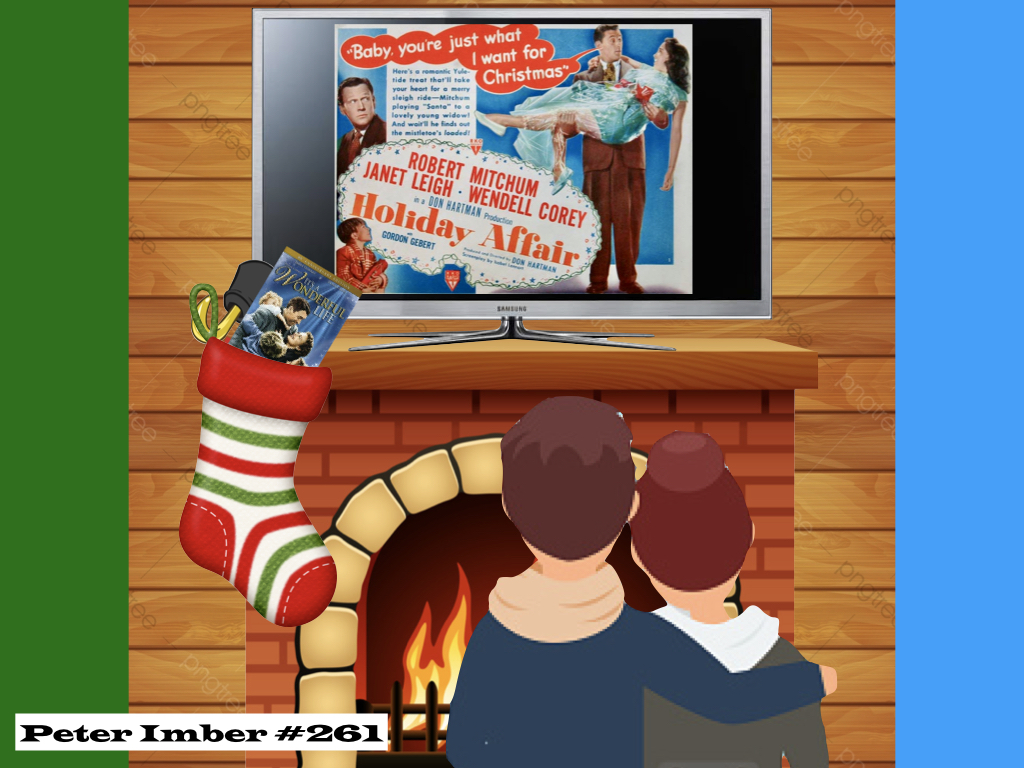
A week from today is December 24th and my favorite evening of the year. It will be Christmas Eve and I’m posting this now because our backup white Christmas has just arrived– a predicted five to eight inches of it –and that’s put me in a holiday mood. I don’t know when my special feeling about Christmas Eve started but on that night I am the not so whiny tot who is all aglow with visions of peace on earth and goodwill to all that lasts until sometime on Christmas Day when the illusion wears off.
On Christmas Eve I imagine a stillness, a complete timeout for the world on the playing field of everyday life. In the time of COVID-19 the pause that replenishes I annually look forward to might seem less unique and merely additional time we’re already spending in the pandemic penalty box but I don’t think so. I’ll embrace it like always. A week from tonight Jo and I will be observing a tradition that I’ve begun since we moved to Maine. We’ll be watching the movie Holiday Affair.
There are enough Christmas movies that they’re now considered a separate genre of their own. The very first one was made in 1898 in Great Britain and by 1912 there were a dozen more, including the first A Christmas Carol shot in the Bronx and distributed by Thomas Edison’s film company. It was black and white and silent of course.
There are so many Christmas movies already and more being produced each year that I’d bet you could watch a different one everyday until the holiday rolls around again and then maybe do it for another year without having to sit through a rerun. Well, almost.
The Washington Post did a computer search to create the graph I’ve inserted above. It only extracted feature length Christmas films that had gotten at least 1,000 reviews. Their algorithm took 34 hours for the computer to complete– Yes, as in the street number in the movie title about a department store Santa Claus who claims he’s the real deal. Coincidence? Hey, since my iOS update the other night I hear sleigh bells when I turn on my desktop.
Last year the Hallmark and Lifetime channels alone broadcast over 50 new Christmas movies with titles like Christmas in Rome and Christmas in Vienna (Take your pick.), Christmas Scavenger Hunt, and Christmas Temp. I wonder if that last one was about an elf who wasn’t in the union?
In my opinion the best Christmas movie hands down is It’s a Wonderful Life with Jimmy Stewart and Donna Reed and the two characters Bert and Ernie who Sesame Street creators swear were not the inspiration for the two Muppets with their names. The film’s director, Frank Capra was always on the side of the everyman but there’s a dark side, to Stewart’s George Bailey. He contemplates suicicde and leaping off a bridge before being shown his life’s true worth and impact which propels Capra’s own hopeful optimism to leap off the screen. Wouldn’t Donald Trump make a great choice to play the skinflint Mr. Potter in a remake?
Where does Holiday Affair rank in this titanic trove of Christmas Movies? On the movie review website Rotten Tomatoes it doesn’t show up among the top 63. The highest ranking I’ve found for it is 23rd on a site called The Pioneer Woman. Who knew they liked romantic comedies in the Old West?
Holiday Affair was made in 1949 and lost $300,000 at the box office for its studio RKO but it has become a Christmas staple on Turner Classic Movies. It stars Janet Leigh in the last of seven movies she made that year and Robert Mitchum in a role that was a departure from the tough guy film noir characters he was typically cast to play. Ah, but there was a reason. In 1948 Mitchum had been arrested and served jail time for marijuana possession. Howard Hughes owned RKO and made Mitchum take the part to rehabilitate his image. He also insisted that Leigh wear tight sweaters.
Here’s a summary of the plot you might find in TV Guide…
–A young widow is romanced by a sales clerk whom she inadvertently got fired…
— Two men vie for the affections of a widowed mother…
–A war widow is torn between a boring attorney and a romantic ne’er-do-well…
And here’s my own version adapted for Christmas Eve…
It was the night before Christmas and you won’t hear boo in our house.
We pay an exterminator monthly, so there better not be a mouse.
Nothing is hanging by our chimney and we wouldn’t dare.
Being Jewish, eight days of Hanukkah is all we can bear.
But each year we nestle all snug in our bed,
Turn on our television and look straight ahead.
It’s an annual custom, a gift I unwrap.
The same saccharine Christmas movie, just call me a sap.
In the toy department a miniature train is making a clatter.
And tense Janet Leigh’s in a hurry. What could be the matter?
She wants that train and has the exact cash.
The store clerk sells it to her and gets fired in a flash.
Leigh’s a comparison shopper* and Robert Mitchum should know
His not turning her in was a big uh-oh.
But instant Karma’s going to get them. Right away that’s so clear.
They’re both swept off their feet by more than holiday cheer.
In an instant Bob wins over Janet’s cute as a button young son.
And for his ambushed rival Wendell Corey it’s all but over and done.
That toy train plays a big role in sealing this Christmas romance.
Life gives us gifts sometimes, no? out of pure happenstance.
*Comparison shopper was a real job back then. Then it became known as market research. Now, it’s the customer reviews on Amazon but don’t let me spoil your Christmas shopping…
Holiday Affair will be shown Christmas Day at 4 p.m. on TCM.
——————

Ironically, exactly 100 cartoons ago I used a Robert Frost quote:
“The world is full of willing people;
some willing to work, the others willing
to let them.”
For a while now I’ve piggybacked on Frost with my own attempt at updating his homespun wisdom:
“America is full of two kinds of people;
some shop at Walmart, the others
shop on Amazon.”
I created today’s cartoon yesterday and as often happens, once there’s a cartoon, it’s only then I begin thinking about what I can write to go with it. This one almost blew my head’s circuit breakers.
I shop on Amazon. I’ve bought things as big as a mattress and as small as a ChapStick– three of them were in the package. Ever hear of Amazon Guilt? It’s actually something that’s been written about.
We shop on Amazon because it’s convenient and during the pandemic you can make the case that it’s also to stay safe by avoiding going out and into a store. The guilt feelings preceded the coronavirus of course and include (1.) awareness of the environmental impact of Amazon’s billions of deliveries. I actually consider ripping up their boxes as a form of exercise at this point.
(2.) It’s pretty clear that working in an Amazon warehouse is dangerous to your job security and health and not just in the time of COVID-19. If you don’t fill orders fast enough, you’re possibly out the door and the injury rate for employees at Amazon “fulfillment centers” is twice as high as the national average.
(3.) And then there’s the issue of Amazon’s impact on local business. That one takes us to Walmart which pretty much blew up small town main streets before Amazon was a twinkle in Jeff Bezoz’s idea of iCommerce. The “Walmart effect” is a term that’s been used since the 1990s.
Years ago I had my own idea for a website. It would be a place on the internet where you could search for local businesses. I went so far as to purchase a domain name. For a number of years I owned
unchainedamerica.com
Click on it now and you’ll see that even though I let my exclusive possession lapse, it’s still available. There certainly are other sites that I’d likely be competing with today if I’d have created my own. But that’s just it. How useful are they? What truly local businesses are left? I had to drive 50 miles to find a shoemaker.
I am happy with the fact that where we live here in Midcoast Maine the chain stores and restaurants are not on our main streets but a bit out of town. We do have a Walmart and I use its pharmacy. Only recently did I discover that all along I need not have gone inside to have had my prescriptions filled. When it was built about 10 years ago a pneumatic tube drive through was installed that I didn’t know about until the pandemic.
But there was another reason I had for going inside. Walmart shoppers are outside the bubble I live in and not just any recently created COVID induced one. I mostly see just people like me in what used to be our daily lives. I and they are reasonably well off or even plain wealthy. I’m guessing, but believe we’re also more likely to shop on Amazon and not at Walmart.
I’m a fairly voracious reader but not of books. I read newspapers and magazines and almost exclusively on a screen. Another question that exploded in my head as I sat down to write this morning was whether or not there’s any basis for the premise that where you shop is how you vote?
A guy named Tim Sneed beat me to it in 2006. I don’t have his book but Sneed wondered why Walmart shoppers tend to vote Republican even though he considered it against their best interests and boy, isn’t that as baffling as it is disheartening. I’m sure he didn’t do a scientific study. In fact I’d bet he just wrote from what I call gut observation which is what I do most of the time, too.
So, is there a likelihood that Amazon shoppers tend to vote Democrat? Maybe here’s where we bring in Malcolm Gladwell and his “tipping point” concept. Have we reached that moment where so many of us shop online that our political preferences no longer are distinguishable there? We may have historic income inequality and not have lived up completely to our Pledge of Allegiance’s notion of liberty and justice for all but if we were to add shopping to the list I think we’re still a light unto the nations.
Whoa! I haven’t even mentioned McKenzie Scott’s philanthropy. I’ll just say my ski hat is off to her and as Ben Franklin opines in the cartoon sometimes divorces are worth it.
—————–

Trump and Putin, Trump and Putin
Go together like the Tsar and Rasputin
You can ask your mother
What’s the dirt one has on the other?
Trump and Putin, Trump and Putin
One winks, the other does the lootin’
Russia may hack in every entry
Our president will just be complimentary
Try, try, try to separate them
There are no solutions
Try, try, try and you will see
Only more intrusions
Trump and Putin, Trump and Putin
Go together like the Tsar and Rasputin
Four more years of this woulda made me shudder
Thank God we’re gonna have one without the other
(“Love and Marriage” from 1955 song with lyrics by Sammy Cahn and music by Jimmy Van Heusen.)
—————–

Yesterday was a gift. Outside in Maine it was overcast but mild enough to walk without a hat or gloves. Jo and I did our five mile loop that is just inland from the ocean and actually hugs it which is where I took the picture that serves as today’s cartoon.
This is the shortest day of the year. The sun came up a little after 7 this morning and will set at 4:01. On Tuesday the sun will rise a minute earlier but still set at 4:01. By Wednesday we will gain an additional minute at both ends. And this is not a hey, but who’s counting? I’m counting.
Oh, it’s a long, long while since March, who cares to remember
We’ll hope for the best from now, this day in December
When being stuck indoors drives us insane
We will endure and bellow Trump’s to blame
As vaccines trickle down to the precious few
His defenders, Mar-a-Lago members
And all these precious days until he’s through
These precious days just let him stew
September Song was composed by Kurt Weill with lyrics by Maxwell Anderson. It was introduced by Walter Huston in the 1938 Broadway musical production Knickerbocker Holiday.
—————–

When I think of moments connected to history that I’ve witnessed, the first one that comes to mind was shaking John F. Kennedy’s hand early in 1960 when I was 12. My uncle Sam was very active in Westchester County, N.Y. Democratic politics and after Kennedy spoke at an event in White Plains my uncle introduced me to JFK. He didn’t pull any punches either…
Uncle Sam: “Peter, I want you to meet the next president of the United States.”
Kennedy smiled and signed an autograph for me. He had not yet officially announced his candidacy for president and had teased the press in the room at the very outset of his talk with his opening line…
Kennedy: “I’m here today to throw my hat in the ring.”
There was a long pause and I remember that there was a hush as lots of bodies leaned forward and reporters’ pencils were poised to record the moment. Jacquline Kennedy sat upright in her pillbox, her expression revealed nothing. Now that he had the complete attention of the room he continued…
Kennedy: “For all the Democratic candidates running in Westchester County.”
Anticipation turned to laughter and I’m not sure when but afterward I lost the autograph.
The next historic event I witnessed in person was the launch of Apollo 11 in the summer of 1969. My best friends since high school– Ken and Terry –and I drove virtually nonstop from Pennsylvania to Florida. I got food poisoning from some southern fried chicken I ate on route and queasily watched the blastoff from miles away which was as close as we could get. The roar of the booster rocket was ear-splitting and I didn’t experience the earth shaking so noticeably again until after I had moved to California and learned what a whole lotta shakin’ goin’ on was really about.
Actually, in between meeting Kennedy at the dawn of the decade and being present at the space launch that put the first man on the moon at its close, I also attended a football game that is today considered one of the greatest ever played.
When Harvard and Yale compete in football the contest is simply called The Game and the one between them in 1968 is legendary enough that the 40,000 fans who actually saw it has probably doubled over time by the others who didn’t but now say they did.
Both teams were undefeated and Yale with several players who went on to the NFL was heavily favored. At one point the Elis led 22-0 but with less than a minute left in the fourth quarter Harvard scored 16 points to tie the score at 29. There was no overtime in college football back then. In the wild aftermath my date and I crashed the celebration in the Harvard Lampoon building and ate a lifetime ration of caviar.
A wonderful documentary titled Harvard Beats Yale 29-29 was made by the late Kevin Rafferty and you don’t have to like sports to enjoy it. Rafferty, a Harvard alum and also a nephew of Barbara Bush, whose ex president husband and ex president son both went to Yale, subtly slants his film (and maybe not so subtly at times) to portray the Yalies as bluebloods just off the Mayflower and the Crimson as auto mechanics taking time out from changing your oil.
So, how did I get a seat for myself and my date on the Yale 40 yard line? I was sports editor of The Dartmouth and a friend of mine was sports editor of the Yale Daily News. After Yale had crushed my college a month earlier I asked him to get me two tickets to The Game. I had a hunch both teams were going to enter it undefeated and I was right. A few days before I was to head down to Cambridge my friend called me.
Friend: “Peter, do you really want to use those tickets?”
Me: “You bet. I don’t want to miss it.”
Friend: “Oh, I was hoping you didn’t need them.”
Me: “Really, why?”
Friend: “I’ve been offered $300 for the two of them.”
He could have stiffed me but he didn’t. I just checked and the value of $300 in 1968 today is $2,243.35.
Boy, I guess this doesn’t have anything to do with Jupiter and Saturn just about kissing each other yesterday and the fact that this celestial smooch hasn’t happened since 1226. However, I don’t think the two planets had to don masks or even social distance. I just checked and despite this once in a multitude of lifetimes event, Jupiter and Saturn are still presently 450 million miles apart.
—————–

I don’t know how many people have made contributions to Wikipedia but at this point there are over six million articles which have left encyclopedias (I can’t believe I still use Jiminy Cricket’s song from The Mickey Mouse Club to spell that word.) in the dust. I am one of the nearly two billion people in the world who use Wikipedia. Although I’m not a Ronald Reagan fan, and I’ll get around to posting why eventually, I apply one of his axioms when I’m in Wiki mode– Trust but Verify! Not always easy but I try my best.
There’s another website called Quora that I don’t rely on for anything. It’s a question and answer community; anybody can ask a question and anybody can provide an answer. I replied to a question about Citizen Kane once and ever since I think that whenever someone poses a question on Quora about that movie, I’m notified and asked if I want to reply again.
Last week I almost did. The question was whether one needs to watch Citizen Kane before seeing the recently released film Hankabout the making of Welles’ masterpiece. Jo and I sat down to watch the latter last week and were so bored we stopped about a half an hour in. Up to that point all that had been established for us was that Herman Mankiewicz, Welles’ screenwriter, had a drinking problem. Maybe we’ll give it another shot but for now my advice would be you might need to trade shots with the Hank on the screen to get through it.
Hank the movie got me thinking about prequels and sequels. Star Wars didn’t come to mind because I don’t believe I’ve seen another episode since the first two but Casablanca did and it took me back to my seven years in Israel living on the kibbutz in the 1970s.
As the guy who had the job of ordering the weekly movie, which I’ve already written about in Homemade Cartoon #70, I learned quickly that I couldn’t please everybody, so I stopped attempting to. I adopted a line out of Ricky Nelson’s song about his being booed off the stage when he didn’t perform his greatest hits at an “Oldies” concert. I decided “Ya got to please yourself.”
The list of films the small communities in Israel got to choose for exhibiting came out every few months and when I saw that Casablanca and Play It Again Sam were available I ordered both of them. I scheduled the Bogart classic first and Woody Allen’s play, which had just been released as a movie, for the following week. In that one Allen plays a character being counseled about women by the ghost of Bogie. Obviously, to understand what gives Bogart’s character Sam the license to give advice about anything, it’s helpful to see him with Ingrid Bergman in their most famous roles.
But a few days before we would have screened Casablanca a kibbutz member died and when somebody passed away that meant no cultural events for everyone during a full week of mourning. It’s what Jews call shiva, which is derived from the Hebrew word sheva, the word for seven. One couldn’t even listen to music on the radio for seven days. I was unsuccessful at rescheduling Casablanca or postponing Play It Again Sam for the next week when we’d be able to resume normal activity. So, without the original film as a setup I certainly confused if not displeased more of my audience than usual.
Kibbutz Gat, like many others, was founded before 1948 and the establishment of the State of Israel. By the 1970s the young people who had built their home in the desert were now old and beginning to fail. It was foreseeable that periods of week long mourning were going to become more frequent, making kibbutz cultural life less abundant and harder to arrange. I raised the issue. I’m not a religious person but if I were I believe I’d be more of an “In God we trust” and not an “In God we must” adherent. The cancellation of Casablanca ultimately led to reducing shiva for the entire kibbutz to three days.
My kibbutz was totally secular, there were no prayer books nor rabbis, but religious customs apparently have an after life and I would always smile when my ex-wife’s mother would serve open faced sandwiches with the meat ones on one plate and the cheese ones on the other. She and we weren’t kosher but nevertheless we never had chicken parmesan in the communal dining hall on the kibbutz either.
One of the movies I brought to the kibbutz became my favorite animated film. Allegro Non Troppo which was made in 1976 by Bruno Bozzetto. It’s been called a parody of Walt Disney’s Fantasia but when I saw it, Fantasia barely entered my mind. Yes, it’s similar in that pieces of classical music accompany the animated story lines but the impact of the pairings in Allegro Non Troppo is at times way more pointed and at others more touching in my opinion.
The one part of Allegro Non Troppo I’ve provided a link for below is particularly relevant to our world right now and our country under Donald Trump and the Republicans who haven’t stood up to him in particular. It’s been a sad and shocking revelation. I won’t give things away and only say that I hope Bozzetto’s ending will in time be the outcome for us all.
The music is Antonin Dvorak’s Slavonic Dance No. 7, Opus 46.
A lot of sevens in this post today. Jews who believe numbers are meaningful consider seven a particularly powerful one– Shabat is on the seventh day, the Hebrew word for luck, mazal, is represented by the number 77. Mickey Mantle wore 7 when he played for the Yankees… Who knew?
—————–

We’ll be home for Christmas
No one else but us
Can’t catch a plane or take the train
But we won’t make a fuss
Christmas eve will find us
watching the Yule log burn
We’ll be home for Christmas
Until we get our turn
We”ll be home for Christmas
Pence got an early slot
And so did Biden but he’s still hidin’
Even Fauci’s had his shot
We’ve been home since springtime
Let’s hope there’s not a glitch
We’ll stay put til springtime
But after that we’ll bitch
I’ll Be Home for Christmas with lyrics by Kim Gannon and music by Walter Kent was recorded in 1943 by Bing Crosby. The song was written and composed to honor soldiers in World War ll who were overseas and longed to be home for Christmas.
*Correction: Yesterday, I mistakenly referred to the movie Mank as Hank. I play golf with a Hank. Hank Aaron is joined in baseball’s Hall of Fame by another Hank as in Greenberg. Hank Williams has been called the “King of Country Music.” The actor Hank Azaria voices the most characters on The Simpsons.
And did you know that a hank is a measurement of the length per unit mass of cloth or yarn, which varies according to the type being measured. For example, a hank is equal to 840 yards for cotton yarn and 560 yards for worsted?
I thought so.
No matter how Mank does at the box office, Mank is likely to be what any member of the Mankiewicz family will be called from now on until eternity if they hadn’t already been. You can take that to the bank.
—————–

On the Jewish holiday of Passover the youngest person at the Seder table who can read is tasked with asking The Four Questions. All of them call for answers as to why that evening’s meal is different from all others served during the year. It’s part of the holiday’s tradition.
A couple years ago I wrote a piece about a different tradition– an American Jewish one that for many of us occurs on Christmas day and this year may not happen for many of us in the time of COVID-19…
December 24, 2018
This Christmas day I’m picking my sister-in-law up at the airport. She has insisted that upon her arrival I take her to a Chinese restaurant so she can buy takeout to bring for dinner for everyone else at our home.
Yes, it’s true of all the restaurants likely to be open on Christmas the odds are heavily weighted that they’ll be Chinese and yes, it’s also true that of all the customers ordering and eating Chinese food on Christmas the odds are also heavily weighted that they’ll be Jewish. We are. So, let’s musically accompany the rest of what I’m about to write with Zero Mostel singing Tradition from Fiddler on the Roof.
How did this happen?
My favorite explanation for why Jews eat Chinese on Christmas and some of us even weekly during the rest of the year involves a debate between two old men…
“Chinese culture is at least 4,000 years old and we are the civilization that has been in the world the longest,” said Zhang.
“I’m sorry but the Jews have been around for over 5,000 years so we have been here at least a millennium more than you,” replied Abraham.
“Ok”, said Zhang. “But if that’s true, I need you to answer one question.”
“So, ask.”
“What did your people eat to survive for that extra 1,000 years?”
The real answer is actually pretty logical. In the early 20th century Jews and Chinese were the two largest non Christian immigrant peoples in America. Many from both groups lived in cross proximity, especially in urban centers like New York and Philadelphia. For Jews Chinese restaurants were conveniently located and affordable and— and this was important —they didn’t use dairy products.
Jews who keep kosher won’t eat dairy and meat at the same time— that’s the most defining feature of the kosher laws which also rule out shrimp, clams and lobster (What the hell were we thinking?) —but if the wontons had pork filling, they sure resembled kreplach (dumplings) from the old country and hey, does God have X-ray vision? Many Jews were becoming flexible in their new country. Some still kept kosher in their homes but weren’t going to ask about what might be in the fried rice when they ate out.
As Jews moved to the suburbs, Chinese restaurants moved with them and I grew up eating takeout from the only Chinese restaurant in Reading, PA on nearly every Sunday night. In fact a woman I know who grew up orthodox and kosher told me her family had four sets of dishes. One was for dairy, one for meat, one especially for the week of Passover and a fourth for their weekly Chinese. I’ve known more than a few of us who will fearlessly eat bacon for breakfast at home but are terrified by the thought of ham in the refrigerator. Bacon is a threshold that can be crossed. Ham is a bridge too far.
The matter of Jews and Christmas however, is more complex than just food. Take the issue of having or not having a Christmas tree. The founder of Zionism himself, Theodore Herzl, lived in Austria and had a Christmas tree in his house and this was before anybody thought of calling it a Hanukkah bush. After the chief rabbi of Vienna once came to visit him during the holidays he is alleged to have written in his diary, “I hope the rabbi doesn’t think less of me because of this. Then again what do I care what he thinks?” Herzl was a secular Jew like the majority of Jews in the United State today.
And herein lies the question, is having a tree or sitting on Santa’s lap an indication of Jews’ security or insecurity in their identity? Is it a sign of assimilation that’s harmless or harmful. I’m not sure many of us grapple with divining the answers. We do what feels right and that can be different for everyone. As a kid I got to sit on Santa’s lap but my son never did. My parents didn’t have a tree but instead scattered blue and silver ball ornaments meant to hang from a tree in bowls around our house. As a parent myself there were no Christmas decorations. As I said we all do what feels right.
In the meantime many of us can give the same answer that Supreme Court Associate Justice Elena Kagan did when asked at her confirmation hearing where she had spent Christmas.
“You know, like all Jews, I was probably at a Chinese restaurant.”

If you are without those you most want to be with today, I’m hoping that way before next Christmas you will be celebrating being together with them again.
I don’t think it’s a holiday song but it feels like one so I’ve attached a link to it. Adiemus was composed by Karl Jenkins. If you choose to play it you may think you’ve heard it before and you probably have. Part of it was introduced to America in a Delta Airlines commercial. Don’t let that prevent you from giving it a listen today…
—————–

Guess what! Presidential pardons and commutations are more of a delivered in bulk item than I expected. Throughout our nation’s history you may have had a better chance of being granted a pardon than getting a $2 bill in your change at the supermarket. OK, that’s an exaggeration but not much of one.
George Washington got the pardon ball rolling as soon as the ink dried on Article ll, Section two, Clause 1 of the Constitution. Among the first presidential pardons were two men convicted of treason for participating in the Whisky Rebellion in the 1790s.
Washington pardoned, commuted or rescinded the convictions of 20 people but by the time James Monroe was the fifth president his list of pardons, etc. grew to over 400.
Only two American presidents didn’t pardon anybody and if you want to know who they were, you can skip to the bottom of this post to find out. But the history of executive clemency is more than just a chump’s dump by Donald Trump. It’s fascinating.
I don’t know that any one president has had a monopoly on giving the most undeserved or even shocking pardons but looking at the list of who in history has received a free presidential get out of jail card has caused me to shake my head so much I’m going to be able to skip that part of my yoga routine today. Here are some highlights…
Let’s start with a strange one. President Andrew Jackson pardoned a man named George Wilson who had been convicted of stealing from the U. S. mails. Wilson refused to accept his pardon and I’ve been unable to find any explanation for his reasoning. His case went to the U.S. Supreme Court which ruled it couldn’t force him to do so and by rejecting it his pardon was null and void. He was executed by hanging. There’s a miniseries there, no? Title: Returned to Sender
And here’s another possible screenplay. A decade before the Civil War Franklin Pierce pardoned a man named Noah Hanson who had been convicted of assisting slaves to escape to the North. Hanson was the only known black person to receive a pardon for his involvement with the Underground Railroad.
James Buchanan pardoned Brigham Young for his participation in an armed Mormon uprising against American troops.
Abraham Lincoln pardoned 200 of 300 Dakota Indians who had attacked white settlers in 1862.
Andrew Johnson and Ulysses S. Grant together pardoned just about everyone who had fought for the Confederacy. No one was ever executed for treason and in the 1970s both Robert E. Lee and Jefferson Davis had their U.S. citizenship restored by acts of Congress after separate posthumous pardons by Gerald Ford and Jimmy Carter.
Among the nearly 2500 people pardoned by Woodrow Wilson was another instance of someone refusing to accept one. This time it was a journalist who had pleaded the 5th Amendment to protect his sources for an article he’d written. The Supreme Court reaffirmed that to get a pardon you had to accept one and the newspaperman George Burdick served time in jail.
And here’s an interesting follow up. Gerald Ford allegedly justified his pardon of Richard Nixon by citing from the text of the Burdick v. the United States decision and even carried in his wallet a portion of it which stated that “a pardon carries an imputation of guilt and that acceptance carries a confession of guilt.”
In 1921 Warren Harding pardoned socialist Eugene Debs who had been convicted of sedition and in 1927 Calvin Coolidge pardoned Black nationalist Marcus Garvey who had been convicted of mail fraud. Garvey was then deported.
During his four terms Franklin Roosevelt granted over 3500 pardons and other acts of clemency. Many of them were forgiveness for violations of Prohibition laws. It’s no wonder. With the Great Depression and World War ll who wouldn’t have wanted a drink or two or three?
Oh, and the only two presidents who did not issue any pardons were William Henry Harrison and James Garfield. If you know your presidential history (and I don’t confess to but have a great friend who certainly does), you’d be able to guess why. Harrison you may recall died after exactly one month in office. Garfield was assassinated after six and a half months into his term. I think it’s reasonable to conclude they just didn’t have enough time.
To Be Continued
—————–

Presidential Pardons Part ll
Among Harry Truman’s pardons, commutations and rescinded convictions one stands out as most unusual. Oscar Collazo was one of the two Puerto Rican militants who had tried to assassinate Truman in 1950. The other man was killed during the failed attempt after fatally shooting a police officer. Collazo was wounded and sentenced to death. Truman commuted his sentence to life imprisonment and in 1979 Jimmy Carter further commuted it to time served. Collazo died in Puerto Rico in 1994.
Teamsters Union president Jimmy Hoffa entered prison in 1967 convicted of bribery and fraud. Less than five years into his 13 year sentence Richard Nixon commuted it to time served. And no surprise, the Teamsters, who normally but not always had supported Democratic candidates, then endorsed Nixon in his reelection race against George McGovern. Nixon really didn’t need the help– he trounced McGoveren –and Hoffa might have been better off in prison. He disappeared never to be seen again in 1975.
As mentioned yesterday Gerald Ford issued what may have been the most consequential and criticized presidential pardon ever to his predecessor Richard Nixon. Would you be shocked if Donald Trump trumps that and raises the ante for all time in the coming month? Probably not.
But there was another Ford pardon that I’m attaching a link to for you to read about if you’re interested. It was granted to a woman named Iva Toguri D’Aquino on Ford’s last full day in office.
And here’s a hint. Pair a city in Japan with a flower and what do you have?
Among those who received pardons and commutations granted by Jimmy Carter are three people who are still alive today. G. Gordon Libby had served a quarter of a four year sentence for his role in the Watergate break-in.
Heiress Patty Hearst who was kidnapped by leftest radicals and participated in a bank robbery and committed other violent acts had her prison time commuted by Carter after two years of what could have been a 35 year sentence. Bill Clinton then gave her a full pardon in 1971. Hearst’s life has taken a very different turn since. She’s acted in a number of director John Waters’ movies and had a dog earn a first place at the Westminster Kennel Show.
Peter Yarrow, the Peter of Peter, Paul and Mary, was pardoned by Carter after pleading guilty on a morals charge for which he went to jail in 1970. That was a bad year all around for Yarrow since the trio had also split up.
And Carter pardoned over 200,000 Vietnam War draft evaders. Not all of them came back to live in America afterward. I went to a town in British Columbia and did a story about a few of them if you’re interested in why.
Here’s the link:
Ronald Reagan bestowed pardons to both the well known and to someone whose role in presidential history only became known later on.
NASCAR driver Junior Johnson had his conviction for moonshining erased and Yankees owner George Steinbrenner was pardoned for both illegal campaign contributions and obstruction of justice.
Reagan also pardoned two FBI officials one of whom was Mark Felt. It had been long speculated that Felt was the source for Carl Bernstein and Bob Woodward’s reporting on Watergate who they made known to the world by the pseudonym Deep Throat. Nixon while still in office was told that Felt was the leaker but that if he went after him, Felt, who knew everything about the break-in and the subsequent coverup, would likely reveal it all as well as his identity and that would prove more damaging to Nixon.
It wasn’t until 2005 that Mark Felt confirmed publicly that he indeed was Deep Throat. He died three years later.
George H.W. Bush only granted clemency to 77 people during his single term but six of them, including one preemptively for Secretary of Defense Caspar Weinberger, reversed convictions for their involvement in what was known as the Iran-Contra Affair– a shady bit of business that traded arms for American hostages in Lebanon and also sent supplies secretly to rebels fighting against the communist government in Nicaragua.
Bush had of course been Reagan’s two term vice president.
Bill Clinton made a couple of hold your nose pardons– one to his half brother Roger who the Secret Service nicknamed “Headache” because of his erratic behavior. Roger had served time in federal prison for drug trafficking.
Another of his pardons literally on his way out the door was at least partly motivated by politics and greed– Clinton’s. Denise Rich was an FOB (friend of Bill). Her ex husband international financier Marc Rich had been indicted on 65 criminal counts for a host of nefarious acts and schemes. After Marc was pardoned for all of them it became known that Denise had given over a million dollars to the Democratic party and the Clinton Library.
But one of Clinton’s pardons that has generated little notice was to a man named Henry Flipper. In 1877 Flipper had been the first African American to graduate from West Point. After his commission he became the first non-white officier to lead an all black regiment of the Buffalo Soldiers.
Flipper served with distinction but was dogged by racist smears and worse. Eventually, he was framed for embezzling government funds. After he was found innocent of the charge he was found guilty on another– conduct unbecoming an officer and a gentleman –and dismissed dishonorably from the army. For the rest of his life Flipper fought unsuccessfully to regain his commission.
Clinton’s pardon came nearly 60 years after Flipper’s death and today there is a bust of him at West Point and an annual Henry O. Flipper Award given to a graduating cadet at the academy who exhibits “leadership, self-discipline, and perseverance in the face of unusual difficulties.”
I think I’ll stop here with that uplifting story.
It was Alexander Hamilton who proposed at the 1787 Constitutional Convention giving the president the authority to pardon those who committed federal crimes or to reduce their sentences. His reasoning? Hamilton believed pardons could be useful to “restore the tranquility of the commonwealth” in times of upheaval.
Well Alexander, all I can say is how’s that working out?
—————–

Mexico by the Numbers
or
The Trip That Kept on Giving
I think it’s a safe bet that in the fall of 1967 there wasn’t anybody else attending Dartmouth College who had a wardrobe of shirts, pants, socks and underwear all bought in Mexico City unless they were actually from Mexico. How that happened to me takes a bit of explaining.
In 1967 I was part of a group of students from my college who signed up for “Dartmouth Project Mexico.” What kind of a project are we talking about? I’ll get to that shortly. Some of my friends drove themselves from the United States to get there. I flew down. When the guys picked me up at the airport, there were too many of us for my suitcase to fit inside their station wagon but there was a luggage rack on the roof and we secured my stuff to it.
I had never been out of the country except for a trip across the border a few miles into Canada and Mexico was going to be a new and exciting experience. It didn’t take long for the new to become a little too exciting. After stopping for dinner we had trouble finding where we had parked the car. When we did locate it, it hadn’t been stolen or moved. No, just the luggage rack was missing with all my stuff. Yes, I was left with literally only the shirt on my back on my first day in Mexico.
Please follow my saga as I write about each of the numbers on today’s cartoon. This incident was #1 and is represented by the station wagon. You’ll notice it has a luggage rack but not my stuff. I guess my plane hadn’t landed yet.
The bricks #2 and the outhouse #3 represent our summer’s project. We were tasked with the mission of constructing latrines in a slum which we called Brick City. The material for them came from wooden crates provided by Chrysler which shipped parts to Mexico in them for assembly into cars.
The reason for Brick City needing outhouses was simple. It had no plumbing, no sewer system, minimal running water and barely any electricity. But it had several thousand people and their livelihood was making bricks from the very ground their shacks with dirt floors and corrugated sheet metal walls and roofs were standing on.
Over the years Brick City was a community that had dug itself into a hole. In 1967 it was at least 20 feet below the roads that surrounded it. During that summer I got to know pretty much every part of this impoverished excavation. I was assigned to scout locations for the latrines with one other member of our group. Once we determined where we thought an outhouse should be placed we dug the hole for it– a hole deeper than the hole Brick City was already in as it were. In total I believe we built several dozen outhouses and I‘m pretty sure I haven’t used a post hole digger since.
The community’s reception of their first private bathrooms (Until our project women would try to wait until dark when it was harder to see them relieving themselves out in the open.) was at first hesitant and then positive but ultimately in some instances disappointing. Although we explained that the outhouses were to be used by all, that did not prevent the appearance of padlocks on some of them by the time our mission was over.
The real shocker however, wasn’t until one of our last days on the job when we decided to explore the area beyond Brick City. We didn’t have to drive very far to discover that our slum was a small one compared to others nearby and today– fifty years later –this area on the outskirts of Mexico City known as Nezo–Chalco–Itza is still considered one of the largest slums in the world.
The volcano represented by #4 is called Poppcatepetl and at a height of nearly 18,000 feet it’s by far the highest I’ve ever climbed. Before we started I had no idea what I had gotten myself into. We began our ascent in the middle of the night and I don’t know at what altitude we set out from but the air was pretty thin already.
The terrain was not difficult and aside from strapping on crampons for traction after we reached snow and ice, we had no other gear except whatever clothes we were wearing.
For the one and only time in my life I experienced altitude sickness and became terribly nauseous and a bit lightheaded. Every step became an ordeal. At times I mistook the crosses on the slope for trail markers and that was a good thing since I found out later that they were placed there as memorials to those who had died on their journey.
When we reached the top I remember the smell of sulfur and white smoke coming from the caldera and I recall that it was possible to fall right into the crater if you weren’t careful. Whatever sense of accomplishment I might have been celebrating was overwhelmed by how lousy I felt. In my head Julie Andrews should have been singing Climb Every Mountain. Instead, I needed to convince myself I was Ok and the appropriate accompaniment could have been Ray Charles doing I Don’t Need No Doctor since I certainly knew what was ailin’ me.
Descending was easier but when we were low enough to remove our crampons, I briefly passed out.
Poppcatepetl was dormant in 1967 and started erupting again in 1994 and is off limits to climbers today but its nearby twin named Iztaccihuatl is still inactive and open for scaling. My climbing a volcano was certainly something I’m glad I did but at the time I had no idea what I was doing.
To Be Continued
—————–

Part Two
On our ride back from climbing the volcano I noticed that in the fields we passed were the tallest corn stalks I’d ever seen. Shortly afterward I was to eat a Mexican dish that had in it the largest corn kernels known to man. It’s a soup/stew called pozole and it’s #5 pictured in the cartoon.
Marcella introduced pozole to me. She and her husband and their kids were the family I lived with during my summer with Dartmouth Project Mexico. Their modest house was in what was in 1967 a new suburb of Mexico City called Satelite and pronounced sah-til-ah- tay in Spanish or Satellite City in English. The Jetsons lived in nearby Orbit City… just kidding.
Marcella and her family were upper middle class by Mexican standards and provided me my own room and fed me breakfast and dinner and made me a lunch to go. But what was really special was Marcella taking me to places that were special to her and when she realized I was game to eat anything, food became a major focus. From pozole to mole I tasted and loved all of it.
Marcella took me to Xochimilco (So-chi-milko), a sort of Venice if its canals were in the Garden of Eden and its gondolas served as taxis with shopping carts and restaurant tables to stow and eat the many possibilities to choose from the gondola shops and kitchens that glided up beside you.
At other places around the city we sampled street food probably before that description had become commonplace to describe the vendors who offer local specialties. Horchata, a milky drink made from rice with cinnamon and corn fritters and little corn pancakes that were almost like cookies were two of my favorites.
Mole and horchata were not hard to find when I lived in Los Angeles but I’ve never had as good a pozole or corn fritters and corn pancakes as those Marcella introduced me to.
I’ve also found it nearly impossible to procure the beer I grew to like that summer in 1967. Bohemia— there’s a bottle of it in the cartoon —won a blind tasting competition against all comers when I lived in LA but then almost disappeared entirely. It’s a Pilsner and maybe when I have my next beer– I haven’t had one since before the pandemic –I’ll be crazy enough to drive and pick up a case of Bohemia in Portchester, NY. I just checked and it’s the closest place to me that claims to sell it.
Marcella also took me somewhere that any PETA supporters will think less of me for requesting her to. Before my trip to Mexico I had started watching bullfights on television. A UHF (remember that knob on your TV?) station in Philadelphia aired them with an ex bullfighter providing the commentary. This wasn’t just any bullfighter it was Sidney Franklin. Never heard of him? Franklin was the first successful American matador. How successful? Here’s an opinion…
“Brave with a cold, serene and intelligent valor” and “one of the most skillful, graceful and slow manipulators of a cape fighting today.”
The words are Ernest Hemingway’s in his nonfiction work about the bullfights titled Death in the Afternoon.
Franklin was certainly qualified to school his audience on the basics as well as the finer points of the corrida. He was also an unlikely bullfighter. He grew up in Brooklyn in an orthodox Jewish family and was a closeted gay. Before he would enter the ring in Spain Catholic nuns would pray over him. When someone asked him why he let the nuns do it, he allegedly answered, “Because the bulls are Catholic.”

When I told Marcella I wanted to buy a bullfighter’s cape– a capote de brega –she took me to a small shop I’d have never found where the real ones were made. I still have it hanging in my closet. I’ve written previously about my experience getting slammed by a horny bull on the kibbutz so I can assure you it will never be used for its original purpose.
As Marcella and I traveled around Mexico City the emblem of the PRI (#6) was everywhere. The initials stand for Partido Revolucionario Institucional or Institutional Revolutionary Party. The PRI dominated Mexican politics and ruled the country from 1929 until 2000 when it finally lost the presidency to the largest opposition party.
In many Mexican cities white washed walls separate the street from the homes behind them and I guess I saw this as a metaphor for stories of the country’s economic and social inequality and rampant corruption I heard about that summer. The axiom “In Mexico you either have servants or are one” certainly seemed to be borne out. Marcella’s family had several.
When I returned to college that fall and became a government major I took a course on Latin America and wrote a term paper about the PRI. I consider it to actually be the impetus that set me on the path to be a journalist. But it wasn’t because of what I wrote. It was because of what my professor told me I had failed to write.
My term paper earned a B and deserved to. It was a dull effort full of paraphrasing from library books about Mexico’s political history with all the appropriate footnotes and bibliography. But I had also written several pages of introduction that were my observations and opinions about what I had seen that summer. There was a concluding line that I think went something like this: “From the outside the whitewashed walls with their bougainvillea draped over them smell nice. Behind the walls in stinks.”
The note on my paper under my grade read, “I wanted to hear more about what you saw and thought. Why didn’t you continue with your own reporting?” In that moment I realized that my writing and observations could stand on their own and be valid and compelling enough for an audience to want to read them.
My professor’s name was Peter Smith and it was only a few years ago I found an email address for him and wrote to thank him for his comment that launched a career.
On to #7 and the story of the broken plate. If you’ve been in our house you might know it already. The plate hangs in a box frame on the wall in our kitchen and as you can see in the cartoon, it’s in two pieces. What you’ll also see if you ever get to look more closely is that it has been put back together several times in other places. It was after the third time it was broken that it became an objet d’art.
I had purchased the plate in Taxco which is known as Mexico’s city of silver but it and a wood carving I found there were both more beautiful and more affordable. I gave both to my parents but there came a time when my mother said she wanted to relinquish custody to their buyer and I was happy to have them back.
Jo and I lived in an apartment before and after we got married in Los Angeles. The kitchen was small and the sink had a divider which made it hard to wash the plate without banging it against the porcelain. Needless to say, LA being a place where plates are almost as likely to be broken by a seismic event as they are by an accidental one, it wasn’t a problem to find someone to fix it the first time or the second time. But by the third time we decided we’d just keep the pieces– the plate had broken cleanly into two and Jo had the idea that it was now museum quality.
The last stop on our Mexican trip isn’t connected to my summer adventure and qualifies as one of the Top Ten Places I’ve Ever Been –I will now have written about five of them but have three more months left to get to the others.
The plight of the monarch butterfly(#8) is not something new but it has gotten more dire. The population of those monarchs that only migrate along the Pacific coast is now down to 1% of its historic level. Fortunately, 90% of monarchs in North America travel back and forth to Mexico from the Midwest and East coast, but in the last 20 years their decline has also been drastic and is threatening the species’ extinction.
Two weeks ago the United States Fish and Wildlife Service announced the monarch butterfly still won’t be put on its endangered species list and that’s not the part that’s disappointing or even disturbing. The reason the Fish and Wildlife Service gave for deciding against granting federal protection to the monarch butterfly was that there are 161 other species who need it more and the agency simply doesn’t have the budget.
I produced a story about the die out of the monarchs back in 2005 and having the opportunity to see them “wake up” in a monarch butterfly sanctuary in the Mexican state of Michoacan is certainly one of the most incredible performances by nature I’ve ever been fortunate enough to witness.
Here’s a link to that story…
—————–

Whether it’s the best of times or the worst of times,
it’s the only time we’ve got.
–Art Buchwald
Now that 2020 is about to end and we can look forward hopefully, to brighter and less stressful days ahead, we’ll also be deluged by reflections, analysis and opinions looking backward at what we’ve been through.
It shouldn’t surprise you that I’ll take an early stab at it. Hmm… maybe not. I’ve actually been thinking more about another year in my life and the lesson I believe I learned from it concerning the importance of time. It was an even longer year than this one for me when after army basic training in 1974 I was posted to an Israeli artillery unit near the Suez Canal.
During my stint in the Sinai I lived in a tent. To the tent I was a transient, another Jew in the desert passing through and although I came and went and left nothing tangible behind others did. On the insides of the tent prior occupants had drawn calendars, calendars on which they had crossed off the days and months as their conscription moved forward toward that day they’d be done. I didn’t etch anything on canvas but counted that time in my head until I would be done, too.
After the regular army I did six weeks annually in the reserves, a couple of them dedicated to artillery refresher exercises and a month of duty on security details from patrolling the fence on the Lebanese border to guarding the hospital, telephone exchange and other facilities in the Gaza Strip.
Remember this was in the 1970s and less than a decade after the Six Day War had insured Israel’s survival but had turned it into an occupying force and 1974 was only a year after the Yom Kippur War in which Israel’s existence had been a lot more threatened than you may realize. The kibbutz I was living on had lost five men in combat.
I believe both the Palestinians and the Israelis were still in an extended state of shock about 1967’s outcome and in the Yom Kippur War’s aftermath both peoples were still grappling with a changed region both geographically and psychologically in 1974. The days when an Israeli soldier could buy hummus and foul mudammas from a vendor on the street in the West Bank or Gaza like I did back then would end a short time later.
So, why am I writing about my army experience now? Well, I could say that the most unusual New Year’s Eve I’ve ever spent was patrolling the beach in Gaza, just as the most special Passover Seder I have ever been at was conceivably where Moses might have had a meal himself wandering in the desert between Egypt and the promised land, although I doubt he dined on matzoh balls and gefilte fish out of cans. No, a New Year’s Eve watching the waves breaking on the shore of the Mediterranean isn’t the reason.
I think I’ve handled this year of sheltering in place, quarantining, pod creating, social distancing, mask wearing and Trump’s mishigas (Yiddish for insanity) pretty well and way better than what was going on inside my head during my army duty.
In the time of COVID-19 and a year that for many has been without question the most unusual and often trying of our lives, I’ve been reflecting about time and how we choose to use it and especially when we may think we just want it to speed up and speed by.
I spent too much of that year in the army wondering why I was there. No, I knew why I was there. I had a military obligation to fulfill as an Israeli citizen, a 27 year old married Israeli citizen, which is why I only had to serve a year in the regular army and not three like unmarried 18 year olds.
No, the question I often asked myself was why I had come to let ME be there? There were moments when I thought I was wasting my time and had made a mistake and felt sorry for myself. I wanted that year to fly by and I wasted it. I could have kept a journal. I could have read and learned about the desert and this particular one’s place in history and the Bible.
Yes, I was taught how to take an Uzi apart and reassemble it in the dark but that was a required course. I squandered opportunities to major in something else, something I could have documented or been enlightened by, something that would have made that year more than a calendar I was checking off in my mind.
Sure, I’ve had experiences since then where I could have made better use of my time but the army and the Sinai helped teach me the value of time and the possibilities I had ignored to make good use of it. I’ve applied that lesson in the time of COVID-19. While life the past nine months has been confining and restrictive, it has not been a waste for me and I hope you have also been able to use your own time well.
Is it callous for me to feel it’s been a good year? Certainly it would be and I won’t let myself. There’s been so much death and pain and anger and wrong and for me the voting in November didn’t reduce my anxiety about the country’s future and whether we’ll be able to repair it back to the nation I had believed I lived in before Trump’s presidency.
I‘m making paella for our New Year’s Eve meal tonight and have a shopping list. I have no time to waste. Neither do you!
—————–


 pawnedaccordion