Yesterday’s cartoon was lousy and nonsensical. I’m not clear myself on the point I was trying to make but I wish I’d seen Brian Stelter’s Reliable Sources show before rather than after I posted what I did.
Stelter made an argument that stories about Lady Gaga’s dogs or Mr. and Mrs. Potato Head are distractions from the media’s dealing with the truly consequential issues of our time. And yes, a steady diet of them gets in the way of other things we really need to know, be thinking about and act upon.
Stelter’s right but not completely. I was a sports writer and editor in high school and college. Sports has always been considered the toy department of journalism. But hey, we all need to have toys to play with sometimes and guess what? When so many things divide us like they do at the moment, sports can be something that remains a way we can still interact civilly and even celebrate together.
But it’s not just sports. If I haven’t said this before, I’ll say it now that In my career as a television news producer what I most enjoyed doing were pieces called show closers– stories that were interesting and fun but rarely about the things that made a difference in viewers’ lives. I did those stories too of course but finding one about sculptures made from discarded car parts by muffler shop workers that ended up being mounted as a museum show was in my opinion worth wanting people finding out about– A “Whata you know!” that could complement the daily reports of political gridlock in Washington and terrorist bombings somewhere else in the world.
My stories were hard to get to do then and I’m sure even harder to get on the air now. Today everything, whether warranted or not, is labeled “breaking news,” even missing celebrity French Bulldogs and about to be neutered Potato Heads. Everything has to sound like it requires you to know about it even when it doesn’t. I never felt you had to know about a show closer I produced. I just thought you might enjoy seeing it and even be glad that you did. That’s really what I guess I’ve aimed to do with these cartoons as I enter my final month of posting them.
Some of my subscribers have told me they have enjoyed getting to know me better through the cartoons. A few have said that the stuff I’ve written to accompany many of them has been like an autobiography in progress– one perhaps a bit unconventional but yeah, I get that. So, Ok then, here’s today’s installment.
Adventures of an Apartment Manager
What do a plumber and a psychiatrist have in common?
If you said one unclogs toilets and the other tries to untangle psyches you’d be clever but really, the two have nothing in common except that they bill by the hour. On the other hand when you’re an apartment manager you have an opportunity to be both.
When I moved to Los Angeles in 1979 I had an offer I couldn’t turn down. I was able to take over managing a 16 unit apartment building from a friend. The deal included an apartment for me and my ex with free rent and utilities. In return I was responsible for renting units when there were vacancies and handling minor repairs.
As a plumber, it would usually take me most of a day to change out a busted garbage disposal. You could never find the exact same one to replace the one you removed which even now just remembering how inconvenient that was makes me angry– always had to repipe. I should have just found someone else and paid the damn piper.
However, I did make one discovery that saved me time and probably aged the infrastructure of the building by 50 years. I found a hardware store that sold a brand of drain cleaner that I’m sure was illegal. I’d stand clear when I poured it since doing so created an actual plume of smoke that was clearly toxic but most often very effective. Wisely, I refused to attempt anything other than garbage disposals that would have involved electricity.
As for the psychiatrist role, I nailed what I believe is a prime requirement for the job. I listened to tenants complaints patiently and at times even took notes. I’d offer solutions to their problems when I thought I could be helpful but I was more suited at compiling them as case studies. The people I dealt with and the experiences I had often stunned me and might possibly have caused even a jaded shrink to blink.
To Be Continued
And here’s a link to that story about “Muffler Art”…
—————–

Part Two
The first person I rented an apartment to also led to the only time I’ve ever been interviewed by the FBI. Jim had recently graduated from law school and was being vetted for an appointment. The two agents who payed me a visit were right out of central casting. Their faces never changed expression and their voices never betrayed any emotion. They could have been understudies for Jack Webb’s Sergeant Friday.
Jim got his clerkship for a federal judge and went on to have a successful career as an attorney with the SEC. In the three years I was an apartment manager I rented a couple dozen of the apartments in the building, some of them multiple times. It turned out that Jim, my very first renter, was the only one who became a good friend. That was blind luck.
My real luck was meeting another apartment manager who gave me a piece of genius advice. It was just three words– “Check the car.” It’s the law that you can’t refuse to rent to someone because of their race, religion or ethnicity but I don’t think it’s been decreed that you can’t turn someone down if their car is a wreck and a mess. I would and I did. I always made it a point to see their car and especially the interior before I’d let them sign a lease.
Still, initially I inherited all my tenants. Would I have rented to them if I’d known more about them? Would anyone have?
Denise was a brunette by day and a blonde by night. As far as I could tell she didn’t have a job and seemed to spend nearly all her time in her tiny one room apartment. Only two of the 16 units– My ex and I lived in one of them –had separate living rooms, dining areas, kitchens and bedrooms. The others were “studios” which had sliding doors but no windows and one large space that served as a living and sleeping area and kitchen. I don’t know how they got the name studios. You could not have squeezed actors together with a film crew inside them at the same time.
Anyway, once I knocked on Denise’s door when she was late with the rent and she opened it pointing a handgun at me. That was the daytime Denise. The nighttime Denise dressed as a hooker– long blonde wig, tight black leather skirt cut way above the knee, mesh stockings and boots.
She wasn’t a knockout but she certainly might have attracted Johns and that’s just it, I don’t know if she wanted to. I’m pretty certain she didn’t work professionally. Most nights if I caught a glimpse of her, she was either setting out or returning with only her toy poodle on its leash.
Cliff dressed for the job he told me he had which he claimed was a precious metals commodities broker. His attire was flashy, a loud sport coat and tie over a neatly pressed shirt and slacks. I think the outfit further down terminated with tasseled loafers but I might be just imagining that. A few months before I was terminated myself as the building’s manager– I’ll get to that –Cliff moved out but he left plenty behind in his vacated apartment.
For starters his frost free refrigerator hadn’t apparently been defrosted since the last ice age. The freezer alone could have supplied enough ice for a hockey rink. But as I entered the bedroom– Cliff had lived in the other one bedroom apartment directly above ours –there was more. Under his bed were empty pizza boxes, dozens of them stacked on top of each other. I surmised that he never threw one out and when I opened the cabinet beneath the sink in the bathroom I was even more sure of it. A cache of empty shaving cream cans were piled on their sides and formed a pyramid.
I never saw Cliff again and doubt I would have asked him about any of this. The refrigerator took a week to defrost.
Then there was a guy whose name I don’t remember. He was a short timer. He told me he worked at a drug and alcohol rehab facility. I called the place and verified that it was true but within weeks of his moving in I noticed that his mailbox had a note taped on it from the postman informing him that the mailbox was full and he’d have to empty it before any more mail could be delivered.
I knocked on the door of his apartment and getting no answer let myself in. It was empty. He had cleared out. But there was a familiar aroma to me at the time and even today although I haven’t smoked weed for almost 50 years. It came from his bathroom. The bathtub was full of stems and seeds from marijuana plants he was likely stripping, packaging and selling.
This guy who worked in a place where people were being helped to kick their addictions had a side hustle that I’d bet wasn’t on his resume and was still a prison sentence if caught back then. In any event isn’t life just full of weirdness as well as all the other stuff?
To Be Continued
—————–

Part Three
Everything seemed normal until she was reading the contract. Her car had passed my inspection for neatness and she had a job at a nearby veterinary hospital. But as she held the papers she was about to sign, I noticed the horizontal scars on both her wrists. One might have been an accident. Two immediately registered as something else.
As she filled out her information she said, “I’m putting my boyfriend’s parents as who to contact in case of an emergency.” I thought Ok, maybe she had problems with her own parents, though It also struck me as odd since she had just told me that he wasn’t her boyfriend anymore. She had unfurled a second red flag and it would hang in my mind.
She signed the contract and moved into what had been Jim’s apartment. I rarely saw her after that. About a month later the ex boyfriend’s parents called one evening and wanted to know if I had seen her recently. I told them no. They asked if her car was there. I went and checked and it was parked in its space.
The parents: “She hasn’t been to work for five days. We’re coming over.”
We agreed that I’d wait for them and that we should go check her apartment together. There was no response when we knocked on the door and inside when I opened it and turned on the light we saw the phone had been unplugged from the wall. Moments later I plugged it back in and called 911.
I hadn’t missed the signs but was there anything I should or could have done differently? Was it my responsibility to have?
——-
I’m sure the owner of the building wasn’t the worst landlord in Los Angeles but I didn’t feel comfortable around him. Usually, I only saw him once a month when he stopped by to pick up the rent checks.
One hot Southern California summer afternoon he showed up and asked me to accompany him with the master key. As we went around the building he put his ear to each unit’s door. Utilities were included in the rents and he was listening for the sound of air conditioners. If one was on he’d knock and if someone answered and came to the door, I’d introduce him to them and we’d move on. If there was no answer and he could hear an air conditioner running, I’d unlock the door and the owner would enter the apartment and turn it off.
If this sounds illegal, it might have been but even if it was, I’m doubtful it would have resulted in a successful legal challenge.
The frugality canvas happened only once during my tenure as manager and our unannounced tour resulted in one renter’s eviction. I had never been inside a few of the apartments of the tenants who had lived in them for years and when we let ourselves into John’s I was amazed and the owner started swearing. John wasn’t there but his air conditioner was running full blast and likely needed to be. The array of items turned on and sucking electricity crashed the owner’s own circuitry. His eyes could have been the spinning fruits on a slot machine and they weren’t stopping on three cherries.
John seemed like a quiet guy and I knew virtually nothing about him. It appeared he had equipped himself to be able to monitor every law enforcement radio transmission in the country while simultaneously searching for extraterrestrial life in the universe. John had created what looked like a wing of NASA’s Mission Control in a tiny apartment in Sherman Oaks.
It was then I learned about the loophole in Los Angeles County’s rental law that may well still exist today. It provided a way to force John to move. It allowed an owner of a rental property to place a family member at any time in any unit of that property even if it meant displacing a tenant for no other reason.
A few days later the owner showed up with an elderly man and informed John that he would have to vacate because his father needed an apartment. What happened next was an act of a retribution I had to applaud even though it made unpleasant work for me.
When a tenant left an apartment a cleaning service would come in and restore it to rentability. Sometimes that meant a new carpet. It could mean a fresh coat of paint and one time that even included repainting a “cottage cheese” ceiling, you know the ones that have the bumps and are quite unattractive. The tenant who left was a heavy smoker and the nicotine and tar had made the bumps look like the ceiling had come down with the chicken pox.
By now as an experienced apartment manager I shouldn’t have been surprised that mild mannered John had taken his revenge. The cleaning crew– two college girls –knocked on my door to be let into John’s apartment and knocked again barely a half hour later. One of them pointed to the other and informed me that her friend’s father had been rushed to the hospital and they would have to leave. When I went into the apartment myself I knew they were lying.
Yes, the rug was stained and the walls would need patching and touch up but that was the least of it. Trashed was an inadequate description. The place had been vandalized.
Among the highlights was the garbage disposal I was going to have to replace. In the kitchen sink were the nuts and bolts that were leftover after John had filled the disposal to the brim with them. I turned it on anyway and then wondered what it must have sounded like for the last seconds of its life when he had. The bathtub may have been John’s tribute to the Rolling Stones. He had painted it black.
The air conditioner still functioned and all the electronic apparatus was gone. The owner’s father never moved in.
A few months later I got my own order to pack up and leave. This time the owner had a nephew who had a girlfriend and this time as far as I know they did move in. My career as an apartment manager was over. My ex and I were able to buy a house not long afterward. It didn’t have a garbage disposal and I never installed one.
—————–

Ok, I missed it! March 2nd was Dr. Seuss’s birthday but I doubt any descendants of Theodore Geisel were in a celebratory mood. His past caricatures of some of his books’ characters have come back to taunt him and although I initially thought this was “breaking news,” it’s not. The cat has been out of the bag for years– since the 1980s if not before –but I had no awareness of that fact until the announcement on Tuesday by Dr. Seuss Enterprises, the company that oversees his legacy.
Six Seuss books including And to Think I Saw It on Mulberry Street (Geisel’s first one in 1937) and If I Ran the Zoo will no longer be published because they have been deemed to contain “racist or insensitive” images.
I have no problem with the decision– offensive is offensive and in most instances the group offended should get to make that call– but of course the Seuss tadoo, which so far has spared one of my favorites– Horton Hears a Who, has instantly become another of the culture wars sideshows that we may be getting numb to by now.
Geisel’s birthday is also annually Read Across America Day which was created in 1998 by the National Endowment for the Arts and no other than Dr, Seuss Enterprises. Since then, American presidents have mentioned Dr. Seuss in their Read Across America Day proclamations but not this time. President Biden failed to.
You may not have noticed that but Fox News did and asked about the omission at Tuesday’s White House briefing. When the White House press secretary told the reporter to take the question to the Department of Education it just made it sound like there was more to why Dr. Seuss was excluded. That triggered an instant right wing media frenzy that likened Seuss to Robert E. Lee and made him the latest posthumous victim of the cancel culture.
By the way Seuss is actually doing quite well in his repose. Dr. Seuss Enterprises took in $33 million last year and Theodore Geisel is number two on Forbes’ list of the highest paid dead celebrities, ahead of Chales Schulz and only second to Michael Jackson whose personna unlike Suess’s took its greatest hits while he was still alive.
Consumers, however, didn’t take the baiting. Within two hours of Tuesday’s announcement more than half of the top best selling 20 books on Amazon.com were by Dr. Seuss including the two aforementioned soon to be unavailable ones that doubtless will become collector’s items.
A good day in a way for The Cat and the Hat and friends as well as Fox and Friends I suppose. Let’s just call it a “woke” up call for the Biden administration.
—————–

“Something is only worth what
someone is willing to pay for it.”
The internet has disrupted so many things that the demise of the flea market is hardly anything that should bug me but it does. Many of the places in Maine where Jo and I would hunt for stuff that we didn’t particularly need but could convince ourselves we wanted when we saw it have either closed or just don’t have the same quality of offerings to entice us to even stop and look anymore.
A friend of mine worked for a time at a big auction house near us that’s still in business. I was surprised but shouldn’t have been that on the day I attended one of their big events of the year there were only a dozen or so other people physically present with me and way way more watching the proceedings in their homes on their computers and bidding on the phone or online. The world can now look at the same thing you are at the same time even if it’s an ashtray.
So yesterday, when I read that somebody bought a 15th century Ming Dynasty bowl at an old fashioned yard sale in Connecticut I took heart that hidden treasures can still turn up in plain sight and be stumbled upon after all. The buyer paid $35. The bowl has been estimated to be worth between $350,000 and $500,000 at auction. I’m happy for the buyer and sorry for the seller but of course such things have happened before.
One of the most noteworthy finds occured at a flea market near where I grew up in Pennsylvania, the same flea market where Jo and I bought a piece of art that’s one of the first things you’ll see when you come in our front door. It’s a reverse glass painting of the Lusitania but you have to pause a moment and look more closely to spot that a torpedo from a German U-boat has just been fired and is about to sink the passenger ship which led to the United States entering World War I.
No, our painting wasn’t the one that made big news. We paid $200 for it. The man who ended up becoming rich from unknowingly purchasing something famous paid $4. So, what do you want to learn first, how much he made or what was so famous? Let me build a little more suspense. After the guy brought home what he bought it wasn’t until two years later that he discovered what was concealed in it. As for the money he got for it, it is still plenty in 2021 but was a princely sum when all this happened in 1991.
Here’s the next part. The man wanted the painting for its frame and when he got around to finally removing the art inside it the frame fell apart. It was then that a folded document between the canvas and the wood backing fell out. Last tease… The document was signed by a lot of men but one signature was much larger than the others. A friend advised him to get it appraised and shortly afterward the copy of the Declaration of Independence from the year when it was originally written sold for $2,420,000 at Sotheby’s.
Recently, two paintings by the African-American artist Jacob Lawrence that had been missing for 60 years were found in New York City apartments– one of them just three days ago. That one had been inherited, the other was purchased at a charity auction. Both owners were apparently unaware of the paintings’ provenance and for now have loaned them to museums so they can be publicly exhibited. When and if they’re auctioned their owners will need estate planners.
So, I’d like to think I’m in possession of something of immense value that I just don’t realize. I’d like to be one of the people I see on Antiques Roadshow who bring something in from home and walk away with it a lot more cautiously after being told they might be able to buy another house. What could I take for appraisal if Roadshow ever came to my neck of the woods?
I have some Xavier Cugat 78s from the 1940s. Cugat’s own album cover art is cool. I paid $5 for each of them years ago, Hmmm… eBay says I might be able to get as much as $20 apiece for them now.
I have a pair of Nazi field glasses that my father brought home from Europe after serving there in WWII. Ah… hopefully, that’s still a non starter for television.
But I do have a first edition of Mark Twain’s last novel with illustrations by N.C. Wyeth. I got it when I was in college and volunteered to package up a woman’s library for a book sale. When I saw it I asked if she’d mind if I took it for myself and she agreed I could. Didn’t really think at the time it might have any value. I had read the story and Twain’s view of the world fit snuggly with my own then and now.
Hey, just found one for sale for $5,500. Oops, the seller says that it’s signed by the author. Wait! How can that be? Twain was already dead for six years when The Mysterious Stranger was published in 1916. Wait again! If it really is signed, that’s one incredibly valuable book and if you’ll excuse me, I’m going to check my own right now.
—————–

Drove by Bullwinkle’s yesterday– a restaurant and bar in Waldoboro which serves great hamburgers not made from moose nor squirrel –and there must have been two dozen cars (mostly pickup trucks) in the parking lot.
Dana-Farber in Boston where I go to see my hematologist/oncologist just sent me an email that on my next visit in April Jo can accompany me. It appears things are loosening up.
Jo got her first jab this week. Next week it will be two weeks since I had my second. How much will this change our behavior after a year of living COVIDly?
I really have no idea and I believe nobody really knows.
Can we have dinner together with another couple who have been as careful as us these past 12 months? Can we think about getting on a plane? I haven’t seen my son in Los Angeles for over a year. Can he? Nobody really knows.
And in my case because I have an indolent lymphoma how much protection from the coronavirus will the vaccine actually provide someone like me with a compromised immune system? Nobody really knows.
But I’m pretty sure declaring we’re out of the woods and bellying back up to the bar too soon is a bad idea. I would think we might know better by now.
—————–

Reportedly, CBS has paid $7 million for the interview they are broadcasting tonight with the Duke and Duchess of Sussex who now reside over 5,500 miles away from their Duke and Duchdom in California. I imagine more Americans will tune in for this than we did for the investiture of Joe Biden and Kamala Harris.
If so, it won’t be the first time television has upstaged a presidential inauguration. The episode of I Love Lucy in which she gave birth to Little Ricky drew 44 million viewers on January 19, 1952. The following day when Dwight Eisenhower took his oath of office, only a paltry 29 million of us were in front of our sets. Lucy actually had twins the night before. The other grew up quickly to become the new kingdom of popular culture–TV Land.
I’ve never cared about the royals and so someone else will have to explain to me why so many Americans have such an interest and fascination with them. Jo has already and said simply the British monarchy is like an entertaining soap opera. She’s right for those who like soap operas and England’s has been able to survive on the heirs it has managed to shuttle in and out of the show for over a thousand years.
Often it’s been pomp and circumstance– lavish weddings in particular –that get the most Nielsens but of late there has also been tragedy– Princess Diana’s death –and misbehavior– Prince Andrew’s relationship with Jeffrey Epstein — and of course there’s gossip and rumor. Does Prince Charles actually have his valet put toothpaste on his brush for him and will he live long enough to succeed his mother? Such things are always fair game in a perpetual hunting season that doesn’t require a license or a space above the fireplace for mounting a trophy kill, but only a media outlet and a public that craves being stuffed full of such things.
For $7 million I’m betting Oprah and CBS had assurances that Prince Harry and Meghan Markel were going to serve up more than simply royal pudding — btw my favorite Royal pudding was chocolate tapioca –in tonight’s two hour “prime time special.” If they do, will it be much ado about nothing or will we find out that Queen Elizabeth kicks her dogs and Prince William and Kate Middleton are anti-vaxxers? In my book that’s still much ado about nothing.
I won’t be watching but if it turns out to be more than a gripe session with Harry licking his wounds and Meghan ripping open her own for the world to gasp, I won’t be missing anything either. They had their royal wedding and if things down the road don’t work out, their fairytale won’t end now in a royal divorce. It’s already been a marriage that has turned into a sort of reverse Cinderella story. He for all intents and purposes is no longer a prince and she had to return the golden slipper. Now, of course with $7 million dollars more in the bank Meghan can buy all the shoes she wants.
If the Oprah interview makes them total pariahs in the eyes of the Queen and those who are obsessed with Elizabeth II and her progeny, Oprah shouldn’t claim that it’s news. In my opinion the separation of Prince Harry and Meghan Markel from the royal family became official and irrevocable well over a year ago. Within 24 hours of their initial announcement that they were stepping back from their royal duties and going to be splitting their time between Great Britain and North America Madame Tussauds of London removed their figures from alongside those of the rest of the family.
Meghan and Harry are still waxing nearby somewhere in the building and so is Jack the Ripper.
—————–

Correction:
Yesterday, I was mistaken when I claimed that CBS paid Prince Harry and Meghan Markel $7 million for the interview that was broadcast last night. It might have been even more money than that but it all went to Oprah Winfrey and her production company. So, there will be no royalty fees paid to them which seems appropriate since Harry and Meghan are no longer royals.
But did you see the article in the Washington Post yesterday describing how much money the Clintons and Obamas are making since they left the White House? Tons! Richard Nixon got the ball rolling for cashing in as an ex president when he received $600,000 for his interview with David Frost in 1977 and Ronald Reagan upped the ante by being paid $2 million for a couple of short speeches in Japan in 1989.
There’s absolutely nothing illegal about making money after serving your country but things have certainly changed since January 20, 1953 when Harry Truman left Washington and took the train home to Missouri without secret service protection or anything other than a U.S. Army pension.
Just sayin’.
—————–
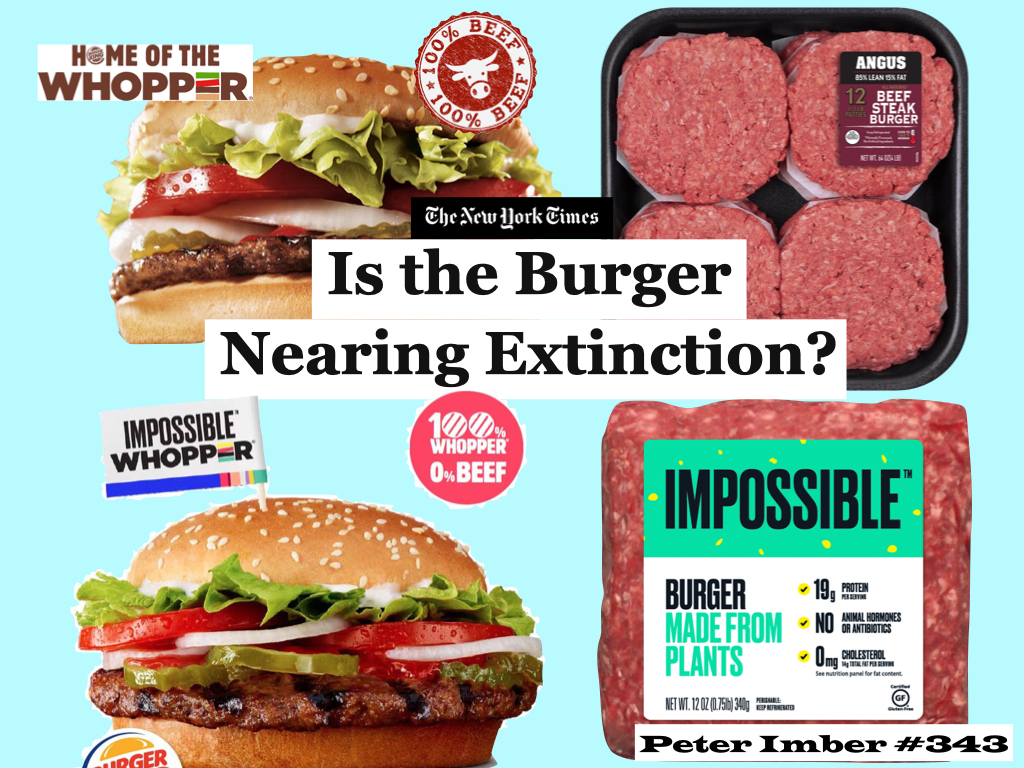
I’ve loved hamburgers even before a time when I can remember that I did. How can I know that? My family’s home movies provide the proof. I couldn’t have been older than two but I was already stepping out in style in the clothes my mother dressed me in. In particular, there was a camel’s hair coat. By the way camels are smelly temperamental animals. Living for a year in the Sinai qualifies me to point this out but their hair makes nice coats.
So, there’s a home movie of me in my camel’s hair coat bawling my head off because I can’t wiggle through a picket fence and free myself from being turned into the fashion plate of our apartment complex. Apparently, I succeeded in destroying the coat a short time later. We were driving to Florida to see my grandparents and I ranted and raved, I was told, until I was permitted to have hamburgers for every meal. After a few days of this and a fateful burger breakfast one morning the camel’s hair coat had to be thrown out.
I think hamburgers are the Swiss army knife of meals. You can get them almost anywhere and that’s handy. In fact try driving across the country without eating one. You’ll be lucky if you can always find an alternative. Hot dogs, grilled cheese and tuna sandwiches are not nearly as ubiquitous.
Unless the friends you invite over are vegetarians, until now hamburgers have been pretty much the default summer meal on the patio and still are even in the dead of winter. Hamburgers have achieved gourmet dining status. The fanciest restaurants serve them although not necessarily ones that are even close to being worth the price.
I was given a Burger King burger on a Delta flight once. It was the perfect airplane food. No plastic looking lasagna to peel open or plastic utensils to have to unwrap with my teeth. I’m surprised I never have been offered another sky burger.
Hamburgers can be easily disguised as a regional item. In Pennsylvania when I was growing up we had the California burger. What was it? It had a piece of lettuce and a slice of tomato in the bun with the meat. That’s it. Of course when I lived in California I could never find a burger named that nor one called a Pennsylvania burger either. Although I imagine if you wedged the burger in a pretzel roll you could say that it was.
Obviously, you can have hamburgers just about any place in the world. After eating two weeks worth of noodles in Japan Jo and I were desperate for something else and found a hamburger place in a small village just in a nick of time. But I admit this was an example of how hamburgers can bring out the myopia of some of us when American fast food burger chains beyond our own borders are looked to for actual comfort in addition to the comfort food they offer, filling multiple rolls so to speak.
When I lived in Israel American humorist S.J. Perelman visited the country– he co-wrote the Marx Brothers movies Monkey Business and Horse Feathers –and I heard him interviewed on the radio. He liked the Tel Aviv Hilton where he was staying but expressed his great disappointment that there was no McDonald’s nearby. Can we call that a beef stew? I just did and apologize.
There’s a list of things that can be lined up and reach the moon if they were, but the 50 billion hamburgers consumed annually in the United States could make it to the moon and back and back again. That’s a measure of quantity. When it comes to quality, a burger up until now has only been as good as the beef it was made from.
But what if there is no meat? Can a hamburger still be a hamburger if it’s made from plants? I had a meatless burger for lunch yesterday. I’ve had more than a few actually even before Burger King made a splash with their “Impossible Whopper” in 2019. I can see myself living a meatless future before I’m driving a gasless car actually.
But are 0% beef burgers as good as the real thing? That’s the deal breaker if they’re not. Well, let me take you back to Washington, D. C. in 1970. I remember this because it made news then and made me laugh. It was a moment during a Congressional hearing looking into the marketing of breakfast cereals.
Cereal makers were up against the wall after convincing evidence had been submitted that two-thirds of the leading brands were so lacking in nutritional value that the children of America were consuming “empty calories” and even worse, kids’ meager breakfasts in poverty stricken countries were claimed to be better than one here of Coco Puffs or Frosted Flakes.
I recall an industry representative trying to defend the seriousness of the allegations with something along the lines of these words…
“Look, a serving of breakfast cereal is hardly if ever eaten by itself. There’s milk and often fruit along with it…”
You get the idea.
With my Beyond Burger yesterday I added lettuce, tomato and onion, a little relish, mustard and ketchup. .. You get the idea.
—————–

Milestones
Today marks two weeks since my second dose of the Pfizer vaccine. I’ve made an appointment and am getting a haircut at noon. I’ve been trimming the hair I have left myself while COVID-teening. Jo is excited for me. I’m sort of nonplussed about it. Have I been doing that bad of a job?
Yesterday I went to an ATM for the third time in a year to get some cash to pay for it. It was a new type of machine and flashed lights at me as if it were saying hello stranger or was it signaling that I needed to pull over to the side of the road?
I won’t compare this to learning to walk again but it is similar to wading into the ice cold Atlantic Ocean here in Maine. If you submerge yourself all at once you’re going to have a brain freeze.
For my next trick I might go to the supermarket. Who knows what’s changed there? Will I find the hummus and the pita bread? Are they allowed to enter the country again?
We are living in strange times.
—————–

Disclaimer: I admit I don’t understand the concept of cryptocurrency except that it reminds me of something I read a long time ago…
“The priests tried to show us, through a small screen, a fragment of the genuine Pillar of Flagellation, to which Christ was bound when they scourged him. But we could not see it, because it was dark inside the screen. However, a baton is kept here, which the pilgrim thrusts through a hole in the screen, and then he no longer doubts that the true Pillar of Flagellation is in there. He can not have any excuse to doubt it, for he can feel it with the stick. He can feel it as distinctly as he could feel anything.” —Mark Twain in Innocents Abroad
That’s as good an explanation of my comprehension of bitcoin as I can think of… Bitcoin is like money but I can’t see it and should just accept that it exists even though it doesn’t have any pictures of dead presidents on it.
The other part that exceeds the limits of my personal decryption is the concept of “mining” for bitcoin which is how you acquire it. Apparently, you need warehouses full of commuters and servers to do this and it sounds like the process is a cross between panning for gold and playing the slots.
Whirling algorithms that would have taken eons to solve every five minutes ago go to work for you and something called blockchain adds up how much your bitcoin is worth instantly and allows you to hoard it or use it to buy stuff from anyone who will accept it as a means of payment for something– no ATMs or checkbooks required. And whatever it is you’re creating it bounces up and down in value like a basketball.
Bitcoin mining uses massive amounts of electricity to create this digital coin of the realm and presently, the largest bitcoin mining operation in the world isn’t represented in the Senate by Joe Manchin. It’s in Texas and I wonder if it had any connection to the state’s power grid buckling under its strain a few weeks ago? Hey, if bitcoin mining becomes a huge deal will that make Ted Cruz the Manchin-ian candidate?
This business all sounds like a Stephen Hawking lecture Jo and I once attended although I may understand black holes a little better than I do bitcoin. One thing both have in common. When I think of either of them I hear a loud sucking noise…
We’re in the Bitcoin
We’re in the bitcoin
Don’t know what we’ve joined
We’ll get a lot of what it is, what can go wrong?
It might smell funny
But I’m no dummy
Thanks, Elon Musk for letting us just tag along
Come on and make a beeline
No need to find a cosine to play…
Forget about hypotenuse or worry ’bout the power use
Let your desktop make the hay
So what if it dips
Could it be tulips?
We’re doin’ fine until we find it’s gone away
The Gold Diggers’ Song (We’re in the Money) with lyrics by Al Dubin and music by Harry Warren was written and composed in 1933.
Here’s Bing Crosby singing We’re in the Money…
And here’s Frankie Yankovic singing another tune that sums up my apprehension about Bitcoin…
—————–

It’s not my intent to make light of what happened to employees at a Panda Express outlet in California two years ago. The so-called self improvement seminar where at least two attendees were ordered to strip and hug sounds more like a mock terrorist interrogation than a “team building” exercise.
Although nothing comparable took place at my own workplace in the years before retiring from ABC News and the Disney Company I found the so called online sensitivity training and self performance evaluations we were required to complete a bad joke. They were ridiculous and insincere. I imagine whatever Panda Express was up to was in a similar vein but with actual “instructors” involved it was also an opportunity for abuse and humiliation just waiting to happen.
So what’s more damaging to the Panda Express brand at this moment in America?
A. A Panda Express employee being made to strip by her manager.
B. The revelation that Panda Express has been using actual panda in their food.
C. Someone finds a human digit in their order of Panda Express Kung Pao Chicken.
I think that C is likely the correct answer. I couldn’t eat pot pie after 2nd grade for decades because Larry Yoder bit into a nail in his one day in our elementary school cafeteria. That kind of thing creates a “this could happen to me” fear and is an especially nail in the coffers kind of event for a food chain.
The fallout from B would be hard to overcome since Pandas are a “cute as a button” member of the animal kingdom. They are also endangered and the outrage would certainly topple top management, but if no one ever complained about Beijing Beef on occasion being laced with panda, there might still be a route to avoid ruin. Yes, “Panda-Plate” would be horrible PR for sure but a recovery strategy starting with giving away stuffed pandas with every order might just entice kids to beg their parents to pony up and buy a meal so they can get one. The lesson here going forward for any food enterprise is you don’t make food from animals who have given names.
As for A, an individual’s unlawful or immoral behavior can damage or even destroy a company let alone their and others lives and if it’s the big boss himself or herself who is guilty– Harvey Weinstein, Steve Wynn, Mario Batali come to mind –the consequences can be dire. But for every person or company in such instances that is totally scorned, many more are merely chastized and often even fully rehabilitated.
There are other times unfortunately, where the charges are injurious, then turn out to be bogus but linger in the public consciousness forever. However, worst of all are examples where perpetrators of serious crimes– usually the rich and famous — have gotten off scot free, save their reputations, from going to prison. O.J. Simpson and Robert Blake killed people. Woody Allen molested a child.
Jo and I watched the documentary Allen vs. Farrow on HBO this week. It’s quite disturbing and Allen’s on screen neurosis is shown clearly to be an offscreen sickening personality disorder. He’s vile and although never convicted, plainly guilty of sexually abusing a seven year old girl. The mother, Mia Farrow, comes across better but she needed to have learned something from the woman who has brought the suit against Panda Express for allegedly being forced to disrobe. When you know something that is happening is very wrong, you don’t wait until it’s too late to intervene and stop it.
—————–

Jo’s uncle Harold was brilliant. He was also eccentric. When he visited Maine and stayed with Jo’s parents, I once carried his suitcase into the house and up the stairs and it weighed as if it were full of bricks.
Harold Dondis graduated from Harvard Law School when he was barely 20 years old and during his career argued cases before the United States Supreme Court. But his passion was chess and he wrote a chess column for the Boston Globe from 1964 until he died in 2015. That suitcase I lugged around was full of a portable chess library.
Harold was president of the Massachusetts Chess Association when a 20 year old chess phenomenon named Bobby Fischer visited his chess club and played 56 separate opponents simultaneously. Fischer beat all but one of them. He made an errant move against Harold and resigned.
In 1972 Harold met Fischer again while covering the World Chess Championship matches in Reykjavik, Iceland. for the Globe. Here’s an excerpt from one of his columns.
“He is a handsome, athletic, nattily dressed 6-foot bachelor. He very frankly plays chess for money. In a game where complex theory and PhD players abound, Fischer is an uneducated, gruff, and badly-mannered person who says what he thinks, with little or no delicacy. His attitude toward the Russian players is one of complete disdain.”
Harold Dondis learned to play chess when he was 10 when a summer camp counselor, after continually losing at checkers thought that if he taught him a more complicated game they’d be more competitive– sort of reminiscent of how the chess prodigy in the recent series The Queen’s Gambit became introduced to the game, no?
Harold competed in the United States Open Chess Championship a number of times and I found a record of his seven games. In three of them the opening was the Queen’s Gambit.
—————–

How many things that tell time have you had to move forward either when you went to bed last night or after you got up this morning? Here in Maine I believe it’s a bigger deal when we do this adjustment than many other places because of our awareness that even after we’ve sprung ahead an hour we’re still going to have the sun go down at 8:30 on the longest day of the year. Maine is blatantly in the wrong time zone.
Youth may be wasted on the young but daylight is wasted on the Canadians on our borders who are one time zone ahead of us and have restaurants that are still open on summer evenings after they come out of a movie theater.
But today is full of causes for celebration, at least according to something called the National Day Calendar. Listed on it are nine other events, commemorations or promotions that occur annually on March 14th. Here are a few of them:
National Learn About Butterflies Day (The only ones in Maine this time of year have pins stuck in them.)
National Pi Day (I think it’s predictable that any discussion about whether a Pi Day should really be observed would merely result in endless division.)
National Potato Chip Day (It’s certainly PC and did you know that the inventor of the potato chip was a guy named George Crum?)
And if you’re looking for something to celebrate tomorrow, it’s going to be National Open an Umbrella Indoors Day (The guy who created it claimed he was conducting a science experiment. I’m not kidding.)
Having “National” days to mark just about anything you can think of is, I think, a quintessentially American thing. According to the website
https://nationaldaycalendar.com/ there are nearly 1500 National Something Days during the year from
National Personal Trainer Awareness Day on January 2nd, which feels definitely like a scales pitch, to
National Whiners Day on December 26th, which I guess is for those who didn’t get what they wanted for Christmas.
Many of these days involve food– escargot, s’mores, Wiener schnitzel –and the tooth fairy even has two of her own, one in February and another in August. If your child is the right age, this seems a little like the parent having to pay quarterly estimated taxes.
But let me cut to the chase– and the “cut to the chase” expression comes from the silent film era and yes, there is a National Silent Movie Day. This National Day thing has become ridiculous! I suppose it’s not harming anyone and maybe I’m taking things way too seriously but having on average over four National Days every day adds to the mountain of observances and rituals that have become so numerous and frequent in the United States that in my opinion they are all but meaningless.
And here’s another annoying example of adulation inflation. To paraphrase Henny Youngman, “Take awards shows, please!” We all know the Oscars, the Emmys, the Tonys and the Grammys, which are happening tonight btw. These have long histories and I’m not saying awards don’t have their place. People work hard to earn recognition for their efforts. It’s just that there have become so many of these shows that they are beyond ho hum which rhymes with dumb.
Aside from the ones with established identities, there are a few dozen others with acronyms like CMA, TCA and SAG, probably so they can fit the award’s name on whatever piece of brass or glass they’re handing out to their recipients. How many times in one year can the same person win an award for the same film or show or song and deliver the same acceptance speech? Answer: A lot!
Years ago at ABC News Brian Rooney and I did a story about this glut of awards programs that ABC didn’t see fit to put on the air. Admittedly, it wasn’t one of our best efforts but in hindsight I hit myself in the head when I realized we were seriously biting the hand that fed us. The ABC network was broadcasting a lot of these shows that got decent ratings and made money. That was then but may not be true much longer. The Golden Globes last month had dismal viewership numbers and if the other broadcasts don’t do any better this time around, the Oscars after party may be catered by Oscar Meyer in the future.
And then there’s the total diluting of awards for merit that has undermined youth sports where “trophies for everyone” has been a boon to trophy makers but a bust for teaching a valuable life lesson– not everybody can win all the time.
Full disclosure, I have a few awards I’m proud of so you can call me a hypocrite if you want. One of mine is from the News and Documentaries branch of the Emmys and it even came with instructions of how it should be placed on display. I don’t remember which side of Ms. Emmy’s face shows her best profile so I hope if I’ve guessed wrong, I won’t have to give it back. And all false modesty aside, I was nominated for three others. When I told my mother I finally won, she of course said what any Jewish mother would. “So, what was wrong with the other stories?”
I have a Dupont Columbia, another from the National Press Club and one from an Hispanic organization that I won with a correspondent who handed it to me immediately because it was heavy and then she delivered such a long acceptance speech, that I didn’t even get to say thank you. I didn’t give the award back to her. It’s shaped like the Washington Monument but with a sharp point and could be used as a lethal weapon. I think it’s in our attic somewhere and no longer a clear and present danger to anyone.
However, the most prestigious award in our house for work in television and the most prestigious award in all of television news wasn’t given to me. Jo has a Peabody for her work as a producer on a series that ran on PBS. I am insanely not jealous.
—————–

Is acronym an acronym? If you’ve heard of the comedian Steven Wright, don’t you think it’s a question he might ask? I don’t know about the answer. My cursory research indicates it isn’t. But we have so many acronyms now that it’s becoming a close call between which I remember the least, acronyms or passwords.
Actually, my cartoon today contains three uses of the same initials– PSA –that stand for three very different things. Two of them I knew but the third– Professional Sports Authenticator –I didn’t and that one is who you send any baseball cards for appraisal that your mother didn’t throw out decades ago.
If you’re extraordinarily lucky you might have paid a nickel for the payback of a lifetime. In January the Mickey Mantle card from 1952 sold for $5.2 million and became the most expensive sports card of all time. Apparently, there are a few more out there in mint condition and worth a mint as well.
But it’s the other two PSAs I am going to write about today and attempt to connect. This morning when you read this I most likely will have had my first dose of five and a half weeks of radiation with an excellent chance of knocking out intermediate stage prostate cancer. I was diagnosed recently and I’m not that anxious about it but want to share my tale that might be useful to other men my age.
At this point most men my age– I turn 74 on Wednesday — are familiar with the PSA (Prostate-Specific Antigen) test that can indicate cancer by assigning a number to your result. The PSA test doesn’t always give an accurate result and an elevated PSA– 10 or higher –doesn’t always indicate cancer. And here’s where I hope my story will serve as the third PSA– a Public Service Announcement.
Clint Eastwood starred in a movie about ten years ago about a washed up baseball scout called Trouble with the Curve. Right at the beginning he takes what can be described in baseball terms as a long time in the batter’s box urinating. As he’s doing so he’s looking down at (another baseball analogy) his pitcher and exclaims, “I outlived you, you son of a bitch!”
I had no symptoms that I had cancer but I had my reasons for wanting to know how well (last baseball reference, I promise) my own pitcher was throwing. Having one cancer already increases the odds of having another– I have an indolent lymphoma –and I also have prostate cancer in the family. My brother had his prostate removed several years ago which also increased the odds that this cancer was in my future.
Doctors will tell you that if a man lives long enough he’ll likely die with prostate cancer and not from it. And even though prostate cancer is the second slowest progressing cancer (skin cancer is the slowest), it is also the second leading cancer that men die from so if you have it, you want to know it sooner than later.
So, here’s the part of the story which you may already have had your own experience with. There are times when you have to be your own advocate to get a test or a diagnosis after you’re told, “Don’t worry about it. We’ll watch it.” My PSA result was elevated but not alarmingly. Nevertheless I wanted a biopsy because of the other factors I’ve described and sure enough I was right to push for one. Radiation was one of several options I was presented with to pursue. I’m confident I’ve made the right decision.
This morning I will have gotten in the car at 7 a.m. to drive an hour to Bath and I figure to be back home by 10. I anticipate that this routine will result in my final couple of weeks of cartoon offerings sometimes getting sent out ASAP when I get back from my new daily commute. I’m in the habit of usually thinking up a cartoon and then writing something to go with it in the evening before I get in bed. When I wake up I look at both with fresh eyes. It’s amazing how much tweaking can happen first thing in the morning.
So, take my advice and get an annual prostate exam and a biopsy if recommended or you feel you need to have one like I did. You’ve probably figured out that I’m not a big fan of Ronald Reagan but he did have a phrase that applies to things other than nuclear arms agreements– Trust but verify!
—————–

I recall very well my disbelief that afternoon when I learned JFK had been assassinated. I was 16. I remember my shock the morning I saw the second plane crash into the World Trade Center live on television. I was 64.
There is no single moment that I can identify as the one where I was jolted into realizing the enormity and impact of the pandemic. And today, March 16th, marks the date that Jo and I began what I have come to call “Covidtining.”
A year ago the evening before our sheltering in place began, we had planned to go out for dinner with friends and were aware and apprehensive enough about COVID-19 to have decided to eat at their home instead of the tiny restaurant literally around the corner. The place closed permanently months ago.
I don’t remember exactly when Jo and I got our first masks. I’m sure it was very early on. Somebody told us about a woman who was making and selling them and when we went to pick them up we learned she was busy filling mask requests instead of taking her usual orders for summer wedding dresses.
Pretty quickly the shelves of our supermarket were empty of items like hand sanitizer, paper towels and toilet paper. Schools, restaurants and theaters closed. The only good news was that it was the tail-end of Maine’s winter and soon we were at least able to spend time outside, but for quite a while we would be wary of getting too close to anyone.
I’m not telling you anything you didn’t already know. Some of us took more precautions than others. Eventually, it would be the rare individual who didn’t know someone who hadn’t contracted the coronavirus.
As the contagion became widespread and the number of those who died in America rose– 100,000 by the end of May, 200,000 by the end of September, 300,000 by the middle of December, 400,000 on the last full day in office for the previous president –and then reached over a half million last month. We became numb to the numbers and the lucky ones among us like Jo and I have been able to make adjustments to stay safe– Zooming, working from home, curbside pickups, ordering as much as can be delivered to our front door by Amazon.
The Dow Jones after initially dropping precipitously at the pandemic’s outset hit a record high yesterday and those of us who are even more lucky have actually seen the value of our investments increase nicely in the past year. It defies logic to me but Robert Reich explains it this way…
The richest 0.1% own 17% of stocks.
The richest 1% own 50% of stocks.
The bottom 50% own 0.7 of stocks.
Repeat after me: The stock market is not the economy.
So, although in the last 365 days I can’t pinpoint any single moment with the exception of this past January 6th as being as horrifying as President Kennedy’s assassination or Al-Qaeds’s attacks on 9/11, I believe our year of Covidtining has been devastating even though I feel unscathed.
The country was divided a year ago. Those divisions have widened further and worse, show no signs of narrowing. I wasn’t around for the 1918 pandemic or the Great Depression but it seems to me that the COVID experiences of the haves and the have nots have never been so different, unequal and more apparent. The emotions of those stirred up for a long time now about what America stands for or takes a knee about are as heightened and worrisome as ever.
I don’t believe the country could have been miraculously united by any leader around our COVID response but being misled from the outset of the outbreak by a man so indifferent to truth and suffering has resulted in an almost incomparable tragedy.
The rapid development and deployment of vaccines has been a stunning accomplishment but there is and will never be a way the efforts of Pfizer, Moderna or any scientific brain power will be capable of inoculating us from hate and lies.
A year from now we may well have but COVID-19 behind us. I’m not sure the other ills of this time in our nation’s history will be closer to being cured.
—————–

The power drill is the undisputed most useful
electric tool in the homeowner’s arsenal.
–The Christian Science Monitor
Sometimes something totally forgettable sticks in my mind and stays glued there forever. Take the power drill. I once read that nearly two-thirds of American homes have one but in the course of its owner’s lifetime the drill is used an average of 12 minutes. I have one and every time I get it out of its case I feel like a coach who is putting his last player on the bench in the game. I’m kind of sad for my power drill getting so little time on the field.
I did just use my drill recently to put some hooks in my closet. I should have timed how long I turned it on for.
The point I’m trying to make with today’s cartoon is that there are certain things we likely have– and most much less useful than a power drill –that we never use but never get rid of– fondue sets, workout videos. For years my grandparents sent me an annual fruit cake and after almost breaking my wrist cutting the first, I never ate a piece of one again but we kept the tins they came in and never used them either. When we were paying for cable TV, there were hundreds of channels we never watched. And how about those extended warranties? I’ve paid for a few of them in the past and don’t recall ever availing myself of any.
Of course eventually, the repository for the stuff you own that never gets thrown is the attic and in our house in Maine our attic has a sort of microclimate that limits access to it. Let me explain.
When we moved from Los Angeles we traded two seasons for three. LA only has summer and winter. A switch gets thrown twice a year and suddenly it’s one or the other. The interesting thing about that is when you see pictures taken out of doors in Southern California, unless there are blooming jacarandas in the background you’ll have a tough time determining which season of the year it is. Definitely not the case in Maine.
I consider Maine to have three seasons. The missing one is spring. Certainly, it’s not the spring I knew growing up in Pennsylvania. Spring there was March doing the lion and lamb number. And April showers presumably brought May flowers but I never paid attention to that until living here. When things start to wake up and blossom around our house it’s as if mother nature’s kitchen only has one appliance– a microwave. It happens fast and I’ve learned the order of the cast’s appearances– forsythias come first, lilacs soon afterward and we have a bush that is a weeping something that is incredibly beautiful when it produces its white flowers but only holds on to them for a few days. Winter is a marathon in Maine. Summer is a hundred meter dash.
But what about the attic? Ours is not heated or cooled so it’s freezing in winter and sweltering in summer and that means there are only two stretches of time in between when it’s comfortable to be up in it– two opportunities when the attic allows me to do inventory. Every year I resolve to go through all the boxes containing things stacked to the brim up there. The stuff in them is hardly ever needed nor missed but every time I start what the Brits call a “sort out” I end up doing a lot more sorting than discarding. It goes like this…
“Someday I’ll want to read those papers I wrote for my Hitchcock course at film school.”
“Hmmm, I bet I could sell this light meter on eBay.”
“You never know when we might need those old suitcases.”
But now I have thought of a new litmus test, a process that takes me out of it. It’s a simple mantra I haven’t tried before– five words. “Would my son want this?” He will get to choose what he wants anyway but I think my own dispassionate pruning will make the job easier.
Can I do it? It’s going to take supreme willpower to pull off. An awful lot of stuff will be going to the dump or Good Will. And one item I’d like him to have he won’t need. He already has a power drill.
—————–

Don’t even ask. It’s been that kind of day.
—————–

I understand the reasons people oppose abortion although I don’t see eye to eye with them. Of course no small number of these same people also support the death penalty. I guess an eye for an eye is a higher priority in their minds than a woman’s right to choose.
I can’t get my head around why so many people demand that there be no gun control laws. Opposition to registration, background checks and the banning of weapons like AR-15s called assault rifles, because they were designed to kill people, is not defensiveable. I am certain that an individual’s right to own any gun without regulations was not what the framers of the Constitution had in mind when they wrote the second amendment.
These are two big issues that divide Americans and there are others of course but next on my list is climate change. How can it still be that despite all evidence to the contrary some of us can still deny that it’s happening? It defies common sense. So, since it is getting harder and harder for anyone to argue climate change is nonexistent, I’ve seen an “evolution” in some people I know who were total deniers in the past but now see economic opportunities in “them there ice melts.”
It might surprise you that strong warnings about climate change were sounded 50 years ago by someone who was revered as “The most trusted man in America.” I came across an article yesterday that reminded me I was there when it happened. I’ve mentioned before that I had the incredible good luck of working on the CBS Evening News with Walter Cronkite straight out of college in 1970.
“It was New Year’s Day, 1970, and Walter walked into the Broadcast Center and said, ‘goddamnit, we’ve got to get on this environmental story. When Walter said ‘goddamnit,’ things happened.”
The producers who worked for Cronkite were as talented a group of people as I’ve ever been around. Ron Bonn was one of them and I’ve quoted him here. He was the one assigned to produce what would become a series called “Can the Earth Be Saved?”
One of my jobs on the broadcast was responsibility for the graphics. I was the go-between for the writers and producers and the graphic arts department. I ordered the maps, the still pictures, the graphs, the charts and anything else that was needed to be projected behind Cronkite as he read the news of the day. Back then the electronic process known as chroma key was in its infancy and we only used it when Cronkite was physically somewhere other than New York. We still relied on old school technology and used slides and slide projectors positioned in front of the anchorman that had a cutout covering part of the lens so that a map of Cambodia wouldn’t be superimposed on Cronkite or whoever else was in his seat.
There was a specific slide used for the stories in the “Can the Earth Be Saved” series. It was the globe of the earth being held in a man’s– Ron Bonn’s –palm.
The broadcast’s director Ritchie Mutschler liked to refer to this particular slide as the “Hand Job” and eventually Cronkite let Mutschler know he was tired of hearing it and it was never said again.
Cronkite’s concern about the future of the planet and his mission to sound the alarm for the nation began just a few months before the first Earth Day in April of 1970. He made sure his viewers knew it was coming and persuaded CBS to let him air an hour long special report in prime time on that night.
No doubt Walter Cronkite would have admired and encouraged Greta Thunberg in her crusade but I think he also would have been disheartened to learn that we who may determine if there is to be a humanly inhabitable world have not moved far or fast enough in the first 50 years since Cronkite warned us we must.
—————–

—————–

My father once taught me a lesson about war and simultaneously why sports should never be compared to it.
One day at our golf course as we were waiting to tee off he pointed to a man who was playing ahead of us.
“He saw combat in Europe and had a really rough time in the war. You’ll never hear him talk about it. The guys who talk about the war the most are the ones who never had to see it.”
On the other hand, those who talk the loudest about getting others to fight a war often did their very best to avoid having to be in one. Dick Chaney comes to mind immediately with his five deferments, but not at all surprising is the list of others who have waved the flag after waging their own battles within the system to get a waiver from serving the country.
Rush Limbaugh received a deferment for having an anal cyst. I’m not kidding. Rudy Giuliani got the judge he was clerking for at the time to help him get his. Newt Gingrich and Bill O’ Reilly received deferments for graduate school.
And of course it’s not just Republicans. Bill Clinton enrolled in ROTC to postpone his going to Vietnam but when he got a high lottery number he opted out. Joe Biden, like me, got a 1-Y which was a “Don’t call us. We’ll call you,” classification. Mine was for my back. Biden’s was for asthma.
But the most head scratching example of a draft avoider has to be John Wayne. His career as an actor hadn’t taken off yet in 1941 but he already had four children and received a deferment for “family dependency.” He wanted a few more movies under his belt but 13 wartime films later he was still in Hollywood. Unlike Henry Fonda and Jimmy Stewart he was content to be a hero on the Sands of Iwo Jima and as one of the Green Berets far from danger. Thus my point that those who claim to be the biggest patriots are often merely the loudest phonies.
What does this have to do with the so-called “Big Dance” that marks the end of the college basketball season? Just this. When somebody who does something on an athletic field or court that has won a crucial game or a prestigious championship he may never have to buy another beer for himself. Sports heroes and war heroes are different. A war hero too often never has another beer and his widow never rides in a parade with her folded flag.
War is perhaps the greatest failing of humanity and looking at a list of wars that are presently being fought among countries along with civil wars, regional conflicts, destabilized regimes and violent oppression is ample proof and terribly depressing.
And in a way we’ve turned even our wars into sports. After America’s invasion of Iraq in 2003 I was astonished to see that very quickly there were video games one could purchase to “play” the war from the comfort of your home.
Sure, during WWII a child could keep abreast of developments by marking a map with the positions of the allied forces. Maybe he or she had a father or a brother serving in Europe or the Pacific. But that’s very different from shooting the enemy on a computer screen using your mouse and what are the odds today that he or she or we even knew anybody in our all volunteer army who was serving in Iraq?
All I know is that in my cartoon I drew up a bracket with only eight countries. I could have probably come up with 64 pairings like at the NCAA tournament– India vs. Pakistan, Palestine vs. Israel and Syria, Yemen, the Congo…
When the video game comes out that lets you play all of them, I’ll be 4-F.
—————–

If you’ve never heard the term “news peg”, it’s a justification to run a story on a particular day. For example this coming April 30th the media will outdo itself to evaluate President Biden’s first few months since it will mark his 100th day in office. That benchmark started with Franklin Roosevelt when he became president in 1932 and has been a news peg for judging an incoming administration ever since.
The cartoon and the story I’m about to tell probably didn’t need a peg but I found one. It’s Wolf Blitzer’s birthday. He’s 73 today.
A little background… Wolf Blitzer was born in Germany in 1948 to parents who had survived the Auschwitz concentration camp. His surname Wolf goes back generations in his family, only it wasn’t Wolf in Eastern Europe but the Yiddish-Hebrew word for a wolf Ze’ev.
While he was in college Blitzer took a year abroad and studied at Hebrew University in Jerusalem. Afterward he became a reporter for Reuters in Tel Aviv.
He returned to the United States in 1973 when Israel’s English language newspaper, The Jerusalem Post, hired him to be their Washington, D.C. correspondent and he held that job until moving to CNN in 1990.
While working for the Post, Blitzer also wrote articles for a Hebrew language paper, Al HaMishmar, using his Yiddish-Hebrew first name Ze’ev in his byline.
Al HaMishmar was the most left wing newspaper in Israel and aligned with the left wing political party Mapam which was the party that the kibbutz I lived on from 1971 until 1979 was affiliated with. Each morning copies of Al HaMishmar were in our mailboxes but since I was learning Hebrew, I also got a daily copy of The Jerusalem Post. So, I knew both Blitzers– Wolf and Ze’ve.
Until 1977 every prime minister of Israel had been from the Labor party which was somewhat akin to America’s Democratic party. Menachem Begin led the Likud which was more like our Republican party.
Most of the newspapers in Israel when I lived there, and there were many of them for such a small country, were often published by the various political factions– Al HaMishmar being the most liberal and therefore the most critical of and detested by Begin. The Jerusalem Post on the other hand was centrist.
Cut to Washington in the late 1970s and a press conference with Jimmy Carter, Menachem Begin and the White House press corps. Wolf Blizter rises to ask his question and the following exchange ensues…
Blitzer: “Wolf Blitzer, The Jerusalem Post…”
Begin: “No, you’re not! You’re Ze’ve Blitzer, Al HaMishmar!”
I was watching this in Israel and laughed my head off.
—————–

—————–

COVID Song
Oh, it’s a long long blur
From April to April
And it’s way past a year
Since I’ve had a good bagel*
When the spring weather
Turns my efforts lame
It’s clearly time
To end the cartoon game
And the days wind down
To the final few
Remember, remember
And these long COVID days
We’ve made it through
These COVID days
I’ve spent with you
*EXCEPTION: My friend David has started making bagels. He gave us some. They were really good.
September Song was composed by Kurt Weil with lyrics by Maxwell Anderson and sung by Walter Huston in the 1936 Broadway musical Knickerbocker Holiday.
One week more of offerings and then I’m toast— Wait! It’s Passover —and then I’m matzo!
—————–
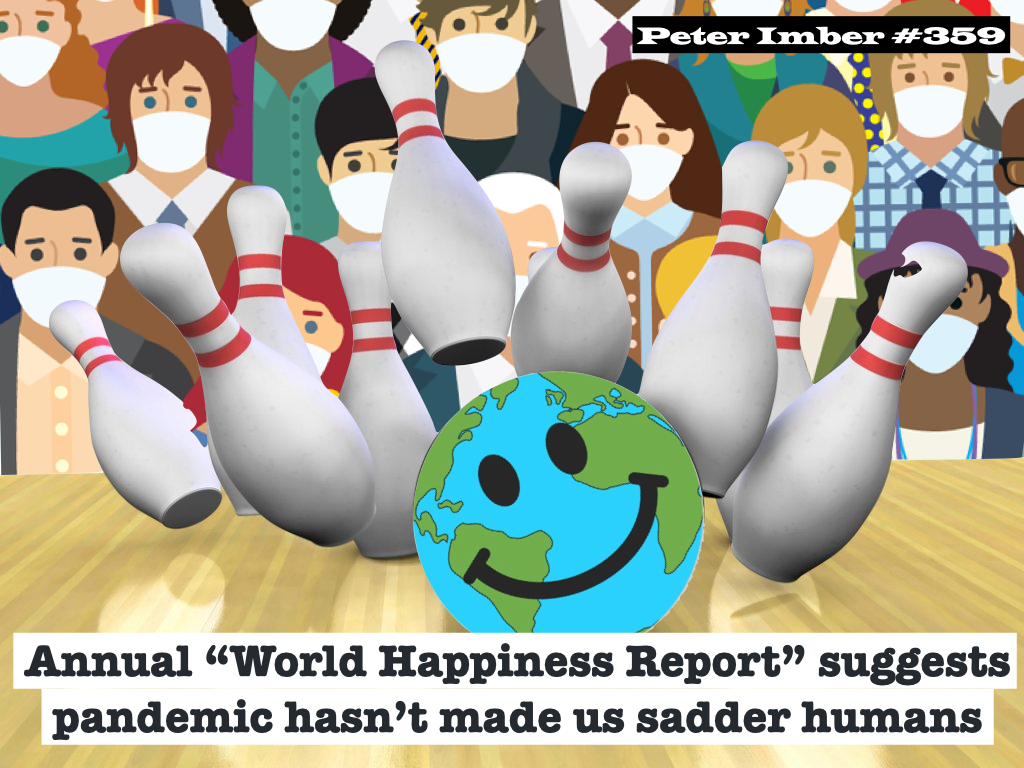
Global life evaluations have shown
remarkable resilience in the face of COVID-19
–World Happiness Report
Disneyland may call itself the happiest place on earth but it’s not yet a country. And until it becomes one we have the World Happiness Report to tell us just which country is. The ninth edition was released a few weeks ago.
For the fourth year in a row Finland has been ranked first. I’ve always wanted to go there. I’m an admirer of the Finnish composer Jean Sebelius whose music has created vivid imagery for me of his homeland’s forests, lakes and seas but one that is neither joyous nor bleak. I’ll take the report’s word for it that Finns are a content and cheerful people. They certainly don’t seem to brag about it.
Proponent of doom and gloom about the world that I am, I’m surprised to learn that Finland turns out to be the place that Disneyland claims to be, but I’m more amazed that apparently, many people globally see 2020 as having been a blip on their lives’ radar screens and despite the coronavirus feel the same satisfaction as before and a good deal of optimism about their post pandemic lives.
I hope that means something more than just a shrug at the pandemic and blind faith that the future will be coming up roses. We may have adapted well to COVID-19 and certainly science has performed a miracle with the speed at which vaccines have been developed. However, there’s still so much else that needs to be done to fix the world and if we just retreat into our past existences without addressing our existential challenges, all the resilience in the world won’t keep us from becoming an endangered species if we aren’t one already.
Here are the criteria that the United Nations funded World Happiness Report used to determine if a country is happy or less so…
- real GDP per capita
- social support
- healthy life expectancy
- freedom to make life choices
- generosity
- perceptions of corruption
And after compiling the data I’ll bet you’re probably not surprised that the study found that the next seven happiest countries in the world after Finland are all in northern Europe. In order they are: Iceland, Denmark, Switzerland, Netherlands, Switzerland, Germany and Norway.
And guess who’s next? If you said the United States, you’d be wrong. We’re 14th, just behind Ireland and just ahead of Canada. Number nine is New Zealand with Austria, Israel and Australia rounding out the top 12.
What do these top ranked countries have in common? Most of them have homogeneous populations but not all. They’re at peace with their neighbors but not all. They’re doing pretty Ok economically, true.
What stands out to me is that all are democracies and provide extensive social services for their citizens. All hold elections and in the case of Israel currently, they are doing so very often, but they have also taken much of the anxiety out of getting healthcare, a college education and life after retirement. It’s not only that they are not authoritarian regimes, it is also the fact that the majority of their citizens see their government generally as a good and not an evil that makes their lives more secure.
On the downside the dozen unhappiest countries do not include any in Europe or North America but six are in Africa, three are in Asia, two in the Middle East and one in South America.
The last country at the very bottom of the list is Zimbabwe and I don’t think the producers of this study were trying to be funny by making a country with its first letter being the last letter in the alphabet the unhappiest place on earth.
And what do these unhappy countries have in common? That famed social scientist Leo Tolstoy said it best. “All happy countries are alike, but every unhappy country is unhappy in its own way.”
—————–

In Judaism 18 is a lucky number. Why? Because for those who are believers or dabblers in Jewish mysticism– you’ve likely heard of Kabbalah –letters in the Hebrew alphabet have numeric values. The two letters that add up to 18 are
chet which is 8 and
yud which is 10. Adding them together is 18 and the word they form is Chai, the Hebrew word for life–

.
What does this possibly have to do with today’s cartoon? Not much other than today’s Homemade Cartoon is number 360 which is Chai x 20 and it’s about the Republican stunt the party always performs when administrations change hands which is a 180°– Chai x 10 –when it comes to the United States’ budget deficit. It’s the Republican playbook to cut taxes and drive the deficit up when they’re in charge and then oppose spending on things necessary for the well being of the nation when they’re not.
But looking at some other numbers, the only presidents in the last 50 years to leave the White House with a lower deficit than the year they entered it have been Democrats Bill Clinton and Barack Obama.
Tax cuts do not pay for themselves. “Trickle Down” economics has only made the rich richer. Since 1933, the U.S. economy has grown at an annual average rate of 4.6 percent under Democratic presidents and 2.4 percent under Republicans. Have we not learned this yet? Supposedly, you can’t fool all of the people all of the time but I guess you still can certainly fool a lot of them.
Republicans know how to feather the nests of their wealthiest constituencies when they’re holding the reins. Then when they leave the Democrats have to clean up the mess.
Chai aye yai yai!
—————–

Years ago I was driving past a lake and the passenger in my car started shaking his head. “What was God thinking?” he said.
We were traveling in Pennsylvania. My friend was Israeli. It was his first visit to America and he was stunned by the sheer abundance of water he saw everywhere. He was thinking perhaps about the Sea of Galilee and the Jordan River back home. The size of the Sea of Galilee is 64 square miles, Lake Michigan is 22,000 square miles. The Jordan River is neither chilly nor wide and would only show up on an extremely large map of Maine.
You may remember this exchange between Humphrey Bogart and Claude Rains in Casablanca…
Rains: What in heaven’s name brought you to Casablanca?
Bogart: My health. I came to Casablanca for the waters.
Rains: The waters? What waters? We’re in the desert.
Bogart: I was misinformed.
Until recently I was misinformed, too. I thought I had lived over half my life up to this point in the desert. Adding seven years in Israel to 31 in Los Angeles, I believed I was within dry mouthed spitting distance of matching Moses’ 40 years in the Sinai. And although parts of Los Angeles County– which is huge –are considered desert, my old neighborhood– the San Fernando Valley –is classified as having a Mediterranean climate.
Israel has a border on the Mediterranean Sea but over half of it is true desert and according to a recent World Resources Institute report only Qatar and Lebanon rank ahead of it as countries most likely to run out of water. Of the top ten eight are located in the Middle East and two in Africa. That’s nothing to celebrate, but for Jews in Israel and the rest of the world, tonight will be festive anyway.
Passover begins this evening, a holiday known for matzo ball soup and gefilte fish as much as Thanksgiving is associated with turkey. Just as we remember the pilgrims’ arrival in America in search of a better life, during the Passover meal or Seder, Jews give thanks for having escaped slavery in Egypt and being led across the Red Sea by Moses to the land God had promised them as parched as it still may be.
There’s an ironic twist to Passover this year that I’m sure will be brought up at thousands of Seder tables this evening. A cargo ship is breached across the Suez canal and disrupting global shipping. I don’t think it has lowered the water level of the passageway to permit a pedestrian crossing but as is said “God works in mysterious ways” and if the ship is freed during the week of Passover? Just sayin’.
But back back to Moses and the Book of Exodus. As I see it, Moses was more or less the tour guide. Pharaoh was the Abraham Lincoln in our story and he freed the Jews only after God did the prep work and inflicted 10 plagues upon all of Egypt which included annoyances like lice and boils, locusts swarms as well as cosmic cruelty like pestilence, darkness and death for newborn babies. And there were even a few additional things.
In the Haggadah– the account of the Passover legend –water is also weaponized. It’s the very first plague God has Moses unleash on the Egyptians by empowering him and his brother Aaron to turn the Nile and all other Egyptian sources of water into blood. Today, I think we know this as something called the “red tide.”
So, were all these other horrific things possible too? Sure, to one extent or another. Anything from botulism to hoof and mouth disease could have created the pestilence that wiped out livestock. Hail, another of the plagues, has always been a potentially devastating danger to crops. Still another, a solar eclipse, could have been thought to signify the end of time. Even frogs as hard as it may be to conceive of them as a plague could have created havoc. In 2010 thousands of them actually emerged from a lake in Greece and tied up local traffic for weeks. The only plague I haven’t mentioned yet is flies. Ever worked on a farm?
What God wrought on Egypt to twist pharaoh’s arm to let my people go was dreadful and extreme but like my Israeli passenger, I’m envious of other places in the world that he might have chosen for Jews to seek refuge. As a blind man who lost his sight in an accident once said to me, “I guess God knows what he’s doing.” I’ll take his word for it.
There’s a point in the Seder service that the youngest child is asked to read the Four Questions. All of them have to do with why tonight is different from all other nights of the year, including why we eat matzo– answer: we left in a hurry and couldn’t wait around for the bread to rise. The other questions also help explain what we remember at Passover.
And there’s another moment near the conclusion of the meal that involves the children and maybe it’s because by this time the adults have had four glasses of wine and are feeling a little wobbly about getting up from the table themselves. So, the children are sent to the front door. Their task is to welcome the prophet Elijah to the Seder table. A place has been set and waiting for him all evening and he has even been poured a full glass of wine. When the kids return from ushering him into the house Elijah’s glass will be miraculously empty to prove to all that he has indeed arrived.
When my son Gil was five or six we were having our Seder with friends when the time came for the kids to go to the door to bring in Elijah. All of them went except for my son.
Me: “Gil, you should go to the door with the others.”
Gil: “I’m not going.”
Me: “Why not?”
Gil (pointing to Elijah’s glass of wine): “I want to see how he does this.”
Hag Sah-may-ach! Happy Holliday!
—————–

Two weeks and 10 radiation sessions so far with three and a half weeks left and 17 more bursts of x-ray photons to go. And I also received a bonus exposure this week to what I’ll call the lighter side of prostate cancer treatment.
Monday through Friday I get undressed and put on two hospital gowns. I don’t know why just one isn’t sufficient but with doctors and nurses I mostly do what I’m told. From the dressing room I pass the facility nurse on the way to the giant ray gun which looks like something from the laboratory of a mad scientist in a 1950s sci fi movie but probably cost more than all of those films put together did at the time.
The nurse is always cheerful but also all business. Anyway, that morning as I went by her station, she asked me this…
“Everyday the same outfit. Don’t you have any other clothes to wear?”
I smiled and the following day I brought her the Homemade Cartoon I’ve sent you.
—————–

In answer to today’s cartoon question on this day 40 years ago Ronald Reagan certainly was better off. Tomorrow will be exactly 40 years since he was nearly assassinated by John Hinckley. His press secretary James Brady was also shot and permanently disabled.
The Brady Handgun Protection Act was passed 12 years later and the NRA soon funded multiple lawsuits to strike it down. In 1997 the U.S. Supreme Court ruled that the provision of the Brady Act that compelled state and local law enforcement officials to perform background checks was unconstitutional.
However, the decision did not make it illegal for states to conduct checks on their own, and the majority of states elected to do that and use the FBI’s National Instant Criminal Background Check System– NICS –to do so. Although today about 20% of all gun sales in America still take place without a background check.
Today’s cartoon isn’t about guns or Ronald Reagan. It’s about us. Most of you who are reading this are about my age so in 1981 you’ll remember how life was and are able to compare it to our lives now. We’ve seen so much change and the speed of it just feels to me like it’s accelerating all the time.
Let me ask then, is Google better as a reference tool than those heavy encyclopedia volumes that gathered dust on your parents’ bookshelves or a trip to use the card catalog at the library?
Is the smart phone in your purse or your pocket really more convenient and less annoying than the rotary dial phones that were around the house and obligated you to talk but didn’t allow you to text?
Has Facebook been an improvement for keeping in touch with friends or extending congratulations and condolences rather than writing a letter in cursive?
And is Amazon a more pleasant shopping experience than going into the variety of stores downtown that used to carry just about anything you needed?
Jo and I on occasion tell each other that if we had a chance to return to life in a time even earlier than the 1980s that would be without the internet, the mobile phone and big box stores, we’d do it in a second. But if we were actually given that choice, I’m certain we’d think long and hard before returning to an era when the most serious dilemmas television sitcoms tackled were a housewife scrambling to cook something special for her husband’s boss after she just found out that he and surely not a she was being brought home to dinner in two hours.
Can you imagine a show being broadcast or streamed today called Father Knows Best where the father actually does? That would have been the case perhaps in the 1950s. By 1981 we had Archie Bunker and All in the Family. Things were changing by 1981. So, I guess when Jo and I talk about missing the past enough to want to return to it it’s more wistful thinking than the wishful type.
Could I get along without devices and resources that make life easier or even better today? GPS? I actually like to read those fold up maps I used to get at the gas station. eBay? I enjoyed hunting for stuff that was hard to find. Now, it’s more like shooting fish in a cyber barrel. And Shazam? That’s the app that identifies music as it’s playing so if you’ve never heard it before, you’re able to know what it is. I love that app but I know I could live without it.
I think we could live without a lot of the stuff we have and use now if we had to. But if we should have learned anything during our pandemic time apart from family and friends, it’s that being together with them in person is a lot more important and desirable than through any app on our phone.
Even a confirmed mancaver like me has learned that!
—————–

Would you believe I forgot to send this out until my brother reminded me that he hadn’t received #364 today. I’m showing my age.
This is a cartoon version of a favorite joke of mine. Our mother wasn’t like the one depicted here although she certainly worried about us and in my case, quite justifiably, fretted about my wardrobe. My couturier used to be Costco.
There is hardly a day that goes by that I don’t think of her when I sit down with my morning coffee. She never got to our house in Maine but I think she would have liked it a lot. I think I inherited her eye and I certainly adopted her belief that all walls should be covered with art.
If you can read this mom, I want you to know things could not have ended up any better for me. We may have had our differences at times but you did good.
Your Son,
Peter
—————–

If you’re pondering what life after the coronavirus might be– the new normal –I haven’t the answer but I do have some news about normal. There already is one that you might not be aware of.
I took my temperature this morning and it was normal. It wasn’t 98.6, it was 97.9. Up until recently I thought that was a bit low. Turns out it isn’t. 97.9 or even 97.5 is now considered the normal body temperature according to several new studies. Physiologically, our species is cooling off. In many other ways, if you haven’t noticed, we certainly are not. It’s been the most feverish year of our lives.
I’ve grown used to the pandemic. I have worn my mask and social distanced. Now that many of us are vaccinated it’s hard not to feel like we’ve become bulletproof. It’s hard to resist the urge to just say it’s over and resume life as it used to be but it’s still too early for that.
Nevertheless I feel relief but no joy and that’s because the coronavirus killed more than 550,000 of us. Until recently we responded poorly to this plague as a government and in innumerable instances as individuals. COVID-19 should have united us, instead it further divided us. The behavior of our former president and his supporters would have been unfathomable a generation ago and we remain mired in a bad place no matter the waning of the pandemic.
We might recover soon from the deadly effects of COVID-19. Medical science appears to have rescued us. But the other plague that has infected and paralyzed America will not be vanquished in a laboratory. Minds have been poisoned and in all of human history there has never been a universal antidote for treating that type of disease.
Pfizer and Moderna won’t discover a vaccine that immunizes people from assaults on truth or from incitement that foments anger, fear and bigotry. This is the other plague that has spread across America and we’ll need a lot more than herd immunity to contain it. What kind of normal will we return to if we don’t?
And for those who have died from COVID-19 in the past year and still are and for all those who mourn and suffer because they have, I am saddened.
It has been 365 straight days that I have posted a cartoon and with most of them my thoughts and opinions. This is the end. Thank you to all who have shared the year with me. Maybe I’ll do something more at some point, I don’t know.
My very first cartoon on April 1, 2020 was of an alligator who was surprised that there was no one on the golf course but him. Today, March 31, 2021 I was at my golf course and played an alligator free round here in Maine. This is very early to be able to play golf here. We’ve had a mild winter. Happy spring!
—————–


 pawnedaccordion