

“How long do you Americans want to fight? One year? Two years? Three years? Five years? Ten years? Twenty years? We shall be glad to accommodate you?”
— North Vietnamese Premier Pham Van Dong in 1966 during an interview with an American journalist
What a sad time for the world and for all of us. As our country has now engaged in three failed wars in Vietnam, Iraq and Afghanistan I have found myself less aware of the costs of each of them. I knew guys who died in Vietnam, I know journalists who almost died in Iraq. I don’t know anyone, not a soldier nor a reporter who went to Afghanistan.
But I do believe that my feeling progressively more distanced from each of these wars wasn’t so much my getting older and not needed to fight them. No, in each case the sacrifices by those who did go were increasingly easier for me to pay less attention to and avoid thinking about. The draft existed for the Vietnam War but like millions of others coming of age in the ’60s I was able to skirt it with a doctor’s letter or a deferment or a lucky lottery number. The unpopularity of that war led to our present day “all volunteer” armed forces and further insulated me and you from having to be concerned with America’s involvement on distant battlefields.
When wars are out of sight they also may become out of mind. The transformation of news coverage which I witnessed during my own career further made our wars less visible and conscience raising. Media, and especially television news, changed from seeing its responsibility to bring you the news you needed to know, to pandering to present you the news it thought you wanted to know. Soldiers dying overseas became almost less important than the latest diet that might make you thin. And besides stories about eating to combat COVID are a hell of a lot cheaper than having a news bureau in Kabul.
Sometimes when I found a story for an ABC News broadcast and if a correspondent didn’t participate in its production, I’d write and edit a version of it and voice it myself. In 2004 during the United States’ military involvement in Iraq I went to a beach in Santa Barbara, California and was moved and saddened by what I saw. It was a Sunday and a local carpenter was laying out crosses in the sand– one for each American soldier who had been killed in the war.
He had been doing this for months and each week he had to make and then plant more crosses. I interviewed a man there whose nephew had died in Iraq just months before and what he said then has haunted me ever since… “If we don’t finish what we do now, this is all in vain. And we don’t want any of these boys’ lives to be lost in vain.” Today, thousands upon thousands of parents, husbands and wives, brothers and sisters and children of the dead we lost in Afghanistan are asking themselves if their loved ones’ sacrifice was indeed for naught.
Here’s a link to that 2004 story…
https://www.youtube.com/watch?v=SZLBDAuWAJc
—————–

Rosh HaShanah can be translated literally from Hebrew as head (rosh) of the year (shanah) on the Hebrew calendar. When I was growing up my family belonged to a Reform Jewish congregation. We went to services on erev (the evening of or beginning of) Rosh Hashanah and in the morning the following day. After that my father and I headed for the golf course. But we didn’t play at our country club. Our exclusively Jewish club was closed in observance of the Jewish holiday so on Rosh Hashanah my father and I would usher in the new year by playing at a public course.
Ten days later was Yom Kippur, the Day of Atonement. Catholics have Confession which, it’s my understanding they may do every month, or even every week. We Jews do our only official ask for forgiveness once a year. Yes, the joke is we go for wholesale versus retail when it’s available. But Yom Kippur is a solemn day that even those of us who do not go to synagogue like me take seriously. I fast. Very observant Jews fast on six different occasions in the course of a year. Many others, however, fast only one day a year on Yom Kippur.
Our country club, which no longer exists, was closed on that day as well so many years ago. After services my father and I never played golf.
May the New Year be a happy, healthy and prosperous one. May your family bring you joy and may we all help to make the world better by our presence.
Peter
—————–

Having a last name that begins with the letter ‘I’ often had me being the only person in a classroom with that distinction or one of just a few ‘I’s on any other subsequent roster in which I was listed. The name that immediately preceded me in the Disney Company directory was that of Bob Iger, the CEO. I thought that at some point I’d get a call intended for him but it never happened and if he ever got one intended for me I never learned about it.
But it’s not like there are none of us with ‘I’s as the first letter of our last names. There are dozens of ‘I’s who have notably dotted the world from playwright Henrik Ibsen to singer Burl Ives with Sports illustrated swimsuit model Kathy Ireland and Hall of Fame baseball player Monte Irvin alphabetically in between, plus there have been 14 Popes Innocent which ranks second behind the most popular Papal appellation which is John with 21.
Imber isn’t a common surname but not the most uncommon one by a longshot. A website– namecensus.com –estimates there are over 500 Imbers in the United States which seems awfully high to me. Apparently, I only know a tiny number of them.
Years ago before it cost money to search people’s names on the internet I discovered there were three Peter Imbers in America plus a number of others overseas from Australia to Germany. That prompted further research and I found there were 14 Abraham Lincolns alive in the United States at the time. In fact there was someone with the same name as every president in America’s history, including multiple Millard Fillmores and even several James– including the middle initial K –Polks. I thought visiting with a few of them and getting their take on being a modern day Ulysses Grant or Harry Truman– there were eight of each of them –would have been a fun Nightline show but my idea was vetoed. Ted Koppel and I weren’t on the same wavelength when it came to story ideas which in retrospect probably served him well.
As for those two other Peter Imbers, I contacted both of them. One even had the same middle initial as I do– K. Almost the first words out of his mouth when I reached him were, “So you’re the one who has been getting the United Mileage Plus miles I’m missing.” Needless to say we haven’t communicated since. I’m not sure what he does but his father– Gerald Imber –is a notable American Imber.
Dr. Imber is a plastic surgeon in New York City who has been called an artist of a surgeon for his skills at keeping his patients looking younger than their age and not turning out like some less fortunate celebrities– Meg Ryan and Sylvester Stallone come immediately to mind –whose face lifts have left them looking like Cabbage Patch Kids.
Another Imber who actually was an artist was Jonathan Imber who lived here in Maine. My brother’s name is Jonathan and I have been asked a number of times if I was related to the painter. “No,” I say, “I’m related to the scholar who is a chaired professor at Wellesley and my brother.”
Ultimately, it’s a small world for Imbers. In fact it’s so small that once upon boarding an airplane I found a woman in my seat and we both had been given the same seat assignment. I guess Southwest didn’t believe that two Imbers could be traveling to the same place at the same time.
Ah, but I haven’t mentioned that third Peter Imber. I discovered he was a Catholic and thus he became the only non Jewish Imber I’ve ever personally known about. And there’s another distinction here as well. That Peter C. Imber, who has since died, didn’t claim to be related to me which was also a first since every Jewish Imber will swear that he or she is a relative of the same Imber who I have been assured I am a descendent of and who died over a century ago.
Naftali Herz Imber was born in 1856 in the Ukraine and after wandering about Europe moved east to Ottoman Palestine in 1882. When most others were headed west and often to America, Naftali’s sense of direction was unconventional and so was to be his life and his destiny. He had begun writing poetry as a boy and in 1886 published his first book of poems in Hebrew. One entitled Tikvahtaynu– Hebrew for Our Hope —quickly became the lyrics for the Zionist anthem in the late 19th century and later the Israeli national anthem after the establishment of the modern state.

Imber’s poem was retitled Hatikvah– Hebrew for The Hope —and is sung at events in Israel just like our Star Spangled Banner. He’s the country’s Francis Scott Key as well as considered its first beatnik. That is sort of revisionist history since our own beatniks didn’t make the scene until the late 1950s but Naftali was a special case…
“a relic of the extinct species of wandering minstrels who used to pay their way in song and story, wit and wisdom…always broke but never without something to give to the needy, his pockets always bulging but only with scraps of paper scribbled full of Hebrew verses.”–Gerard Wilk in a 1951 article in Commentary.
Today, a couple dozen streets are named for Naftali Herz Imber in Israel, while one of America’s original beatniks, the author Jack Kerouac, only rates an alley in San Francisco and as far as I know there’s not anything anywhere named for the poet Allen Ginsberg.
Naftali Herz Imber returned to Europe from Palestine and eventually came to the United States where his life took a dark turn.

In 1909 he died at age 54 in New York’s Bowery, a penniless alcoholic. His remains were reinterred in Jerusalem in 1953. My father told me my grandfather sent Naftali money in the final sad years of his life.
—————–

At dinner the other night my friend David asked me how I thought the Salk vaccine would have been accepted by Americans if the polio epidemic were to be happening today. We looked at each other and shrugged. We both knew the answer. Polio shots wouldn’t have been nearly as well received and instead of respirators we’d have needed a lot more iron lungs.
Blame today’s resistance by those who refuse to get the COVID vaccine on whatever you like. There’s politics, misinformation spread by social media, a loss of respect for science, fear, a belief that an individual’s freedom trumps the common good of all… In the past couple weeks I’ve seen up close that those hesitant to get the jab can be anyone from a dental hygienist to a yoga instructor.
I am by no means a student of U.S. Supreme court decisions but recently, I learned of one I’d never heard of and my apologies to professor Vincent Starzinger if he mentioned it and it sailed by me. His course on constitutional law was one of the best times spent in the classroom during my undergraduate years at Dartmouth.
Jacobson v Massachusetts was a U.S. Supreme Court case decided in 1905 that affirmed the authority of the states to enforce compulsory vaccination laws. The vaccination in question was for smallpox and in a 7-2 decision the court held that “in every well ordered society charged with the duty of conserving the safety of its members the rights of the individual in respect of his liberty may at times, under the pressure of great dangers, be subjected to such restraint, to be enforced by reasonable regulations, as the safety of the general public may demand.”
For a more complete explanation of the case here’s an article written on the occasion of the 100th anniversary of Jacobson v Massachusetts:https://ajph.aphapublications.org/doi/10.2105/AJPH.2004.055152
—————–

What’s the most amazing thing that hasn’t happened in my lifetime? Easy! The world hasn’t had a nuclear weapon used in anger since the United States leveled Nagasaki and Hiroshima in 1945. What’s arguably had an impact on the world comparable to an atom bomb since then? Easy! the internet.
With the world so far avoiding nuclear annihilation being the exception it seems that throughout history whatever humans have created and developed through research and technology has invariably been put to use. For nearly every discovery and invention that we’ve embraced and believed beneficial we have also often belatedly realized that there have been unexpected consequences. What has an upside rarely hasn’t also come with a downside.
Sure, at the moment I’m thinking about social media and the continuing string of accusations about Facebook’s bosses being more concerned about its profits than its impacts on society. But I’m not sure at this point that, even if they wanted to, social media platforms like Facebook, Twitter, et al. could fumigate their sites and eliminate the toxic fumes that all too frequently spew so noxiously from them. They and the totality of the internet have become as uncontrollable as Frankenstein’s creature.
Mass media and the internet used to be called the information highway but regretfully they have also become a misinformation morass. It’s not something new. Since the invention of Gutenberg’s printing press in the 15th century to the yellow journalism of Hearst and Pulitzer in the 20th, truth and facts have always been up for grabs but today it’s easier than ever before to dispute, distort and damage them while stoking anger, hate and fear.
For me a key experience in my understanding of the internet’s potential for good and for bad goes back decades to a used bookstore in California. I wanted to find a book to read to my young son. In fact it was a whole series of them I had read as a kid about an athlete named Chip Hilton. Hilton starred in three sports and the books followed him through high school and college where his exploits on the football and baseball playing fields and the basketball court were matched by his qualities as a person and a leader.
It was a time before the internet and when I finally found a copy of A Pass and a Prayer on a shelf in Santa Barbara, I also discovered the author’s writing was so dated that my son showed no interest in my hero. But I was undeterred and soon there was eBay and instead of hunting for Chip Hilton randomly in stores and flea markets I could easily find and collect all 23 of the books that my mother had given away to the public school library. The internet had quickly become the world’s largest and most well stocked bookstore.
What I realized also after restoring my Chip Hilton trove was that people no matter where they were located physically who had common interests no matter how arcane, could now discover one another more readily and more quickly than ever before in human history. All the Chip Hilton book possessors and hunters could now communicate with one another if they so desired to. All the racists, homo and islamophobes, anti-semites, white supremisists and anti vaxxers could too.
From A to Z– Amazon to Zoom –we have seen so much change in so short a time. Doubtless we will see much more and be challenged to constantly adapt and be vigilant. I’m not sure we’re doing a good job of that at present and what Mark Zuckerberg created in his college dorm room may be just a precursor of how difficult it will be to control what’s coming.
“Nothing is so painful to the human mind as a great and sudden change.”
–Victor Frankenstein in Mary Shelley’s Frankenstein.
—————–
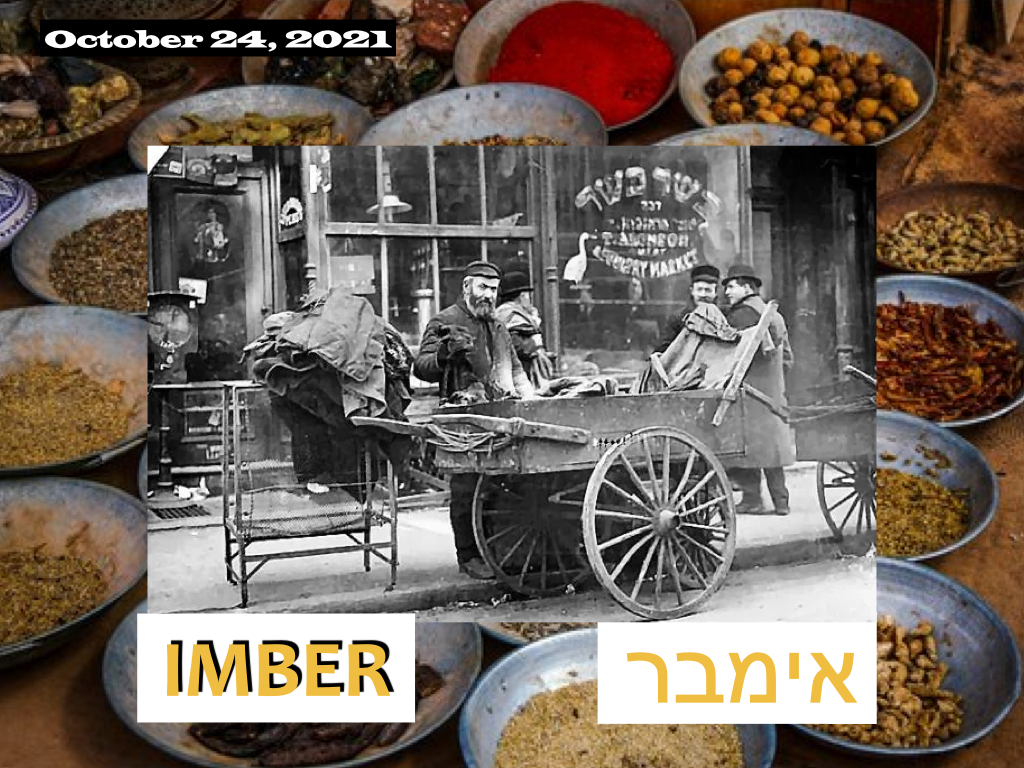
In the past surnames were often tip offs to one’s occupation– Baker, Fisher, Mason, Taylor, Weaver…Willie Shoemaker was a famous jockey but it’s a good bet somewhere along the way a Shoemaker ancestor shoed people and not horses.
As far as I can determine, the name Imber is derived from a Yiddish form of the German word ingwer, which means ginger. My family name originally may have indicated that one was a grower or seller of spices as far back as the late Middle Ages. Ancestry.com claims to have over 10 billion records but my specific family tree’s roots stumped their database. The Jewish villages of Eastern Europe called shtetls weren’t noted for their record keeping.
I did meet and knew of other Imbers in Israel when I lived there in the 1970s. One was an officer in my artillery unit during my time in the army and another was a disc jockey on Israel radio. Both of course claimed to be related to Naftali Herz Imber, the poet who wrote the words of Hatikvah in the 19th century which became modern Israel’s national anthem.
Shamira Imber was at one point suspended from broadcasting because she played a protest song about the Israeli Army’s treatment of Palestinans in Gaza and the West Bank on the eve of the day that Israel commerates the Holocaust. I guess some Imbers have rocked the boat. Others just got on one.
My grandfather, Jonas Imber, fled Europe along with his brother Joseph to avoid conscription and came through Ellis Island in the early years of the 20th century. One of my most prized possessions is the English dictionary he was given by an American Jewish newspaper shortly after his arrival. Its pages have exceeded their lifespan and I dare not open it.
Jonas and Joseph settled in Reading, Pennsylvania after being advised that opportunities awaited them there and within a decade they went from peddlars with a horse and wagon to businessmen with a store and employees.
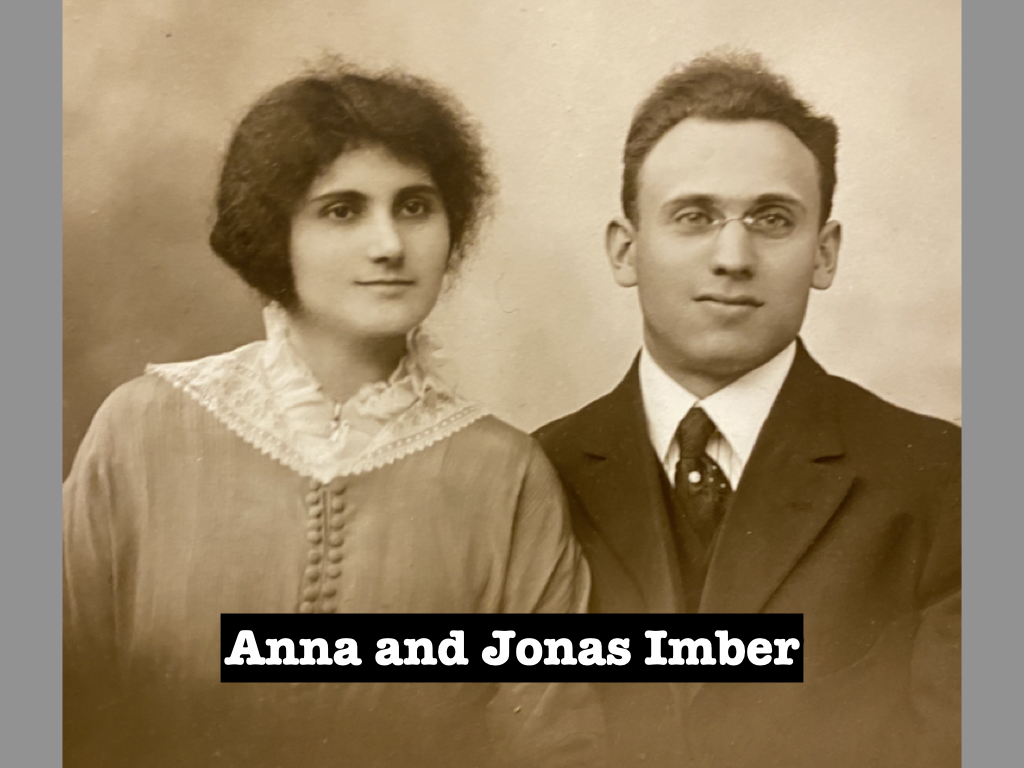
My grandfather Jonas met my grandmother Anna in America and while he learned and spoke the language of his adopted country, Anna, although she comprehended English, hardly ever brought herself to speak it. Like many Jewish immigrants my grandparents spoke Yiddish when they didn’t want their three children to understand what they were talking about, but sometimes the kids could anyway.
Anna was not a great cook. Her chicken soup might have had curative powers, but it could have used a spoonful of sugar to help the medicine go down. My father told me that on occasion Jonas, a kind and patient man, became exasperated by what was offered at the dinner table and would blurt, “Ikh kum heym far dem?” I don’t think I need to translate.
The two Imber brothers built houses side by side on a steep street above the city of Reading. The houses were identical. Up the hill from them was the mansion of William H. Luden, the inventor of the menthol cough drop. The smell from the Luden’s factory downtown is deep in my olfactory memory alongside that of grandmother’s Anna’s chicken soup.

I had never considered why Jonas and Joseph had identical houses until I took Jo to see them and she asked me. My mother had the answer.
“The two women didn’t like each other and didn’t trust one another. They insisted on the same house for each of them because they wanted to make sure neither got a square foot more.”
It was the spring of 1929 when both families moved into their new homes and simultaneously, construction was completed on a luxurious three story department store on Reading’s main street to house the Imber Brothers’ burgeoning business. Six months later in October they lost it and literally everything else except for the two identical houses when they were wiped out financially by the stock market crash.
My father was 12 at the time. He and his older brother and younger sister all managed to go to college and my father went on to get an MBA after paying his first year’s tuition with winnings from a fraternity poker game at Penn State.
When he returned to Reading after landing in Normandy on D-Day plus 1 he went to work for his father and his uncle at the smaller store they had reopened, but soon realized that Jonas and Joseph weren’t about to let him implement any of what he had learned at Harvard Business School. As I’ve seen in my own life– my mother told me to sit up at the table on the occasion of my 50th birthday –you often remain a child in the eyes of your parents.
My father bought in and then bought out the owner of a women’s ready-to-wear store down the street. I liked visiting him there because in the basement was a bowling alley and I’d be given a couple dollars so I could bowl and entertain myself while waiting for him to finish work. The noise from the rolling balls and flying pins was certainly strange accompaniment for the women upstairs trying on dresses and millenary but apparently, not an obstacle to sales.
At one point the business had expanded to three other retail stores plus two outlets in Pennsylvania and New Jersey. My father’s wish was for one of his sons to work with him. I wasn’t interested and neither was my brother. We both moved away and pursued our chosen careers. All the stores have been shuttered since the early 1990s.
There is only one Imber left in Reading. My grandfather’s brother Joseph’s son Harold is still alive. The two identical houses also remain side by side on Eckert Avenue and I assume their current inhabitants have no idea of how that symmetry came to be. Families take their memories with them and leave behind mysteries in their place.

Last night I searched for pictures of the Imber Brothers store on the internet and found something else instead. For sale on eBay was a wood handle for a shopping bag. Imber Bros. was printed on it. The seller believes it’s from the late 1800s. Close, but it isn’t. I remember those handles and believe they were still in use when I was a kid. For $19.99 I bought it.
—————–

Stuff(ing) You Might Not Know About Thanksgiving


The debasement of the human mind caused by a constant flow of advertising is no trivial thing. There is more than one way to conquer a country.
–Raymond Chandler
—————–

Send in the Clowns
Sung by Bernadette PetersAccompanied by Stephen Sondheim
https://www.youtube.com/watch?v=KOZhmsp6iBQ
—————–

The latest COVID variant– Omicron –is the 15th letter in the Greek alphabet. WHO gives COVID variants their names. That’s not a question, it’s the answer! The World Health Organization decides which variants are ones we need to be concerned about. The first one designated Alpha was formally identified in the United Kingdom almost exactly a year ago.
To get to Omicron WHO skipped two letters– Nu since it was believed it would have been confused with the word “new” and Xi, as some have speculated,not to offend China and its president Xi Jinping.
COVID now has the Greek alphabet naming rights all to itself. This past spring the WMO– World Meteorological Organization –decided to stop using Greek letters to identify tropical storms and hurricanes which it fell back on in years when its list of 21 selected proper names was exhausted.
In 2020 nine Greek letters had to be utilized in addition to the regular 21 from WMO’s prepared list that started with Arthur and ended with Wilfred. From September 18 to November 18 last year the Greek names began with Alpha and ended with Iota.
At one point Hurricane Zeta named on October 25thwas followed in rapid succession by Hurricane Eta on October 31st and Tropical Storm Theta on November 10th. Little wonder the Greek names were shelved. Zeta Eta Theta sounded like a fraternity.
So, will COVID with its variants become akin to an annual hurricane season? Here are a couple thoughts…
“We need to get used to the fact that there will be large numbers of variants appearing globally over the coming months and years. Stay calm, we will need to do this again and again in the future.”
–John Bell, professor of medicine at the University of Oxford
“There’s a joke among epidemiologists. If you’ve seen one pandemic, you’ve seen you’ve seen one pandemic one pandemic.”
–Brandon Dean, Los Angeles County Public Health Department
Who’s laughing? The WHO’s not.
Hang in there!
—————–

Without cream cheese what’s a bagel to do?
Under the heading “This is just too rich” was something I stumbled across yesterday. Would you believe that Kraft Heinz, the company that makes Philadelphia Cream Cheese will pay you $20 NOT to make a cheesecake this holiday season?
You may be aware by now that among the multitude of things that have been impacted by supply chain shortages is cream cheese. I first noticed this a couple months ago when there was no Philadelphia Cream Cheese on the shelf at my local supermarket. I was a bit surprised but then again during the pandemic a lot of grocery items have been unavailable at times.
However, when shortly afterward I couldn’t find the whipped variety– my favorite cream cheese –anywhere, I realized that bagels and lox would at least temporarily lack the very mortar that has made the three of them bind together so immortally.
So, what happened? Well, according to an article a couple days ago in The Forward the problem is in the water– specifically, the water in a small town in New York State near the Canadian border. Lowville, NY is apparently low on water because of all the cream cheese making that takes place there. It’s the site of one of the largest cream cheese production facilities in the country and of late 80% of the town’s water has been used to meet an increased demand for cream cheese for use in comfort food at home in the time of COVID-19. In order to have enough water for its residents, Lowville officials recently reduced the amount of water available to the cream cheese factory.
According to the Washington Post spokespersons for both the town and Kraft Heinz have denied that the water reduction explanation is the reason for less cream cheese on the shelves or as neither of them would say but I will, the withholding of the water excuse just doesn’t hold water.
As with everything else that has inconvenienced, outraged or frightened us these days, much blame is now being spread around to explain the present paucity of cream cheese. There have been claims of worker shortages, unvaccinated truck drivers, cyberattacks and one I have to attribute to the author of The Forward article and wish I could take credit for that pointedly accuses New Yorkers of “laying it on too thick.”
New Yorkers do buy a lot of cream cheese but it’s not just for their lox and bagels. Junior’s in New York uses about 140,000 pounds of Philadelphia cream cheese every week for its classic New York cheesecakes and besides providing them to its four restaurants it also supplies 8,000 supermarkets nationwide. Since Junior’s cheesecakes are 85% cream cheese that’s four million pounds of the product required annually. I think for Junior’s output alone there may never be a glut in the demand for cream cheese as long as there are guts in need of cheesecakes.
So, what about the $20 being offered by Kraft Heinz for you not to make one for the holidays yourself? Well, of course there are hoops to jump through but not ones as daunting nor risky as trying to slice a bagel when you’re barely awake on a Sunday morning. First, the $20 is only for the initial 18,000 people who sign up in advance to be eligible. Second, you will have to send in a store or restaurant receipt for a dessert purchased in a market or eatery between December 17 and December 24. And third, you’ll need to reserve your opportunity to get the $20 starting TODAY at noon. Go to SpreadThe Feeling.com to sign up.
I still have a small container of cream cheese in our refrigerator. I’m using it sparingly but my problem isn’t whether it will last into the new year. My lox supply is not an issue either. No, my problem is with the bagels. Where I live there aren’t any to schmear about.
—————–
The Winter Soltice or the Day of the Year that’s Not the Mostest
Today is the shortest day of the year but if the past nearly two years feel to you as if they’ve been short then you must have spent them in a coma. They have not flown by and here we are again wondering when we might ever fly anywhere at all again.
Last year on this date I posted a cartoon that wasn’t a cartoon but instead a photograph I took of a snow covered road beside the ocean here in Maine that I had walked the day before. I also added a parody of the lyrics to September Song. Here it is again…
Oh, it’s a long, long while since March, who cares to remember
We’ll hope for the best from now, this day in December
When being stuck indoors drives us insane
We will endure and bellow Trump’s to blame
As vaccines trickle down to the precious few
His defenders, Mar-a-Lago members
And all these precious days until he’s through
These precious days just let him stew
Well, there isn’t and there still is Trump a year later. His and the Republican wrecking ball is still swinging and smashing American democracy although at the moment the person who is quite literally deserving of the most coal in his Christmas stocking is a Democrat senator from West Virginia.
A year later there is a vaccine available to all in the United States that can help mitigate and even prevent the effects of COVID-19 but the failure– and it’s perhaps the biggest self induced failure of the country in my lifetime –is that so many of us are refusing to get jabbed endangering themselves and others who are elderly and/or immunocompromised like myself. Who takes one for the team anymore?
I realized I haven’t been doing a lot of laughing recently. Humor and pain are not mutually exclusive. My favorite professor in film school had a saying, “Show me a happy comedian and I’ll show you someone on the way down.”
I consider myself happy and I make quite a few jokes. I look at humor as sort of a suit of armor I wear to keep smiling and feeling fortunate on the inside while wincing at what’s all around me on the outside. But I also am aware of how lucky I am with what I have in my life which includes the friendship of many of you and I keep hoping for better tomorrows.
Below are three frames from movies traditionally watched at this time of the year. I’ve taken actual lines from the films and changed them a bit. They may or may not be funny but the very essence of comedy is that it’s more often than not the truth.



—————–

Enjoy! And if you didn’t get what you hoped for today, then may you continue to hope that you will…
Perry Como https://www.youtube.com/watch?v=eHrODQsSGek
Chuck Berry https://www.youtube.com/watch?v=Dafn020Q52k
Peter, Paul and Mary https://www.youtube.com/watch?v=nABowLcQlHc
—————–
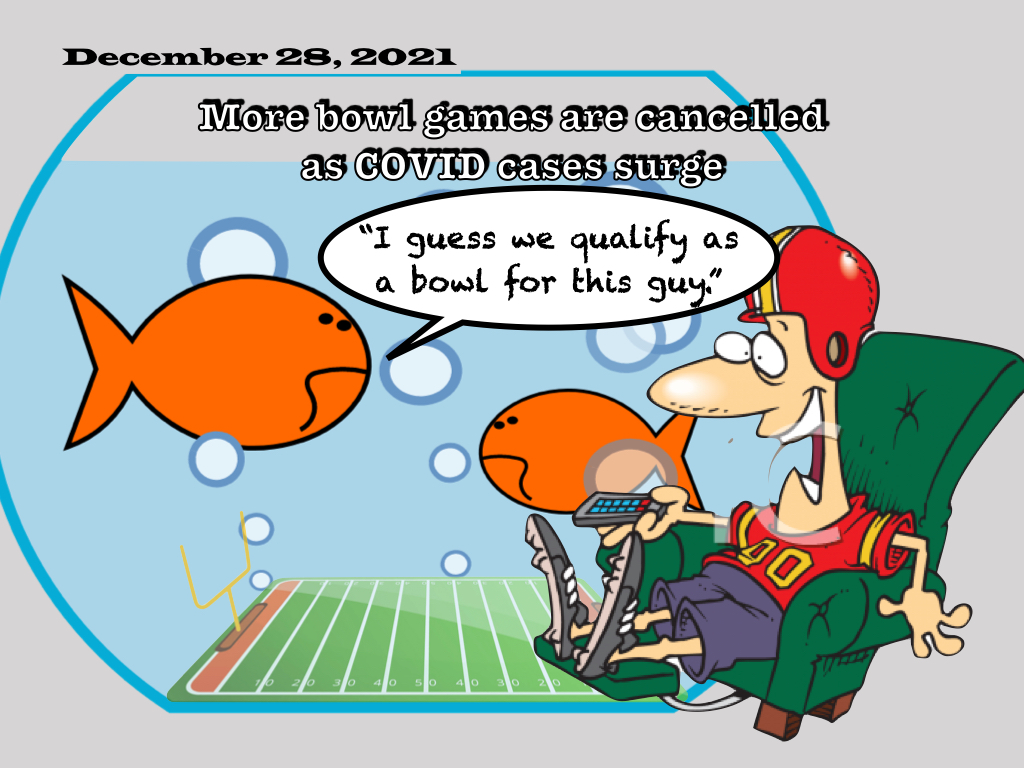
Somewhere in America someone is committed to watching every minute of every college football bowl game that is being played this year. That total originally stood at 43 but at the moment has been reduced by four to 39 due to the latest spike in COVID-19 illness.
Football needs the most players available to compete of any sport. The NCAA requires teams to have a minimum of 85 on their rosters and with a bunch of them now reduced by half that number due to COVID protocols, bowl watching has gotten less exciting for some and less tedious for others.
The height of the bowl barrage actually begins today with six games and that slate is also a prime example of how bloated the post season college football schedule has become. Only six of the 12 teams playing have winning records. However, when it comes to televised sports quantity trumps quality.
The New York Times may claim that it publishes “All the news that’s fit to print” but during my career in television news we might as well have had a different slogan– “All the news that fits between the commercials.” And that’s why we have this year the Lending Tree and the Guaranteed Rate bowls if you’re strapped for cash and the Cheez-it and Duke’s Mayo bowls if you’re snacking in your seat. There’s even the Famous Idaho Potato bowl if that seat is a couch.
Unfortunately, the bowl with my favorite sponsor this year is one of the games that was canceled. It’s the Wasabi Fenway bowl that was to be played in Boston at Fenway Park between Virginia and SMU. I assumed the wasabi part was the Japanese horseradish that comes on a board with your sushi. But no, turns out this Wasabi is a company that stores data in the cloud and has just notified me that I can save 80% on my own cloud storage by going with them.
And I think I just figured out why they call themselves Wasabi. The company claims that they have “changed the cloud storage landscape.” They call their innovation “hot cloud storage.” I wonder if I’m right?
Anyway, I can hear a tune that might have replaced Sweet Caroline if the football game had been played at Fenway…
Buckle down, Wasabi
Buckle down
You can win, Wasabi
If you knuckle down
—————–

Over 40 years ago I spent a year in the desert. It was the same one where Moses had wandered for 40 lugging the two stone tablets inscribed with the Ten Commandments. I don’t know how old Moses was at the time or how he managed to do it but I was in my late twenties and only had to carry a knapsack and an M16 rifle. I had been drafted into the Israeli army and assigned to an artillery battery not too far from the Suez Canal. It was 1974, the year after the Yom Kippur War and the time passed slowly but peacefully.
Why I’m thinking about this experience right now has to do with a radio station in New York City that plays classical music. If you have been a reader of mine, you may be aware by now that if my brain were a car, I’d likely be pulled over for a sobriety test. Moses may have meandered about on foot but my mind bounces around like a Superball– remember those? You threw them down on a hard surface and they ricocheted as high as a three story building. Talk about an amazing product. Try to do that with a Tesla!
So, where was I? Yes, I mentioned WQXR, the classical music radio station I listen to pretty much every day. Each year at this time the station asks its listeners to vote for their favorite pieces of classical music and then plays the top 100 throughout the week between Christmas and New Years. I’ve never voted so I have no right to complain and I’m not, but I have observed that if this countdown were a week earlier, the WQXR hosts could have done their shifts and their Christmas shopping simultaneously.
Mahler’s Symphony No. 3 clocked in at 59 minutes, Orff’s Carmina Burana at an even hour and Schubert’s 9th at an hour and three minutes. And that was just between noon and 5 p.m. yesterday!
Ok, that covers the radio station but if you’re still with me then what about the desert?
So, after my basic training I arrived in the Sinai and at 27 was the oldest soldier in my artillery unit. Why artillery? Simple. I was still learning Hebrew and artillery was the branch of the army where you needed the least. Most days were uneventful although at one point we had a serious rat infestation and I was bitten twice. There are no purple hearts for that, just tetanus shots.
The daily routine also consisted of a nightly routine which was guard duty and unless your shift was first or last you never got to sleep through the night. It was shortly after I had gotten there that I got pranked by a battery mate. I had an early shift that evening and it was time to be relieved. When my replacement arrived he didn’t have his weapon with him.
“Ok if I finish listening to a song on the radio and then come back?” he asked.
I said sure, thinking I was being a mensch (a good guy in Yiddish) and not a “frayer” (a sucker in Hebrew). My gesture of goodwill turned my guard duty that night into a double shift. The reason was an Egyptian singer named Umm Kulthum.
I had never heard of her but when she died less than a year later four million people in Cairo lined the streets to witness her funeral procession. Umm Kultum was the Maria Callas of the Arab world as well as the Beatles, Elvis and the Motown catalog rolled into one. Her songs were events. One of her most popular varied between 45 to 90 minutes in length depending on her mood. I have no idea what she was singing that night and took what I perceived as my indoctrination into my unit like a good sport. What’s an hour and a half if there’s a chance I might get to be like Moses and live to 120? Of course that’s a sucker’s bet, too.
One of the few material things I’ve ever lost that I regret is the ballpoint pen I was given when my year in the desert ended. That ballpoint pen was inscribed “To Avram (my Hebrew name) from Battery Gimmel.”
You might have heard the joke about bar mitzvahs where instead of the bar mitzvah boy claiming “Today I am a man” he blurts “Today I am a fountain pen.” Nobody uses or gives fountain pens anymore as gifts. In fact when I was bar mitzvahed I didn’t get any and could have said “Today I am a thermometer/barometer.”
I got a stack of those. But boy, I wish I still had that pen.
—————–

I used to think that when anthropologists in the distant future uncover relics from our era that they might spend a great deal of time trying to figure out the function of a salad shooter. And when they did they would conclude that we so loved firearms that we even shot our vegetables. But our behavior is even stranger than any device for any purpose that humans have come up with until now.
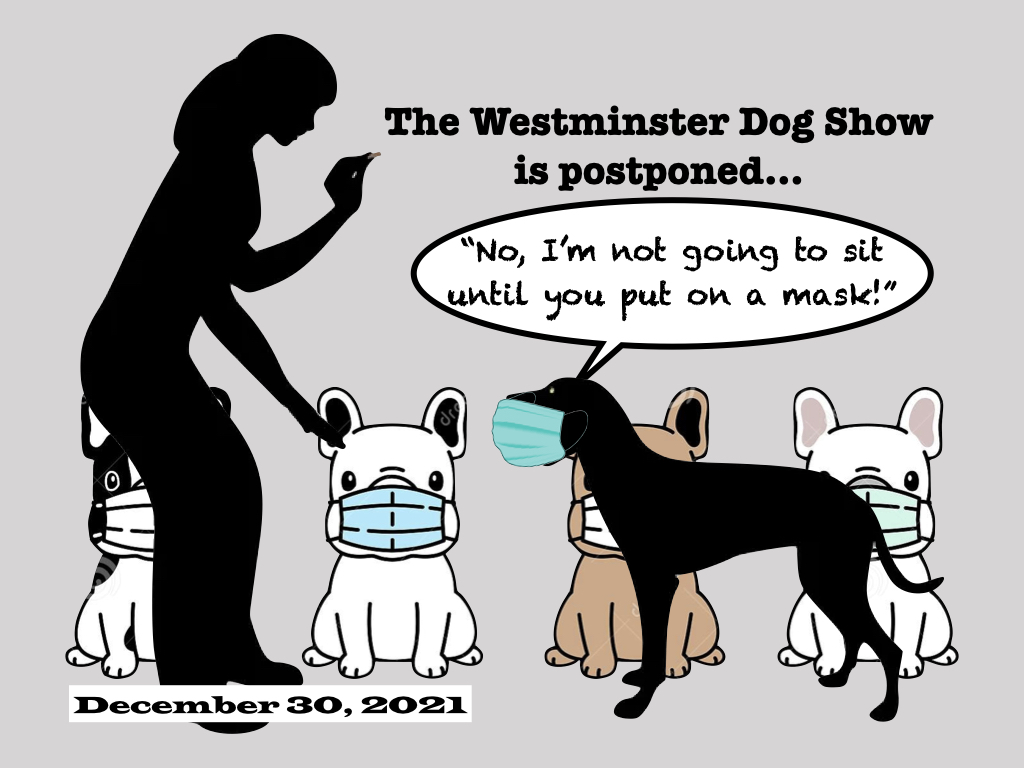
With the current rise in COVID cases in New York the Westminster Dog Show has been postponed until spring. The press release states that it’s out of concern for the safety of all participants. When I read the word “all” I immediately checked to see if dogs can contract COVID and the answer is yes.
There haven’t been many instances of this happening but enough of them for the CDC to have guidelines posted for how to take care of your pet and yourself during the pandemic if this were to happen. It appears the dog owner can transmit the virus to the dog but the dog won’t give it to its owner. Out of an abundance of caution the Westminster Kennel Club has shut down its event for now. Score one possibly for the dogs.
I wrote earlier this week about college football’s bowl schedule being disrupted and a number of games canceled because teams lacked enough healthy players. But tomorrow the really big games are slated to take place and the Cotton and Orange Bowls are sellouts. It’s possible 150,000 fans may show up. It’s huge money for the network carrying the game and big money for the schools participating. You can be sure the athletes on those teams have been virtually locked in their rooms this week when they weren’t practicing.
Yes, it’s true there apparently haven’t been “super spreader” incidents as a result of large crowds attending sporting events up to now. And it’s also true that the more we’re learning about the Omicron variant, the less dangerous contracting it appears to be for all but the unvaccinated, elderly and immunocompromised. But the see-sawing rationales for what’s more safe and less safe stoke no small amount of ever present anxiety and frustration for some of us. I’m confused and I bet you may be too.
You know it’s so confusing I might just need to relieve some stress and get out a salad shooter and blast some cucumbers.
—————–

The Scot Robert Burns wrote the poem in 1788 that was later set to music and became what will be sung around the planet tonight when some clocks still strike midnight but most of today’s digital devices will silently signal the beginning of a new year.
Once the poem became a tune it didn’t take long for musicians of the time to compose their own arrangements for Auld Lang Syne; Joseph Haydn and Ludwig von Beethoven being foremost among them. It was originally sung in Scotland to mark occasions both happy– graduations –and sad– funerals –and other events both large and small such as the election of a new government or the end of an evening’s dancing and even the closing of a store for the day which became customary in Japan.
Of course the song is now mostly associated with New Year’s Eve gatherings and, as you might already be aware, we have a Canadian bandleader to thank for that.
Guy Lombardo grew up in an Italian family in the province of Ontario, a region settled by Scots, and first heard Auld Lang Syne after he and his brothers formed a musical group and performed at church socials. They came to America when they were still teenagers and by 1929 after a successful stint in Chicago they relocated to New York.
The band had become so popular that two radio networks were competing for its services. On New Year’s Eve of that unsettling year– stocks had already lost almost half of their value in October’s crash –Guy Lombardo and His Royal
Canadians started their evening being broadcast on the radio by CBS and signed off just before midnight so they could be switched over to NBC. To cover that gap Lombardo had the band play the tune he had learned at home– Auld Lang Syne.
Thereafter on New Year’s Eve for nearly 50 years until Guy Lombardo’s death in 1977 he led His Royal Canadians in celebrating the end of one year and the dawn of another on both radio and television.
LIFE magazine once wrote that if Lombardo were for some reason not to play Auld Lang Syne, Americans would not believe that a new year had actually arrived and Variety claimed that he was “the only Canadian to ever create an American tradition.”
In the British Library Sound and Moving Image Catalogue there are 935 versions of Auld Lang Syne. Here are a few I have found to represent the range of what’s available. If you only choose one to listen to, I suggest it be the bluegrass…
https://www.youtube.com/watch?v=19-Giy1g8V0
Early recording from 1910
https://www.youtube.com/watch?v=s5DnjPSTuXo
Blues Rock
https://www.youtube.com/watch?v=PT1qsNagugY
Bluegrass
https://www.youtube.com/watch?v=wwCmWPqHGA8
Guy Lombardo and His Royal Canadians in 1939
HAPPY NEW YEAR EVERYBODY!
 pawnedaccordion