
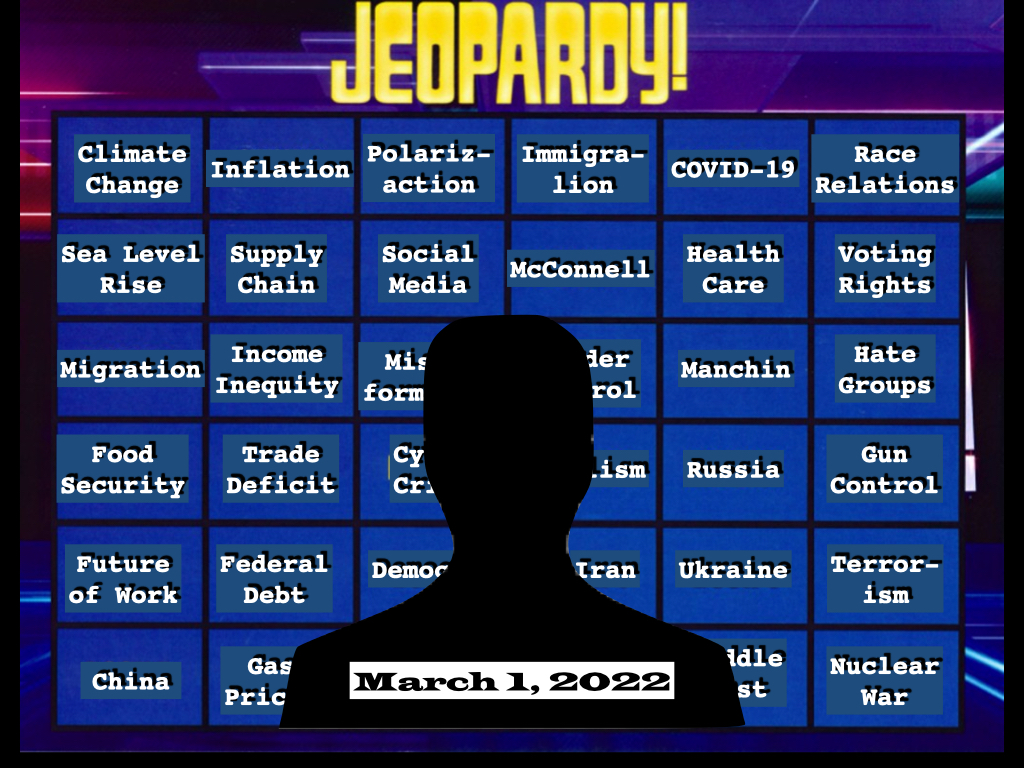
Tonight is the State of the Union Address. Maybe I haven’t been paying attention in the past but it seems to me no president in my lifetime has had more on his plate than Joe Biden does right now.
My effort to write anything about the problems, the obstacles, the crises that the President faces has actually been made easy. Let the picture below be worth however many words I might have written to describe how I see the state of our union today.

Yes, the fence erected around the Capitol after January 6 last year has been reinstalled in advance of Biden’s speech tonight.
—————–

“Meine Ruh ist hin, Mein Herz ist schwer.”
“My peace is gone. My heart is heavy.”
— From Faust by Johann Wolfgang von Goethe
In the 7th grade German was the only foreign language taught by my school district in the Pennsylvania Dutch country. We learned the 23rd Psalm in German. I remember none of it except for “The Lord is my shepherd; I shall not want.” But later there was another German sentence that I was able to interpret when I heard it and it has stuck in my mind for decades. It’s the one I’ve quoted above from Goethe’s play Faust. Until now I had thought it was from a Heinrich Heine poem. We all sometimes make misassumptions.
In the past week it seems as if Aesop’s fable The Boy Who Cried Wolf is playing out grotesquely in reverse. The United States repeatedly warned that Putin would attack Ukraine and yet when it happened it seemed like our country and Europe were surprised and caught off guard. It was as if as much as we had heard about the wolf being at the door, no one actually believed it was until it broke it down.
Goethe’s words are now my lament. My heart is heavy because the free world I believed I live in seems powerless, unable and unwilling to stop the bloodshed in Ukraine. I am discouraged by how tragic the divide is between the Ukrainians’ courage and our caution and dismayed by how our concern for them so outweighs the impact of our actions to deter Russia. Isolation of Putin and his country is comfortless consolation when his and its brutality remains unchecked.
It’s not a fair fight and we are like spectators at a sporting event supporting the underdog. The difference is of course that we are not cheering. We are shocked by each play and dreading the final outcome. We— at least I presume those of you who are reading this —are intensely following and contemplating the repercussions of this catastrophe because, unless you believe in miracles, it has already changed our world. For now and the indefinite future “unser ruh ist hin”— our peace is gone.
But the truth is even without Putin’s invasion of Ukraine there are a multitude of violent conflicts among and within countries around the globe that I am not even conscious of. Let me be the first to admit that I could not identify with certainty any of the flags that appear in my “cartoon” today.
The flags are beautiful and many of the nations they represent are all but unknown to me. What the flags don’t reveal is that they are stained with blood. Obviously, the situation in Ukraine is and will be— as we say in the news business —the lead for a long time. But once I checked this list out…
https://en.wikipedia.org/wiki/List_of_ongoing_armed_conflicts
…it confirmed something I already think I knew.
At a time in the history of humanity when it is exponentially easier to connect the world and be individually connected to it than it was just over a century ago, it seems in other ways we are just as disconnected as we were before Marconi sent the first wireless transmission across an ocean in 1901. Admittedly, this does work both ways. Ukrainians are using their smartphones to communicate with each other to hopefully sustain their fight and morale.
We are focused on the war between Russia and Ukraine like we never were on our involvement in Afghanistan where there were 78,000 deaths in 2021. That conflict was out of sight and therefore out of mind. There were seldom stories on the evening news let alone live shots from the scene until America ineptly abandoned its mission there last summer.
It’s human nature that what doesn’t affect us very often hardly interests us. And maybe we are overwhelmed by how little capacity we have to absorb all that happens elsewhere which on any day we have access to learn. How many reports do we read in our online news digests about what’s going on in Myanmar or Yemen or Syria or Rwanda? My fear is that in time we may be just as uninterested in and unaware of the fate of Ukraine.
Franz Schubert was 17 years-old when he put Goethe’s words to music. I think his piece conveys the sorrow and disillusion of the character in Faust it was composed for. Listening to it now and despite its musical beauty, I just feel horror.
“Gretchen am Spinnrade“ (Gretchen at the Spinning Wheel)
—————–
In 1969 I spent a day in Germany that I have suppressed. Dachau was the first concentration camp opened by the Nazis a month after Hitler became the chancellor of the Third Reich in 1933. Although thousands died in Dachau of disease, malnutrition and suicide none did in its gas chamber. The one built there was never used. Those who were to be gassed were sent elsewhere. Dachau was where the SS trained to run the extermination camps.
I was surprised later to discover that of the hundreds of photographs I took on my travels in Europe that summer I took none during my visit to Dachau that morning. And perhaps even more surprising, I have no recollection of what I saw there.
Dachau is a short distance from where I was staying in Munich and that same evening I went to see a play esentially, about the very Jews the Nazis and their collaborators murdered– Fiddler on the Roof performed in German. At the end of the show there was sustained applause from the large audience. I remember little else.
As a Jew, to have had those two experiences on the same day and recollect very little of either of them might be easily interpreted by a psychiatrist but that’s not something I need to spend the time or the money to learn. In fact I think it more valuable that my clouded recalling of that day has provoked other questions. Were these the same Germans who committed modern history’s greatest genocide just a quarter of a century earlier? And just how long is a country’s or the world’s memory?
Today Americans travel to Germany without fear or bitterness. Books about World War II and the Holocaust are still being written, movies about the war are still being made but I realize that when I was growing up, just a decade after World War II had ended, it might as well have been the Civil War. WWII was ancient history to me. My father landed on the beach in Normandy on D-Day Plus 1 but I never talked with him about it. I never got the details. I never asked to share his memory.
In 2014 Jo and I visited Japan. At one point we needed to find an ATM to withdraw money and didn’t know where the nearest post office or 7-Eleven was located. Post office ATMs and those in Japan’s 7-Elevens– Japan has way more 7-Elevens than anywhere else in the world –were the only places we could use our credit cards to get cash.
Despite the language barrier we were able to make clear to a woman in a small shop what we were trying to accomplish. She motioned for us to follow her and accompanied us all the way to a post office blocks away. She hadn’t bothered to lock up her store and smiled broadly at us as she turned around to head back to it. Nearly 70 years before America had dropped two atom bombs on her country.
I guess the world moves on and that’s a good thing because otherwise existence would become unbearable. Of course an intractable conflict like that between Israelis and Palestinians provides little supporting evidence.
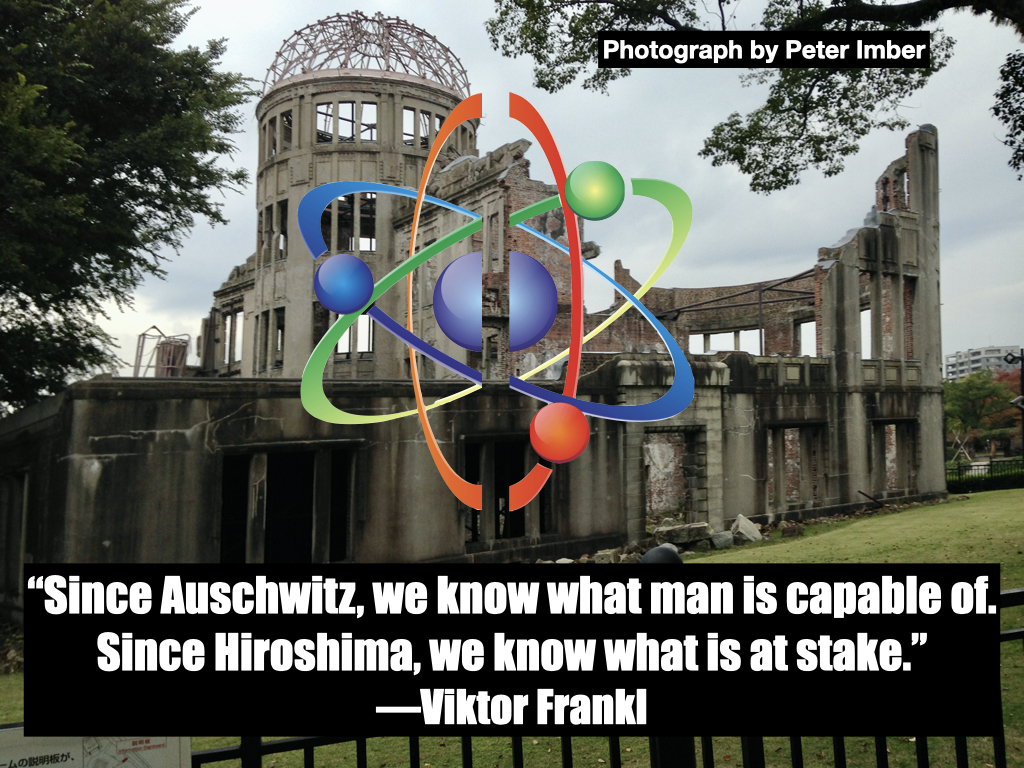
We traveled throughout Japan– Tokyo, Kyoto, Osaka. I hadn’t prepared for Hiroshima. What’s left of the building in the picture at the top of this post was located near the epicenter of where the atomic bomb fell and is one of the few structures that were not completely obliterated by the blast. It’s believed that 66,000 people were killed almost instantly in Hiroshima on August 6, 1945. Three days later 39,000 more were killed when a second bomb was dropped on Nagasaki.
Near the domed ruin I photographed, Jo and I listened to an old man playing an upright piano. A piano tuner in Hiroshima about my age has restored six pianos that survived the bombing. He does the minimum amount of repair so that they may be played but also recognized as damaged.
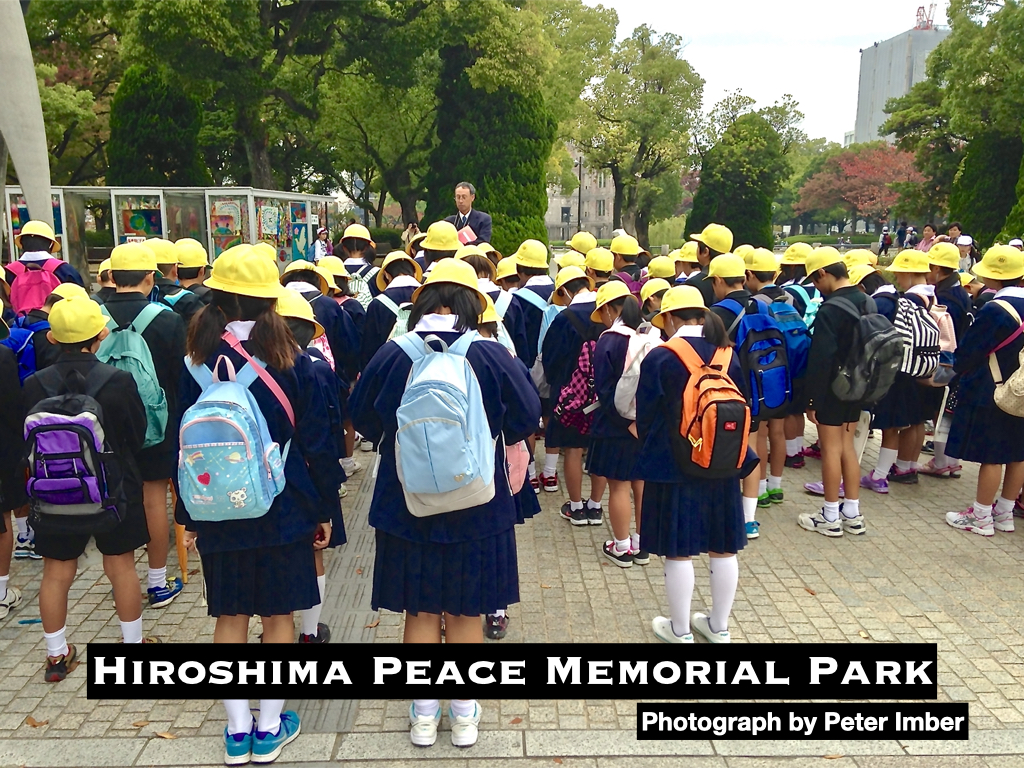
I don’t know if the old man was using one of them but it was old and beat up. As we listened, a Japanese woman approached us with a petition calling for the elimination of nuclear weapons. After we signed we saw what I presume was a school field trip and I wish I had known what was being said to students at the moment I took the picture below…
We entered the Hiroshima Peace Memorial Museum and when memory is not possible, then maybe emotion takes its place. A kid’s tricycle was what brought me to tears. Rusted and disintegrating but obviously more haunting than the burnt out cars I would come upon when I covered wildfires in the West for ABC News, it was given to the museum 40 years after the war.
I’ve pasted a link below to a video that I recommend you watch to learn more about it and especially what purpose it may serve…
Soon all those who survived the Holocaust or the nuclear carnage in Hiroshima and Nagasaki will be dead. The world’s memory of these events will be entombed in books, or uploaded to the “digisphere” to be read or streamed. But even now for those of us who weren’t alive during those catastrophes or personally affected by the survivors we knew afterward, memory may have stopped running beside us and have become frozen in the distance behind us. I wonder if without it, without the experience of it, we are at all prepared for another global tragedy?
——————

For a while cell phones threw things into reverse for a lot of men. Remember when “My phone’s smaller than yours” was a thing? Ok, maybe you don’t but it was perhaps the first time in history men bragged about… Hmmm, let me put it this way. The first cell phones were as big as WWII walkie talkies and when they eventually became smaller than a banana and pocket size I think even Mae West would have been impressed.
That’s sure not how it is with yachts. Ever heard of the Azzam? It’s 590 feet long– the largest private yacht in the world and owned by the Emir of Abu Dhabi. The longest home run ever hit by a major league baseball player traveled 582 feet. And if you need another sports analogy, the Azzam is the length of two football fields.
In second place is the Eclipse which cost a billion dollars to build and is shorter than the Azzam by about the length of a bowling alley but that’s the least of its owner’s concerns these days. Roman Abramaovich is one of seven Russian individuals whose assets were frozen two days ago by the UK and in Abramovich’s case that includes his ownership of England’s Chelsea football club which he was already trying to sell.
Turns out there are a slew of websites that track the positions of the world’s mega yachts and at the moment Abramovich’s is sailing in the Caribbean to parts unknown. Over a dozen yachts owned by so-called Russian oligarchs have already been moved to remote ports that at present do not have sanctions that could allow for their seizure. A bunch of them have relocated to the UAE and the Maldives.
And here is the most interesting yacht repositioning of all of them. A yacht reportedly believed to belong to Vladimir Putin was moved from a German repair yard to a Russian port two weeks before the invasion of Ukraine began. Jo and I have been watching old episodes of Madam Secretary recently and I bet Tea Leoni would have picked up on that particular yacht’s relocation and maybe American intelligence actually did too.
So, we know what Russian oligarchs are– those who have benefited enormously and gained a modicum of power and great wealth through their connections to Putin –but why are they called oligarchs?
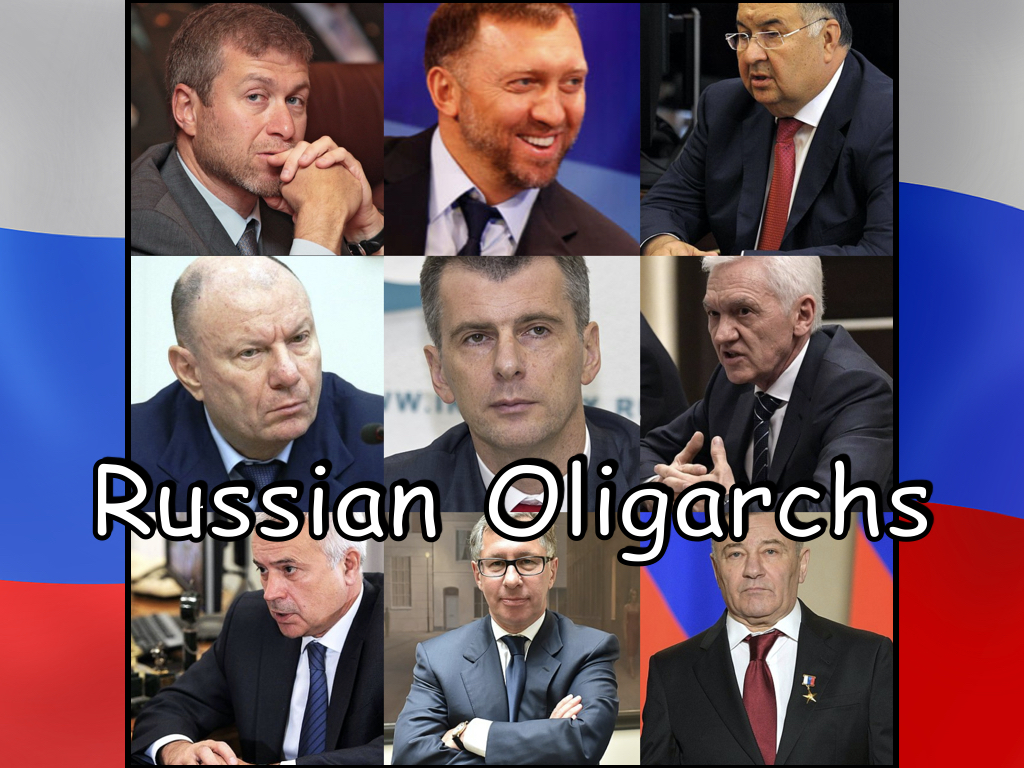
The word Oligarch is from the Greek and oligarchy is a term that was used by Aristotle over 2,000 years ago to describe rule by the rich. Today a more commonly used word to describe that arrangement is plutocracy. The more I have tried to discern the difference between the two, the more blurred any clear distinction appears to be of one from the other.
But I have come across another concept that seems significant although discouraging. In the early 20th century sociologist Robert Michels developed the theory known as the “Iron Law of Oligarchy” which claims that all large organizations, including democracies, tend to turn into oligarchies.
Michels contended that the necessary division of labor in large companies and governments leads to the establishment of a ruling class mostly concerned with protecting their own power which can reasonably be presumed to include their wealth.Michels held that the goal of representative democracy to eliminate elites was not possible, and that representative democracy actually serves to legitimize the rule of a particular elite and that elite inevitably becomes an oligarchy.
Russia has its oligarchs but is it an oligarchy? Well I guess so, if said oligarchy can also be an elite beholden and subservient to one person for its members’ rights and privileges with the condition that disloyalty to or the whim of that one person can cancel their oligarch status in a heartbeat. When it comes to Russia’s oligarchs Putin has been like a dog obedience trainer. He hasn’t eliminated the group and they can still remain useful to him, but only of course if they’re housebroken.
Will the Russian oligarchs, if they see their fortunes evaporate, turn against Vladimir Putin? I wouldn’t count on it. Russia today isn’t an oligarchy or a plutocracy. It’s a “Putinocracy.” Pundits, who we consider experts and humble observers like myself who are not, speculate continually these days on Putin’s motivations and his sanity but one thing we can agree on is that he is a ruthless and evil man.
I think it’s not been possible to call Russia an oligarchy for some time. Vladimir Putin has now been president or prime minister of his country for 22 years and has done so by being even something more. Putin is someone that Aristotle and Plato both wrote about– a tyrant –one they defined who ruled without law and by fear, using whatever cruel methods it took to stay in power against both his own people and others.
The sad evidence of the ancient Greeks’ assessment is part of our news cycle right now 24/7. I’ll be stunned if Putin’s attempt to subjugate Ukraine will be stopped before massive human carnage and immense material damage in that country. I’m already pessimistic about whether the free world will be able and willing to respond to any further Russian aggression if we don’t succeed in doing so now.
Sanctions may have closed Russia’s McDonald’s and sent the oligarchs’ mega yachts scurrying to Dubai for safe haven but the contrast of that with the millions of refugees fleeing Ukraine and crossing the border into Poland with a suitcase and a backpack has made me realize that I paid too little attention to Putin when he was destroying Chechnya and Syria.
Suddenly, the world faces the most challenges it ever has in my lifetime. So far we don’t seem to be doing very well.
—————–
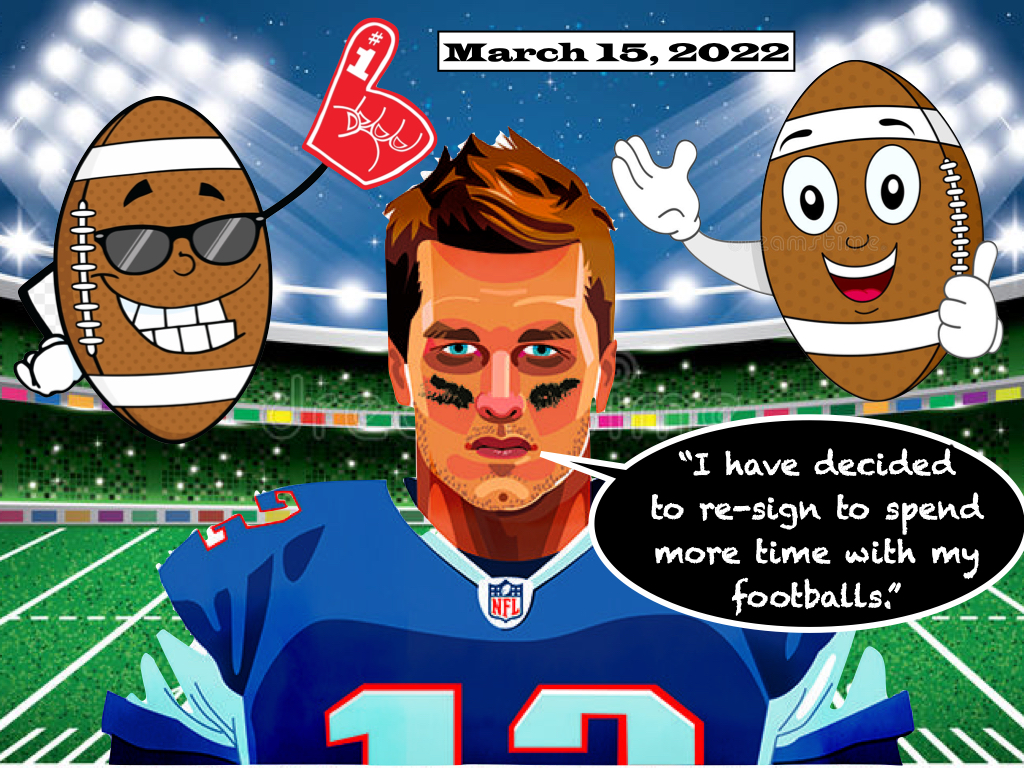
“Well that didn’t take long,” said my wife Sunday. Jo really dislikes football but even she was aware that Tom Brady had announced that he was no longer part of the “Great Resignation.”
Just a little over a month ago, Brady, acknowledged as the greatest quarterback in the history of professional football and holding records in almost every QB category, had announced his retirement at age 44. That’s awfully old to be playing a contact sport and especially football but another NFL player named George Blanda kept suiting up until he was 48. Maybe Brady now wants to break that record too.
To his credit, in his retirement announcement, Tom Brady didn’t use any of the cliches about wanting to spend more time with his family or pursue other interests or opportunities. He was actually candid about the possibility he might change his mind..
“What my days will look like will be a work-in-progress… I am going to take it day by day.”
Brady’s not an exception. Other athletes have said goodbye and then hello again. Another pro quarterback named Brett Farve even did it several times. Michael Jordan took a sabbatical of sorts and found it a lot harder to hit a baseball than a jump shot and then returned to the basketball court to win three more NBA championships.
I usually take the sign “Closing Forever” on a storefront about as seriously as the words “Farewell Tour.” Am I too cynical? Those concert tickets you saved from Barbra Streisand’s or Garth Brooks’ supposedly last concerts in 2000? I rest my case.
But back to retirements and resignations. Politicians probably are at the top of the list for being the most disingenuous when leaving their jobs but fired executives are right behind them. Resigning their positions often comes about because of a scandal that they hope to cover up or a firing that was humiliating. But when either trot out the “spend more time with the family” excuse after decades of receiving entitlements in office or careers as a workaholic at their companies, it’s pretty certain that it’s breaking news to those at home.
Some people do quit with blunt honesty. Take for example Campbell Brown when she left CNN after her news show was cancelled…
“I could have said I am stepping down to spend more time with my children –which I truly want to do. Or that I am leaving to pursue other opportunities –which I also truly want to do –but the simple fact is that not enough people want to watch my program.”
Or they leave us with a chuckle as did an executive named Andrew Mason…
“After four and a half intense and wonderful years as CEO of Groupon, I’ve decided that I’d like to spend more time with my family. Just kidding — I was fired today. If you’re wondering why… you haven’t been paying attention.”
And others discover they simply have been working at the wrong task…
“As long as I live under the capitalistic system, I expect to have my life influenced by the demands of moneyed people. But I will be damned if I propose to be at the beck and call of every itinerant scoundrel who has two cents to invest in a postage stamp. This, sir, is my resignation.”
That one was a letter written in 1924 by a postmaster in Mississippi named William Faulkner.
I didn’t have to write a letter to resign or hold a press conference. I retired after I received a buyout offer of the remainder of my contract when ABC News reduced the unit’s size by 25% in 2010. The buyout was a gift since I had already decided I had had enough while standing soaking wet one night in a gale on a beach near Santa Barbara.
I was 63 when I realized that covering the news for television at times was a contact sport that I was too old to play anymore. Obviously, Tom Brady hasn’t yet seen the light at the end of the huddle. Good for him!
—————–

It’s St. Patrick’s and it’s my birthday. Yes, green is my favorite color and the color has followed me and I’ve followed it for much of my life– I went to a college whose sports teams are called The Big Green and I’ve rooted for the Boston Celtics since I was a teenager.
I think the only thing I have in common with St. Patrick is a problem with one of my knees. According to something I just read, Patrick had arthritis. But despite our coinciding birthdays there’s a story about why I am a Peter today despite some leaning on my parents to have had me be a Patrick. Even though I likely was present in the room when this happened I cannot be considered a credible witness.
My parents lived in Hartford where they had met before WWII and I was born there. It was March 17, 1947 and I was not nearly the only boy who came into the world at a hospital named St. Francis that day. That itself was no surprise at the beginning of the post war Baby Boom but in a Cathlolic hospital there was sort of a dilemma. All the other boys born that day were like me. We were all Jewish.
I guess it was a tradition at St. Francis that a baby boy– at least one –be named Partrick on St. Patrick’s Day but to my knowledge I’ve never met a Jewish male named Patrick and my parents and the other baby boys’ parents apparently hadn’t either. So, there was some lobbying taking place to break with one tradition to prolong another. No one would budge to fulfill the request. It got down to crunch time and as my mother put it…
“We told the nuns Peter was as far as we were willing to go.”
My parents didn’t go full Irish that day but they didn’t go full Issiah either. Today I am 75 and I am grateful and I am Peter.
I have probably told some of you how I view life as like the quarters of a basketball game– with a shout out to Villanova, my favorite college team as March Madness gets underway.
I have divided life into 20 year increments. At the end of the first quarter I was 20 and in college and thought I didn’t have a clue what I wanted to do when I got out. As it happens I was doing what I’m doing right now– writing and trying to be observant (God knows not religiously) and creative. As an editor on my college newspaper I had a column and I spent more time at that than on my classwork.
After I graduated and began the second quarter of life I left a job in television news in New York, went to Israel, got married, did the army and after being handed an opportunity to make videos, applied to film school and returned to America. By halftime when I was 40 I had a good job that would take me through to retirement, a nice house and time to golf once a week.
My career at ABC News was part of my entire third quarter, as was raising my son who in the past year became my daughter and it also became the end of my first marriage. By the start of the fourth quarter in 2007 I was old enough to be the parent of many of those who I was working with, I was living in a small apartment with someone who I still love as totally today as I did then and who is the luckiest single thing that has happened to me in my life.
So, 75 has me now closing in on the end of the final quarter here in Maine and worried about the world’s future much more than about my own. I’m hoping to stay out on the court into overtime and actually, I have something going for me to help possibly make it happen.
Jo, if I haven’t mentioned it already, is not a sports fan but she has a very uncanny ability to impact the outcome of almost any game or match I might be watching.
Jo: “When is this over?”
It can be a basketball or a baseball game or even a golf tournament.
Peter: “There’re just a couple _______ (select minutes, innings or holes) left.”
Invariably, there’s a tie and subsequent overtime, extra innings or a playoff.
I think if I were a betting person, I could leverage this into a trip overseas or at least a new set of golf clubs… But you know what? I’ve already hit the jackpot. I’m happy with things just the way they are. 75 feels real good.
—————–

I have no words.
—————–

War and death are on my mind. That’s not a “spoiler alert” these days.
Climate change and the pandemic are bad enough to be worrying about and we’re all vulnerable to the consequences of both of them, but the tragedy in Ukraine is different. I feel helpless.
Unlike global warming and the pandemic, the war could stop instantly. The rise of the seas and the spread of the virus won’t but neither of them have an unambiguous hero and villain who are occupying center stage and embodying the outcomes. This war does.
The simplicity of that fact and the roles being played by Zelinsky and Putin might make for compelling fiction, but the suffering and destruction are too horrible to be a backdrop for a novel or the scenery on a stage or screen. Maybe in the future metaverse war will become a bloodless game but as long as we still have reality it isn’t.
Events in Ukraine have led me to think about how frequent there has been war during my lifetime— war that I was shielded from when it was reported in newspapers, war that I can now see and hear and yet still be shielded from as it actually takes place on television and the internet.
For those who are combatants or refugees the memories of war are never forgotten. For those who are its victims, many of them leave only their memory to those who knew them. Some time ago I discovered two men who left more. The two were composers who died as soldiers in World War I.
Rarely does a piece of music stir me immediately. The lament movement in From the Scottish Highlandsdidwhen I first heard it played. The story of the composer that I learned afterward made it more extraordinary. He was a Scotsman named Cecil Coles. Look carefully at today’s “cartoon” and you’ll see that the cover page of a score he wrote is bloodstained.
Coles sent that draft of his work from the Western Front in France in late 1917 to his mentor Gustav Holst. You might know of Holst and his orchestral suite The Planets. A few months later in 1918 Sergeant Cecil Coles was killed by sniper fire while attempting to rescue casualties. He was 29.
Coles’ Wikipedia page is as incomplete as his life was. He and his music remained all but unknown until 2002 when the album Music from Behind the Lines was initially released. Until then, not only were there no recordings of Coles’ music, there was almost none to record.
His daughter, who knew very little about her father, began researching him late in her own life and discovered a cardboard box at a school in England that contained virtually all of his compositions.
I bought the album CD years ago and over the weekend found that its music, which I had imported to my iTunes library, had gone missing from it. Fortunately, I still have the CD and I have listened to it again. As if I needed the reminder, I know that all the things I have entrusted to be preserved in hard drives, servers and clouds are likely as ephemeral as life itself.
There is another English composer who was killed in World War I, and his story is just as tragic as Cecil Coles’. George Butterworth was a close friend of Ralph Vaughn Williams, a central figure in English music in the early part of the 20th century, and Butterworth himself had already been recognized as a promising talent when he joined the British Army at the outbreak of the war.
Lieutenant Butterworth was wounded in the Battle of the Somme and awarded the Military Cross in July of 1916. He never received it. A month later he was shot through the head at the age of 31. His brigade commander only learned upon his death that Butterworth had been a composer and wrote to his family that, “He was a brilliant musician in times of peace and an equally brilliant soldier in times of stress.”
The ironic part of this story is my mistaken impression of a piece of George Butterworth’s when I had listened to it for the first time. Butterworth composed a song cycle for a series of poems by A.E. Housman known together as The Shropshire Lad. Among themwasone that’s a conversation between a dead man and his living friend. Housman had written the poem titled Is my team ploughing in 1896. Butterworth composed the music for it to be sung to in 1911.
Despite all evidence to the contrary, I assumed the two young men in Is my team ploughing were one who had died in the war and the other who had not. Perhaps both Housman and Butterworth were prescient but it is a chilling coincidence that this is one of Butterworth’s works that he left us.
I’ve never fought in a war but I have been terribly close to one– the 1973 Yom Kippur War. Five men on the kibbutz in Israel where I lived at that time were killed. I knew them all, their wives and children, their parents and friends.
War may not always be pointless but it is never victimless and humanity has not reached the end of fighting war or counting up its victims. Our species has had many achievements and successes. We have invented and created great things. We have cured and eradicated diseases that once shortened lives. We have not come close to figuring out how to eliminate the hate and evil that still causes lives to be ended by wars.
I haven’t been able to upload the Coles’ piece From the Scottish Highlands from my CD to YouTube but I have found another one in its place. Below are links to short pieces by Cecil Coles and George Butterworth…
Verlaine Song No. 1/ From Four Verlaine Songs, Music by Cecil Coles
Is my team ploughing/ a Poem by A.E. Housman, Music by George Butterworth
Is my team ploughing?
by A.E. Housman
“Is my team ploughing,
That I was used to drive
And hear the harness jingle
When I was man alive?”
Ay, the horses trample,
The harness jingles now;
No change though you lie under
The land you used to plough.
“Is my girl happy,
That I thought hard to leave,
And has she tired of weeping
As she lies down at eve?”
Ay, she lies down lightly,
She lies not down to weep:
Your girl is well contented.
Be still, my lad, and sleep.
“Is my friend hearty,
Now I am thin and pine,
And has he found to sleep in
A better bed than mine?”
Yes, lad, I lie easy,
I lie as lads would choose;
I cheer a dead man’s sweetheart,
Never ask me whose.
from A Shropshire Lad
—————–
Jo has told me that my “office” in our house looks a lot like the office I had when I was working for ABC News. She’s right.
On either side of my desk where I’m seated are the two bulletin boards tacked full of memories that I had on my wall in Los Angeles. On one, among the overlapping things devoted to my work experiences, there’s an O.J. Simpson criminal trial parking pass and next it a note from Mike Wallace who voiced a script I wrote for a documentary about a South African judge who challenged and helped undermine aparthteid. In one corner is a yellow pin shaped like a hand with a raised index finger and outstretched thumb which I brought back from the People Power Revolution in the Philippines in 1986.
The other bulletin board is full of personal stuff. There’s a receipt from an Italian eating club in Pennsylvania called the Saint Marco Society that allowed me to inherit my parents’ membership after they died and a ticket from a performance by the late Ricky Jay, the amazing sleight of hand magician. On the upper left is the scorecard from the lowest round of golf I have ever shot that’s signed by Ely Callaway whose company’s clubs I used to do it. Every item on both boards has a story. I collect stories.
Jo has pointed out that I’m more or less up here still doing what I used to do for a living– looking for more stories. Again, she’s right.
Sometimes the spark for a story or these days a “cartoon” just comes out of nowhere. This time I don’t even remember where the nowhere came from, but despite the horror and carnage of the war in Ukraine that deserve all the coverage they are receiving, here’s a story within the story that I think has a context worthy of being reported and I expect eventually might be.
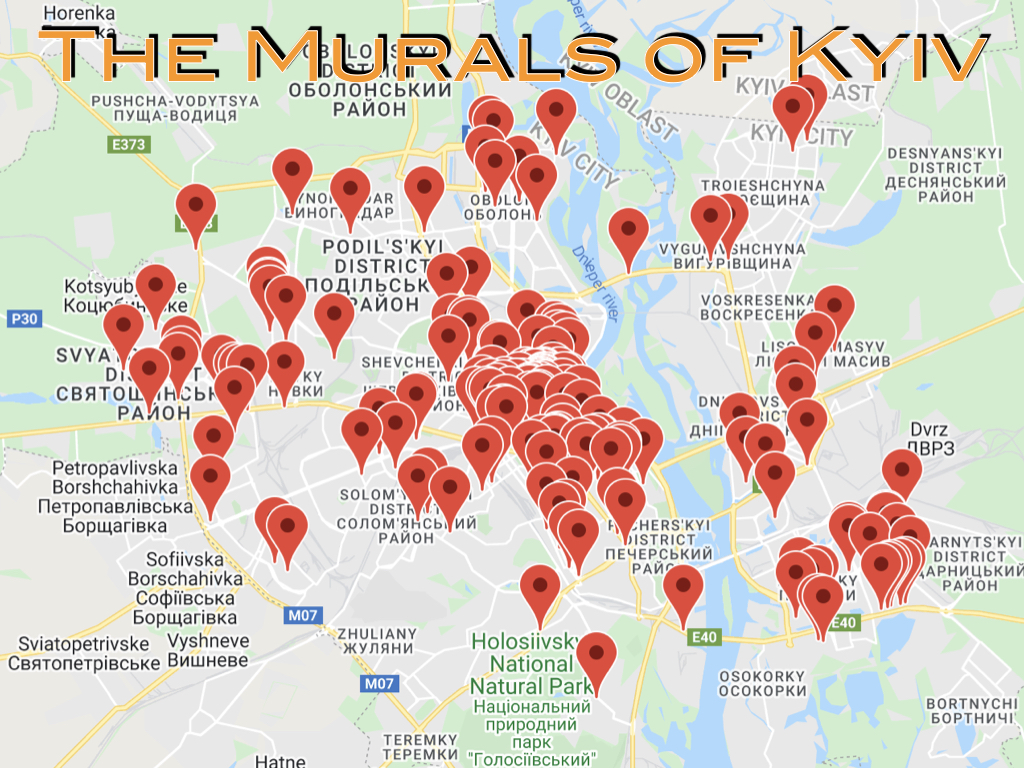
Across the city of Kyiv are approximately 170 murals that have been created since 2014. Many were done by artists from around the world as well as Ukrainians. None were funded by the government. When it comes to most geopolitics I have a short memory if I have any at all, and I needed to read up on what is now called the Maidan Uprising which began in Ukraine in late 2013 and resulted in a change of government after considerable bloodshed a few months later.
If the war raging in Ukraine now is the movie, the Maidan Uprising was the movie preview. In 2013 Ukraine was about to sign an agreement bringing it closer politically and economically to the European Union when at the last minute the country’s president– Viktor Yanukovych –bowed to Russian pressure and backed out.
By February of 2014 protests over Yankukovich’s capitulation to Vladimir Putin’s threats had turned violent and dozens were killed and hundreds more were wounded when government forces attempted to clear Kyiv’s central square known as the Maidan and quash other demonstrations taking place around the country.
Despite the casualties the will of the Ukrainian people to rule themselves and continue on their trajectory toward the West was not halted. Yanukovych’s authority crumbled quickly and a few weeks later he fled to avoid impeachment. He currently lives in exile in Russia.
Of course there is more to this snapshot of events and perhaps it’s more accurate to compare Russia’s present war on Ukraine to a movie sequel. Ostensibly, fighting has been going on in that region for eight years. A month after Yanukovych’s departure in 2014 Russia invaded and annexed Crimea which had been part of Ukraine. Peace has not been a feature of life in Ukraine for a long time.
The proliferation of art on the walls of buildings in Kyiv that began after Maidan and Crimea was in response to those turbulent events and the murals represent and express many different things– Ukrainian history and folklore, tributes to those who have given their lives in Ukraine’s quest to keep its freedom, but the theme of many of these works is simple. It’s an aspiration for what’s been so far so illusory– a desire for peace.
I’ve taken liberties with the murals I’ve pasted below. I’ve cut them out using Apple’s Keynote software application and surrounded them with images of the current war’s physical damage and human despair.
I have no idea how many or if any of the murals have been hit by artillery or rockets at this point. While millions have fled and many more millions have remained and are huddled in shelters, the murals of course have no protection. As such they share the fate of Ukrainians who are vulnerable. However, there is one significant difference. The murals are defenseless, the brave Ukrainian people who are fighting have shown the world that they are not.

The Rebirth by Alexy Kislov and Jullien Mallan
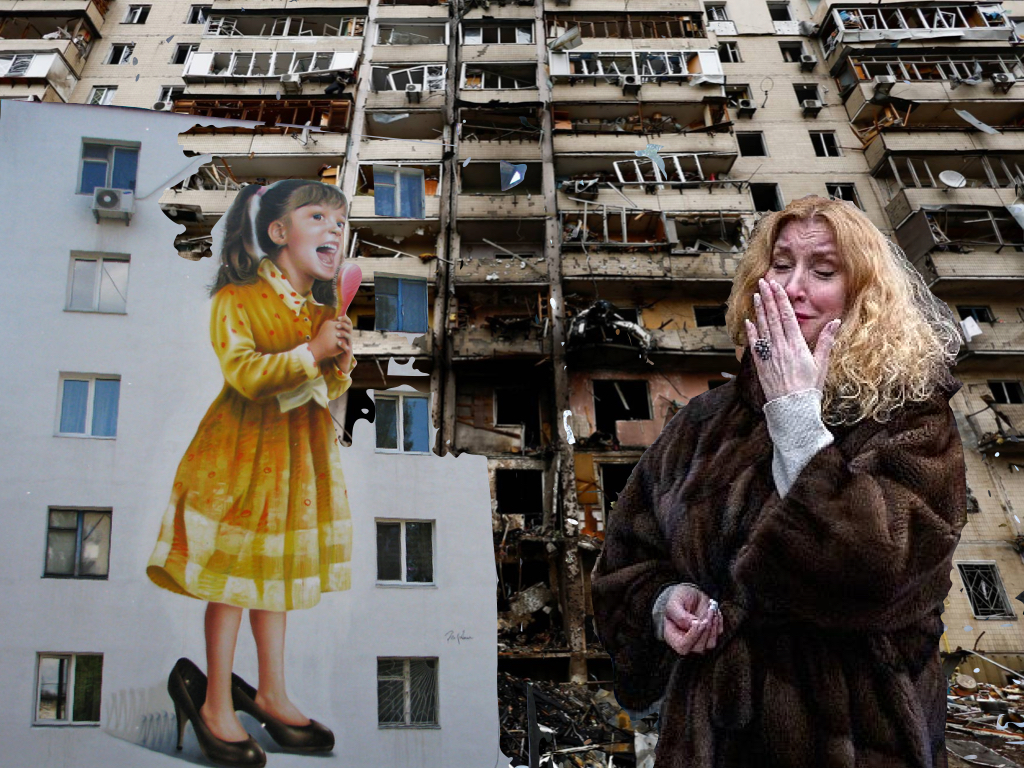
Singing Girl by Sasha Korban

Rise Up in the Dirt by BKFoxx
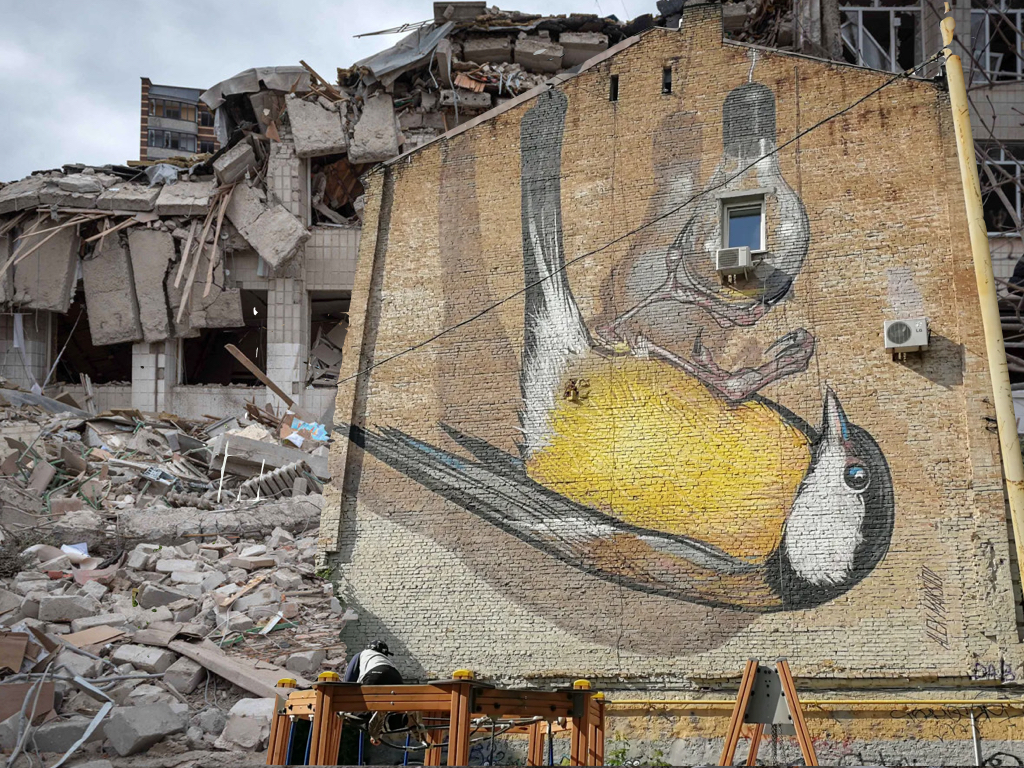
Freedom by Alex Maxiov

The Rebuild by Finton Magee
—————–

If I say the name Oscar, what do you think of first? Any of the guys pictured here? I doubt it but they’re all Oscars and whoever can supply their full names must like to forage on the internet for arcane stuff like me. I’m sure someone will get right on it… Deborah, Barbara? I used to post these kinds of puzzles on Facebook and those two women were champs at solving them.
The story goes that the Oscar on millions of minds tonight got its nickname from someone who remarked that she thought the statuette looked like her uncle. I didn’t know until I looked this up that the first Academy Awards ceremony was held in 1929. It wasn’t on radio and there wasn’t yet television and here’s the most amazing fact– it lasted 15 minutes!
At that first “Oscars” the statue handed out hadn’t been given a name. That only happened about a decade later and another surprising feature of that first Academy Awards that had also changed by then was that the winners didn’t know they had won an Oscar until their names were called. At that first ceremony the winners had already been announced three months earlier. Talk about giving away the ending! Maybe that explains why in 1929 the whole deal only took 15 minutes.
I haven’t watched an Academy Awards telecast in years. I haven’t seen but a few of the movies nominated for best picture this year but once I had a lot of fun at Oscar time. At ABC News I would find a story to do about a nominated film, someone connected with it or just something that I wanted to know and it would be broadcast on the evening of the Oscars.
I got to walk around inside the actual Spruce Goose, Howard Hughes’ wooden airplane that was the main inanimate character of The Aviator. The original plane is in a museum in Oregon and in the fuselage there are still pieces of beach balls that had filled it when Hughes piloted its only flight in 1947 for all of 30 seconds. Hughes was afraid his gooses would be cooked and he and it would sink when they hit the water. The inflated beach balls were intended to keep them both afloat.
After I saw the movie Brokeback Mountain I went looking for the real one. A rancher in Wyoming claimed it was to be seen from out his window. Although he told us we were looking right at, it we weren’t and the movie, although it was set in the state, had actually been filmed in the Canadian Rockies.
There was a movie theater in the nearby small town and it hadn’t yet shown the film. I gathered a group of about two dozen locals and we asked them on camera if someone had seen Brokeback Mountain anyway and not a hand was raised. We asked them if any of them would see it and its story about two gay cowboys if it eventually came to their town’s theater and got the same response.
I don’t remember much from the interview we did with the married couple who made Little Miss Sunshine except that they mentioned they had been on the radio program Fresh Air and felt the host Terry Gross hadn’t done much preparation. Afterward I wondered what they may have said about me and my correspondent Brian Rooney.
For a story about the couple– Michael McKean and Annette O’ Toole –who wrote the song A Kiss at the End of the Rainbow for the mockumentary A Mighty Wind we got them to sing their composition for us. They did so quite beautifully but sadly, didn’t win for Best Song that year.
But if we’re mentioning not winning then there was no one like Kevin O’Connell who, when we told his story, had been nominated 20 times for an Oscar for sound mixing and had never won. And yes, he had written acceptance speeches every time. I’m happy to report that a few years later on his 21st try he got one!
So below are links to each of these stories. If you do happen to watch tonight’s Academy Awards and find it slow going, they might be a pleasant diversion…
The Spruce Goose
Searching for Brokeback Mountain
Little Miss Sunshine
Kiss at the End of the Rainbow
All Time Oscar Loser
—————–
 pawnedaccordion