
Yes, It’s April Fools’ Day and wouldn’t it be nice if all of the problems in the world could be something we could make jokes about even if it were just for today.
Forget about it!

In the Ukrainian (for now) Black Sea port of Odessa, April Fools’ Day has been a local holiday for nearly 50 years. Since 1973 Humorina as it’s called is celebrated as a festival that includes a parade, street fairs and concerts. People dress up in costumes and after pulling off a prank warn their recipient, “It’s April the first, I trust nobody.” I assume that to the last part can be added, “And you shouldn’t either.”
Odessa certainly isn’t trusting its fate to anyone but themselves right now. It’s Ukraine’s third largest city and one of the largest ports in the Black Sea region. Odessa’s capture by Russia would be a coveted jewel in the new Russian empire that Vladimir Putin has gone to war to construct.
Odessa’s citizens see the savaging of Mariupol, which is 300 miles away and has been completely encircled by Russian forces for over a month, as potentially their future fate. Much of the population of Odessa has left. Those still there sleep in their clothes. The city has been transformed into as much of a fortress as those who have remained can muster.
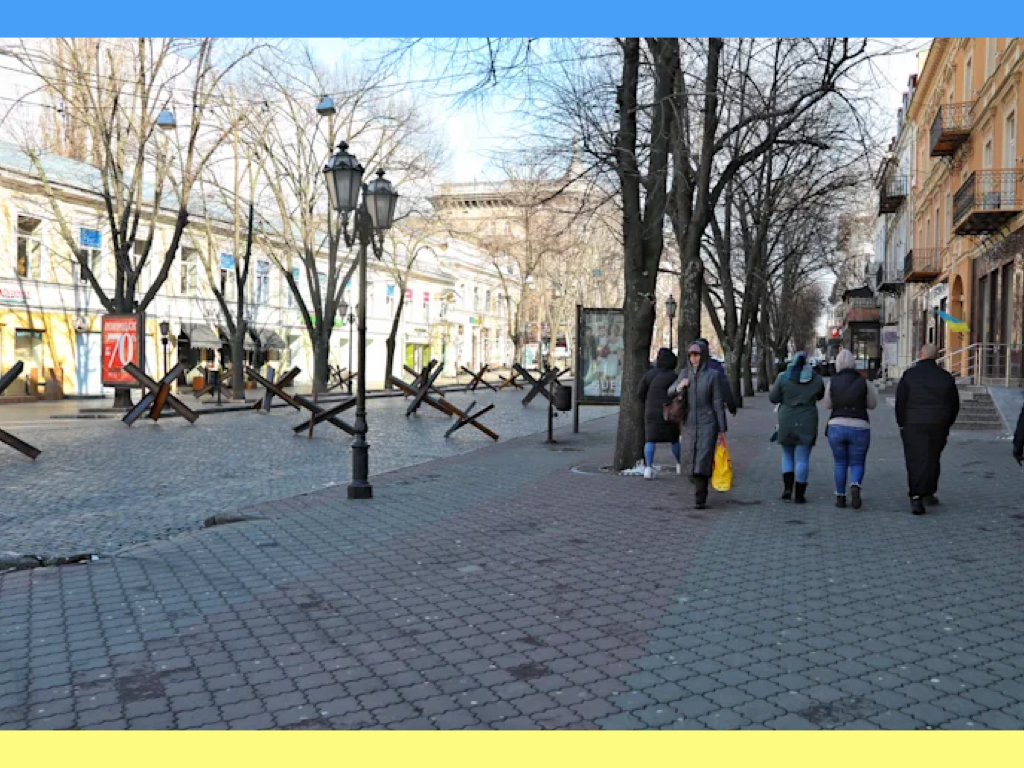
Anti-tank “hedgehogs”– metal I-beams that look like children’s jacks –fill the streets.
Odessa’s most iconic monuments are swathed in sandbags.

If you are a film history buff, it’s likely you know of one of Odessa’s landmarks. Battleship Potemkin is a movie that was made there by the Russian director Sergei Eisenstein to mark the anniversary of the Russian Revolution in 1905 that established the USSR. The film was so powerful that Nazi propaganda minister Joseph Goebbels allegedly said after his viewing, “Anyone who had no firm political conviction could become a Bolshevik after seeing it.”
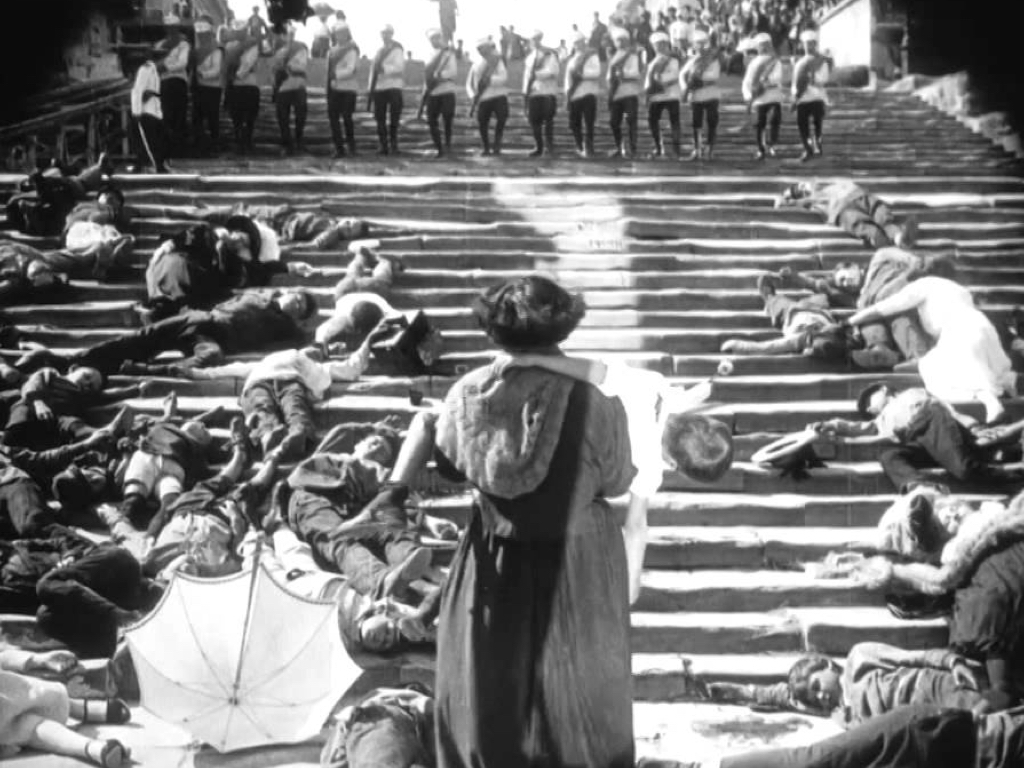
In Battleship Potemkin there is a scene where the Tzar’s soldiers march down the giant stairs in Odessa that lead from the entrance to the city to the sea firing their weapons at anyone they encounter. Today, those few moments of film are known as the Odessa Steps Sequence and considered one of the most influential in the history of filmmaking.

The stairs were built in Odessa almost two centuries ago and are 40 feet wide, nearly 500 feet long and descend 70 feet. Originally, they were named the Primorsky– the word for maritime in Ukrainian –Stairs but during the Soviet era they became known as the Potemkin Stairs. After Ukrainian independence in 1991 their name reverted back to Primorsky. In the past on April Fool’s Day they have been a favorite site for pranks– a motorcyclist, a skier, even a taxi would bounce their way down.
So far I have not been able to get any news of what it’s like in Odessa today. Unfortunately, that was until a few minutes ago when I learned that three Russian missiles launched from Crimea have struck buildings in Odessa and there are casualties. From this picture just now how can there not be.

On April Fools’ day in Odessa today there are no pranks or jokes, just destruction and death.
—————–
In an opinion piece he wrote a decade ago Calvin Trillin admitted he was envious of Tom Brokaw. No, Trillin had no desire to be a television news anchor. He was happy to write columns and books, but Brokaw had managed to, as Trillin put it, “slip a phrase into the language” and Trillin had yet to accomplish that feat.
The phrase in question was “the greatest generation”, the title of Brokaw’s 1998 book about Americans who had grown up during the Great Depression and went on to serve and fight in World War II. I’ve used Brokaw’s phrase many times myself and usually counterbalance it by saying I consider myself a member of the luckiest generation, those of us who grew up eating TV dinners and watching Ozzie and Harriet and who– or at least a great many of us –have had lives unburdened by economic hardship and uninterrupted by military service.
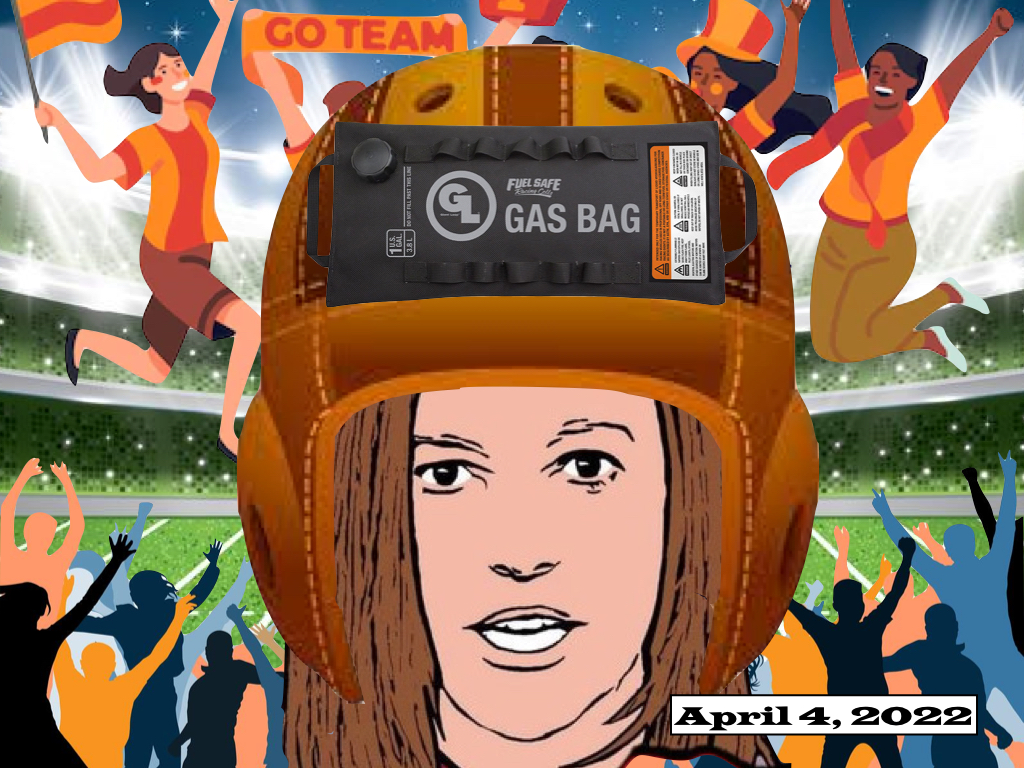
The phrase of Trillen’s that he himself thought had the best chance of becoming commonly used was one I am aware of but don’t believe I have ever uttered or heard of anyone other than Trillin mention. It’s his description of who most of us today call pundits and Trillin described more colorfully as “Sabbath gasbags.”
I think it’s obvious why Sabbath gasbags never caught on. For one thing the Sabbath, while it may be Sunday for Christians, for Jews it’s observed from Friday night to Saturday night and in Islam, since Allah never needs to rest, there is no one day that is considered a Sabbath although Friday is the most important for prayer.
And then there’s the word gasbags. The dictionary definition I’ve found gives two meanings– 1. a bag to hold gas which is an item I’ve never used or even seen and 2. a person who’s excessively talkative. When’s the last or the first time you ever called anyone a gasbag?
But as much as I have made my case for why Sabbath gasbags hasn’t made the cut as a colloquialism, I do approve of and agree with Trillin’s sentiment. He was describing the participants on America’s Sunday morning television news shows, which have grown over the years from NBC’s Meet the Press— which is as old as I am –, CBS’s Face the Nation, and ABC’s This Week to also include CNN’s State of the Union, Fox News Sunday and other similar broadcasts on networks and cable channels throughout the day. And lest I forget there’s PBS’s Washington Week, which airs on Friday evening. Sabbath gasbags are everywhere now and not just on Sundays anymore.
Hey, sometimes these shows do make news when they become the stage for an intentional official announcement or an off the cuff embarrassing gaffe by somebody important. But usually, there’s also a round table (or whatever kind of table the invited journalists and experts are sitting at) where the conversation at any moment may devolve from insights to inanities and sometimes from politeness to polemics.
In more recent times the Sabbath gasbag has become a pundit for hire. They now have paid gigs. Some are more lucrative than others certainly. A Karl Rove or a David Axelrod can probably buy that second or third home with what Fox News and CNN pay them. Lesser stars in the pundit firmament probably have to settle for a remodeled kitchen.
In recent years there has been one job in particular that has been not just a path but a launching pad to a cable news gig– that’s having been a White House press secretary.
Two of George W. Bush’s– Dana Perino and Ari Fleischer are at Fox News.
All three of Barack Obama’s– Josh Earnest, Jay Carney and Roberts Gibbs are now “contributors” at NBC, MSNBC and CNN.
And three of Donald Trump’s press secretaries– I forget how many he had –landed media work which only goes to show that the fake news might not be all that fake when you’re on the take. Kayleigh McEnany and Sarah Sanders are at Fox News and Sean Spicer has a show on Newsmax where I imagine no matter how many viewers are tuning in it’s more than Obama would ever get.
Now, we’ve learned that Jen Psaki is negotiating to leave her press secretary’s post in the Biden administration for MSNBC. Will she get her own show or be on call 24/7 to punditize (my word) on Zoom from her bedroom? Will she become the most popular redhead on TV since Lucille Ball or will Rachel Maddow out her as a brunette?
Do we really need so many pundits?
A writer in the Washington Post once suggested pundits should have their own country and call it Punditstan and when it might reach a point– if it hasn’t already –that no further verbiage might be extracted from the mouths of its denizens, we will have reached peak punditry. My guess is we’ll run out of oil first.
So here’s my advice to Ms. Psaki and I swear I haven’t been drinking the beverage named for her…
Suckle up Jen Psaki, suckle up
You can spin Jen Psaki if you suckle up
Don’t dare feel regret, it’s what we expect
Just take the checks and suckle up
You’ll be swell Jen Psaki, you’ll be swell
You can spin Jen Psaki if you learn to yell
Master butting in and you’ll be in like Flynn
Hell, enjoy the din so suckle up, just suckle up
Suckle up Jen Psaki, suckle up
They have too to you Jen Psaki, they have suckled up
They’ll want your current fame
Until you’re a “What’s her name?”
And that’s the game Jen Psaki so you better suckle up
Buckle Down Winsocki is a song written by Ralph Blane and Hugh Martin for the 1941 Broadway musical Best Foot Forward. Winsocki is a fictitious boys’ military academy where chaos ensues after a Hollywood starlet accepts an invitation from a cadet to be his date for the prom.
In the 1943 movie version Lucille Ball plays the movie star. Before her move to television and I Love Lucy, Ball was known as the “Queen of the B’s” and an actress, who like the movies she made, had failed to make it big at the box office. As it turned out she was putting her talent on the wrong sized screen.
—————–

This evening is the first night of Passover– a commemoration of the Jews being led out of slavery in Egypt to the Promised Land. You may know the word Pesach which is the Hebrew word for the occasion and the word seder which is the Hebrew word for the ritual meal Jews gather together to eat to mark it.
Of all of the Jewish holidays Pesach with its seder is the most beloved and observed. About 70% of those of us who identify as being Jewish– religiously observant or not –will sit down around the world and take part in this tradition in some way, shape or form. It is the Jewish Thanksgiving or since Passover came first, Thanksgiving is the American Pesach.
Seder in Hebrew means order. It’s arranging things– putting things in order. The reason a seder is called a seder is because of the order of the 15 customary parts of the meal that some perform in full and others don’t at all and most of us carry out somewhere in between. The ceremonial four cups of wine are usually included in observances of any length.
The word seder is also used in contemporary Hebrew to describe structure and stability or to issue a request or demand like “order in the court!” When I was asked to try my hand at filling in as a teacher of English as a second language to a class of 4th graders on the kibbutz where I lived in the 1970s, I found myself frequently asking for “seder” in the classroom. As comedians say about unresponsive audiences in nightclubs, it was a tough room.
Pesachis all about the Old Testament account in the book of Exodus of events that took place some 3,000 years ago. Back then the Jews had been doing alright in Egypt. Joseph– son of Jacob –was even Pharaoh’s close confidant but when Joseph died and a new Pharaoh took over, he saw the Jews as a threat to his reign and enslaved them.
To be doubly sure that no Jew would again rise to a position of influence in Egypt, Pharaoh took things even further and ordered that all newborn Jewish males be drowned in the Nile River. However, one Jewish boy was saved by Pharaoh’s daughter and grew up to be Moses.
Moses saw that his people, the Jews– although I’m not sure who told him they were his people and I don’t think there is a clear answer to that question in the Bible –were enduring great hardship and suffering and after some prodding by God he challenged Pharaoh to– you know the words — let my people go. When Moses’ appeals failed, God took matters into his/her own hands and what came next would make a nuclear winter seem like a skiing vacation.
Here’s the list of horrors that began with the waters of the Nile turning to blood. God started by killing all the frogs in Egypt which may not seem like a huge deal but the stink afterward must have been awful. Next, everyone was infested with lice and herds of wild animals ran wild in Egypt’s cities and, I guess just because he/she could, God killed all the domestic animals as well.
At that point the stench must have been unbearable but if it weren’t enough, God infected everyone with boils and followed that up by slamming Egypt with a gigantic hail storm. Whatever crops growing in the fields that weren’t destroyed were then devoured by swarms of locusts. Like a late night TV commercial, God kept coming up with more ways to try to persuade Pharaoh to close the deal and free the Jews but none of these plagues or in Hebrew mah-kot worked.
With nine down there was one more to go and finally, we get to the actual “pass over” part of the story. God has still not budged Pharaoh to free his/her people and so like a wrestler who is nearly pinned hopelessly one moment but able to put their opponent in a submission hold the next, God did to Pharaoh what Pharaoh had done to the Jews. At midnight on the 15th of the month of Nisan on the Hebrew calendar God administered the final blow. All the firstborn of Egypt were slain.
All except that is for the children of the Jews who had been alerted to what was coming and told to sacrifice a lamb and sprinkle its blood on their doors so that they would be “passed over.”
That did the trick and Pharaoh literally begged the Jews to leave the country which they did in a hurry and is where the legend of the unleavened bread– matzo — comes in. No time to let bread rise in the oven when you’re in a rush? Leave out the yeast.
I eat matzo year round so when in the Passover ritual we get to the part about the reasons why the seder night is different from all other nights of the year, it isn’t completely for me. I spread hummus on matzo, as well as cream cheese or a Greek fish roe called taramasalata most mornings. I have already stocked up at the supermarket on my supply of matzo that should get me through to Passover in 2023.
I think I’ve mentioned in the past that I actually took part in a Seder in Egypt the year I was in the regular Israeli army and stationed in the Sinai Desert not far from the Suez Canal which leads to the Red Sea that Moses parted so that the Jews could complete their escape. But I have two additional special Passover seder memories.
There’s a part of the tradition that calls for an extra glass of wine to be placed on the table for someone who is not physically present– the prophet Elijah. At a point in the service the children attending are asked to go open the door to the house so Elijah can come in and drink his cup of wine. Of course when the kids are out of sight one of the adults gulps down Elijah’s glass to prove that the prophet indeed showed up.
How this custom began or why this is done has led to different explanations by the sages through the centuries and both my favorite Passover remembrances involve the invisible guest Elijah who hopefully will have a chauffeur driving him on his millions of rounds tonight.
When I was a kid I was banished once from our family seder and for good reason. I had chickenpox. I was feeling left out but saw an opportunity to participate that evening nevertheless. When it came time for my brother and our cousins to open the door for Elijah I bounded down the stairs covered in a bedsheet. I was met with howls of laughter but didn’t quite make it to the table before being chased back to my room.
The other story involves my daughter, who was at the time my son. She did me one better when he was about six. The moment came when the children were told to go open the door and mine opted not to join them.
Me: “Gil, why aren’t you getting up with the others?”
Gil: “Elijah’s going to drink the wine, right?”
Me: “Yes, that’s what he does.”
Gil: “Well, I want to stay here and see it happen.”
True story.
And so we celebrate Passover with the seder tonight on the 15th of Nisan and no, the Japanese car manufacturer that is almost spelled the same has no connection to the saga. That Nissan came about when the company took its Tokyo stock exchange abbreviation and adopted it as its name in the 1930s.
And by the way, the Passover seder and Good Friday are on the same day this year– one being determined by the Hebrew calendar and the latter by the first Sunday after the full moon that occurs on or after the spring equinox. If you got all of that you might be wondering how often that symmetry happens? Just looked it up– about 13% of the time.
Let’s drink to both! And a joyous Pesach and a happy Easter to all.
—————–


The term supply chain originated in a newspaper article at the turn of the 20th century but its early global examples go back further and include rum and slaves. Before that the production of food was our species’ most obvious and necessary supply chain.
My college required me to take some science classes and being shortsighted about the value of learning basic physics, chemistry, biology or mathematics, I looked for “guts”– courses that were easy and fulfilled the obligation. That’s how I ended up in a room with half the Dartmouth hockey team listening to lectures about the history of technology.
I needed to write a term paper and found a book titled Medieval Technology and Social Change and to this day I’m surprised by how well I remember it. As I’ve tried to show in today’s first cartoon, the Middle Ages was the period when man began to reach a point beyond subsistence farming and was able to provide others with surplus crops. That original agricultural supply chain is something we are embracing again and call “locally sourced food.”
This big leap forward in farming that literally nourished the Industrial Revolution was due to advances in agricultural technology that allowed enough food to be grown so that fewer farmers were needed to do it. Here’s the short list of those developments and you can call the first one earth shattering (or not).
The invention of the iron plow made it possible to furrow arable but hard soils that had been impenetrable before and the harrow, a tool that was dragged over the plowed ground to prepare it for planting, led to greater crop yields.
I wrote about Passover and the Book of Exodus last week but in addition to telling the story of the Jews escape from Egypt there is also a passage in Exodus about tilling… “Six years you shall sow your land and gather in its produce, but the seventh year you shall let it rest and lie fallow.”
The expanded practices of crop rotation and periodically leaving fields fallow– this year happens to be one of them on the Hebrew calendar –so that their soils’ nutrients could regenerate became more widely adopted a millennia ago. And the invention of the harness made it possible for horses to replace oxen as faster and more efficient draft animals and to be used for transporting crops for distribution.
More food produced allowed more people to move to villages that would become cities. Gutenberg’s invention of the printing press created books that spread knowledge more quickly and widely. And in my Cliffs Notes reduction of history into as few sentences as possible the assembly line allowed us to drive onto the information highway from where we have been launched into cyberspace.
Perhaps the transitions from backbreaking labor on the land for thousands of years to mind numbing work in factories for centuries to the complaints blasting in your headset if you’re working in a company call center today haven’t been a great bargain for everybody. But our quest for knowledge, drive to invent and readiness to accept innovation are like a teenager with an insatiable appetite. They will not stop as long as the light in the refrigerator indicates it isn’t empty and supply chains still exist to keep refilling it.
We have become an interdependent world and my realization of the risk involved struck me while I was producing the last piece I ever did with Peter Jennings. Shortly afterward he was diagnosed with the lung cancer he died from.
Jennings had a farm of his own and wanted me to find a story about agriculture that we would broadcast while he was anchoring World News Tonight from the West Coast. What I came up with was that California was losing its farm acreage to development because the land was more valuable to those who owned it if it were sold than if held onto for farming. The cause was simple. Food could be produced more cheaply around the world and imported here.
I found a Whole Foods store that illustrated the point. In the produce section the fruits and vegetables had little signs identifying the countries from where they had been grown. Whereas before I had thought nothing of it that I was eating a tomato from Mexico or a pear from Argentina, suddenly it seemed unsettling and I asked myself if this might become a security issue someday. Certainly, in the United States we could grow enough food to feed ourselves but were we or would we in the future?
Now, years later the stresses on the global supply chain are something that have impacted me and likely you as well. I have a list of what I’ve determined are my own supply chain issues:
–We ordered a sofa last September. We’ll hopefully have it by this June.
–I broke a door handle this winter and am still waiting for its replacement to be shipped.
–A guy backed into our station wagon a few months ago. The bumper needs to be replaced but the part has yet to be found by the body shop.
–I use a CPAP machine for my sleep apnea. It is no longer sending its required data to my doctor and I have been entitled to receive a replacement machine for over a year. There are none available.
These are what are rightly called “first world problems”– trivial in the scheme of things, embarrassing to mention in comparison to being trapped in or displaced from Ukraine, suffering from hunger in South Sudan, cowering in fear of gang violence in Honduras or being imprisoned anywhere for having the courage to speak truth to power.
Obviously, none of what is on my supply chain list is life threatening. None of these things are really even a major inconvenience for me. But what they do represent is a larger concern– an anxiety I feel –and it is not just that the supply and demand paradigm we probably all assumed was relatively seamless is now frayed and in disarray. No, it’s not just about couches, doorknobs and car parts. It’s about all the things that I’ve taken for granted or only worried about in an abstract way that I now believe are actually threatened and not working well if at all anymore.
That’s another list I haven’t committed to paper maybe because unlike my supply chain issues there are no phone numbers to call.
Here’s a link to the ABC News farm story I mentioned…
—————–
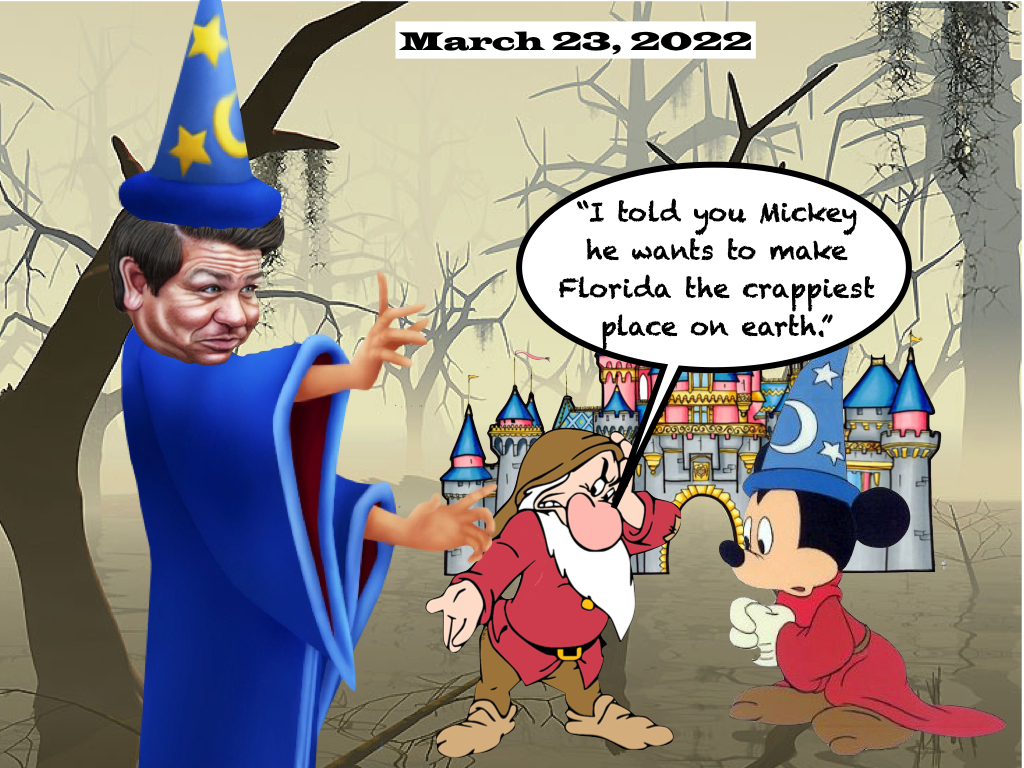
Never Say Gay Land
I know a state that’s anti-woke
And where math books are banned
A place that lets you start
Unlocking hate that’s in your heart
It’s Never Say Gay Land.
It might be full of crocs and Trumps
And long lines to vote they stand
Don’t let reason change your mind
That’s how suddenly you’ll find
Never Say Gay Land
You’ll have lots of leisure if you stay there
And no taxes from what I’ve been told
So once your address is made there
You won’t ever have to withhold
And it’s a place where guns are cheap
And you’ll always be so tanned
Just think of all the things
That DeSantis can still spring
Forever, in Never Say Gay Land
Never Never Land is a song from the Broadway musical Peter Pan which opened in 1954. The music was composed by Jule Styne and the lyrics written by Betty Comden and Adolph Green.
Here’s Mary Martin singing the original Broadway version of Never Never Land…https://www.youtube.com/watch?v=PuHixDALrAg
And an instrumental take played by Vince Guaraldi…
—————–

Why does every election in every country where free elections are still held make me nervous these days? Next question…
So here are some others the election that just took place in France led me to wonder about.
How long did it take to build Notre Dame Cathedral?
Answer: 182 years from 1163 until 1345
How long did it take to build the Arc de Triomphe?
Answer: 30 years from 1806 until 1836
How long did it take to build the Eiffel Tower?
Answer: Two years, two months and five days from 1887 until 1889
It seems to me that the moral of this story is…
–Obviously, some prayers take centuries to be answered.
–Napoleon was too busy giving orders to his soldiers and change orders to his contractor to get work on the Arc completed in a timely manner.
–Eiffel apparently must have known people in The Paris Building Permit and Code Enforcement Office.
I feel better now.
—————–

 pawnedaccordion