

Back in what surely seems like a long time ago somebody described the internet (When we still capitalized the I) as being like a library after an earthquake in which all the books had fallen off the shelves and lay open on the floor. Chat GPT is of course now reading them all if it hasn’t already. The vast sum of human knowledge and experience being made available to perform at our command is an earthquake whose aftershocks are undoubtedly yet to be felt or even fully known.
Looking back I guess my first awareness of how books would metaphorically be be “restacked” for cyber consumption was when I went to Stanford several decades ago to do a story about its “Reading Robot.” The university had bought a machine that could digitize the library’s contents so they might be accessible on the internet.
Here’a link to that piece that I guess was ahead of its time because, like the fate of many books, it never got taken off the shelf at ABC News and put on the air…
At a later point Google became involved in the project and the whole thing ended up in court. But by 1999 there was already enough content on the internet that students were using “download-copy-and-paste” to submit plagiarized essays and research papers and I found another story.
This time it was at Cal Berkeley where a graduate student had come up with an algorithm that could detect any short consecutive string of words on the web and identify their source. Here’s a link to that piece and a demonstration of the algorithm that I tried out myself, taking sentences from what I considered very obscure corners of the internet and showing that their sources were all findable…
If you just watched the story you may have noticed that Peter Jennings looked delighted to introduce it. Peter dropped out of school after failing 10th grade and eventually went to work at a radio station to began his career in broadcasting. I don’t know if he had it in for those of us who went to college but obviously, a lack of a degree didn’t hinder him. He was insatiably curious and when I produced for him he always took my writing and made it better.
But back to the future or is it already the present. “Download-copy-and-paste” may have been disarmed but what to do about ChatGTP?
Well, here’s something I just came across that shows how one man has eliminated any attempts at plagiarism or stolen copyright of his work. Last fall the great but not yet late– he’s 94 –satirist Tom Lehrer decided to just give all his songs away and put out this statement…
I, Tom Lehrer, and the Tom Lehrer Trust 2000, hereby grant the following permission:
All the lyrics on this website, whether published or unpublished, copyrighted or uncopyrighted, may be downloaded and used in any manner whatsoever, without requiring any further permission from me or any payment to me or to anyone else.
Some lyrics written by Tom Lehrer to copyrighted music by others are included herein, but of course such music may not be used without permission of the copyright owners. (The translated songs may be found in their original languages on YouTube.)
In other words, all the lyrics herein should be treated as though they were in the public domain.In particular, permission is hereby granted to anyone to set any of these lyrics to their own music and publish or perform their versions without fear of legal action.
If you’re as old as me, you might remember Lehrer’s song about plagiarism. If not check this out…
—————–
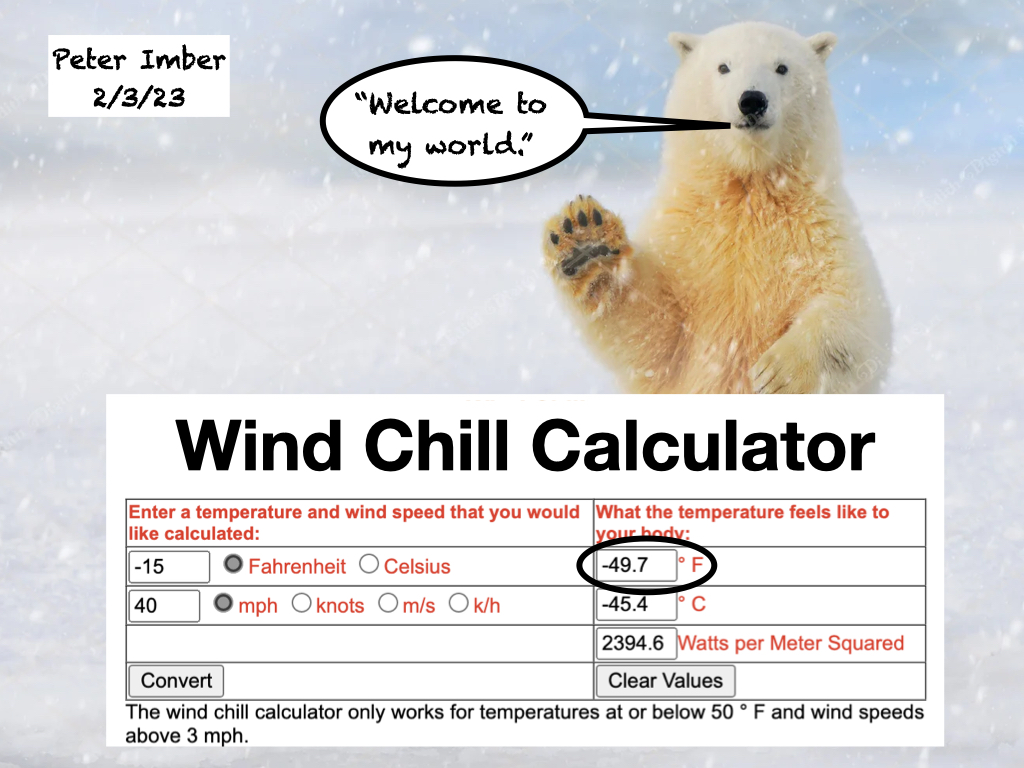
It’s 5 degrees outside in Camden as I write this. That’s not all that unusual for Maine in February but what will be is when the temperature drops by 20 more degrees tonight to -15 with wind gusts of up to 40 mph. That wind chill will feel like -50 if you are foolish enough to want to risk the experience. Our area’s weather alerts for the next 24 hours on weather.com fill an entire page…
The lowest recorded temperature ever for Maine since weather statistics have been kept is -50 without factoring in whatever the wind might have been doing at the time.
If it’s said during a heat wave that it’s hot enough to fry an egg on the sidewalk, then how about this! A couple years ago when a polar vortex dropped temperatures in Minnesota to -30 degrees, you could literally freeze your pants off. Well, actually you took them off first…

Post Spoiler Alert… You soak the pants in water and then hang them on a clothesline but allegedly they do become ice sculpture quickly.
So, everything is relative. And when Jo and I lived in Los Angeles and the temperature hovered around 50, her walking group would declare it too cold to bundle up and venture out of their homes. Wool jackets and down vests come out of the closet in LA when temps reach the low 60s. Hey, it’s 61 in my office at the moment. Our upstairs heat pump’s output doesn’t quite reach here and yes, I am wearing a sweater.
I sure know the coldest I’ve ever been and it was just a few hours from where I’m sitting. My favorite ABC News correspondent Brian Rooney and I were in Canada in the middle of winter in a place in New Brunswick called Plaster Rock.
It was 2009 and this small village had come up with an idea for a weekend event they called The World Pond Hockey Championships. Hundreds of aging amateur hockey players came to relive their childhoods and compete as four man teams on a lake that was outfitted with several dozen small rinks.
The village was remote and Rooney had a great line in his script about that, writing that Plaster Rock “being so deep in the woods they had to pump in light to it.” Lodging was not easy to find on Pond Hockey weekend and we ended up staying in a log cabin with a team from the Cayman Islands who presented us with a challenge.
On the dining room table was a giant bottle that contained enough rum that if it had been gasoline we could have likely driven back to the U.S. with just its contents in the tank. And it was made clear to us right away that we were supposed to join the expat Canadian Caymanites in getting the other kind of tanked to help them empty that bottle– call it a request for a Pond Hockey assist.
Just to demonstrate the attraction and commitment to this event that teams felt I asked a question of one of our lodge mates…
Me: Are there any hockey rinks in the Cayman Islands?”
Caymanite: “No.”
Me: “Then how do you practice?”
Caymanite: “We fly to Miami.”
Just how cold was it?
Well, it was the only story I ever produced where we walked on– not just across –a frozen river to get to it. And when it came time for the championship came I made a bad decision.
I had a small video camera and when I saw a cherry picker was available to raise those of us who wanted a bird’s eye view to see and record the game, I joined a couple others and was raised high above the rink. We were also elevated above the tree line and discovered there was a strong wind that hadn’t been really that noticeable on the ground where I had left Rooney and my crew filming below.
Quickly, my sunglasses froze and after I removed them so did my eyelids. But I got the shot I wanted, only the problem was we weren’t going to be lowered back on the ground until the others with me got their own. When they did and we were down I could have passed for a cardboard cutout.
How cold was it Part Two?
As the game was winding down the story’s real cameraman told me he didn’t dare stop shooting and needed to let the videotape in the camera keep moving or else it would probably freeze up. He was a Canadian and would know. Luckily, he had enough tape left that we were able to capture the award ceremony and the victors’– Canadian expats from Boston, MA –hoisting a wooden replica of the NHL’s Stanley Cup.
If you have the notion this winter’s World Pond Hockey Championship– the 20th edition –is in two weeks. There will be 120 teams competing from 12 Canadian provinces and territories, 35 American states and 13 other countries. I don’t know about the rum supply but there’s a tent the competitors can skate into for a beer.
Here’ a link to our ABC News piece…

—————–


Years before I began doing these cartoons in the first days of the pandemic I posted puzzles that used imagery– a lot were “match these things to those things” –on Facebook. Often they were pretty obscure but my friends Deborah and Barbara were absolute wizards at figuring them out along with a few others who happened upon them online and who I didn’t know and never met.
I got off all social media when I felt it was becoming more of a malicious threat than a marvelous thread and you have become my curated audience for whom I’m grateful.
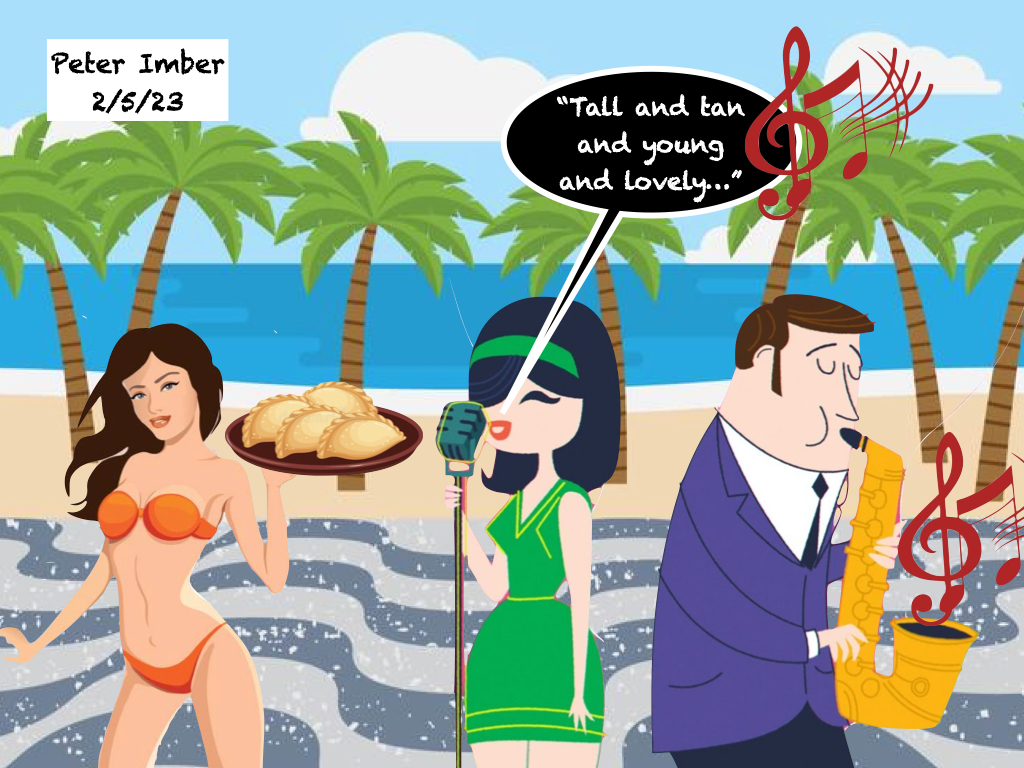
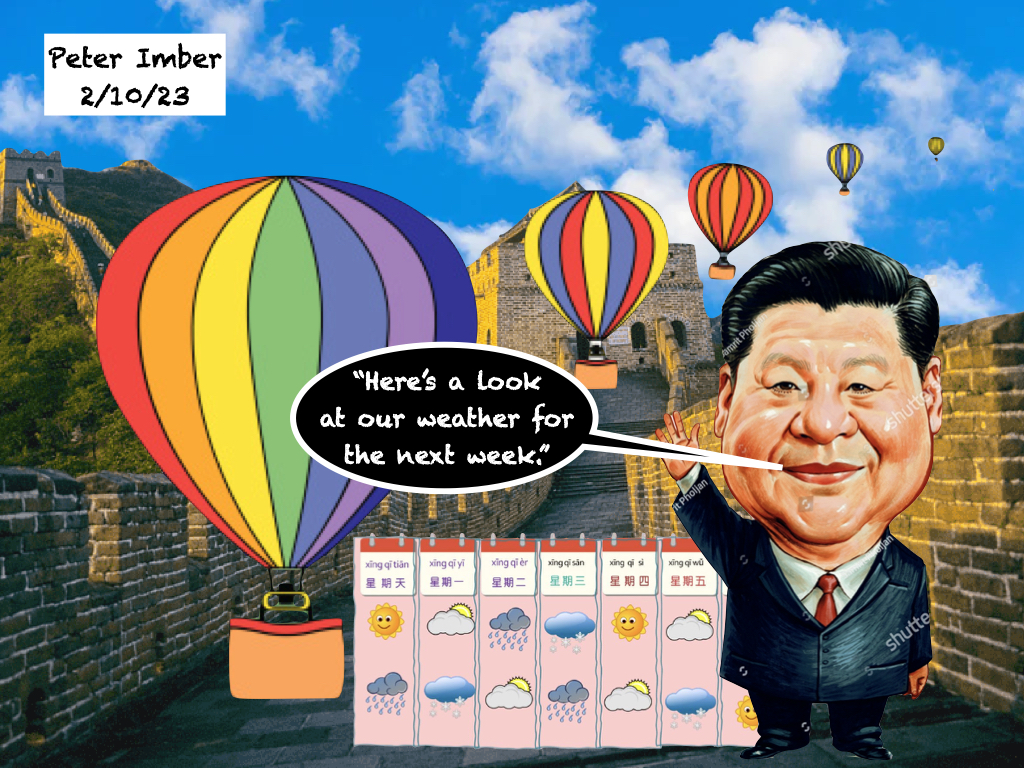
So, what I’m attempting to do today is turn the three cartoons above into sort of puzzles for you to solve. The three are not connected in any way but something is wrong in each one of them. Your mission, if you choose to accept it, is to discern what that might be.
So, I’m asking you to be a nitpicker. Until just a moment ago I didn’t know where the term nitpicker came from and now that I do I feel lucky that I don’t remember if I ever required the services of somebody for the actual procedure performed to have been considered one.
Turns out a nitpicker was originally a person who picked lice eggs– nits –out of someone’s hair. The term didn’t come into widespread use until the 1950s when we baby boomers were having our hair checked frequently. I don’t know if the expression “You need to have your head examined” originated at the same time but it sure makes sense if it did.
I’ll reveal the answers to the cartoon quiz in another post. Good luck!
And here’s a story about how I was justifiably shamed by a nitpicker and not for having lice on my scalp.
Before I produced stories at ABC News I was originally hired as a videotape editor. How I got the job with no news editing or any professional editing experience at all is a fluke.
I went to film school at UCLA where I made two documentaries that I was later able to monetize. One of them paid me enough for selling the licensing of just 5 minutes of its material to buy a new car plus drapes for Jo’s library and the other, a short segment that was broadcast on a long forgotten Sunday morning show on ABC called Lamp Unto My Feet, paid enough for some nice dinners out.
I cut both my documentaries on editing equipment at UCLA that was very new and not yet widely used except at one place where I went looking for a job– ABC News. They hired me!
Anyway, I edited a Nightline piece about the overcrowding and underfunding of America’s National Parks and the opening shot was the stunning “Tunnel view” of Yosemite Valley. In the frame you could see that there were birds flying but you didn’t hear them.
“I can fix that,” I thought. I had recently edited another story where you could actually hear the birds you saw. So, I inserted a few seconds of that sound and filled the avian sound vacuum in our opening shot.
A week later I got a call from a Nightline producer in Washington…
Nightline: “Where did you pull the bird sounds from you used in the Yosemite piece?”
In movies what I had done is called “sweetening”– an enhancement of the sound already recorded and on the screen by inserting additional sound effects. If you grew up watching sitcoms, think laugh track.
But in television news I imagined what I had done was likely a fireable offense and I immediately confessed my insertion of the heard but not seen songbirds and threw myself on the mercy of the court and waited for the verdict.
Nightline: “Well, we got a phone call from an ornithologist who says the birds whose sound you used aren’t found within a thousand miles of Califoronia.”
And at that he hung up the phone.

One more food related cartoon for the road… After I thought of this one I was curious if anyone else had ever made a similar play on wurst. For a moment I thought I was the first but then I discovered that years ago at a door to door salesperson’s convention a prize was given to the least successful attendee.
And yes, it was the knockwurst award…
The answers to yesterday’s cartoon quiz have poured in and many let me know immediately that I didn’t do my due diligence when it came to the Jerusalem artichoke.
I composed that cartoon knowing that the Jerusalem artichoke is native to North America and was not available on the dinner menu after a hard day’s work inscribing the Dead Sea Scrolls during the period of the second Temple two thousand years ago. What I didn’t know was that the Jerusalem artichoke is NOT an artichoke at all but instead a member of the sunflower family. Jo pointed out that I didn’t even have the right picture of it in the cartoon.
I did better with the anchovy cartoon and so did you who responded. Anchovies are primarily found in warmer marine waters and they are not fished for with hooks but are commercially trawled for with nets. According to an article a year ago in Science, anchovies are an endangered species. You may not miss them on your pizza or in a Caesar salad but other fish and seabirds and ocean mammals surely will.
My punny valentine to Antonio Carlos Jobim, Astrud Gilberto and Stan Getz got varied responses. I was going for The Girl from Ipanema being from Brazil while the plate she was holding was full of empanadas from Argentina.
A number of you got that but there were others who wondered if singing was permitted on the beach in Rio de Janeiro, and if it was, then how was Astrud’s microphone connected to electricity and– my favorite –that there is no line in the song that mentions that she was serving empanadas.
I congratulate you all for playing!!!
Peter
—————–
Ex Presidents watching (or not) last night’s State of the Union address

In Jimmy Carter’s wood shop…

In Bill Clinton’s dining room…

In George W. Bush’s art studio…
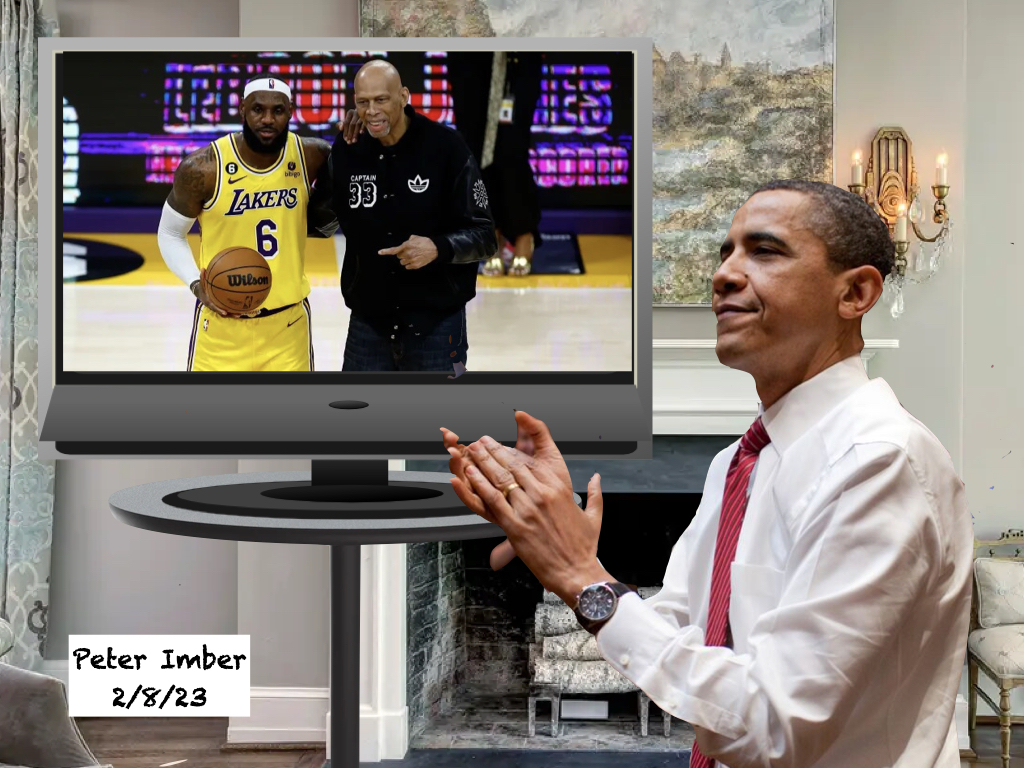
In Barack Obama’s den…

And meanwhile at Mar- a -Lago.
—————–
Dumb excuses come in threes…


—————–

During my career at ABC News I covered two super bowls and got to be on the sidelines during one of them. I’d never been that close to a professional football game and when a running back nearly ricocheted into me after being hit and catapulted out of bounds, I concluded that if I had been him, I likely wouldn’t be writing this today.
The size of the players, the speed at which they moved and above all the sound when they collided was not anything close to what we see on our television screens as we tackle our dips and chips from a safe distance.
At some point I produced a story about how those of us watching from our sofas prepare for the big game. The image in the piece I remember the most was from inside a facility where guacamole was being made and packaged. A hose hovered over a conveyor belt on which plastic containers moved along swiftly to get their squirt of guac which couldn’t have lasted more than a fraction of a second. And you thought our country only knew how to shoot down balloons.
In 2012 after I retired I wrote a column for the website Bleacher Report expanding on the idea of how big an event Super Bowl Sunday is for the snack food industry. I’m using mostly statistics I found at the time but I doubt if any of the numbers mentioned then have decreased…
Super Bowl Sunday ranks behind only Thanksgiving as the biggest food consumption day of the year in the United States and the proof is in the Pepcid. There is a 20 percent increase in antacid sales in the 24 hours after the game.
For some, the food and drink take an additional “excessive celebration” toll and many partygoers face being penalized a day’s pay because about six percent of American workers will call in sick on Monday.
Halloween may be pumpkins, costumes and candy, Thanksgiving is turkey and apple pie, Valentine’s and Mother’s Day are flowers, and the 4th of July fireworks, but if you’ve invited people to your house on Super Bowl Sunday, you better make sure you cover the spread!
Super Bowl avocado consumption is estimated at between 54 and 70 million pounds, enough to spread guacamole across a football field to a height of 12 feet according to the Hass Avocado Board.
I don’t know if the Aztecs had a Super Bowl but the oldest evidence of avocado use was found in a cave located in Mexico that dates back to around 10,000 BC. Guacamole came later and is thought to have been made first by the Aztecans in the 16th century. Why did it take so long to discover this? Well, archaeologists believe it was because it was at the bottom of a seven layer bean ans salsa dip.
Potato and tortilla chip munching estimates vary widely on how many will be eaten on Super Bowl Sunday, from a low of 11 million to a high of 28 million pounds according to the Snack Food Association. The discrepancy might be accounted for by checking under your seat cushions after the game.
As a country we may have to catch up to the rest of the world in producing our own computer chips but while those chips are down there will not be a shortage of potatoes and corn for the ones we need for watching the game today.
According to the National Chicken Council, more than 1.25 billion chicken wings will be nibbled on during the Super Bowl weekend. That’s more than 100 million pounds of wings, and if the wings were laid end to end they would circle the circumference of the Earth more than twice— a distance approximately a quarter of the way to the moon.
If I could afford a super bowl commercial– $7 million for a 30 second spot this year –I think I’d target poultry farmers and ask, “Do you know where your chickens are?”
Pizza is a $30 billion a year business in the United States and on an average day Americans buy 11.5 million of them. Super Bowl Sunday is the busiest day of the year for pizza restaurants, and the big chains like Papa John’s, Pizza Hut and Domino’s will sell twice as many pies as they do on any other day.
Many of Sunday’s pizza orders will be delivered and for the additional drivers needed to bring those pizzas to your door, Super Bowl Sunday also means a higher risk of auto accidents which insurance companies are very aware of. Fireman’s Fund has recorded a nine percent increase in auto insurance claims resulting from pizza delivery accidents on Super Bowl Sunday.
And where do you think the highest grossing single location independent pizzeria in the nation is located? If you guessed New York or Los Angeles or any place in the Lower 48, you’d be wrong. It’s Anchorage, Alaska. Annual sales at Moose’s Tooth Pizzeria are about $8 million and I wonder if any are delivered by dogsled?
Have I missed anything? Sure! There are subs, sandwiches, hamburgers and hotdogs, ribs, shrimp, chili and I haven’t even mentioned alcohol. How about 325 million gallons of beer down the hatch today? That’s enough to fill 500 Olympic size swimming pools.
If your team loses, you now know where to go to drown your sorrows. Wait! The pools will be empty. Ooooo, that will hurt.
—————–

And if you receive a box of chocolates todaymay you pick one out that you actually like!

I guess it’s just an everyday thing for Forrest Gump.
—————–

A few miles after you drive across the Piscataqua River Bridge from Portsmouth, New Hampshire to Kittery, Maine on I95, there is a sign on the side of the highway that reads “Welcome to Maine– The Way Life Should Be.”
When you leave the state before you cross the bridge again there’s another:
“Maine– Worth a visit. Worth a Lifetime.”
For hello and goodbye signs I think Maine has its other 49 competitors beat handily. But there’s also a quote attributed to the travel writer Paul Theroux that presents a different context in which to evaluate this place– “Maine is a joy in summer. But the soul of Maine is more apparent in winter.”
Well, guess what? Theroux apparently is implanted with a rubber soul because these days he bounces between winters in Hawaii and summers on Cape Cod! So, I guess I shouldn’t have been surprised the other day when I heard Jo say…
“You know, Lou McNally isn’t here in Maine.”
If you’re a listener to Maine Public, which is our state’s broadcasting affiliate with NPR and PBS, there’s a good chance you know Lou McNally. He does the weather report on the radio most mornings and he’s good at his gig.
McNally’s signature signoff line is “That’s the way it looks from here” but as I’ve now learned, he’s not HERE! He’s the guy I have relaxing on the beach in the cartoon below and when he’s telling us listeners in Maine how cold it’s going to be, he does it from Florida where he lives for much if not most of the year.
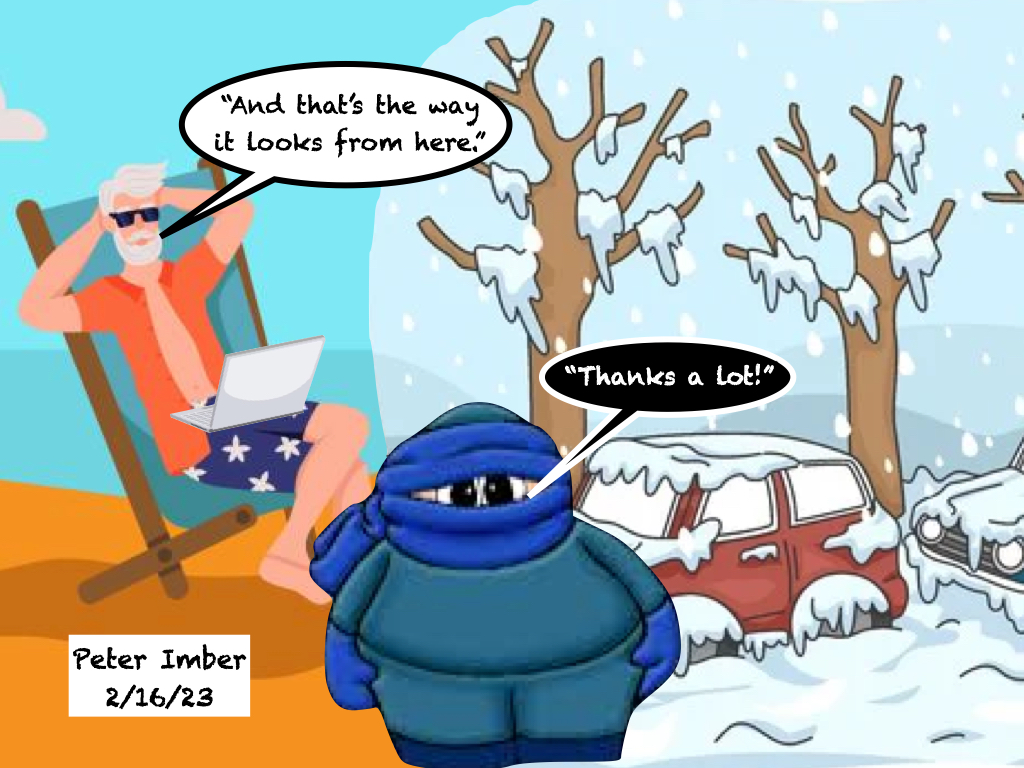
I guess a more fair weather weatherman might be hard if not impossible to caricature. But in fairness McNally’s long broadcasting career did begin in Maine and he was once widely seen and heard on local TV and radio. Full disclosure also requires that I reveal that McNally came up with his signoff long ago and used it first when he was still here in Maine and before he was there in Florida. Safe to say Lou’s signoff has now transitioned from iconic to ironic.
Florida might almost be called Maine South. Lots of people who live here for part of the year go there for the other part or is it the opposite? It’s where our ex governor bolted immediately after losing last year’s attempt to get re-elected and from where he had reappeared to run for Maine governor again after he had termed out and became a Florida resident even before his successor was inaugurated in 2019. To his credit he forthrightly claimed his exile was to avoid paying Maine’s taxes and not to escape its weather.
You see a lot of Florida license plates in Maine in the summer. I’ve heard a guy on a local radio commercial claim to be “Your Maine go-to real estate agent for property in the Sunshine State.” Butsince the beginning of the pandemic we’ve been seeing some Florida snowbirds delay migrating long enough to be seen with snow shovels and more and more license plates from New York and even California on the roads here in the winter.
Although the cost of buying a house in Maine has gone up, this is an attractive place to raise kids or retire and perhaps increasingly so. Yes, we certainly have our share of poverty and crime but we don’t have earthquakes, wildfires, mudslides or tornados and politically, we’re blue on the coast for those who this matters. Of course we do have “the weather” and that’s where the “two winter test” comes in.
Observing the out of state licenses now sitting in ice covered driveways in our area, Jo said to me recently, “Let’s see how many are still here after their second winter.” And last week at a Chamber of Commerce dinner I sat beside a realtor who confirmed Jo’s challenge.
Me: “How many homes that you’ve sold have come back on the market after the buyers spent a couple of winters here?”
Realtor: “I’ve had a number of them. Not everyone is able to make the adjustment from “Vacationland” to “Staycationland.”
The Maine license plate is indelibly inscribed with the former but a few years ago a Maine lawmaker proposed to change it to the latter with the intent and belief that more people, especially young families, might see the light and move here. In the middle of December when that light is the faintest, it’s often a dealbreaker.
In fact, as much as I love Maine and am happy here, I am obliged to mention that it’s also the only place I’ve ever lived where when the sun is out and it’s not freezing or blusterly, strangers don’t acknowledge one another with just a perfunctory “Hi.” No, much more often we smile and cheerfully say, “Nice day!” And that’s especially in the summer when we who are here all winter believe that on any nice day we earned and deserve it.
Jo was born and grew up here and remembers hearing stories that it was once possible to actually drive a car across 15 miles of frozen ocean from Rockland on the mainland to the island of Vinalhaven. In just the 12 years we’ve lived in Camden, winters have become noticeably warmer and shorter. According to the thermometer in my window, it’s 52 degrees this morning. The average temperature for February in Maine has historically been below freezing.
However, what hasn’t changed is the length of the shortest day of the year which, barring Elon Musk fooling with the earth’s orbit around the sun, is less than seven hours.
A few years ago when we were in Ecuador it was the first time I ever stood on the equator. Those who live there have 12 hours of light and 12 hours of darkness every day. Sounds Ok but the more I thought about it I concluded that living on the equator would drive me crazy. No summer and no winter! Now, that’s a dealbreaker.
_________________

Ok, to “get” the reference I’m making with the image above you had to be at the Camden Conference this past weekend. With my sense of irony I’m betting even if you were, you might not get it anyway. I’m used to that.
I was there. It’s an event that was started by a group of people who had moved to Midcoast Maine after careers in various government jobs in Washington, D.C. In 1987, after deciding that the area needed a bit of intellectual stimulation in the middle of the long Maine winter, they organized the first Camden Conference. That initial gathering was attended by only a couple dozen people sitting on folding chairs in the Camden library.
Through the years the Conference, which is held over parts of three days, has had as many as a thousand attendees and since they can’t all fit into the Camden Opera House, a number of other venues in Rockland, Belfast and more recently Portland have been added to which the Conference is live streamed.
I got involved with Conference shortly after we moved here in 2010. I think the leaders at the time were more interested in recruiting Jo but since she was already involved in what would become all but a full time job transitioning the Strand Theatre that her grandparents had built in Rockland 100 years ago from near extinction to a thriving and successful nonprofit, I was the next available target.
I learned a couple of things very quickly. One was that the easiest way to meet people when you’re new to a place is to become a volunteer in your community’s organizations. The second was that if you agree to take on any leadership position and then do what you say you’re going to do, within just a few years you will more than likely be asked to lead that organization. After a meteoric rise I was a president of the Camden Conference five presidents ago.
The Camden Conference was formed with the original goal to be a yearly gathering to discuss American foreign policy as well as crucial issues and events that impact our country and the world. It is a nearly completely volunteer operation with just two employees who are vital and do much of the heavy lifting and each year’s topic for discussion is chosen by committee. In recent years those topics have ranged from the regional– China, Europe and the Arctic –to the information revolution, the global refugee crisis and the future of food and water.
The Conference invites nearly a dozen experts– academics, journalists and relevant leaders –from around the world to come to Camden each February who give presentations followed by questions from attendees. As one speaker from India said this weekend, “My friends told me I would be crazy to come to someplace so cold, but they didn’t know that the people here would be so warm.”
This past weekend’s topic was the status, impact and future of the globalization of trade. As is always the case some of the speakers hit the ball out of the park while others may have struggled with the curve ball. Hey, in baseball a .300 batting average gets you a plaque in the Hall of Fame in Cooperstown and the Conference always doubles that at the very least.
I’ve made many good friends through my involvement with the Conference and I thank those who have continued to sustain it. Congratulations to all!
Oh, and here are a few of my own takeaways from the weekend…



_________________

In 1923– still the silent era of motion pictures –the highest grossing movie of the year was Cecil B. DeMille’s The Ten Commandments. And yes, it was the same Cecil B. DeMille who made The Ten Commandments again in 1956 this time as a “talkie” with Charlton Heston starring as Moses. For trivia fans Heston was born in 1923.
In 1923 there was also a significant movie milestone for Rockland, ME and Jo’s family. Her grandparents opened the Strand Theatre and this week marks its 100th birthday. The theater was really her grandmother Ida’s idea and the property was purchased with her own savings. Rockland had suffered a fire in 1920 that wiped out part of Maine Street and Ida, seeing that theaters were opening all over the country, sensed it was a good business opportunity.
So, there I was 100 years later on Tuesday afternoon sitting in the Strand with our about to be seven-year-old grandson watching the third highest grossing movie of 1923– Safety Last starring Harold Lloyd. I marveled at Lloyd. In the film’s most famous scene he hangs from the minute hand of a clock mounted on the side of a building many stories up.
Lloyd’s acrobatics, as he struggles to maintain his grip, are even more remarkable when you’re aware that four years earlier he had mistaken an actual bomb for a prop and it blew up. Lloyd lost his thumb and index finger on his right hand and wore a flesh colored glove with fake fingers for the two he was missing. Of course he wasn’t really that high up a building to begin with. He was dangling on a set while a film of the city was projected behind him.
How do I know? Having been a video editor in the past, I still have my “editor’s eyes” on occasion which wince at bad cuts and lapses in continuity. In Safety Last’s climactic “clock hanger”– considered by many as silent comedy’s most iconic scene –the projected background changes about halfway through.
But my real discovery at the movie to my delight was the laughter of our six-year-old. A century later and Harold Lloyd was as funny for him as it was for me. Full disclosure– Harvey also gets my puns.
In 1927 when in The Jazz Singer Al Jolson bellowed “You ain’t heard nothing yet!” and synchronized sound disproved what one of the Warner Brothers had contended that, “Nobody wants to hear actors talk!” the silent film era was doomed. The geniuses of silent comedy– Buster Keaton, Charlie Chaplin and Harold Lloyd –were more or less finished too. Keaton in particular was all but forgotten and only rediscovered in the 1970s.
Today, to a large extent they are like great athletes remembered for their exploits now memorialized on plaques and recounted in books but rarely is the recorded evidence of their skills actually removed from the archives and viewed and appreciated.
Yesterday, Harvey and I watched another movie together which I believe I saw when I was his age which was 1954. I have no idea if he’ll grow up to be a lover of the films of the past but I think there’s hope. Part way into 20,000 Leagues Under the Sea he said, “I think this is a better movie than the ones I usually see.”
—————–
Marjorie Taylor Greene wants a divorce– a second one. Her first from her husband of 27 years was finalized just this past December. She declared her desire for the latest one a week ago. Her proposal is for the United States to break up. Red states would govern themselves the way they want to and blue states would supposedly be able to do the same. In her mind it’s better to have the elites and degenerates in their space and the evangelicals and deplorables in theirs.
It strikes me as not such an original idea. Let’s see, if you take blue that begins with the letter B and red that begins with the letter R and add EXIT to the two of them… What do you have? Well, I’ll be darned– BREXIT!
Lame jokes aside, Marjorie Taylor Greene has learned from Donald Trump that keeping yourself in the news and striving to be a continuous story on television and online accomplishes two things. The first is by throwing fresh red meat to your base and being outrageously base when you’re doing it, the more likely they will eat it up. The second is that those more reasonable elected representatives in your own political party are going to be afraid of you and won’t have the guts to refute you because they know your base is their base.
It’s sick but too bad Marjorie Taylor Greene isn’t the biggest problem the country has on its hands. Nevertheless, she’s a pathetic pom pom girl for divisiveness and authoritarianism and we ignore her at our peril.
She isn’t my favorite subject for a cartoon but she does need to be opposed and ridiculed. Here are three attempts by me to achieve that. And I’ve tried to say it with music so see if you can sing along…



—————–
 pawnedaccordion