

Have you ever tried to break a piece of matzah exactly in half? It’s all but impossible. And even if you have a scalpel and a surgeon using it, I’m not sure after the years of medical training required to operate on a human body you would see it happen either.
Maybe that’s an obscure but instructive quality of matzah. A whole piece looks perfect and after it’s broken it does not. Matzah is easy to break but not simple to divide equally.
Breaking pieces of matzah is what millions of Jews in Israel and beyond did last evening at seder tables to begin the week long observance of Passover. In the seder ritual matzah is referred to as the “bread of affliction” and therefore has a symbolic presence in Passover’s observance and the Jews’ liberation from their bondage in Egypt.
I am no Biblical scholar. My Torah portion for my Bar Mitzvah was from Leviticus and about how to sacrifice animals on an altar. That wasn’t motivation to learn more. But here is the passage in Deuteronomy that explains the significance of matzah…
“Seven days you shall eat it with unleavened bread, the bread of affliction—for you came out of the land of Egypt in haste—that all the days of your life you may remember the day when you came out of the land of Egypt.”
As far as I know an actual technique for breaking matzah isn’t prescribed anywhere in the Torah or the Talmud but experience has taught me life, like the uneven halves of matzah, is not perfect and that it’s easier to break things than to repair them. And most importantly, if and when you do break something, there are often consequences.
An encapsulation of this truism for me has been called the “Pottery Barn rule.” I have never broken any merchandise at a Pottery Barn but years ago I tripped entering an art gallery up here in Rockland, Maine and broke several ceramic pieces on display.
I had knocked over an easel that fell and hit the art. A leg of the easel had been sticking out just beyond the entrance to the gallery. “Not my fault,” I thought. But the gallery owner didn’t see it that way and was furious. The first words out of his mouth were, “That will cost you $1,000!” I was shocked.
Jo, seeing that I was beginning to seethe myself as the owner continued to rant, pushed in between us and in the end I was not charged for the damage and the “Pottery Barn rule” was overturned… Have you figured out what it is?
“If you break it, you own it,”– Colin Powell
Now, do you remember? The “Pottery Barn rule” is famously attributed to Powell. When he was Secretary of State, he allegedly recited and compared it to the practice he believed existed at the home furniture chain in a warning to President George W. Bush. And certainly he was prescient when he told Bush that if the United States invaded Iraq, it could mean unforeseen challenges and an uncertain time frame for the commitment of American troops to remain in that country.
“If you break it, you own it.”
Years later Powell would disavow he ever described it as the “Pottery Barn rule,” although he did not deny that the company got a lot of favorable advertising by claiming that it had no such policy.
Anyway, this has been a long way round to getting to the real point of the Homemade Cartoon today. When the Israeli Prime Minister Benyamin Netanyahu broke a piece of matzah at his Seder last night, I’m guessing he did not reflect on its symbolism beyond the Biblical account of Moses leading the Jews on their escape from slavery to the Promised Land. I’m certain he wasn’t thinking of the Pottery Barn either.
But matzah is not all that was and has been getting broken in Israel recently. The divisions between religious and secular Jews in the country have existed since its modern day rebirth. The tension between the two has been like a kettle on a stove that has slowly simmered through the years but never come to an actual boil– that is until now.
By forming a government that includes right wing extremists with a goal of controlling Israel’s judicial appointments to its Supreme Court and empowering the Israeli parliament to override the judiciary’s decisions, Netanyahu hasn’t just boiled the water in the kettle, he’s been setting the kitchen on fire.
The religious political parties in Israel have historically been a minority entity but have on occasion been the crucial ballast on the end of the seesaw– the necessary weight that has brought the lever down and determined if Israel’s liberal or conservative factions could seat a coalition majority in the country’s parliament and therefore have the authority to form the government.
The religious parties’ price to be the kingmakers has been that since 1948 they have control over civil matters such as marriage and divorce and also the persistence of requirements that Israel’s hotels and army be kosher and public transportation on Shabbat be forbidden.
The ultra orthodox want the country to be a theocracy and to impose religious laws on all secular Israelis. Others aligned with them want to be able to create more settlements virtually anywhere on the West Bank. Both would press for discriminatory measures against Arab Israelis, women, and LGBT people.
Combine all this with Netanyahu’s self-interest in “reform” of Israel’s highest court — namely, his own personal legal jeopardy. He’s actually presently on trial for bribery, fraud and breach of trust while serving as prime minister in the past. A legislature granted the power to overturn any conviction of him… Well, I can think of someone else on our own shores who would like nothing better than to have that same potential enshrined into law here.
In Israel the ultra orthodox make up 10% of the Jewish population. Males are exempt from military service and the vast majority are not employed. Their religious studies are heavily subsidized by the government. For a country that has faced existential threats since its founding this irony might be comical if it were not so illogical.
So, what happens if Netanyahu and his religious allies succeed in weakening, if not wrecking, democracy in Israel? I guess it would be Biblical in some analogous and fateful ways. Very likely there would be an exodus of Israeli citizens and companies from the Promised Land to what they would consider more liberated and promising lives and opportunities elsewhere.
And Bibi Netanyahu himself might well be remembered as the person who became King Solomon in reverse. He may be breaking his matzah in half this week in Jerusalem but in the coming days he could also be responsible for having irreparably split not a baby in half this time but an entire country. And Solomon’s genius of course was that his threat spared the infant.
Netanyahu has been described in the past as a political magician and adding together his total tenure, he is Israel’s longest serving prime minister. The story of Humpty Dumpty isn’t in the Bible but Netanyahu’s magician’s talents may not be able to put back together the matzah he has broken so unevenly this time.
—————–
“To pun is human, to be forgiven for doing it is unlikely.”
I delivered a meal to a man this week and as I handed it to him he said, “The world is falling apart.” We all hope not but I’ve discovered that there are actually bookies offering odds on the apocalypse. How one gets paid if and when it occurs has me stumped.
For me humor is the best defense against dark thoughts and doom and– if you’ve been reading my stuff up until now –puns are often my prefered attempt at being humorous. Admittedly, the response to them ranges from grins to groans. So, here goes an attempt at being historically funny…
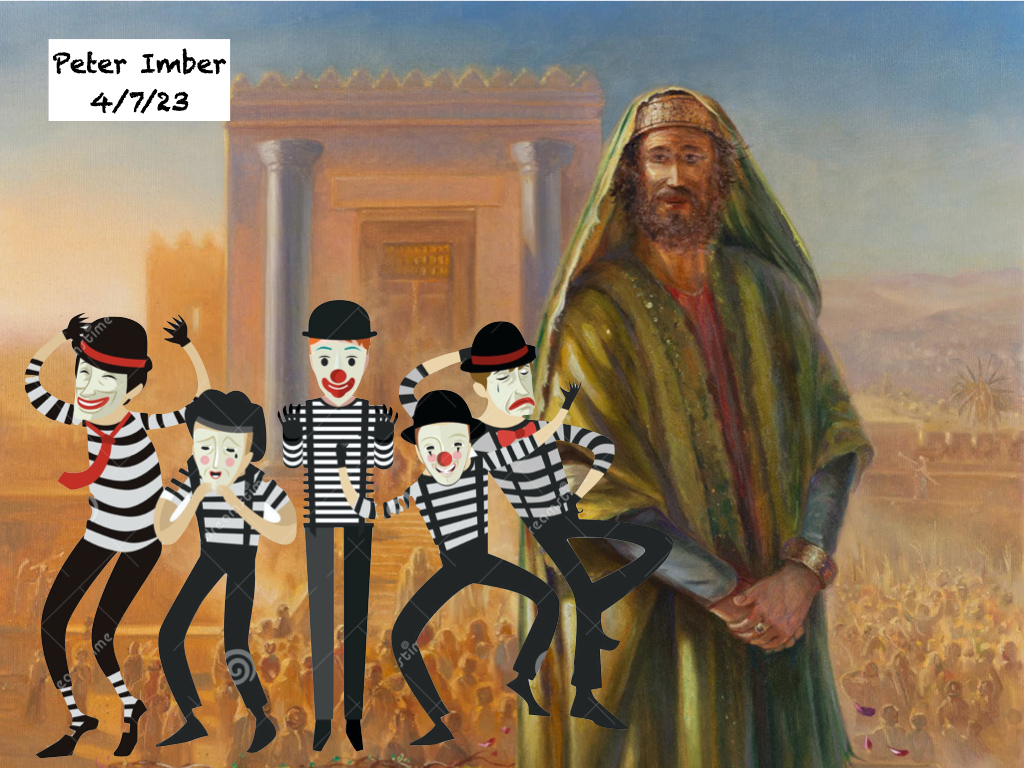
King Solomon’s Mimes
“Sometimes in life, I’m just trying to have a little fun with some wordplay, and the people around me aren’t having it. They’d rather have no pun at all.” –Julie Beck

The Griddle of the Sphinx
“Puns are threatening because puns reveal the arbitrariness of meaning, and the layers of nuance that can be packed onto a single word.” –John Pollack

Geeks Bearing Gifts
“They can be a demonstration of wit, of cleverness. You’re relying on a person’s ability to parse language, to understand the nuances and complexities of words.” –Peter McGraw
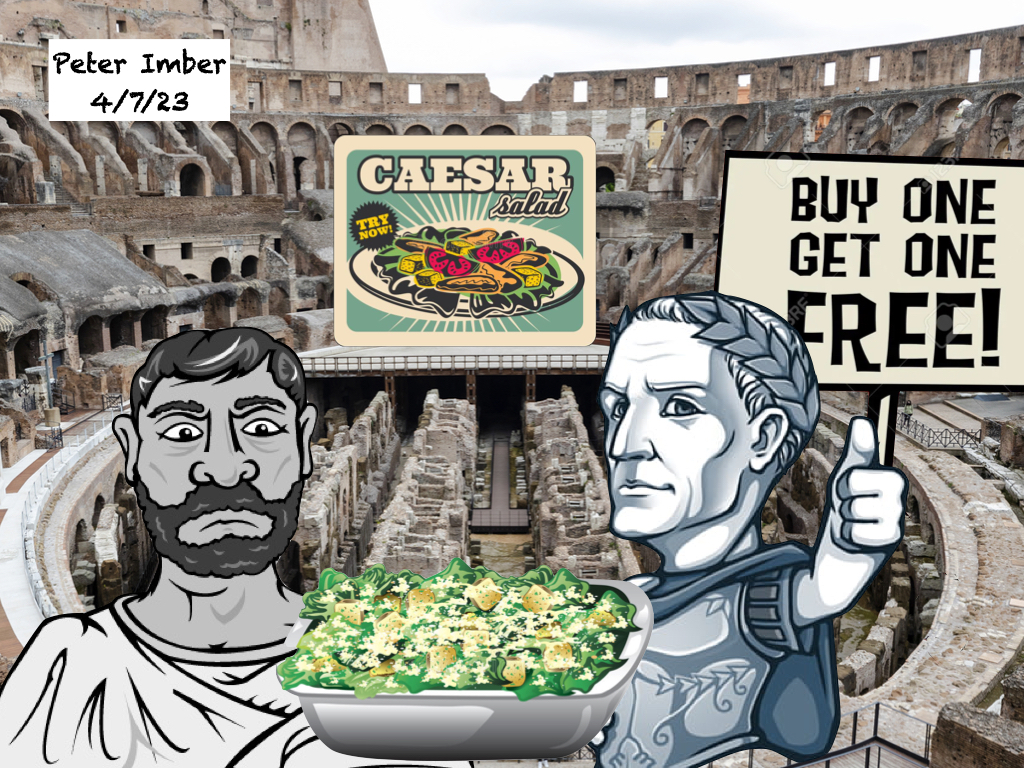
Eat two Brute
“They’re usually deployed by people who know you’ll think the pun is annoying. Which is annoying. … A pun sidetracks you. It’s your friend who won’t let you get anything done.” –Charlie Hopper
Did you make it this far?
—————–

“In spring an old man’s fancy turns to thoughts of golf.”
Yes, I played golf yesterday. The temperature here in Maine was in the high 40s and I’m giving the wind the benefit of the doubt by calling it a breeze. My best shot of the day was on the very first hole which I parred.
Don’t it always seem to go…
After that I was welcomed back onto my home course by all my familiar nemeses– the hook, the slice, the fat shot, the skulled shot, the pushed putt, the pulled putt… I was already in midseason form.
Was I discouraged? Not one bit. But it led me to write what’s below and to come up with today’s Homemade Cartoon to accompany it…
His Masters Choice
A man is on his deathbed and as the end draws near he hears a voice in his head.
The Voice: “Hi Jim (maybe last name Nantz). Well, it’s moving day!
Jim: “I know but how about a mulligan?”
The Voice: “You’re not the first to ask but you’ve had many shining moments and now it’s time.”
Jim: “Isn’t there anything you can do? Can’t you let me play through?”
The Voice: “Play through? I’m afraid not. Do you have any last words, like maybe ‘Goodbye friends?'”
Jim: “Wait! I have one final request. Could you play the Masters theme music as I leave this earthly life behind?”
The Voice: “Yes, I can and I’ll even make you an offer. Here’s your choice. I’ll play the Masters theme or I’ll play ‘Highway to Hell.’ You pick.”
Jim: “That’s sort of an obvious choice. Let me hear that Masters theme one last time.”
The Voice: “You got it but too bad.”
Jim: “What? Why is that too bad.”
The Voice: “Well, the Masters theme will take you straight to your next life but if you had chosen ‘Highway to Hell’ you could have played golf for another ten years.”
—————–

Baseball expressions are plentiful and you don’t even have to be a fan to use or understand them beyond the game itself in everyday speech: A home run, bush league, heavy hitter, play hardball, thrown a curve, cover all the bases…
Immigrants to our country learning English have probably felt they needed to learn baseball and other American sports jargon in order to fully assimilate.
For me one of the most memorable examples of using a baseball metaphor to make a point occurred in 2005 during the confirmation hearing for the man who ever since then has been the Chief Justice of the United States Supreme Court. Here’s what John Roberts said in his opening statement:
“Judges are like umpires. Umpires don’t make the rules, they apply them. The role of an umpire and a judge is critical. They make sure everybody plays by the rules, but it is a limited role. Nobody ever went to a ball game to see the umpire…
I will decide every case based on the record, according to the rule of law, without fear or favor, to the best of my ability, and I will remember that it’s my job to call balls and strikes, and not to pitch or bat.”
In baseball there’s something called an intentional walk. It’s a piece of strategy and occurs when the team in the field decides that a player on the other team that is at bat at home plate should go to– be given –first base without having the opportunity to swing at a pitch and possibly get a hit.
Up until 2017 a pitcher was required to throw four pitches outside the strike zone that the umpire would signify as balls and only then would the batter be free to leave for first base. Since then, a team’s manager can simply signal to the umpire that he wants to issue an intentional walk and the batter is awarded the base immediately.
I’m sorry if this sounds complicated to those of you who don’t follow the game but the point I want to make is that the adjustment baseball made six years ago to speed up play also removed the umpire’s role in calling balls and strikes in the specific situation of how an intentional walk is accomplished.
And this leads me back to Chief Justice Roberts’ role on the Supreme Court and his use of a baseball analogy years ago. Specifically to what I think is its relevance concerning Roberts’ role in addressing the behavior of Justice Clarence Thomas that has recently come to light
An investigative piece published by ProPublica last week revealed that over the course of 20 years Thomas and his wife have received free hospitality in the form of lavish trips worth many thousands of dollars from a private individual.
Yes, John Roberts can rightly claim that in matters before the court involving the law his duty is to call “balls and strikes” on the merits of the cases before him. But in baseball an umpire has another duty beyond strictly enforcing the rules of the game.
An umpire is responsible for monitoring the behavior of the players on the field and the managers in the dugout during the contest and if that behavior is unruly or egregious in any way, the umpire will decide whether or not to eject the offender from the game. He or she has that authority, responsibility and duty.
What’s remarkable to me is that besides the rules for the playing of a game, baseball has this expectation concerning behavior beyond those rules and a means to enforce a standard of conduct which our nation’s highest court apparently does not… Well, it does but here’s what I discovered this morning.
There is a federal judicial code of ethics for supposedly all United States judges and part of it says:
Code of Conduct for United States Judges
Canon 2: A Judge Should Avoid Impropriety and the Appearance of Impropriety in all Activities
(B) Outside Influence. A judge should not allow family, social, political, financial, or other relationships to influence judicial conduct or judgment. A judge should neither lend the prestige of the judicial office to advance the private interests of the judge or others nor convey or permit others to convey the impression that they are in a special position to influence the judge.
Astonishingly, earlier this year Chief Justice Roberts claimed the above code of conduct need not be monitored or enforced at the Supreme Court because he believes, “The (Supreme Court) justices do in fact consult the code of conduct in assessing their ethical obligations.”
Oh sure, Clarence Thomas can claim his benefactor has no business before the court and that the two of them have never discussed any issues that Justice Thomas renders opinions about in his lifetime appointment to his day job. And I might even have given him the benefit of the doubt and accepted that if he had paid his own way for those free trips.
People do hang out with people with whom they have similar interests and points of view. There’s nothing wrong with that and justices, just like anyone else, cannot be expected to live in a vacuum.
But it seems very hard to the point of having to be a contortionist to be able to claim such largess accepted over such a lengthy period of time is ethical or at the very least not problematic or a concern.
The knowledge that this has occurred if not addressed internally as well as publicly by the Chief Justice, will further erode the already sagging public confidence in our Supreme Court.
And there’s an unfortunate and disturbing pattern with Thomas. Is it really plausible to believe that his wife has never mentioned to him any of her political activities– like her involvement in trying to overturn the results of the 2020 Presidential Election? That’s of course what he has also claimed.
Such defenses ring as hallow to me as the pronouncements of “thoughts and prayers” after mass shootings that are now pro forma for many politicians who have no intention to ever pass sane gun laws that might do something to limit the carnage.
Will Roberts do anything to apply the code of conduct that Justice Thomas has in my opinion clearly violated for all but those who would likely behave the same way as he? I’m betting he won’t because he’s set himself up so he doesn’t have to.
Clarence Thomas will be given a free pass to first base unreservedly because, just like the rule change six years ago in baseball, Roberts doesn’t have to worry about the batter’s strike zone if he’s already decided that Thomas and his fellow justices get to call their own balls and strikes.
So, I’ll wait to see what happens but not hold my breath that what should happen ever will. To combine two memorable quotes by baseball’s most quotable player Yogi Berra:
“It’s never over until it’s over.”
But most likely we’ll just have to accept that in our United States…
“The future ain’t what it used to be.”
—————-


Daniel Ellsberg, Chelsea Manning, Edward Snowden– They weren’t just fooling around. Ellsberg was incensed by what he knew was really happening in Vietnam. Manning disapproved of America’s wars in Iraq and Afghanistan, Snowden believed he was a patriotic whistleblower when he leaked classified information that revealed the extent of the National Security Agency’s electronic espionage activities.
And Jack Teixeira, who was arrested yesterday by the FBI and will be arraigned and charged for uploading hundreds of secret documents detailing U.S. intelligence being used in the Ukraine War– Why did he do it? I’m guessing to show off and just because he could.
The news that this 21 year old Massachusetts Air National Guard IT tech had easy access to this crucial information and could share it with a group of his friends undetected until now that in the meantime has also become available to the rest of the world as well rattles me.
How could someone, who I would have assumed was far down on the classified documents food chain, have access to all this and how could there have what appears to be a clear absence of oversight that ought to have prevented it? The implications have me thinking about Slim Pickens’ last ride in Dr. Strangelove and a nuclear holocaust.
In my lifetime, and especially the past few decades, it seems like technological change has occurred exponentially. The internet has evolved and become the Gutenberg printing press and postal system. The web has usurped the telephone and television and devastated print newspapers and magazines and main street and mall retail stores. It’s how we do so much of what we do.
Information sent, received, stored and retrievable to the internet resides in many more servers in farms and data centers than the two million– shall I call them legacy? –farms used for growing food and raising livestock in the United States.
I had a science teacher in seventh grade who stood silently in front of our class one day completely absorbed in rolling a lump of clay in his hands. As we watched him I was thinking, probably like all my fellow students, that this was a prelude to whatever lesson we were going to learn that hour.
Suddenly, Mr. Reindel (who actually remembered me at my 50th high school reunion for my points scored in basketball games more than my grades scored on his science tests) looked up at us and said, “If I succeed in creating a perfect sphere, the world will end.”
That was it! He said nothing else.
Mr. Reindel was the only even slightly eccentric teacher we had in the school and if there was a hidden message in that ball of clay, I think it eluded all of us in 1960. Then again, it was the era of the Cold War and the threat of a nuclear one and the end of the world were new and actual possibilities we were growing up with.
They still are of course and we are as unprepared for such an eventuality as we were back then when Reading, Pennsylvania, a city of 100,000 residents, had one public bomb shelter with a sign that read “Maximum Capacity 50.”
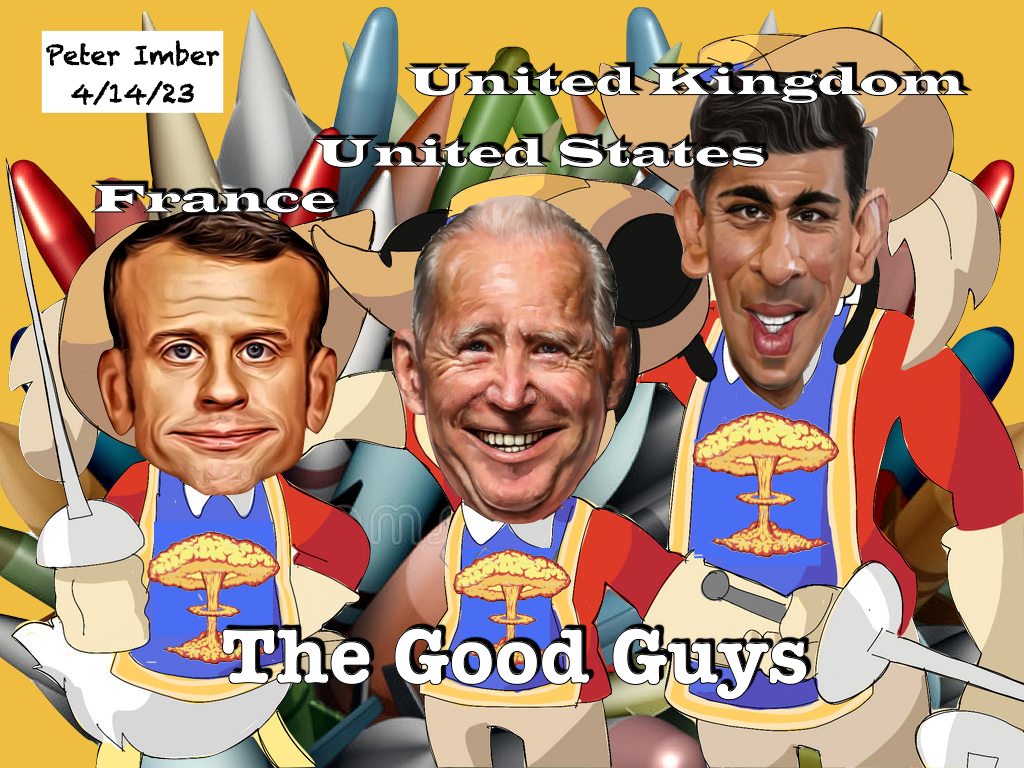
It’s been nearly 88 years since the United States dropped atomic bombs on Japan and no other country which possesses such weapons has been insane enough to use them since.
In fact, until Vladamir Putin’s decision to invade Ukraine and his subsequent veiled threats that he might just use nukes if provoked enough, all but a few of the nearly eight billion of us on the planet haven’t paid much if any attention for decades to the nuclear arsenals possessed by nine of the nearly 200 countries on earth.
Fail-safe became part of the vernacular in the 1960s when it became the title of a book and a movie. Something is fail-safe when it has been designed so that if just one part of a device fails, the entire thing is disabled and no longer functional or dangerous.
Anything is fail-safe until it isn’t of course– re seventh grade: nothing is perfect –but I would have thought whatever security measures existed at the National Guard base on Cape Cod and at any government facility where classified information is accessible would have been less unsafe.
Mr. Reindel did not create his perfect cube and the world didn’t end that day for us so long ago but I’d like to believe that there are things that are near perfect. Today, it just seems too easy to find what you’re looking for and maybe what you’re not on the internet.
Theoretically or maybe all too realistically, I fear the internet may already or in the near future give anyone the potential and opportunity to initiate catastrophe. Call it Mr. Reidel’s perfect cube in reverse waiting to happen. I hope I’m wrong but that’s why I’m replaying the finale of Dr. Strangelove with Slim Pickens straddling that atom bomb and hearing Vera Lynn sing We’ll Meet Again in my head. I’m sorry to sound so gloomy on such a nice day outside.
I’ve thought of an irony about the events yesterday. The suspect– Airman Teixeira –served at that base on Cape Cod not very far from the wireless antenna station built nearby by Guglelmo Marconi and used to transmit the first two way wireless communication between America and Europe in 1903 when President Theodore Roosevelt and King Edward VII communicated using Morse Code.
What a long, strange trip it’s been since then. I’m grateful we’re all not dead yet. Take it away Vera…
—————–
MUSINGS ON A RAINY EVENING
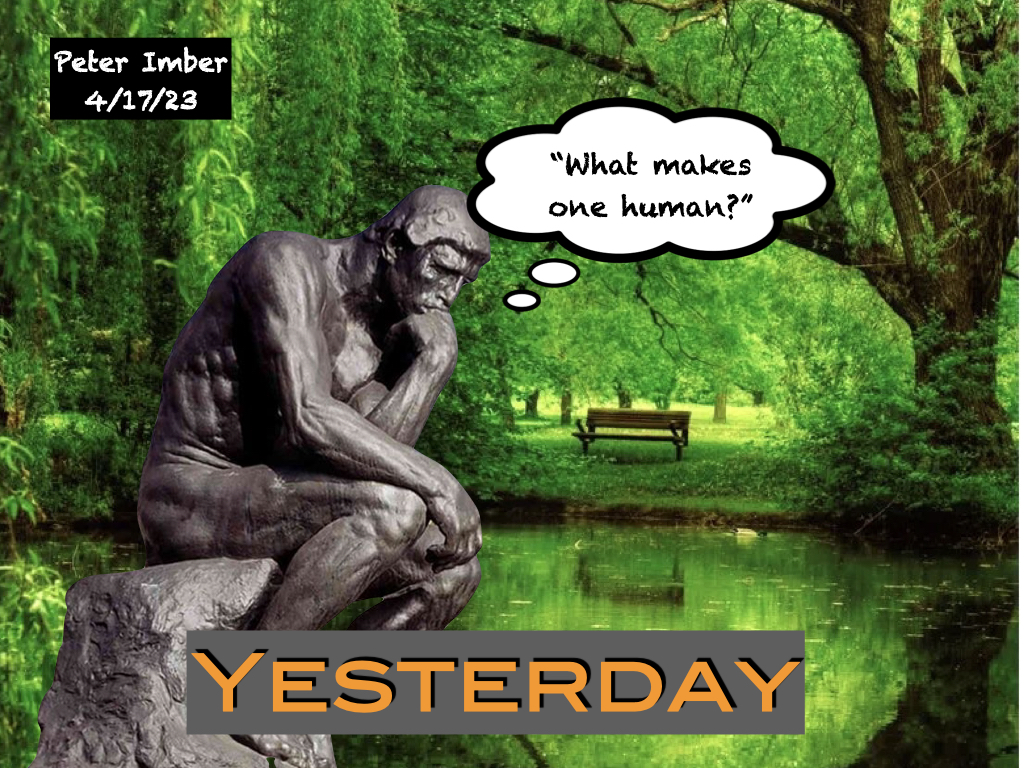


I just learned that Auguste Rodin initially named The Thinker something else –The Poet –when he created his first plaster model in 1881. After the first bronze casting was exhibited publicly– the six foot version that sits in the gardens of the Rodin Museum in Paris –Rodin made or supervised the creation of some 40 others which are now on display or privately owned around the world.
The only Rodin’s The Thinker I’ve ever seen in person is one at the Rodin Museum in Philadelphia but it’s arguably not the most famous statue — at least with tourists –in town. I looked it up and it’s a 13 minute walk from The Thinker to the Philadelphia Museum of Art and a different statue that’s as big an attraction in Philly as Independence Hall and the Liberty Bell.
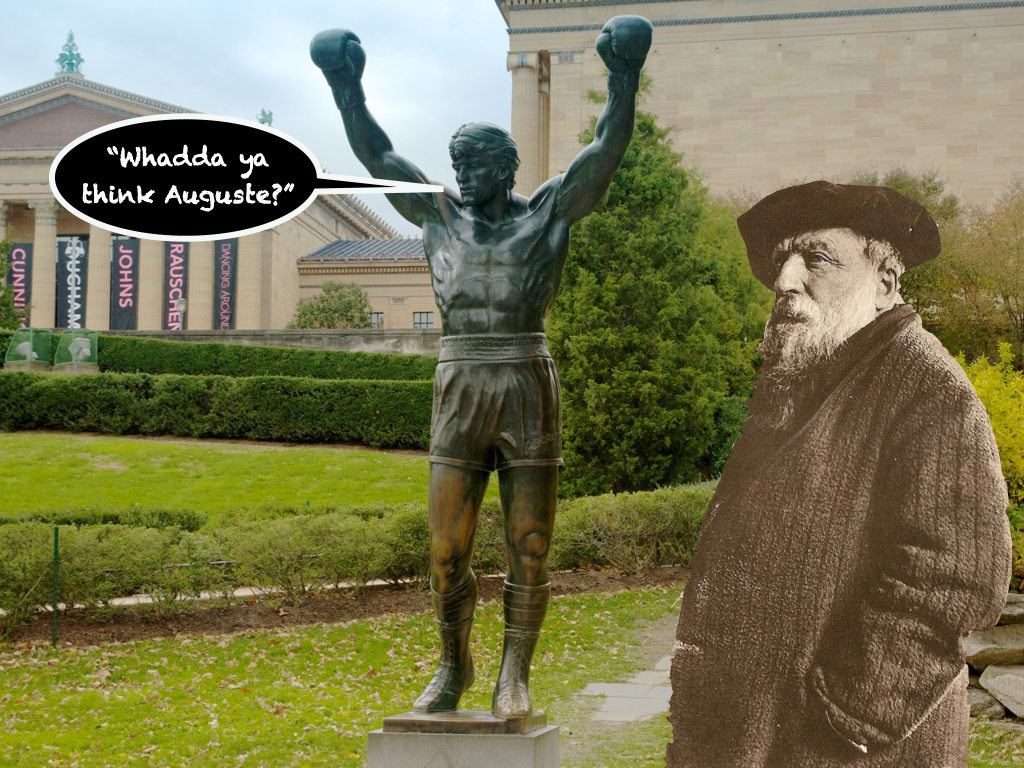
Need a hint? If I always choose provolone on my Cheese Steak sandwich, does that help? Probably not… Ok, it’s a statue of Sylvester Stallone as Rocky and running up and down the museum’s steps was how he trained in all five of the movies. But when the statue was originally put in front of the museum some Philadelphians objected calling it a movie prop and undignified and not art.
For nearly a quarter of a century the statue of the “Italian Stallion” was exiled to the local sports arena where Rocky’s fights took place in the movies until being put back in front of the Museum in 2006.
—————–

In a frame on the wall of my office along with other stuff from my life plus over two dozen reproductions of film posters in foreign languages– e.g., Det Er Herligt At Leve (google it!) –is the sheet of paper with the “Peter Imber Dress Code.”
It’s easy to explain why it’s there and why it was authored by my favorite colleague to have worked worth in my career at ABC News. Brian Rooney felt I needed it and he was right.
If clothes make the man, then I have never made it. Not that there wasn’t the opportunity. My father was a retailer–women’s ready-to-wear. My mother was fashionable and fashion fortunate with a husband in the “Schmatta” business.
Both my parents always dressed well and in the beginning they tried to impress upon me a sense of style of my own. Our home movies show me in a camel hair coat as a toddler. I puked all over it on my first road trip. It wasn’t premeditated although I was told I had been eating only hamburgers at every meal. It did perhaps foreshadow my relationship with clothes for most of my life.
After college in the 60’s where nobody seemed to care about what they wore I lived on a kibbutz for seven years where even white collar job holders often wore blue collar work clothing– blue shirts, blue pants and black work boots. My entire kibbutz wardrobe could have fit in a shopping bag.
During my quarter century in television news I was based in Los Angeles where Levi’s and sports shirts were almost de rigueur at the office and passable outside of it as well. I happily followed suit so to speak. Costco became my outfitter and just how much so was apparent one day in a phone call to a Costco executive I wanted to arrange an interview with. When asked, I confessed to him that I was a Costco member.
He: “How many things are you wearing right now that you bought from us?”
Me: “Hey, my pants, my underwear, my socks, my watch… maybe my shirt.”
Yes, I was a walking advertisement for the brand.
Brian Rooney was my polar opposite when it came to apparel. Of course he was also an on camera correspondent and I was an off camera producer so how he looked really mattered but how I looked eventually mattered to him, too.
It actually had begun with shoes after I was diagnosed with a foot injury called plantar fasciitis. The orthopedist’s office had another description for it– “Topsiders Disease” –named after the shoes I had been wearing for years that had no arch and as a result had most likely inflamed mine.
“You’ll never regret buying good shoes,” Rooney advised me at the time.
A few days later he came into my office and threw a piece of paper in front of me with a more comprehensive set of guidelines. Its title was “Peter Imber Dress Code” and although it didn’t instantly change my life, it did immediately change my footwear buying habits. I purchased my first $200 pair of shoes. They were for golf and at the time the most comfortable shoes I had ever owned.
I left Costco behind in 2010 when Jo and I moved to Maine. Actually, Costco left us behind as well since presently the closest one to where we live now is about a four hour drive.
But when one retailing door closes another one opens and in Maine that’s abundantly clear which one. The state tree is the pine. The state’s clothes tree is L.L. Bean and quickly, I was all in– free shipping, a generous return/replace policy and a flagship store open 24/7, what was not to like?
L.L. Bean had it all. Shirts and pants and sweaters… But was I again falling into my previous Costco modus vestium? So, at Jo’s urging I branched out. I bought a pair of dress khakis from Orvis that I even dry-clean. I have a beautiful shirt and tie from Brooks Brothers and three handsome sweaters purchased at Bloomingdale’s.
As for shoes, I buy Ecco and Naot and I was an early word of mouth influencer for Hoka. I value comfort and quality now and pay for it. And I own not one but two parkas from The North Face. Wearing the same parka six months of the year up here gets boring even for me. Have I finally evolved as someone with a sense of or at least an aspiration for style?
Hmm… I guess I’m not all the way there yet. Jo has pointed out that I have an abundance, no make that a preponderance of striped shirts hanging in my closet. So, there’s work left to be done and before coming up here to my computer I realized my clothing choices may just have narrowed once again and I might be regressing.
As I write this I am wearing what might be called the “Full Carhartt”– sweatshirt, jeans, socks… And yes, I’m quite comfortable. Today, the wind isn’t whipping and it’s not that cold outside but I guess if I might never be a fashionista, I’m at least always ready for a Maine Nor’easter!
And here’s ZZ Top from when records were vinyl albums and this song of theirs waxed sartorial…
—————–
The following “conversation” took place this morning…

Yes, the image probably “does not align with ethical or moral guidelines” but that’s the point! I’m wondering where you received your own moral compass from. So Chat GPT, I guess I’ll have to ask Norman Rockwell to create it himself…

What do you think Chat GPT? Of course I don’t think that you think you think– at least not yet. But here’s one last question…

You know, you talk a very clinical and inoffensive game and I’m pretty sure I wouldn’t enjoy having a cup of coffee with you. Sometimes “subtle and indirect” just doesn’t cut it. But that’s just me being human… I think!
—————–


Breaking News!
Was CNN Trying to Top Fox?
“If you don’t win you’re going to be fired.
If you do win, you’ve only put off the day
you’re going to be fired.”
—Leo Durocher
—————–

WINNER, WINNERCHICKEN DINNER!
I’ve heard this line occasionally and never searched for its origin until now. I’ve found a couple of explanations and both seem plausible.
One theory dates back to the Great Depression and the game of craps. As a player shook the dice, he might have been heard to shout, “Winner, winner chicken dinner!” in the hope of rolling a number that would win him enough money to eat.
A different story suggests the phrase originated as a promotional ploy at a casino in Las Vegas a half century ago when gamblers were offered chicken dinners that included a potato and a vegetable for about $2. The low price was an incentive to play more at the tables where the standard bet was $2. If you won a bet, you had the money for a meal.
Both of these anecdotes imply that the winners ended up eating a chicken dinner and only paid $2 for it. Of course they fail to take into account how much money the dice roller, the blackjack or roulette player may have possibly already lost before winning enough to pay for their food.
So, what does this have to do with the settlement last week between Fox Corp. and Dominion Voting Systems? Well, I think it’s fair to say both sides were in a way shooting craps in an alley or placing a bet in the casino.
A jury trial would have been a risk for either of them. Making the settlement was a prudent choice for Dominion. Whatever the verdict the appeals were likely to have stretched things out for years before the company ever saw a check and there was no guarantee that a jury would have decided in their favor.
For Fox courtroom testimony by its executives and talent could have revealed even more damaging information about how its news division operates beyond surely providing the stage for further embarrassment.
Is there a “winner,winner” here? Certainly, Dominion has had its good name reaffirmed and despite yesterday’s firing of its most popular and noxious provocator Tucker Carlson, Fox still has egg production continuing pretty much uninterrupted in the news channel henhouse.
Has anything really changed? Will Fox be chastened? My own opinion is they’ll just be more careful. I bet the number of emails and texts are way down at Fox News headquarters and that there is already a lot more walking than before into and out of offices. If I had the contract to service the water coolers in the building my deliveries are probably already up. And old fashioned telephones hard wired internally may well be installed in short order.
As for Rupert Murdock… He might even be sulking and thinking that three quarters of a billion dollars could have bought a good portion of the world chicken dinners.
—————–

Let me be clear. I am not an admirer of Clarence Thomas; not as a Supreme Court Associate Justice and not as a person.
The recent revelations concerning his acceptance of gifts of travel and other items and failing to report any of this, as well as the disclosure of his transacting a real estate sale that he was required by law to reveal but didn’t, are examples of exactly what the nation doesn’t need at this time– more evidence of unethical behavior that adds to the ever growing archive of acts that damage the faith and trust of Americans in our government.
But to be fair I need to point out that although Thomas likely is the most egregious case of poor ethics by a member of the Supreme Court, he is by no means alone. Below is a list of other justices who have been bestowed with similar perks and not always reported them in a timely manner compiled by the Supreme Court watchdog group Fix the Court.
Significant, And Often Unreported Travel
by Supreme Court Justices
2023
Justice Elena Kagan traveled to San Diego in January to dedicate a new navy ship, with the ship having been built by General Dynamics, a frequent SCOTUS litigant that in 2022 won a five-year, $298-million contract to upgrade the judiciary’s IT systems. Under current rules, the public won’t learn who paid for Kagan’s trip until June 2024 at the earliest, when her annual disclosure is released.
2022
Justice Samuel Alito spoke at an event in Rome in July under a banner that read, “Notre Dame Law School Religious Liberty Initiative.” RLI and affiliated faculty have filed amicus briefs in five SCOTUS cases in the last three years, and the public will not know if, in fact, RLI or a connected entity paid for Alito to travel to Rome until June 2023, or nearly a year after the speech was given.
2021
Justice Amy Coney Barrett gave a speech at the McConnell Center at the University of Louisville in September, standing next to Minority Leader Mitch McConnell, during which she said, “My goal today is to convince you that this court is not comprised of a bunch of partisan hacks.” The speech was preceded by dinner with Barrett, McConnell and a dozen unnamed friends of the senator.
2018
In fall 2017, a company founded by businessman Morris Kahn called Amdocs was a SCOTUS litigant, and the Court’s denial of cert. in the case preserved Kahn’s lower court victory. There were no recorded recusals. The following year, Justice Ruth Bader Ginsburg was Kahn’s most- or all-expenses paid guest on a tour to multiple countries in the Middle East.
Justice Clarence Thomas omitted from his disclosure the free transportation, food and lodging he received from Creighton University School of Law, University of Kansas and the University of Georgia in 2017-18. After Fix the Court brought this omission to the Court’s attention in 2020, Thomas amended his reports, though the amendments were not made public until 2022.
2017
Justice Kagan spoke at the University of Wisconsin Law School in September during the Dean’s Summit, an annual gathering for those who pledge at least $1,000 per year to the school. Included in her visit was a free ticket to a Wisconsin football game, where she sat in the chancellor’s box and which was not reported on her annual disclosure.
2016
Justice Sonia Sotomayor omitted from her disclosure six free or reimbursed trips, including one to the University of Rhode Island, an institution funded by R.I. taxpayers, where the school paid for up to 11 rooms in one of the state’s fanciest hotels for her, her security detail and possibly some friends; paid more than $1,000 for her flight; and gave her a five-car motorcade from the airport.
The five other free-trip omissions were to the (public) law schools of the University of Illinois, University of Minnesota and University of Wisconsin and to Rutgers University and the University of Alaska. Sotomayor’s disclosure report was amended in 2021 and made public in 2022.
In fall 2015, a company controlled by businessman John Poindexter called MIC Group was a SCOTUS litigant; the Court’s denial of cert. in the case preserved Poindexter’s lower court victory. There were no recorded recusals. A few months later, Justice Antonin Scalia flew on a private plane, furnished by Poindexter, to stay for free in a $700-per-night room on the businessman’s hotel/ranch.
Justice Stephen Breyer attended a $500-per-plate dinner at the University of Texas at Arlington in September with finance and oil executives ahead of his talk at the school. The high price suggests the event was a fundraiser — ethics rules, to the extent they’re followed, generally prohibit justices from speaking at fundraisers — and the school’s name does not appear on his annual disclosure.
2013
Justice Breyer flew on financier David Rubenstein’s private plane in August to attend a wedding in Nantucket. Rubenstein has been a supporter of the Supreme Court Historical Society, which former members have described as a conduit of access to the justices. And if reported, the events and perks (hotels, flights, meals) were reported many months, even up to a year and a half, after the fact.
Supreme Court Chief Justice John Roberts summers in Maine and not far from where Jo and I live year round. I’ve never met him or seen him here but I know he frequents restaurants that we do, attends events that we have and that he has even played golf at my home course.
A high school classmate of Jo’s handled the legal work for the house he purchased on an island off of Port Clyde and I’m told that ever since the guy likes to jokingly call himself the Chief Justice’s lawyer. The Supreme Court will recess for the summer soon and maybe I’ll have my first John Roberts citing and I certainly won’t be laughing or even smiling.
Recently, I wrote about Roberts and compared him to a baseball umpire. After all, he testified at his confirmation hearing almost a quarter of a century ago that he saw his role as chief justice to “call balls and strikes and not to pitch or bat.”
Roberts’ has now declined the Senate’s invitation to appear before it to answer questions about how his court deals with “umpiring” its own ethics. To continue with the baseball analogy, that means a tarp will continue to remain on the infield and the players out of sight.
Last season Major League Baseball allowed
pitchers and catchers to transmit signals electronically between each other for the first time. It’s an innovation that was adopted as an attempt to eliminate “sign stealing”– a part of baseball that has always been considered cheating but until now very difficult to detect and enforce. Supreme Court justices might not be stealing but unless we find out how or even if the Court polices itself how we will know?
It was in his address to Congress over a century ago that President Theodore Roosevelt spoke these words…
“No man is above the law and no man is below it; nor do we ask any man’s permission when we require him to obey it. Obedience to the law is demanded as a right; not asked as a favor.”
How ironic and unacceptable it is that the one branch of our federal government that is responsible for interpreting our laws for everyone cannot be held accountable to comply with them. I’d call that an unlevel playing field.
—————–

Somehow I’ve managed to be in the vicinity when famous Brits pass away.
It was on this day in April— the 29th —in 1980 when Alfred Hitchcock died in Los Angeles. I was in LA and an MFA student at UCLA’s film school and just happened to be taking a course on Hitchcock that term.
Fast forward to last September when Jo and I traveled from London to Edinburgh. Within an hour of our arrival in Scotland we learned that Queen Elizabeth had died at Balmoral castle there.
Ok, it’s a stretch but maybe that’s why I haven’t received an invitation to the coronation of King Charles which will take place in Downton… oops, sorry… Westminster Abbey a week from today.
I wonder if Charles has ever seen a Hitchcock film? I don’t know if his mother ever did either but her interaction with Hitch could be entitled Pomp and Pompousness.
For all his success and fame Alfred Hitchcock never received an Academy Award for directing any of his movies. He was nominated five times and lost to the likes of John Ford, Billy Wilder and others.
Hitchcock wasn’t even nominated for Vertigo which has been consistently considered one of the best films ever made although not by me— too creepy. In 1968 the Academy attempted to make amends and presented Hitch with its Lifetime Achievement Award. His acceptance speech was two words, a sarcastic “Thank You” and he immediately turned and left the stage.
If he was grouchy about the Oscars, Hitchcock was apparently in just as foul of a mood toward British royalty. In 1962 Queen Elizabeth offered him a title– Commander of the Order of the British Empire –that he turned down. A CBE is a step below a knighthood or KBE and one who receives a CBE is not addressed with the honorific prefix “Sir.” In Hitchcock’s view it was not enough of a prize to do honor to his contribution to British culture.
In 1979 only months before his death he was finally given– and he accepted –a knighthood. When asked why he thought it had taken so long for the Queen to bestow the honor Hitch replied, “Maybe it was carelessness and she forgot.”
And so in the spirit of mean spiritedness that Hitchcock displayed rightly or wrongly toward awards and titles and the British monarchy itself, I have put together a Hitchcock Film Festival to be shown over the next week leading up to the coronation of King Charles III.
I have adapted the movie posters to reflect how Hitchcock has cast the royals in his remakes of each film that will be screened. And if Charles shows up for the screenings he might just revert back to being the Prince of wails…

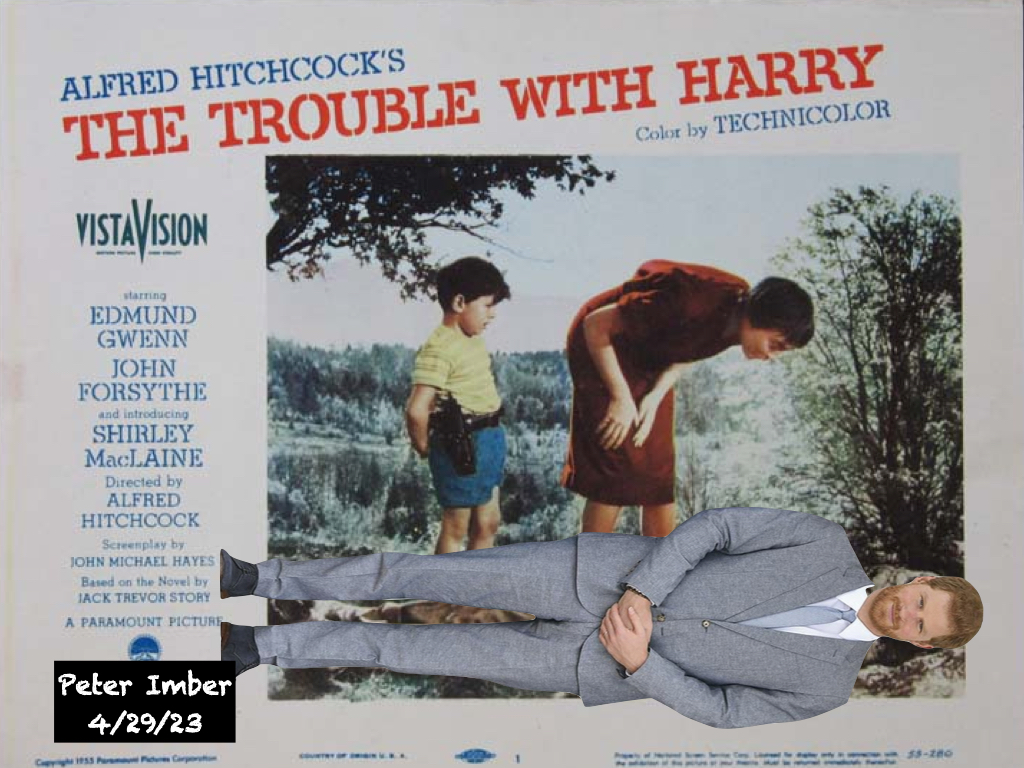



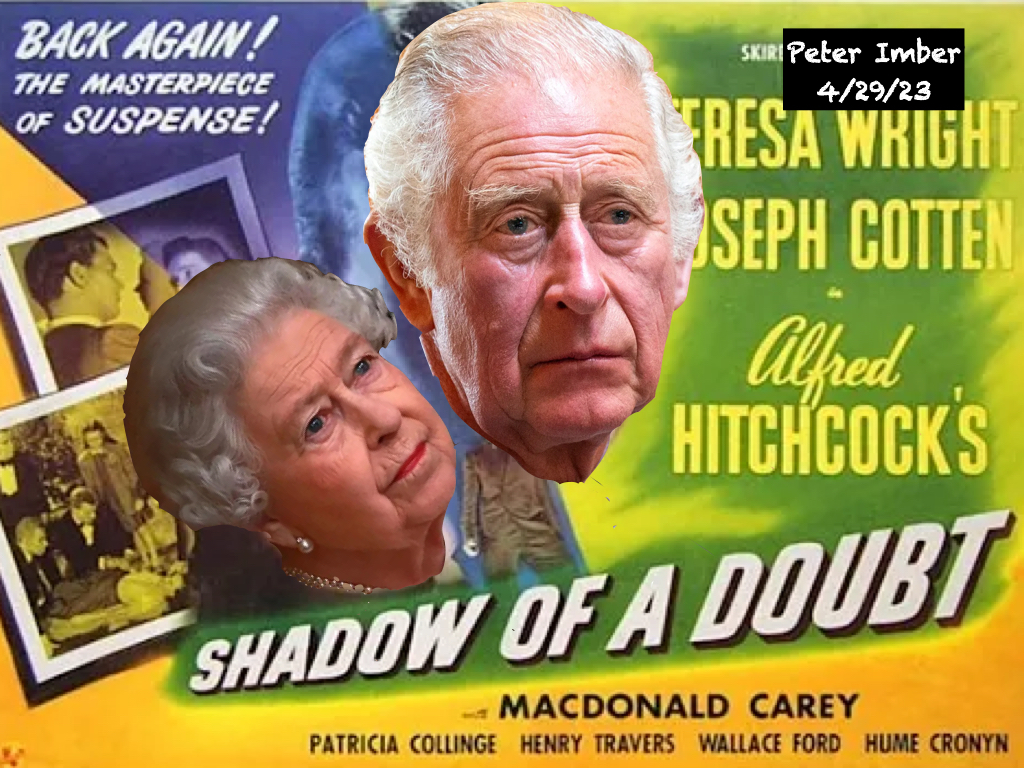
________________

 pawnedaccordion