
—————–

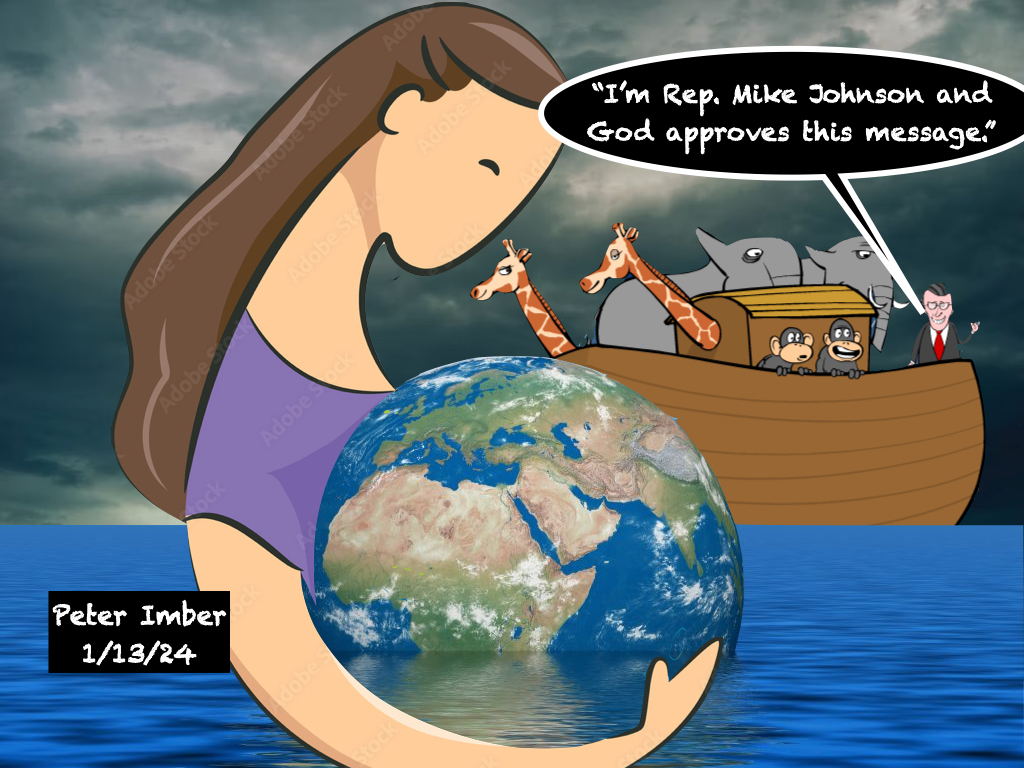
The Galapagos Islands are famous as the location where Charles Darwin researched what became his theory of evolution. Along with the Great Barrier Reef in Australia the Galapagos is considered one of the most pristine places on earth. The news that the islands are now a conduit for the cocaine trade is alarming and depressing.
It is approaching six decades since I was in college and America then and now seem so different. That’s an illusion. It’s easy to remember those four years as splendid isolation from the problems of the world beyond my campus but that’s nostalgia for you. There was turmoil in America then as now– civil rights, the Vietnam War, riots, assassinations…
The sociologist Robert Nisbet defines alienation as, “The state of mind that can find a social order remote, incomprehensible, or fraudulent; beyond real hope or desire; inviting apathy, boredom or even hostility.”
It’s perhaps wishful thinking to believe I can pinpoint the moment I believe I became alienated. It was 1967 and I picked up a record album by a band I had never heard of and placed it on a turntable. The record was physically warped and I could only play a couple songs. One was titled You’re Probably Wondering Why I’m Here. It seemed to fit the moment.
The band called itself the Mothers of Invention. If you’re a Baby Boomer like me, you’ve probably heard of its leader and composer of its songs, Frank Zappa. He has left us flashes of brilliance as a musician and just as many stories of his nastiness as a person. I bought most of his albums and admittedly, sometimes in spite of the music for their cool album covers by an artist named Cal Schenkel. The titles were as off the wall– Burnt Weeny Sandwich, Weasels Ripped My Flesh — as the names Zappa bestowed upon his children– Dweezil and Moon Unit.
I think, or at least convinced myself, that I had outgrown my alienation many years ago but that’s another story. I’m certainly not a sociologist but could it be that Americans’ alienation a half century ago aside from the more often enumerated other grievances is a large part of what has metastasized into our society’s fragmentation today?
When I read the Washington Post article about the emerging drug world presence in the Galapagos another song on that Mothers of Invention album titled Trouble Every Day leapt into my head from out of nowhere. It seemed sadly suitable. Here are the lyrics.
Well, I’m about to get sick
From watchin’ my TV
Been checkin’ out the news until my eyeballs fail to see
I mean to say that every day is just another rotten mess
And when it’s gonna change, my friends, is anybody’s guess
So I’m watchin’ and I’m waitin’
Hopin’ for the best
Even think I’ll go to prayin’
Every time I hear ’em sayin’
That there’s no way to delay that trouble comin’ every day
No way to delay that trouble comin’ every day
Frank Zappa and the Mothers of Invention recorded Trouble Every Day and You’re Probably Wondering Why I’m Here on their debut album Freak Out in 1966.
—————–

Oh, the candidates running may be frightful
And their ire sounds certainly spiteful
But since they have sunk so low
Let it snow! Let it snow! Let it snow!
—————–

—————–

—————–
What is easier for a young person to read?

The original document of the United States Declaration of Independence or…

...the menu at a restaurant?
Yesterday I learned that a few months ago a law was passed in California to make something old new again. This past October a bill introduced by a former elementary school teacher made cursive handwriting instruction required in the state’s elementary schools. California isn’t the first state to bring back the teaching of cursive. The number is up to nearly two dozen states after having declined to about half that a decade ago.
When I was producing stories at ABC News which now seems like back in the stone age, I wanted to do one about how cursive handwriting wasn’t even being taught then in very many schools and especially in public school systems. I had read that a company that published handwriting instruction materials had divided its annual national student handwriting contest into two divisions– one for public and one for private schools because the private– particularly Catholic –schools which were still teaching cursive, were winning at all levels every year.
My pitch for the story was rejected. But maybe if I had realized and made the point that those kids who didn’t know cursive could not likely have been able to read the original document that is the United States Constitution but could instead have ordered off a menu in a restaurant, I’d have had a better chance to have gotten to do it.
Oh, and the private schools are still doing very well in the handwriting contest…
https://www.zaner-bloser.com/national-handwriting-contest/current_winners.php
I’m happy to learn that the teaching of cursive handwriting is coming back although my own experience learning to write some 70 years ago was not a happy one. We had pencils and crayons for most activities but when it came to handwriting instruction we used inkwells that fit into a hole in our desks and pens with sharp points that you dipped into them. I don’t recall that anyone in my class ever stabbed another with one of these but nevertheless I needed to employ a defense strategy.
I’m left-handed and being told I needed to slant my budding penmanship at the same angle as the right-handers, I often smudged what I wrote as my hand moved across the page. Hence, the only consistent Cs on my report card were for handwriting. Well, not the only ones. For several years we had an art teacher who didn’t like me although I guess I could also blame my art grades on the scissors we used which were made for those who were right handed. Hey you righties, try using a left handed scissors sometime!
And yes, in college I was one of those who took up two seats in lecture hall classes so I could use the lectern for a right handed person from the seat I wasn’t sitting in. But who takes handwritten notes anymore? I assume today the problem has been solved.
As newspaper people say I have buried the lead here or at least my main thought. Artificial Intelligence— A.I. –is almost as big a headline grabber as Taylor Swift or Donald Trump these days. But I have a new competing acronym for A.I. How about the consequences we are experiencing as an impact and as I see it, the reverse of A.I. and from other sources of ever faster moving technological change?
I propose we call them Anachronistic Intelligence. Intelligence we are surrendering and shedding along the way as our species slithers forward.
Sure, we no longer need to know how to make a fire without a match or add, subject, multiply and divide large numbers without a calculator. But what about the tasks that keep our brains engaged and agile? Don’t we still want to know the multiplication tables? Don’t we still want to be able to read old letters that once upon a time were handwritten?
We have a new car that senses when it needs to operate the windshield wipers if it rains and when it needs to dim the headlights at night for oncoming traffic. I have the option of using these features or not and so far I have chosen to let them handle what once were my taks. And I know if I live long enough, I’ll then probably want to have a car that drives me where I want to go by itself.
How much of me might be left of me by then?
—————–

I bought guacamole yesterday at the supermarket even though the Super Bowl isn’t until Sunday. I thought if I waited until closer to game time, there might not be any left on the shelves. There seemed to be plenty but something else surprised me. Guacamole was on sale.
I had expected that with a huge built in demand for guac this weekend that prices would be higher. It’s a given that at millions of Super Bowl gatherings every year guacamole and tortilla chips are essential. It might even be one of those crazy Super Bowl bets that we’ll see a shot of Taylor Swift wiping the stuff off her face– Hey, the game is in Las Vegas. But I guess avocado producers must have determined that food gorging is a better play call than price gouging.
Guac may be the right stuff but if one’s launching a party this weekend, you better have more on hand than just it. Years ago I wrote articles for a website called Bleacher Report. One of them, about what one needs to provide for a winning Super Bowl Party, is still findable on the internet and gets its share of hits this time of year.
I can’t vouch for all my information from 12 years ago still being completely accurate today but I’d put all my chips on the table if I were to bet on it.
Top 10 Things to Eat at a Super Bowl Party!
by Peter Imber
February 3, 2012
Nobody watches the Super Bowl on an empty stomach, and here are some other facts for you to digest:
The average number of people at a Super Bowl Party is 17* —only five percent of the TV audience watches the game by themselves —so, whether it’s potluck, take out, home cooking or catered, nobody is going to go home hungry.
Super Bowl Sunday ranks behind only Thanksgiving as the biggest food consumption day of the year in the United States** and the proof is in the Pepcid. There is a 20 percent increase in antacid sales in the 24 hours after the game.***
For some, the food and drink take an additional “Excessive Celebration” toll. About six percent of American workers will call in sick on Monday.****
*Treehugger.com
**American Institute of Food Distribution
***7-Eleven Stores
****Challenger, Gray & Christmas, Inc.
Halloween may be costumes and candy, Thanksgiving turkey, Valentine’s and Mother’s Day flowers and the 4th of July fireworks, but if you’re hosting a party on Super Bowl Sunday, you damn well better make sure you cover the spread!
And here are my Top Ten Essential Super Bowl Foods for doing just that.
10. Popcorn
Popcorn is often mentioned as a healthy snack food, and this is as healthy as this list is going to get. When I buy popcorn at the movies, it always feels like it weighs nothing, but anywhere from four to eight million pounds of popcorn are going to be eaten across the country Sunday*—that’s plenty of nothing.
*Calorie Control Council
9. Hamburgers
Move over apple pie. Americans eat 50 billion hamburgers a year and Super Bowl parties will offer their fair share, but hamburgers aren’t a first round pick this weekend. That’s because in most parts of the country it’s too cold to grill outside and we eat so many anyway that burgers will most likely be benched this weekend. Nevertheless, a really good one is always a welcome audible at the chow line.
8. Potato Chips
Estimates vary widely on how many potato chips will be eaten on Super Bowl Sunday, from a low of 11 million to a high of 28 million pounds*. That kind of consumption could add up to 27 billion calories*, but who would possibly want to watch football without them?
*Snack Food Association
So, support your local potato chip maker. Don’t buy Frito-Lay’s or just any old chip. Find ones that are certifiably unhealthful. My favorite are Dieffenbach’s. They’re made in Womelsdorf, PA near where I grew up and admittedly the most notorious I know of; made with just potatoes, lard and salt. They’re also the best chips in the world and a big part of the reason the ER at the Reading, PA hospital is one of the busiest in the country.**
**Becker’s Hospital Review
7. Pizza
Pizza is a $30 billion a year enterprise in the United States and on an average day Americans buy 11.5 million of them.* Super Bowl Sunday is the biggest slice of business of the year for pizza restaurants, and the big chains like Papa John’s, Pizza Hut and Domino’s will sell twice as many pies as they do on any other day.*
*Pizzatoday.com
Many of Sunday’s pizza orders will be delivered and for the drivers bringing you those pizzas, the Super Bowl means more tips. It also means a higher risk of auto accidents and insurance companies are very aware of that. Over the past five years, for example, Fireman’s Fund Insurance Co. has recorded a nine percent increase in auto insurance claims resulting from pizza delivery accidents on Super Bowl Sunday.
And here’s a surprising fact. Where do you think the highest grossing single location independent pizzeria in the nation is located? If you guessed New York or Chicago or any place in the Lower 48, you’d be wrong. It’s in Anchorage, Alaska. Annual sales at Moose’s Tooth Pizzeria are about $8 million. They must have a hell of a delivery fleet and I wonder if it includes sleds?
6. Ribs
Barbecued ribs are not a great choice for something to devour in front of the television. They’re messy and require focus that may distract you from the game. But how many of us are actually watching the game that closely anyway? A rack of great ribs is hard to pass up. No carnivore is going to complain if they miss a play—at least not this one.
5. Shrimp
Shrimp are a high end finger food and while other offerings should make it into the fourth quarter, shrimp may not make it through the first commercial. Better have a spare wheel in the fridge if you’re serving them.
4. Subs and Sandwiches
The trick with subs and sandwiches is to keep them small. Not everyone wants to commit to a big one but if the offerings are good, people tend to work up to or even pass the equivalent of eating a whole one anyway. And sandwiches are a real crowd pleaser because you can mix it up — roast beef, turkey, ham, veggie, Italian. This is the “one size fits all” of Super Bowl food.3. Chili
Chili is all about bragging rights. Have you ever heard of a hamburger cook off? Great chilis are like great quarterbacks, there aren’t too many of them, but if you find one, you’re going to be happy they are on your team that makes them a welcomed invite at any bowl game.
2. Chicken Wings
If the Dallas Cowboys can call themselves America’s Team, then poultry farmers are probably entitled to call chicken wings “THE Super Bowl Party Food.” Battered, basted, roasted or fried, chicken wings may have gotten their start in Buffalo but after the obligatory dip, wings are now Super Bowl Sunday’s go-to plate.
According to the National Chicken Council, more than 1.25 billion wing portions will be consumed during Super Bowl weekend. That’s more than 100 million pounds of wings,and if the wings were laid end to end they would circle the circumference of the Earth more than twice.
(UPDATE! Is it just me or are there millions more wing nuts in the country today than in 2012.)1. Guacamole
This is the mandatory Super Bowl food. A party without this dip will be intestinalized as the worst Super Bowl in history for those who are forced to suffer through it. So get out the sour cream and onion soup mix or salsa or even Cheez Whiz and succumb. Go green or go home!
Super Bowl avocado consumption is estimated at between 54 and 70 million pounds, enough to spread guacamole across a football field to a height of 12 feet.* Turns out avocados have been around for over 10,000 years but guacamole came much later and is thought to have been made first by the Aztecans in the 16th century. Why did it take so long to discover this? Well, archaeologists believe it was because the guac was at the bottom of a seven layer dip.
* Hass Avocado Board
There it is! A list of what you will either want to prepare or should expect on Super Bowl Sunday. And here’s an extra bit of gastronomic advice…
Part of the secret of success in life is to eat what you like
and let the food fight it out inside. –Mark Twain
—————–


—————–
On Sunday I watched the Super Bowl with friends. The matchup between the Chiefs and 49ers didn’t live up to the hype for me– the football rarely does. But the game did have the drama of needing an overtime to decide the winner.
Even if it had been more exciting, the game was really just the fun annual reason for a get together to share guacamole and chips as well as a lot of laughs. I’m sure that’s true for a vast number of viewers and especially those who don’t know a blitz from a blintz.
Of course this year’s contest had special added appeal for many who might not have ordinarily tuned in and who did so specifically this time for just 55 seconds of an event that took four hours and 18 minutes from the opening kickoff to the game-winning touchdown.
Somebody took the trouble to break those seconds down and point out that Taylor Swift’s less than a minute of Super Bowl screen time meant she was part of the television coverage for .0035% of the broadcast.
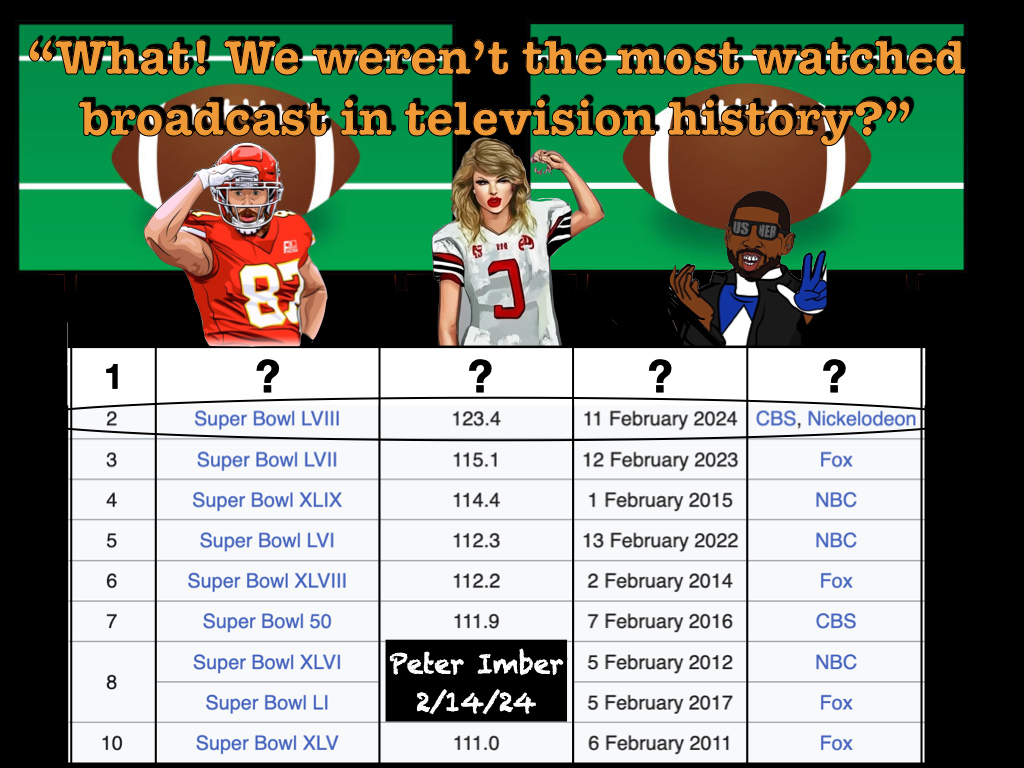
But helped by the hyperly hyped romance between Swift and her football hero, the Kansas City player Travis Kelce, the game is now being called the most watched event ever in the history of American television. But was it? Well, it depends on how you want to run the numbers.
According to the Nielsen ratings, Sunday’s game averaged 123.4 million viewers across today’s television and streaming platforms which was a seven percent increase from last year’s Super Bowl viewership that was claimed to have set the previous “most watched American TV event ever” mark.
But of course things get interesting when coming up with an accurate figure for how many people may be actually watching at any one time. Afterall somebody’s gotta go get the pigs-in-the-blanket out of the toaster oven.
We were only four at our Super Bowl get together but as I wrote last week, the average number of attendees at a Super Bowl party is considered to be 17. So, go figure! And make that both figuratively and literally and crunch the numbers as well as any leftover chips while you’re calculating.
The Nielsen Company– the historic authority for counting TV viewing eyeballs –was founded by A.C. Nielsen in 1923 just four years before the first demonstration of an invention by a 21 year old named Philo Farnsworth that became the basic technology for modern television. Mr. Nielsen is also credited with devising the approach to measuring sales results which turned into the fundamental principles of market share.
The application of Nielsen’s methods was first applied to television viewing in 1950 and I’ll digress for a moment to illustrate how quickly popular culture became a draw for TV audiences that sometimes eclipsed even television broadcasts of historic events.
It was January in 1953 and a comedy– the term sitcom hadn’t been coined yet –had become the most watched program on American TV. I Love Lucy was in its second season and its star was expecting a baby. The show had worked Lucille Ball’s real life pregnancy into the storyline and on that night Lucille’s Lucy went to the hospital to give birth to her TV son Little Ricky.
There were fewer than 20 million television sets in American homes on the night of January 19th in 1953 but for that episode by Nielson’s measurement almost three quarters of them were tuned into the program which was extrapolated to be an audience of 44 million people.
The next day– January 20th –was the Presidential Inauguration of Dwight Eisenhower. It was broadcast nationally and it turned out that although the country may have liked Ike, they loved Lucy more. Eisenhower’s swearing in ceremony drew not even half the audience; just 19 million viewers.
But back to football… The number 2 line on the chart of today’s Homemade Cartoon indicates that Sunday’s Super Bowl/Taylor Swift game wasn’t according to other sources than Nielsen, the most watched event in the history of American television. So, what was number 1? Well, it wasn’t pop culture. It was however a significant moment in the history of all mankind…

It is believed between 125 and 150 million people in the United States watched the moon landing of Apollo 11 and its astronauts aired live on all of the three major American television networks at the time on July 20th, 1969. I saw it. Did you?
(When I started writing this I was not aware that yesterday NPR’s TV critic had a similar take on Sunday’s Super Bowl TV audience. I’m not saying that great minds think alike but maybe lesser ones sometimes may have similar thoughts.)
—————–
Jo and I have been watching the series All Creatures Great and Small. It’s a remake of the original series that ran from 1978 until 1990 which I never saw. Frankly, I’m very happy watching it because I’m pretty sure nothing bad is going to happen.
Farm animals do get sick and pets injured but the human characters at least so far have been spared from harm and tragedy. There are just so many truly bad things happening in the world at the moment I don’t need to entertain myself by seeking out additional exposure to them.
Years ago I stopped going to nearly any movie that I knew beforehand had scenes of violence but I still can be disturbed by films that others enjoy or find praiseworthy. Two recent examples I suffered through were Saltburn and Poor Things. The latter received 11 Oscar nominations.
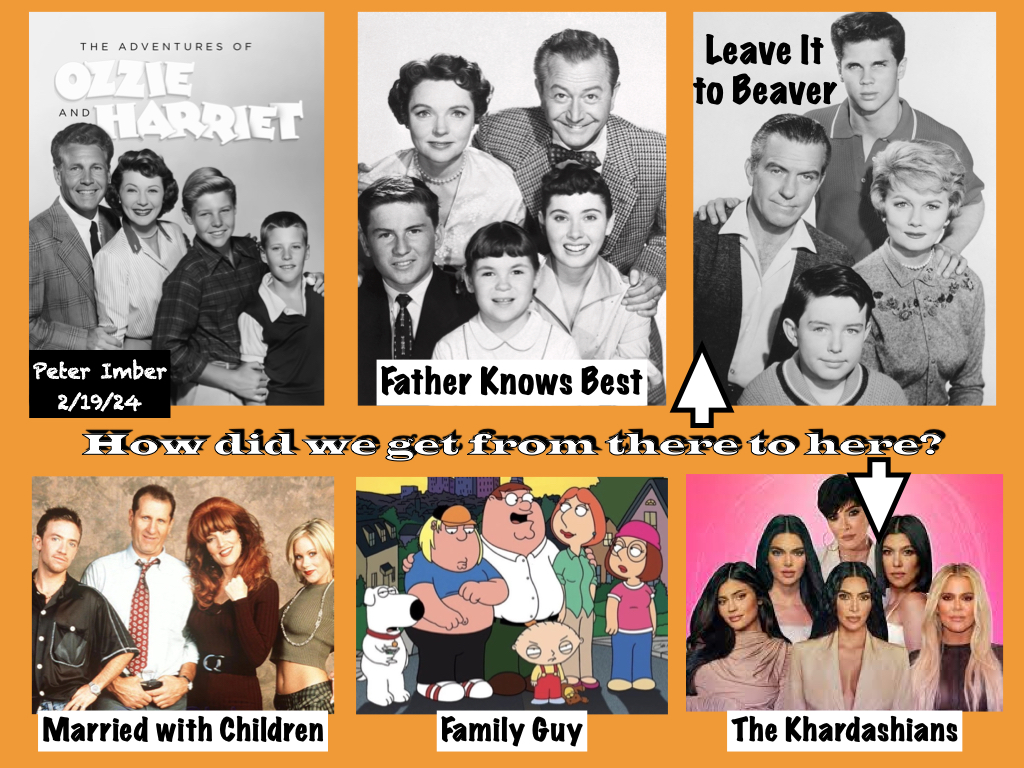
Perhaps I’ve never gotten over the comfort I felt from watching The Adventures of Ozzie and Harriet when I was a kid growing up in the 1950s. Wednesday evenings at 8 I was in front of our Magnavox black and white set that wasn’t even the size of the screen of the desktop computer I’m using as I type this.
I’ve mentioned before that I have about 100 episodes of Ozzie and Harriet that rest on a shelf after having made Jo watch with me as I’ve collected them. She’s only enjoyed– barely –the ones when David and Ricky were old enough to be taking their girlfriends to the local malt shop.
The early nuclear families in sitcoms were almost exclusively heterosexual parents with two kids where the husband was at work all day (Ozzie Nelson of course was the well known and mysterious exception.) and the wife was a “homemaker”; a term you won’t hear anymore but it was I guess an apt description of the job.
Harriet Nelson even did the commercials for the Hotpoint appliances she used in her kitchen and, as Jo pointed out to me, it was humanly impossible for her to have tied the large perfect bow on the back of her apron which she wore a good portion of the time.
Ozzie and Harriet and other early sitcoms– Father Knows Best, Leave It to Beaver, The Donna Reed Show –were what have been called portrayals of “The Happy Perfect American Family.” Of course they were as unreal as Harriet’s bow but were they harmful?
I don’t know but it was a time when much of the country felt good about itself and optimistic about the future. In the 1950s four out of five of us would have trusted the government according to Gallup. To my knowledge not a single kid at my school had a parent object to our getting polio shots when we were in second grade in 1955.
Americans seemed pretty much on the same page but life– married or otherwise –certainly wasn’t perfect. I learned the three Rs at school but I can think of three As– alcoholism, adultery and anxiety — that were kept pretty secret back then.
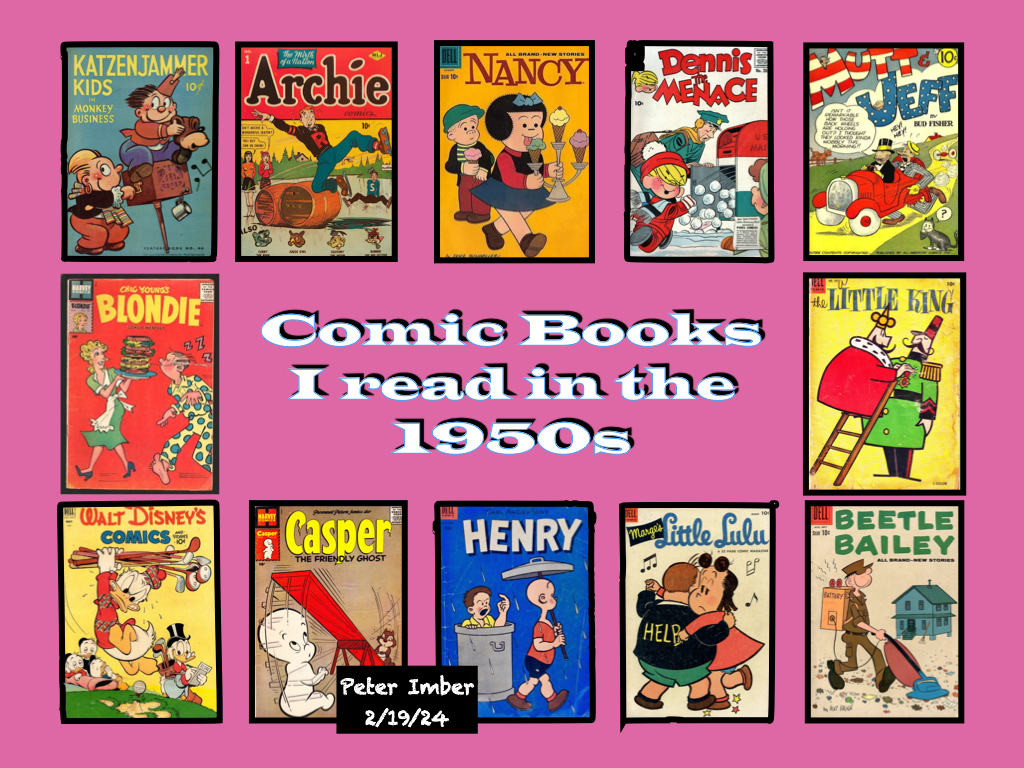
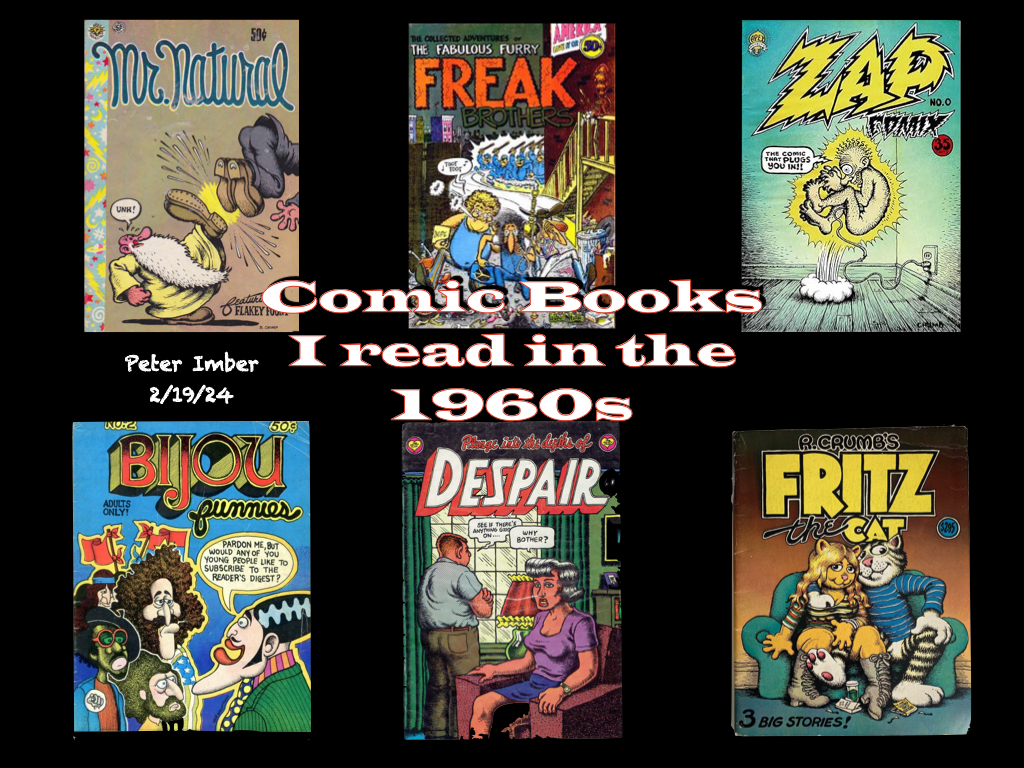
Yes, in the 1960s my comic books changed and not just changed, we baby boomers certainly didn’t all take to the streets but literally blew the covers off the manholes even if we didn’t. Families seen on television began to change as well until those seen today seem as unreal as I realized the Nelson family was a long time ago. Did we do that? How did we get from there to here?
—————–
—————–

—————–


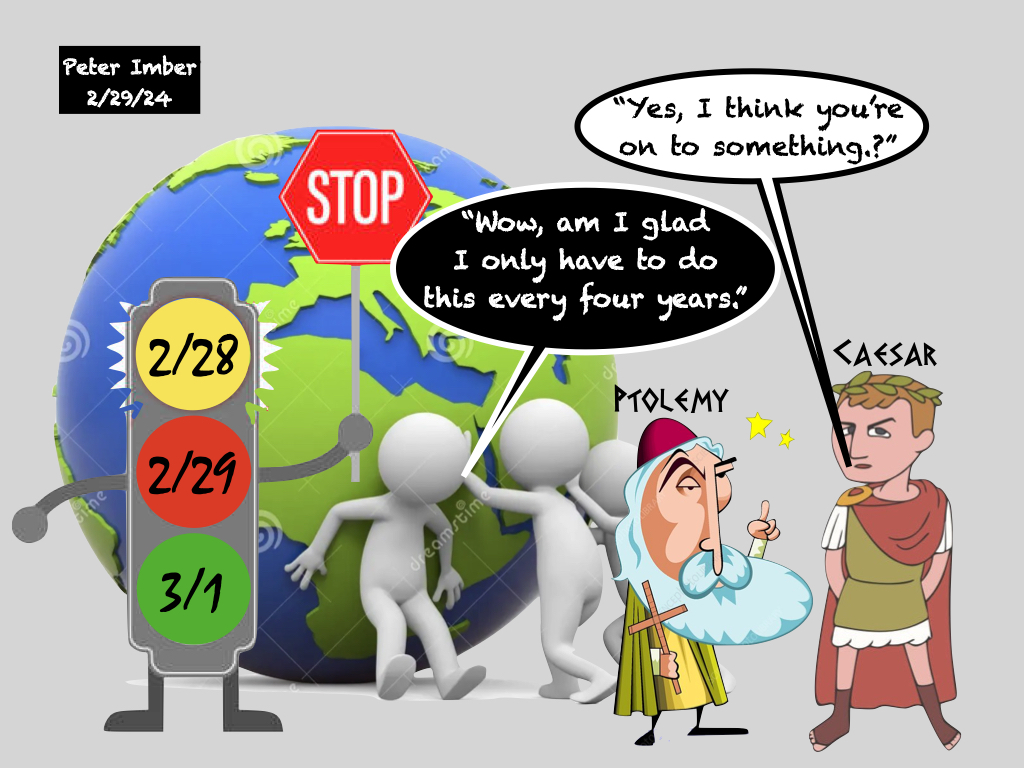
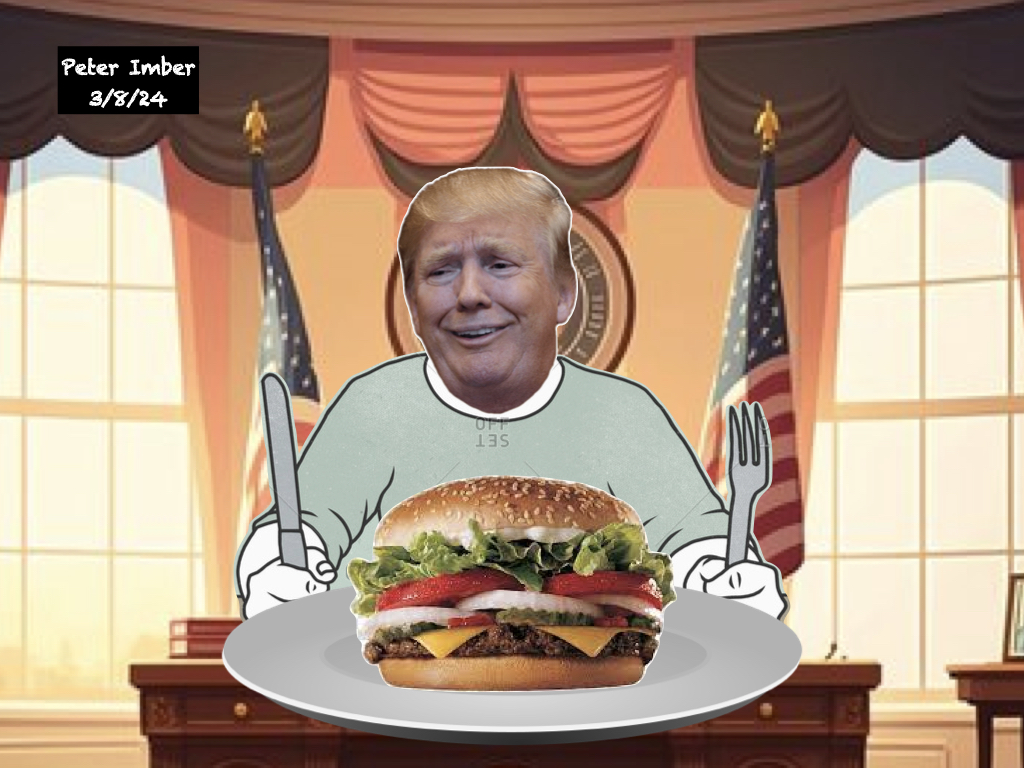
Bear with me. I’m afraid I’m sort of going to be taking a few side excursions today from the point I’m attempting to make with the two cartoons above…
Don’t know if the link I’ve pasted below will allow you to see this article about a former NBA player, teacher, poet and cancer survivor who I thought was dead but is alive, flourishing and inspirational…
https://theathletic.com/5279301/2024/03/06/tom-meschery-nba-warriors-cancer-poet
Tom Meschery is only 85 and I say only because I’m only 8 years younger than he is but when I was 12 and he was 20 that was a space of time as wide as his former basketball teammate Wilt Chamberlain’s outstretched arms.
I’m old enough to remember when Meschery played for the Philadelphia Warriors– my favorite team –who became the San Francisco Warriors and are now the Golden State Warriors. The franchise moved in 1962 and they weren’t the first team that I felt abandoned me. The Brooklyn Dodgers had transplanted themselves to Los Angeles four years earlier when commercial jet airliners made coast to coast travel a lot faster and the West Coast a logical new home for sports teams.
I have stuck with being a loyal Dodger fan and actually living in Los Angeles for longer than I’ve lived anywhere else made that easy. It also is true that Carl Furillo– one of the players forever memorialized in a book entitled The Boys of Summer about the Brooklyn team in the 1950s –grew up about a mile from my house in Pennsylvania and during one of his off seasons I had my picture taken with him in the hospital when he had his appendix taken out by a neighbor of ours who performed the surgery.
However, I quickly switched my basketball allegiance to the Boston Celtics, who in the 1960s could justly be called The Boys of Winter with Bill Russell and Bob Cousy and a bunch of other Celts now in the Basketball Hall of Fame and a clothes line of championship banners hanging from the ceiling of Boston Garden.
And there was another reason I became a Celtics fan. His name was David Williams and I realized today in my musings I have dropped the names of other Williams named Ted, Serena, Hank and Ralph Vaughn but David, who I called Mr. Williams, I’ve only mentioned once before since I started posting these musings four years ago.
Teacher, coach, role model– Dave Williams also let me babysit for his kids on a lot of nights when Celtics games were on TV and when I’m certain none of the other students at my prep school were being accorded the same opportunity. Yes, that may have had a little to do with my becoming a Celtics fan.
Here’s my tribute to him that I wrote when he died…
I would hope that in every person’s life he or she has someone who they know helped them at a crucial time and to whom they are forever grateful. I entered prep school at Governor Dummer Academy outside of Boston as a junior in 1963 and had a teacher in charge of my dormitory who was a cruel jerk and eventually fired. It was a rough way to start at GDA but fortunately I made the basketball team and the coach was someone I quickly came to revere.
That November President Kennedy was assassinated and the nation was shaken to its core. As we gathered in front of televisions to watch the news coverage that afternoon, Mr. Williams pulled those of us on the basketball team away and had us practice. I think many of us did so while fighting back tears and feeling that we didn’t want to be in the gym; that somehow it was wrong to be carrying on as if it was just a normal day. It didn’t take years for me to realize that it had been the right thing to do for us.
Dave Williams always seemed to do the right thing and another incident that season I particularly cherish. A classmate’s father was the team dentist for the Boston Celtics. I don’t know how much dental care professional basketball players required but the connection had a real benefit for those of us on the basketball team. Through Jeff Kane’s father we occasionally got free tickets to Sunday afternoon games at the Boston Garden.
But an even bigger thrill was when Celtics players actually came to our games– Sam Jones, Tom “Satch” Sanders and John Havlicek. All three of them are in the Basketball Hall of Fame and it was with “Hondo” Havlicek in the stands one afternoon that I missed an opportunity to change the outcome of the game. I missed a shot at the buzzer and we lost by a point.
I was sitting glumly in the locker room when our Celtic go between informed Mr. Williams that John Havlicek would be happy to come to one of our practices and give us some pointers. We all perked up and I’ve never forgotten Dave Williams’ heated reply– “You tell John Havlicek that I don’t need another coach of this team!”
Again, that response seemed unreasonable to me at the time. Who wouldn’t want one of the best players in NBA history giving you some personal attention? But eventually my disappointment turned into even greater respect for my coach and teacher. Havlicek was a great player but to me Dave Williams was a great man!
The following season when I had the honor to be co-captain of our team, we won the Private School League championship. We had talent and I won’t claim that Mr. Williams was the greatest basketball coach when it came to teaching or strategizing the game, but he molded us into that winning team by treating every player equally.
No one was ever allowed to be a prima donna nor to display even an inkling of bad sportsmanship. It was an experience and a lesson I have valued my whole life.
And there’s one more story that I have been reminded of many times about how we should put things in perspective when it may seem our whole life is going to be altered or even determined by one moment.
Dave Williams was my history teacher senior year. We were preparing to take a test– a big test that would determine much of the last grade the colleges we were applying to would see. Some of us felt that weight and Mr. Williams realized that and suddenly stopped our review and said this to our class.
“I know that you think this test is important but in the scheme of things, many years from now, it will not be important in your lives at all.”
The words have stuck in my head ever since and the real tests in life have been both ones I could prepare for and others for which I couldn’t. Some I know I’ve passed and others I feel I’ve failed. But I do know this. Mr. Williams was right about that history test 50 years ago.
Dave Williams had the admiration of every student he taught or coached and he had it because he cared about every student he ever met.
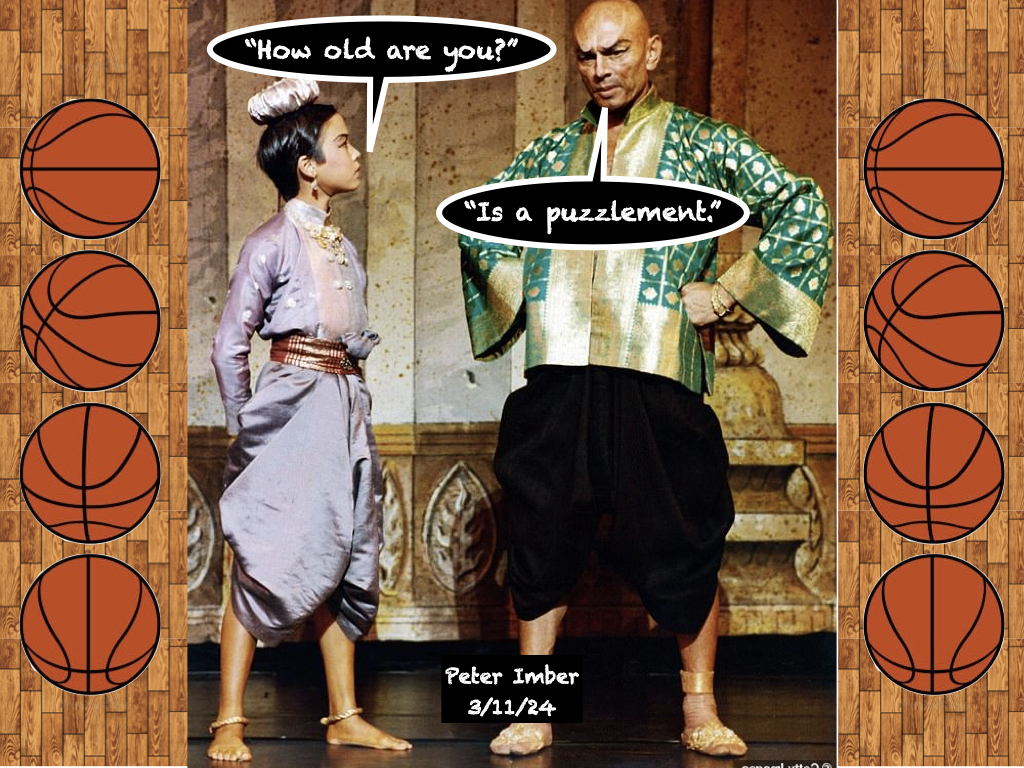
Yes, I’ve strayed from my original idea of writing about the relativity of aging. What’s new? And what was my point anyway? Simply this, I was so much younger then when I was shooting at a basket in my driveway after school and Tom Meschery was simultaneously playing with Wilt Chamberlain on the night the “Stilt” scored 100 points. I’m older than that now and while eight years between us then was the Grand Canyon. Eight years now may be more like Mt. Everest but I feel Tom Meschery and I are climbing it together.
I guess I’ve strayed a bit along the way from my original idea of writing about the relativity of aging. What’s new? And I’ve also managed to flip the lyrics around in Bob Dylan’s song My Back Pages. So, let him explain what he meant.
—————–

It is our grandson Harvey’s eighth birthday today although his party where I took his picture was yesterday. Harvey designed his own cake four years ago which is now known by its bakers as the “Harvey Cake” and there was enough leftover so that we can eat it again when we celebrate my own this evening. Yes, Harvey and I share a St. Patrick’s Day birthday.
Below is an updated version of something I wrote and posted two years ago…
It’s St. Patrick’s and it’s my birthday. Yes, green is my favorite color and the color green has followed me and I’ve followed it all of my life— I went to a college whose sports teams are called The Big Green and I’ve rooted for the Boston Celtics since I was a teenager. I also love spinach and mowing the lawn.
I think the only thing I have in common with St. Patrick is a problem with one of my knees. According to something I read, Patrick had arthritis which might explain why he’s always pictured with a shillelagh and not a pint of Guinness.
But despite our coinciding birthdays there’s a story about why I am a Peter today despite some leaning on my parents to have had me be a Patrick. Even though I likely was present in the room when this negotiation took place I cannot be considered a credible witness.
My parents lived in Hartford, Connecticut where they had met before WWII in a department store they both had been working and I was born in Hartford after the war. It was March 17, 1947 and I was not the only boy who came into the world that day at a hospital named St. Francis. That itself was no surprise at the beginning of the Baby Boom but in a Catholic hospital on St. Patrick’s Day my birth— through no fault of my own —presented sort of a dilemma. All the other boys born in the hospital that day were like me. We were all Jewish.
It was a tradition at St. Francis that a baby boy— at least one —be named Patrick on St. Patrick’s Day but to my knowledge I’ve never met a Jewish male named Patrick and my parents and the other baby boys’ parents apparently hadn’t either. So, there was some lobbying taking place by the hospital staff to break with one tradition to assuage another. When none of the Jewish parents would budge it got down to crunch time and as my mother put it…
“We told the nuns Peter was as far as we were willing to go.”
My parents didn’t go full Irish that day but they didn’t go full Isaiah either. Today I am 77 and I am grateful that I am Peter.
I have probably told some of you how I view life as like the quarters of a basketball game with a shout out to Marquette, my favorite college team as March Madness is about to get underway.
I have divided life into 20 year increments. At the end of the first quarter I was in college and thought I didn’t have a clue what I wanted to do when I got out. As it happens, I was doing what I’m doing right now– writing and trying to be observant (God knows not religiously) and creative. As an editor on my college newspaper I had a column and I spent more time at that than on my classwork.
After I graduated and began the second quarter of life I left a job in television news at CBS in New York, went to Israel, got married, did the army and after being handed an opportunity to make videos in Tel Aviv, applied to film school and returned to America and Los Angeles. By halftime when I was 40 I had a good job that would take me through to retirement, a nice house and time to golf once a week.
My career at ABC News was part of my entire third quarter, as was raising my son who a couple years ago became my daughter and as time expired, the third quarter also marked the end of my first marriage. By the start of the fourth in 2007 I was old enough to be the parent of many of those who I was working with, I was living in a small apartment with someone who I still love as totally today as I did then and who is the luckiest best thing that has happened to me in my life.
So, 77 has me now closing in on the end of the final quarter here in Maine and worried about the country’s and the world’s future more than about my own. I’m hoping to stay out on the court make it into overtime and actually, I have something going for me to possibly help make it happen.
Jo, if I haven’t mentioned it before, is not a sports fan but she has a very uncanny ability to impact the outcome of almost any game or match I might be watching.
Jo: “When is this over?”
It can be a basketball or a baseball game or even a golf tournament.
Peter: “There’re just a couple _______ (select minutes, innings or holes) left.”
Invariably, her query produces a tie and subsequent overtime, extra innings or a playoff. I think if I were a betting person, I could leverage this into a trip for us overseas or at least a new set of golf clubs… But you know what? I’ve already hit the jackpot. I’m happy with things just the way they are. 77 feels fine. I guess it’s just the luck of the Irish!
—————–
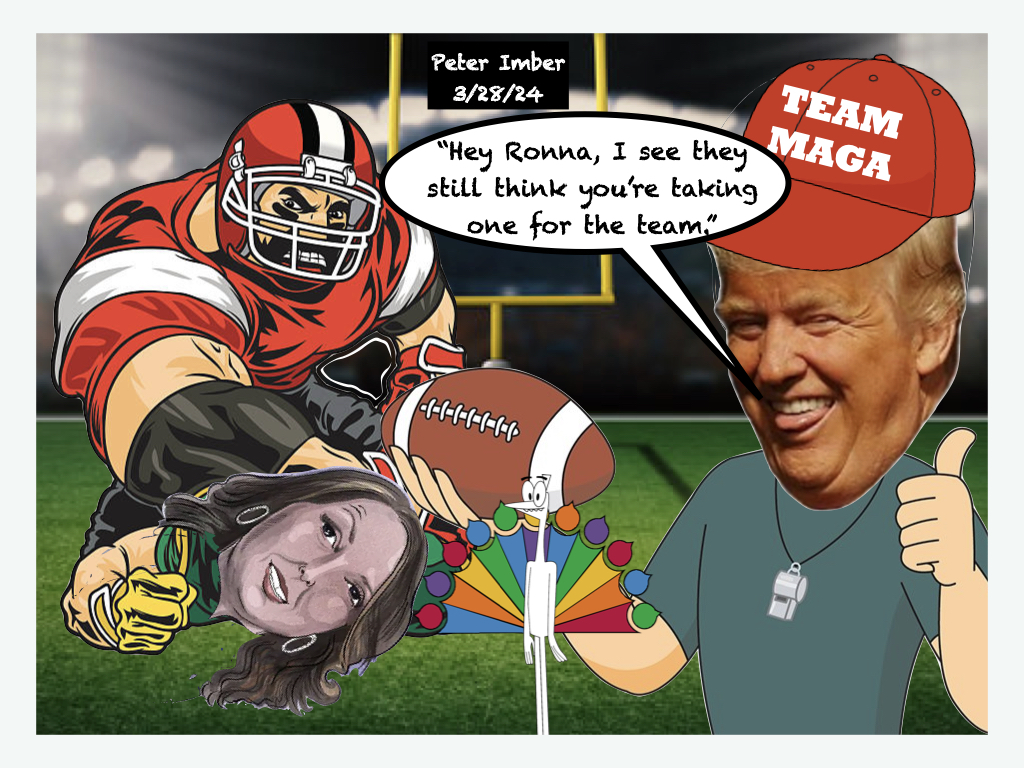
“When you’re the RNC chair, you — you kind of take one for the whole team, right? Now I get to be a little bit more myself.” –Ronna McDaniel 3/24/24
The hiring and firing of former Republican National Committee chair Ronna McDaniel by NBC is an incident that makes me wince more than smile. I’m actually horrified. How the management at NBC thought that an instrumental denier of the 2020 election result should be rewarded with a job– allegedly paying her $300,000 –to give credible commentary about anything is a classic “What were they thinking?” fiasco.
I take some measure of relief in the opposition by the network’s on-air faces to McDaniel’s hire who rebelled and succeeded in getting management to reverse the decision. But the incident clearly shows how perilously close we are to ignoring and excusing the threat to our country from the Big Lie by organizations and people who should know better.
Several years ago I gave talks to a number of groups in Maine about what I called The Ten Reasons for the Decline of the Evening News. I realized today that an essay I wrote in addition to the talk I’ve never included with a Homemade Cartoon. So, here it is…
The Day the News Changed
It was a phone call from an ABC World News Tonight producer in New York that did it, although it began routinely.
“Hey, we want you to do a story about bears,” he said. “Great,” I said. “What’s the story?”
That is how I often got assignments. My bosses in New York had read or heard or seen something somewhere, and they wanted me to turn it into a story for us, but in the next instant everything felt as if it had changed.
“Find one!” he said.
Let me explain. I worked in the Los Angeles Bureau of ABC News from 1983 until retiring in 2010. Until that day in the spring of 2001, I had done hundreds of stories that I had been asked to produce for all the ABC News broadcasts. But usually— no, invariably —they had been connected to some larger news event happening at that moment, like “Get an interview with someone who claims to have been sexually abused by a priest,” or “Show us what it takes to purchase an assault weapon.”
I did not ever recall being told to actually find a story on something as seemingly unrelated as bears to anything else newsworthy going on in the world.
So, I asked, “Why bears?” And I was told, “Because bears are hot. Our research and our focus groups are telling us that people want to see and hear about bears right now.”
I took my marching orders and discovered that bears were indeed the flavor of the month on Madison Avenue. They were taking a star turn and especially in television commercials— a visual element, I realized, that might make it actually a fun story to put together.
We shot at the Los Angeles Zoo where a zookeeper told us that bears could look cute on TV but they’ll rip you apart in a minute if you give them an opportunity. And we went to a ranch where wild animals are kept to be rented out for the movies. There we discovered how you get a bear not to rip you apart but still make it look like it wanted to. How do you get a bear to charge after an actor on the screen? Easy! Just drag a dead chicken on a rope in front of it and run like hell.
Until that assignment I hadn’t even known for sure— although there had been suspicions —we were actually using focus groups and market research to determine stories that got on the air at ABC News. But what I also realized was that in my world of television news journalism, it was no longer going to be a bunch of mostly white men with newspaper backgrounds deciding every night what viewers ought to know. From that point on, what we thought viewers wanted to know became just as, if not more, important. Television news was now grappling with how it could be both popular and informative simultaneously.
How did it happen? There were a number of reasons. One big one was the swallowing of the three formerly independent American television networks, along with their news divisions, by larger corporate entities in the 1980s. The famous quote by CBS’s founder William Paley, “You guys cover the news; I’ve got Jack Benny to make money for me,” no longer applied after that. Network news operations, once viewed as the prestigious company flagships and excused as financial loss leaders, were now expected to pay their own way and become profit-makers like any other space in their new homes.
When Disney bought ABC in 1996, I became just another “cast member,” as all Disney employees are addressed in official communications. I thought of myself as a journalist, but in Disney’s eyes I believed I might as well have been dressed up as Mickey Mouse himself, posing for pictures in Fantasyland.
The fragmentation of television from how we baby boomers had grown up with it— at my house we had three channels to choose from —preceded the rise of the internet, and with competition from alternative news channels— CNN was the first in 1980 — network television news began its decline which then only accelerated. At the peak of Walter Cronkite’s popularity in the 1970s, The CBS Evening News averaged nearly 40 million viewers every evening. Today, all three legacy network evening newscasts combined garner only half that number of viewers in an entire week.
Eyeballs— read that ratings —became everything. Good Morning America and The Today Show, considered parts of their networks’ news divisions, almost stopped covering news and got better ratings by featuring celebrities plugging their movies and chefs making hors d’oeuvres than Peter Jennings or Tom Brokaw did in the evening on their traditional news broadcasts. The morning shows became where the viewership was greatest and the most money was made and so, aside for the evening anchormen’s salaries, that’s where it was mainly spent.
When I started at ABC News in the 1980s, I never had to do a budget for a story. I even flew on chartered Lear jets to breaking news events— almost always tragic ones —like school shootings and natural disasters. Increased competition had fragmented viewership but the impact of the internet with its immediacy and its unforeseen addictive hold, turned us in the TV news kingdom from princes into paupers.
It felt like it happened in the blink of an eye. The jets disappeared. When I produced pieces for Peter Jennings when he came to the West Coast, a New York retinue, including his own valet and makeup person, no longer accompanied him. By the end of my career I had to itemize and account for everything I was going to need to spend before I was allowed to spend anything that wasn’t for breaking news coverage. In those last years I traveled much less even when breaking news happened.
There just were not enough eyeballs peering in anymore to justify an advertiser paying hundreds of thousands of dollars for a nightly commercial, and so we, the news gatherers, became a little like farmers paid subsidies to leave their fields fallow. One of our bureau chiefs even tried to get rid of our coffee machine to save money.
Understand that hard news could be hard. Trying to get people to talk to a camera who had lost loved ones in an airplane crash or all their earthly possessions in a wildfire was not pleasant duty. The pressure to put together a story in just a few hours was enormous and with what we had left at our disposal along with what was being added on to our plates, the work did not just become harder, it was also less thorough and fulfilling.
We were given new responsibilities that, with the budget cuts, further eroded our ability to cover the news. The convergence of multiple new media “platforms” meant we were at times filing reports almost nonstop. Our correspondents became tethered to satellite trucks so they could be shown live on location at any moment. And if that truck wasn’t close by, they were asked to report on their cell phones or update from their laptops. Sometimes they did not get to bear witness to what was happening as much as only relay what they heard from others who might have been barely able to assess the scene themselves.
The technology that provided instant coverage often made us hostages to it. Pictures and human emotions are a big part of what TV news provides best, and trying to serve all masters simultaneously— the network, the affiliate stations, radio, a webcast and a website —impeded our seeking and collecting them. When there were no more scheduled deadlines, every moment became a deadline. Famously, or rather infamously, someone at ABC News was alleged to have said, “I’d rather be first than right.”
But what has gone missing most from network news is the depth and the craft we were once empowered to pursue and avail ourselves of to achieve. Television news has continued to deteriorate, both qualitatively and quantitatively. Survey after survey show that people, especially younger people, get their news online. We may still look at a screen, but it is not on a TV we turn on to watch at 6:30 p.m. or the printed newspaper delivered on our doorstep anymore. It is in our pockets and purses and available whenever we want it but placed there in a rush and cursory.
The number of Americans sitting in front of a screen every evening to watch a half hour of what they consider the news of the day isn’t that at all if it’s tuning into Fox News or MSNBC. Both of them are more like a competition where you pick a side and watch a bunch of talking heads telling you what and how your side is doing. The bar for television news coverage is not just lower; it may have fallen to the ground. Our country’s news infrastructure in general has been hollowed out and it has happened in an era when we needed the best journalism to be louder and more pervasive.
The thing I loved most to do during my career was not hard news. Many of my favorite stories I found began with the same introduction from the anchorperson— “Finally, tonight…” We called them show-closers, and they were about things that were more “Gee whiz!” and “How about that!” I got to visit a guy in Canada who had cornered the market on virtually all the remaining unsold slide rules in the world around the time of Y2K just in case. I visited a lightbulb in a firehouse in California that had burned continuously for over a hundred years. The company that made them at the beginning of the 20th century had gone out of business probably because the lightbulbs lasted so long. I loved sharing these things that I hadn’t known about and more than likely you hadn’t either.
John Updike played golf for me as part of an entire show I produced for Nightline on my favorite sport and I got to meet and hear the stories of Buddy Holly’s real life Peggy Sue and Ritchie Valens’ teenage girlfriend Donna. The surviving Munchkins from The Wizard of Oz sang for me. What a great ride I had!
My stories were best when I had the best people working with me— video shot by a skilled cameraman, an editor who could cut it together so it turned a great script by a correspondent into something even better. My work was collaborative. “The best idea wins” was my mantra.
Having the ability to do the best work possible is rarer now. In today’s “spend as little as you must” environment, the talent I was able to utilize would not likely be available anymore or even appreciated by those curating the news and counting the beans.
If I sound bitter, I am not. Perhaps, I am merely feeling what countless others before me have felt about their jobs after they finished their careers; that their work and workplace had changed almost beyond recognition from what they remembered when they had begun. And it is possible to claim that my generation experienced more change in our lifetimes than we could have ever imagined. Maybe, things just got to a point where it was just me who stopped changing.
I do not miss the early morning phone calls commanding me to get on a plane and fly to a hurricane. I do not miss going nearly sleepless for several days straight covering a mass murder. I had a tremendous responsibility to provide the best account of whatever I was assigned to produce and also the amazing opportunity to turn my curiosity into stories that were seen by millions of viewers.
Now, I rarely watch television news. I am grateful for my career. I am saddened that it changed but then so has the world.
—————–
 pawnedaccordion