
Beginning on April 1, 2020 and for 365 straight days I emailed cartoons to many of you who are receiving this one today. At the onset of the pandemic most of us were unsure how to be safe and we sheltered in place. I needed a way to spend my time and cartooning unexpectedly turned out to be it.
Even though I can’t draw, I discovered that I didn’t need to. If I had an idea for a cartoon, I could find the imagery I needed on the internet and by using Apple’s presentation app Keynote I could turn my ideas into cartoons. As the distribution list for the cartoons grew so did my receiving encouraging responses to them. Although a good friend advised me several times to keep my day job, I responded that this had become my day job and kept going.
Of course the rest of 2020 and the beginning of 2021 became more than just the time of COVID. It was an election year and even the pandemic was ensnared in politics and America’s culture wars. Along the way I added commentaries with the cartoons I was sending out commenting on what I saw happening and what I thought as well as stories about my life and other random observations on whatever I felt like.
I have been looking recently at what I wrote– it was a lot –with the intention of selecting some of it to self-publish as a book. This morning I came upon a post from January 21, 2021 that I’m reposting today. As I read it, I sadly realized a familiar adage applies…
The more things change, the more they remain the same.
–Jean-Baptiste Alphonse Karr in 1849
Homemade Cartoon on January 17, 2021

When I came across the picture in the the lower right panel of yesterday’s cartoon (posted again above) I had to restrain my brain from imploding– a woman protesting that she be asked or required to wear a mask in the time of COVID-19 and co opting the slogan of abortion rights activists “My body, my choice.”
Not knowing her position on a woman’s right to terminate an unintended or high risk pregnancy, I’m not sure what it might be. If she supports one right and not the other, then her poster gets my Ignobel Prize in cynicism. It’s also my Exhibit A of how disassociated the concept of individual freedom has become from concern and responsibility for the common good among so many in our society. The logical extension of Donald Trump’s America First has always been just as much a personal credo “I always come first.”
But for me the key in the ignition of our journey from selflessness toward selfishness and the unraveling of American unity was turned a long time ago by a pair of quotes.
“Government is not the solution to our problem, government is the problem.”— President Ronald Reagan (January 20, 1981)
“The nine most terrifying words in the English language are: I’m from the Government, and I’m here to help. “
— President Ronald Reagan (August 12, 1986)
At the time Reagan uttered the latter I had already started my career with ABC News and was on an assignment in Arizona. At the motel where I was staying were a group of scientists from the United States Geological Survey. I overheard them talking about their work and was impressed. I thought to myself that both the government and I were lucky to have them working for us.
Ronald Reagan didn’t plant the seeds of distrust of the government by so many in this country. He watered them and helped them grow. It’s been a tendency that has ebbed and flowed throughout our history, but Reagan demeaned the very people and institutions he had been elected to sustain and improve. He made it acceptable to view the government as an impediment and those who worked within it inept.
Ronald Reagan wasn’t outwardly a mean person. In fact his amiable nature along with his leading man presence undoubtedly were a large driver of his appeal. His vision of our country being like a shining city upon a hill has taken a beating since his time in office but Reagan is still widely esteemed.
A moderately popular president while serving, his reputation morphed into reverence after he left. Recent polls have recorded that increase to be over 20% and that’s more of a gain in retirement than has been measured for any other president.
With the passage of time Ronald Reagan has become as legendary as the football coach he didn’t play in Knute Rockne, All American (Reagan’s role was George Gipp– the Gipper –the ill fated star of the team.). Could it be that The Great Communicator is idolized at least as much for how he acted the part of president as he is for his record as president?
Public trust in government had already eroded by the 1980s and Reagan’s tenure. According to surveys done in the late 1950s by the National Election Study, about three-quarters of Americans then “trusted the federal government to do the right thing almost always or most of the time.” The Vietnam War, Watergate and a flagging economy undoubtedly played a role in harming that support but for me a significant and damaging part of Ronald Reagan’s legacy is what he nourished with his disparagement of government and his criticism of the role it played in Americans’ lives.
Reaganomics and Trumpism may seem very different but I see them as the Queen of Hearts from Alice in Wonderland meets Marie-Antoinette. Cut to the scene where the two jovially gossip about the cakes they’ve eaten and heads they’ve offed at a tea party or make that with the Tea Party.
So, where do we stand now? How much do all of us, no matter what our political affiliations, trust our government. The picture, as you would probably expect, is not a pretty one. Here are the findings of the Center for American Progress from 2018. Overall 14% of voters say they trust the government in Washington to do what is right just about always or most of the time, 65% trust the government only some of the time and 21% say they trust the government none of the time.
The diminished trust for those who govern us and the institutions they oversee and the disdain for the people who staff them coupled with the presently irreconcilable views of how we even see each other have abetted making Donald Trump possible. In hindsight his rise was no surprise.
Trump looks dorky riding a golf cart and we’ll never get to watch him hoist himself onto a horse. Unlike Reagan, Trump has a seething threatening tone anytime he speaks unless he’s reading from a teleprompter which makes him sound like a Zombie. He’s Bela Lugosi from a different Notre Dame than Knute Rockne’s. I can see Edward G. Robinson playing him but Trump reciting the immortal “Is this the end of Little Rico?” after he’s gunned down in Little Caesar? No, I don’t wish that. I’ll gladly settle for him ending up sitting on a blanket outside of Bloomingdale’s with a tin cup.
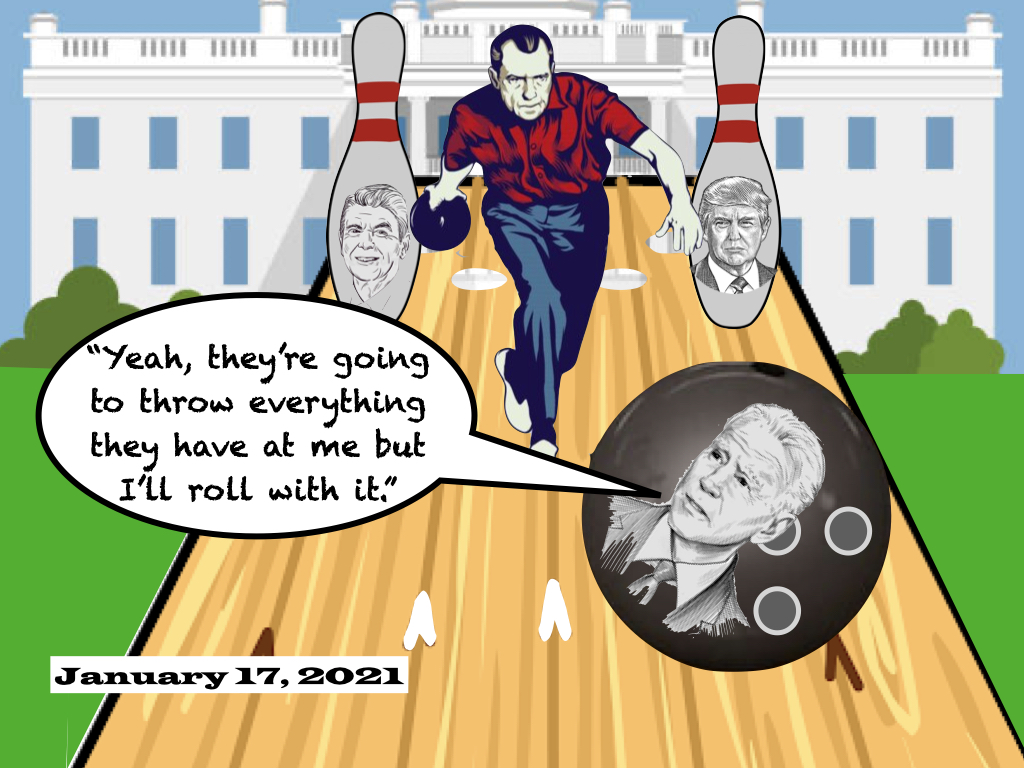
Now, that Trump’s presidency has taken things a giant step further than we imagined possible, Joe Biden and his administration face a daunting challenge. In today’s cartoon above I liken it to a 7-10 split at the bowling alley with the Reagan damage on one side and what Trump has wrought on the other. You might want to know the odds to convert the spare. It’s 1 out of 145 attempts– a probability of 0.7%. Maybe I should have chosen a different challenge for Biden. We’ll see.
One of the phrases I’ve heard a lot recently is that Donald Trump is the symptom and not the cause of our present woe. This is true as I have mentioned but when someone has cancer and they die, the cause was not their symptoms, the cause was the cancer. All by himself Trump is an incurable cancer and with his election defeat and an unsuccessful coup attempt, the United States may go into remission but the cancer could come back.
In reading about the history of the polio vaccine I found an interview with Jonas Salk’s son Peter, who is also a medical researcher, and something he said about social media back in 2014 and the growing opposition to vaccines I believe works as a starting point for what President Biden will have to accomplish in the next four years.
“I don’t know quite how to put this, but it’s like there’s an epidemic of misinformation, and we’ve got to inoculate the public against it.” –Peter Salk
We’re in the time of COVID-19 but of all the vaccines being developed there’s this other one needed to cure poisoned minds that’s still left to be discovered. That one certainly will be even the most important for our future.
—————–
Short Night’s Journey into Day
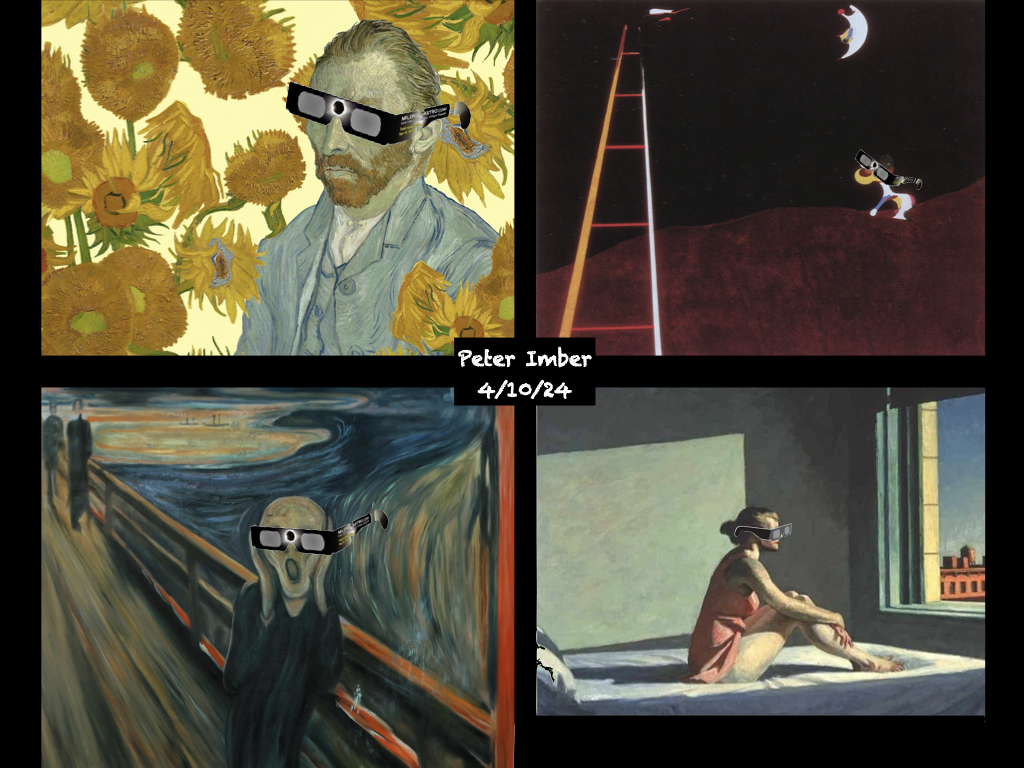
With apologies to Vincent van Gogh, Joan Miro, Edvard Munch and Edward Hopper, I know I’m a couple days late outfitting your paintings with eclipse glasses and I should have thought to have done so before. Hopefully their conservators didn’t have any of them pointed toward the sun on Monday.
Jo and I didn’t go anywhere beyond our backyard to see our 97% portion of the eclipse. We had scored some of the last eclipse glasses left at the library and if we hadn’t, I’m sure we would not have been as inventive as a couple of our friends who also stayed home here in Camden but discovered that the entire local supply of eclipse glasses had been either doled or sold out. When the celestial event took place, they held a colander up as protection to shield their eyes.
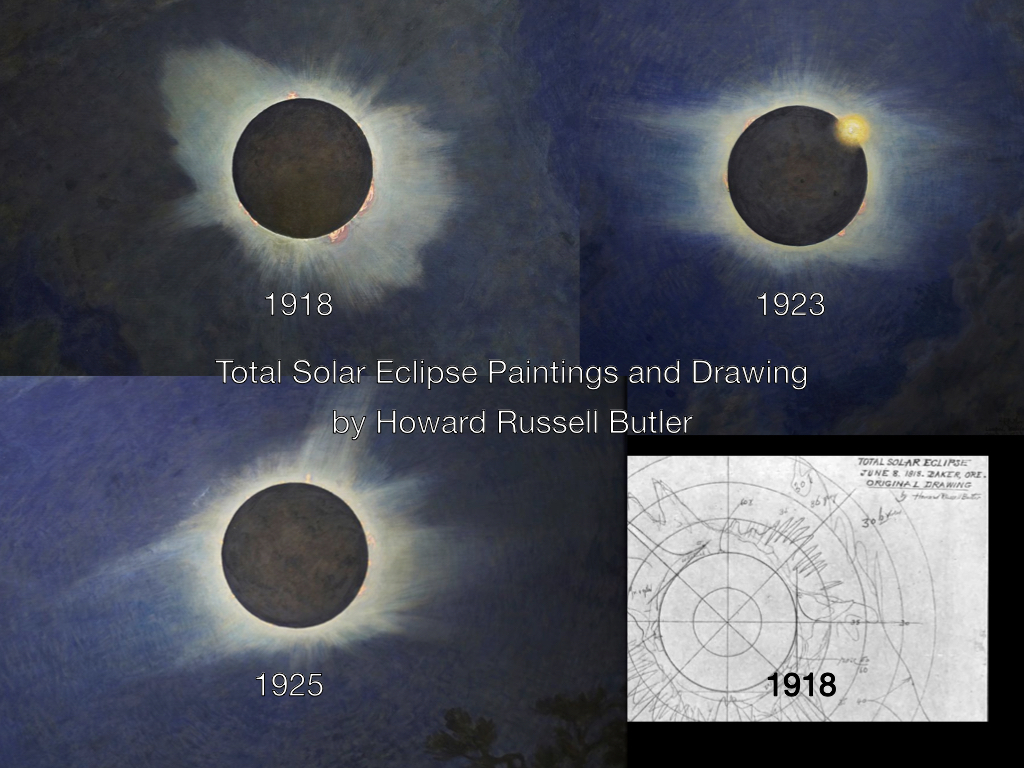
But getting back to art, I’ve found a connection to an artist and the eclipse. His name is Howard Russell Butler and I’d never heard of him before sitting down to compose today’s cartoon. Butler graduated from Princeton in 1876 with an engineering degree but he also began painting landscapes and acquired a reputation for being able to paint momentary solar events like the aurora borealis. Butler took meticulous notes while observing them and created his own system for numerically designating shades of color while quickly sketching shapes and contours.
By 1918 when Butler saw his first solar eclipse in Oregon he had so finely honed his technique that in the few minutes of totality he knew exactly how many seconds he could spend making notes on each of the various aspects of the eclipse he wanted to record.
Butler’s paintings of solar eclipses– he saw four in his lifetime — were displayed for many years at the Hayden Planetarium in the American Museum of Natural History in New York City. At some point they were moved to storage and all but forgotten for nearly seven decades until a few years ago when they were found in miraculously good shape in a janitorial closet at Princeton.
I guess Jo and I will just have to wait for the next total solar eclipse which will be coming our way again on August 22, 2044. Well, not exactly. In the lower 48 it will be visible only in Montana, and the Dakotas. I’ll be 97 and possibly residing in a different Big Sky setting. Until then at least we have Butler’s paintings to look at…
—————–
From the New York Times…Donald Trump’s trial is the culmination of a case that has been hotly contested since it was unveiled last spring. After months of legal machinations, including three long-shot appeal attempts this week, it seems to be on track to actually begin: Jury selection is scheduled to start on Monday. Testimony is expected to last weeks, amid a level of media scrutiny that some have likened to the O.J. Simpson trial nearly three decades ago.
Kind of ironic for this to appear today after the news of O.J. Simpson’s death. Four years ago I gave a series of talks in Maine that I titled: Ten Reasons for the Decline of the Evening News. My reason number 4 was what I called The Blockbuster Effect. Here’s what I said and some slides from my presentation:

Jaws is considered a landmark event in the history of the movies. In 1975 it became the first film to ever gross over $100 million dollars at the box office. Just as significant was what it created in its wake. Hollywood studios saw that a movie marketed extensively and released nationally simultaneously could be a blockbuster. After Jaws and Star Wars, movie studios sought to roll the dicemore often on expensive films that might appeal to as wide an audience as possible, especially a younger one. Some movies, if they were hits, became franchises with multiple sequels and even merchandise for purchase that netted additional revenue.
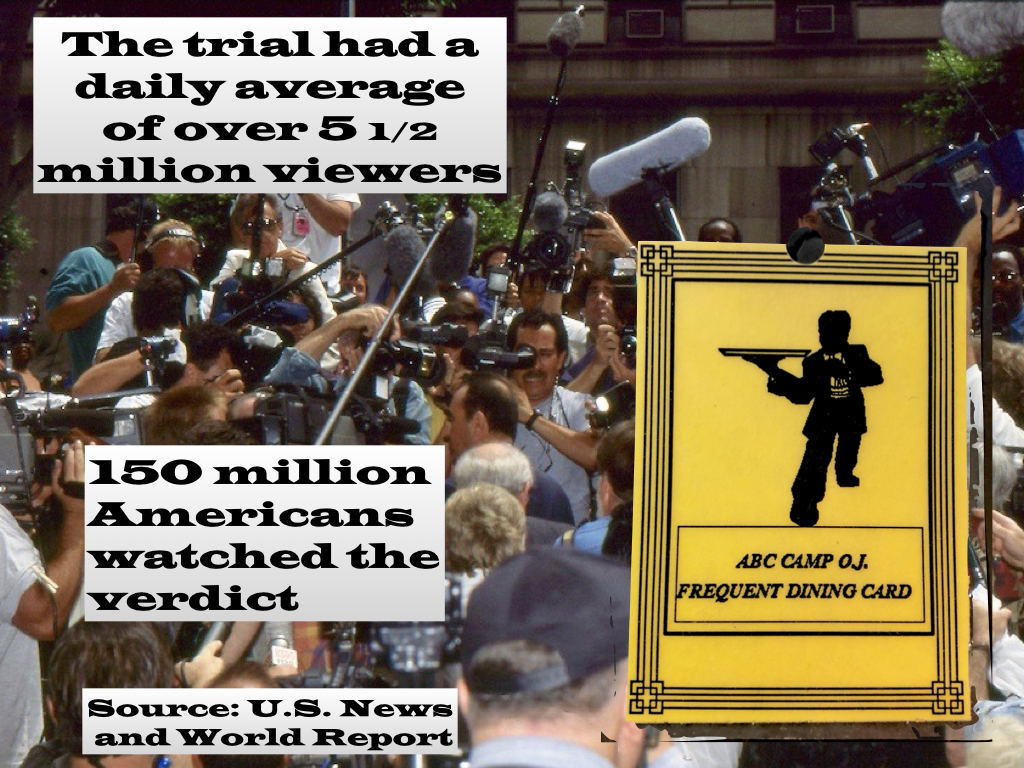
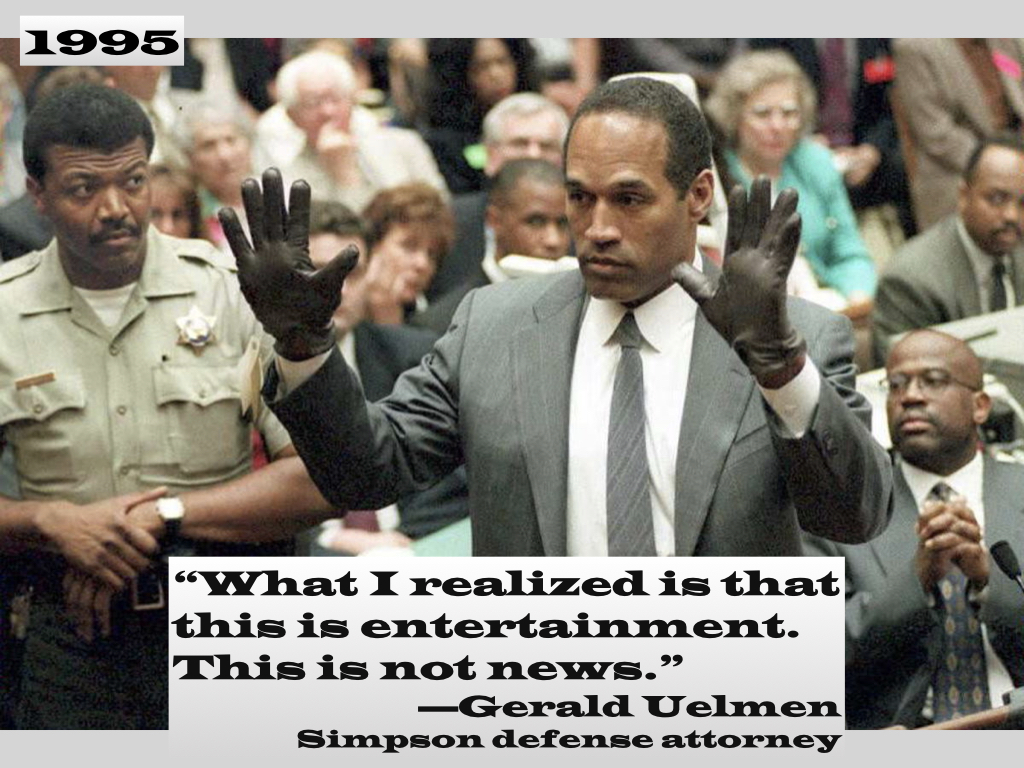
The O.J. Simpson story was network news’ Jaws and Star Wars rolled into one. I think we were surprised by the level of interest in it at first. It wasn’t until five days after the murders that Nightline even covered it. Quickly however, it was seen as a gold mine for ratings. As much as we might not have wanted to admit it— It had undeniable entertainment value including suspense. You knew he did it but would he get off?
I was involved with this story for over a year. I co produced the World News Tonight pieces for most of that time. During the trial we had up to four deadlines every day, one for each time zone across the country. Being in LA the trial was often still in progress when we hit air in the eastern and central time zones. It was a plum but tough assignment. We worked out of a trailer in a parking lot across the street from the courthouse that was dubbed Camp O.J. For me it became more like a jail but that’s another story.
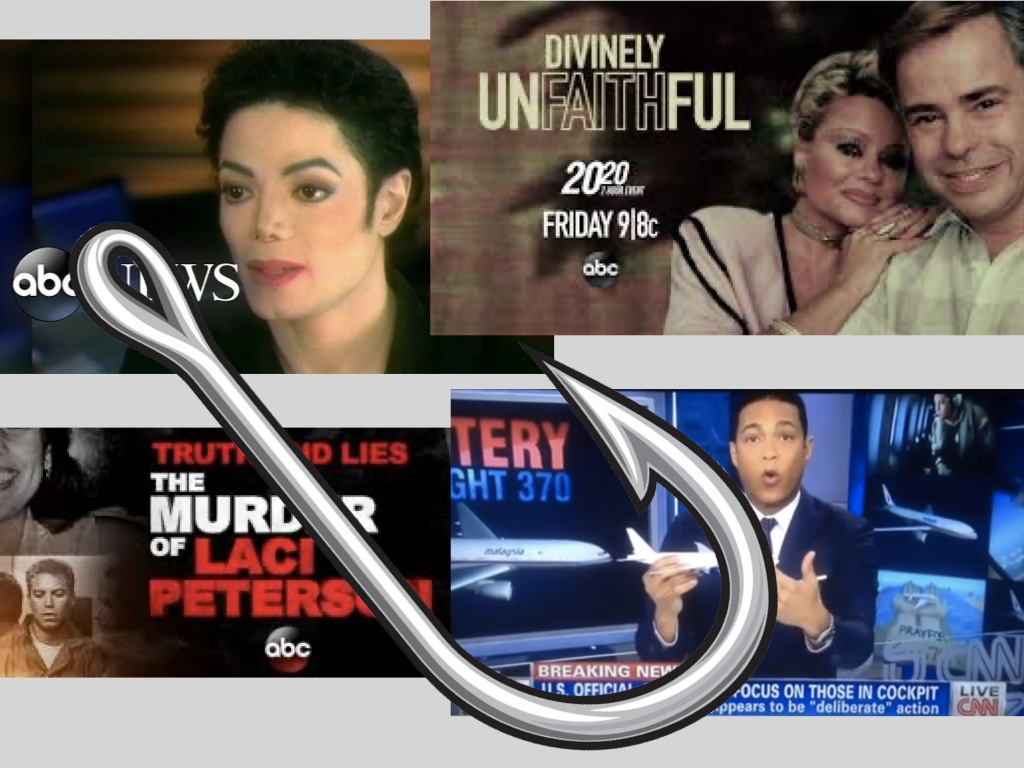
So what happened with network news after O.J. parallels what took place after Jaws. Like major league hitters today, we weren’t so much going for singles anymore and instead swung for the fences in quest of home runs— Michael Jackson, Tammy Fay Baker, a murder of a pretty wife by a handsome husband (If they hadn’t been attractive I’m sure we wouldn’t have covered it.) … giving the stories punchy titles as if they were movies. It was “let’s go with a story as long as the ratings indicate we’ve hooked the audience and they’re still watching it.” In the meantime we did not need to cover as much of anything else happening. We gained viewers and saved money.
Even Ted Koppel’s Nightline fell prey to this. Was he happy about it? I’m sure he wasn’t, but he wasn’t able to stop it. After all, we had discovered that we were not just the news business. We had become the news and entertainment business.
—————–
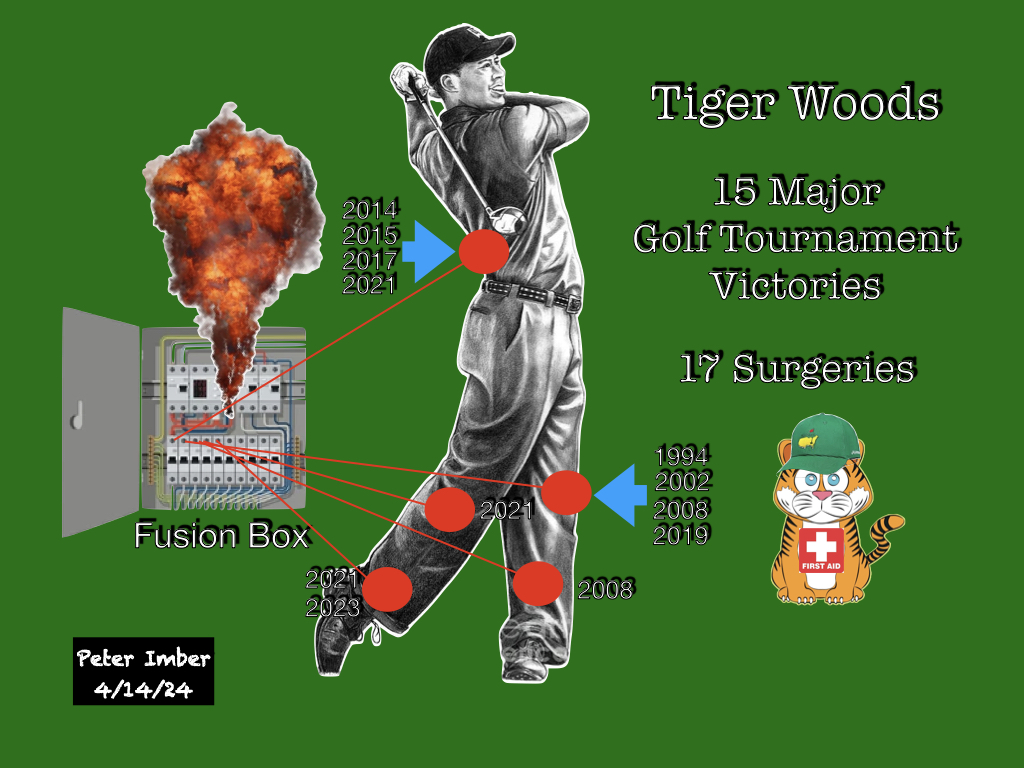
In his golfing career Tiger Woods has won 5 Masters, 4 PGAs, 3 U.S. Opens and 3 British Opens. His 15 major tournament wins is only surpassed by the 18 won by Jack Nicklaus.
Golf is not usually thought of as a contact sport but if you consider that swinging a golf club at speeds exceeding 100 miles an hour to hit a ball, I’d contend that while golfers may not be hitting each other, they are exacting a significant toll on their bodies over time.
Tiger Woods is considered by many to be the best golfer in history. He’s also been one of the most challenged physically. His back and one of his knees have been surgically repaired nearly a dozen times. A car accident that could have easily killed him injured his right leg and ankle so severely that walking 72 holes of a golf tournament is a challenge he may soon be unable to accomplish.
But of course part of Tiger Wood’s enduring mystique is when most of us have counted him out, he never has and won his 5th Masters five years ago when he was 43. Only Jack Nicklaus at 46 was older when he earned he his last ceremonial Masters green jacket. By the way after decades of pain Nicklaus had hip replacement surgery when he was 59.
And I’ve mentioned this before but on at least one occasion Tiger Woods injured someone himself and it wasn’t by an errant golf shot. I was the victim when I met him in 1996.
In my role as the ABC News producer who never passed up pitching a golf story, I caught up with him in Oregon where he was on his way to win his third straight U.S. Amateur championship. As we were about to do an interview I reached out my hand to shake his and when he grasped it I felt as if I had put my hand in a vice. The next day I could barely move it.
Tiger Woods Surgical Medical Chart…
1994: Two benign tumors and scar tissue are removed from Woods’s left knee.
2002: Fluid removed from inside and outside the ACL of his left knee. Benign cysts also removed.
2008: In April after the Masters, has surgery on his left knee to repair cartilage damage. In May, he was told by doctors that he had two stress fractures in his left tibia.In June, he famously won the U.S. Open on that injured leg before undergoing surgery to repair his left ACL using a tendon from his right thigh.
2014: After withdrawing from two events in the Florida Swing, has surgery on a pinched nerve in his back
2015: In September, Woods has two microdiscectomy surgeries on his back to remove bone fragments that were pinching a nerve. In October, he has another back surgery.
2017: In April, he has a spinal fusion, his fourth back surgery.
2019: In August, he has arthroscopic surgery to what he described as minor cartilage damage in his left knee. It’s his fifth procedure on the knee.
2021: In January, he undergoes another back surgery, again a microdiscectomy to remove a bone fragment that was pinching a nerve.
In February, Woods has a car accident in California. His right leg and ankle are severely broken, requiring emergency surgery including inserting a rod into his tibia and screws and pins into his foot and ankle.
2023: In April, two weeks after the Masters, Woods has ankle surgery to address issues associated with a talus fracture that occurred during the 2021 car crash.
—————–
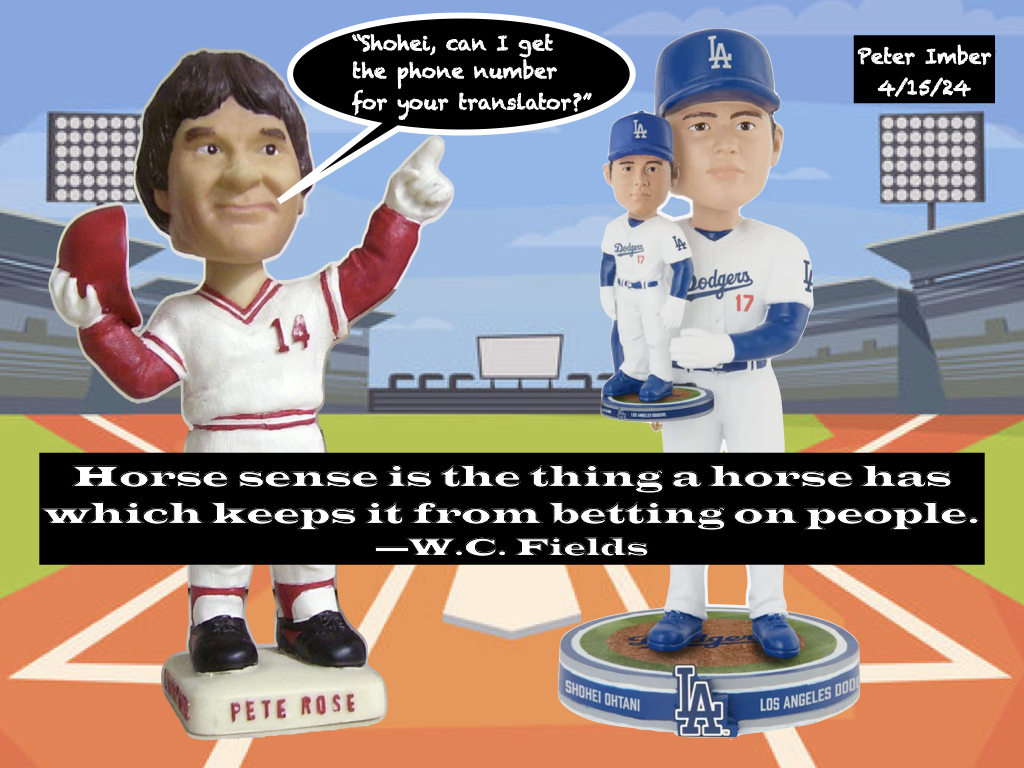
My Homemade Cartoon today might make you laugh if you are a baseball fan. It might not mean a thing if you’re not.
Pete Rose holds the all time record for most hits by a Major Leaguer– 4,256 –but there is no plaque in the Baseball Hall of Fame in Cooperstown, New York with his face on it. Rose was caught gambling when he was both a player and a manager. Well, not just gambling. He was betting on the outcomes of baseball games although he claims to this day he only bet on his own team to win.
Rose’s gambling got him a lifetime ban from having another job in baseball and he is also banned from having his name on a Hall of Fame ballot that could enshrine him in Cooperstown. This took place in 1989. Thirty-five years later there’s now another baseball betting scandal and it’s way more baffling.
Shoei Ohtani is from Japan and received a $700 million dollar contract this winter to play for the Los Angeles Dodgers. It’s an astronomical sum but Ohtani has already been compared to the biggest star baseball ever had– Babe Ruth. If Ohtani continues to play at the level he has until now– like Ruth he has been a two-way player, meaning he pitches as well as bats –he will undoubtedly join “The Babe” in the Hall of Fame.
However, this year’s baseball season was barely underway when it became known that Ohtani, who doesn’t speak English, is tangentially involved in a betting scandal of his own. His personal interpreter admitted that over two years he gambled away $16 million of Ohtani’s money which, amazingly, Ohtani said he didn’t have a clue about. Last week the results of a federal investigation determined Ohtani is in fact a victim and cleared him of any involvement or knowledge of his interpreter’s deception.
If you haven’t noticed legal sports betting has exploded in the United States. The American Gaming Association said the U.S. sports betting industry brought in nearly $120 billion in 2023 which was almost a third more than the year before. Keeping track of the odds of a sports event has now become a part of many sports broadcasts.
Sports betting has become legal in 38 states and if you’re asking how this happened all of a sudden, I have the answer. In 2018 in a case titled Murphy v. The National Collegiate Athletic Association the United States Supreme Court struck down the federal ban on states being permitted to authorize sports betting. And which justice wrote the majority opinion? Think about it a second… Yes, that’s right, it was Samuel Alito. He who hath taketh away– Dobbs v. Jackson –may also have giveth.
But back to baseball and the curious case of Shoei Ohtani. Ohtani, like an ever increasing number of major league pitchers, injured his pitching arm last season and had surgery that will require a year long recovery. When he did pitch, one of his responsibilities when a batter would reach base was to “hold the runner.” That means he was supposed to be aware before every pitch where the player on base was to prevent him from “stealing” and advancing to the next base.
Apparently, Ohtani’s interpreter, a man named Ippei Mizuhara, might not have been Ohtani’s “runner”, but he sure as hell stole him blind.
And one other baseball item…

Four years ago on this day I created the Homemade Cartoon above. I started the cartoons on April 1, 2020 and the short story I added to this one was the first time I wrote anything to accompany it…
Today is Jackie Robinson Day, baseball’s annual tribute to him that marks the date in 1947 when Robinson became the first black to integrate the Major Leagues.
I got to see Robinson play for the Brooklyn Dodgers in Ebbets Field when I was a kid but only briefly. He had to leave that game after colliding into the wall chasing a foul ball. The Dodgers were playing the Chicago Cubs and their Hall of Fame shortstop Ernie Banks hit the winning home run. Some 40 years later I met Banks in Los Angeles.
Ernie Banks was famous for his love of baseball and a quote that encapsulated that. “Let’s play two,” is what he would say, meaning his desire was to play a doubleheader and not just a single game. That day in LA he also displayed a fantastic memory after I told him I’d seen him hit that game winning homer on the night Jackie Robinson was injured in Brooklyn so many years before. Ernie Banks thought for just a moment and then looking me in the eye said, “Yeah, I remember that game.” I have no doubt that he did.Normally, the 2020 baseball season would be well underway and I miss it. But I miss even more the example of courage and integrity that was the life of Jackie Robinson.
—————–
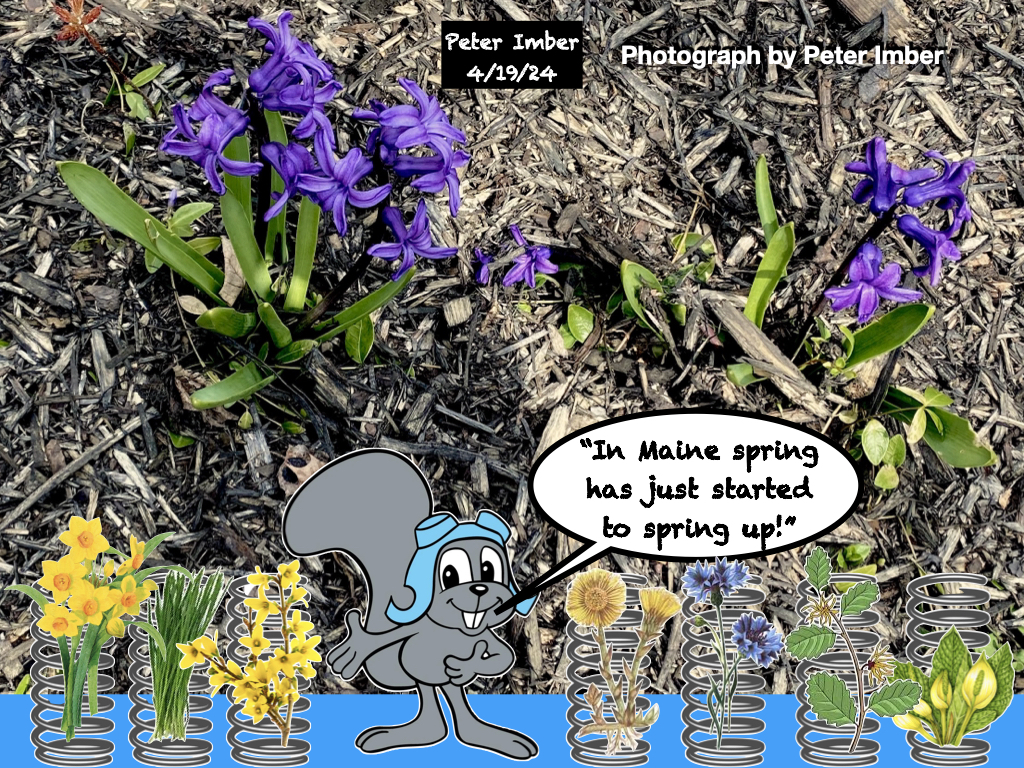
So, if it has to be at least 50 degrees for you to get out on the golf course,
you’re going to have a short golf season.
–Essie Dondis (Jo’s mother)
My golf course opened for play this week. I have been there three times and I believe the temperature reached at least 50 degrees on each of them. The ground is wet and soft. A golf ball can land and bury in it and then be given up as lost. I wore my winter boots.
During our short golf season I play as much as my body allows and until recently I’d always smile before hitting my drive off the 1st tee. “Today’s the day,” I’d say to myself. “I’m going to have the best round of my life.” I still smile but now accept that the hope I’ll have my best round ever is no longer an aspiration. It’s a fantasy.
For the past several years some of my golfing friends and I have complained that the course has been lengthened during the winter just to torment us. Yes, I know that’s not true but it’s tough to swallow that as my years grow longer my drives off the tee have become shorter and shorter. Some holes that are a par four and I could reach with two shots now take three or even more strokes even if I think I’ve hit them well. I hit fewer shots well now but appreciate the ones I do more.
I now play as much for exercise as for scores. I’m still walking the course and have only used a golf cart on the rare occasions in Maine when the temperature and humidity in summer make walking a safety concern. Comradery has supplanted results. I have a great group of golf buddies including an accomplished sculptor and a once upon a time roadie for Van Morrison.
My father loved golf and played the game well into his 80s. At that point finding others his age to golf with became a challenge and one day we had the following conversation on the phone after one of his rounds.
Me: “How did you play today?”
My Father: “Well, it was a bit of a struggle.”
Me: “What happened?”
My Father: “After a few holes Bobby had to quit because his shoulder was bothering him. Then after nine Jake went in. You know he had bypass surgery last month.”
Me: “Wow! And did you keep playing?”
My Father: “Yes, I went on alone.”
Me: “Dad, I’m not sure you’re playing golf anymore.”
My Father: “Oh.”
Me: “Have you ever seen the TV show Survivor?”
So Maine’s abridged version of spring is here. At our house the forsythia bushes have just started to bloom. Chives poked up earlier beside our driveway. Daffodils are all around but not at our house. We planted dozens of bulbs years ago and squirrels dug them out but didn’t eat them. They’d just take a bite and I guess never understood that if they didn’t like the first one, they wouldn’t like the tenth one either.
Soon our neighbor’s lilac trees will bloom and their fragrance won’t recognize the property line. I’ll be mowing the lawn before long and in another month or so leaves will obstruct the view of the mountain behind Camden that we clearly see for most of the year.
I lived in Southern California for three decades where there are really only two seasons. One of the unusual things about Los Angeles is that you can take a photograph almost anywhere and unless it’s time stamped you’d be hard pressed to identify what time of the year the photo was snapped. LA has winter and summer and I believe there is someone who throws a switch and suddenly you move from one to the other.
I’ll contend Maine has five seasons. Winter here counts as two.
Oh, and the photograph with today’s Homemade Cartoon was taken in early May four years ago.
Enjoy your spring!
—————–
A man used to go to school with his dog.
Then they were separated.
His dog graduated!
–Henny Youngman


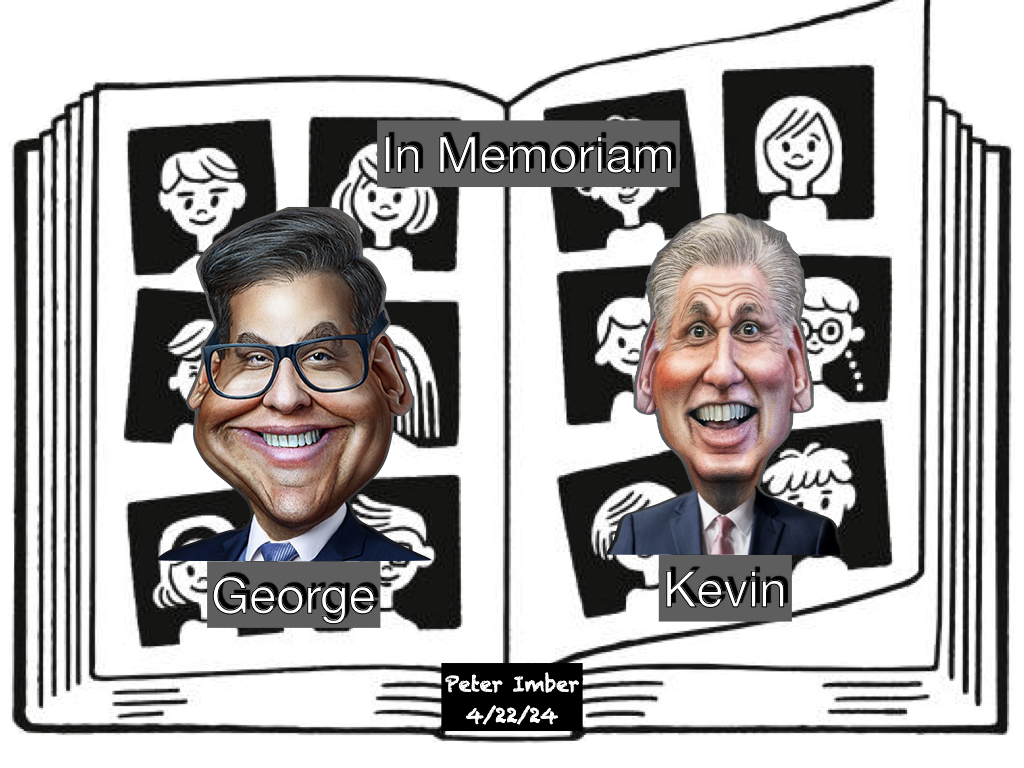
—————–
Trump v. United StatesDocket No. 23-939 Argument April 25, 2024Opinion TBD Vote TBD Author TBD
Yesterday the Supreme Court heard Donald Trump’s claim that as president he had absolute immunity from prosecution. It appears a decision on the case won’t be happening anytime soon. As a friend said to me some time ago, “We are watching democracy being used to destroy democracy.”I couldn’t fit my feelings into one Homemade Cartoon…


—————–

Guess you gotta keep her down on the farm
After she shot her puppy?
How you gonna keep her off the Beltway
Cruisin around, shootin up the town?
How you gonna keep the story of Cricket
From hurtin the ticket that is a mystery?
You’ll need a surge protector at every metal detector
After she shot her puppy
“How Ya Gonna Keep ’em Down on the Farm
(After They’ve Seen Paree?)”
was a popular songpublished after World War I. With apologies to Walter Donaldson (music) and Joe Young and Sam M. Lewis (lyrics)
—————–
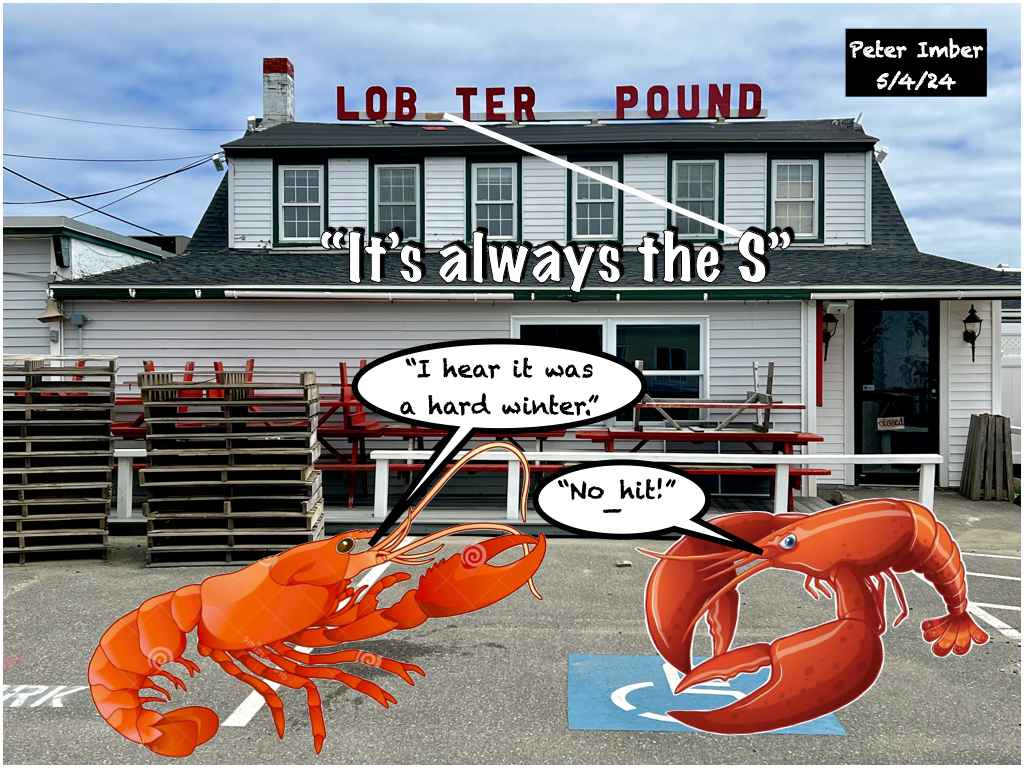
Today I took out the glass in our storm door. It’s later than usual to have switched it to a screen door. Every year I try to have six months of glass and six months of screen but it’s already May 4th which is a bit late and means for there to be equal time between screen and glass this year I will be switching back on November 4. According to local weather history records, the temperature at night in Camden, ME will be averaging below freezing by then.
Maine is a joy in summer.
But the soul of Maine is more apparent in winter
–Paul Theroux
In March there was a headline in a local newspaper that read “Third 100 Year Storm Hits Maine in Three Months.” The Lincolnville Beach Lobster Pound opened in 1926 and sits just a few feet above the ocean (It’s pictured above and missing the S from its sign.). It was damaged severely this winter and is now for sale with an asking price of $1.5 million. I’ll be shocked if it sells for half that amount and if it ever opens again.
Across the street from the Lobster Pound is a sandwich shop. It got flooded out after the first storm and reopened only recently. The owner makes a great Italian sub and since I grew up within 50 miles of Philadelphia, I feel my opinion carries some weight. I’m a good customer.
Me: “That sign above the Lobster Pound seems to lose a letter every year.”
Sandwich shop owner: “Yeah, and it’s always the S.”
—————–

My mother’s mother was my favorite grandparent. It was close between her and my father’s father. He had a kind heart and would kiss his grandchildren on the forehead every time he saw one of us. She was a good cook and when I was in college sent me knishes in the mail. A knish on a plate that I could eat trumped a kiss on the keppalah that as I’d gotten older I tried to avoid.
Dormitory life 60 years ago at Dartmouth College would be unimaginable now except maybe at a military service academy. No girls in the rooms except at certain hours and never overnight and only a few things that required electricity like a radio or record player were allowed. No televisions, refrigerators or things you could cook with were permitted in the rooms.
There was a guy across the hall from me who had an immersion coil (strictly forbidden) and would boil water in his waste basket and make spaghetti. Yes, that was as gross as it sounds but I can top it. There was another guy on the hall who broke his foot playing rugby and was in a cast. He took showers with a plastic bag taped around it but when he wanted to clean the sole of his foot which was exposed, he stuck his foot in the toilet and flushed.
But enough about life at the then all male college that inspired Animal House. My wonderful grandmother was worried I wasn’t getting enough to eat and certainly not the things a Jewish boy could have gotten at Columbia or NYU but didn’t stand a chance of finding in Hanover, New Hampshire. So, one day a package arrived full of her homemade knishes.
Fortunately, it was winter and I put the box of them outside on my window ledge. They froze quickly and whenever I wanted a knish I’d open the window, break one off, put it on a plate, put the plate on top of the radiator and soon enough I could have a bite without breaking my teeth.
This worked very well and the following year it became unnecessary. No, Dartmouth didn’t change its policy about appliances in the dorms but a new sandwich shop opened in town and the Italian owners either got some questionable marketing advice or just took a gamble on the demand for knishes in Hanover.
Yes, in addition to subs at this Italian deli potato knishes were available and astoundingly so was kishka, which is also called stuffed derma— an Eastern European Jewish dish traditionally made with matzo meal, schmaltz (animal fat), spices and vegetables encased in an animal (excluding pig) intestine casing. You may be disgusted but for me this was fine dining!
I loved kishka and apparently might have been the only person on campus who did because after a couple months, although knishes were still being sold by the Italians, kishkas were not. My patronage hadn’t been enough to keep them on the menu so the stuffed derma was suddenly snuffed perma…nently. I was disheartened but undeterred and made a proposal to one of the owners.
Me: “Tony, how many kishkas would I have to buy for you to order them for me?”
Tony: “A box of 24.”
Me: “Such a deal!”
I was delighted and resumed using my window ledge and radiator as a kitchen.
So many years later I live in Maine and the only kishka to be found in the state is in my house if I decide to make it. I have attempted several times and admittedly, mine doesn’t measure up. I wrap it in aluminum foil and not the casing of an animal’s intestine but I don’t think that’s the problem. It’s just a work in progress as I try to resurrect a dish that’s actually lost its standing in the Askenazi food chain.
We get to New York City every year and kishka can still be found there. The problem is that so can the best pastrami and trying to eat a kishka and a pastrami sandwich together takes guts… Yes, I can hear you groaning!
But I have a solution. Come to Katz’s Delicatessen with me next time and we’ll split the order!
—————–

I haven’t heard the term “fish story” used by anyone in quite a while but it’s still in the dictionary. I thought of it because I just discovered that stories I’ve heard numerous times since I’ve lived in Maine about lobster are apparently fishy.
One story goes like this. A long time ago when lobsters were considered food only eaten by the poor, inmates at the Maine State Prison rioted because they were being served them so often. And in furtherance of the legend I had heard that lobsters were so plentiful and unpopular for eating back then that farmers used them for fertilizer.
According to an article published in the Maine Island Institute’s newspaper The Working Waterfront, the stories are counterfactual crustacean characterizations. (And I’m willing to bet those three words have never been used together in a sentence in the history of the English language.)
People come to Maine for the beautiful coastline or to enjoy its lakes and mountains and hike or bike its scenic trails and until recently the summer weather here was cool enough that most Mainers didn’t even own air conditioners. But Vacationland is also lobsterland and a few years ago the Maine Office of Tourism did a survey of visitors and discovered that nearly 70% of them came here for “culinary experiences” and nearly half of those said they came primarily to eat lobster.
Although many of the most popular places selling lobster to visitors are called “shacks”, it’s appropriate today to classify lobster as a luxury food item. The going price for a pound of lobster meat is presently anywhere from $70 to over $100.
Red’s Eats in the village of Wiscasset calls itself the “World’s Best Lobster Shack” and even if it isn’t, it may be Maine’s busiest. Red’s serves nearly 15 tons of lobster meat in a season to customers who often wait in line for hours. It has been the source of summer traffic backups on the U.S. 1 coastal route for so long that those of us who live here will sometimes drive miles out of our way to avoid getting near it.
But just across the street from Red’s is Sprague’s Lobster where the wait for its fare is usually just a few minutes. The quality of the lobster served at both establishments seems to be comparable according to comments on websites like Trip Advisor and Yelp and so is the price of each of the lobster rolls– over $30.
This has led me to wonder why the vast majority of people choose to endure standing in a long line at Red’s Eats when there is hardly any line at Sprague’s across the street?
Here’s a take I found on why from a professor at Northwestern’s Kellogg School of Management…
“There are two restaurants that appear to be largely interchangeable except that one has a full dining room and the other is nearly empty. Which would you go to? For most people, the default is to go to the busy restaurant. Presumably, if those people knew that the empty one was better, they would choose it but if all they know about either one is that one is busy and the other isn’t, they are likely to infer that the busy one is better than the other.”
That explanation makes sense of the common variety. It doesn’t seem to me to have required research. But another sagacious observer of human behavior has my prefered take on why many of us who live in Midcoast Maine don’t frequent either establishment and avoid the annual seasonal bottleneck in Wiscasset.
“Nobody goes there anymore, it’s too crowded.–Yogi Berra
And you might not know this but just a short walk from…

—————–
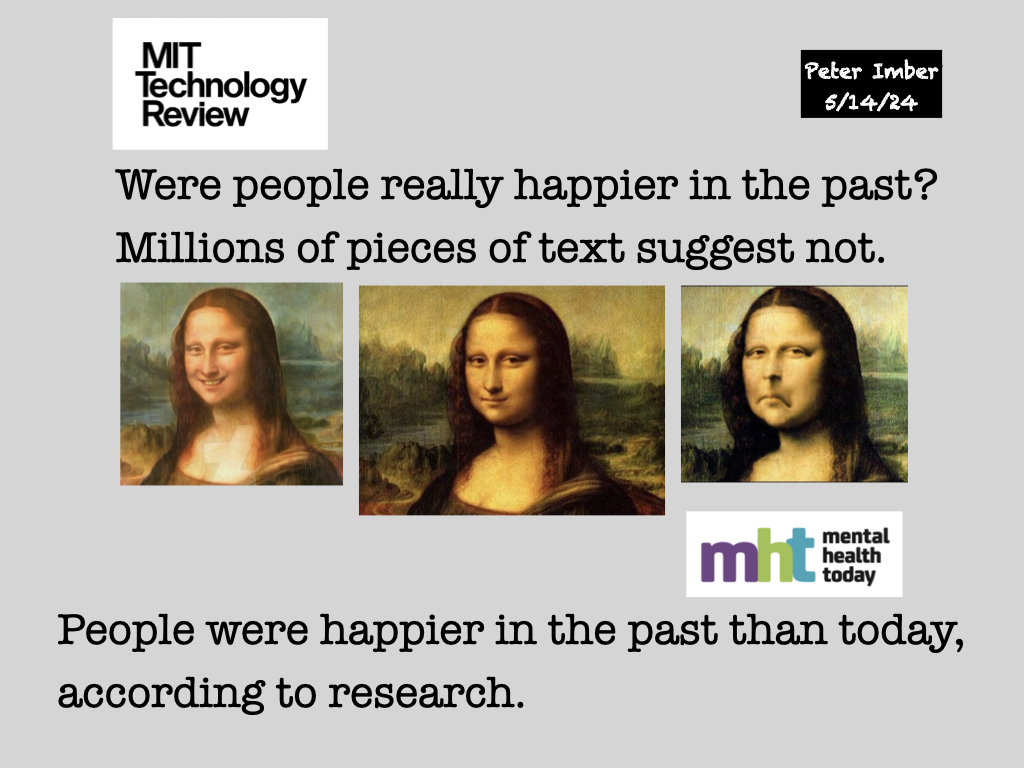
Will we ever know if the Mona Lisa was smiling? Read to the end and you’ll learn the latest scientific opinion. But let me add that I’ve been smiling since I came across the two articles with two different views of the same study called Understanding Happiness that was published back in 2017 by the Social Market Foundation and the Centre for Competitive Advantage in the Global Economy (acronym CAGE).
(Yes, this is the kind of thing that interests me and what I enjoy digging into when I sit in what Jo calls a replica of my office at ABC News. She also says I’ve never really stopped working.)
Here’s one summary from MHT– Mental Health Today:
Traditionally, the growth of GDP has been the chief measurement of success of government policy in the West. However, more recently attention has turned to ‘happiness’ – should policymakers turn their attention to increasing happiness in the same way that they seek to increase GDP?
Happiness does not appear to rise in accordance with GDP, the researchers found, yet growth of GDP is commonly treated as the highest aim of public policy. The researchers theorized this may be due to something missing from our historical understanding of the relationship between happiness and growth.
And here’s a take away from the MIT Technology Review of the same study:
Ever wondered whether people were happier in the past? We now have a much better idea, thanks to a new technique that involves analyzing the sentiment behind the words used in millions of pieces of text over the last 200 years. (And the answer is: people in the US are probably happier now than they’ve ever been, despite what you might think.)
Beyond such different interpretations the “new technique” mentioned above was what caught my attention. In 2006 I did a story about a machine that the Stanford University library had recently acquired. They called it the Reading Robot. Here’s a link to it which you may want to view now but if not read on…
https://www.youtube.com/@PeterImber/search?query=stanford%20robot
The flip description of the Reading Robot is that it was the ultimate speed reader. Lay a book flat on it and open to its first page and the machine would without further human involvement digitize the book’s contents at the rate of 1,000 pages an hour. Yes, it turned the pages and even separated them if they were stuck together. Up until its invention in Switzerland the digitization of books had been tedious, time consuming and expensive.
I was told Stanford’s goal was to digitize its entire library and when I surmised that the cost of doing that might require dipping somewhat into Stanford’s endowment, I suspected that somebody other than the University was subsidizing the project. When I asked who that might be I didn’t get an answer but I had a hunch it was a company headquartered nearby in Silicon Valley and founded by two Stanford students named Page and Brin. Although I couldn’t confirm it for the story at the time I turned out to be right.
And that leads me back to happiness and the CAGE report and how its creators pursued arriving at what they called Understanding Happiness. A group of researchers assigned “happiness scores” to thousands of words in different languages and then calculated the proportion of positive connotation versus negative in the frequency of the words’ usage. Think Word Cloud.
And how did the researchers gather the words they evaluated? They analyzed eight million books and 65 million newspaper articles from different countries. And where were all those books and articles able to be found without building a couple of airplane hangars? The entire collection of them came from something called Google Books (See: https://en.wikipedia.org/wiki/Google_Books) which I now realize I may have been observing at its very beginning.
But where does all this leave happiness? Well obviously, happiness isn’t delivered via a reading robot scanning infinite words and is the purview of each of us. But I do think that in our country and the entire world at the moment the CAGE team could go back and do updated “happiness” attribution focusing on words like anxiety and disillusionment.
Oh, and about the Mona Lisa. It too has been reduced to zeros and ones and gotten a cyber facelift which you might have heard about. Dutch researchers used something called emotion recognition software and algorithms to analyze the Mona Lisa’s facial expression and determined that her countenance was 83% happy. It was also was detected to be six percent fearful and two percent angry.
I’m sort of afraid right now to go look at myself in the mirror.
—————–

I believe I ate at a Red Lobster once but I don’t believe that if I did the “endless shrimp” offer was in effect. I would have certainly shelled out what recently has been $20 for as many shrimp as I could have eaten. Customers apparently have been doing just that and what had been an occasional limited promotion that was turned into a permanent deal last summer has helped cause Red Lobster to file for bankruptcy today.
During the pandemic a number of the “all you can eat” restaurants chains went under but I just checked and it appears shared serving spoons and tongs and plexiglass sneeze guards are back and business is booming. Ever hear of Golden Corral? It’s the number one endless anything you want to eat chain with nearly 400 restaurants where you can still stuff yourself on their butterfly shrimp and not break the buffet at least not yet.
Gluttonous style eating has been a tradition in the United States since the 1950s when the first all you can eat establishments started popping up. When I was a kid the place my parents often took me out to eat was called the Crystal, the most popular restaurant in Reading, PA. The Crystal ran a buffet on the weekends. They called it a smorgasbord which is Scandinavian. The owners were Greek. The food was totally American. It remained an all you can eat arrangement until it wasn’t.
I was very young but I witnessed an incident that probably helped lead the Crystal to decide to turn the smorgasbord into one stop chomping. I remember watching a man walking back to his table with his arms encircling his plate. The food he had piled on it was so high that it was only prevented from falling on the floor by his forearms and shirtsleeves wrapped tightly around it. Images like that last a lifetime in one’s head.
My other vivid memory of endless portions was at a Howard Johnson’s in White River Junction, VT. My college was nearby in New Hampshire and when HoJo’s started promoting “all you could eat” opportunities once a week, the population shift from one state to the other on that day might have been measurable. But it didn’t take long for the restaurant’s management to come up with a game plan that stemmed the invasion.
My favorite time to show up was on evenings when fried chicken was offered. I could easily devour at least three portions but one time after I polished off the first two the third that I was served almost broke my teeth– it was all but frozen.
Maybe that’s the tactic Red Lobster needed to employ. The chain lost millions on its “endless shrimp” although it wasn’t the only cause of the company’s demise. But with shrimp being the most popular seafood in America it appears Red Lobster tried what only movie theaters can get away with– free refills on their most popular item, popcorn.
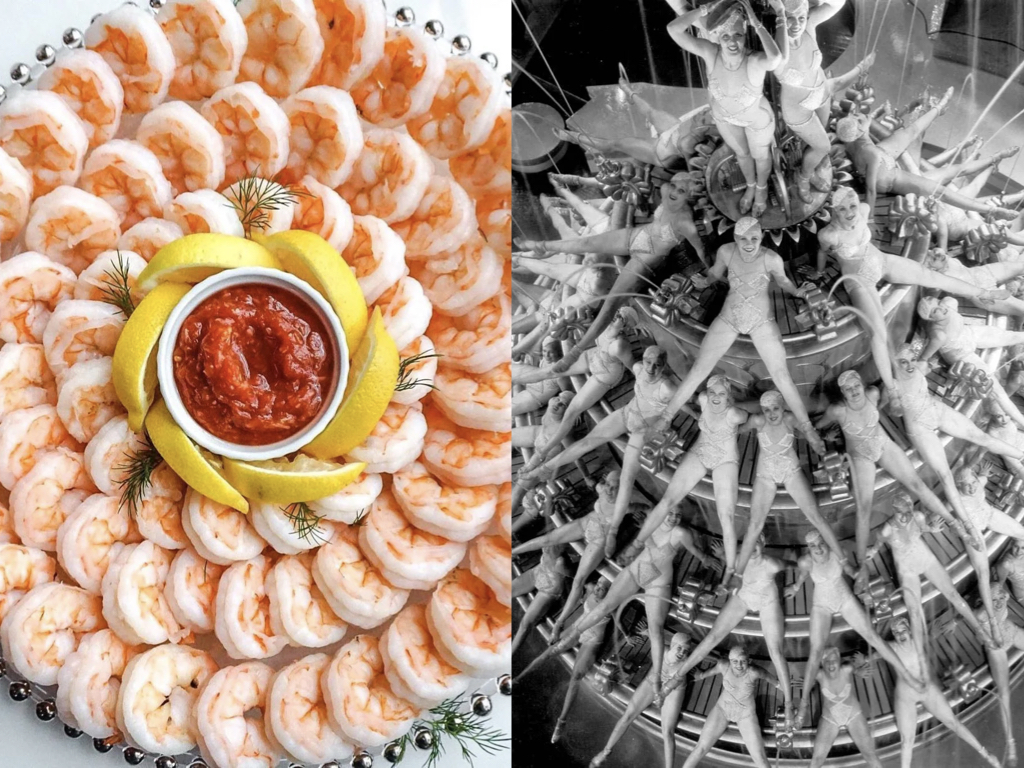
Oh, and whenever I see what’s called a shrimp wheel in the seafood section of the supermarket I think of Busby Berkeley.
—————–


I originally published this on May 25, 2020…
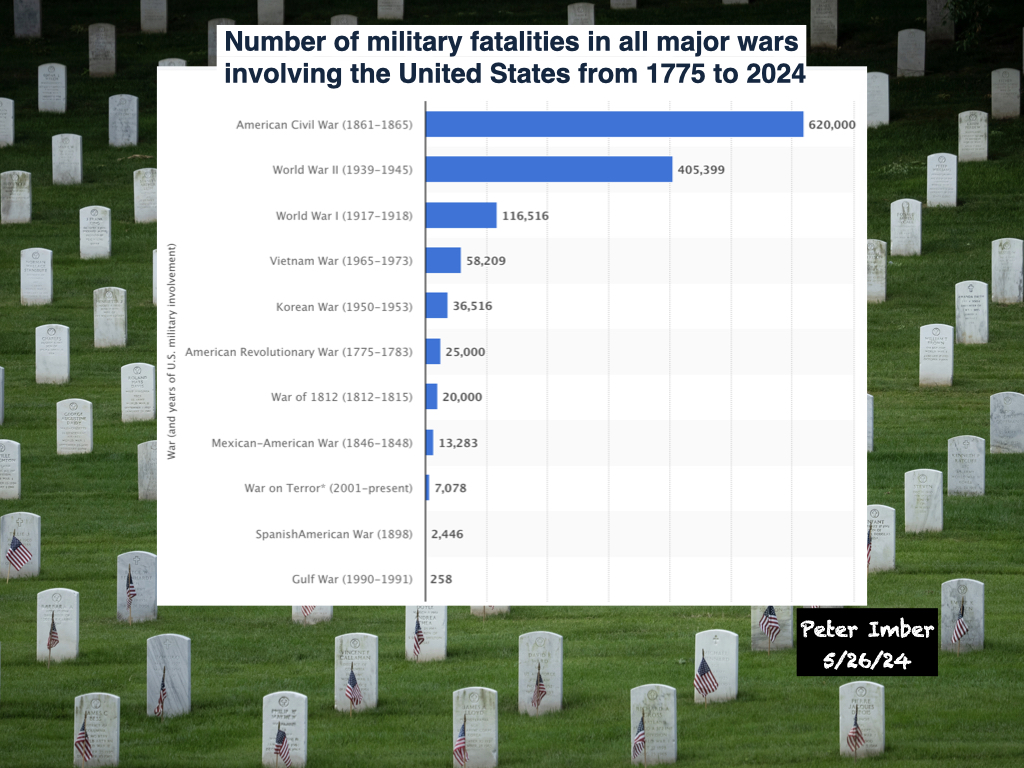
We’re a big country and many of us don’t have someone to remember who lost his life in a war, let alone fought in one. So what do we think of first when we hear the words Memorial Day? Little wonder that it’s a cookout or a shopping opportunity.
I’m an admirer of the sculptor Claes Oldenburg. I just checked and he’s still alive and in his nineties.* My absolute favorite thing of his is an idea for a sculpture that was never created. Back in the 1960s Oldenburg did a series of drawings that he called “Colossal Monuments.” One of them was a war memorial. I’m inserting a rendering he made of it below…
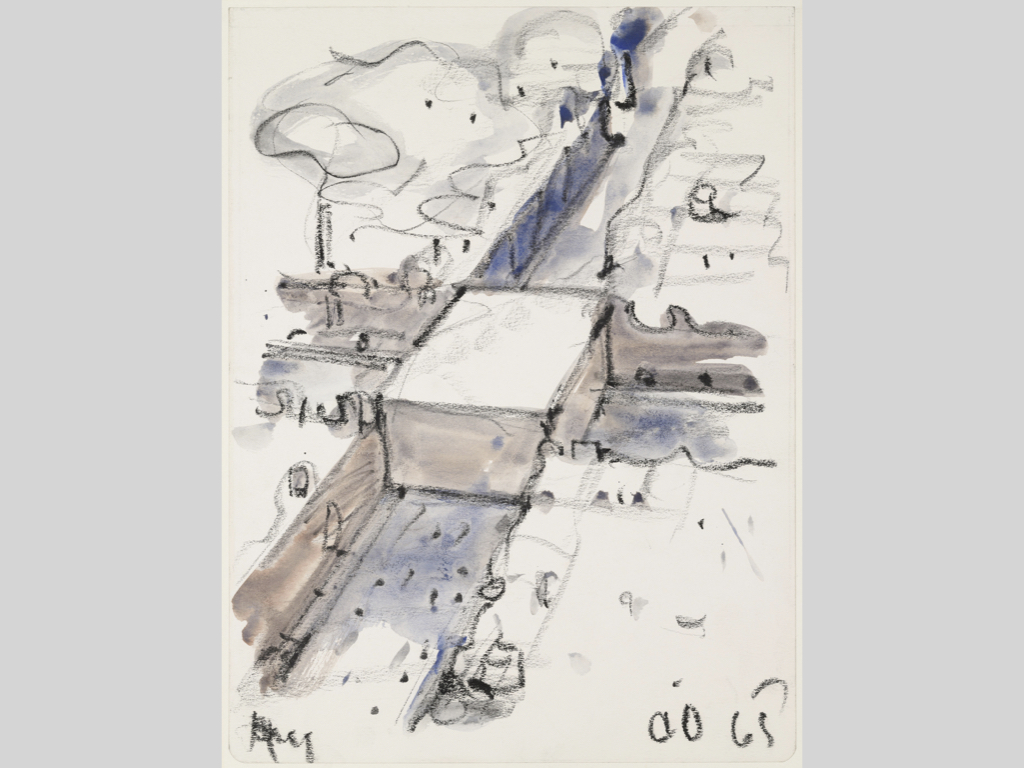
It was to be a giant block of concrete as high as the buildings that surrounded it that would have been placed in the middle of the intersection of Canal St. and Broadway in Manhattan. Oldenburg would have had the names of “war heroes” carved in it.
Was Oldenburg making a serious anti-war statement with his idea to disrupt New York City traffic permanently in one place? Was his intent to have people curse being inconvenienced and war simultaneously? As far-fetched as it seemed, Oldenburg’s conception for this memorial and how I interpreted its purpose made sense to me when I saw his drawing for the first time. Afterward I figured it was more like a satirical aside.
Since then I’ve been to the Vietnam War Memorial in Washington and was quite moved. I knew people killed in that war that I myself didn’t have to go to– nobody who was a close friend but high school and college classmates whose names I could find on the wall. Seeing all the names of those who had died was a jolt. The Vietnam War Memorial is a destination you don’t just happen upon. You know where it is and why you’ve come to see it even if you don’t know how you are going to react..
In retrospect I think plugging up Canal St. and Broadway would have made a powerful war memorial but it would have needed to be a temporary obstruction and constantly moved to someplace else without any advance notice. That way it might have pissed you off when you suddenly encountered it for two reasons and you could have blamed both the traffic tie up and all wars for your being late.
Our public reminders of the cost of wars are mostly way too polite.
So, what should we think of today on our nation’s Memorial Day? For a start, how about this? Let’s not call it a holiday. It’s not a celebration. It’s an observance. Memorial Day is the one day a year set aside to actually remember and think about those who died in America’s wars and didn’t get to grow old and be here for the cookouts and the sales.
*Claes Oldenberg died in 2022.
—————–
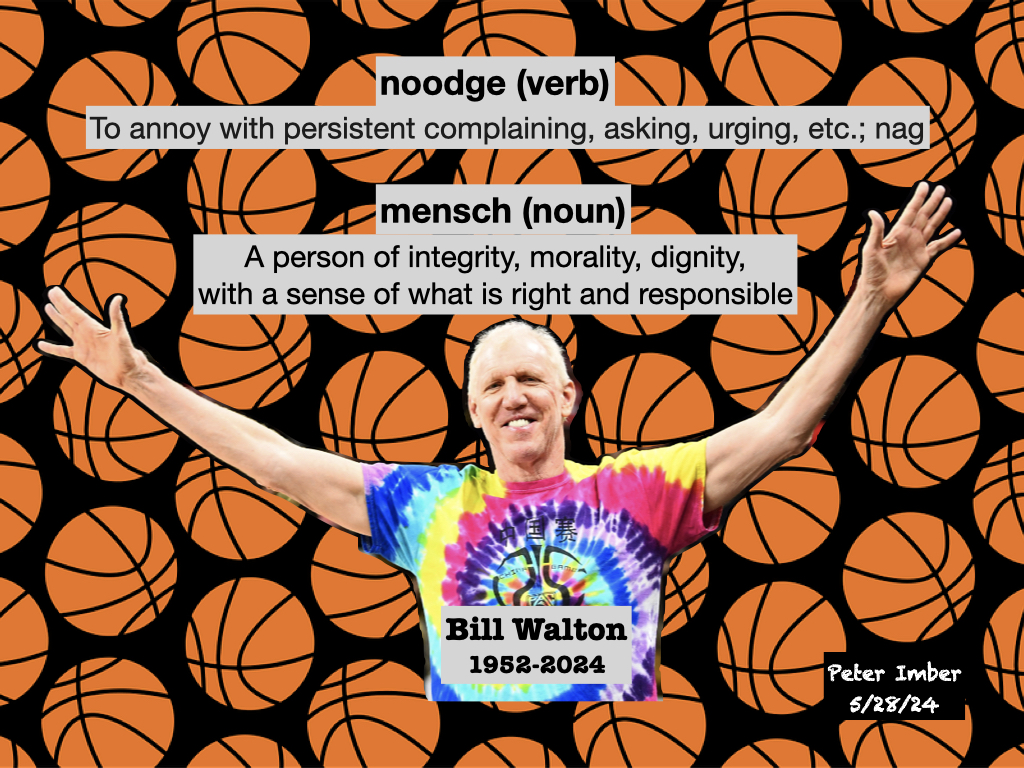
Sometimes someone’s passing hits me surprisingly harder than I would have imagined. Bill Walton’s has. Partly, it’s because I had no idea he had cancer. He seems to have kept that a secret from the public. But mostly, it’s because in recent years I loved listening to him broadcast basketball games.
larger-than-life (adjective)
exceeding imposing, impressive or memorable,
especially in appearance or forcefulness
Words like noodge and mensch fit him like the pair of size 17 sneakers he wore to play basketball. He was at once outlandishly opinionated and instinctively bighearted– a Yiddish combination of gall/chutzpah and kindness/chesed.
Physically, he was apparently taller than his listed height of 6′ 11″. He didn’t want to be known as a 7 footer. Spiritually, he called his attendance at hundreds of Grateful Dead concerts as “going to church.”
His accomplishments as a basketball player despite numerous injuries earned him a place in the game’s Hall of Fame. His stances on the issues of his time got him arrested for demonstrating against the Vietnam War and bailed out of jail by John Wooden– his coach at UCLA and a legendary straight arrow.
I think Walton and the late Los Angeles Dodgers’ broadcaster Vince Scully are the only two announcers I’d tune into just to hear no matter the game being played. And there was one particular aspect of Walton’s announcing unlike any I’d ever heard. Bill Walton didn’t just know the players on the teams; he often knew their parents. He had taken the time to meet them just as he had to know and praise even the teams’ trainers.
Bill Walton’s size 17 sneakers were indeed larger than any available at a shoe store. Just as the man’s life was larger to me than any words in an obituary can convey. Walton called himself the luckiest guy in the world. In recent years I’ve often told others that I am. If I’d had the chance to meet him, I wonder if he would have agreed to call it a tie?

—————–
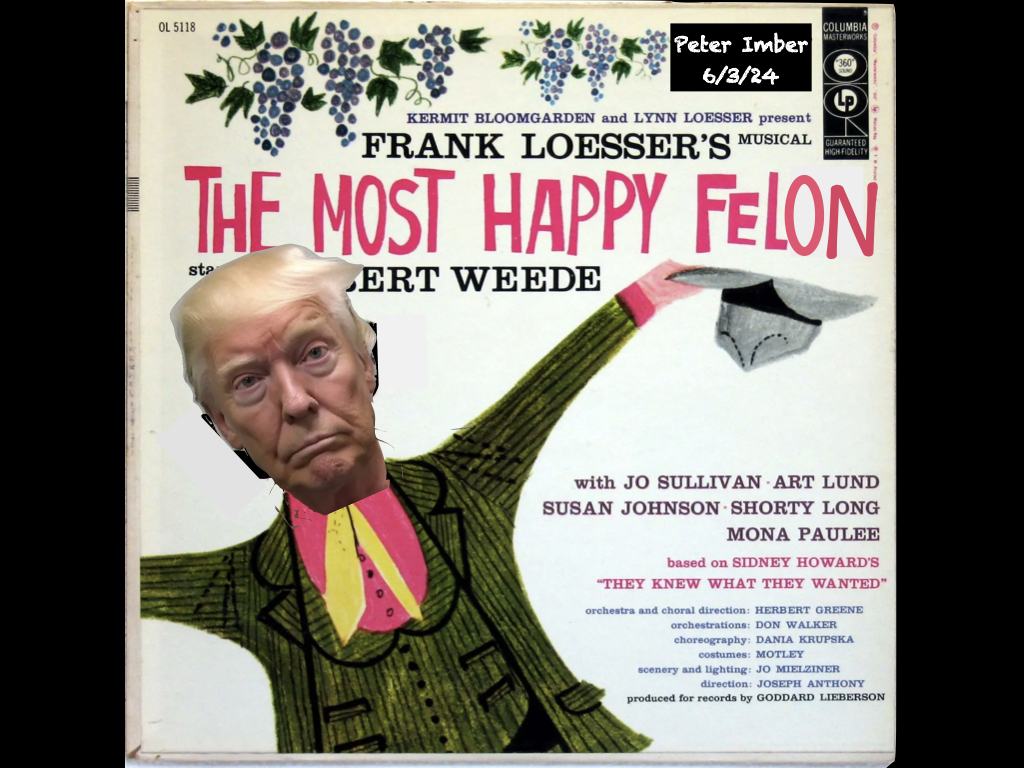
Sung to the tune of Standing on the Corner. Words and music by Frank Loesser from the Broadway show The Most Happy Fella which opened in May of 1956 and ran for 676 performances…
The court just came to order. No juror dared to look me in the eye.
The court just came to order. Can they extradite me from Dubai?
Who will deliver if I’m put in isolation?
Can I get burgers or even fries?
The court just came to order. No one looks me in the eye,
Looks me in the eye.
What the hell? All 34 counts? I’m back here in July!
Should I have called it The Most Unhappy Felon? As they say the jury is still out on that one.
—————–

—————–
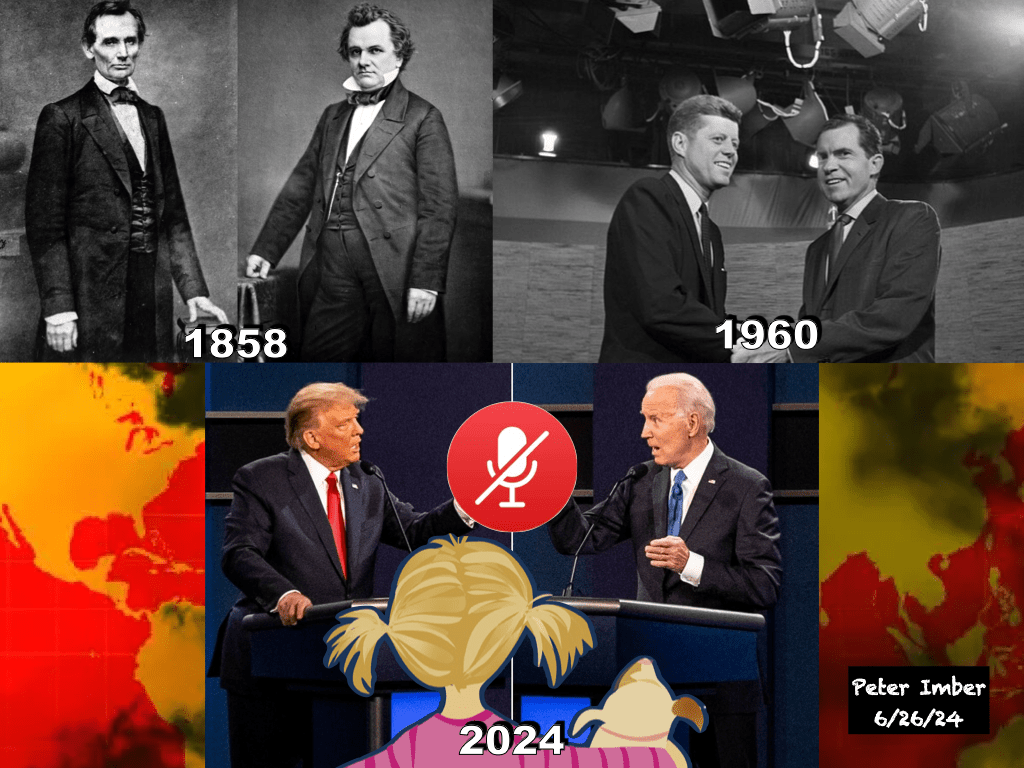
In 1960 I was 13 years old when Richard Nixon and John F. Kennedy squared off in the first televised presidential debates. I remember watching and learning about two islands off the coast of China named Quemoy and Matsu. I haven’t heard them mentioned again since.
Tonight’s debate between presidential candidates Joe Biden and Donald Trump, neither of whom has been officially nominated yet by their parties, is an acknowledgement that the Democratic and the Republican Party conventions have become boring scripted coronations where nowadays the only wheeling and dealing possibly left is over where the delegates are going out to eat when their rubber stamping is done for the day.
But at the same time the debate tonight will also mark a partial return to the original televised presidential debate format 64 years ago. Those first Nixon-Kennedy debates were conducted in a TV studio with nobody present in that room other than the candidates, a moderator who oversaw the ground rules, several journalists who asked the questions and the TV personnel operating the cameras.
I’m guessing there were at least three cameras and whoever was behind the one that showed closeups of Nixon’s sweaty brow and his 5- o’clock shadow apparently had a hand in determining the winner of the election that fall and earned an unrecognized place in our nation’s history. Ok, and so did the director and producer who put those shots of Nixon on viewers’ screens to see.
Tonight, as Yogi Berra allegedly said, is a little like deja vu all over again at least technically.
But let’s go back further to perhaps the most controversial and consequential political debates in American history which weren’t even between two candidates jousting for the presidency. In 1858 Stephen Douglas and Abraham Lincoln were running for the United States Senate and historians consider the debates they had in seven Illinois towns the American debating gold standard in substance and eloquence. Each debate was outside and lasted about three hours and all were attended by crowds that numbered in the thousands.
The debates had a consistent thread of Douglas accusing Lincoln of being an abolitionist while Lincoln argued that Douglas wanted to nationalize slavery. There were no microphones and loudspeakers to augment the sound of their voices. Douglas apparently had the edge there with his booming baritone but Lincoln’s softer tenor still allowed him to be heard by those at the very back of the audience.
Chicago newspapers sent teams of “phonographers” which was what those who took shorthand were called at the time. With those written testimonies the debates were closely followed in newspapers across the entire country.
In the subsequent election Douglas, the incumbent, kept his Senate seat in Washington but Lincoln’s performance made his national reputation and two years later he was elected President of the United States.
Skipping ahead a century… Don Hewitt invented 60 Minutes at CBS in 1968 but eight years earlier he produced the Nixon-Kennedy debates and immediately recognized the impact of televising presidential debates on our nation’s elections. At the end of his career he reflected on what he thought he had wrought.
“When it (the first Kennedy-Nixon debate) was over, I realized we didn’t have to wait for an election day, we just elected a president. It all happened on television… I don’t think you ought to pick your presidents by who’s the best television performer. There’s something wrong with that. That’s always worried me. Great television performers don’t necessarily make good presidents, and yet that’s how we pick them now.”
I won’t venture a guess of what the impact and outcome of Biden’s and Trump’s debate tonight will be other than I’ll be glad if I’m not dispirited after it ends and I’ll quote Yogi again. “It’s tough to make predictions, especially about the future.”
I will be amazed if the debate is substantive and surprised if it’s civil but I’ll be shocked if it becomes determinative. If, as Don Hewitt believed, we pick our presidents on the basis of how they look and act on TV, I’ll add and contend that our social media platforms seem to have usurped the power of the tube at this point.
If what you see on television isn’t always what you get, then we have sadly moved quantumly further along to what you see, what you hear, and what you read on the internet is more than just what you get. It’s likely pinpointing your allegiance to the tribe you belong to. And for some even when the information and pronouncements there have been proven to be false, crazy and dangerous lies and conspiracy theories still remain unassailable bedrock gospel.
And one last thing for you to unravel. What do the numbers 94, 90 and 159 have to do with presidential debates?
Ok, I won’t keep you in suspense.
In 1858 Abraham Lincoln was 49 years old and Stephen Douglas was 45. That equals 94.
In 1960 Richard Nixon was 47 and John Kennedy was 43. That equals 90.
You know where I’m going with this, no?
In 2024 Joe Biden is 81 and Donald Trump is 78. That’s 159.
Biologically, Biden and Trump could have been the other four’s parents! Only Nixon lived as long– and just barely –as tonight’s debaters.
June 28, 2024
Below is the beginning of George Washington’s farewell address which was written and published in September of 1796 just 10 weeks before presidential electors were to cast their votes in an election that most likely would have elected him for a third term.
“Every day the increasing weight of years admonishes me more and more that the shade of retirement is as necessary to me as it is welcome.”

In the address Washington warned of the danger of the takeover of a political party by an authoritarian figure…
“…they are likely in the course of time and things to become potent engines by which cunning and ambitious and unprincipled men will be enabled to subvert the power of the people and to usurp for themselves the reins of government.”

Every year since 1896, the Senate has observed Washington’s birthday by selecting one of its members, alternating parties, to read the 7,641-word statement in legislative session.
—————–
 pawnedaccordion