

Under the headings “I’m turning over a new leaf” and “An old dog can still learn new tricks” Homemade Cartoons is moving and you’ll still be able to access it for free.
I’ve created a Substack website and will END sending out mass emails of my cartoons and musings to you. Instead, if you subscribe to my new space in cyberspace, you’ll receive an email notification for each post directing you to my Substack presence. There you’ll be able to open my posts after you subscribe. There is no fee, it’s FREE!
You can subscribe to me on Substack by choosing that option at the link…
If you have any problem reaching this link and signing up, please email me and I’ll help with your access.My substack is called the THE PAWNED ACCORDION which is what happened to my own instrument when I quit playing it but that’s a story I posted four years ago and I’ll post again down the road.
Substack will offer me the opportunity to share my musings more widely and distribute them more easily. And perhaps I might even earn some money by accumulating paid subscribers but you won’t have to be one of them. There is no obligation for you to become a paid subscriber now or in the future. There is no paywall on Substack.
You’ll be able to sign up at the above link and continue to see my stuff. Yes, you’ll also see there is a paid subscription option if you feel what I do is worth your support.In the past four plus years I have created over 600 cartoons and written many thousands of words. I don’t intend to stop.
During the pandemic in 2020-2021, I posted a cartoon for 365 straight days. I found out that I liked coming up with the cartoons and musings I created and a lot of you have told me you were happy to be receiving them then and still do.
I won’t have something to post every day but both the biggest and the smallest things often lead me to want to know more and share my thoughts either as a cartoon or in writing or both.
If life is like a parking space –and I doubt anybody has ever contended that it is before –I’ll keep feeding the meter to pay for remaining curious and the chance to share ideas, opinions, stories and cartoons that you’ll continue to be able to see and read.
As long as I still have change in my pocket I’m going to use it to keep my parking meter from expiring since none of us knows how much time we have left on it to explore and learn and create.
Hope to see you on my Substack!
Best Wishes,
Peter
Who Is He Kidding?
Joe has lost his mojo




At this point in the history of the United States if our country were a radio station, its call letters might be WTF! Less than a week ago we witnessed a presidential debate that was like watching a boxing match between Mike Tyson and Mr. Rogers.
Then came the Supreme Court decision a few days ago on presidential immunity which feels like a sucker punch in the gut to what I believed was the bedrock principle throughout American history that no person, even a president, is above the law.
The Pawned Accordion is a reader-supported publication. To receive new posts and support my work, consider becoming a free or paid subscriber.
I’m hardly a Constitutional scholar, although in college one of the best classes I had the privilege of taking dealt with the history of that document taught by a man named Vincent Starzinger.
Of the many tributes from former students after his death I’ve picked out this one to sum up his particular gift to us.
“He was not there to make you think a certain way, he was there to make you think.”
So, here we are six decades later and I wish Professor Starzinger was still around to help my brain make sense of an ever growing number of decisions during the Roberts Court era that to my own thinking have not made our nation better, safer, fairer or stronger but are accomplishing the very opposite.
I’ve picked out some of them and applied the standard which has guided medical practice for centuries but apparently not our Supreme Court justices— First, do no harm.
District of Columbia v. Heller (2008) made it much harder to ban and regulate the ownership of guns.
The Impact: Since the decision, guns owned in the country now exceed our population and gun violence is epidemic with nearly 50,000 deaths from guns yearly by homicides and suicides. Guns are now the number one killer of American children. The fear of gun violence has unquestionably changed our sense of security if not our daily lives.
Citizens United v. Federal Election Commission (2010) made it possible for corporations, unions and wealthy donors to spend unlimited funds on elections.
The Impact: So called Super PACs have been able to hide the sources of their money— dark money —and in 2020 alone total election spending was $14.4 billion, up from $5.7 billion two years prior and yes, I know 2020 was a presidential election year. And I am also aware that election spending is a bipartisan problem that has led to the pervasiveness of negative advertising bombarding us from all sides that has created the distressing fact that American elections are often up for sale.
Shelby County v. Holder (2013) struck down the formula by which the 1965 Voting Rights Act required certain states with a history of discrimination against minority voters to get changes to their voting requirements cleared by the the federal government before they went into effect.
The Impact: Since the decision 29 states have passed 94 restrictive voting laws and while some have been blocked, most are presently in effect and since the 2020 election, 21 states have passed 33 more laws restricting mail voting access.
Dobbs v. Jackson Women’s Health Organization (2022) determined that the Constitution does not confer a right to abortion and overturned a precedent of half a century of that right set by Roe v. Wade (1973).
The Impact: Within a month of the decision 43 clinics in 11 states stopped providing access to abortions. There are now no abortion providing facilities in 14 states that enforce total abortion bans. Nearly two-thirds of Americans polled believe access to abortion should be a legal right.
Loper Bright Enterprises v. Raimondo and Relentless, Inc. v. Department of Commerce (2024) overturns a 40 year old decision Chevron v. Natural Resources Defense Council that established the law that federal courts defer to a federal agency’s reasonable interpretation of a statute when it is ambiguous.
The Impact: In all likelihood executive branch agencies will face increased difficulty in regulating the environment, cyberspace, public health, workplace safety and surely other areas. Judges may now exercise more power than experts.
Trump v. United States (2024) This highly controversial decision grants presidents presumptive immunity “from criminal prosecution for a President’s acts within the outer perimeter of his official responsibility”, meaning a president is presumed to enjoy immunity from prosecution if his action is related even by just a small amount to his official status.
The Impact: Consider writing checks in the Oval Office to Michael Cohen for his legal services to pay off Stormy Daniels as possibly a presidential act now permitted within his constitutional powers. More brilliant minds than my own both joyous and mournful will be parsing and pontificating about Trump v. United States for years to come but to quote a line that every movie horror film fan is familiar with “Be afraid. Be very afraid!”
And there’s this other quote that I’m thinking about more frequently from founding father Benjamin Franklin to the question of whether we have a republic or a monarchy to which Franklin answered “A republic if you can keep it.”
And did you know that once Benjamin Franklin had an understanding of the behavior of electricity, he invented the lightning rod to protect houses from destruction by lightning? I wish he were still around to come up with another to prevent America’s destruction by politics.
So, Happy 4th of July if you feel like celebrating!
—————–

Landslide in the UK, Backslide Averted in France
Pundits and historians, pollsters and social scientists and famously, James Carville can claim we vote with our pocketbooks as in “It’s the economy, stupid!” And then there’s also the longstanding and still mostly verifiable “We vote how our parents did!”
I took a government course in college and my professor asked us what ketchup we preferred? The two candidates were Heinz and Hunts. (Was there even a third?) A followup question was which one did you grow up with at home? We used Heinz and I still do. And yes, my parents were Democrats and so far so am I.
This postulate did not apply thankfully in adulthood to my childhood spaghetti— Muller’s —and tomato sauce— Del Monte. As we age, certainly we are capable of changing our past even beyond our pastas. And times change and change us.
It seems to me that at this point in history the countries in the world where people are still allowed to vote without intimidation (and there are fewer now than there were a few decades ago) voters are more often expressing their angst and discontent and even their pessimism and fears and although the first line in the stories about the election results in the UK and France may have the words “The left won”, it’s certainly not the whole story.
I know I’m not showing such nuance in today’s cartoon. Remember, I’m a recovering television news journalist and I always realized my work was sort of adding captions to pictures without the space and time for a lot of depth.
A picture may be said to be worth a thousand words but I rarely ever got that many. So now that I have a chance to use them plus express an opinion, I’ll add that these election results don’t really mean there’s been an about face for the future political direction of the UK and France. I don’t think whatever gyroscope that has been balancing western democracies for decades is working now.
Equilibrium in many societies is teetering and to adapt the quote that the astute political prognosticator Bette Davis uttered in All about Eve 84 years ago “Fasten your seatbelts. It’s going to be a bumpy future.”
—————–
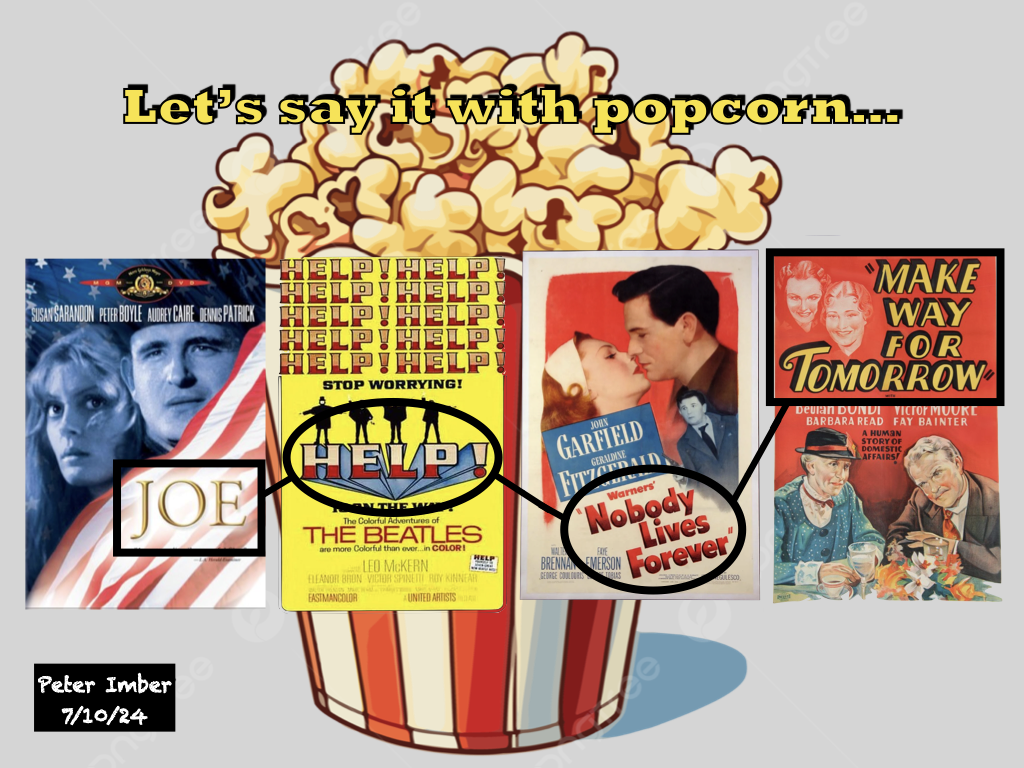
What Biden Said About His Favorite Movie
Can watching a movie help influence or even inspire an important decision by the President of the United States? After coming up with today’s cartoon I looked for any evidence of that actually having happened and could only find one substantiated example.
It occurred in 1970 during Richard Nixon’s presidency and the Vietnam War. Despite opposition from his advisors, cabinet members and the American public, Nixon was determined to expand the war into Cambodia.
The Pawned Accordion is a reader-supported publication. To receive new posts and support my work, consider becoming a free or paid subscriber.
A few months before ordering that mission to begin, a film had been released starring George C. Scott as the uncompromising and eccentric General George S. Patton. Ronald Reagan among others had turned down the role. John Wayne was not offered it.
Nixon apparently watched the film Patton repeatedly and although he later denied any connection between it and his decision to bomb Cambodia, his national security advisor Henry Kissinger said he felt that the President viewed himself as a military commander in Patton’s cinematic image.
Although there are numerous books about actual and fictional presidents portrayed on film, I have found only articles about presidents watching movies themselves during their time in the White House.
Movie screenings there did not get off to an auspicious start. The first was in 1915 during the presidency of Woodrow Wilson. The one chosen was Birth of a Nation which to this day is considered among the most controversial and racist films ever made in United States history.
At the time D.W. Griffith’s movie was an outrage to many, portraying its black characters as despicable and the Ku Klux Klan as heroic. Afterward Wilson had his personal secretary deny that he had known in advance of the film’s true nature.
Since Franklin Roosevelt created a permanent White House movie theater in 1942— His own tastes ranged from Mae West’s I’m No Angel to Walt Disney’s Snow White and the Seven Dwarfs — it appears some presidential office holders have been downright movie fanatics or perhaps in the course of their duties, the job and a need for distraction from it may have driven them in that direction.
Dwight Eisenhower watched over 200 movies during his two terms. His favorite— High Noon. But the runaway record holder for film zealot may surprise you. Coming in at 480 viewed in four years is Jimmy Carter who was also the first president to screen in the White House what had initially been an X-rated movie— Midnight Cowboy. By the time Carter saw it, the rating had been revised to an R.
A presidential consensus about favorite films? High Noon again. It tops the list. Bill Clinton claims he watched it 20 times. John Ford’s The Searchers and My Darling Clementine and David Lean’s Lawrence of Arabia and The Bridge on the River Kwai are also up there.
And then there’s Joe Biden and an answer he gave in an interview to a question about what was his favorite movie during the 2008 campaign when he was running for a second term as vice president with Barack Obama…
Katie Couric: “What’s your favorite move and why?”
Joe Biden: “Chariots of Fire” is, I think, probably my favorite movie. But the truth of the matter is the thing about it, there is a place where someone put personal fame and glory behind principles. That to me, is the mark of real heroism, when someone would do that.”
Couric: “Do you remember your favorite scene from that movie?”
Biden: “I think the favorite scene is when he is making the decision and talking to his … about do I do this? What do I do? He so desperately wanted to run, but concluded he couldn’t. It was that, you know, that moment of decision, I think that was my favorite scene.”
Yes, Joe Biden actually said this 16 years ago! If only he could hear himself now.
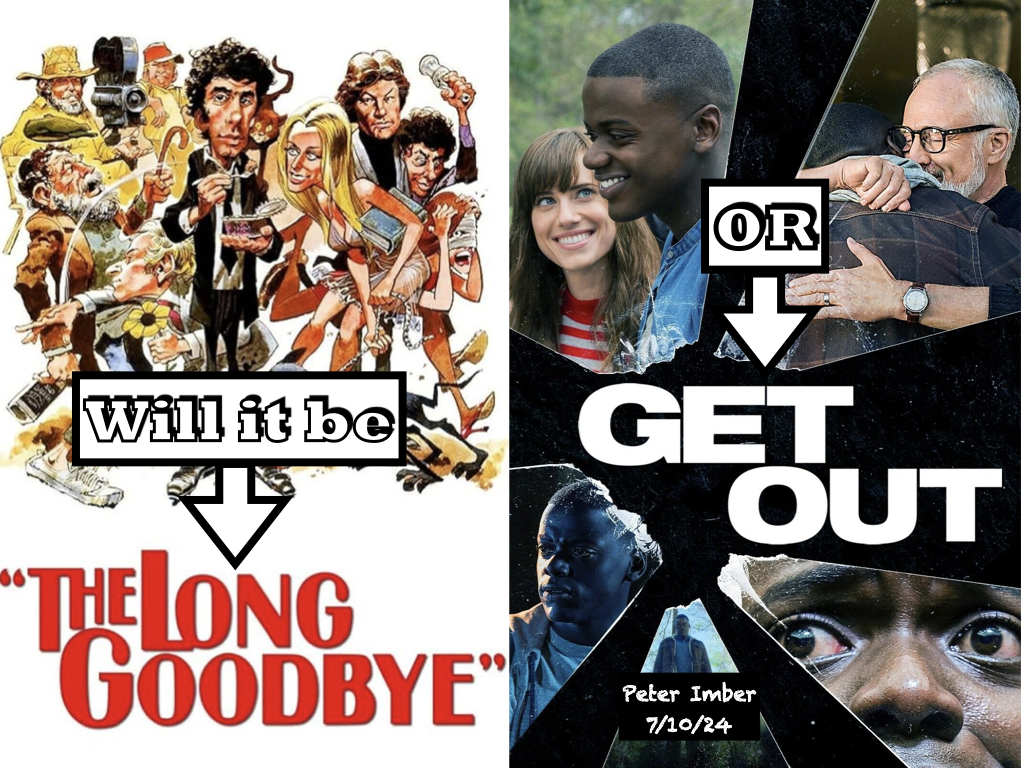
My Brain Is Shrinking!
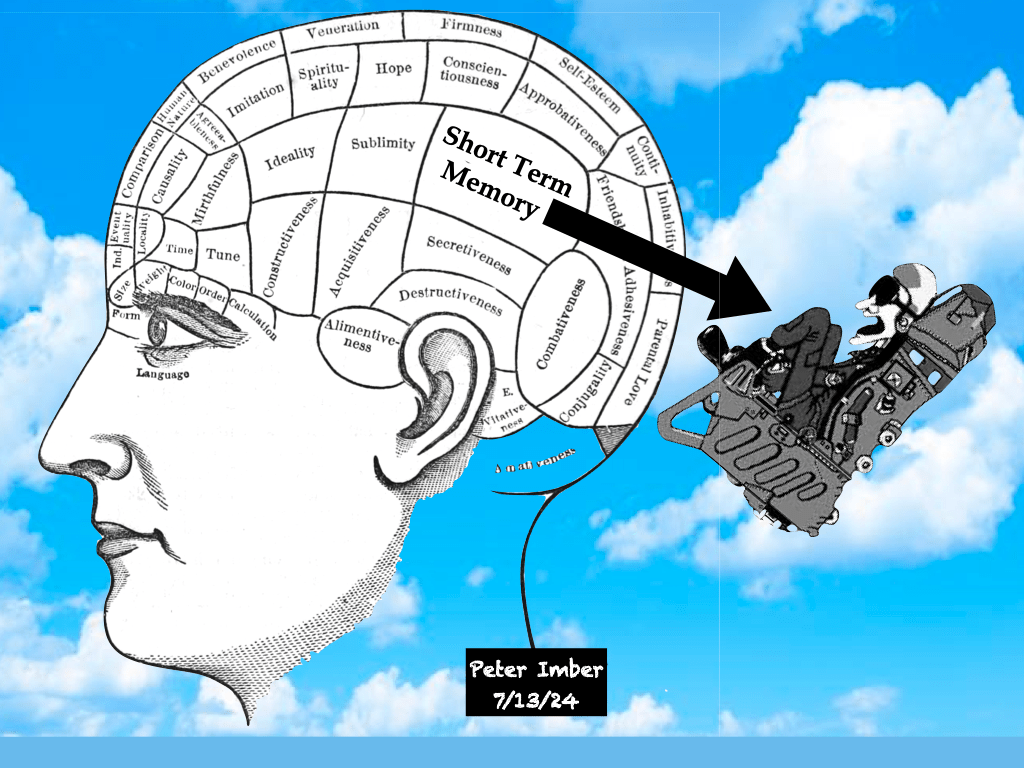
Remember the children’s toy that had a plastic page that you could draw and write on and then by lifting it you could make whatever you had just drawn or written instantly disappear?
It was called the Magic Slate and lately I’ve realized my brain seems to have become one. My short term memory loss is accelerating. It’s the usual stuff… “What did I just come in the room for?” “Where did I put that?” And in response to Jo, “I know I was supposed to do that but I forgot.”
I’m not panicked but I am annoyed and dealing with my brain’s size shrinking— all ours do as we age —has led me to realize that I now have the equivalent of a Magic Slate inside of my head.
There’s the blunt stylus (Weren’t they usually red?) that I know inscribes the thought or task I have told my brain I intend to carry out, but in just seconds whatever was imprinted on it has disappeared. Ok, I’m 77 and I know that memory loss is a typical part of getting older but here’s what keeps me confident. I figure that as long as I remember I forgot, I’m Ok!
Computers are like us and we’re like them. We pack both full of stuff and there can come a point when there is no more room to cram in any more stuff. Of course you can always purge a computer of what’s using up its memory and create more room for storage or you can just go buy a new machine. Our species hasn’t come up with an implant of extra RAM for us YET! I’m sure Elon Musk is working on it.
I’m not telling you anything that you likely don’t already know or are already experiencing. You may have your own Magic Slate now squatting inside your hippocampus (In Greek it’s a sea horse. In our brains it’s shaped like one and is the repository for our memory. The word also makes me think of college and the ballet sequence in Walt Disney’s Fantasia.)

But back to the Magic Slate and my surprise to learn that one of the all-time inexpensive toys became an important counter espionage tool during the Cold War. And it happened not once but twice.
The first time was in the 1950s after a microphone was found planted in a gift from some Russian children to the American ambassador in Moscow— it was inside a wooden replica of the Great Seal of the United States no less. After that discovery there was alarm and suspicion that doubtless other bugs were hidden in the embassy.
Someone came up with the idea that since conversations inside the building were likely being heard beyond its walls, the staff needed to communicate silently among themselves. A shipment of Magic Slates from America provided the work around and also had the added benefit of leaving no trace of the information that was being written and shared on them.
In the 1980s more concealed listening devices were again uncovered in the embassy and this time newspaper reports of how Magic Slates were being used to thwart Soviet spying spurred sales of the toy at home.
The manufacturer of Etch A Sketch suggested (perhaps jealously) to the State Department that their product would be an even better device to deter the Russians— Ok, I made that up. Have you ever tried to write a single word on an Etch A Sketch?
But back to my increasing short term memory issues and I’m surprised that I remember this joke..
A doctor tells his patient, “Well I’m afraid I have good news and bad news. The bad news is, you are suffering from short-term memory loss.”
The patient replies, “Ouch!… So, tell me what’s the bad news?”
—————–
Why?


“It’s not who we are as a nation.”
—President Joe Biden
Unfortunately, it’s undeniable to me that guns and the violence they so often wreak in the United States are precisely who we are and have been historically as a nation. I may have learned about “Guns and Butter” in political science courses in college but maybe I should have taken the history class in “Guns and Bullets.”
I just looked it up and discovered that presidential assassinations in America— successful and attempted —date back to a man named Richard Lawrence who tried to kill President Andrew Jackson in 1835. He was a house painter and historians have speculated that his exposure to the toxic chemicals in paint in the 1800s caused his mental illness that led to his violent behavior. Until it had manifested itself, he was described by acquaintances as a “fine young man.”
The Pawned Accordion is a reader-supported publication. To receive new posts and support my work, consider becoming a free or paid subscriber.Subscribe
In our history four American presidents have been assassinated— Abraham Lincoln (1865), James Garfield (1881), William McKinley (1901) and John Kennedy (1963). One sitting president was injured by an assassination attempt— Ronald Reagan (1981). And two former presidents have been injured in attempts on their lives— Theodore Roosevelt (1912) and now Donald Trump. In all instances guns were the weapons used.
There have been an astounding number of unsuccessful assassination attempts or plots to have achieved that end against 12 other American presidents in office.
Trump’s attempted assassin is being identified as Thomas Matthew Crooks and although it’s not always been the case, the use of his full three names follows a strange tradition that includes of course John Wilkes Booth and Lee Harvey Oswald.
Handguns, shotguns, machine guns… In America if you want one, you can get one. And pardon the reference to the Billboard Hot 100, we’re number 1 in the world with a bullet! The number of civilian-owned firearms in the United States breaks down like this. For every 100 people there are 89 guns. The country in second place with 55 guns for every 100 people is Yemen which is in the midst of a civil war.*
And yes, we are ourselves barely civil about what laws we should have for regulating the possession of guns in America. You likely can guess that gun ownership breaks down starkly across party lines— 44% of Republicans and those independents who lean that way say they own a gun, while only 20% of Democrats and those independents who lean that way say they do.**
I imagine there are also those who when asked are not saying anything.
For one of our major political parties guns are as American as apple pie and you can make that two servings. For the other despite any efforts to affect serious change, the issue is today pretty much a minefield surrounding a third rail.
Just as President Biden did not offer thoughts and prayers in his messages of the past few days (For me at this point there is nothing more disingenuous you can say after any shooting in America.) he also made no mention of the elephant and the donkey in the room that so few politicians are brave enough to meaningfully confront head on— sane gun control!
For the present and indefinite future there seems no mass shooting horrific enough to envision to bridge our differences.
*The Small Arms Survey (SAS) is an independent research center in Geneva, Switzerland that provides information on aspects of small arms and violence committed with them.
**Pew Research Center
—————–
The Disassembling of America And what I learned from IKEA

When we moved into our house here in Maine I put together the last piece of IKEA furniture I ever intend to. It’s the desk I’m sitting at right now and it’s fine except for a drawer just below one of my hands I’m typing with.
I’ve assembled a fair amount of IKEA stuff in my life and I do admire their user friendly directions for putting their furniture together. They consist of only pictures instead of the maddeningly dark alleys of words I’ve been taken down too often by other instruction guides.
This desk I tackled was a project— a sort of IKEA final exam —with fourteen pages of pictures and I thought I was acing it until…
I had completed the assembly and was about to start filling up the desk’s two drawers. The one on the left side pulled out easily but the one on the right got stuck less than halfway. Way less than half way…
I figured that I had put a screw in the wrong place and found where it was located but it was beyond my reach to unscrew. I started to remove screws in other places to clear the way but this didn’t help. Somehow, some way, the screw I had screwed up must have been screwed in much earlier in the assemblage.
I kept disassembling and the desk was no longer upright and now balancing sideways on my lap as I continued to reverse the work I had done and CRASH!!! It escaped my grasp and dropped on the floor accompanied by the sound of cracking wood.
If you’ve ever assembled a piece of IKEA furniture yourself, then you are likely familiar with the little wooden pegs that you insert on the ends of the larger pieces of particle board to join them together. They are called dowels. My dropping the desk sheared off a bunch— broke them into pieces! I was angry and that gave way quickly to despondency.
What had been my innocent mistake quickly needed a scapegoat. I blamed IKEA and VOLVO and ABBA and all of SWEDEN. I asked myself what would Henrik Ibsen do? Yeah, I know he’s Norwegian but that put him in the neighborhood.
I was mentally treading water in order not to sink further into depression. My mind, working like it does, suggested I write a tragic play with a title— “A Dowel’s House.” Even spellcheck thought it was a stupid idea.
I left the desk in a heap for two days while I fumed and considered my options.
- I could call IKEA and while trying not to curse, order lots of parts or even ask for a new desk for free.
- I could hire someone more competent than I or even a carpenter to take over and try to repair the damage.
- I could just put the damn thing back together as best I could and live with a gimpy drawer if in fact the desk could even be resurrected to that condition again.
I chose the last option and have pulled out that drawer just now. For the first six inches it’s fine, after that it’s a bit of a tug.
“Going around Robin Hood’s barn” is an expression I’ve heard used to describe someone who has taken a long time to get to the point. And although I’m not aware that Robin Hood ever had a barn, I’ll plead guilty to taking you on a stroll through Sherwood Forest and confess that my IKEA experience is the setup to how I’ve been feeling for a long time about what’s happening to our country. I’ve been watching us disassembling.
Here’s the short list of some of what has been astounding and appalling…
- A former president who spreads dangerous falsehoods and incited a violent insurrection attempt is now a felon running for reelection,
- A Supreme Court that has members who have been unabashedly unethical is reversing long held precedents— decisions that the majority of the country often oppose.
- A shocking debate performance by our current president has divided his political party and demoralized its members.
These things are increasingly distressing to me and that’s why I’ve been remembering the moment the IKEA desk fell off my lap. It was sudden and shocking but looking back I believe inevitable. All the taking apart of what I had put together had weakened the desk to the point that it collapsed.
The United States is not a piece of IKEA furniture and perhaps equating my desk to what I’ve observed taking place in America is ludicrous. But I am convinced that I am witnessing things that I have believed in and taken for granted about our nation all my life getting disassembled piece by piece— screw by screw.
I realize this is a downer of an analogy but hey, I’m sitting at my IKEA desk that I didn’t know was salvageable until I decided that I’d attempt to put it back together.
The desk has held up with its sheared dowels and served me well for 14 years. But here we are in the reality of 2024 and I worry that the institutions and laws that have served us well for way longer may not withstand the pressure that will surely further test them. Can the America we’ve known be reassembled again? Or are we to become something very different very soon?
—————–
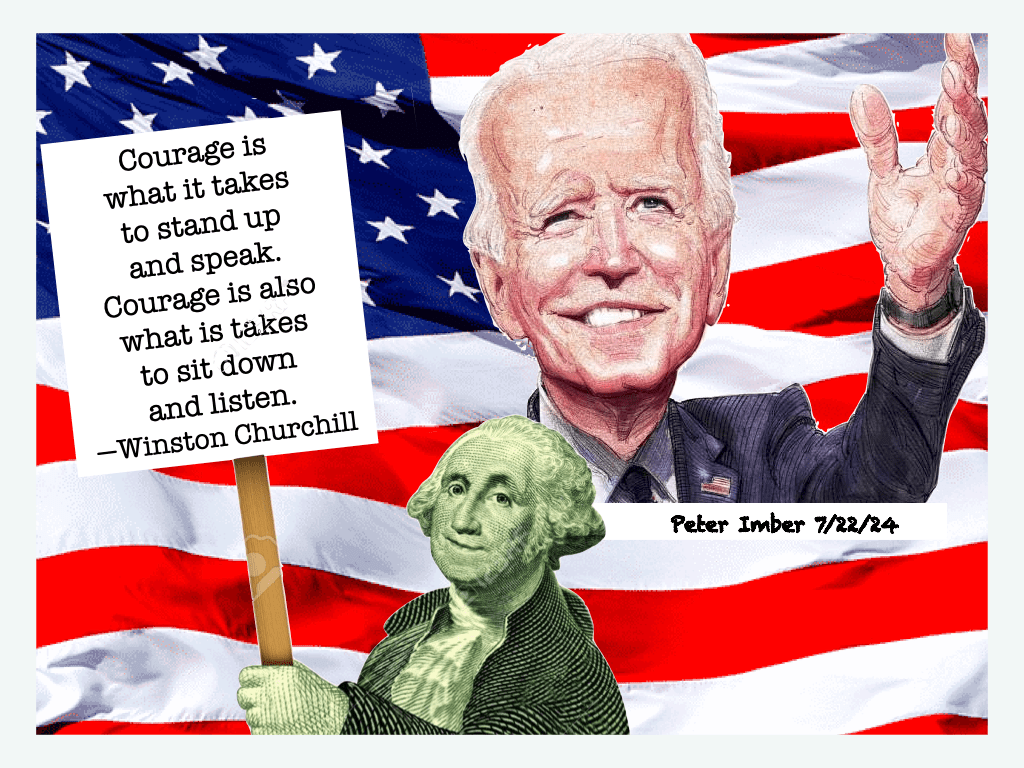
Thank You Joe!
—————–
Paris When It Sizzles!
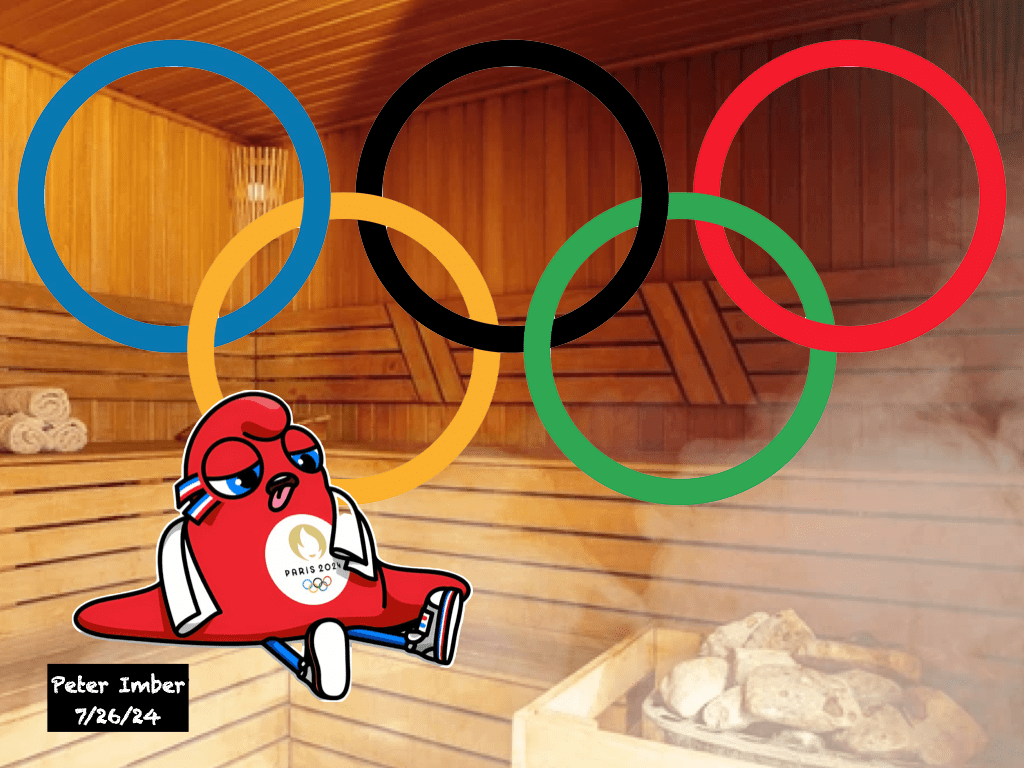
When the final torch bearer lights the Olympic cauldron in Paris today athletes will be hoping to set new records in the 45 sporting events in which they will be competing. One event included for the first time this year will be breakdancing and it seems such a surprising addition that I might just watch it.
Unlike the freestyle routines in ice skating and gymnastics, the “breakers” will have to improvise their performances to music they won’t have heard beforehand. Olympic DJs will select the tunes and I doubt we’ll hear anything from The Nutcracker or Swan Lake although I’ll assume that just like with skaters and gymnasts, spins and flips that earn a 10 from the judges will be necessary to get you the gold medal.
The Pawned Accordion is a reader-supported publication. To receive new posts and support my work, consider becoming a free or paid subscriber.Subscribe
However, the most consequential world record for the next two weeks and beyond was already set even before these Olympics begin. This past Monday was the hottest day globally ever recorded and it broke the previous high average temperature for the earth over a 24 hour period that was reached just the day before. It’s old news that our planet is heating up but how this relates to things we have historically taken for granted is increasingly staring us in the face.
Take the Olympics for instance. Six months ago China hosted the Winter Olympics and not a single snowflake was supplied by Mother Nature. One-hundred percent of the snow was man-made using nearly 50 million gallons of water shot by 290 snow cannons that operated non-stop for two months.
That was a technological feat that ranks as the greatest snow job of all time but whether or not it is going to be sustainable for making Winter Olympics of the future feasible is questionable.
It’s predicted that by 2050 nine of the locations around the world that have hosted the winter games in the past will not be reliably cold enough to do so again and a short time after that virtually none of the places where the games have been held previously will be suitable to do it again if global warming remains on its current trajectory.
And how about the Summer Olympics? In a generation global warming is likely to eliminate over half of the cities where the games could take place today. China, Japan and all of Southeast Asia will be too hot by mid-century and if the summer games continue to be held in July and August only cities in northern Europe, Russia and Canada or locations in the southern hemisphere when July and August are winter months will be left as useable venues.
Recent history has already shown us where we’re headed. The average temperature in Paris during late July and early August has warmed by more than five degrees fahrenheit since 1924, the last time the city hosted the Olympics.
I wasn’t much interested in math as a student but I wasn’t bad at it either. The difference between arithmetic and exponential growth is a concept that I grasp but wonder if the world does. Global warming isn’t like increasing a kid’s allowance by a dollar or two a year. If you start multiplying it instead of adding to it by the time he or she finished college you’d be bankrupt and trying to cut a deal with the Saudis.
The reason for environmentalists having such dire outlooks about the future is that they understand the definition of exponential.
Here’s a quote I found…
“A lack of appreciation for what exponential increase really means leads society to be disastrously sluggish in acting on crucial issues. I am utterly convinced that most of the great environmental struggles will be either won or lost in the next decade. And by the next century it will be too late.”
Thomas Lovejoy, an ecologist and conservation biologist who coined the term “biological diversity” spoke these words in 1989 and was referring to the decade of the 1990s. Lovejoy died last year.
So, “Que les jeux commencent!” and best of luck to all the athletes and especially to those competing outside “Restez hydrate!”
And for those in the break dancing competition “Casse une jambe!”
Actually, I’ve just learned that the French term used to wish French actors success is the word merde. Why? Because a couple centuries ago people arrived and departed the theater in horse drawn carriages. The evidence of how many had showed up was left in the street.
How Ya Gonna Keep Us Away From The Pharmacy?

Yes, John Travolta is getting older but apparently he could still bust a few moves earlier this year at a music festival in Italy. Travolta’s 70 so even if he’s in the best of shape, too much reprising of his iconic disco dancing in Saturday Night Fever might result in chronic disc problems for him now.
The expression “Old age is not for sissies,” is attributed to Bette Davis but we don’t know if she actually said it. However, she had a line in All About Eve that was a definitive description of what getting old is like even if she didn’t write it— “Fasten your seatbelts. It’s going to be a bumpy night.”
I’m not morbid about mortality but I was struck by finding out recently that life expectancy in the United States has not recovered fully from the drop we experienced during the COVID-19 pandemic. That drop in in 2021 was a full year of lost longevity to 77.8 and the most recent update I could find from the Centers for Disease Control put American life expectancy at 77.5.
The Pawned Accordion is a reader-supported publication. To receive new posts and support my work, consider becoming a free or paid subscriber.Subscribe
There are dates in one’s life that are memorable and some are celebrated annually— birthdays, anniversaries —and there are others we experience only once. I’m about to have one of those or at least I certainly hope so. In September I will be 77.5 years old.
If life was a basketball game, I’d say I’m nearing the end of the fourth quarter. Reaching 80 will be overtime.
And over time American life expectancy has steadily and significantly increased. At the outbreak of the Civil War you could expect to live to be 40. By World War I life expectancy had increased by 15 years to age 55. In 1960 when John F. Kennedy became president it had risen by another 15 years to 70 and in 2020 average life expectancy at birth in the United States had reached 78.8 before experiencing the pandemic relapse.
Modern medicine and other learned and implemented health measures have had everything to do with it. When I was in my twenties I had a severe case of strep throat. I likely would not have survived it if I’d lived a century earlier. Who knows what other illnesses I could have contracted if I hadn’t had my childhood vaccines.
I have every reason to believe that the prescription drugs I take now are helping to prolong my life including one for an indolent lymphoma that I was diagnosed with seven years ago.
But there’s been an added bonus for baby boomers like myself. Have you noticed in movies made even as late as the 1950s that people who were playing characters in their 50s then looked like many of us do in our 70s today? What’s responsible? Nutrition, exercise, cosmetic surgery? Do we care?
Living longer yet looking younger than those who barely made it to our age in the not so distant past just seems totally logical in the upside down world I frequently feel like I’m living in.
Some of us can be described as workout and diet fanatics with memberships at the Y, yoga and Pilates classes and Weight Watchers but most of us now have a different prescription for the pathway to a longer life— many of them!
We belong to a nation of prescription drug users. Nearly half us are taking at least one. Over four billion prescriptions for drugs are now filled annually in America. For a substantial number of us our medications give us an improved life if not a lifeline itself.
That’s the message in our bottles and we hear about it incessantly. You can always tell the demographic of an audience watching television by the commercials. I worked for ABC News and our viewers were old. If I had really paid attention to the advertisements that took up a substantial portion of any newscast, I would be a walking encyclopedia of the side effects from hundreds of drugs.
And I truly believe that in the future when anthropologists study our period of time on earth they won’t be as interested in our politics or our wars as much as they will be in our commercials. Over the course of human history slander and killing will seem old hat. But commercials! They will tell the tale of how we lived and how we were different.
I can envision it. There’s one researcher centuries from now staring at at a commercial playing on a primitive gizmo called a television and saying to another, “What the hell do you think this was? Did they really shoot salad with it?”
The United States is one of only two countries in the world where drug makers can market directly to their consumers. I doubt many of you will guess the other one so I’ll give you a hint. It’s not on a continent. It has significantly more sheep than citizens and it battened down its hatches and dealt pretty successfully with the coronavirus. It is not Taiwan although that country did an excellent job staunching COVID too.
By the way the price paid for prescription drugs in New Zealand as well as in many other countries is less than one half of what we pay in the United States. Some of you may be aware and grateful, like I am, that the passage of President Biden’s Inflation Reduction Act put a cap this year on out of pocket costs for prescription drugs for those of us on Medicare. That has undoubtedly been nothing less than life saving for the life savings of so many.
I’m not a visionary but I’d wager there is somebody out there who is and sees that prescription drugs have become such a normal part of our lives as we get older that unexploited marketing opportunities for pharmaceutical companies getting together with real estate developers are there to be… well, pillaged.
There are plenty of retirement communities that are already centered around things like golf and tennis, the arts and continuing education. Could it be that in the future seniors might flock to Club Meds where you can live alongside others with whom you share the same medications?
And just think if you’re self conscious about the number or type of pills you pop, you’d be able to literally swallow them and your pride together with someone else.
I have a few specific names for these residences I’ve come up with that might work…

Kamala’s Choice

With all the polling that’s done in America when it’s a presidential election year you would think that everyone of us would be asked to weigh in with our own preference at least once. Have you ever been polled? I haven’t. I’m not waiting for my phone to ring either.
On the other hand the number of candidates other than Harris and Trump running for offices at every level across the country who beseech me by text and email everyday for support— as in money —feels like enough at this point to fill an NBA arena. And if I had a dollar— no better make it $100 —for every text and email that I delete from them, I might even be able to buy a team to play in it.
The Pawned Accordion is a reader-supported publication. To receive new posts and support my work, consider becoming a free or paid subscriber.Subscribe
But enough of what you already know!
I’ve been doing a little research into vice presidential history and don’t peek down at the bottom of this post yet because I have a quiz for you to take. Let’s start with the presidential election of 1952. If you’re old enough to have been alive and voted that year, it means you were born in or before 1933 which makes you at least 91 years old.
“I like Ike” was the winning presidential slogan in ‘52 and his less likeable vice presidential candidate had to salvage his spot on the ticket by claiming his wife didn’t own a mink coat and that his daughters’ cocker spaniel would not be regifted.
Yes, the famous “Checkers” speech was one of the earliest uses of television to appeal directly to voters and Richard Nixon became Dwight Eisenhower’s vice president and then one of ten in American history who had held that position to later be elected to be president themselves. Nixon made it to White House but Checkers was in doggie heaven by the time he did.
And here’s the beginning of the quiz. In both 1952 and 1956 Eisenhower ran against the same candidate, the governor of Illinois Adlai Stevenson. Can you name who were Stevenson’s vice presidential running mates in ’52 and ’56? If you can, you’re either at least 80 years old or a presidential historian. Jo and I actually know a terrific one who I bet can give you the answers.
No looking down below yet!
Keep your eyes right here and try to name all vice presidential candidates of the party that LOST in presidential elections from 1952 through 2020. That’s a total of 16 men and two women. I’d say if you remember half of them, you have done well.
You have five minutes before you have to hand in your bluebook…
Pencils down! Ok, go ahead and look and when you’re finished, click on the link at the very bottom of this post to see how one of the unsuccessful vice presidential aspirants made a clever comeback of sorts.


Click below…
Don’t Touch That Dial!
But will the AM bandwith play on?

There’s a long list of things that used to be part of and even important in my life that are not any longer. Ask kids today to make a call on a rotary telephone and try not to laugh when they push their finger down on the numbers in the holes and nothing happens or try not to cringe when after putting a record on a turntable they press the phonograph needle into it. I’ve witnessed both of these.
Heraclitus figured out over two-and-a-half millennia ago that “the only constant in life is change” but that doesn’t mean we accept it. Jo asks me why I insist on keeping the several hundred CDs we have when they’ve all been embedded in our computers. I tell her I worry that someday we might need to use them again even though the last couple of Macs we’ve bought no longer have a slot to insert CDs nor do our cars.
VHS tapes? I’ve got a shelf of them. And DVDs? Three shelves!
Once a year I find a phone book in our mailbox. I throw out the one from the year before and keep the new one. I can’t remember the last time I used any of them.
VHS tapes and CDs and DVDs collect dust on their shelves and unlike books, they become indicators of one’s age more than one’s interests. Time marches on and we either get in line and march with it or we stop and wave goodbye and let the parade move on without us.
And then there’s radio. When our younger grandson turned six I bought him a pocket size transistor radio. We were both born on St. Patrick’s Day but 69 years apart. He was fascinated by mine— I have three which I keep in case of emergency — and how you could pull out its antenna and turn its dials to instantly and randomly listen to oldies music, talk of sports, politics and the gospel.
A couple months later Harvey heard a commercial on his radio…
Harvey: “Mom, there’s a store in Rockland that has everything you need for Father’s Day!”
And yes, Mom and Harvey went there and I don’t know what they got but was told it was everything they needed for Father’s Day.
I grew up in the 1950s listening to AM radio. I had a Zenith Royal 700 All Transistor model that had a leather case and used 6 C cell batteries. It must have been a birthday present and a very special one. I’ve discovered that adjusting for inflation the $70 it cost in 1959 is equivalent to about $750 today.
I didn’t have any awareness at the time that commercial radio broadcasting in America was barely 30 years old and had dramatically changed the way we received information and entertainment. I knew the call letters of AM stations near: WHUM, WEEU, WRAW —and far: WMEX, WKBW, KMOX —as well as the names of the disc jockeys: Dick Biondi, Hy Lit and Arnie “Woo Woo” Ginsberg.
When I went off to prep school I couldn’t have a radio but figured out that if I always scheduled my mandatory monthly haircut for 8 p.m., I would be able to hear the Theme from Studio X on WOR, the station the school’s barber always listened to. I still love that melody.
In college I had a clock radio and used its alarm function set to radio until one morning it woke me up with an announcement that the temperature in Hanover, New Hampshire was below zero. I switched to the buzzer alarm after that and tried not to schedule any of my classes to begin before 10 a.m.
Maybe you’ve figured out the cartoon by now and are asking yourself why I’m apparently writing an obituary to AM radio. It’s because AM radio, particularly in cars, may be well on the way to be buried for eternity. Not completely yet, after all there are nearly 4,500 AM radio stations in the United States and they serve an important and constant role for others unlike me who merely wax nostalgic.
In rural parts of America and especially areas with an older demographic AM radio can provide a life saving service. It’s the source for warnings and information about severe weather and natural disaster. In fact the Federal Emergency Management Agency’s National Public Warning System —through which FEMA delivers critical safety alerts to the public —operates through broadcast AM radio stations.
I’ve driven across our country several times and by doing so I learned that AM radio has niche audiences for whom it is vital— farmers get crop reports, indigenous people and ethnic minorities get to hear their own voices. With the ongoing demise of local newspapers AM radio stations are now often a crucial remaining binding keeping communities together.
So, why is the National Association of Broadcasters raising an alarm?
Turns out there is a problem. As EVs are increasingly becoming the cars we are encouraged to buy, automakers want to say bye bye to the AM radio band being provided in them. Electric vehicles produce electromagnetic interference that distorts an AM signal in EVs causing it to hum and be unpleasant to listen to. Providing a decent AM band with more shielding from the rest of an EV’s electronics could solve the problem but would increase the production cost of the vehicle. So, the quick fix is no fix; jettison the AM band and problem solved .
Last year a number of carmakers— BMW, Mazda, Polestar, Rivian, Tesla, Volkswagen, Volvo, Porsche and Mercedes —decided that an AM radio band will no longer be a standard feature of the radios they install in their cars. Ford was going to join this group but changed its mind for now. There’s a bipartisan bill actually before Congress to stop this from happening but even when support comes from both sides of the aisle, there apparently isn’t enough of it to get a bill passed.
For sure cars will still have FM reception but as you may already be aware the FM signal, which is of considerably better quality than AM, only travels about 40 miles. I remember while driving one night in Tucson picking up WCAU, an AM station in Philadelphia 2300 miles away.
Jo and I bought a new car a year ago. We don’t listen to AM and probably won’t unless there is an emergency and it becomes our only option— hence my emergency transistor radio stash —but we do listen to FM and now we also have something called Apple CarPlay. It allows us to access radio stations that stream their broadcasts over the internet by connecting our iPhones to a good cell phone signal— if it’s a bad one we hear nothing.
CarPlay hasn’t been that easy to learn. I brought our car to the dealership from which I bought it twice for tutorials and still don’t have the effortless hang of using it.
Yes, time marches on and I am not a Luddite but I confess that I like knobs and dials. I miss them! And I guess what I really miss is the simplicity they represented. Can’t turn back the clock and I’m not able to as easily as I used to anyway. All mine are digital.

—————–
Donald Trump Has A Problem
Only one?


You get to me under my skin
You get deep in my head it’s true
So deep in my head I want no part of you
Like Nancy and Liz you’re under my skin
I can’t try not to give in
I say to myself why am I so impelled
To never resist trashing women who know me too well
You get to me under my skin
I can’t play nice, I’m so uptight
And the stakes are all too clear
I don’t have a choice but to fight from fright
Because your name fills me with fear
I don’t know I’m a fool, that much is clear
But lacking morality, that’s my totality
Just the thought of you makes me spew
And I can’t stop once I begin…
Because you get to me under my skin
With apologies to Cole Porter who wrote I’ve Got You Under My Skin in 1936. The song was introduced in the movie Born to Dance and sung by Virginia Bruce. It was nominated for Best Song at the Academy Awards that year but lost to The Way You Look Tonight performed by Fred Astaire in the movie Swing Time. I’d say Virginia Bruce was bigfooted (but gracefully to be sure) by Astaire.
—————–
If Google Is A Monopoly Will The Search Party Be Called Off?
Google is so synonymous with what it’s used for it’s like Kleenex and Scotch Tape and unlike both of them it’s actually become a verb. When we search for something on the internet we google it. Now a federal judge has ruled that Google is a monopoly which doesn’t mean that we will see the search engine broken into “Google-lets” any time soon but eventually the data juggernaut might actually be forced to make space in cyberspace for genuine competitors.
Data is the present day equivalent of what oil and steel were in the past and Google’s parent company Alphabet is easily the colossus of data collection and Google the goliath of search engines with a market share of 90%. That translates to 8.5 billion searches on Google a day or 99,000 a second and makes it a magnet for advertisers willing to pay lots of money to cut to the front of the line on search results as well as buy the right to annoy and distract us.
The Pawned Accordion is a reader-supported publication. To receive new posts and support my work, consider becoming a free or paid subscriber.
There might be free speech but there’s no free search! If you’re using the Alphabet owned Chrome browser like I do to access Google as your search engine, it reminds me of the early days of Hollywood when movie studios owned their own theater chains and if they wished, could show only their own films in them. Maybe the theaters ran ads on the screen before the main feature but today your screen at home is doing it non stop. I feel at times like I’m playing whack-a-mole or macheting my way through a jungle. Google’s ad revenue last year was nearly $225 billion which is roughly the GDP of Portugal or New Zealand.
Equivalencies like these I’ve mentioned use to seem daunting to me but in a world where a baseball player named Shohei Ohtani is being paid over $430,00 for every game he plays somehow they don’t anymore.
Alphabet owns over 250 companies that it payed over $20 billion to acquire to enable Google to gobble up its competition. The Justice Department accuses Google of paying billions annually to device makers— like Apple and Samsung —wireless providers— like AT&T and Verizon —and web browsers— like Mozilla —for Google to be the default search engine on their devices, networks and sites.
Will Google go down as one of the most famous monopolies in American history like Standard Oil, U.S. Steel and Heinz Ketchup? And why did I add the last one? Well, what’s the ultimate compliment you can give a product? Those ketchup bottles in lots of restaurants may have a Heinz label but what do you think they get refilled with? That’s market share. That’s respect. That’s cheating but I bet you still put it, whatever it is, on your burger because you think and want it to be Heinz.
Anyway, I’ve created a couple cartoons to have fun with Google’s dominance. Let me know if you have a favorite. Both have a personal spark of inspiration…
Google Acquires Everything on the Monopoly Board…
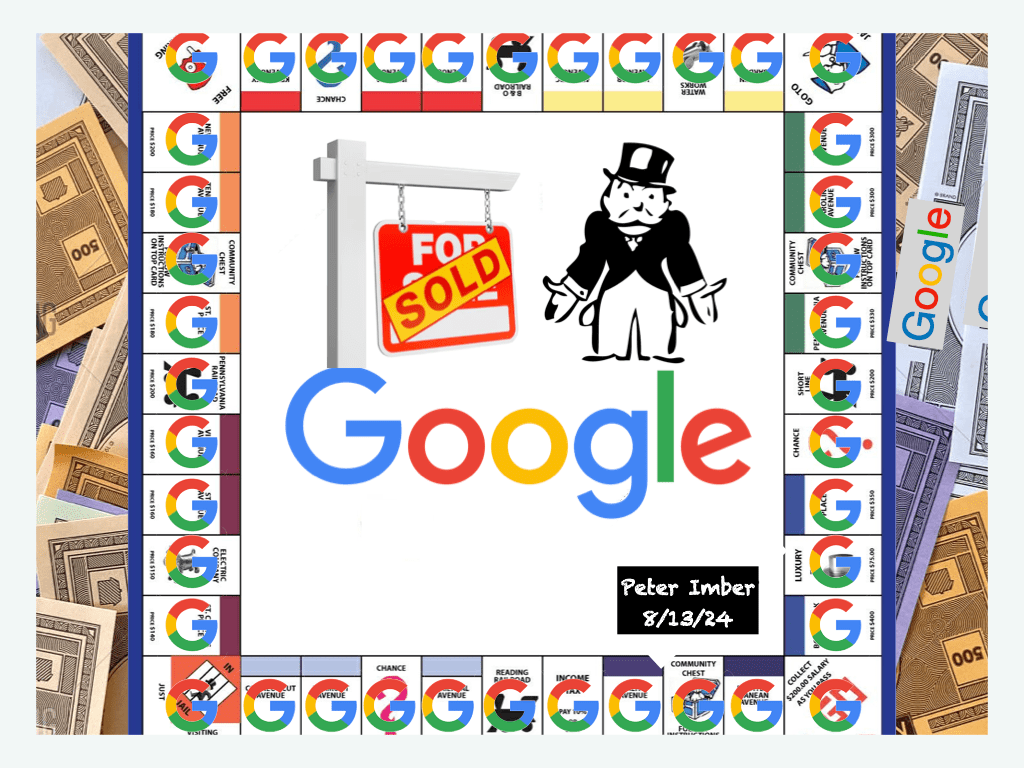
A few years ago our older grandson had a fixation with the board game Monopoly. He was eight or nine at the time and roped Jo and me and his younger brother into a game one afternoon that was interminable— FOUR HOURS!
He was the banker but assumed additional roles as our financial advisor and mortgage broker, which meant he kept the game going by keeping all of us out of bankruptcy and thwarting my every effort to achieve it so I could exit.
The invention of the game of Monopoly would actually make a great movie. It involves a woman named Lizzie Magie who invented and patented what she called The Landlord’s Game in 1904. It never sold widely but years later a man named Charles Darrow stole her idea; called his game Monopoly and sold it to Parker Brothers.
When it was discovered that Lizzie Magie had the original patent, Charles Parker— the company founder and not the jazz saxophonist —deceived her into taking the sum of $500 for the rights in perpetuity with no royalties offered and Charles Darrow became the first board game millionaire. Life is not fair as if you didn’t know.
Diogenes Meets Sherman and Mr. Peabody…
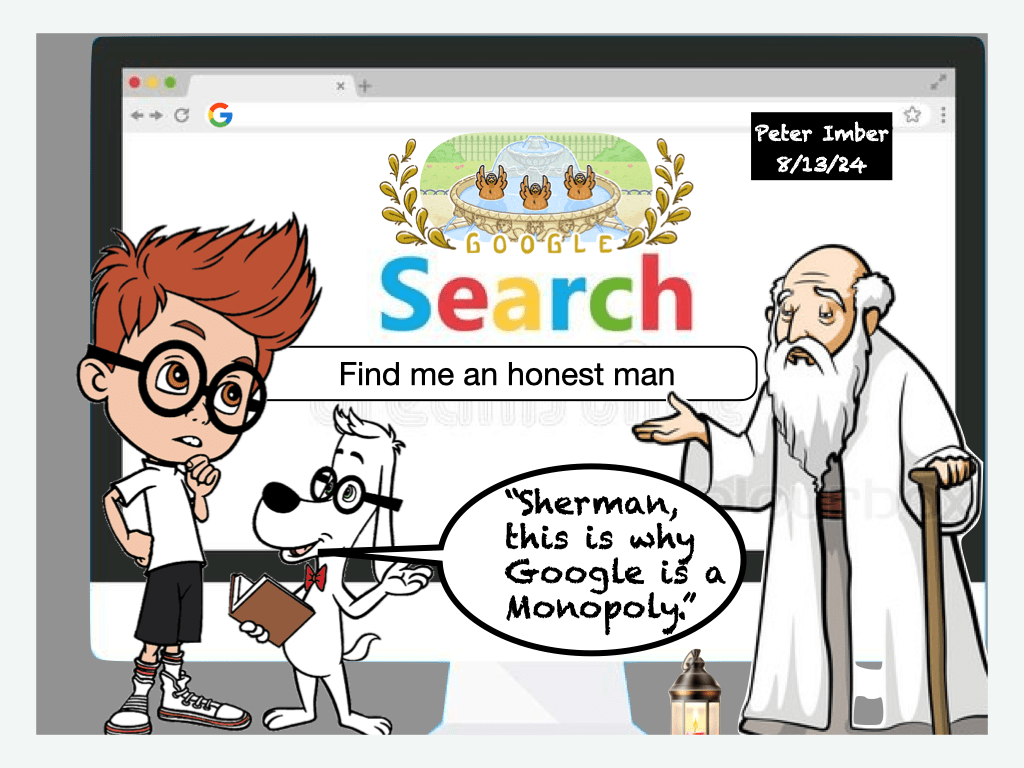
I just checked and found out that my vintage Bullwinkle Buren 17 jewels wind up watch might fetch $200 today on eBay. I bought it in 1971 for $12.95 and paid for it with one weekend’s winnings from the CBS Evening News football pool.
I don’t remember the first time I saw Jay Ward’s characters but I loved them instantly. Rocky and His Friends premiered in 1959 when I was 12 and followed American Bandstand in the afternoon after I got home from school and turned on the TV.
I’m sure I’m not the first to observe that Rocky and Bullwinkle, Boris and Natasha, Sherman and Mr. Peabody and Dudley Do-Right might have been created to amuse children but even then I felt I was monitoring an advanced class in cartoons way beyond the infantile antics of Bugs Bunny and Donald Duck. It was like being seated at the kids’ table but listening raptly to the adults’ conversation.
And Rocky and His Friends was instructive. In its cunning and beguiling way it taught history. Mr. Peabody and Sherman used their “wayback machine” to time travel and help out and often save the day for a Who’s Who of famous figures from Confucius to Geronimo. I found a list of all of them and interestingly, no ancient Greeks are on it. Diogenes in particular could have certainly used Peabody and Sherman’s assistance. Would Google have found him an honest man? I just asked it and was given a couple candidates. Ever hear of Leon Pilar or R. Budd Dwyer? I didn’t think so but I guess Google has and thinks very highly of them.
And do you think that Sherman might have been named for the Sherman of the Sherman Antitrust Act of 1890? I didn’t think so and won’t google it to find out. But hey, if you have to google to learn who Sherman and Mr. Peabody are or never heard of Bullwinkle J. Moose and Rocket J. Squirrel, you’re either a lot younger than I am or grew up not watching much television.
As Harris Polls Higher, Will Trump Sink Lower?
Really, do I need to ask?

“A low voter turnout is an indication of fewer people going to the polls.” —Dan Quayle
“Polls? Nah… they’re for strippers and cross country skiers.” —Sarah Palin
“Polls are fake! (pause and then…) They just came out with a poll. The most popular person in the history of the Republican Party is Trump! Can you believe that? Rarely do you see a poll that’s very far off.” —Donald Trump on 7/30/24
We all say stupid things sometimes but politicians historically have said stupid, dismissive, contradictory and unfortunate things and gotten clubbed over the head with them in the past.
“There is no Soviet domination of Eastern Europe.” —President Gerald Ford in 1976 in his debate with Jimmy Carter (That classified as stupid).
“It depends on what the meaning of the word IS is.” —President Bill Clinton in 1998 when questioned about his relationship with Monica Lewinsky (This one was nonsensical).
“Read my lips: no new taxes.” —President George H.W. Bush in 1998 at the Republican Convention (An epitaph?).
Running for office and then being elected puts you under a permanent high powered public and media microscope. Now that most of us are carrying in our pockets or purses a means to catch and expose any verbal or other kind of egregious misstep by a candidate, we actually have the potential to change history as slim as that chance might seem or DO WE?
“Gotcha” as a term and now a word has a long history going back to 19th century England and has meant understanding— as in “I got it!” or catching someone at something and achieving a surprise or a triumph like maneuvering for and receiving a kiss under the mistletoe. Today, “gotcha” is also perceived antagonistically as a deliberate and partisan act by journalists attempting to embarrass notable persons and especially politicians by asking them questions that might be considered unfair or even inappropriate but are not necessarily.
With the presence of Donald Trump in our lives the “gotcha” landscape, indeed the “gotcha” universe has been altered. Trump, as he has in other significant ways, lowered our standards of what’s acceptable in behavior and discourse in American public life. He has been and will continue to be a self inflicting “gotcha” machine or at least would have been in the past.
If Ronald Reagan was “teflon” when it came to explaining why nothing negative seemed to “stick” to him, then Donald Trump is lead, encased in the only material that shielded Superman from the kryptonite that could destroy him.
From physically mocking a disabled reporter at the very start of his campaign for president in 2015 to questioning whether Kamala Harris is Black two weeks ago along with too many other outrageous false claims, crazy conspiracy assertions, meandering incoherences and bigoted inferences to list without using up substantial memory on my computer, Trump would have been banished from consideration for holding elective office let alone our presidency just a few generations ago.
Is there anything Trump could do or say that would cause his base of supporters to turn their backs on him now? Is there any “gotcha” that could be the end of Trump?
Ed Muskie’s tears that he claimed were caused by snowy weather and not his emotions doomed his chances of gaining the Democratic nomination for president in 1972.
Howard Dean’s scream in 2004 that was heard only through the recording of his microphone and not by any of his applauding supporters in the room where he was campaigning ended his presidential quest.
Looking back on what derailed a politician’s run then and won’t put a dent in it now makes our country feel pretty unrecognizable today.
Forget about any verbal faux pas, unabashed lie, guilty verdict or perhaps even his shooting someone in the middle of 5th Avenue removing Donald Trump from American life a this point. I think it’s a safe bet that if Kamala Harris’s poll numbers continue to rise, Trump will descend even lower than he has. He always manages to find a way.
I’ve been to the lowest point on the earth’s land— the Dead Sea. Its water is 10 times more salty than the ocean and so buoyant that a human being can’t sink in it. But for one person there’s no place too low he can’t sink, even the bottom of the Dead Sea.
They’re Off!
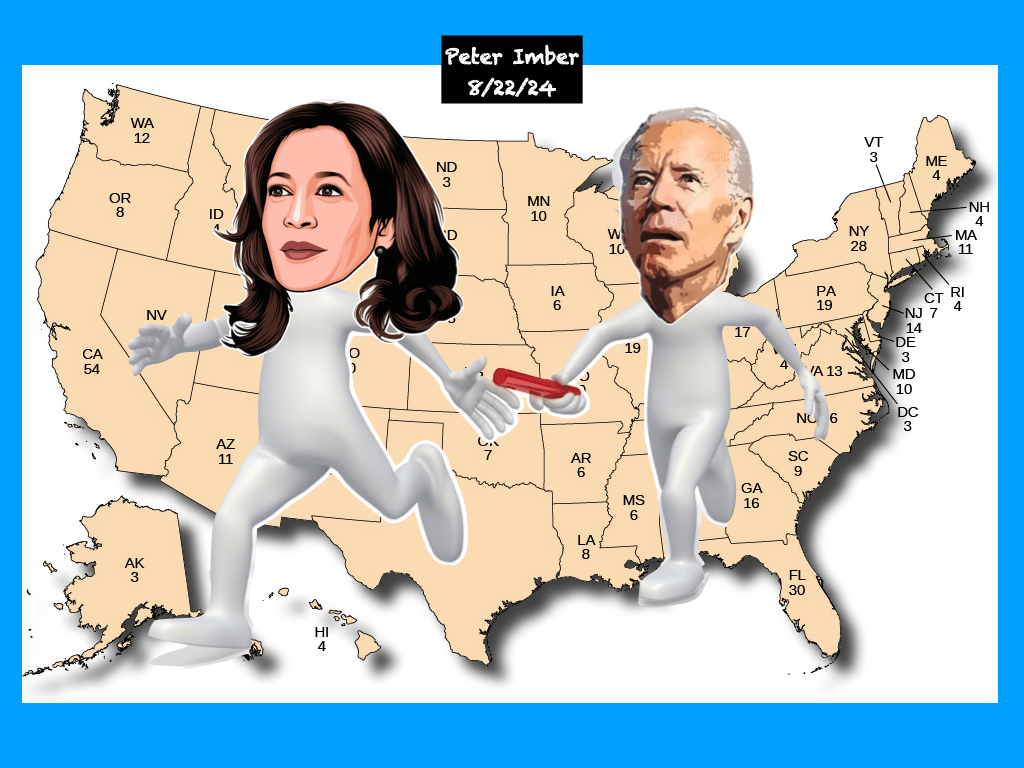
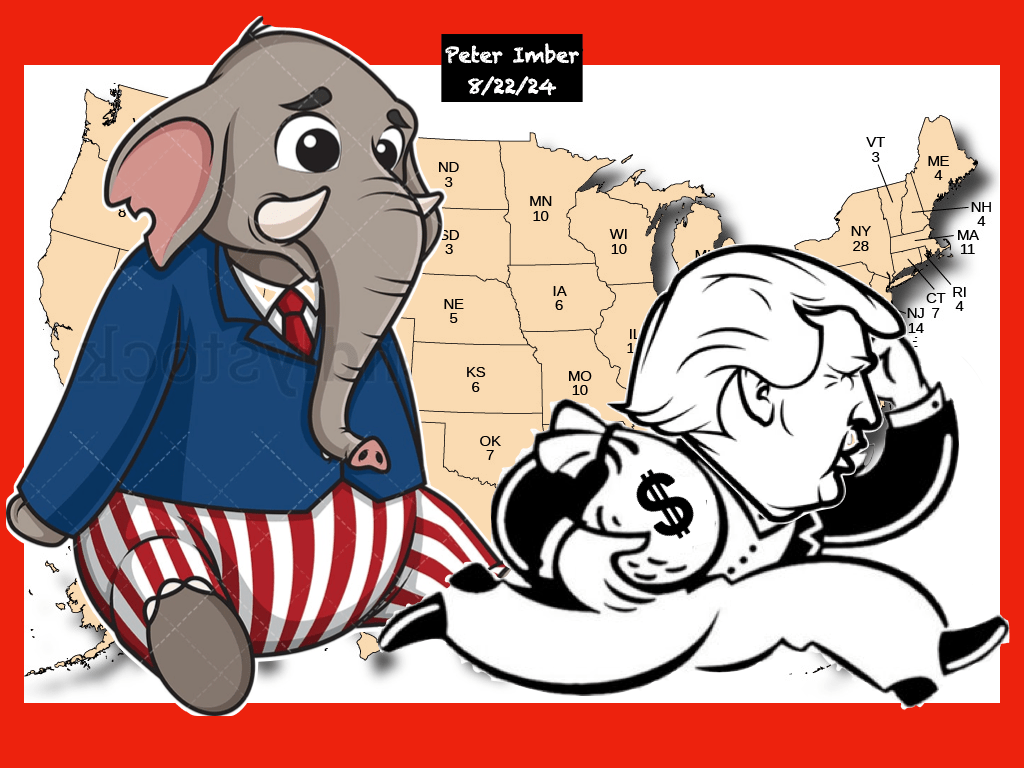
I didn’t realize this until I checked but before 1972 delegates to both the Democratic and Republican national conventions were free to pick a candidate they prefered and not required to vote for the candidate who may have won their state’s primary. Those gatherings weren’t necessarily always the coronations they have become in our time.
Things changed after the 1968 Democratic convention in Chicago. If you’re my age, how can you not remember that one? Ever since then it has been a foregone conclusion that the candidate entering the convention from either party with the most delegates elected in the primaries would receive the party’s nomination to run for president.
That was until the convention occuring right now. Kamala Harris has something in common with 1968 and Hubert Humphrey. She’s the first person from either party since Humphrey to have won the nomination without having entered a primary. The run up to Joe Biden’s 11th hour decision not to seek reelection was a lot more like trauma than drama. Deflated Democrats were instantly elated and rallied behind Harris. Other would be aspirants for the nomination quickly fell in line and this week’s convention has unfolded smoothly if not totally without rancour.
In that regard just as Humphrey, was burdened and wounded in the election in November by his support for the United States’ continuing the Vietnam War and lost in the electoral college although barely in the popular vote to Richard Nixon, Harris will have to confront the opposition by a consequential part of her party to United States’ support of Israel for its ongoing actions in Gaza.
Tonight Harris will give “the speech of her life.” But really will it further energize her supporters more than they appear to be energized already? And will the television ratings be any higher than they have been in decades? Anything approaching a viewing audience of 25 million will be considered a success. By comparison last February’s Super Bowl was watched by nearly 115 million Americans.
National conventions since 1968, aside from being forgone conclusions, have been little more than days long political advertisements and decreased and splintered television coverage of them has reflected that. The legacy networks— ABC, CBS and NBC —now devote minimal broadcast time to them. Cable “news” channels with clearly partisan audiences— right wing Fox, left wing MSNBC and perceived by the right and admittedly others less dogmatic as left leaning CNN and PBS —have filled the space and reflect how even attempting to “be down the middle” is critiqued as “whose side are you own?” by many Americans today.
But fast backward to the past. In my lifetime has there been a more disruptive political convention and worst year for America than 1968? On March 31st President Lyndon Johnson announced he would not seek reelection. Five days following that on April 4th Martin Luther King was assassinated. Robert F. Kennedy was shot two months later on June 5th and in late August when Vice President Hubert Humphrey was nominated as the Democratic presidential candidate pandemonium broke out inside the convention hall as riots raged outside in the streets of Chicago.
I watched that convention at my parents’ home in Pennsylvania with a close college friend. I think the word traumatized by what we witnessed on television may be overdoing it but seeing the network broadcasts cutting back and forth from what was going on inside the hall to what was going on outside in the streets was close to how we felt. I consider it one of the few unfathomable events that have occured in this country in my 77 years.
Mayor Richard Daley’s use of Chicago’s police as a blunt instrument with blunt instruments was sickening. After it ended I asked my parents if I could borrow their car to take my friend home. I’m not sure they realized he lived in Illinois and we weren’t planning to drive there directly. Instead we headed for Canada but with no thought of emigrating.
We just needed a diversion— a way to cool off and absorb our disgust and dismay—and on our cross province journey we attended a Canadian Football league game in Hamilton, stopped in Joni Mitchell’s hometown of Saskatoon and crashed the North American Kentucky Fried Chicken convention in Banff. And yes, Colonel Sanders himself was there and all his franchise owners were dressed in white suits just like him. But even topping all this on our way back eastward across the top of the United States we drove out of our way to watch Evel Knievel launch his Honda motorcycle over 13 Toyotas in Missoula, Montana.
Subsequently, my career at ABC News was full of excitement and opportunities to search for, witness and do stories about things historic but mostly just interesting and I believe coverage of the national conventions was neither. It became an expense the network increasingly realized it could reduce. I was assigned to cover only a couple of them. but I was lucky. The first was in 1984 in San Francisco. The other was in 1988 in New Orleans. I ate well.
—————–

Google the two words “accordion jokes” and there are an abundance of sites solely dedicated to deprecating the instrument.
My own favorite accordion skewer involves a guy stopping for dinner with an accordion sitting on his car’s back seat. When he returns from his meal he discovers the car has been broken into. A window has been smashed but in the backseat there are now TWO accordions.
Somebody called the accordion the Rodney Dangerfield of musical instruments and only the bagpipe rivals it for being the one most picked on. Although the two may not have much in common in appearance or the sound they make, they do when they’re lampooned. Jokes about them both are mostly interchangeable.
I have my own joke about the accordion that was delivered by my mother at my expense. I don’t remember exactly how old I was when I convinced my parents to let me take accordion lessons but I believe my mother agreed because she even said it was a promising vocational path for me in the future.
I wasn’t bringing home stellar report cards. So, maybe she thought I could grow up to be in a polka band and if I didn’t master the accordion, at least I could be an organ grinder. I bet she might have even staked me the money for a monkey.
Zeswitz was and after all these years still is a musical instruments store where I grew up in Reading, Pennsylvania. That’s where I had my entire accordion experience and at the time there were a lot of other kids taking accordion lessons with me.
I’d later realize that Mr. Michaels, the man who was our instructor, was actually a real life facsimile of Harold Hill, the charming huckster in stage and screen’s The Music Man. Like the Davy Crockett coonskin hat and the hula hoop that were crazes in the late 1950s, learning accordion was another one Michaels managed to create in my town through charm and persuasion.
We all started with beginner accordions that Zeswitz rented us for the first half dozen lessons. After that the store played hardball. To continue instruction a signed contract to purchase a new full blown accordion was required, otherwise Zeswitz took away the keys plus the buttons.
My parents, I’m sure against their better judgement, acquiesced to sign on the dotted G Clef and I plodded along for a while but quickly validated any doubts about my commitment when I started to regret having to practice.
At one point Reading’s accordion acolytes had a giant recital inside the field house at the local college. I think all of us, under the spell of Mr. Michaels, nearly filled the entire basketball court. If The Guinness Book of World Records had been advised of the event, we might have qualified for an entry— most accordionists per square foot.
The most proficient among us played that squeeze box rite of passage “Lady of Spain.” I was in the group that played the considerably easier “All Through the Night.” My memory has fooled me into believing that I had already packed up my own accordion and was headed out the door while others were still performing.
A short time later I met my Waterloo (Napoleon’s, not Abba’s) when we had to deal with both sharps and flats for mastering “Oh, Them Golden Slippers.” At that point I also gave up any hope of my participating in Philadelphia’s New Year’s Day Mummers Parade and accompanying a thousand banjos down Broad Street. In my frustration I damaged my grandfather’s beautiful metronome as well.
My parents had been paying for my accordion on an installment plan. I don’t know how they unloaded mine but I do remember that for years afterward every pawn shop in Reading had at least one accordion in its window. I no longer have a clue how to play one and I’ve been told that a true gentleman who does know how is someone who won’t.
But I do hope my accordion got adopted and had a good life. Maybe it ended up at a bar in Cajun country rocking zydeco or appearing at weddings in Williamsburg with a Klezmer band. And maybe it’s just occasionally lifted out of its box and for however long it’s played, no matter how faint the tune, somewhere there’s music .
And that’s the story that explains why I named my Substack The Pawned Accordion. And here I am with the only evidence I can provide that what I’ve told you is true…

—————–
What Will Decide the Election?
The way it looks from here…

“A republic, if you can keep it.” —Benjamin Franklin in 1787
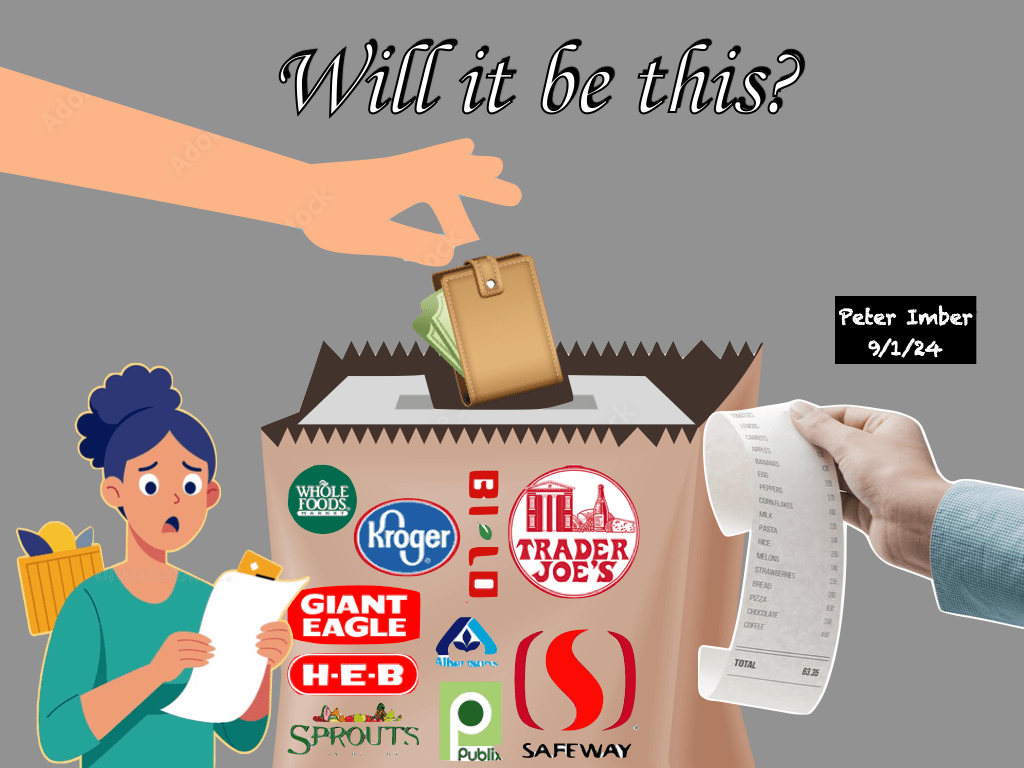
“It’s the economy, stupid!” —James Carville in 1992

“I’m against abortion. On the other hand, I believe in a woman’s choice.” —Nancy Reagan in 1994

“I don’t see how the party that says it’s the party of the family is going to adopt an immigration policy which destroys families that have been here a quarter century.”
—Newt Gingrich in 2011

“Climate change isn’t something people get to choose to believe or not. It’s happening.” —Matt Gaetz in 2019
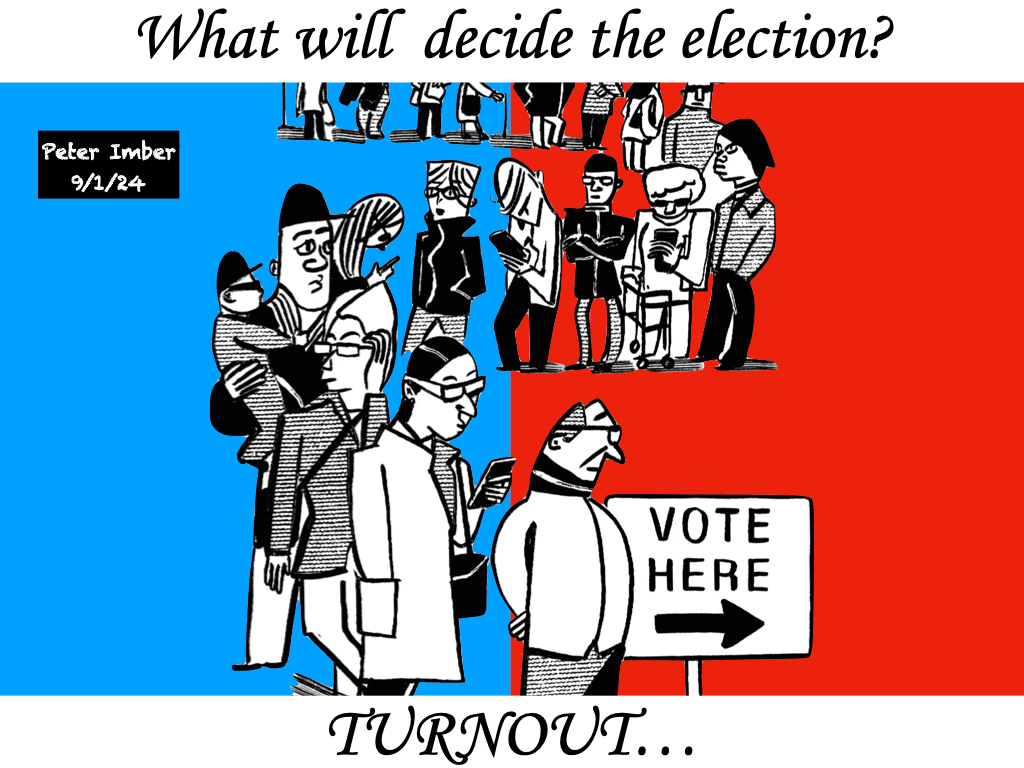
“Elections belong to the people. It’s their decision. If they decide to turn their back on the fire and burn their behinds, then they will just have to sit on their blisters.”
—Abraham Lincoln in 1864
What’s in a Name

If history made sense, then the ghost village of Imber would be located today somewhere in Ukraine or Poland— somewhere my ancestors lived well over a century ago. But history doesn’t make sense and this lonely Imber is in the United Kingdom on the Salisbury Plain. I’ve never been there and if I ever decide to go, I can but only on one of the few days a year that visitors are allowed.
The village of Imber has always been isolated— “Little Imber on the down, seven miles from any town.” but is abandoned today and has been uninhabited since the end of World War II. There was no battle fought there nor any plague that decimated its small population of less than 200. In 1943 the entire citizenry of Imber was evacuated so that their homes and surroundings could be used as a training area for American troops preparing for the invasion of Europe. After the war none of the evacuees were allowed to return and until recently the site of Imber with its abandoned structures was still used for military training.
The first mention of inhabitants living there goes back a thousand years but Imber’s history has nothing to do with my family and I haven’t been able to find any evidence that reveals how the village got our name but I think I know how we did.
In the past surnames were often tip offs to one’s occupation— Baker, Fisher, Mason, Taylor, Weaver… Willie Shoemaker was a famous jockey but it’s a good bet somewhere along the way a Shoemaker ancestor shod people and not horses.
As far as I can determine, my family’s name Imber is derived from a Yiddish form of the German word ingwer, which means ginger. The name originally may have indicated that one was a grower or seller of spices as far back as the late Middle Ages.
Ancestry.com claims to have over 10 billion records but my family tree’s roots weren’t buried in its database. Whatever records were kept in the Jewish village communities of Eastern Europe called shtetls were nearly all destroyed in the Holocaust.
There are other Imbers beyond close relatives of course who I have run across. Once while boarding a plane, an Imber who I didn’t know was already in my seat. We had both been booked to sit in it so I guess actually, it was our seat. Years I ago I discovered there were two other Peter Imbers in the United States. Out of curiosity I contacted them. One was a doctor in Florida and not Jewish and the other rather testily accused me of siphoning his airline miles. Turned out we even had the same middle initial.
I also met other Imbers in Israel when I lived there in the 1970s. One was an officer in my artillery unit during my time in the army and another was a disc jockey on Israel radio. Both of course claimed to be related to Naftali Herz Imber, the most famous of all Imbers. I had known about him since I was a kid because my father told me we too are his relatives. Everyone in Israel knows of him. Streets there are named after him. Naftali Herz was an itinerant poet who authored a Hebrew poem titled Hatikva (English translation The Hope) in the 19th century which later became modern Israel’s national anthem.

School children in Israel are taught that Naftali Herz Imber was the country’s first beatnick. In reality he was an alcoholic and died penniless in New York City. I was told my family on occasion sent him money.
Shamira Imber— the Israeli disc jockey —was at one point suspended from broadcasting because she played a protest song about the Israeli Army’s treatment of Palestinians in Gaza and the West Bank. That took place on the eve of the day that Israel remembers— and Jews everywhere should —our people’s close call with extinction. I guess some Imbers have rocked the boat. Others just got on one.
My grandfather, Jonas Imber, fled Europe along with his brother Joseph to avoid conscription into whoever’s army was fighting at the time and came through Ellis Island in the early years of the 20th century. One of my most prized possessions is the English dictionary he was given by an American Jewish newspaper shortly after his arrival in New York. Its pages and binding have exceeded their lifespan and I dare not open it.
Jonas and Joseph settled in Reading, Pennsylvania after being advised that opportunities awaited them there and within a decade they went from peddlars with a horse and wagon to businessmen with a store and employees.
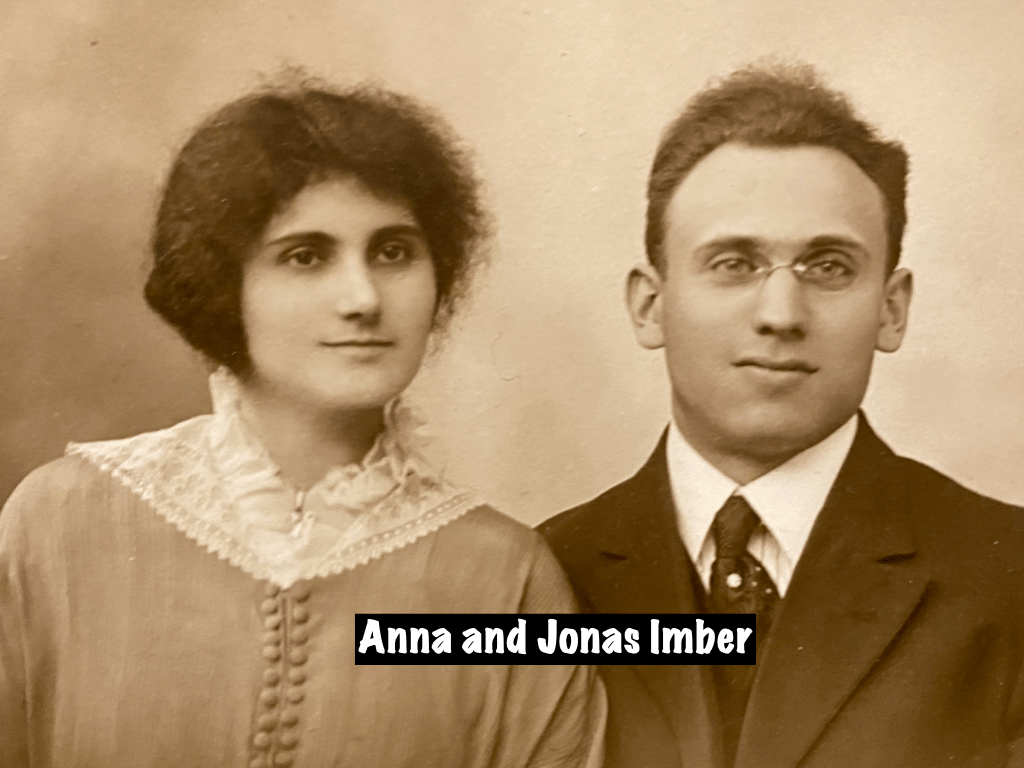
Jonas met my grandmother Anna in America and while he learned and spoke the language of his adopted country, Anna, although she comprehended English, hardly ever brought herself to speak it. Like many Jewish immigrants my grandparents used Yiddish when they didn’t want their three children to understand what they were talking about, but sometimes the kids could anyway.
Anna was not a great cook. Her chicken soup might have had curative powers, but it could have used a spoonful of sugar to help the medicine go down. My father told me that on occasion Jonas, a kind and patient man, became exasperated by what was offered at the dinner table and would blurt, “Ikh kum heym far dem?” I don’t think I need to translate.

The Imber brothers built houses side by side on a steep street above the city of Reading. The houses were identical. Up the hill from them was the mansion of William H. Luden, the inventor of the menthol cough drop. The smell from the Luden’s factory downtown is deep in my olfactory memory alongside that of grandmother Anna’s chicken soup.
I had never considered why Jonas and Joseph had mirror image houses until I took my wife Jo to see them and she asked me. My mother had the answer.
“The two women didn’t like each other and didn’t trust one another. They insisted on the same house for each of them because they wanted to make sure neither got a square foot more.”

It was the spring of 1929 when both families moved into their new homes and simultaneously, construction was completed on a luxurious three story department store on Reading’s main street to house the Imber Brothers’ burgeoning business. Six months later in October they lost the store and literally everything else except for the two identical houses when they were wiped out financially by the stock market crash.
My father was 12 at the time. He and his older brother and younger sister all managed to go to college and my father went on to get an MBA after, according to family legend, paying his first year’s tuition with winnings from a fraternity poker game at Penn State.
When he returned to Reading after landing in Normandy on D-Day plus 1 he went to work for his father and his uncle at the smaller store they had reopened, but soon realized that Jonas and Joseph weren’t about to let him implement any of what he had learned at Harvard Business School. As I’ve seen in my own life— my mother told me to sit up at the table on the occasion of my 50th birthday —at any age with whatever talents you may have acquired you can remain a child in the eyes of your parents.
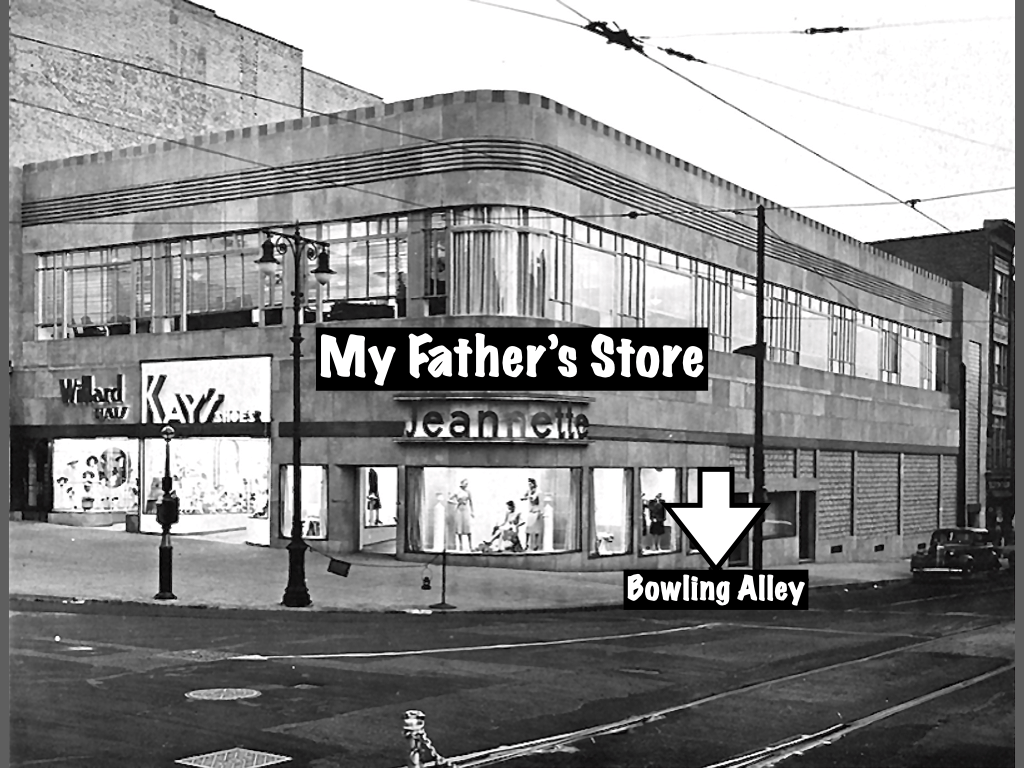
My father bought in and then bought out the owner of a women’s ready-to-wear store down the street. I liked visiting him there because in the basement was a bowling alley and I’d be given a couple dollars so I could bowl and entertain myself while waiting for him to finish work. The noise from the rolling balls and flying pins was certainly strange accompaniment for the women on the floor above trying on dresses and millenary but apparently, not an obstacle to sales.
At one point the business had expanded to three other retail stores plus two outlets in Pennsylvania and New Jersey. My father’s wish was for one of his sons to work with him. I wasn’t interested and neither was my brother. We both moved away and pursued our chosen careers. All the stores have been shuttered since the early 1990s.
There is only one Imber left in Reading. My grandfather’s brother Joseph’s son Harold is still alive. The two identical houses also remain side by side on Eckert Avenue and I doubt their current inhabitants have any idea of how that symmetry came to be. Families take their memories with them and sometimes leave behind mysteries in their place.

A while ago I searched for pictures of the Imber Brothers store on the internet and found something else instead. For sale on eBay was a wood handle for a shopping bag. Imber Bros. was printed on it. The seller believed it was from the late 1800s. Close, but it isn’t. I remember those handles and know they were still in use when I was a kid and my grandfather overpaid me when I would fold together cardboard boxes at his store. For $19.99 I bought the handle.

Hard to believe that over a half century has gone by since Bob Dylan warned us that The Times They Are a-Changin’. Many of us born before the internet and smartphones might disagree on many things but I’m guessing there is still a consensus that in a lot of ways the times —our times since those times— have kept changing but not completely for the better.
Talk radio is one of those developments I’m pretty certain I could live without. Toward the end of his life my father had his car radio tuned permanently to Rush Limbaugh. When I visited and borrowed the car I got a quick earful. When he was driving and I was with him and Limbaugh was on the air I got a serious earful.
The Pawned Accordion is a reader-supported publication. To receive new posts and support my work, consider becoming a free or paid subscriber.
About the only thing I learned from Rush and his cohorts was that there’s no issue too complex that it can’t be reduced to fear and loathing. And if you’ll excuse my own rant, I’ll contend the majority of talk show hosts of any stripe are egomaniacs and many of their callers malcontents or morons.
The late governor of Texas Ann Richards was once asked why she didn’t have a talk show. Her answer: “The people who have time during the day to listen to me on the radio are not the people I want to be talking to.”
But I remember a kinder gentler era when talk radio was in its infancy and I was not much older. There was a program on AM radio in the city where I grew up in Pennsylvania that I’d often go to sleep listening to. Its theme music —big band clarinetist Artie Shaw’s “Nightmare” —would play and Reading’s Night Mayor was on the air.
It might not have been the first radio listener call in talk show in the country but I’ll bet it was close. Paul Barclay was the host and his day job was teaching high school. I’m guessing that back then his radio gig was barely earning him vacation money.
I don’t think he was much of a local celebrity and he certainly wasn’t into spouting his own opinions to his audience. No diatribes, no insults, no spin but something else was missing from Barclay’s show that, despite his impartiality, made him a very singular voice back in his day. His was in fact the ONLY voice.
In that pre high tech era that seems so long ago either the technology to include the caller on the air didn’t exist or the Night Mayor’s radio station didn’t want to pay for it. So listeners to the program only heard one side of the conversation— the Night Mayor’s. Because of this much patience was required from the devotees of the program.
Calls all started the same way: “Hello, Night Mayor!” followed by a long silence as the caller made his point and the listener at home waited to hear Barclay repeat, and no doubt condense, what that point was. Each call was literally translated from English into English and listening to the conversations plod along was at times awkward and even tedious.
The Artie Shaw theme music kind of scared me back then but I couldn’t resist tuning into the Night Mayor when I was growing up. My Zenith transistor with it’s leather casing brought me the world, although St. Louis was about as far as it could reach out into it on a good night.
Reading had three local radio stations and WHUM broadcast the Night Mayor on weeknights. Like any other city, its residents had complaints and of course Barclay heard more than his share of them— potholes, parking, barking dogs and of course the perceived stench of local politics and government. I remember once it was actually the real thing— complaints about tardy garbage collection. I tuned in for it all.
And then one night I decided to call the Night Mayor myself. I had to. Something incredible and disturbing had occurred on live television that afternoon and the Night Mayor was asking for an eye witness. I had gotten home from school and seen it myself on a kitschy variety show called County Fair hosted by “There she is Miss America…” himself, Bert Parks.

It was a stunt gone amazingly wrong. A woman from the audience was blindfolded and spun around while a lit fuse running on the floor was racing toward her husband sitting in a chair below a sack of flour hanging from the ceiling. The studio audience was implored to scream directions to help her find the burning fuse so she could stomp it out with her shoes.
Somebody thought it a good idea to attach a firecracker at the end of the fuse right beside the sack of flour and when his wife didn’t find it to extinguish it, KABOOM!!! The flour ignited and her husband instantly became a human torch. Aflame, he rose from his seat as Bert Parks ran to him and probably saved his life by covering him with his carnival barker’s blazer. YES, this really happened live on TV!
I could barely believe I had seen it but I had and I felt obligated to report it to the Night Mayor. As a loyal listener it seemed my duty. Well partly, but mostly I just wanted to be the first one to call in.
I dialed the radio station from the phone in my parents’ kitchen— it was past my bedtime —and as it rang and waited my turn, my nerves started to get the better of me. Stage fright hit and I was about to hang up. I was a kid, not even a teenager. What was I doing? Only adults called the Night Mayor!
With the suddenness of a car crash it was too late. “Hello, Night Mayor.” His voice sounded different on the phone. I surprised myself and didn’t hang up and as best I could, began my account. The Night Mayor didn’t ask me my age. He had a show to do and now I was part of it. I was relieved that nobody was hearing me but him.
He helped me along with tactical “ah hahs” and “um hums” no doubt honed from years of experience. I navigated around them and listened to the Night Mayor edit me as we went along. I reported what I had seen and The Night Mayor was relaying what I told him to hundreds, possibly thousands of others. Years later I became a journalist. Looking back now, I’d say this was my first effort at reporting a story to the public.
Was I articulate? Did I make sense? Who knows? But together the Night Mayor and I made it work and then it was over. I was alone in the kitchen and shaking a little but not embarrassed or scared. I was now officially a Night Mayor caller.
When I became a television news producer my accounts of news events reached millions. It was my career— what I did for a living. But to this day I have never called another talk show and until writing this I had never told anyone I had called this one.

Before I ever learned that politicians parse the truth or just outright lie a good deal of the time and all of us parse the truth or lie some of the time, I had an eye opening life primer in what’s true and what’s not courtesy of a man named Lester Fisher.
My family belonged to a reform synagogue and I attended weekly religious school that we called “Sunday school.” Classes were held on Sundays because our synagogue was actually closed on Saturdays— the Jewish Sabbath —and pretty much only open on a Saturday for the occasional bar mitzvah. But that’s another story.
The Pawned Accordion is a reader-supported publication. To receive new posts and support my work, consider becoming a free or paid subscriber.
I was in sixth grade when our textbook was titled When the Jewish People Was Young. Some of us couldn’t accept that as grammatically correct but it was— “a people” can be singular although I don’t recall to this day reading or hearing anybody ever say the American people is. There could have been a fix. When the Jewish Nation Was Young may have worked as well as the title but then what would we have had to discuss? Most, if not all of us didn’t read the book.
And for a book about a people who God made wander in the desert for forty years When the Jewish People Was Young was as parched as the Israelites must have been themselves during their time in the Sinai. It was published originally in the early 1930s and when we were given our copies in the late 1950s, it was so stylistically outdated it could have been printed on stone tablets.
Lester Fisher was our religious school teacher that year and challenged with trying to resuscitate this moribund account of Jewish biblical history. I don’t recall that he succeeded. I only remember THE TEST. Now, up to this point in my education a true or false exam was preferable to multiple choice questions or being asked to provide an actual name or date for anything. Having only two options for an answer was easily a more welcome alternative to any question that required a choice among more or, God forbid, a written sentence or a paragraph.
But Mr. Fisher was about to change the entire calculus of what I considered my testing comfort zone. He was my father’s age and I now realize that he likely didn’t want to be teaching our class about as much as we didn’t want to be attending it.
We weren’t a rowdy group but I remember one of us (not me) being caught with a transistor radio inside of her purse which years later I saw reprised in another synagogue classroom but this one was on the big screen in my favorite Coen brothers movie A Serious Man. Fisher confiscated the radio and it was maybe the only moment of levity in our somber year.
Mr. Fisher was generally undemonstrative but sometimes enjoyed being theatrical and on the morning of THE TEST our teacher was in total performance mode.
“Children, close your books and get out a pencil and paper. This will be a True-False test!”
He was as pumped up as we weren’t.
I hadn’t done much of the reading and my goal was to achieve a passing grade and consider it mission accomplished. However, with a single sentence Fisher seemed to ominously up the ante.
“Get ready for Fisher’s Horrible Hundred!”
The questions began and they were tough— really tough —but after the first half dozen I realized I had marked them all as true. I was fairly confident that they were but after a few more that I marked true as well I began to feel uneasy. How could there be this many true answers in a row?
I opened my mouth. “These are all true,” I said and probably sounded more like I was asking a question than making a declaration of certainty. Mr. Fisher did not look at me and did not pause. His face gave no hint of whether or not I was on to something. The questions kept coming and they all still continued to seem to be true even if I wasn’t sure anymore.
An impulse was telling telling me they were. Logic was telling me that it wasn’t possible. I had to make a choice, go with my gut feeling or what seemed like common sense. “Fisher’s Horrible Hundred” could turn out to be the easiest hardest exam I’d ever taken if I were to simply mark all one hundred questions true. But who would ever give such a test?
In a split second I lost my nerve and began to write as many Fs as Ts the rest of the way. As I think about it now, I realize it was an indication that I wasn’t a fearless gambler and looking back on my life I guess I haven’t been. But as I recall I still got the highest mark in our class on THE TEST that day. It was a pyrrhic achievement. “Fisher’s Horrible Hundred” were indeed all true and our entire class failed!

Several years ago I found a copy of When the Jewish People Was Young for sale on eBay and bought it from a public library. Inside the cover I discovered it had been used by a congregation in Las Cruces, New Mexico. A boy’s name was inscribed in it and for no good reason I tracked down his family in Las Cruces and learned he had grown up to become an insurance agent in Southern California. I called him. He did not want the book back.

The summer before I entered Dartmouth College my class was sent books to read in advance of our matriculation. One was by José Ortega y Gasset, the other I don’t remember. I do remember that I didn’t read either one so the lecture about them upon our arrival in Hanover was wasted on me.
Quickly though, I discovered that Dartmouth was not a place where I could blow off or through assignments and skate by. My professors were demanding and my classmates smart and during my four years I remember only one student who I felt might not have had the brains to be there.
The Pawned Accordion is a reader-supported publication. To receive new posts and support my work, consider becoming a free or paid subscriber.
Maybe I’m being harsh about him but it was about midnight in rural Virginia when he bridged a station wagon in which I was a passenger on a railroad track. Missing the turn was forgivable and there was a lively bar adjacent to our predicament. Upon our request some of its customers streamed out to help lift our vehicle off the tracks so we could return to the road from which we had strayed.
But as we got back in the car some of the good samaritans turned into bad drunks, surrounded our car and started banging on the hood demanding money.
“What should I do?” asked our driver. “I can’t run over them.”
“No, but you can back the f___ up and get the hell out of here!”
I’m not sure I was the first one to shout this but I think that we all did.
That incident occurred during the spring of my sophomore year. I was on the golf team and we were on our spring trip, having worked our way north from South Carolina. A place called Fripp Island had been our starting point. It was a newly completed golf resort and its golf course had all the usual hazards you tried to avoid and an extra one that seemed more like a matter of life and death.
In addition to the sand traps and water hazards there were alligators roaming the fairways and more than a few. Our rounds took longer to complete since when we spotted a gator close to us none of us knew how to ask it to let us play through.
The final match of our tour was at the University of Maryland. I was slotted as last man on our team but that day I ended up paired against Maryland’s number one player who was being punished for showing up late and hungover. He was mad about his demotion and in golf, unlike football, anger is not usually going to work to your advantage.
I had a great day. The Maryland number one had a bad one and I beat him. That night my teammates and I celebrated and I vaguely remember at one point making a hazy trip to a men’s room.
When I arrived back on campus in Hanover I was faced with an academic decision I was required to make. In order to continue my studies in the fall I needed to declare a major. I had considered sociology but a baffling encounter as a freshman with a department professor who assigned us to read Jane Jacobs’ The Death and Life of Great American Cities squelched that idea.
It was a Tuesday when she announced that we were supposed to have it completed by Friday— all 458 pages. I approached her after class.
“Professor, I’m not sure I can read the book that fast.”
“Look, let me tell you something,” she said. “Most people only have one idea they’re trying to get across. If they’re great they might have two and if they have three they get the Nobel Prize.”
She was out the door while finishing that last sentence and I decided that I’d explore a different subject for a major.
And so it was shortly after the return from the spring golf trip I walked across the Dartmouth Green to the English Department offices. The afternoon tea at the stately Sanborn House was for prospective English majors and I had put on a jacket and tie for the occasion that I was certain was pro forma. If I had been holding my tea cup and saucer correctly, I might have avoided what happened next.
As I listened and nodded while circulating around the room in front of the genteely dressed professors of the department— all were men back then by the way —I soon became aware that none were making consistent eye contact with me. They were more focused on the center of my chest. As soon as I lowered my head to see why, I understood the attraction. It was my tie— the same tie I had worn into the men’s room the night after my big win on the golf course.
Puke does not exactly blend in and go unnoticed on a repp tie and I immediately concluded that English was not going to be the best choice for my concentration of studies during the next two years and made a hasty getaway.
When we returned to school that fall I still hadn’t made up my mind about a major. History seemed like an option and I went to the bookstore to see what courses I would be signing up for but while checking them out I saw a class on Africa that was being taught by a government professor whose course I had taken and liked… Yep, at that moment I became a government major.
After graduation when I went looking for a job, I was asked by an interviewer what I had studied in college. I told him the story I’ve just told you, vomit stained tie and all. I thought he almost hired me but I could be wrong.

 pawnedaccordion