
The Year That Is Going To Be
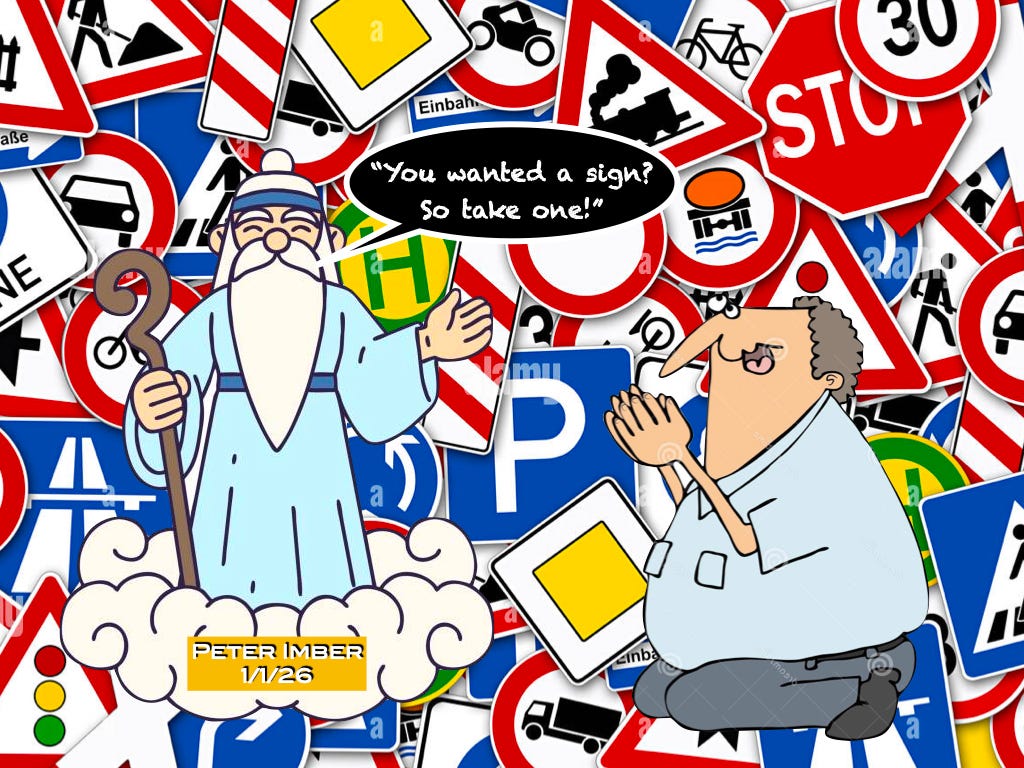
If you could know in advance what 2026 was going to be like, would you want to?
I thought so!
Hey, so here’s a loud shout out to all my readers with heartfelt thanks to those of you who pay for your subscriptions to The Pawned Accordion! I am very grateful for your support and aim to keep cartooning and writing. Please share what you like with others and if you follow my Substack, please subscribe (you can for free) and if you do, encourage someone else to as well.
I began doing cartoons on April 1,2020. The COVID pandemic had just started to isolate us physically from each other and for 365 straight days I did cartoons and also began adding stories and observations. I called my stuff Homemade Cartoons and created my Substack in the summer of 2024 and Homemade Cartoons became The Pawned Accordion.
I can predict two things for sure about 2026. The first is that it won’t be hard to find fresh material for The Pawned Accordion. The other… Wait! I’m sorry, I forgot what it was. Hey, I guess that’s one of the benefits of being another year older. For example take my New Year’s resolutions. I already don’t remember what they were!

HAPPY NEW YEAR!
—————–
What’s Next?

“Speak softly and carry a big stick and you will go far.” — Theodore Roosevelt

Speak loudly, swing often, and lie that you’ve scored a par. —Trump golf

“You break it, you own it.” —The Pottery Barn Rule
—————–
Lest We Forget

“These are the things and events that happen when a sacred landslide election victory is so unceremoniously & viciously stripped away from great patriots who have been badly & unfairly treated for so long. Remember this day forever!” —Donald Trump’s tweet on January 6, 2021
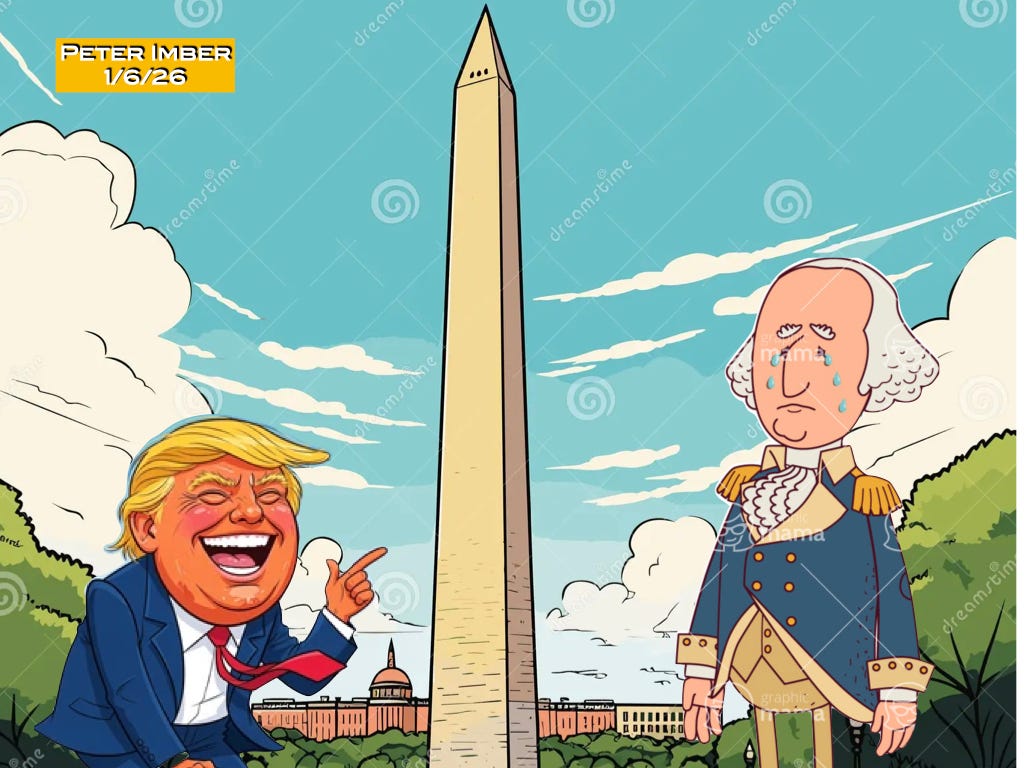
However combinations or associations of the above description may now and then answer popular ends, they are likely, in the course of time and things, to become potent engines, by which cunning, ambitious, and unprincipled men will be enabled to subvert the power of the people and to usurp for themselves the reins of government, destroying afterwards the very engines which have lifted them to unjust dominion. —George Washington’s Farewell Address to the Nation published on September 19, 1796
—————–
Weather Thou Goest… South! Reflections on living in Maine
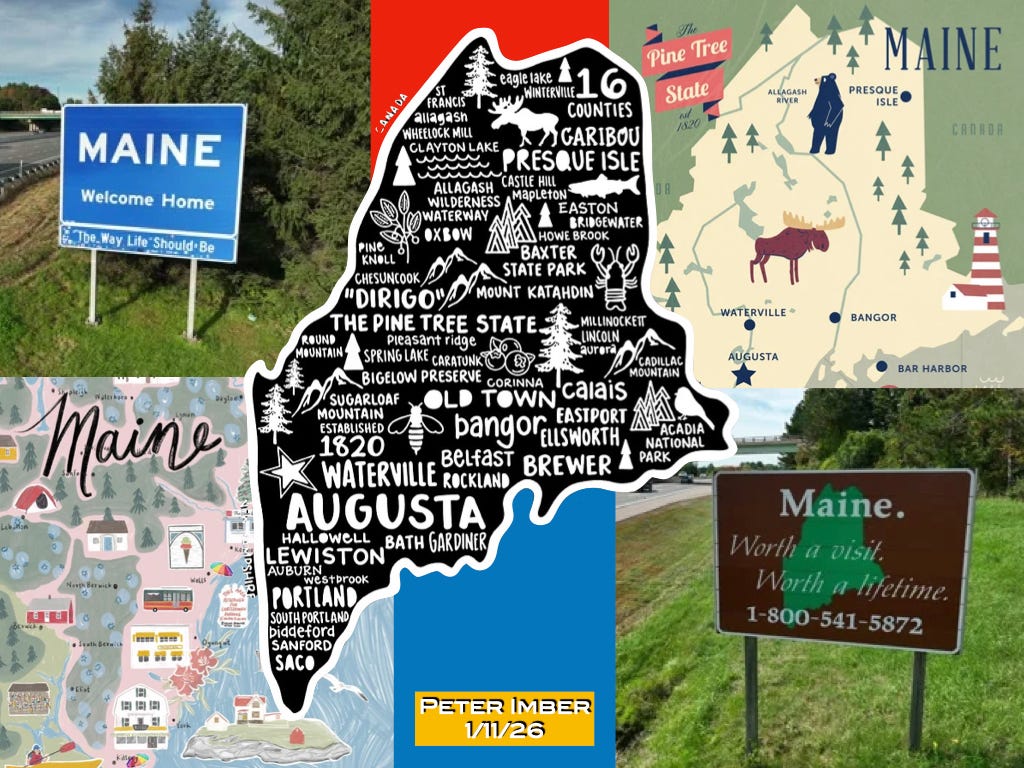
A few miles after you drive north across the Piscataqua River Bridge from Portsmouth, New Hampshire to Kittery, Maine on I 95, there’s a sign on the side of the highway that reads: Maine—Welcome Home—The Way Life Should Be.
When you leave the state before you cross the same bridge from the other direction, there’s another: Maine—Worth a visit. Worth a Lifetime.
For state hello and goodbye signs I think Maine has its other 49 competitors beaten handily. But there’s also a quote attributed to the travel writer Paul Theroux that presents a different context in which to evaluate this place— “Maine is a joy in summer. But the soul of Maine is more apparent in winter.”
Theroux, who attended the University of Maine, hasn’t lived here since and apparently is implanted with a rubber soul because these days he bounces between winters in Hawaii and summers on Cape Cod. So I guess I shouldn’t have been surprised when I heard Jo say…
“You know, Lou McNally isn’t here in Maine.”
If you’re a listener to Maine Public, which is our state’s broadcasting affiliate with NPR and PBS, there’s a good chance you know Lou McNally. He does the weather report on the radio most mornings and he’s good at his gig.
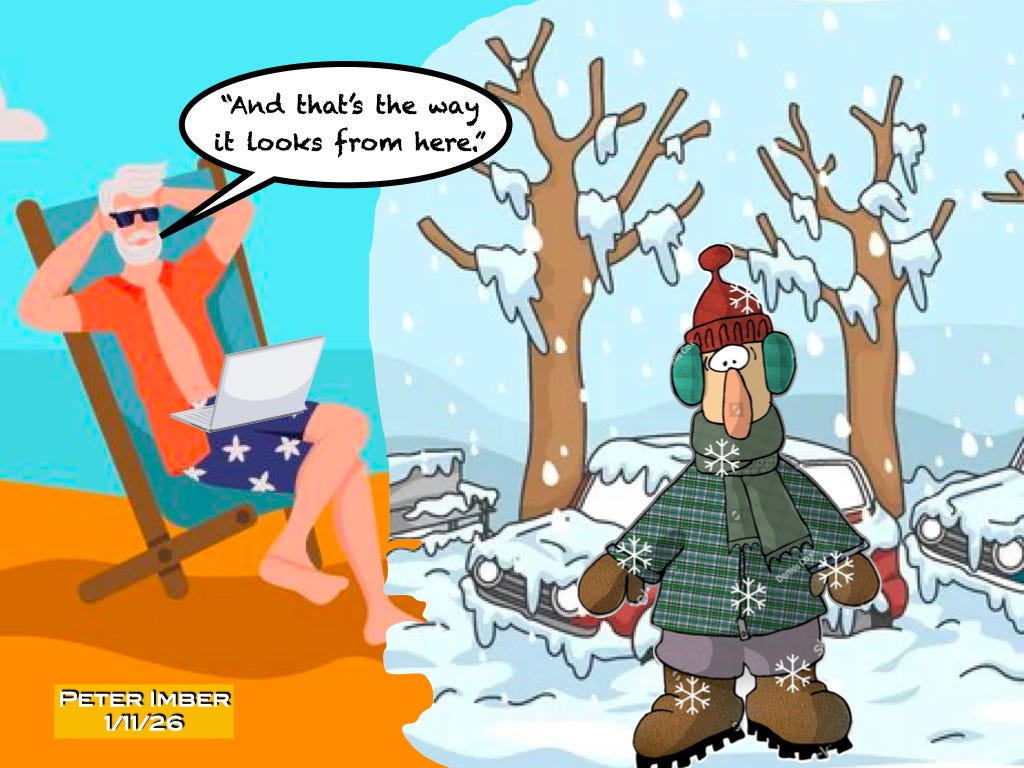
McNally’s signature signoff line is “That’s the way it looks from here” but as I’ve now learned, he’s not HERE! He’s like the guy I have relaxing on the beach in the cartoon and when he’s telling us listeners in Maine how cold it’s going to be, he does it from Florida where he lives in the winter, if not most of the year, and his outdoor thermometer will reach 70 degrees today.
A more fair weather weatherman might be hard, if not impossible, to caricature. But in fairness McNally’s long broadcasting career did begin in Maine and he was once widely seen and heard on local TV and radio. Full disclosure also requires that I reveal that McNally came up with his sign off long ago and used it first when he was still working in Maine and before he split the year between here and Florida. Still, Lou’s signoff has now transitioned from iconic to ironic.
Florida might almost be called Maine South. Lots of people who live here for part of the year go there for the other part or is it the opposite? It’s where our ex governor Paul LePage bolted immediately after losing an attempt to get re-elected and became a Florida resident. He’s running again and this time it’s for the United States House of Representatives. His whereabouts at the moment as I sit next a whirling space heater are not known to me.
Oh, here’s something we just received in the mail that made me chuckle and frown simultaneously. Below is the envelope that contained the bill from the guy we hire to plow our driveway. The return address says Rockland, ME but take a look at the postmark…
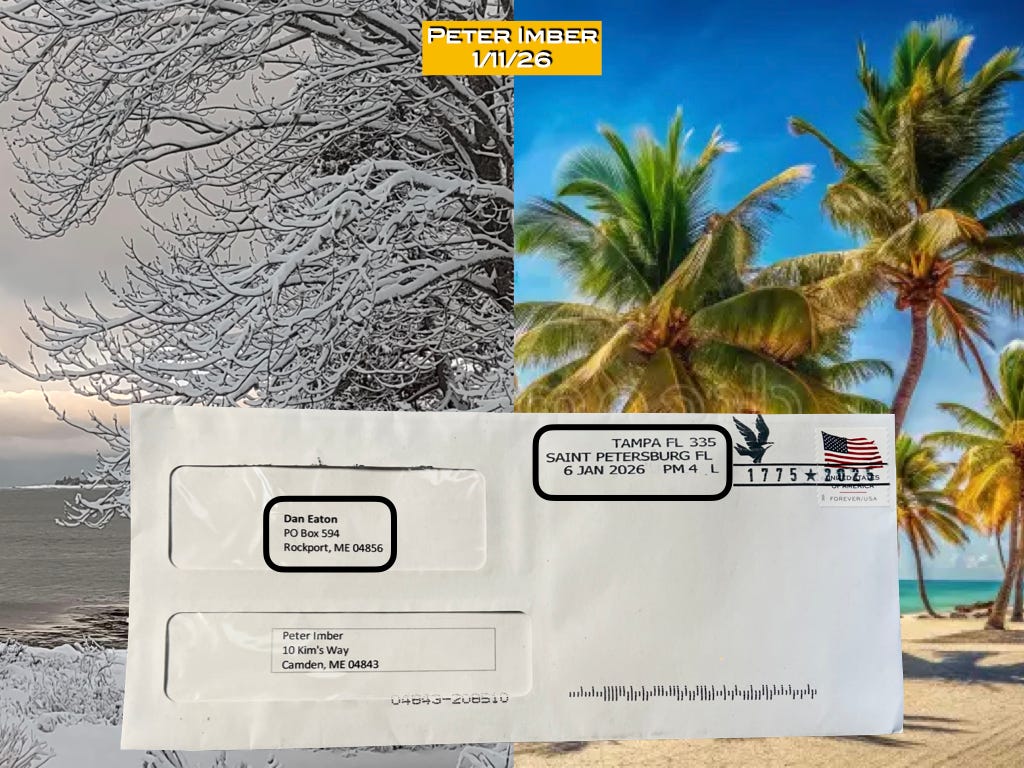
Next time we need plowing I’ll check to see if anyone is behind the wheel of the truck or maybe Dan changed the name of his service to Waymo Snow.
You see a lot of Florida license plates in Maine in the summer. They return north with all the other birds. And for those of us who might be thinking of spreading our own wings south there’s a local radio commercial with a guy who claims to be “Your Maine go-to real estate agent for property in the Sunshine State.”
We’ve noticed that since the pandemic things might be changing a bit. Some Maine snowbirds are delaying their seasonal migration long enough to be seen with snow shovels and more and more license plates from other warmer locals seem to be on our roads than in the past.
Although the cost of buying a house in Maine has gone up like it has everywhere, Maine is an attractive place to raise kids or retire. Yes, we certainly have our share of poverty and crime but we don’t have earthquakes, hurricanes, tornados and wildfires— at least not yet. Politically, we’re still blue on the coast for those for whom this matters. Of course we do have our weather and that’s where Jo’s “two winter test” comes in.
Observing a few out of state licenses sitting in snow and ice covered driveways, Jo said to me a while ago, “Let’s see how many are still here after their second winter.”
At a Chamber of Commerce dinner I sat beside a realtor who confirmed Jo’s challenge.
Me: “How many homes that you’ve sold have come back on the market after the buyers spent a couple of winters here?”
Realtor: “I’ve had a number of them. Not everyone is able to make the adjustment from “Vacationland” to “Staycationland.”
The Maine license plate is indelibly inscribed with the former but a few years ago a Maine lawmaker proposed to change it to the latter with the intent and belief that more people, especially young families, might see the light and move here. In the middle of December when that light is the faintest, it’s often a dealbreaker.
In fact, as much as I love Maine and am happy here, I am obliged to mention that it’s also the only place I’ve ever lived where when the sun is out and, if it’s not freezing or blusterly, strangers don’t acknowledge one another with just a perfunctory “Hi.” No, much more often we break into a smile and say, “Nice day!” And that’s especially true in the summer when those of us who are here all winter believe that on any nice day we earned and deserved it.
Jo was born and grew up in Maine and remembers hearing stories that it was once possible to actually drive a car across 15 miles of frozen ocean from Rockland on the mainland to the island of Vinalhaven. In the 15 years we’ve lived in Camden, winters have become noticeably warmer and shorter. That is until this one!
However, what hasn’t changed is the length of the shortest day of the year which, barring Elon Musk fooling with the earth’s orbit around the sun, is less than seven hours.
A few years ago when we were in Ecuador it was the first time I ever stood on the equator and learned that Ecuador is the Spanish word for equator. Those who live there have 12 hours of light and 12 hours of darkness every day. No dusk in the afternoon and no sunset in the latter part of the evening either. Living on the equator would drive me crazy. No summer and no winter. Now, that’s a dealbreaker!
—————–
My Nightmare on Penn Street
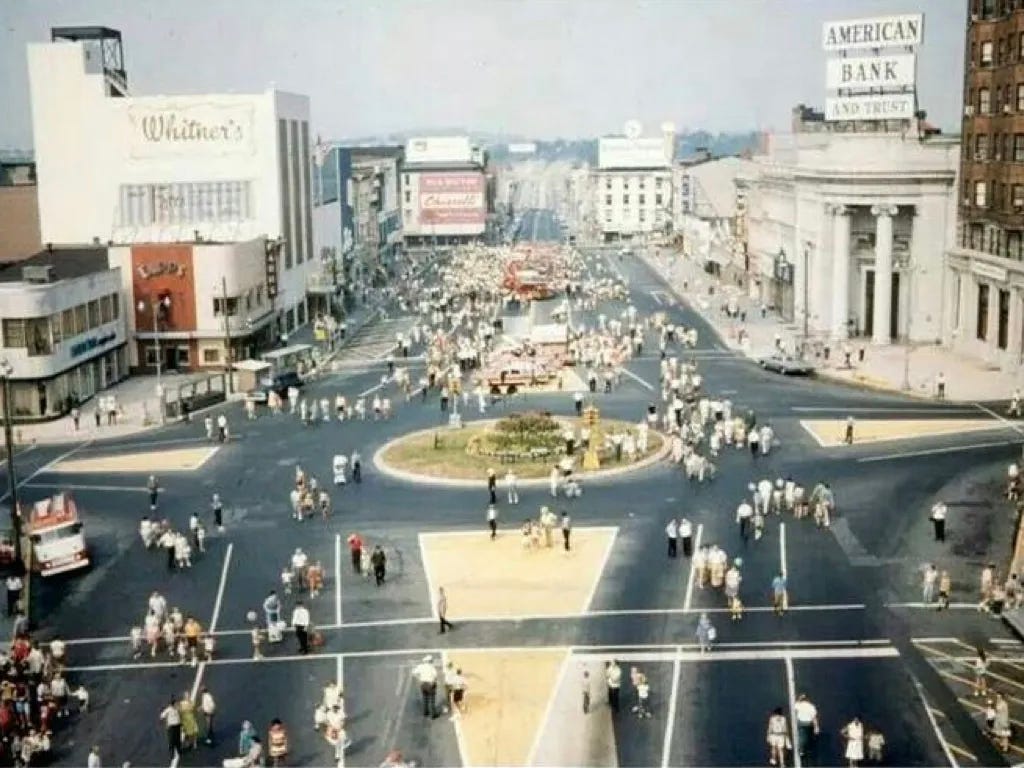
There was a time when downtown Reading, Pennsylvania had everything. Of course I’m thinking of long ago when it helped to be a kid to believe it. Reading’s Penn Street was like a theme park to me in the 1950s.
I grew up in a post WWII suburb of the city when “Just be home for dinner” was often a mother’s only command. I could climb the mountain outside my window, play baseball all day in a friend’s backyard or hop on the bus that stopped around the block and go downtown by myself. Occasionally, I went into Reading to fold cardboard boxes at Imber’s— my grandfather’s store. At a nickel a box he vastly overpaid me.
Mostly my trips were just to have fun and wander among the “Five and Dimes”— Woolworth’s, Kresge’s and W.T. Grant’s —the shiny precursors to today’s look alike “big box” warehouses and the sad proliferation of “dollar” stores. From baseball gloves at Kagen’s to Scouting uniforms at Croll and Keck, Penn Street was the place that had something for everyone and offered special attractions no longer found today.
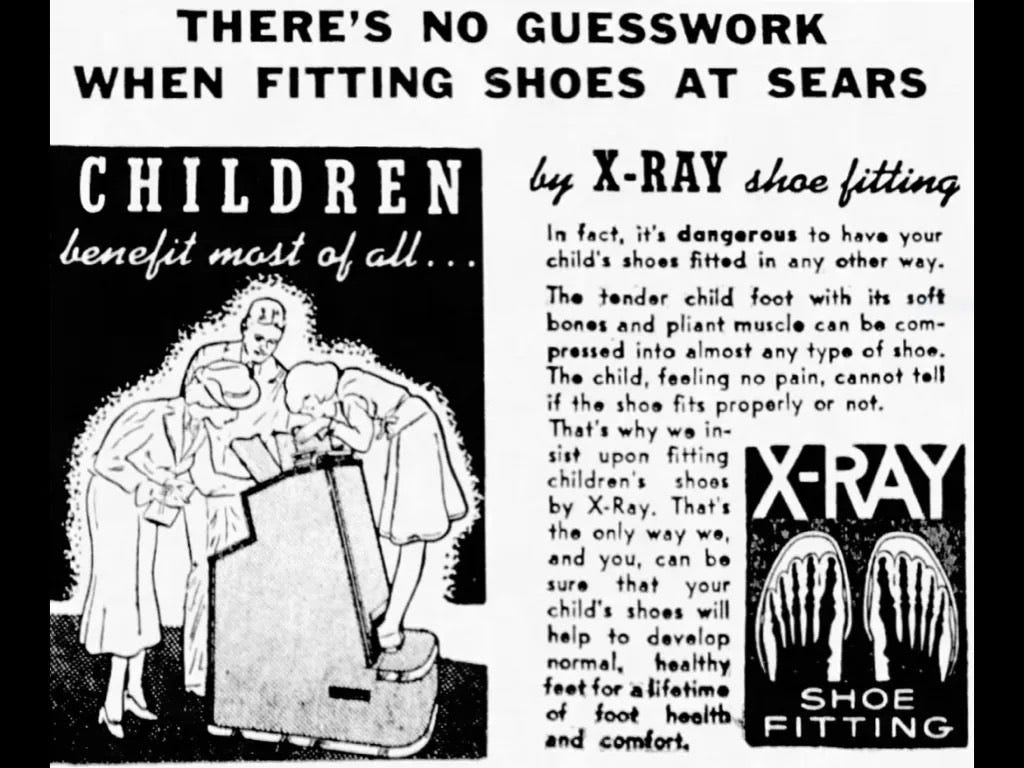
Take the fluoroscope at Farr’s shoe store at 5th and Penn, a tool intended to show how the shoes fit that you just tried on. This was a device that allowed you to look down and actually see the bones in your feet as you stood under its X-ray beam in your new Bass Weejuns. Turned out that it was as unsafe as it was captivating, maybe even as bad as having a stack of X-rays all at once but who knew? And who sued years later after they found out?
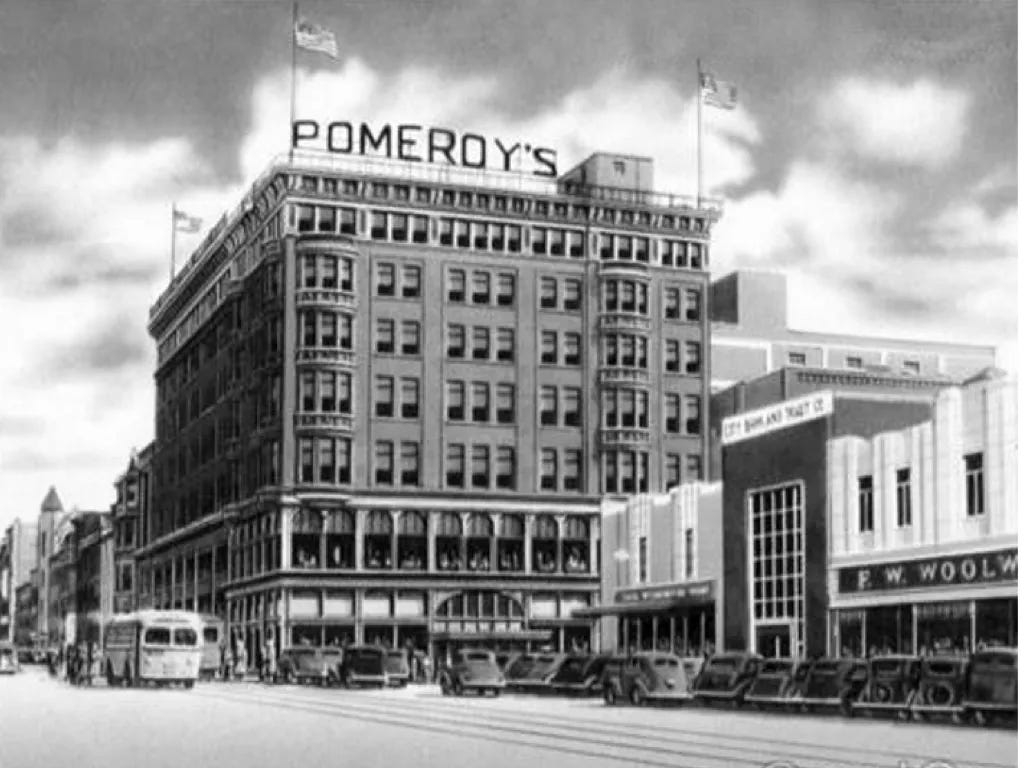
The only escalator in town was at Pomeroy’s, Reading’s multi story department store. It was wooden and like a carnival ride. Unlike a modern mall’s silent metal stairways, it bumped and shook as its moving planks creaked their way on their orbits between floors.
When its stairs flattened out at their zenith there was a gap between where the wood entered and disappeared into the stationary terminus. You could fit your fingers in it if you didn’t know any better. One boy I went to school with did just that and partially sheared off several of his. If it had happened today, I’m guessing he might not have needed to work a day in his life.
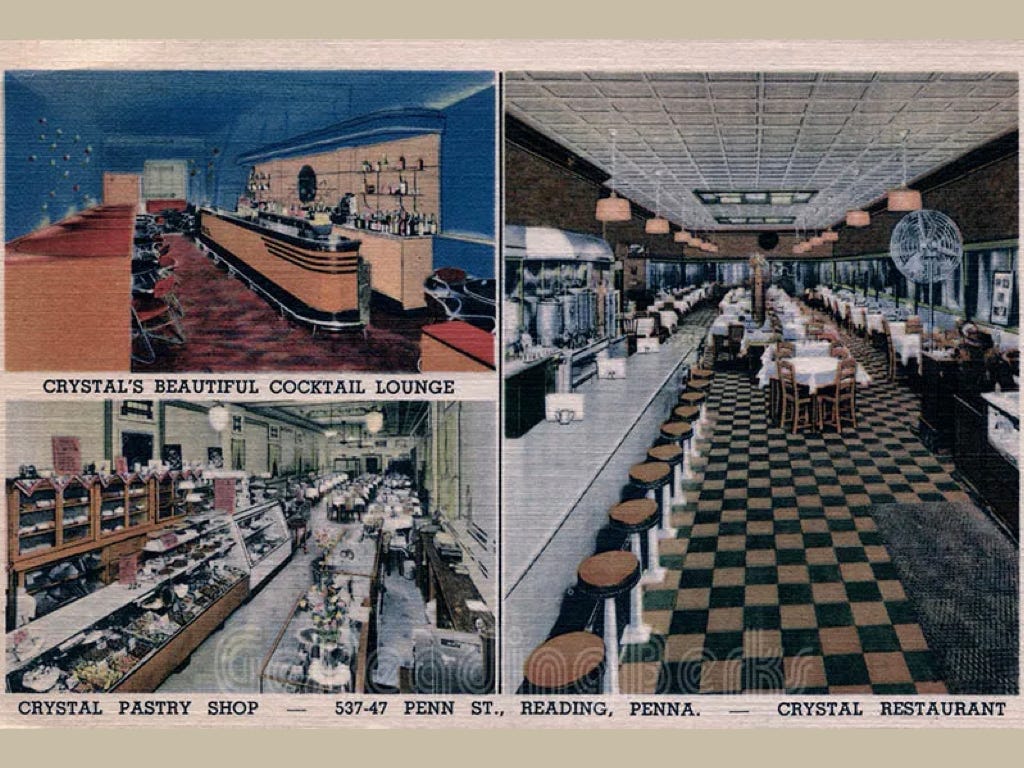
And there was the “Treasure Chest” at the Crystal, the biggest restaurant in town. What a smart bit of marketing by the owners— two Greek brothers who in that American era of aspirational assimilation chose not to offer any Greek food on their menu.
The chest was full of small rewards for kids who had urged their parents to bring them to eat there. If you hadn’t made a scene or even if you had, you went to pick out something from a steamer trunk that passed for a repository of pirate booty.
I got my first baseball cards out of the Crystal’s Treasure Chest, including, I think, an early one of the great Red Sox slugger Ted Williams. Too bad if I did because I have no idea what happened to it but no doubt ballparks today could be filled with men of my generation who blame their mothers for throwing out our “priceless” card collections.
Oh, and one other deeply embedded memory of the Crystal. The restaurant ran a buffet on the weekend. They called it a smorgasbord which is Scandinavian but the food was totally American with an emphasis on Pennsylvania Dutch fare. One could chow on chow-chow— a pickled vegetable relish —with unlimited helpings of chicken pot and shoofly pies. Feasting at the Crystal was a whale of a deal until it wasn’t.
I have always assumed that Reading was in the Top Ten of the most obese cities in America, but I just checked the latest rankings and it isn’t even in the Top 100. That could be because V&S, home of my favorite Philly cheesesteak, has closed all its sandwich shops in the area except one.
Despite the presumed community health benefits from reduced access to cheesesteaks, the ER at the Reading Hospital still holds the title as the busiest in Pennsylvania. And despite Reading mysteriously falling off the national obesity radar, I have often wondered if its airport will eventually need to construct new runways as wide as they are long.
But back to the Crystal’s buffet spread and in the 1950s it didn’t take long for the words “All You Can Eat” to spread like soft butter throughout our county and the most often heard instruction to the guy carving the roast beef was “I’ll tell you when to stop.” The restaurant had turned itself into its main course and was being eaten alive!
Even though I was very young I witnessed the aftermath of the decision that reduced the Crystal smorgasbord into one stop chomping. All you can eat quickly became all you could fit on one plate.
I remember watching a man walking back to his table with the food he had piled so high on a plate that his meal was only prevented from leaving a trail like Hansel and Gretel’s breadcrumbs by his forearms and shirtsleeves tightly encircling it. Before he had a chance to wear it on his face he wore it on his clothes. Images like that last a lifetime inside one’s head.
Dinner at the Crystal was by no means the only entertainment available to me. The Reading Railroad routed its trains right through the middle of downtown. They squealed across the tracks and frequently halted automobile traffic at 7th and Penn. I could watch them while eating a “Coney Island” hot dog from the Crystal Palace Hot Wiener Shop— no connection to the restaurant —that overlooked the rails.
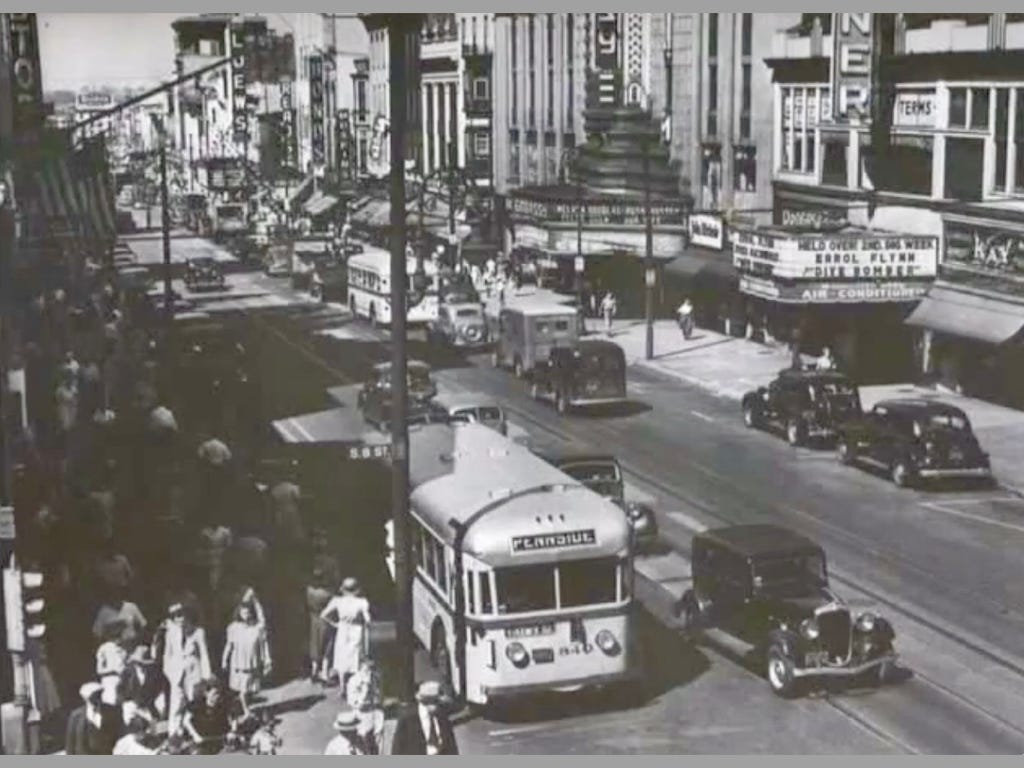
Some of my best times downtown were at Reading’s other palaces and ultimately, also one experience that will forever be my worst.
The city had its fair share of grand movie theaters bearing the names of that era—Astor, Embassy, Loews and Warner. All are gone of course along with the experience that came from sitting in the dark with hundreds and not just a few dozen others to watch a film. There was also one other theater which was off limits to kids.
If Penn Street had everything from A for the A&P supermarket to Z for Zeswitz, the music store where I bought my first record albums, then the Park covered X. It was Reading’s home to the fading years of burlesque as well as the early ones of Bridgett Bardot and later hardcore porn.
My first memories of going to the movies in Reading include Mr. Roberts starring Henry Fonda and Jack Lemon and Guys and Dolls with Marlon Brando and Frank Sinatra. My parents took me. But what they never heard about was the time I missed a day of 6th grade to go to the movies without them. Two friends of mine talked me into it although I can’t claim it took much more than their asking me if I wanted to join them.
We were all Jewish and it was a minor Jewish holiday and so insignificant an observance that only the most devout regulars at Kesher Zion synagogue showed up for morning prayer that day joined by three kids playing hooky who hadn’t yet reached the age of 13 to be bar mitzvahed.
Our absence from school and appearance at the service was a sham of course. We were on our way to a double feature. On the theater marquee was a pairing that wasn’t exactly from the Old Testament. We had skipped class and conned God to watch Frankenstein and Dracula— the classic hall of fame horror genre versions starring Boris Karloff and Bela Lugosi.
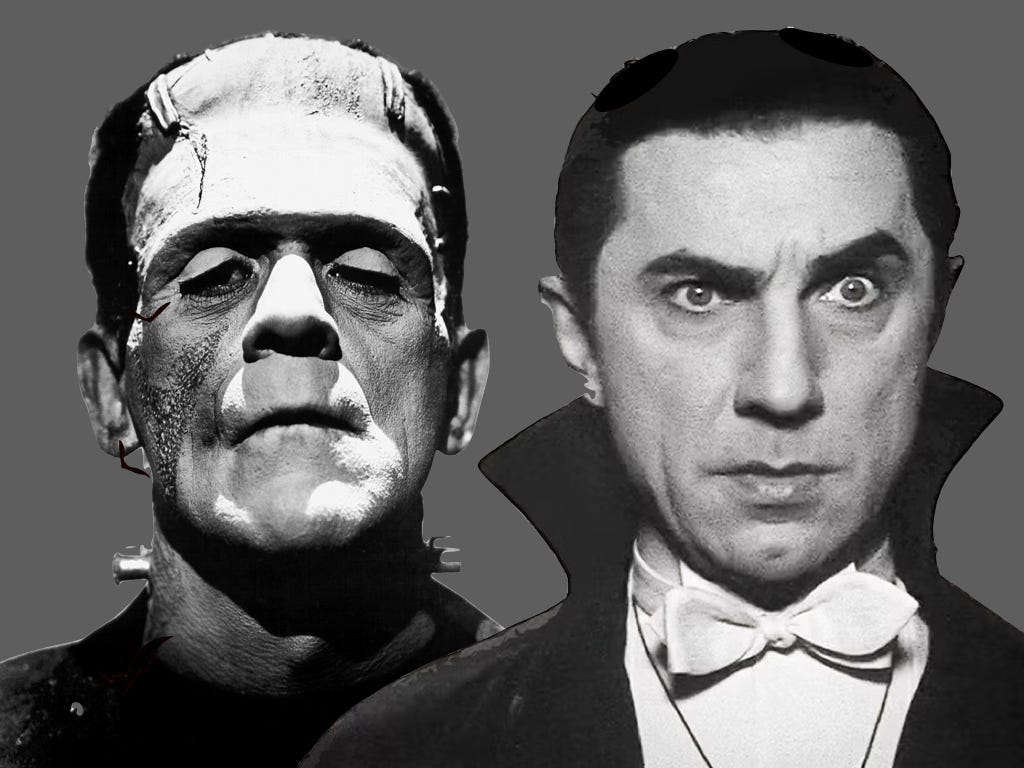
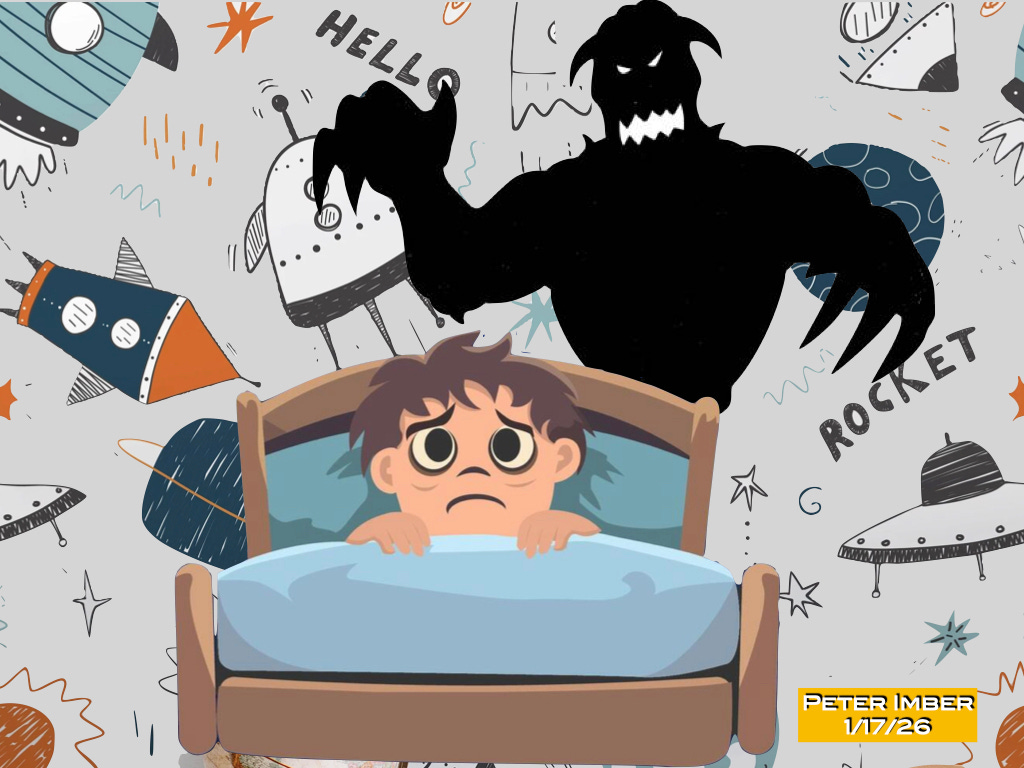
Afterward that night as I lay in bed, I found falling asleep to be impossible. I knew Frankenstein and Dracula were either going to show up in my dreams or in my bedroom and I was powerless to choose. I was grateful for the street light on the corner. At least I wasn’t totally in the dark.
But suddenly a shadow streaked across the wall of my room and I couldn’t move. I almost couldn’t breathe. Several more times the shadow of a surrogate Frankenstein/Dracula seemed to lunge at me until I realized that it was created by each car that passed outside my window and under the street light. I was spooked for days.
Yes, I paid for more than just the two movies. I’ve never watched either of them again and I have avoided horror films ever since. Forget Elm Street. Playing hooky downtown in Reading nearly 70 years ago will always remain my Nightmare on Penn Street.
—————–
Don’t Quote Them On That
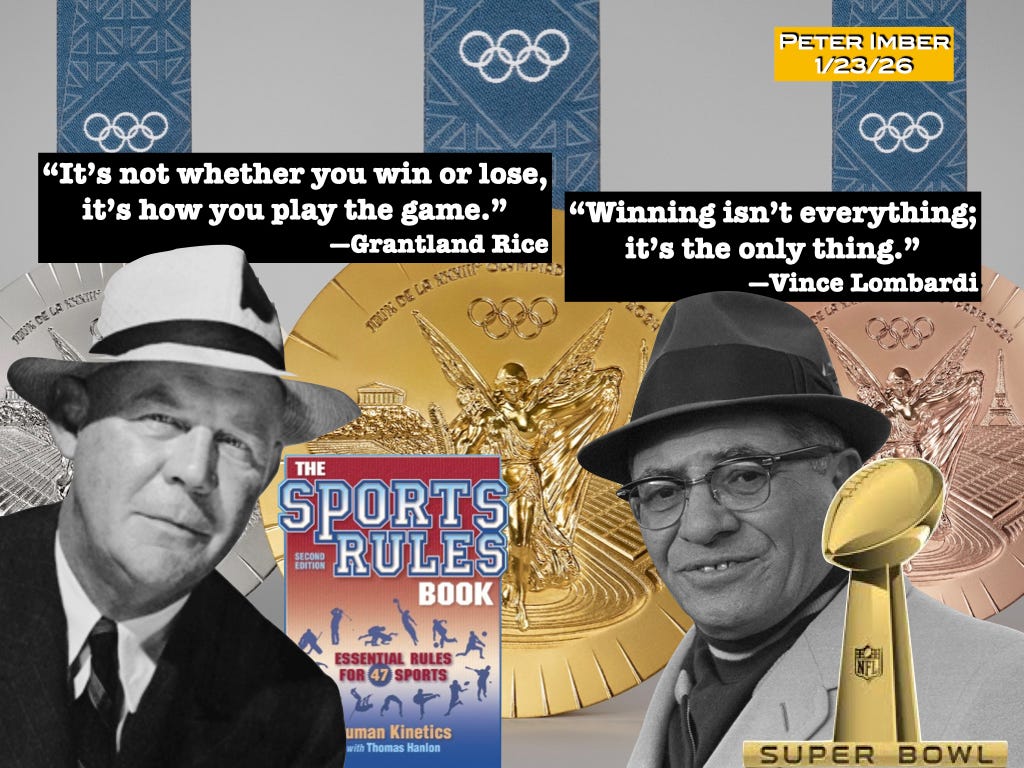
“The only thing we have to fear is fear itself.” —Franklin D. Roosevelt in 1933
“I have a dream.” —Martin Luther King Jr. in 1963
“That’s one small step for man, a giant leap for mankind.” —Neil Armstrong in 1969
The quotes above have become part of American history. I wasn’t alive when FDR uttered his. I wasn’t in Washington, D.C. for MLK’s speech but I did hear and see Neil Armstrong as he stepped on the moon. The moment was broadcast live on television.
Although the first two quotes are entirely accurate, Armstrong’s, which traveled 238,900 miles to reach us here, isn’t. The first man on the moon later claimed he had said, “That’s one small step for a man, a giant leap for mankind.” On earth we didn’t hear that. It was lost in transmission.
Did that missing a make any difference? Not really, but I’m interested in quotations that we remember and use and take for granted because I’ve discovered some famous ones were in fact not originated by who we think they were or have been misinterpreted as to what we think they mean or have even been inaccurate from the beginning of their usage.
Take Grantland Rice’s “It’s not whether you win or lose, it’s how you play the game.” I had always assumed that referred to playing by the rules in sports. Rice was a sports writer and the most noted and prolific one of the early 20th century. He’s estimated to have written over 20,000 columns which when one does the math, add up to nearly 70,000,000 words. That sounds improbable but the late founder of Scientology L. Ron Hubbard is alone at the top of the verbosity leaderboard with an estimated 500,000,000 words in print.
Grantland Rice also published three books of poetry and this most referenced sentence of his is contained within his poem Alumnus Football. When I read it I realized it wasn’t really about football or sports. It’s about displaying tenacity on the field of life. See what you think… Alumnus Football
And how about famed football coach Vince Lombardi’s mantra “Winning isn’t everything; it’s the only thing.”? Well, right off the bat I found that Lombardi wasn’t the original author of what’s regarded as his motivational modus operandi that became an American credo. Another football coach named Red Sanders used the phrase first and it appeared in a Los Angeles newspaper article in 1949 after Sanders’ UCLA team lost to its cross town rival USC.
Lombardi actually claimed to James Michener in a book Michener authored entitled Sports in America that he’d been misquoted and that what he said or meant to say was “Winning isn’t everything. The will to win is the only thing.”
Vince Lombardi is not the only sports figure who has been credited with a memorable quotation that is not warranted or accurate. Baseball manager Leo Durocher acquired his nickname “Leo the Lip” for his run ins with umpires and Durocher’s contribution to the quotation Hall of Fame is “Nice guys finish last.” But if he were alive, I’d surely be getting some lip when I reminded him that he didn’t quite say that.
The story goes that his New York Giants were mired in next to last place in the National League in 1946. In conversation with Brooklyn Dodgers announcer Red Barber, Durocher was ridiculing his team’s performance when Barber jokingly teased, “Leo, come on be a nice guy.” To which Durocher replied, “Nice guy? The nice guys over there (pointing at his club’s players) are in seventh place.”
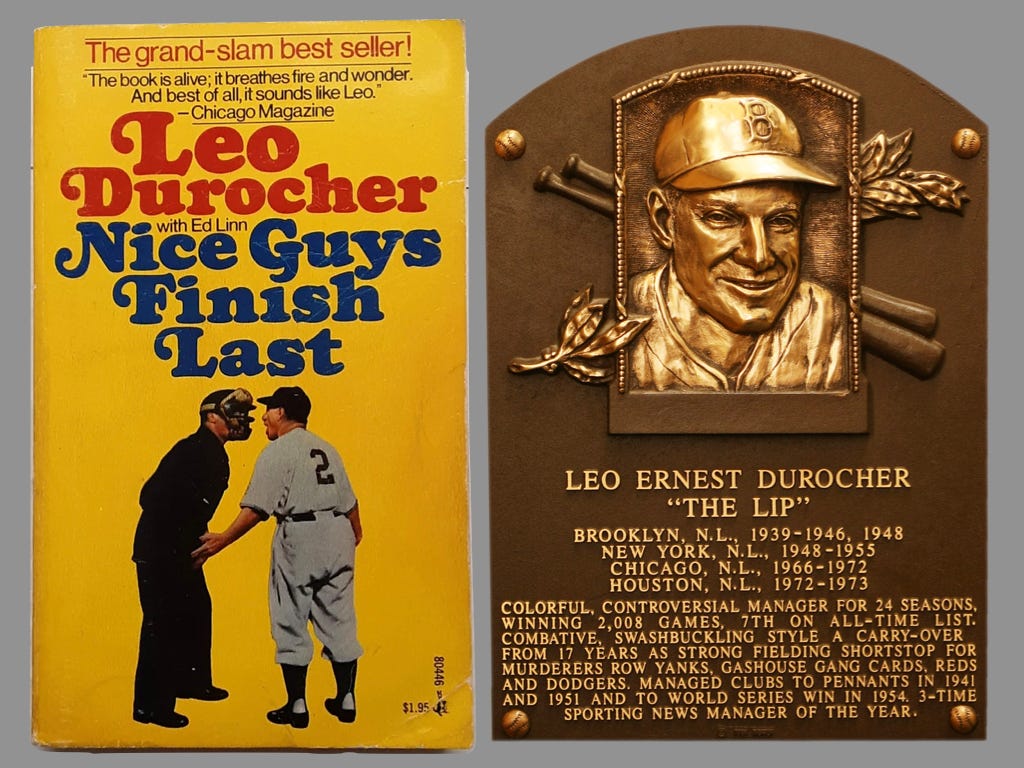
Ok, the National League back then consisted of eight teams so seventh place is awfully close to last but the quote that lives on is not close to “Nice guys finish last.” and what Durocher apparently actually said. He embraced it anyway and his autobiography’s title is the misquote. That makes Leo guilty of misquoting himself! I’m giving him an intentional off-base on balls anyway.
Quotes and misquotes, even when there’s mistaken lineage, seem to have a tendency to take on a life of their own. Oh sure, they can be taken out of context and sometimes that’s of little importance or consequence but there can also be lasting reverberations.
At the top of my list of the most damaging quotations by an American about America in American history has for a long time been this one…
“Government is not the solution to our problem, government is the problem.” —President Ronald Reagan (January 20, 1981)
Yes, that’s right out of Reagan’s first inaugural address— a man assuming the presidency making it clear that he’s disdainful of the government he’s just been sworn to administer. At least that’s what I thought until I did a little digging about Reagan’s declaration which has become one of his most cited pronouncements.
The quote is arguably not quite as definitive as it seems. Reagan purportedly was referring to shrinking government spending and regulations— the cornerstone of what became known as Reaganomics and what I believe was the bedrock of Republican policy until Donald Trump was elected president and took a “bully” club to whatever remained of Republican policy.
Reagan’s remark in 1981 may not have been calling for dismantling the entire government but what “government is the problem” came to mean for many Americans was something arguably destructive to our very governance.
Through the years I believe the kindling Reagan lit has ignited and spread and become the present firestorm. Trust and respect for Congress, the Presidency and government agencies are at or near all time lows and in a 1986 press conference Reagan threw what, looking back now, was additional fuel on the fire…
“The nine most terrifying words in the English language are: I’m from the government, and I’m here to help.” —President Ronald Reagan (August 12, 1986)
According to the quotation experts— The Yale Book of Quotations and quoteinvestigator.com —Ronald Reagan was by no means the first person to mock government and bureaucracy with this description. Its first appearance in print was in Reader’s Digest years earlier and other politicians used similar phrases before Reagan’s own adaptation. The essence of the same sentiment— “Never in the history of the world has there been a situation so bad that the government can’t make it worse.” —can even be attributed to Franklin Roosevelt’s Secretary of the Treasury Henry Morgenthau Jr. who said the above in 1939.
The majority of quotes from presidents in my lifetime that come from their speeches have mostly been authored by speechwriters. Donald Trump’s rambling streams of un-conscience-ness are the unassisted and often stupefying exception we are continually assailed with today. Some us are shocked and outraged, others are entertained and approving.
In our present fractious and fractured society even compendiums of quotes have now become targets for ideological scrutiny. The libertarian Cato Institute published an article several years ago after tallying the number of quotes in Bartlett’s Familiar Quotations latest edition along ideological lines and concluded…
“Readers might discover a pattern of omissions that is perhaps not surprising. The New York and Boston editorial team seem far more familiar with the words of liberal, leftist, and socialist sources than those of conservatives and libertarians.”
Here’s a link to the entire article if you’re interested… Cato Institute

Whenever I’m in New York, I try to walk by the Seagram Building on Park Avenue. It was designed by the architect Ludwig Mies van der Rohe and built in the 1950s. It’s set back from the street which allows you to take it in more fully. Seagrams is simple, elegant and speaks to me like a favorite symphony or painting. It also embodies an aphorism that van der Rohe liked to use— “Less is more.” That nugget is in Bartlett’s and attributed to the poet Robert Browning.
Van der Rohe is now associated with another phrase— “God is in the Details.” It was contained in his 1969 New York Times obituary and since then it is often assumed that he was its originator. Turns out that’s not the case although van der Rohe was known to be stringently detail-oriented. The actual progenitors of the expression are more widely believed to have been the 19th century French novelist Gustave Flaubert (”Le bon Dieu est dans le détail”) or possibly two other lesser known Europeans.
And it’s ironic that “God is in the detail.” has been appropriated by his adversary. “The devil is in the details.” is even heard more often now. It is credited to Friedrich Nietzsche (“Der Teufel steckt im Detail.”).
Ok, that’s enough and I’ll let someone else have the last quote…
“Leave God alone. He has enough problems.” —Elie Wiesel
America’s Horrible Year So Far…
I could have accompanied the cartoons below with more commentary but the facts are louder than words. Donald Trump and his accomplices and enablers have left me shaken and deeply sad…

On January 7 Immigration and Customs Enforcement (ICE) agent Jonathan Ross shot and killed 37-year-old Renee Good in Minneapolis, Minnesota.
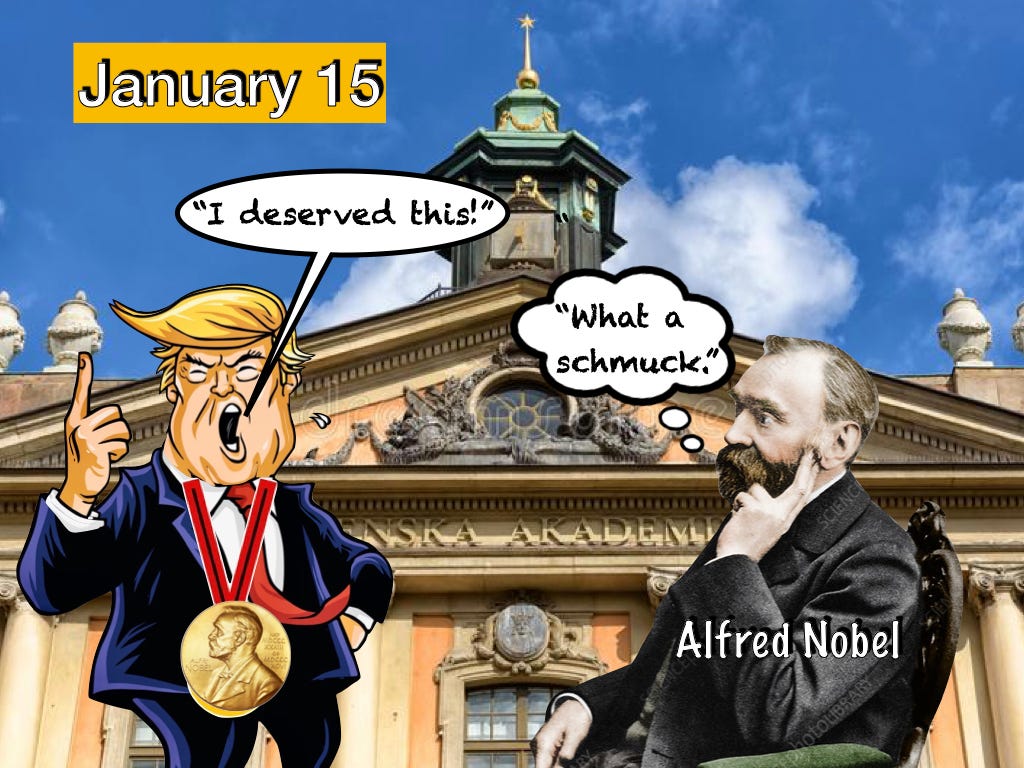
On January 15 Donald Trump received a gift of the 2025 Nobel Peace Prize medal at the White House from Venezuelan opposition leader María Corina Machado who had been awarded it last October.

On January 20 Canadian Prime Minister Mark Carney’s 2026 delivered a speech at the World Economic Forum in Davos, Switzerland for which he received a standing ovation. The following day Donald Trump spoke at the same gathering and the audience reception was described as “tepid applause and nervous laughter.”
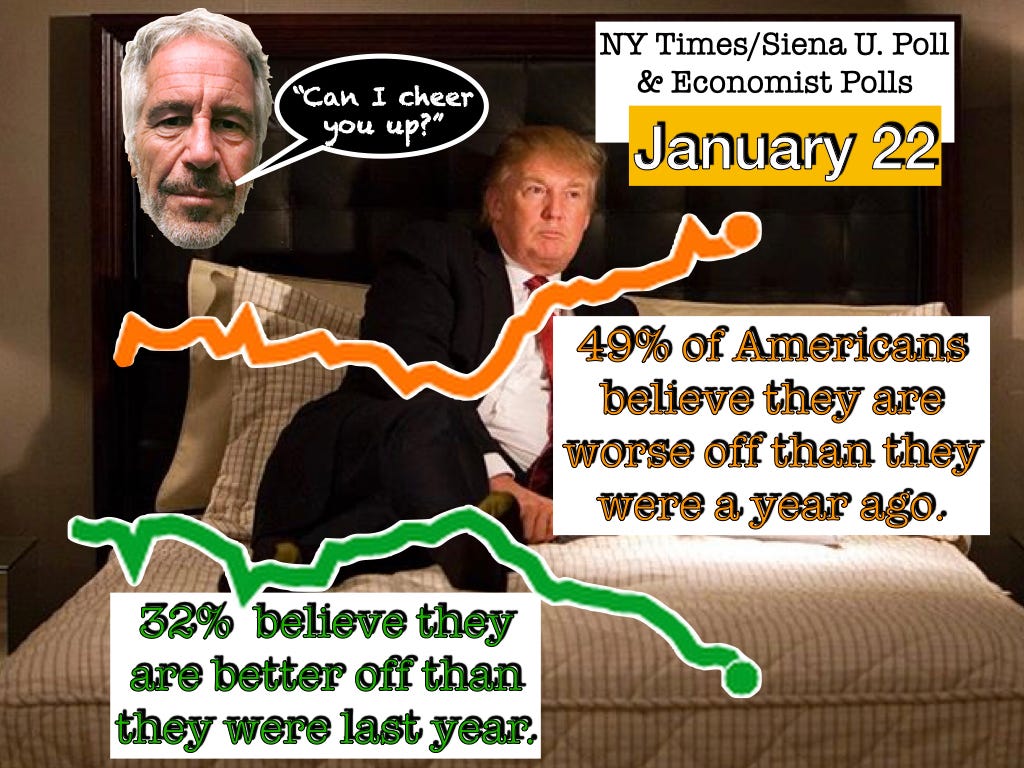
The Times/Siena poll also found that Trump’s current job approval rating is 37% while 56% disapprove of his performance as president after one year.
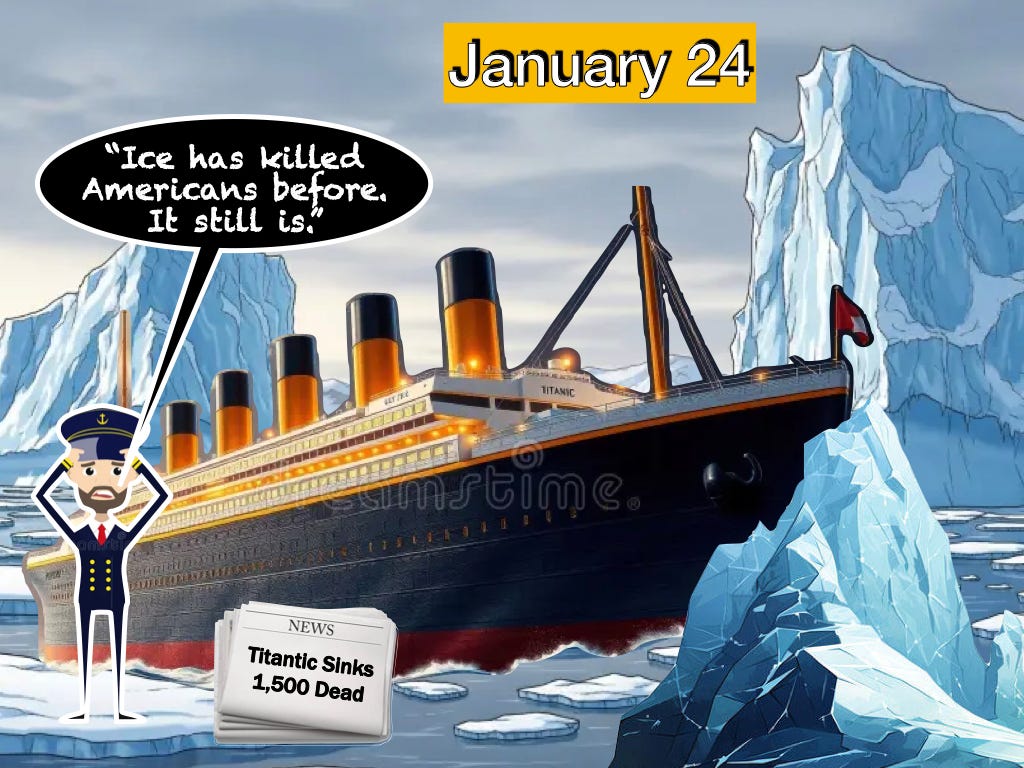
A 13 year old had the idea for this cartoon and I helped him create it. The words in the speech bubble are his. At the moment we don’t know which ICE agents shot and killed Alex Pretti on January 24.

Until the Trump presidencies I never imagined the United States could have befallen such a self inflicted ongoing tragedy but here we are…
Is You Is or Is You Ain’t…
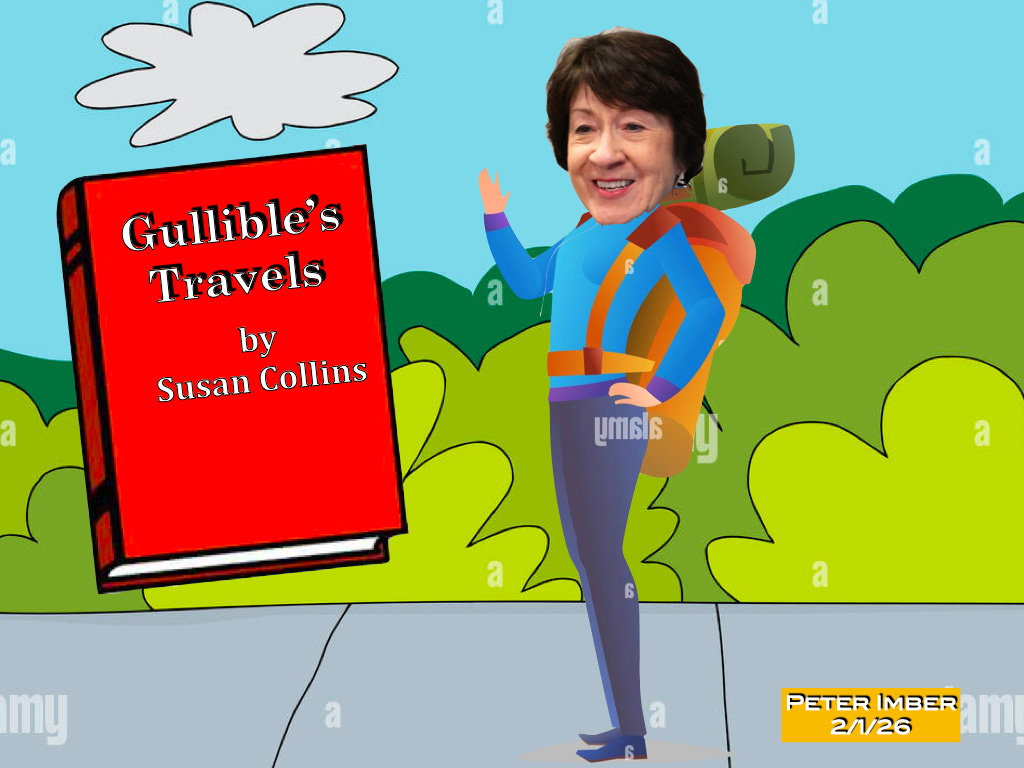
Multiple Choice: Maine Senator Susan Collins is: (a) a riddle, (b) a mystery, (c) an enigma or (d) none of the above? Correct answer: (e) transparent.
As much as I do not support Susan Collins’ reelection bid, I do recognize that by virtue of her position as Chair of the Senate Appropriations Committee she supports the state of Maine through the federal funding she has brought here. This is the most compelling argument Collins can make for her continuing service in Washington.
For what it’s worth Susan Collins is considered at this highly politicized moment in our history the most bipartisan U.S. Senator. Between 1997 and 2016 her party-line votes were cast 59% of the time compared to a Senate average of roughly 90%.
That’s certainly bipartisan but of course Donald Trump was elected president for the first time in 2016 and now in 2026 there are more loaned Chinese pandas— 4 —in America than discernable bipartisan members of the United States Congress.
So what bothers me and many others about Susan? It’s her trustworthiness when her vote really counts on important appointments and I believe there is good cause— an obvious track record —not to trust her because of whom she has shamelessly trusted herself!
Take the abortion issue…

In 2018, Senator Susan Collins claimed Supreme Court nominee Brett Kavanaugh told her in private meetings that he considered Roe v. Wade to be “settled law” and that he recognized the importance of adhering to legal precedent.
A year earlier nominee Neil Gorsuch had told Collins that he was a co-author of a book on precedent and emphasized that judges should not “reinvent the wheel every day.”
So much for reinventing the wheel and settled law. Both Kavanaugh and Gorsuch were part of the 5-4 majority of the Court that voted to overturn Roe v. Wade four years ago.
And take the nomination of Robert F. Kennedy Jr. to be Secretary of Health and Human Services last year…
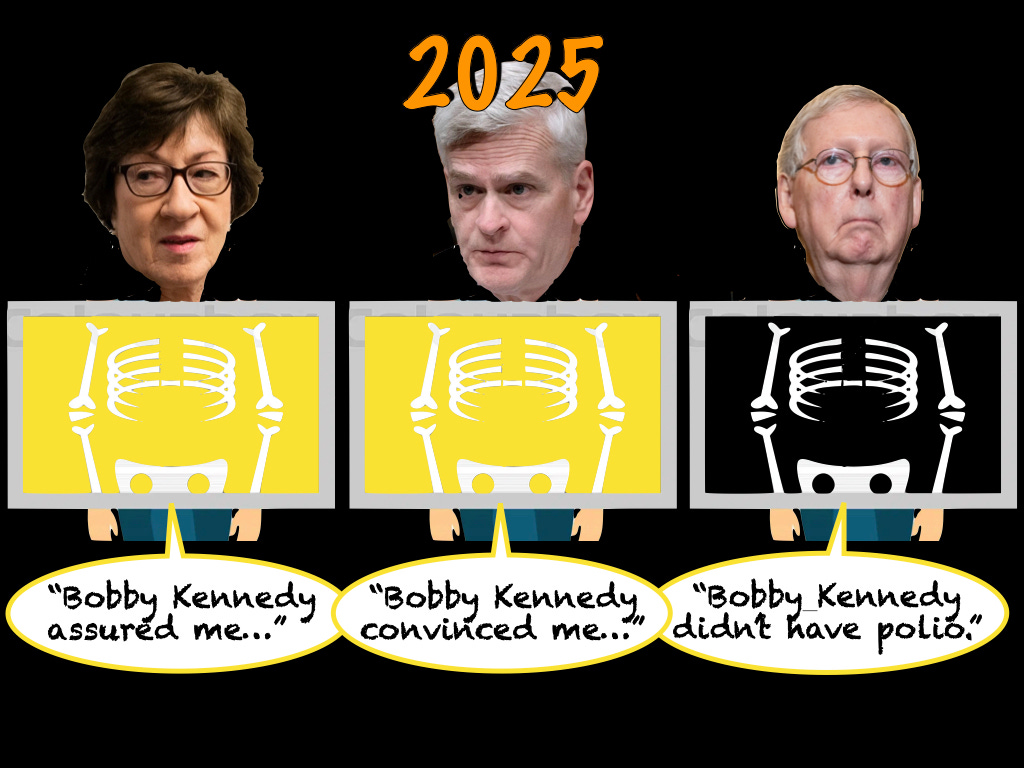
Senator Collins said Kennedy assured her that he supported certain vaccines and pledged not to restrict access. He also promised he would not cut critical National Institutes of Health funding. Collins said she was satisfied with his response to her concerns about cuts she believed would be most harmful to biomedical research.
Collins also claimed that fellow Republican Sen. Bill Cassidy of Louisiana, who is a physician, promised her that the Senate Health, Education, Labor and Pensions Committee would hold regular oversight hearings on RFK Jr.’s actions.
Collins and Cassidy voted to confirm Kennedy. If they had joined Mitch McConnell and voted no, Kennedy would not have been confirmed. And what happened to the promised “oversight”? Within the first months of Kennedy’s tenure thousands of NIH grants were terminated or frozen which included $500 million cut from vaccine research.
And just three days ago…
“I can report that Secretary Noem has informed me that ICE has ended its enhanced activities in Maine.” —Senator Susan Collins (January 29, 2026)

Should we give Collins the benefit of the doubt on this one? Let’s see how it plays out. And yes, Kristi Noem is another member of Donald Trump’s cabinet who Susan Collins voted to confirm.
With Senator Collins’ track record I say while some people play a good game, others attempt to feign one. Collins’ game face is to express dismay and reach into a closet full of verbs. And if verbs could fray, Collins’ use of them would be like pulling out and putting on threadbare sweaters. Below is how I keep score…
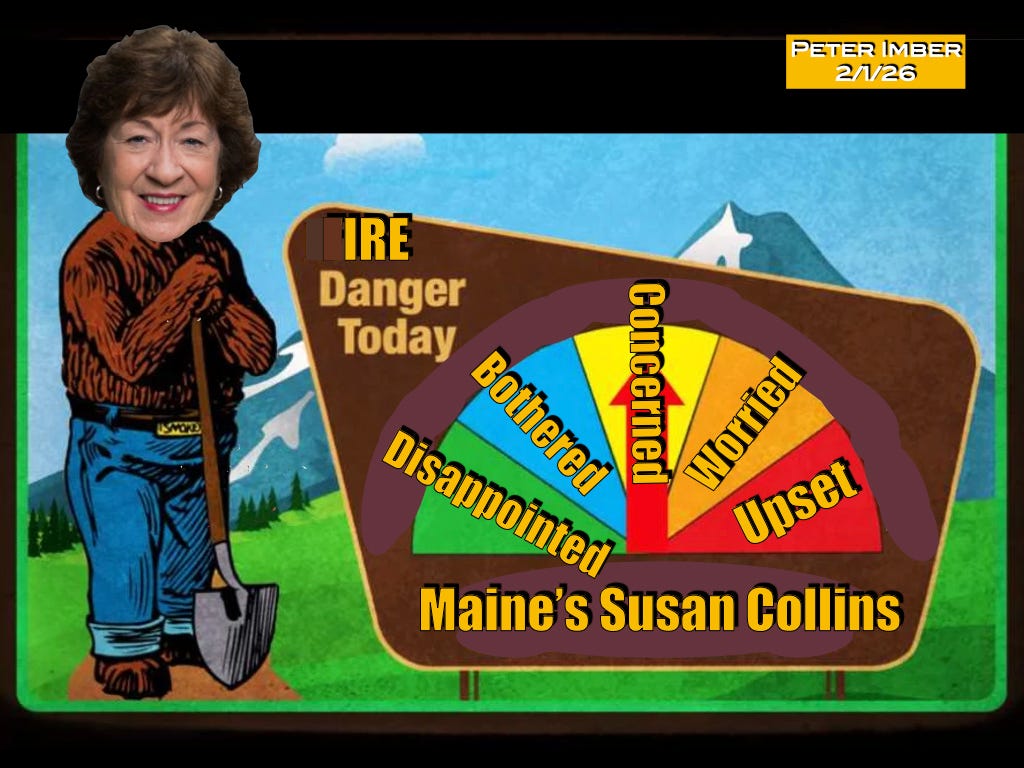
If Susan Collins loses her race here in November, the people of Maine will have decided they have had enough of her bad judgment and wide eyed insincerity.
Eat, Drink And Maybe Watch The Football Game

The Super Bowl is being played tomorrow in California and unless it’s suddenly diverted to Wyoming, North Dakota or West Virginia, Donald Trump will not be attending. Apparently, he has been advised that he’d likely be booed if he appeared at the game despite some of his supporters being among those wealthy enough to purchase tickets with an average price tag of $5,000.
Trump claims California is too far for him to travel. Really? I think I have come up with the name for his local NFL team if he ever decides to buy it. He should name it the Washington Thin Skins.
The game between New England and Seattle is Super Bowl LX. How many things do we have nowadays that use Roman numerals other than movie sequels and Popes? The sport’s connection with the Roman Empire is not an exaggeration. A Football Hall of Fame member named Ronnie Lott alluded to it years ago when he described the sport as one played by “gladiators in pads”.
During my career at ABC News I covered two super bowls and got to be on the sidelines during one of them. I’d never been that close to a professional football game and when a running back nearly ricocheted into me after being hit and catapulted out of bounds, I concluded that if I had been him, I might be writing today sitting in a chair with wheels.
The size of the players, the quickness with which they moved and above all the sound when they collided was not anything close to what we see on and hear from a television screen as we tackle our dips and chips from a safe distance on our sofas. Professional football is a violent game and its competitors often retire with permanent injuries.
The first Super Bowl was played in 1967 and watched by 51 million viewers. I was a sophomore in college and was one of them. The TV audience for last year’s game was 128 million. Super Bowl games now hold the record for 19 of the 20 most-watched television programs in American history.
What’s the one event that’s not on that list? You probably saw it— the Apollo 11 landing on the moon in 1969.
Super Bowl Sunday has become the day in most years when the greatest number of Americans actually all do something together. It’s only eclipsed every four years on the day in November when we vote for president.
The football game may be the main attraction but Super Bowl parties have become a ritual. The teams practice to be ready and many of us will prepare as well, but instead of running through drills on the field like the players, we’ll be running to the supermarket— if we haven’t already —for what we’ll eat when we watch them.
In 2012 after I retired I wrote a column for the website Bleacher Report of how big an event Super Bowl Sunday is for the snack food industry. Just like in the movie Casablanca I rounded up the usual suspects and I have confirmed that he quantities of the things we’ll eat from 14 years ago have only increased.
Super Bowl Sunday ranks second behind Thanksgiving as the biggest food consumption day of the year in the United States and the proof is in the Pepcid. Traditionally, there has been a 20% jump in antacid sales in the 24 hours after the game.
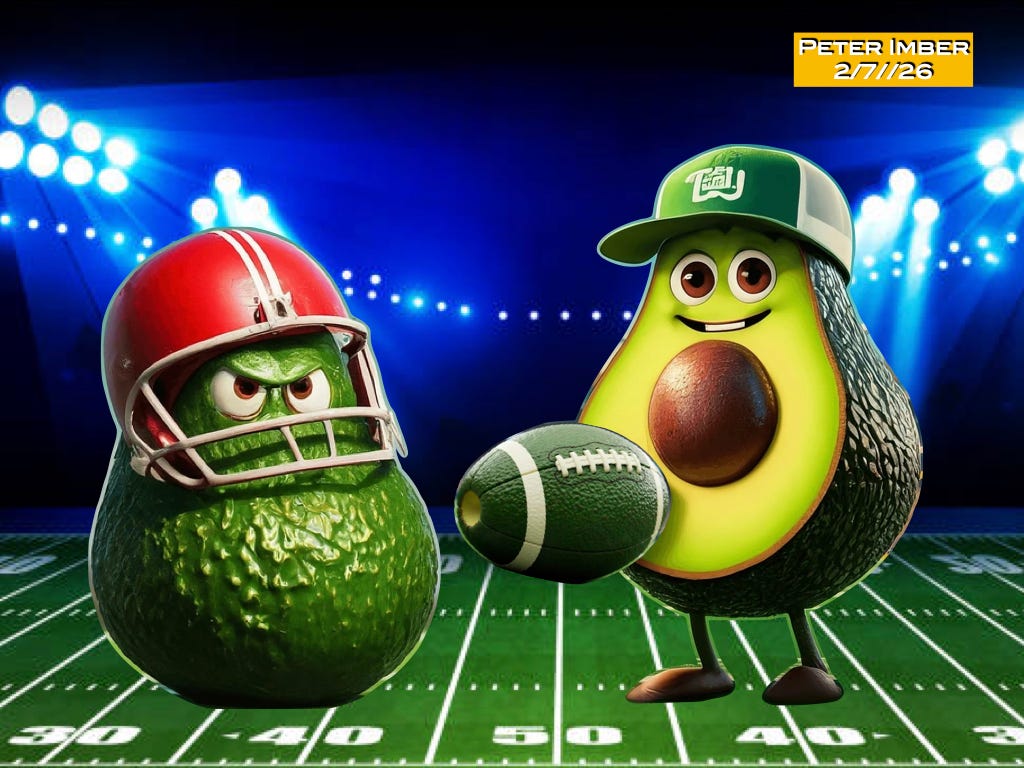
There are many prefered Super Bowl snacks but if there were an MVPP (Most Valuable Party Provision) the winner every year makes all the others see green. Guacamole consumption is estimated to be 8 million pounds made from 80 million pounds of avocados this Super Bowl Sunday. That’s enough guac to spread across an entire football field— including the end zones —to a height of over 20 feet so says the Hass Avocado Board. There’s also news to cheer about. The Board reports that the price of avocados this week is nearly 60% cheaper than a year ago.
I don’t know if the Aztecs (not a team, the people) had a Super Bowl but the oldest evidence of avocado use was found in a cave located in Mexico that dates back to around 10,000 BC. Guacamole came later and is thought to have been made first by the Aztecs in the 16th century. Why did it take so long to uncover this? Well, archaeologists believe it was because it was at the bottom of a seven layer dip.
I’ve not been inside a facility where guacamole is being made and packaged but I’ve seen video of one. A hose hovered over a conveyor belt on which plastic containers swiftly moved along to get their squirt of guac which couldn’t have taken more than a fraction of a second. And you thought our country only knew how to shoot boats from Venezuela out of the water.
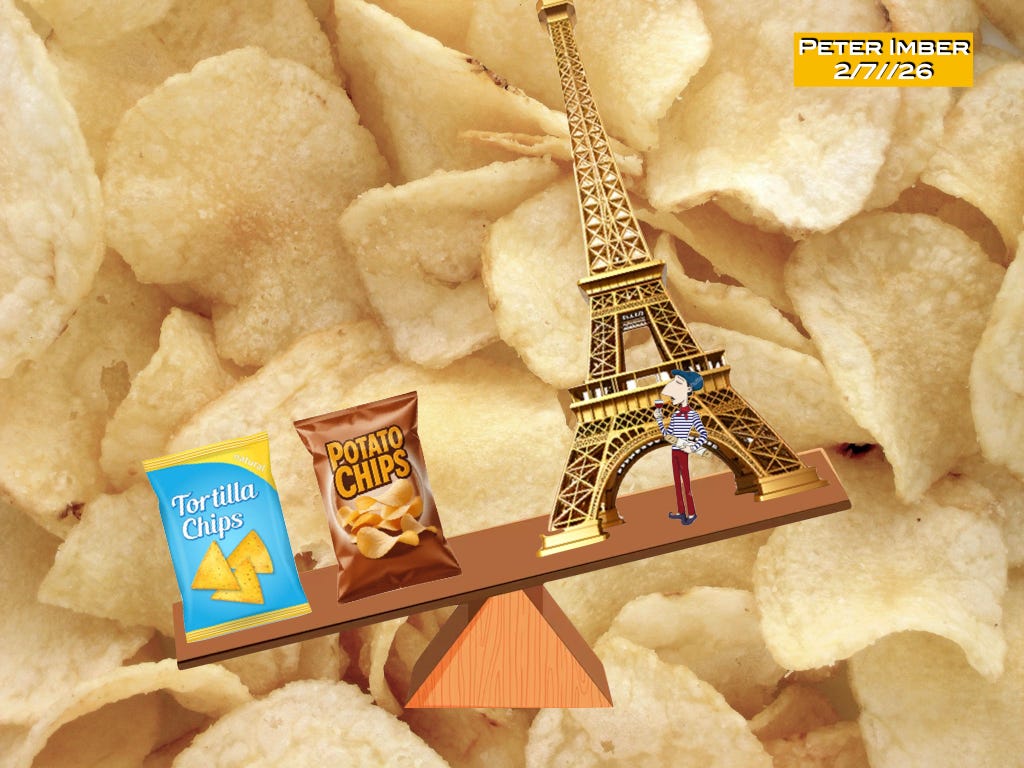
Potato and tortilla chip munching will reach nearly 20 million pounds according to the Snack Food Association— that’s more than the weight of the Eiffel Tower. It could rise higher if after the game those chips discovered under the seat cushions are counted. As a country we may have to catch up to Taiwan in producing our own computer chips but it would rank as a national disaster if there were a shortage of domestic potatoes and corn for the chips we need while watching the game.
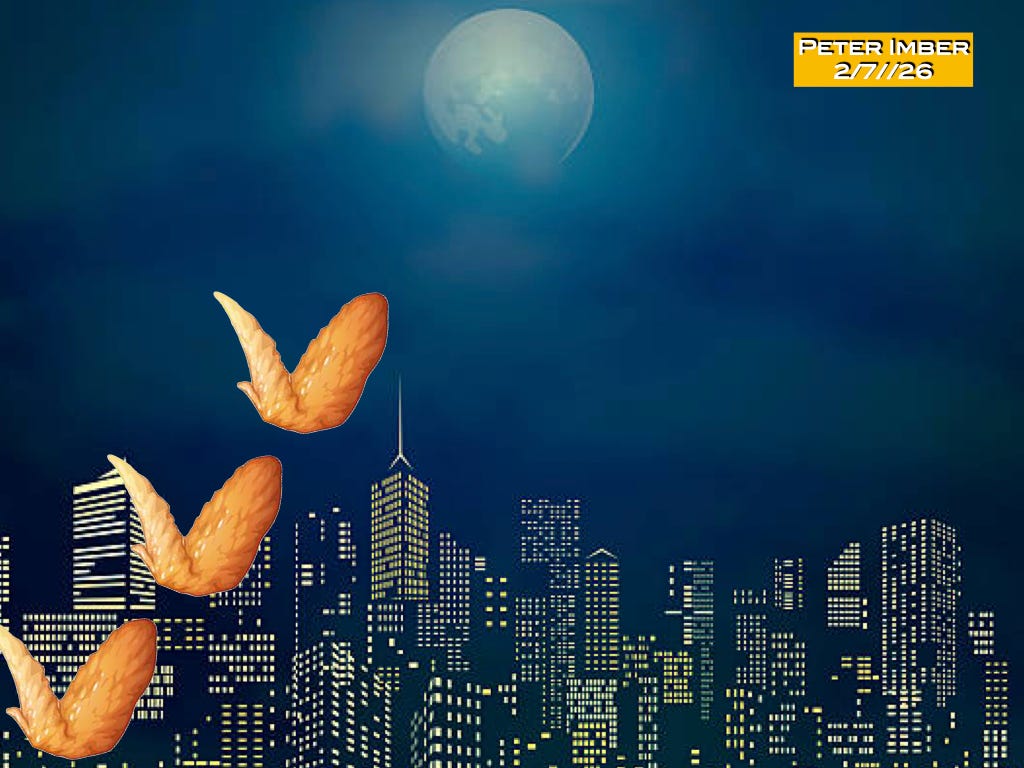
According to the National Chicken Council, people will nibble on more than 1.5 billion (yes, billion) chicken wings during Super Bowl weekend. That’s more than 100 million pounds of wings and a 10 million wing increase over last year. And thanks to the Council for these tidbits… “If one person ate one wing every 30 seconds, it would take them until the year 3430 to finish.” And one more… “If the wings were laid end to end they would wrap around the earth’s circumference twice or reach a quarter of the way to the moon.”
If I could afford the fee for a super bowl commercial— it’s as high as $10 million for a 30 second spot this year —I think I’d target poultry farmers and ask, “It’s 10 pm. Do you know where your chickens are?”
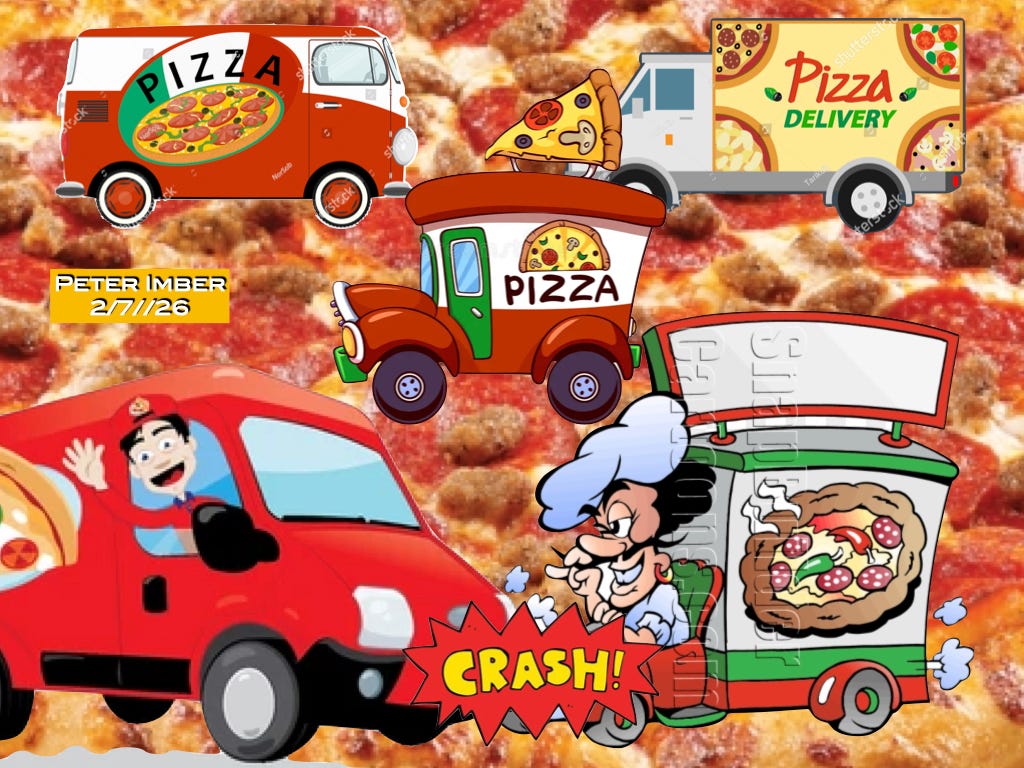
Pizza is a $30 billion a year business in the United States and on an average day Americans buy 12.5 million of them. Super Bowl Sunday is the busiest day of the year for pizza restaurants, and the big chains like Papa John’s, Pizza Hut and Domino’s will sell twice as many pies as they do on any other day.
Many of those pizzas will be delivered and extra drivers are hired to show up with them at your door. With the additional vehicles on the road and in a hurry, Super Bowl Sunday also means a higher risk of those delivery trucks getting in traffic accidents. Insurance companies are very aware of that. Fireman’s Fund has historically recorded a 9% increase in auto insurance claims resulting from pizza runs.
And where do you think the highest grossing single location independent pizzeria in the nation is located? If you guessed New York or Los Angeles or any place in the Lower 48, you’d be wrong. It’s Anchorage, Alaska. Annual sales at Moose’s Tooth Pizzeria are upwards of $6 million annually. I don’t know if any are delivered by dogsled there but here in Maine this winter it could be a business opportunity.
Once the game is over— Super Bowls usually last about four hours — and the stadium lights and televisions are turned off unlucky party goers may still be called for an “excessive celebration” penalty. About six percent of American workers will call in sick on Monday and many will lose a day’s pay.
Have I missed anything? Sure! There are sandwiches, hamburgers and hotdogs, ribs, shrimp, chili, cheese and I haven’t even mentioned alcohol. How about 325 million gallons of beer down the hatch tomorrow? That’s enough to fill 500 Olympic size swimming pools. Hey, if your team loses, you now know where to go to drown in your sorrow. But WAIT! By the end of the game the pools will be empty. Ooooo! That will hurt.

I’ll watch the game but probably tune in a couple hours after kickoff. I don’t know if it’s possible to measure how many others will be like me and record it so we can skip the commercials and hopefully, the halftime show. I’m also going to be one of the less than a third of the TV audience who won’t be watching the game with others. Jo’s not a football fan. I won’t be betting on the outcome either, but I’ll be sure to cover the spread— that is I’ll have my own! Guac, chips, maybe some shrimp. Hmm… do I have to defrost the pigs in a blanket?
Do You Wanna Dance?

“All rock ‘n’ rollers over the age of 50 look stupid and should retire.” — Grace Slick of Jefferson Airplane (Later she claimed she was joking.)
Long ago I thought that I’d still be listening to Led Zeppelin’s Stairway to Heaven as I get closer to climbing my own but ever since we moved to Maine my musical preferences have shifted. In short I most often flip through the pages in the Great American Songbook when I want to play music and relax.
The SunnyBrook Ballroom in Pottstown was close to where I grew up in Pennsylvania and my father told me about his trips there to hear Benny Goodman and Glenn Miller in the 1930s. Miller set an attendance record at the venue in February of 1942 with over 7,000 people crammed into a space that today’s fire codes would have never permitted.
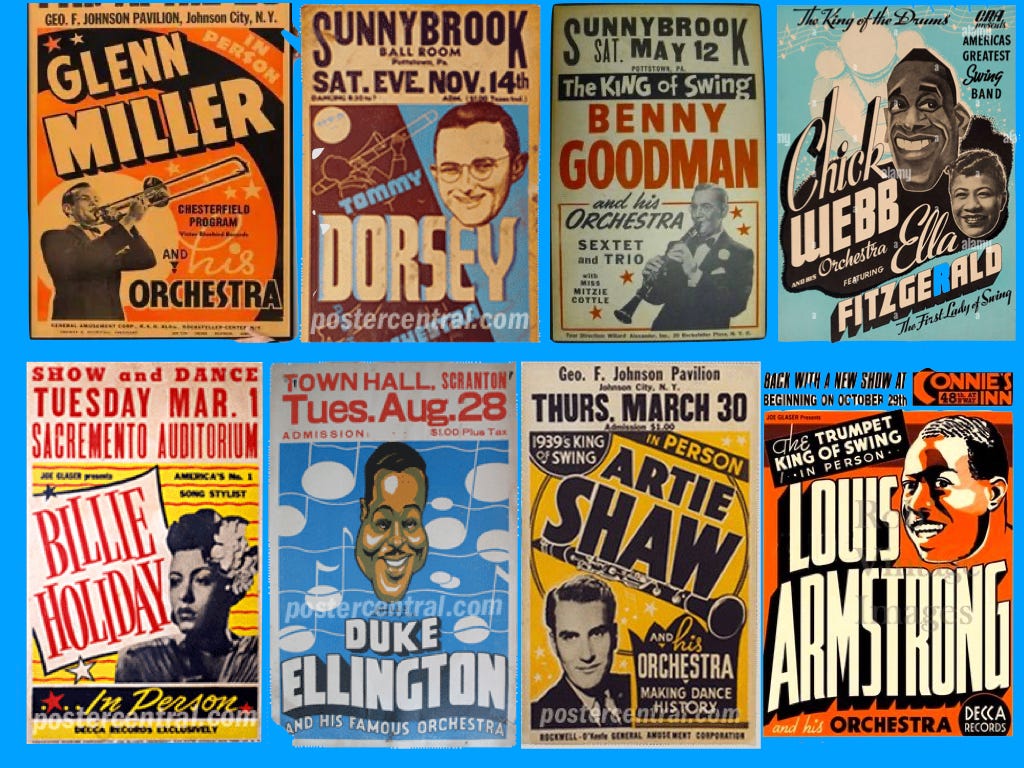
When my father talked about the concerts, I could imagine him as a young man and identify with the thrill he must have felt. When I lived in New York, I went to the Fillmore East to see my generation’s music performed by Elton John and the Allman Brothers and I have my own happy memories. But why am I listening to my father’s music and not my own at this stage of my life?
Well, it reflects just that— this stage of my life. If I were to try to dance to Jimi Hendrix’s Purple Haze, I’d risk turning purple. Give me Duke Ellington’s Mood Indigo instead. Yes, indigo is almost purple but I don’t worry about becoming a whiter shade of pale as I sit listening to it. So goodbye Procol Harum. Give me the big bands like Tommy Dorsey’s and Artie Shaw’s, singers like Frank Sinatra and Dinah Washington and pianists like Erroll Garner and Bill Evans.
I confess on occasion I’ll ask Siri to play Tom Petty and the Heartbreakers Runnin’ Down a Dream and give a push on the accelerator, but only if I’m alone in the car and nobody sees me gyrating. I think I still can rock— albeit it stiffly —to Marvin Gaye’s I Heard It Through the Grapevine, but I am way more inclined these days to nod serenely to Billy Strayhorn’s Take the ‘A’ Train.
Musicians themselves have had their own journeys to what became their style and sound. Benny Goodman and Paul Whiteman were both classically trained. Duke Ellington was influenced by European classical composers and I was surprised when one day I happened upon his symphony The River. Here’s my favorite part…
Duke Ellington- The River VIII
A musician’s evolution and a listener’s tastes certainly can be a journey. When my parents were growing up they had radios and phonographs to create their music libraries. We baby boomers moved from vinyl to CDs and now we stream. Anything we want to hear is available. Anybody’s musical preferences are a voice command or a click away. But it wasn’t that long ago we had quarters handy for jukeboxes that played our music.
I don’t remember the last time I even had any change in my pocket but when I did and pressed a letter and a number, I could fill a bar or a fraternity basement with Aretha Franklin and The Doors. Now, more people hear music through headphones which is not an experience shared with others. But that’s the B-side of this post to reflect on.
I think I’ve taken a long way around to offer you some selections of music I never paid much attention to when I was younger. My parents’ music is now my own and I hope you might enjoy these selections on this Valentine’s Day. No quarters necessary…
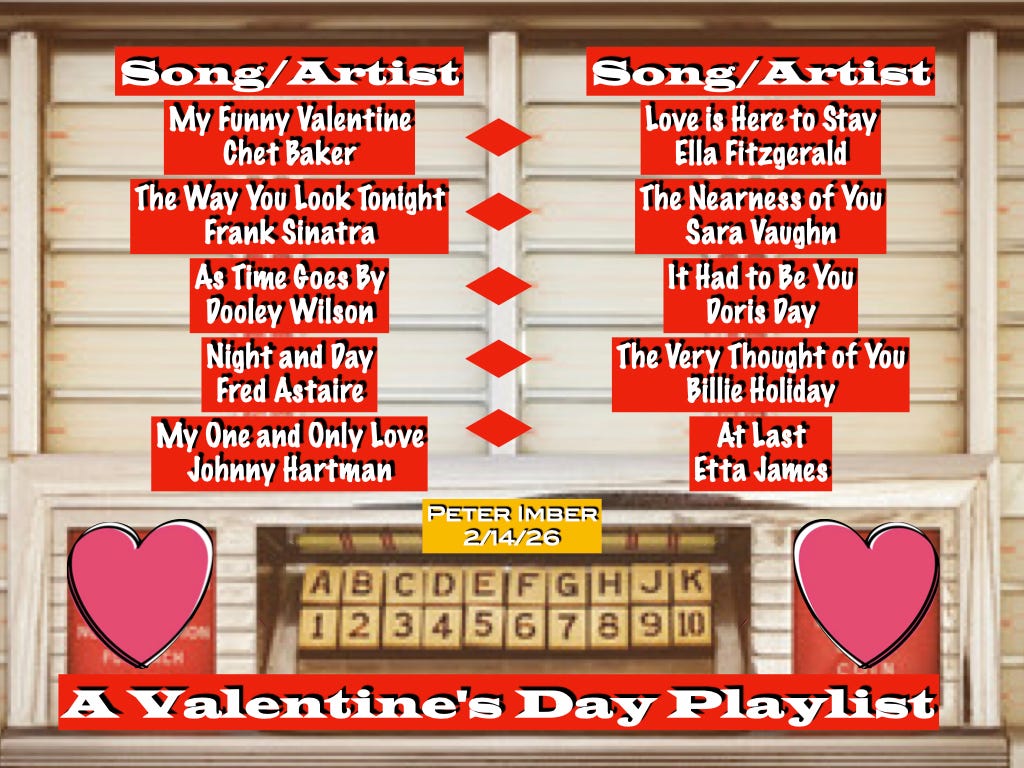
Click on a title below and then on the link that appears for the song you want to hear.
Unevenhandedness— On bring left handed
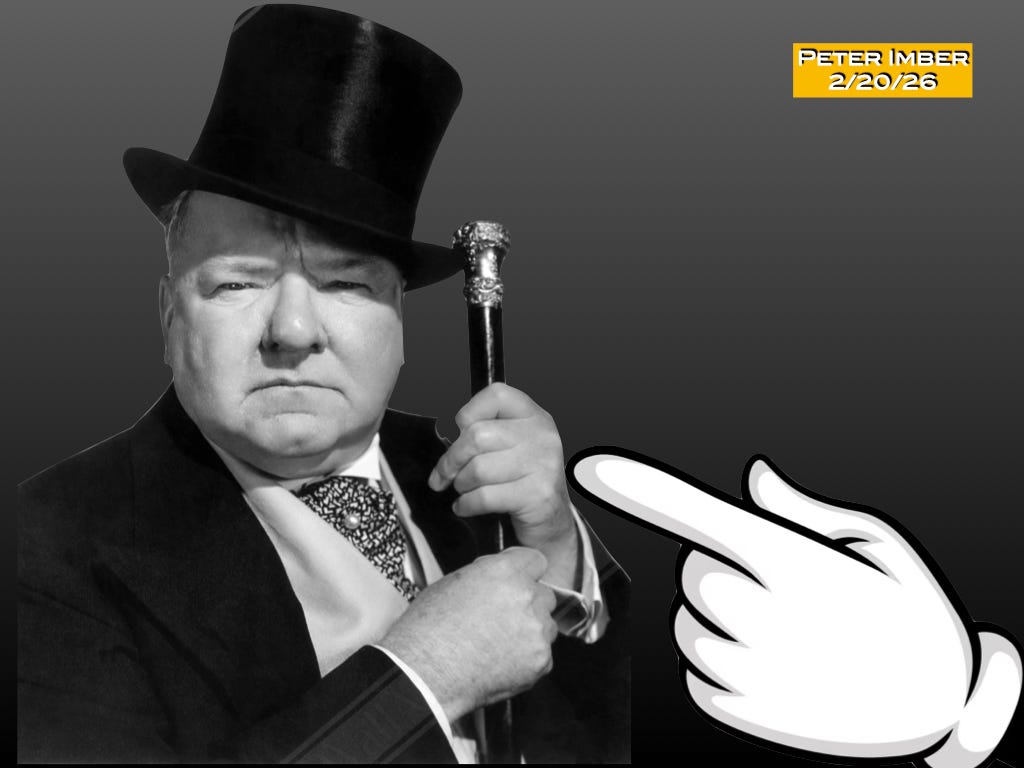
“If the left half of the brain controls the right half of the body, then only left-handed people are in their right mind.”—W.C. Fields
While it’s not true that W.C. Fields’ tombstone has the epitaph “I’d rather be here than in Philadelphia” chiseled on it, it is true that Fields was left handed and so am I. Therefore, according to Fields, we’re both in our right minds.
Since we left handers are the only ones who Fields believes actually may be, is this possibly an explanation for why the world is more often insane and has seldom been able to get its act together for more than fleeting periods of time? Currently and historically, just 10% of our species has been left handed. So let’s convert a whole bunch of right handers from the starboard to the port side. That could cure a lot of what ails us, right?
Ah, there’s the bias we left handers live with right there! In English we say RIGHT when something is correct and acceptable. RIGHT side up for instance. We say LEFT when something is bad or missing, like a LEFT handed compliment or I LEFT my heart in San Francisco (by the way Tony Bennett was left handed). Ok, maybe I’m stretching the point but I do want to talk about growing up left handed.
Take baseball, I love the game but as a kid because I threw left handed there were unwritten restrictions about which positions I could play on the field as shown in the cartoon below.
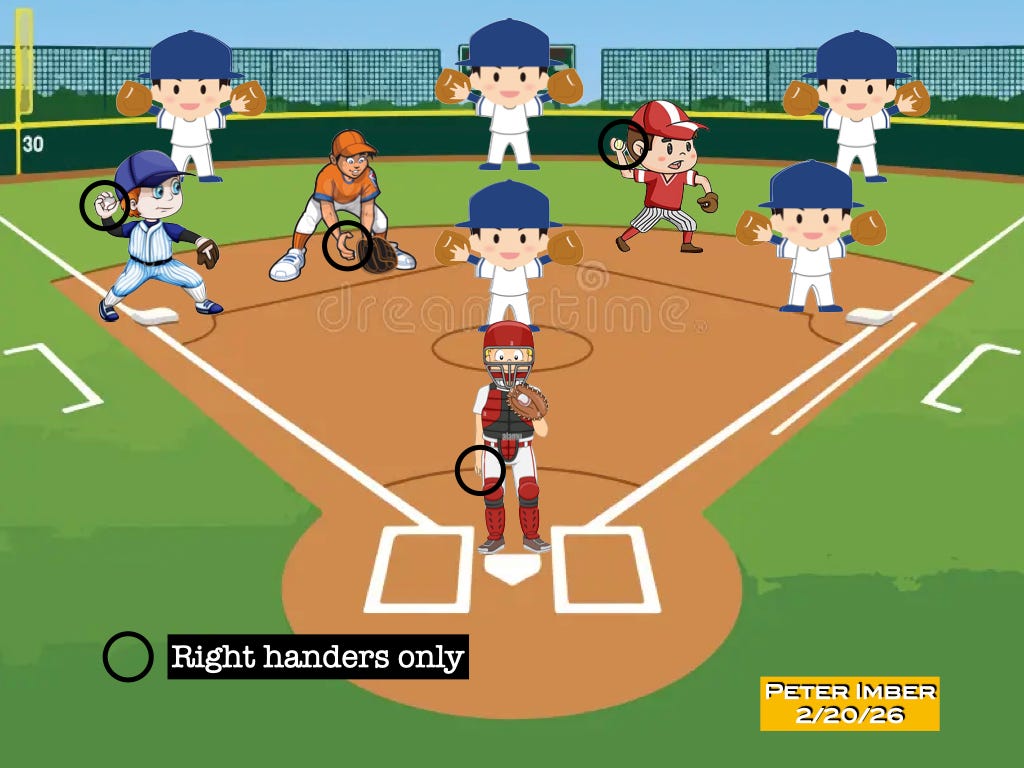
Left handers may have an edge when they bat— they’re a step closer to first base from home plate —but on the diamond players run counter-clockwise around the bases and there’s an advantage for the majority of the infielders and the pitcher and catcher to be able to throw the ball with their right hand and especially on plays at first base.
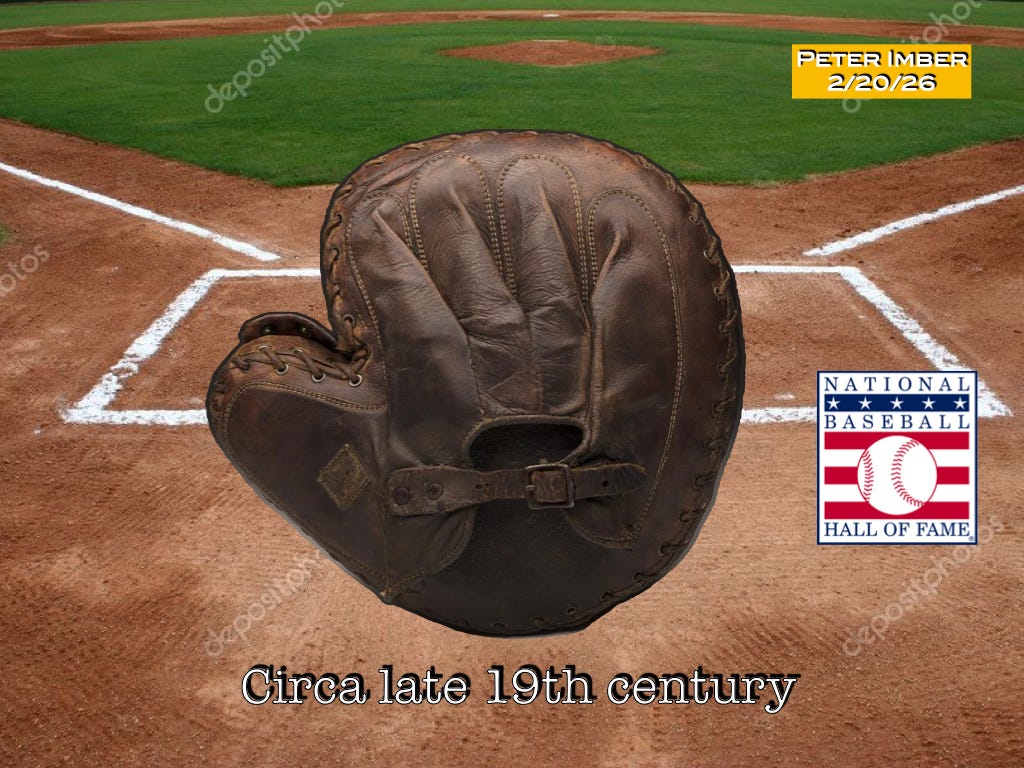
In fact there has not been a left handed catcher in the major leagues since 1889 and a glove for the left hand at that position is so rare there’s one on display in the Baseball Hall of Fame in Cooperstown…
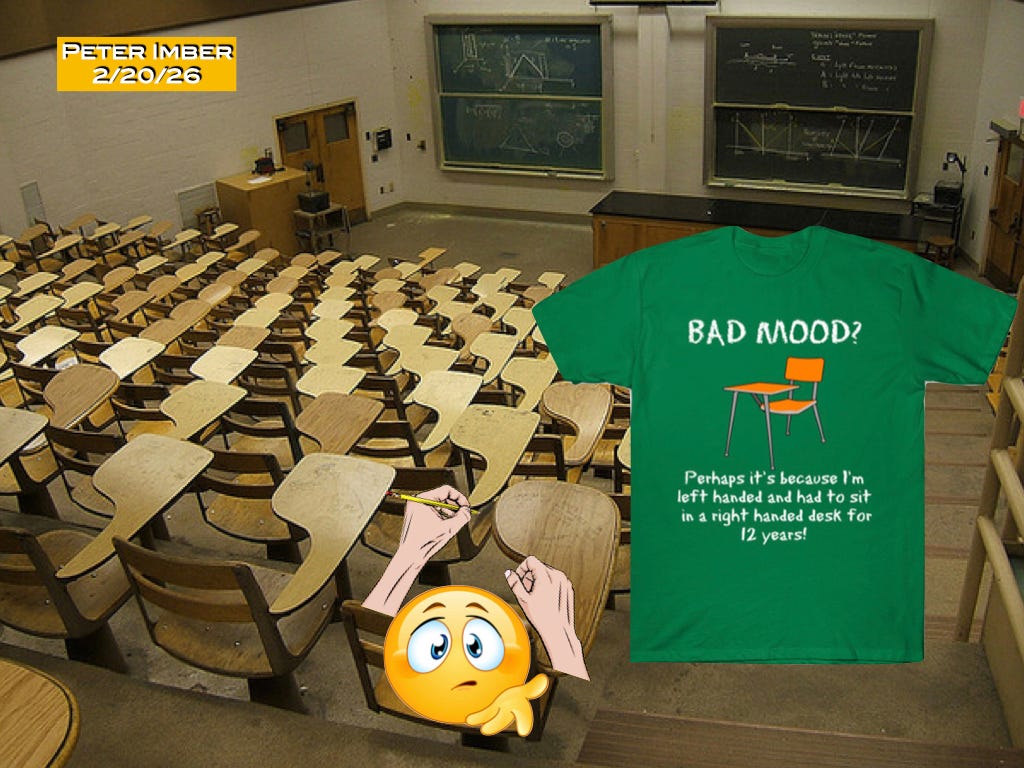
And then there were desks. Left handers from my generation sat at desks not designed for us during all our years in school. We awkwardly adjusted by twisting to the right in our seat and contorting our left arm across our bodies— I think it actually may have become a recognized yoga pose. It certainly was uncomfortable for me and in lecture halls in college I would try to commandeer two seats in hopes that someone would not occupy the one to my left so I could use its pull up arm’s surface to write on.
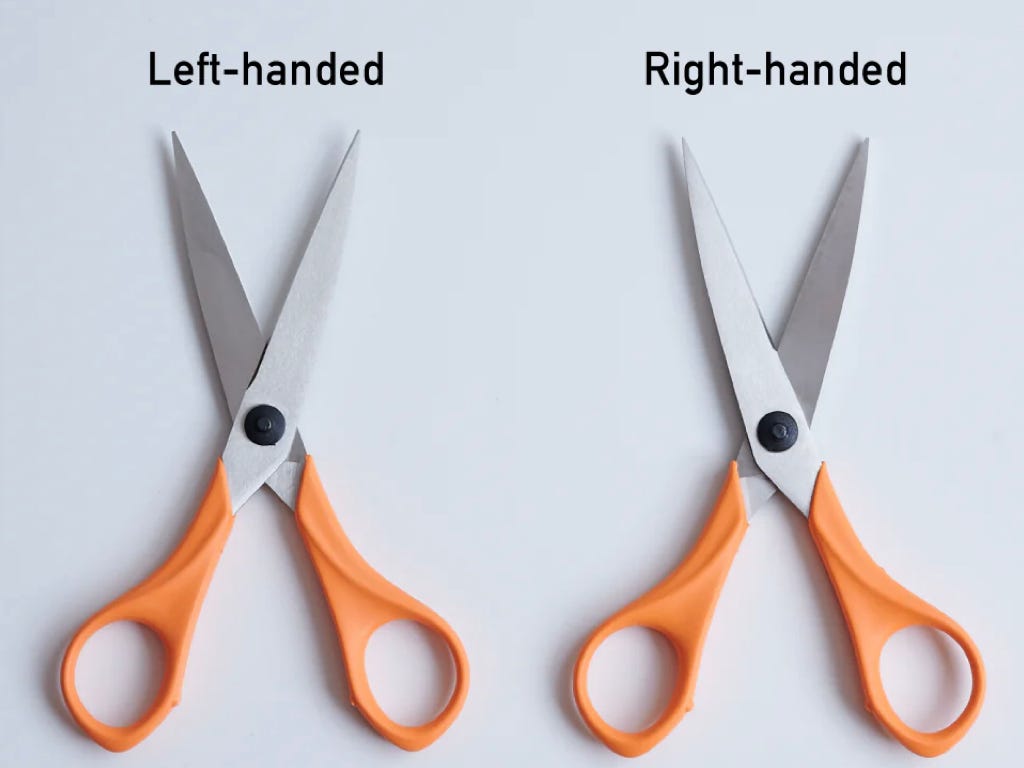
Admittedly, my handwriting is and always has been bad, I got C’s in penmanship that were understandable and C’s in art that were deflating. I blamed the tools and not myself for the latter. I wasn’t good at drawing or coloring or pasting. My first excuse is that scissors were made for right handers although in the 1950s nobody pointed this out or perhaps even realized it. I didn’t. Left handed scissors now exist but by the time they became available I had already graduated.
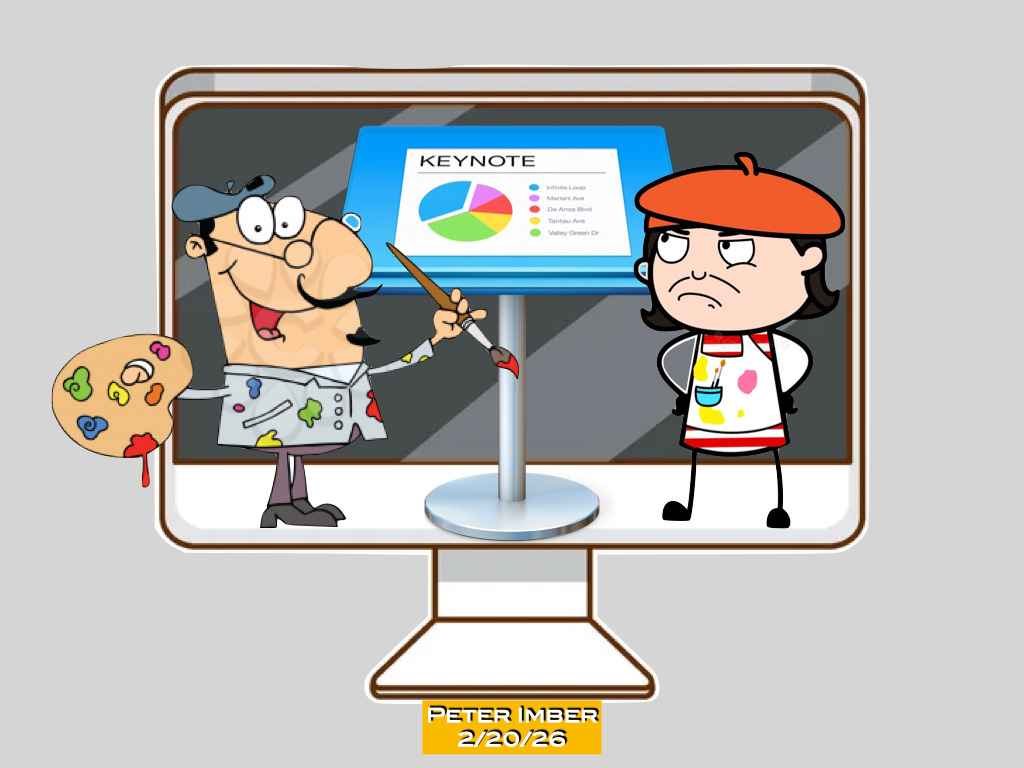
What about other tools? Sure, I know crayons and paste are ambidextrous but in terms of innate ability I can’t draw even a stick figure that doesn’t look like it has scoliosis. So how did someone with so little apparent artistic ability start creating cartoons in 2020 and share many hundreds of them since then? Short answer: The internet, where I can find imagery and use an Apple software app called Keynote with which even I can transform ideas into cartoons. I seriously can’t draw but today if you have a computer, I believe anybody has the means to create what they imagine.
As much as I love music, I showed little interest in art growing up and I regret not taking an art history course in college. The introductory one at mine required recognizing every work pictured in the 572 pages of Janson’s History of Art. I guess I felt that challenge was the ART of the NO deal for me at the time.
Eventually, I came to my senses on a trip to Europe where I binged on the art I had never before paid attention to. The paintings in Vienna of Pieter Bruegel the Elder, Egon Schiele and Gustav Klimt; the Van Goghs and Vermeers in Amsterdam; the Picassos in Paris.
In time I even discovered that artists whom I admired were left handed including Paul Klee, M.C. Escher, and Toulouse-Lautrec. Among the living, both cartoonist Robert Crumb of Zap Comix fame and animator Matt Groening, the creator of The Simpsons are and for good measure Jimi Hendrix and Paul McCartney were and are left handed guitar players.
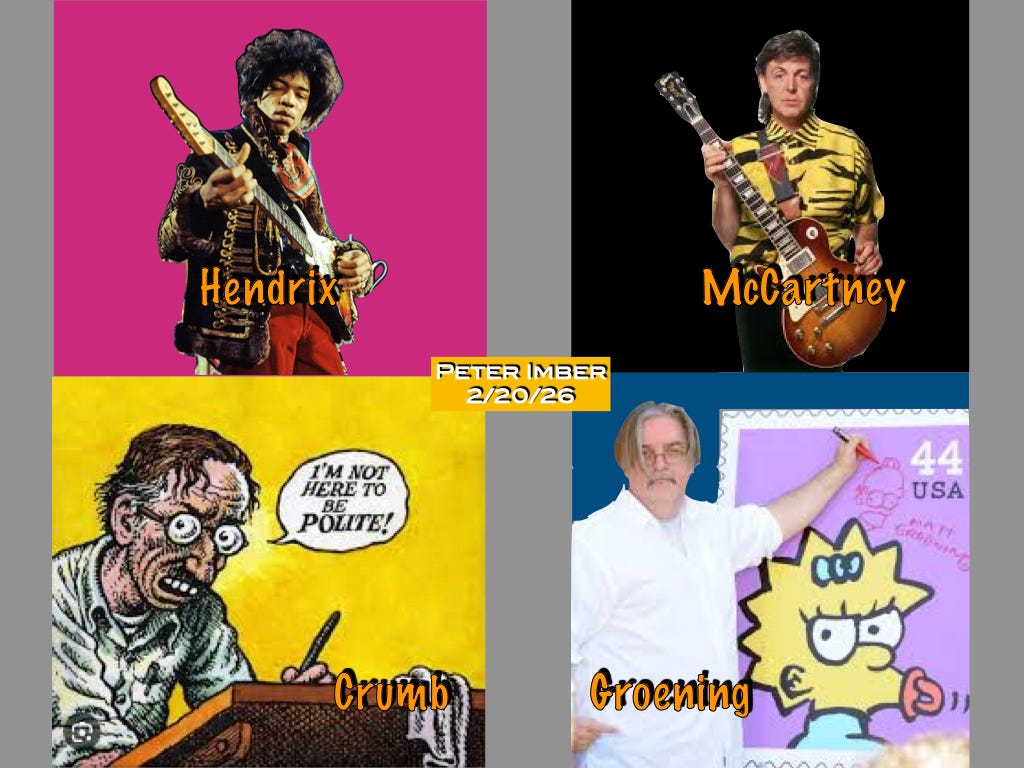
Jo is also left handed and while I know when I write anything down the odds are that I won’t be able read it later, she has the best handwriting for any left hander I know. She’s proof that we’re not all functionally illegible.
Right handers probably never think about this but with both Jo and I being left handed we can sit beside each other at any table without elbowing one another and if we are separately on the left end of the left side of a table, we won’t be elbowing anyone else either.
Actually, left handers have come a long way. Look at the things we didn’t even realize were not designed for us but are now available if we want them…
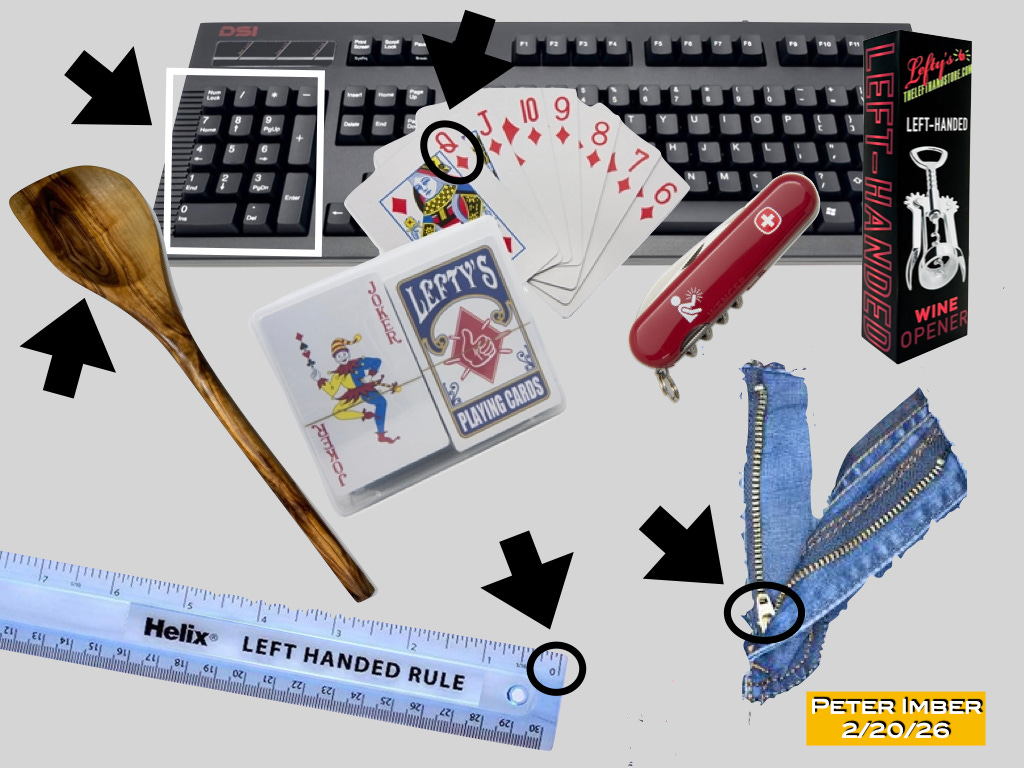
Hey, trying zipping your fly with your left hand sometime.
My father, like others of his generation was subjected to “forced handedness” and made to switch from writing with his left hand to his right when he began school. In the 1950s I may have been one of the few left handers attending my own but by then lefties were left alone and it didn’t cross my mind as I crossed my t’s that I belonged to only 10% of humanity.
While we still are only that one-tenth of the world, today I think we may have reached the point of over compensation on our behalf. There are now right and left handed crayons!
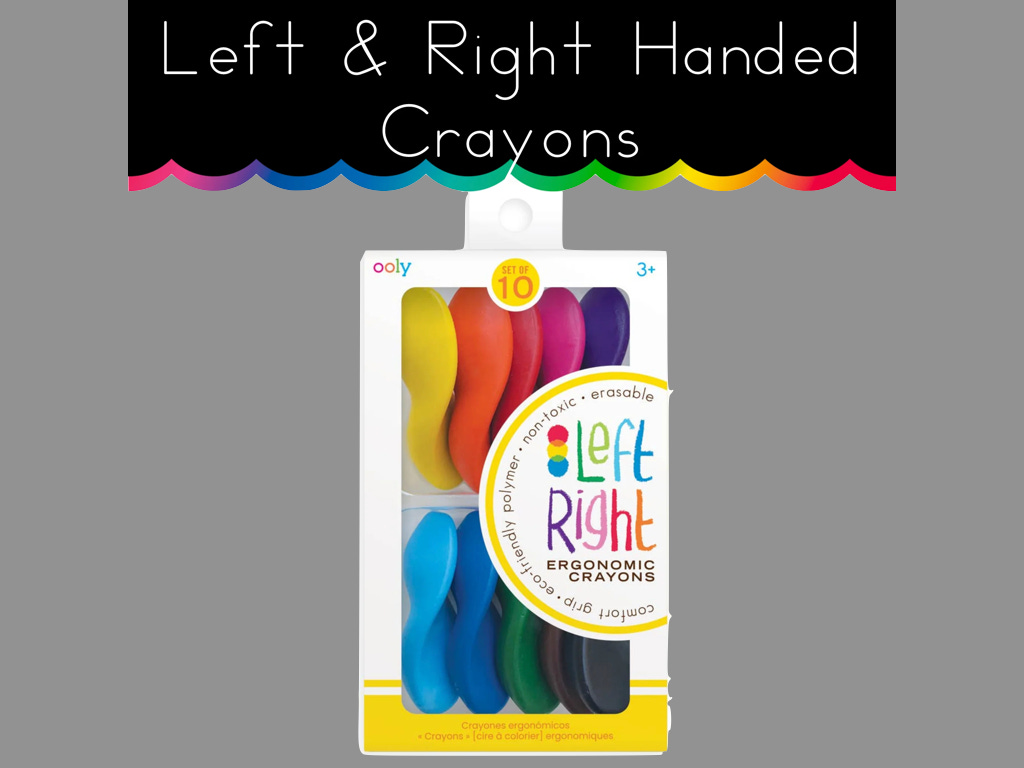
If the scissors and the crayons made for left handers existed when I was in elementary school would it have mattered? Would I be able to draw today? Really?
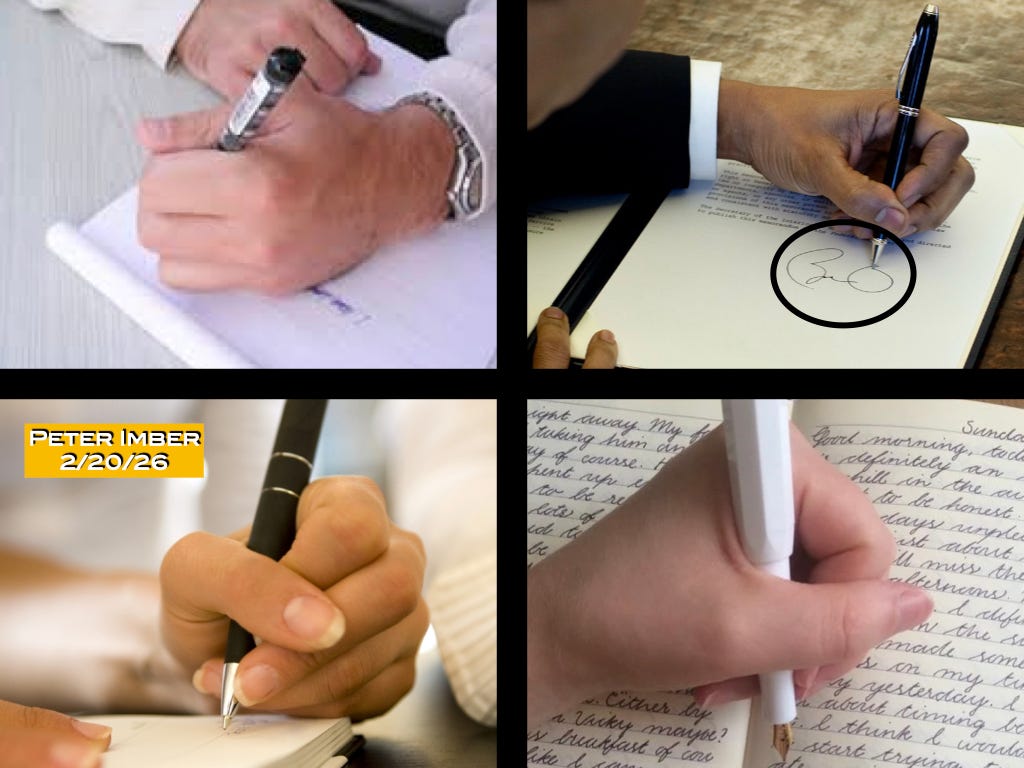
I’ve figured out at least one thing I think I have in common with all the accomplished left handers who can draw. We lefties often grasp our writing instruments as if we’re choking them…
Things Aren’t What They Used To Be
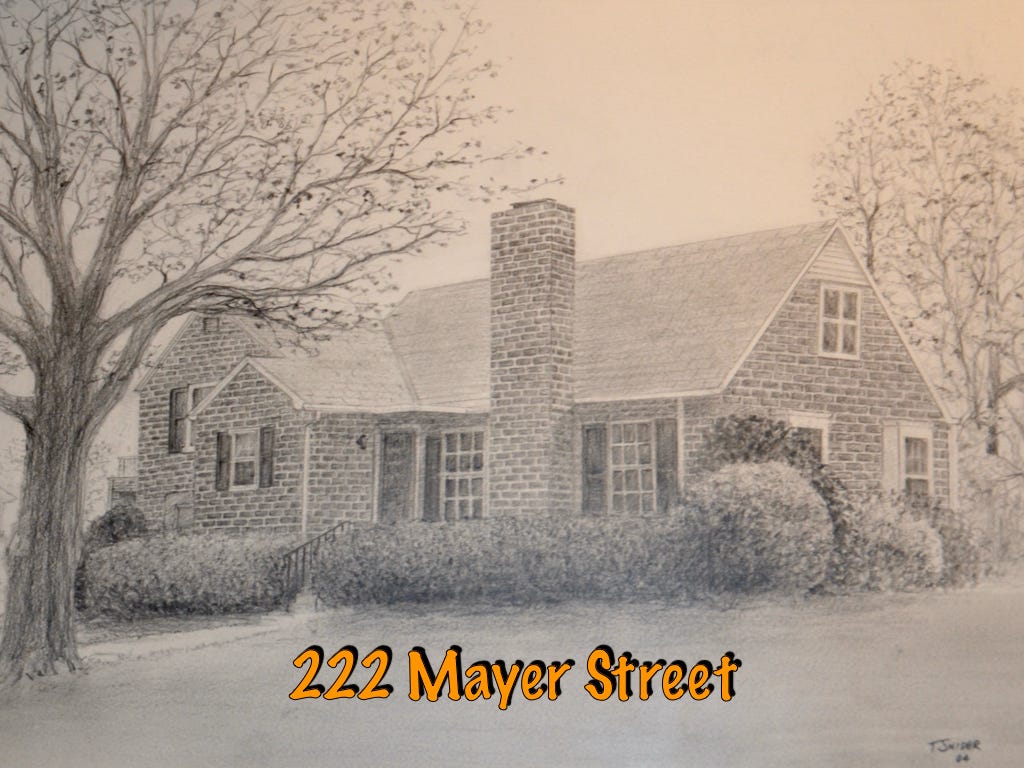
When I took Jo to visit the house where I grew up, the woman who resided there was nice enough to let us inside. In the living room, hanging above where a mahogany Magnavox radio and phonograph console once stood was a framed pencil drawing of the exterior of the house.
It was well done and I asked who had created it. When I learned it was the woman’s brother, I commissioned him to do another for me and gave him one instruction…
Me: “There’s one thing I’d like you to change. On the outside of the second floor window on the right side of the house you drew an air conditioner. That was my parents’ bedroom and they didn’t have an air conditioner when I was growing up.”
My intent all along was to present the drawing to my parents and when I did…
Me: “You know I had to have the fellow who did the drawing change one thing from his.”
My mother: “What was that?”
Me: “I told him that when we lived in the house, you and Dad didn’t have an air conditioner.”
My mother’s eyes widened and she pursed her lips before telling me…
“Peter, we had an air conditioner for our bedroom. You and your brother didn’t.”
Sometimes things aren’t the same because they never were but 99.9% of the time…
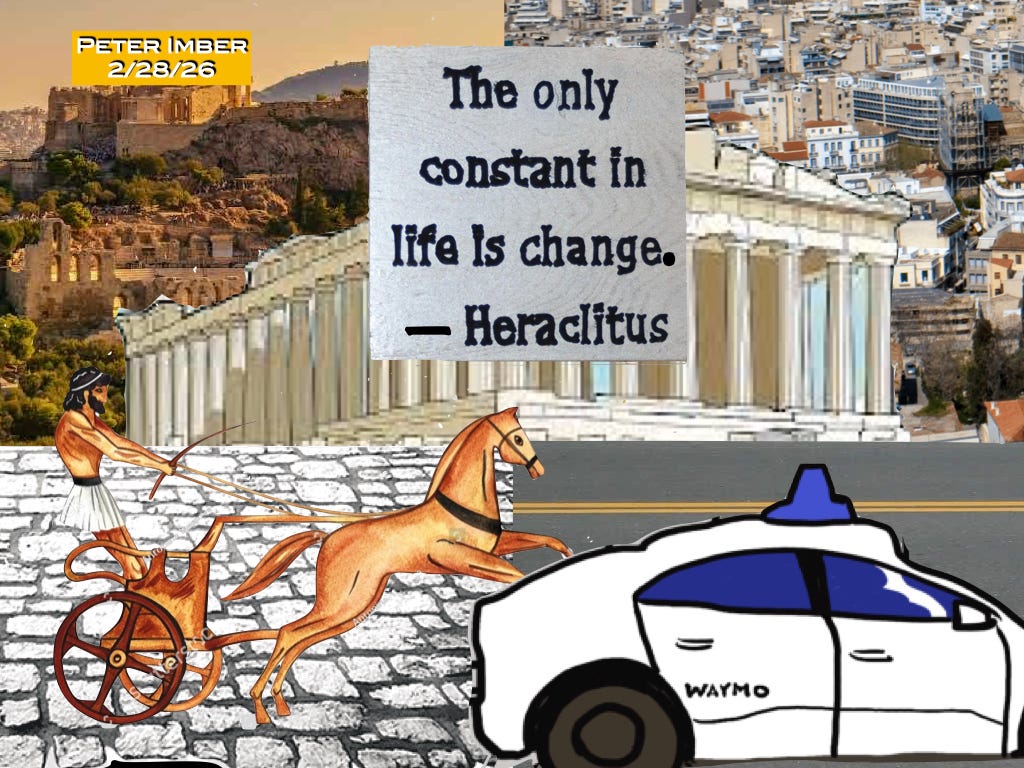
I guess at this point it’s more likely I’ll ride in a driverless car than I ever will in a chariot. And if I were asked to make a list of everything that I’m aware of that has changed in my lifetime, I’d probably need a few days to compile it and it would no doubt be outdated as soon as I finished.
That Magnavox console? I’ve saved some albums for their cover art but I don’t own a phonograph to play the records inside the sleeves. I gave away my beautiful Olivetti typewriter. I’ve forgotten how to use a slide rule. In the attic I still have my family’s 8mm movie camera but none of the reels of film my father shot with it.
I do not possess a rotary dial telephone and when my fingers “do the walking” I use a keyboard and not the yellow pages. I have a VCR and a CD player stashed somewhere as well as a bunch of paper maps in a box but not in our cars’ glove compartments. I no longer reach in the refrigerator for milk in a glass bottle, or fetch newspapers thrown by the front door…
Do I miss any of these things? Maybe, but I would be an ingrate to complain. As a group we boomers have had a journey through life that I only wish we could bequeath to those who will be here when we’re gone.
Jo and I have asked ourselves if we were offered the opportunity to be living in the 1950s again, would we want to? It’s tempting but hey, I wouldn’t be writing so easily with a computer and sharing my thoughts with you using the internet, let alone likely alive without the drugs and procedures that have put me in remission from a cancer that was less treatable in the past.
Not all change is for the better of course and I’ve found there’s change that, although not consequential in the ever expanding array of things I worry about, is just plain irritating. Take paper bags. They used to be stronger. Now they tear easily.
Am I imagining this? Ok, but then there’s plastic and I’m not imagining how much I’m often annoyed by it; how much I sometimes struggle with container lids and especially shrink wrap and fear I might end up in the ER when I take out a steak knife to liberate whatever it has imprisoned. If water is the enemy of architects, then plastic has assumed a spot right up there and become my own.

Oh, and TV remotes! They certainly used to be more user friendly. I have one that was made for the fingers of a two-year-old and is totally black. I like to watch television in the DARK! I can’t use this remote without a flashlight and my glasses. Do the Chinese hate us this much?

Little stuff can get me nostalgic for a time when I could count the number of dials on a TV on the fingers of one hand.
But here’s a change I discovered that is curious and seemingly paradoxical. In 1960 the average size of a house in America was 1,289 sq. ft. Today, the average house is 2,170 sq. ft. and cars in 1960 were an average length over 17 feet and now are on average less than 15 feet long. Undoubtedly, most of us have more stuff today but less room in our cars if we ever want to put that stuff in them.

So why did houses get bigger and cars get smaller? After WWII, returning GIs wanted homes to raise their families. Demand surged. More houses could fit on suburban tract developments and could be constructed more quickly if they were nearly identical and smaller.
As Americans prospered and earned rising incomes, many desired more space in their homes— extra bathrooms and separate bedrooms for their kids. Compared to today, I grew up in a house with way fewer appliances and possessions. So, is it really a surprise that the size of the average American home is twice as large as it was in the 1950s?
The production of smaller cars on the other hand was a reaction to Americans’ desire to spend less money rather than a willingness to spend more. I’m old enough to remember when a gallon of gas was less than a quarter in the 1950s. Adjusted for inflation that gallon would cost $3.37 now.
Gas prices held steady with inflation into the 1960s but a small fuel-efficient foreign import achieved widespread popularity and became the forerunner of things to come for the American automotive industry. I learned to drive a stickshift borrowing a friend’s Volkswagen Beetle. Click on the link below to see a VW television commercial from that time. It makes my point and is a Madison Avenue masterpiece…
And then came the Arab oil embargo in the 1970s when gas prices skyrocketed and the demise of the “gas guzzler” sent them to the junkyard. The Beetle was joined by the likes of the Honda Civic and the Toyota Corolla and American automakers shifted to smaller, more miles per gallon models as well. I don’t believe Detroit has ever really recovered.
Even change is changing. The Lincoln penny was recently beheaded. For a brief time during WWII Honest Abe was a man of steel. To save copper for military uses, steel pennies were temporarily made in 1943. We still think of pennies as being made of copper but every single one produced since 1982 is 98% zinc and eventually cost almost 4 cents to mint. Ending the manufacturing of the penny and becoming one centless made sense.
Nobody is sure how many billions of pennies are out there and orphaned now. I considered gathering all of them that might be lying around our house and putting them in wrappers to take to the bank. I’m not doing it. The cheapest wrapper— $1.35 — surely costs more than any pennies I can find under our sofa cushions or likely in my entire neighborhood.
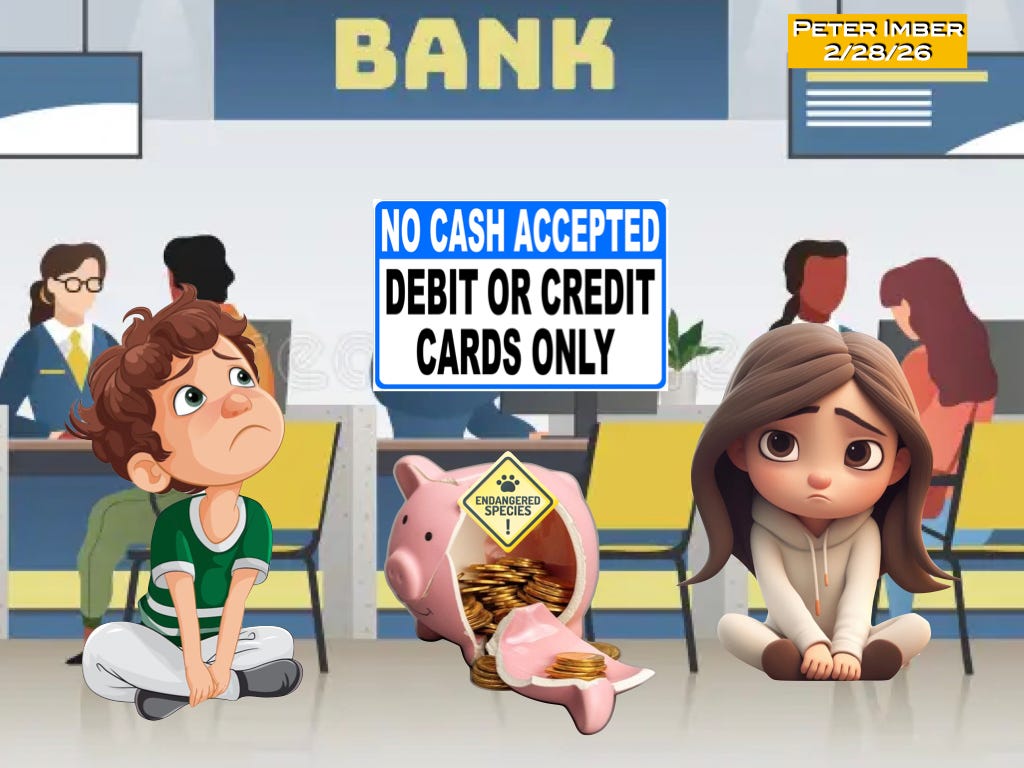
Yes, my Olivetti typewriter and slide rule are obsolete. And goodbye slide projectors, transistor radios and encyclopedias. You know, I still have Jiminy Cricket help me spell that last one. He is singing inside my head every time— E-N-C-Y-C-L-O-P-E-D-I-A!
Hey, Jiminy I’m happy to know you’re still around but maybe you haven’t been paying attention! Google and now AI have replaced the encyclopedia and piggy banks are an endangered species. Oh! I see, you’ve already adapted…

But just for old times’ sake, chirp it Cricket…
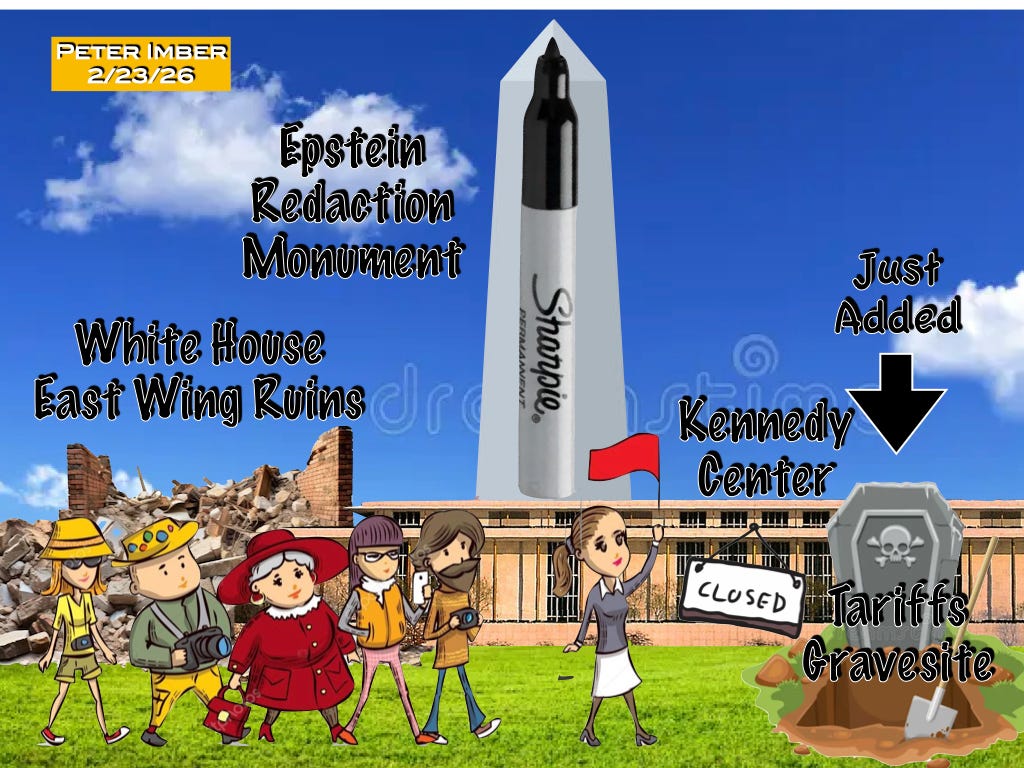
SCOTUS Puts POTUS On Notice
The Reckoning
Supreme Court rules 6 to 3 that Trump’s tariffs were illegal.

The Reaction
“Mr. Trump doubtless won’t offer one (an apology), but his rant in response to his tariff defeat at the Court was arguably the worst moment of his Presidency.” —The Wall Street Journal in an editorial

The Remedy
More than $175 billion in U.S. tariffs collected are subject to potential refunds.

The Reality
Trump’s Maniacal Misery Tour has 1,061 days left until January 20, 2029.
 pawnedaccordion