


Why now, did I remember this? In 1955 I was in third grade and a Brooklyn Dodgers fan. One afternoon that fall a teacher at our four classroom schoolhouse came running out onto the playground yelling…
“The Dodgers won the Series!”
She was a fan of the team like I was and 1955 was the first World Series Brooklyn had ever won after losing seven, five of which were to the New York Yankees.
I can’t explain why one memory remains more vivid than another, especially if they are not traumatic. I wonder in the future if and when A.I. becomes able to perceive and feel things if it will also have inexplicable random memories?
I carry around a bunch of mine of course and some are connected to my career and soundbites from news stories I did a long time ago. Two have surfaced this past week because of current news events.
One was back in 1988 and involved the spotted owl which was endangered then and still is today and the couple of sentences from a conservationist fighting to save the owl were perhaps the most trenchant I ever heard while on the job…
“Environmentalists are like mizers.
We’re hard to live with but we make great ancestors.”
The second occurred on the day that O.J. Simpson was found not guilty of murdering his ex-wife and her friend in 1995. Despite damning evidence and a feeble alibi, the handling of the case by the LAPD, the district attorney and the prosecutorial team was badly bungled and the jury, half of whom were Black, acquitted Simpson.
Los Angeles was profoundly divided by the outcome. While the city’s White population was shocked, many of its Black citizens saw the verdict as retribution– pay back for their own life experiences.
As a producer for ABC News assigned to cover the story and trial for over a year, I was not surprised and all but certain Simpson would not be convicted. On the day that happened one woman summed it up for me with a soundbite in the piece I produced on the city’s reaction…
“We told you. Don’t say we didn’t tell you!”
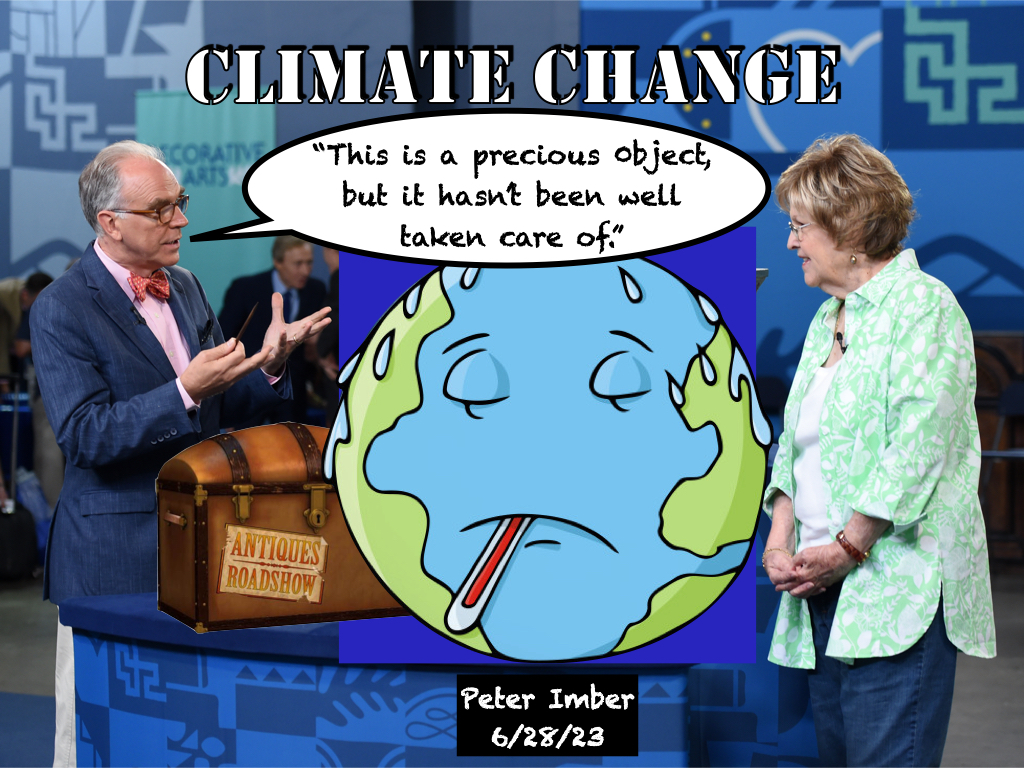
Maybe my trip down soundbite memory lane doesn’t fit that well with the two cartoons and the events that occured this week in California and Arizona that triggered their recollection but we have been warned. The increasing examples of the impact of climate change are here and dramatically real.
State Farm is cutting off the issuance of new homeowner policies in California and perhaps made that decision after learning of a study that predicts it would be possible for a catastrophic fire there to burn down 50,000 homes in one night.
Phoenix is one of the most rapidly expanding metropolitan areas in the United states. Drought there has persisted for well over a decade. For a long time the Southwest has been living on borrowed water from the Colorado River. Now, unless it can put the brakes on growth and succeed at implementing conservation it may soon be living on trucked in bottled water.
I’m lucky we live here in Maine where we still have plenty of water and Smokey Bear might even qualify for unemployment. But it doesn’t mean we have nothing to worry about. And it doesn’t seem to me we’re really listening to the mizer-environmentalists either. Our ancestors may most likely not think of us as great.
—————–


Before Arnold Palmer and Jack Nicklaus, before Tiger Woods there was a golfer just as equally revered and famously taciturn. His name was Ben Hogan and when asked by amateurs and fellow professionals alike the secret to how he managed to become one of the greatest strikers of a golf ball ever, his response is legendary.
Said Hogan, “The answer is in the dirt.” By which he meant that to perfect his skills and achieve his goals he practiced so much and hit so many golf balls that his hands would bleed.
Needless to say the announcement yesterday by the Professional Golf Association of America– the PGA –and the upstart and Saudi backed golf tour– LIV –that they intend to merge was stunning but let me sum up my opinion of how and why this happened by simply quoting Hogan. Yes, I think the answer is in the dirt.
Let’s call it a tale of two deserts.
I’ll start in the Arabian. I just looked it up and ironically, a barrel of crude oil today is priced at $72. That’s equal to a score of par at the majority of golf courses around the world and is the par at Royal Greens Golf and Country Club near Jeddah, considered the best course in Saudi Arabia.
Saudi oil wealth built this course and a dozen others in recent years in one of the most water stressed countries in the world and one of the least likely one might think to embrace arguably the most water dependent sport on earth.
The Saudis may produce only 12% of the world’s oil supply but had a net income of over $160 billion USD in 2022 and claimed it to be the largest profit ever recorded in corporate history.
When you have a commodity the world needs and depends on for energy and fuel and other essentials like plastics it explains how Saudi Arabia can afford to build and buy almost anything it wants from lavishing hundreds of millions of dollars on professional golfers and soccer players to nearly a half billion more for a single painting by Leonardo da Vinci.
The second desert is California’s Mojave. It too has commodities it pulls out of the ground. Borax is one of them and beyond being a bleach in laundry soap it has other applications from strengthening fiberglass to preserving fresh flowers.
If you were a kid like me growing up in the 1950s, you likely remember a television show called Death Valley Days. It aired for nearly 20 years and over 450 episodes. Ronald Reagan only hosted 21 of them but his commercials for Boraxo were all I knew about him before he became a politician. Here’s a link to one he did with his daughter Patti…
It certainly sounds like borax is valuable and about one third of the world’s known source of it along with boron is mined in California’s Mojave. But it’s worth a pittance compared to oil. Last year America’s share of the borax global market amounted to just over $350 million USD. I don’t know how much of that was profit but even if all of it was, that figure is way less than even 1% of what Saudi Arabia made from its oil exports.
Years ago Jo and I drove the back roads in the Mojave and came upon the town of Trona. It was one of the more desolate places I’ve ever seen. It was so dry and so poor that we learned that the high school football team played on a dirt field since the town couldn’t afford the cost of irrigating one with grass.
Being a golfer I discovered that despite the barren landscape there was actually a golf course in Trona. Its fairways were the desert floor and its greens were shaped from sand that had been rolled smooth but required raking after you walked on them. I didn’t have my golf clubs with me so I didn’t play which would have cost $5 to be deposited in a metal box that had posted on it “Beware of Rattlesnakes.”
I just tried to book a tee time at the Royal Greens Golf and Country Club in Saudi Arabia and got back a message that no times are available but I’m sure it would cost more to play than Trona and rattlesnakes wouldn’t have been a concern. That’s OK. I can’t see I’d ever make it my dream to play either golf course but both seem to have been created on similar terrain in a similar environment.
You would be accurate to claim that the PGA’s pivot from adversary to partner with the Saudis is all about money but I wonder about this. If pipelines like those in the Arabian desert had been flowing with oil in the Mojave instead of mules trudging there weighted down with borax, would that golf course in Trona today have been as green as St. Andrews in Scotland? You’ve probably already guessed the answer. Yes, it’s what Ben Hogan said, it’s what was below and in the dirt of both deserts that created the disparities in wealth and in golf courses.
In the past year Saudi Arabia’s oil had already bought dozens of professional players for their new golf venture, some of whom are among the world’s best. Now, it appears the Saudis may have bought professional golf in its entirety.
Golf is not the Boardwalk property in the game of Monopoly but the Saudis apparently now hold a Get Out of Jail Free card and have passed Go without even bothering to collect the $200. We shall see where the next roll of the dice lands.
—————–

“Minutes after former President Donald Trump announced that he was being indicted on federal charges, his 2024 campaign launched a new effort asking for donations to combat the ‘election interference.'” —Newsweek
“The poor folk came to me readily, because I never did them any unkindness: on the contrary, I loved to help them.” –St. Joan of Arc
—————–
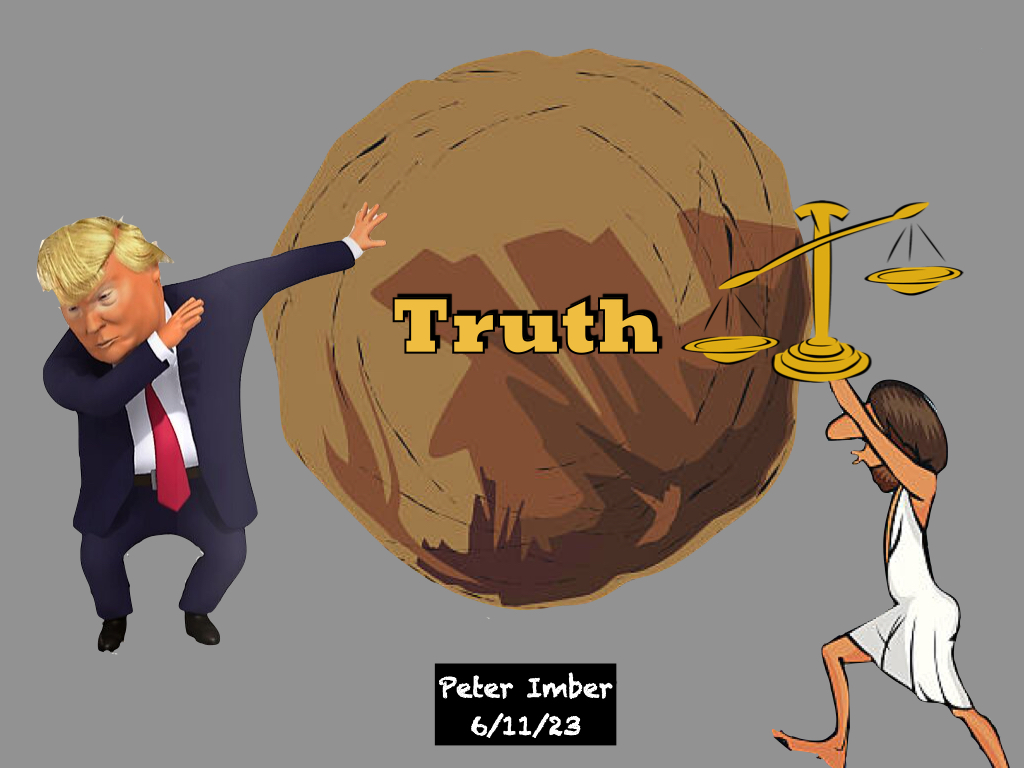
In a criminal trial in an American courtroom there are two sides– the prosecution and the defendant or defendants represented by their defense attorneys.
On an American football field there are two teams and at any point in a game one is on offense and one is on defense. One team is in possession of the ball with the opportunity to score points and the other has the task of trying to stop them.
If I compare Donald Trump’s latest indictment to a football game, he may technically be on defense but he’s using a playbook that has him running, passing and kicking the ball down the field.
In short the evidence of crimes committed by Trump that the prosecution has presented may be strong but Trump’s strategy and tactics will, if they have not already, keep America on the defensive for the foreseeable future.
I don’t often offer anything beyond my own cartoon and commentary but today I have read two articles that sum up the Trump “playbook” astutely and chillingly…
Using the Berlusconi-Netanyahu Playbook,
Trump Can Save Himself
Anshel Pfeffer in Haaretz
The only thing that matters to a political populist fighting an investigation and indictment is not the allegations, but how many people they can get to doubt those allegations and believe that the politician is the victim.
If you can convince enough on your side that it is all a witch-hunt, the court of public opinion will be stronger than the actual court system. They will force your own party to remain behind you. In Italy Silvio Berlusconi and in Israel Benjamin Netanyahu prove it can be done. And it’s much too early to bet that Trump will fail to do so too.
Netanyahu and Berlusconi also defied their indictments and despite them, both made it back to office. Netanyahu is once again Israel’s prime minister, despite multiple ongoing corruption cases against him in the Jerusalem District Court. Berlusconi holds a senate seat, is leader of a right-wing party and one of the kingmakers of Italian politics.
The idea that a damning indictment is a political death sentence belongs to a quaint era of gentler politics. Indictments and convictions are hardly an obstacle to a political comeback in today’s “developed democracies.” One can add to this list Argentina’s Cristina Fernández de Kirchner and Brazil’s Luiz Inácio Lula da Silva, both of whom returned to office despite criminal convictions.
Trump still has plenty of tricks he can use from the Bibi-Berlusconi playbook to stay in the game. He’s already playing them. And while each country’s political context is unique, the rules of facing down an indictment are the same. Here are the seven basic tactics for politicians determined to beat the prosecutors, all of which are already being used by Trump:
Cry Witch: The investigators and prosecutors assembling the case are no honest public servants but a cabal of politically motivated hacks, who together with political rivals and the hostile, lying media are engaged in a “witch-hunt” to subvert the will of the people.
Use the Accusations: Don’t try to play down the allegations against you. Repeat and ridicule them as proof of the lengths to which the dark powers of the deep-state are prepared to go to bring down the People’s Champion. Not everyone will believe you, but enough will to keep you in the running.
Defend Democracy: The only reason for the indictment is that those serving it know you can’t be beaten at the ballot box (for this some creative interpretation of election results is necessary) and therefore they are trying to use non-democratic means to deprive the people of their true choice.
Selective Enforcement: To prove your case, dredge up and inflate seemingly similar allegations against rival politicians to show they were let off the hook by the corrupt prosecutors and media.
True Leader: To solidify your base and discourage potential challengers, build a narrative to the effect that your political camp has no other serious leader who could win the election and therefore an indictment for personal wrongdoing is actually an assault on the “majority” of the population who share your political beliefs. This is often the most crucial step. Netanyahu succeeded in cowing any leadership rival within his own Likud party. Boris Johnson, the former British prime minister, played by all these rules but lost the support of the Conservatives and couldn’t go on.
Play for Time: Indictments are always damning when they come out but as time passes, many citizens grow bored and tired of hearing the details. Fighting every step of the way in the legal process promotes the feeling that you are being prosecuted for inconsequential trivialities and that it is all a waste of time and public resources.
Never Give an Inch: Resigning until the full truth comes out is for losers. So are plea bargains. Power can be used to intimidate prosecutors and subvert the process. Hold on to office no matter what and if you lose an election or are forced out, keep trying to come back.
Playing by those rules is what enabled Netanyahu and Berlusconi to come back again and again, and it is now Trump’s road map both to reelection and staying out of jail. The resignation statement made on Friday by Johnson, who is under investigation by a parliamentary committee for having lied in the House of Commons about his flouting of the COVID-19 social distancing laws, was another example from the same playbook.
Johnson made it clear in his statement that he was being forced to leave parliament “at least for now,” but that he was only doing so because he knew that he was about to be forced out by “a kangaroo court.” He is already launching his comeback campaign but having lost his party, taking back the country will be a lot more difficult.
The only thing that matters to a political populist fighting an investigation and indictment is not the allegations, but how many people they can get to doubt those allegations and believe that the politician is the victim.
If you can convince enough on your side that it is all a witch-hunt, the court of public opinion will be stronger than the actual court system. They will force your own party to remain behind you. Berlusconi and Bibi prove it can be done. And it’s much too early to bet that Trump will fail to do so too.
Trump’s Survive-the-Unsurvivable Plan
Alex Thompson in Axios
Never in the history of American politics has one man survived and even thrived off more terrible news than Donald Trump. The former president has racked up impeachments, investigations, and indictments at a pace never seen in America. Yet he persists — and often comes out stronger.
Trump’s had a lot of practice at surviving the unsurvivable. So his team has developed a playbook to repeat during bad news…
- Pre-release: Trump will preempt any damaging announcement by releasing new information himself beforehand to try to blunt the impact of coming revelations.
- Whataboutism: Trump will try to muddy the waters by pointing to any mistakes — real, exaggerated, or false — by his opponents.
- Martyrdom: He will tell his supporters that any allegations against him are part of a larger conspiracy against his cause to fight the establishment.
- Solidarity: Even before all the facts are known, Trump has his allies hit the airwaves to claim that he is innocent or his enemies are corrupt.
- Shamelessness: Trump never hides or acts embarrassed, even in the face of damning information.
- Flood the zone online: Trump’s team prepares large volumes of content ahead of time to pump out on social media.
- Raise big money: Never waste a chance to raise money — especially if the Justice Department indicts him for obstruction and mishandling classified materials.
- Go apocalyptic: “In the end, they’re not coming after me, they’re coming after you — and I’m just standing in their way,” Trump said Saturday at a rally in Columbus, Ga., his first appearance since the Florida indictment. He also said: “This is the final battle.”
Trump is the first president in U.S. history to be impeached twice. He’s now the only former president to be indicted on federal charges. He may be indicted even twice more — for his part in efforts to overturn his election loss in 2020.
In Camden, Maine today the sun is shining after a stretch of gloomy weather. If it is also a nice day where you are, enjoy it. I fear stormy times ahead.
—————–

Question– What has a shorter shelf life: a banana or a strawberry?
Answer– The news.
Donald Trump was arraigned again yesterday and this time on charges that if convicted, usually send the accused to prison– a historic/horrific first for a former president of the United States. And I think it will be old news before the bunch of bananas and the carton of strawberries sitting in our kitchen rot.
Last week golf was big news. The agreement by the Professional Golfers’ Association of America to merge/be bankrolled by Saudi Arabia caught the sports world as well as those who play the game for a living by surprise. But this week the U.S. Open– one of the four so-called “major” golf tournaments –is being played in Los Angeles and whatever controversy and discussion surrounding the new deal will most likely be tiptoed past by commentators and hardly on the minds of spectators in the galleries on the course or television viewers watching at home.
I guess it’s human nature. We move on and in the world we have created for ourselves everything seems to have speeded up because there is so much news and such easy access to all of it and an unceasing bombardment of it that’s tough to avoid. Our brains may not be mush at this point but maybe they are becoming like bananas and strawberries.
However, let me drill down literally on the venue for this week’s golf tournament, the Los Angeles Country Club. I say literally because there is a subterranean LA that you may be surprised to know that has nothing to do with LA’s often trend setting underground culture– nothing to do with music or clothing or cuisine.
The Los Angeles area has nearly 4,000 derricks extracting oil from over 50 oil fields. Some are visible and some are incognito– hidden in buildings and backyards. Members at two golf courses– Rancho Park and Hillcrest –not far from the Los Angeles CC, at one time shared the royalties from oil revenue produced under the turf they played on.
I don’t know if the ground beneath the fairways and greens at the LACC flows with Black Gold but I do know that the property– the land itself –has been appraised at upwards of $3 billion to $20 billion. That’s a huge range but let’s take the lower estimate. How much do you think the Los Angeles Country Club pays annually in property tax? If I told you $200,000 are you surprised? That amount hasn’t changed since 1978 and that’s because of a California law called Proposition 13, Bob Hope and the club’s members not dying fast enough. Yes, all three!
Here in Maine Jo and I pay an annual tax of over 1% of our property’s assessed worth. If the Los Angeles Country Club was paying at the same rate for the lowest estimate of its land’s value, their bill would be $30 million.
If you have a half hour and want to find out how this is possible and want the whole story including Bob Hope and the mortality rate of the LACC’s members, please click on the link below and listen to an episode of Malcolm Gladwell’s podcast Revisionist History.
But while I’m taking jabs at wealthy private golf clubs in general and the LACC in particular I have two more stories– one I know to have happened, the other is allegedly true –and both are why Esther Williams and Victor Mature are standing tall in today’s cartoon.
Esther Williams was the fastest female swimmer in America when she was a teenager who then became a movie star. Her films like Million Dollar Mermaid with choreography by Busby Berkeley popularized the sport of synchronized swimming.
In 1991 she was to be a guest of honor at a charity event at the Los Angeles Country Club and showed up wearing black silk pants and an Oscar de la Renta jacket. However, when she arrived she was ushered into a sideroom and instructed to change into one of the skirts the club had on hand for violators of its dress code for women.
The Country Club’s rule was that ladies had to wear dresses or skirts whether on the golf course or in the club house. Williams refused to change and left. I love the quote she gave to the LA Times afterward…
“I don’t think I would have been a movie star if I didn’t make waves, so to speak.”
Not so long ago the Los Angeles Country Club’s policy toward Jews and African-Americans was as discriminatory as its attitude about how women had to appear. It was only in the 1990s that the club accepted its first Jewish and Black members.
The ban back then extended to Hollywood types as well. Crooner Bing Crosby’s application to join was rebuffed and then there was Victor Mature. A member invited Mature to play golf at the height of his fame and when the actor inquired about membership this exchange supposedly took place…
Member: “Victor, I’m sorry but the club hasn’t ever accepted an actor as a member.”
Mature: “I’m not an actor and I’ve got 64 films to prove it.”
Fortunately, the players participating in the U.S. Open this week include many who just a few decades ago would not even have been permitted to set foot on the Los Angeles Country Club grounds. Nobody will even bring that up now I bet and that’s progress I guess.
—————–

To be sung to the tune of “I’ve Grown Accustomed to Her Face”…
I’ve grown accustomed to this cell
It almost makes me think I’ve sinned
I’ve grown accustomed to the fact
You never had my back
Your lies, your rants
Your golf shirts, the XXXL pants
Are dirty laundry to me now
Like grieving out and seething in.
I was politically independent and “hail fellow well met”
No way I’ll ever be that way again
And yet
I’ve grown accustomed to this cell
Accustomed to my fate
Accustomed way too late
*I’ve Grown Accustomed to Her Face is a song from the Broadway musical My Fair Lady. The music was composed by Frederick Loewe and the lyrics written by Alan Jay Lerner. I beg their pardons.
—————–

Ok, what’s wrong with a birdhouse with a camera that can show you and even identify the type of bird that lands in front of it? Why when I saw one of these things, did it make me feel discouraged? Answer: Privacy isn’t even for the birds anymore.
It now seems like an eternity ago that I wanted to do a story about surveillance cameras. I was shooting another piece about a book that had just been published that mapped out shortcuts and alternative routes for driving in Los Angeles whenever the freeways were backed up by using what locals call “surface” streets.
It was 1991 and as I gathered video for the story, I was in the room of the city’s traffic monitoring center. Seeing the many screens,…

… I realized that the ability to follow any car and its occupants almost anywhere as it traveled around the city was already possible and that tracking anyone’s location even when they weren’t in their car was becoming increasingly easy.
Even then I began to feel that we were all like Hansel and Gretel leaving bread crumbs behind us as we were seen and recorded by more and more cameras and the time and place of our whereabouts was becoming a giant passport being stamped by our credit card and ATM transactions.
My original pitch to do a surveillance technology story for World News Tonight was perhaps a bit too early and rejected but just a few years later a couple other of my ideas about what were then considered new and unique uses of it were approved and broadcast.
Today, wiretapping is wireless and on any given day even here in Maine I can assume that my face passes in front of security cameras a few dozen times that could add up to several hundred times a week. I don’t expect that I have privacy anytime I leave the house or send an email or text. Do you?
Now, of course we all have our own surveillance cameras on our phones in our pockets and purses when we choose to use them. But let’s focus on just the cameras we encounter everyday– the CCTV or closed circuit television ones –that have the full time job of watching us.
It’s estimated that there are over a billion surveillance cameras operating in the world now and that number will only grow larger. As you might guess, over half of them are in China with an astonishing one camera for every resident in its major cities. But the United States is in second place with two cameras for every 10 people in our own urban centers.
The difference of course between China’s cameras and ours is who is mounting them and who has access to what they see. China’s are almost entirely monitored by the state, as is an individual Chinese citizen’s internet use. Even if most of America’s cameras and internet are not seen by our own government, the potential that they could be is something to certainly be concerned about.
One of the last stories I did at ABC News was for Nightline and about Pandora— the pioneering music streaming service that was the precursor to Spotify and Apple Music. At their headquarters we saw how individual pieces of music were categorized and curated so that if you wanted to listen to a channel devoted to the Grateful Dead you might also hear songs by The Allman Brothers and The Band which human evaluators at Pandora deemed you would also like.
But the most memorable thing I learned was during our interview with one of Pandora’s creators about how well they knew and could track their audience.
“We can probably give you an accurate estimate of the number of women driving pickup trucks in Phoenix listening to one of our country music channels in the afternoon on any weekday.”
That was nearly 20 years ago and it obviously made a lasting impression on me. Now, Pandora probably can give you those women’s names as well.
—————–
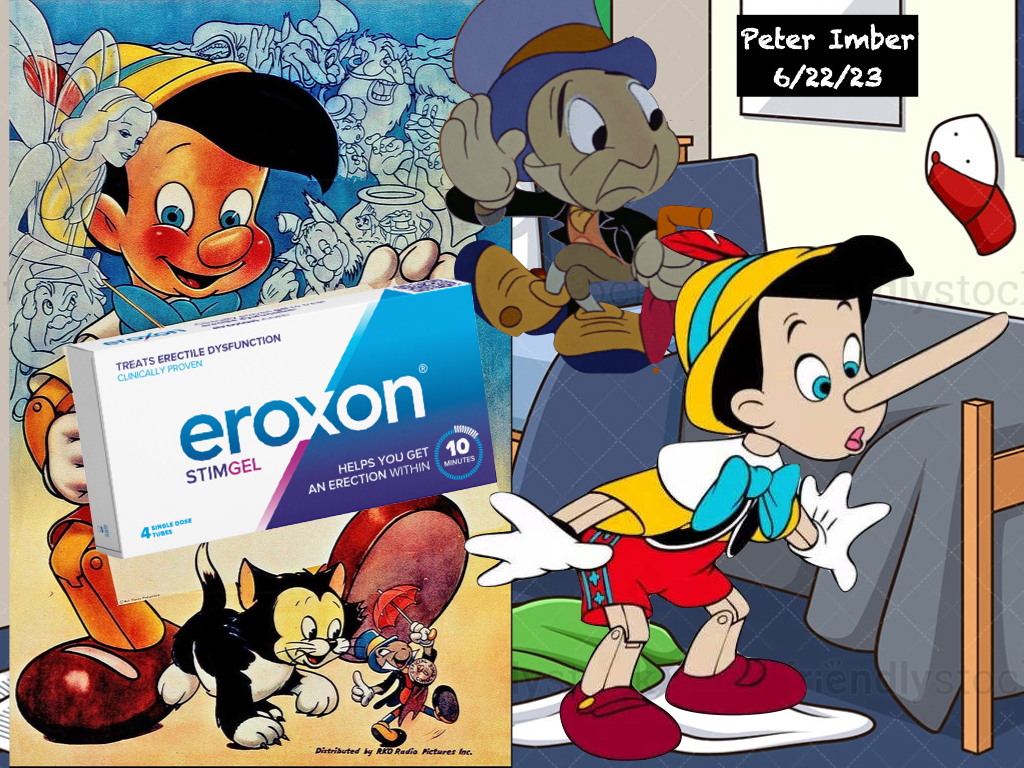
Cartoon Caption Contest
Hey, I don’t think this one would ever be offered by The New Yorker but here’s your opportunity to come up with a winning cartoon caption and get a prize from Homemade Cartoons!
Don’t know what that might be yet but I promise it will be special.
And here’s a link to the New York Times article about a new erectile dysfunction treatment called Eroxon– a name that made me laugh and sort of begs to be the product that launches a thousand stand-up comedy jokes…
Каждую минуту рождается лох.


My last Homemade Cartoon was of Pinocchio using a new drug for enhancing erectile function called Eroxon which had enlarged his nose and not its intended target.
The winner of the Caption Contest was my friend Amy and her winning entry was
“I knew Gepetto was dyslexic, but this is ridiculous!”
Not solving the world’s problems today…



Only 25 more weeks and the days will get longer again. I don’t know why the summer solstice is a sad event for me. I think anticipating the long winter in Maine might be the reason. Of course it is.
I never felt that way in Los Angeles.There was no reason to. One hardly takes notice of the seasons there– most of the time when you look at photographs of the city, you can’t even tell what time of the year it is –and although the difference between the longest and the shortest day in LA is four and a half hours, here in Maine it’s nearly nine hours. That’s a hell of a difference!
This month in Camden the weather has been overcast and rainy. Jo told me I shouldn’t have been surprised since she grew up here and knew June is often like this. I looked it up just now and learned that historically on any June day in Maine the odds of it raining are 35%.
So, it’s time to suck it up and remember what I’m still immensely happy about that I signed up for. Despite the long winter, despite the fact that this month’s excessive rain is a pain to put up with when one’s joy and sorrow turns to the expectation of outdoor activity– GOLF! –I remember the wise counsel I received from Jo’s mother when we moved to Maine nearly 14 years ago.
Essie: “What temperature does it have to be for you to play golf?”
Me: “Oh, I think at least 50 degrees or I won’t go out on the course.”
Essie: “Well, if that’s the case, you won’t be playing as much golf as you hoped to.”
The world faces many many challenges today and likely will have more to confront than we might even have an inkling of. But as far as I’m concerned Maine has turned out to be just like the welcome sign says when you cross the bridge from New Hampshire over the Picataqua River to Kittery…
Maine, The Way Life Should Be
So please excuse today’s dark themed cartoons and chalk it up to our planet now beginning to tilt away from the sun on its northern hemisphere. And on December 21 let’s celebrate… by the warmth of the fire in the fireplace of course.
By the way have you ever seen a globe of the earth that had the southern hemisphere on the top?
—————–

 pawnedaccordion
Hello from Tucson, Peter. We harvest every drop of water we can for our desert landscape.
We have friends from Tucson who have a cottage right near the end of Bailey Island in Harpswell. You can see the Atlantic from their porch. Their well went dry last summer.
Sara
Sent from my iPhone
LikeLike