
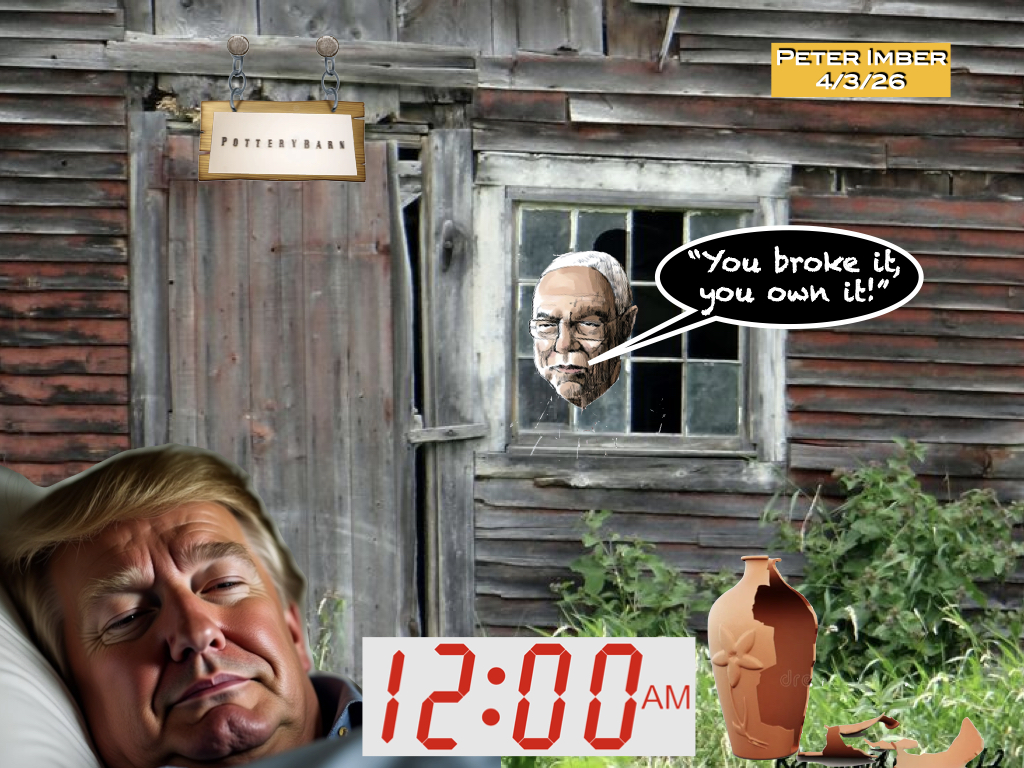
A Day In The Life Of Donald Trump
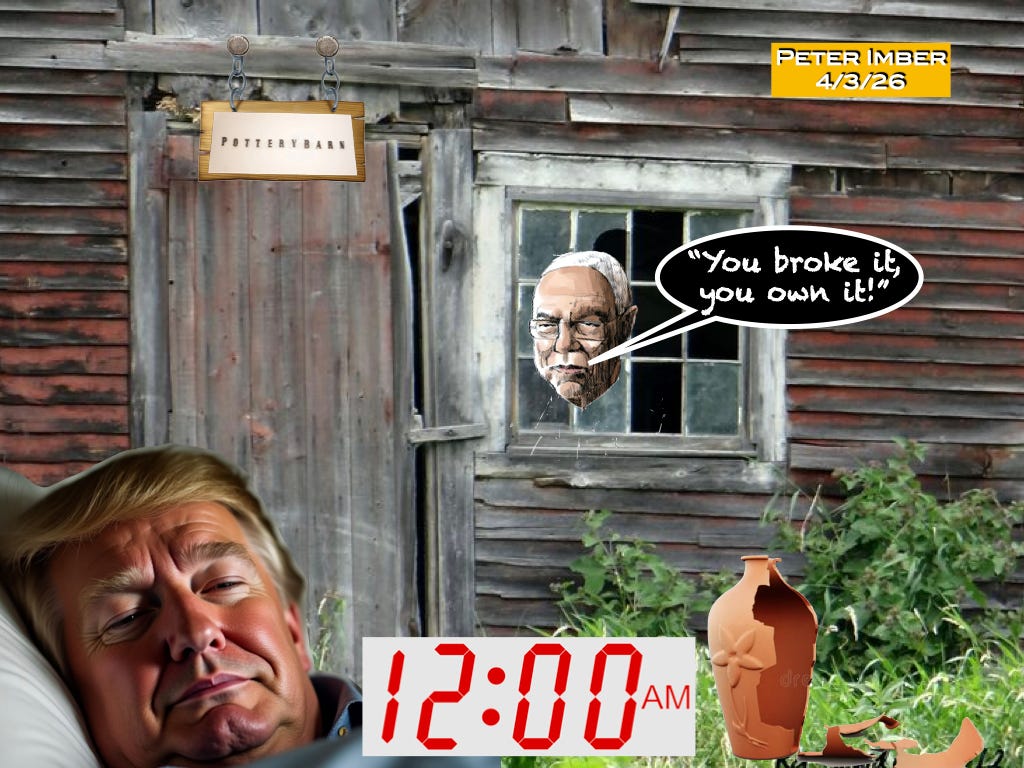





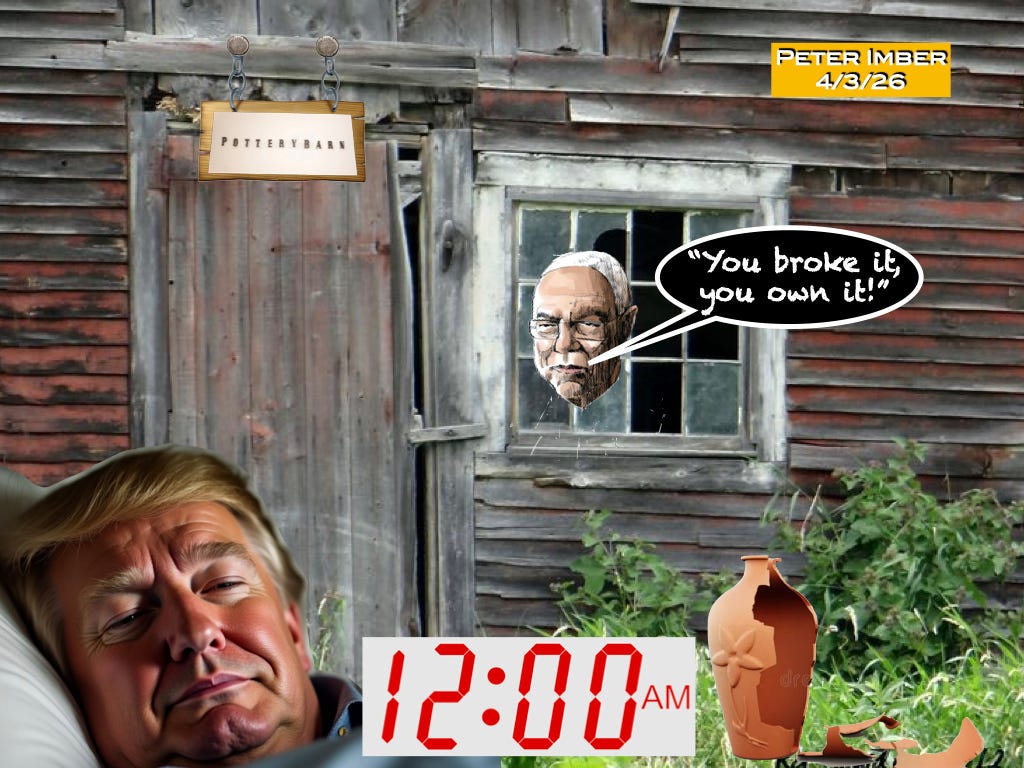
Guess Who’s Coming To Dinner And Who’s Not?
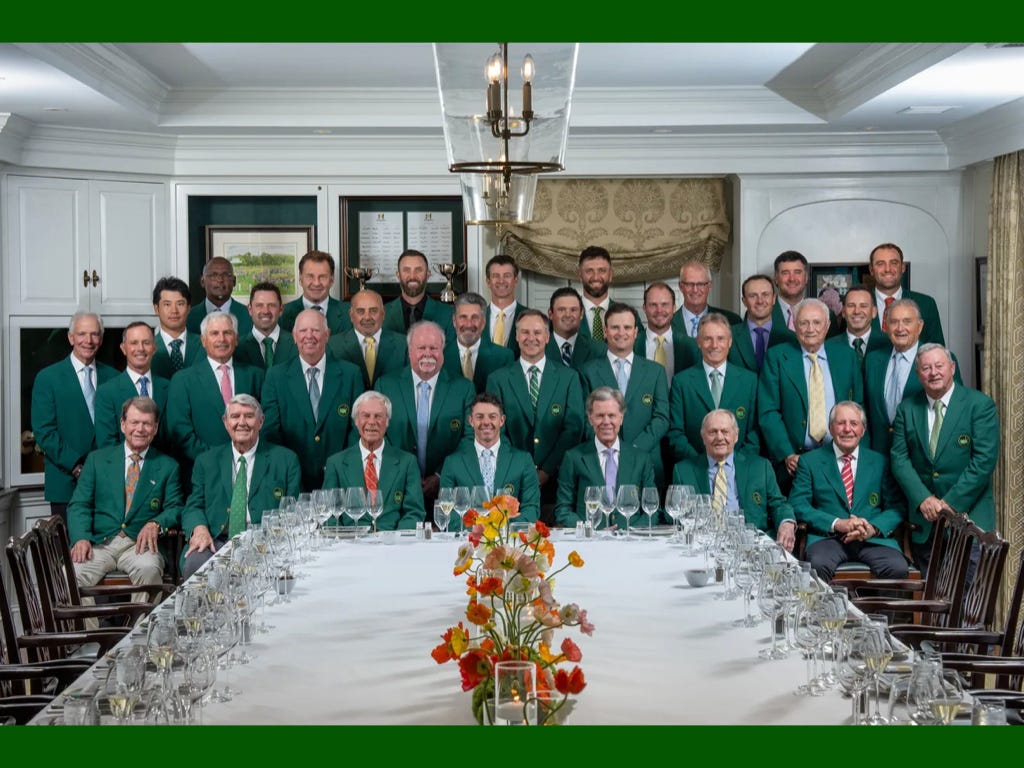
Tuesday night the most exclusive gathering in golf and perhaps all of sports took place in Augusta, Georgia. It’s called the Champions Dinner and it’s a 75 year old tradition. The attendees are all past winners of the Masters Golf Tournament which begins today. No wives or partners, no other golf luminaries, only those who have won the Masters are seated at the table and entitled to continue coming every year for as long as they are alive.
The most recent champion is always the host and has the privilege of planning the meal. This year that honor fell to the Northern Irish player Rory McIlroy, whose dinner menu in addition to grilled elk sliders and yellowfin tuna carpaccio…

…included a selection of wines reported to have cost $50,000. At a press conference McIlroy was asked why he chose not no have any traditionally Irish dishes…
“People keep asking me, ‘Why didn’t you go more Irish?’ And I said, ‘Because I want to enjoy the dinner as well,’”
Although the reigning champion also foots the bill for the dinner McIlroy can indeed laugh it off. He is 36 years old and at the peak of his golfing career which has earned him over $110 million so far. Only one other golfer has made more money than he has and that man is a past Masters champion named Tiger Woods. Woods was conspicuous by his absence from Tuesday’s fete. His recent and latest DUI arrest was presumably a topic of conversation among his peers.
Professional golf today is extremely lucrative for the very few who excel at the game. Palatial estates, private jets, staffs that include caddies, swing and putting coaches, trainers and psychologists are part of the lifestyle for even fewer. It wasn’t always this way. A century ago touring golf professionals and even local pros responsible for running the courses at private golf clubs were not even allowed in the facilities used by club members. Opportunities to compete in professional tournaments existed but prize money was paltry.
Subsequent history has turned that situation on its head but the Augusta National Golf Club which has hosted the Masters tournament since 1934 is about as patrician a throwback to the early years of American golf as can be imagined.
Although financial details of how the club operates and the list of its members are private, membership is thought to number around 300 and is believed to include present and former CEOs of prominent American companies. Warren Buffett and Bill Gates belong to Augusta National as do executives running America’s largest banks, airlines and even Amazon.
A number of sports figures are members like former NFL quarterbacks and brothers Peyton and Eli Manning. But others whose accomplishments or notoriety have been achieved through endeavors beyond business and sports are notably absent from any of those easily spotted as Augusta National members this week. The members wear green jackets and are only allowed to wear them on the premises. That’s right, the jackets cannot not be taken off the property.

Traditions have both their perks and their quirks and often pasts that sometimes can be remedied but not erased. The club was notoriously slow in admitting Blacks— the first was a television executive named Ron Townsend in 1990. And no woman was ever invited to become a member until 2012 when two finally were— a financer named Darla Moore and the former Secretary of State Condoleezza Rice.
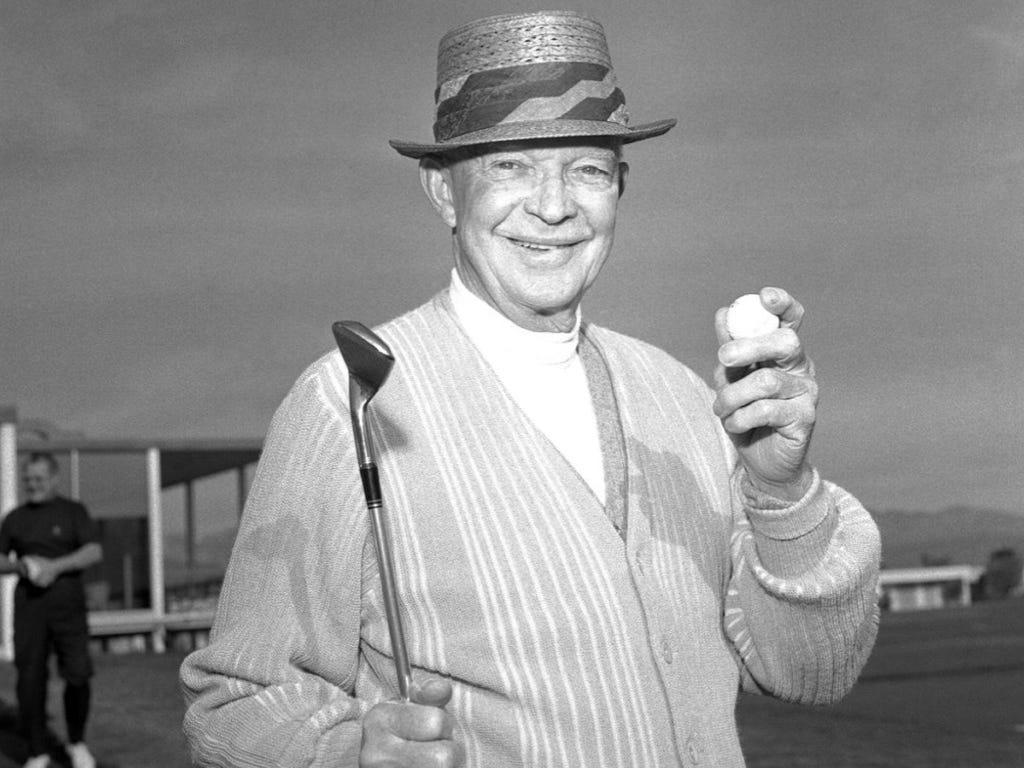
The only American president ever to have been a member of Augusta National was Dwight Eisenhower. Ike was a dedicated golfer and played over 200 rounds there during his eight year presidency. He vacationed at the club so often that a cabin was constructed on the grounds for his and his wife Mamie’s use when they visited. Why have no other presidents been accorded even membership let alone such respect?
If being a golfer carries any weight, recent presidents Clinton and Obama certainly would merit consideration for inclusion but they have not yet been invited. It appears that a fondness for the sport is not enough even if you were once president. Being asked to become a member at Augusta National seems more closely aligned with the process of joining a college fraternity. Just like fraternity “rush”, it is a matter of how those who are already members perceive you might “fit in” with them.
The movie actor Bill Murray of Caddyshack fame is obsessed with golf but he’s also a compulsive funnyman, an odd duck among corporate titans many of whom may not have gotten their jollies watching Ghostbusters. Murray would never fit in. Neither might serious golf enthusiasts like Justin Timberlake and Michael Jordan. With their outsized personalities, they could be viewed as potentially more unnerving than deserving. And how about the man who in his spare time when he isn’t playing golf is the current president of the United States?
It is believed Donald Trump seriously yearns to become an Augusta National member and one who has known him for much of their lives was asked just a couple days ago whether he thinks Trump will ever get his wish. Butch Harmon has been a coach to Tiger Woods and a long list of the best golfers of this era. His father Claude Harmon was the pro at Winged Foot Golf Club where Trump’s father Fred was once a member. So why does he think Fred’s son won’t be making the drive down Augusta National’s Magnolia Lane entrance road anytime soon?
“I think you can answer that yourself – because he’s Trump, I think he is who he is. He’s full of himself. He’s the type of person that I don’t think fits the profile of an Augusta member.”
I’d guess there’s a chance Donald Trump might soon be calling out or calling up Butch but not about a golf lesson.
So what is that Augusta National member profile? Beyond wealth and power it might also embody dignity and discreteness and I’d also hope integrity, honesty and morality. If you weren’t already aware, Donald Trump is a notorious and documented cheater at golf who claims baselessly to have won the club championship at just about every golf club he owns. And perhaps the real deal breakers here for him are that requirement about not taking that green jacket off the property plus another facet of golf that makes it unique from other sports.

Unlike baseball umpires and basketball and football referees who oversee that the rules are followed in those competitions, golf is self-policing. There are rules officials at golf tournaments but in the vast majority of situations players are responsible for upholding the rules and calling violations on themselves even if no one else has observed an infraction has happened.
In a legendary incident many years ago a famed player saw that his golf ball had moved while he was just about to hit it. It resulted in a one stroke penalty he called on himself. The man ended up losing that tournament by one shot. Later when responding to the praise he received he said, “You might as well praise me for not robbing a bank”.

Donald Trump certainly spends a lot of time on the golf course. During his first term he completed as many rounds as Eisenhower had in his two. As of today, President Trump has played golf on 103 days out of the 444 he has served so far in his second term. Even the war with Iran which began at the end of February has not interfered with his flying to Florida to play golf nearly every weekend.
But let me finish this post with a story that’s hopefully, more uplifting and ties in with golf and one of its most respected and revered players…
My mother had a friend whose husband was an ardent and very good golfer. Angela was considerably older than my mom and once told her about attending a party when she was younger. Angela and a man she had just met had disappeared and her husband found them on a bench outside by themselves. The husband was startled but not because of discovering anything untoward…
Angela: “Bill, I want you to meet Robert Jones. We have been having the most enjoyable conversation about books we have been reading.”
Angela’s Robert Jones had a degree in literature from Harvard but he was more widely known as the golfer Bobby Jones. Today he is still considered the greatest amateur who ever lived. In 1930 Jones won the U.S. Open, U.S. Amateur, British Open, and British Amateur. Since then this feat has been known as golf’s Grand Slam. Following his retirement from competitive golf Bobby Jones co-founded both the golf course and the tournament where the Masters is being played today.
Oh, and that player who lost a U.S. Open championship in 1925 by a shot because he had penalized himself? Yes, it was Bobby Jones.

If you are a subscriber to the The New Yorker, here’s a link to an article from some years back all about Augusta National that will fill you in on the place far more thoroughly than I have. It is truly worth a read…
J.D. & Don’s Not So Excellent Recent Adventures
And this isn’t even a full week of them!
Roll the film…

APRIL 7— American Vice President J.D. Vance’s travels to Budapest, Hungary for a visit to support Donald Trump’s ally and ideological mentor Viktor Orbán. On April 12 Orbán loses his bid for reelection and concedes defeat after 16 years in power as Hungary’s Prime Minister.

APRIL 11— No, President Trump is not viewing Julia Child and Fred Rogers fighting on PBS. Instead Trump attends a mixed martial arts event in Miami with his Secretary of State Marco Rubio. While watching men battering each other silly in a cage, it is unclear whether he is informed that the United States negotiations with Iran taking place in Pakistan have broken off in failure.

APRIL 12— J.D. Vance flies back to Washington adding to a growing list of missions on behalf of Donald Trump that have been personally humiliating.
Recently, at a White House event, Trump asked Vance for an update on the preliminary negotiations with Iran. The vice president remarked that things were “going good” and Trump followed up by asking whether the efforts would resolve the war. Vance then said he’d brief the president later.
“So if it doesn’t happen, I’m blaming JD Vance,” said Trump. “If it does happen, I’m taking full credit.”

APRIL 13— In a social media post over the weekend Donald Trump lambasts Pope Leo XIV in reaction to the Pope’s criticism of America’s war with Iran and the Trump administration’s immigration policies. Trump calls him weak, terrible and a radical leftist who “needs to get his act together”.
The transatlantic spat with the Holy See continues on Monday. Pope Leo states he will continue to “speak out loudly against the war” and declares that he has “no fear of the Trump administration.”
Back at the White House Trump tries to explain away to reporters a photo he earlier had posted of himself robed as a Jesus-like figure.
“I thought it was me as a doctor,” he says and blames news organizations for misinterpreting the image. “It’s supposed to be me as a doctor, making people better, and I do make people better.”

What can possibly be next? I can’t imagine. Can you?
As difficult as this might be, how about a laugh? I certainly need one. Click on the link below and I think you may…
How Did We Get Here?
Can TV Sitcoms provide a hint?
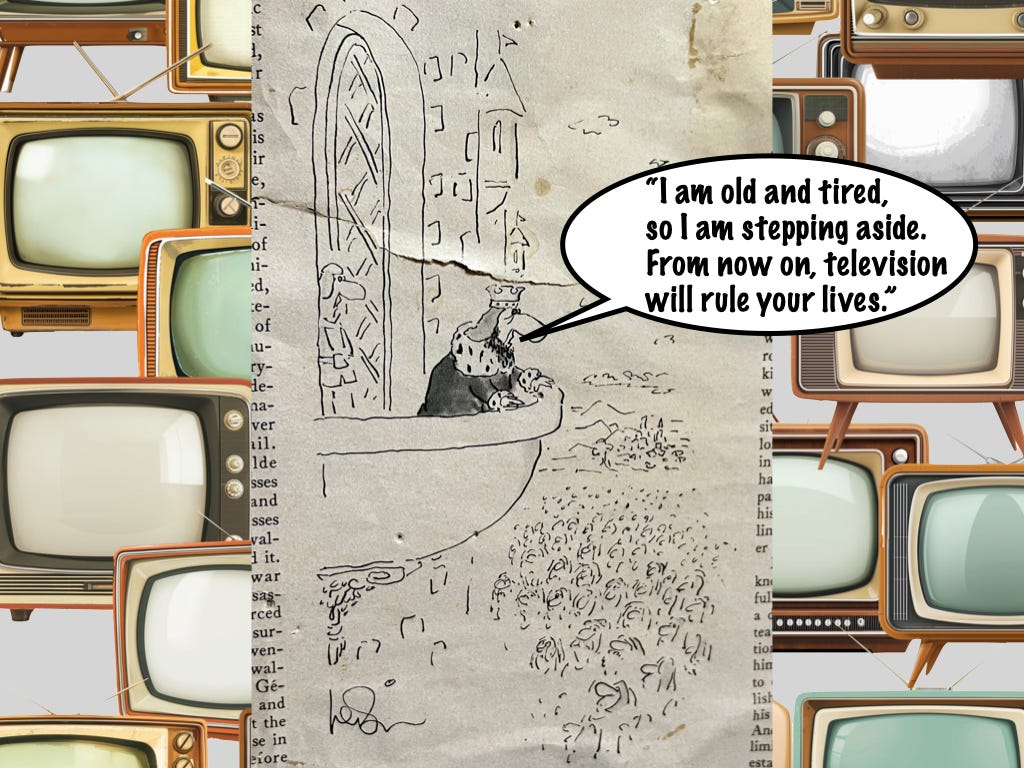
I have had this cartoon thumbtacked to my bulletin board for at least 40 years. When I cut it out of The New Yorker, I found it to be funny. Now, I think it was prophetic and only needs to be updated to include the other screens that we’ve had added to what has become an addiction evolving toward enslavement.
Since getting my first desktop then laptop and subsequent tablets and smartphones, I’ve offered little resistance to becoming a cyber serf-er. For decades I have survived stretches without sitting in front of my computer screen but every time this has occurred it has been because I’ve been far away from it.
The idea of not taking my iPhone with me everywhere with the exception of into the pool at the Y isn’t conceivable. At this point my abdomen may as well have a pouch for it like a kangaroo’s. And it’s on screens that my life is now largely informed, organized and entertained. It’s often how I buy and pay for things and is essential for performing tasks many of which I’m not even conscious I’m looking at a screen when I perform them. I’m even informed weekly of how much time I’ve actually spent looking at my desktop, tablet and ubiquitous smartphone.

And there are increasingly so many other screens popping up everywhere and required for doing more of everything. There’s the car’s dashboard, the self service supermarket checkout, the restaurant menu that’s only accessible by QR code, The ATM, the gas station pump, the parking meter and the TV screen so large I can’t stretch my arms around it. There’s a screen on my coffee maker and a screen in front of my seat any time I’m on an airplane…
I admit in numerous ways screens have made my life more convenient. News is at my fingertips as is banking, getting driving direction and ordering almost anything from the Steelcase chair I’m sitting in to boxes of Kleenex that will be delivered to our door. You may feel the benefits of screens far outweigh the drawbacks and I admit you can make a convincing case.
But it’s undeniable that screens have and are taking the place of real people and not necessarily making my own life always that much easier. Have a problem? Companies don’t want me to talk to an actual person for help but claim a “virtual” one on a screen or a digitally generated voice in my ear can serve as a substitute. Although I’ve actually gotten into an argument at home with Siri, I now try to never lose my cool if and when I succeed— after climbing a phone tree as high as giant redwood —getting an actual human being on the line.
But despite my occasionally being reassured that there are still people with jobs to interact with, more and more if I’m not looking at a screen, I’m in the presence of others who are. In restaurants maybe you’ve seen parents and their kids all sitting at a table each left to their own devices on their own devices. That depresses me. And if you think you may interact more with screens than other human beings in the course of a day, you’re likely right. Studies last year revealed that Americans in 2025 spent on average seven hours— some of us even the majority of our waking hours —every day in front of one screen or another.
For me and likely you, our screen gazing all began with television and we boomers were the first generation to grow up with what we used to call “the tube”. Sure, going to the movies and sitting in the dark looking at the “silver screen” had been possible and popular with our parents and grandparents for some time before televisions were in American homes but “going” was the operative word.
With TV you didn’t have to go anywhere and by the 1960s, 90% of American households had televisions. A decade later one was turned on an average of over eight hours a day in our living rooms. We even bought more of them so we could watch in the other rooms. For the past two decades the average American family home has contained more televisions than people.
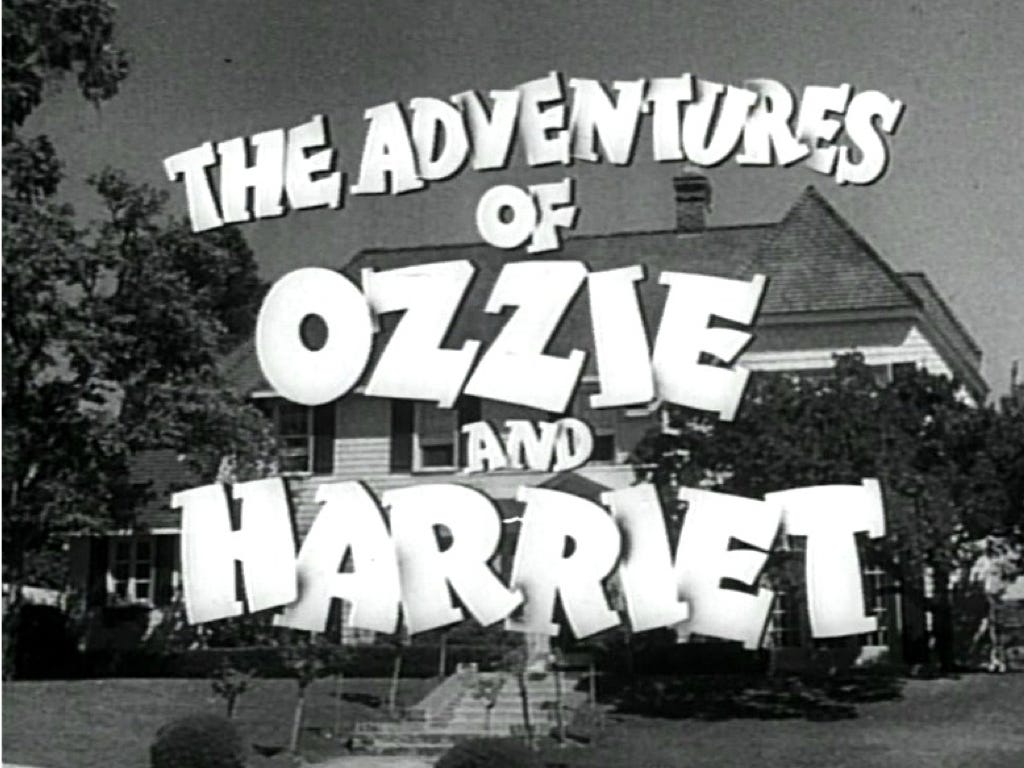
As a kid who grew up outdoors and free to roam the neighborhood, I don’t remember that I watched all that much TV but I did have one regular weekly appointment with ours. That was when I planted myself in front of a black and white Magnavox with a screen that was smaller than the one that I’m typing onto in front of me. At 8 o’clock on Wednesday evenings it was time for The Adventures of Ozzie and Harriet and although I haven’t seen all 435 episodes of the show’s 14 year run, I’ve seen a lot.
Perhaps I had never gotten over whatever it was that watching the Nelson family provided for me growing up in the 1950s. And whatever the pull was then, it tugged at me again unexpectedly a half century later in a Best Buy store in Los Angeles. I spotted a package of DVDs and purchased a dozen episodes of Ozzie and Harriet.
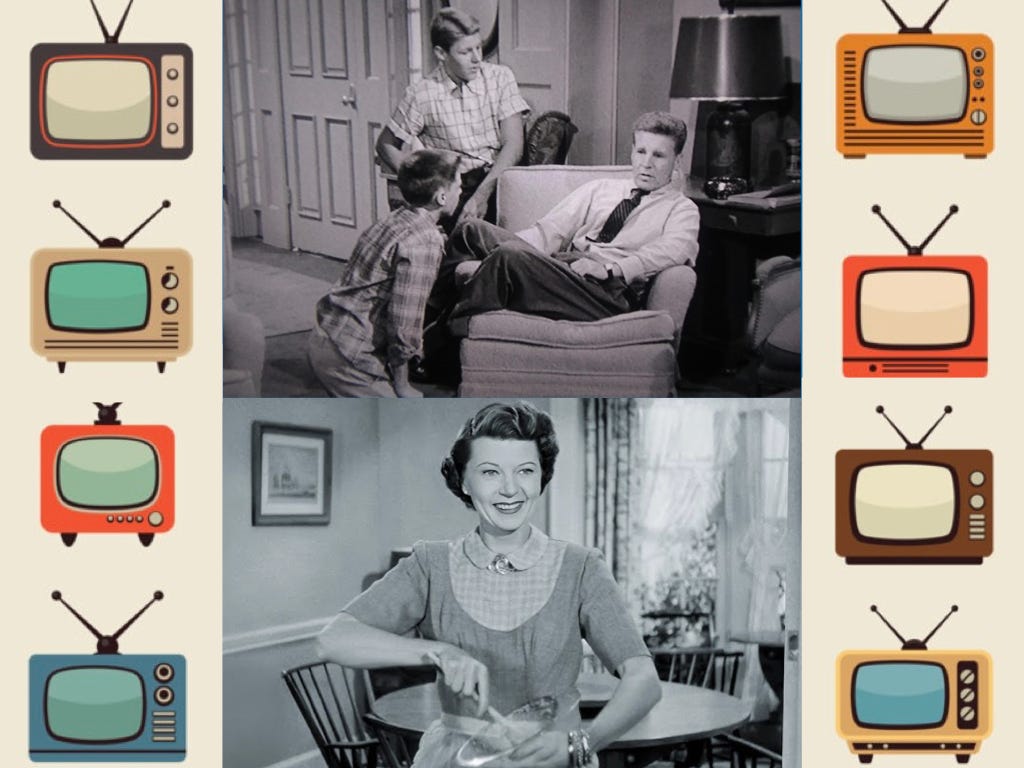
Here’s a typical scene that included a “laugh track” that was added to alert viewers something funny had just happened to encourage us to chuckle along at home.
After Jo bravely watched all dozen shows with me, she offered her opinion…
Jo: “These are terrible.”
Me: “I know but I love them. They’re like comfort food.”
Perhaps I wished to be Ricky or David’s brother because my family wasn’t like theirs. Unlike Ozzie Nelson, I knew what my father did for a living and why he wasn’t at home all the time nor able to attend my basketball games. Unlike Ozzie, he had a discernible job and was at work. And unlike Harriet, my mother didn’t emerge from our kitchen smiling day after day carrying a plate of cookies she had just baked. I don’t think the Imbers were unhappy but the Nelsons sure seemed happier. I suppose you had to be if a family crisis was running out of tutti frutti ice cream.
After Jo and I moved to Maine I decided to explore my Ozzie and Harriet fix; not to cure my habit but to explain it to myself. As I was growing up, I felt very secure to be a kid in America but the 1950s and 60s were also a time when the threat of a nuclear war had some of our neighbors converting their basements into bomb shelters. So in the process of thinking about those sitcoms that were a diversion from the Cold War, I decided to explore the history of television sitcoms and discovered that America’s sitcoms were providing a lot more than just that.
to be continued…
How Did We Get Here? (Part Two)
Can TV Sitcoms provide a hint?
We have a network of what are called Senior Colleges in Maine— 17 of them —in which volunteers can create and teach a course to seniors. It’s a no homework, no credit, no pressure and nearly no tuition opportunity. Jo and I discovered the one near us in Belfast upon moving here in 2010 and were surprised by the variety of offerings.
What we also quickly realized is that Midcoast Maine has attracted an amazing number of accomplished retirees and not just those who spend only their summers here.
Constructing a course around my nostalgia for the sitcoms I grew up with was only partly a stroll down memory lane. Perhaps by exploring the history of television sitcoms, I believed I might better understand why after 50 years I had so enjoyed again watching those episodes of The Adventures of Ozzie and Harriet I had purchased on impulse.
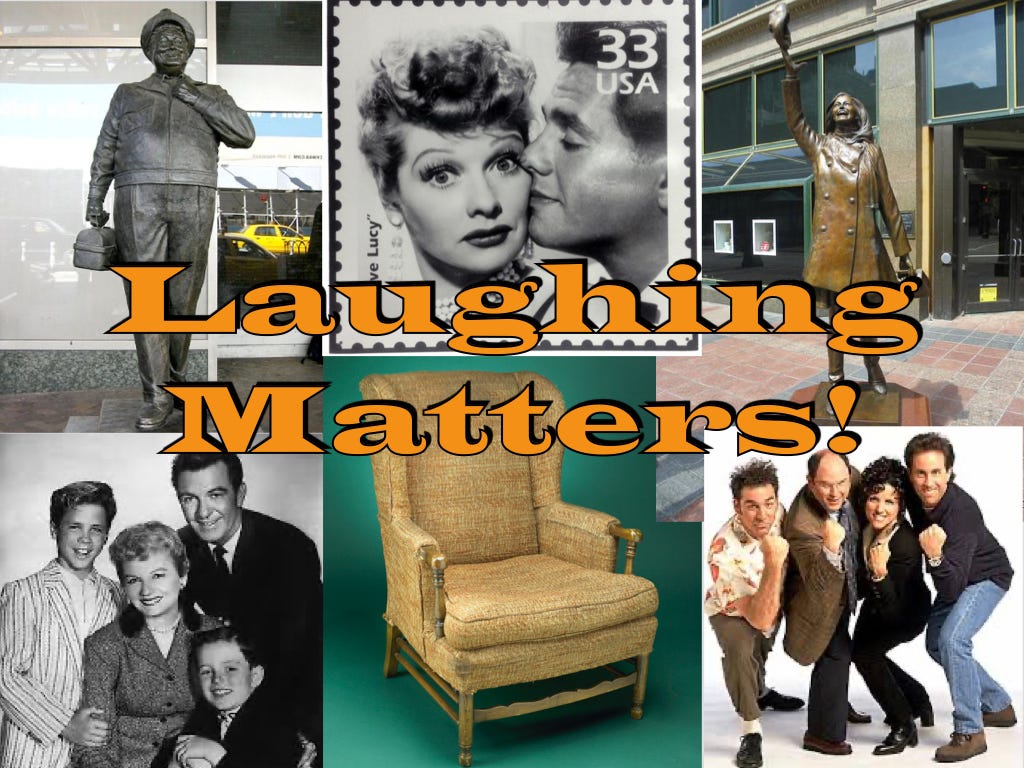
I titled my course Laughing Matters (Yes, the “matters” was intended to be both the noun and the verb.) and for six weeks I presented my thoughts about the significance of American television sitcoms.
If I thought my lectures were the attraction— I had over 40 attendees taking my course — I might have been deceiving myself. I talked but with the help of video clips I had been able to find and download from the internet, I entertained the class as well with memorable moments like the one below from I Love Lucy.
There are lots of ways to measure how the United States has changed in my lifetime and my exploration of sitcoms revealed more to me than scenes to laugh at. It didn’t take much insight to see that the programs were mirrors reflecting who we were as a country at the time the shows were produced and broadcast.
That episode of I Love Lucy for example was more than just Lucy and Ethel failing at their task to keep up with candy on a conveyor belt. They wanted to prove that they could get their own jobs after their husbands claimed housework was easier than any work outside the home.
When the couples reversed their roles, Desi and Fred were spectacularly unsuccessful in their own attempt to do domestic chores. And for me the storyline, coyly if unintentionally, hinted at the dissatisfaction many American housewives felt about being deprived from having careers beyond housekeeping.
So many of the episodes of I Love Lucy were about Lucy Ricardo trying to get into husband Ricky’s nightclub act and being rebuffed. Lucy was hardly a feminist but she was portrayed as a woman who desired to be more than a homemaker when so few were able to get hired as other than teachers and secretaries in the 1950s.
Whether intended or not, the idea that Lucy and American women needed to have a larger and more important role in society was consistently framed and highlighted inside that rectangular screen for millions to see.
Jackie Gleason’s Ralph Kramden on The Honeymooners actually threatened to physically harm his wife— “One of these days, Alice… Pow! Right in the kisser!” —which looking back now is unfathomable and hopefully, despite the far right’s desire to turn back the clock on women’s equal place in America, will remain that way.
The bus driver who never made it out of his job’s uniform or his cold-water flat was portrayed not just as a bossy and bellicose man who bellowed that he was the “king of his castle” but also as a frustrated low wage earner without the means to afford the modern conveniences that others ascending into America’s postwar middle class were acquiring…
In hindsight, Ralph Kramden just may have foreshadowed an angry white American male who in a few decades was going to feel left behind and alienated when millions of middle class manufacturing jobs here were exported overseas.
Sitcoms in the 1950s and 60s may have subtly but presciently served as portents for grievances that would emerge and impact our country’s future but on sitcoms they were also powerfully counterbalanced. I called it the era of the “Happy Perfect Families” as portrayed on shows through families like the Nelsons of Ozzie and Harriet, the Andersons of Father Knows Best, the Cleavers of Leave It to Beaver and the Stones of the Donna Reed Show.
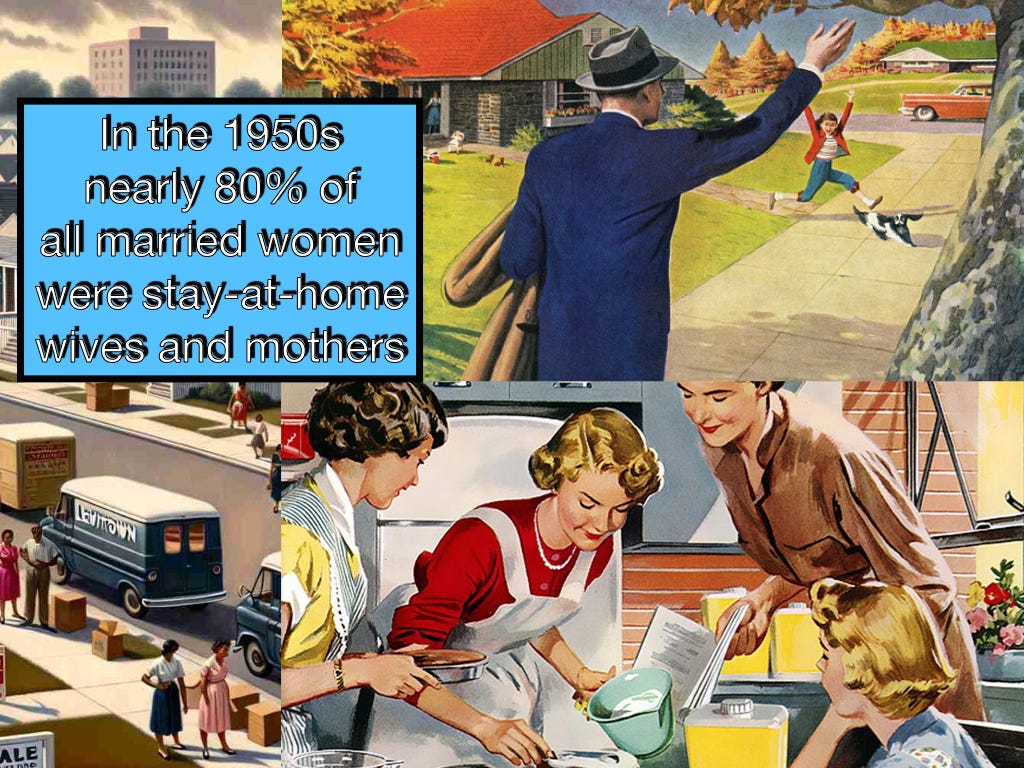
All were exemplary promoters of what we were to know and aspire to as the “American Dream” and all lived in homes in the suburbs with husbands who brought home the bacon for their wives to fry.

In a prospering post war America the stars of these shows often did the commercials for the things a middle class family needed to buy to make their home and lifestyle complete. Harriet hawked Hotpoint appliances and Ozzie kvelled about Kodak cameras. Others praised Campbell’s Soup and Purina Dog Chow.
By 1980, advertisers in the United States were spending over a billion dollars on television commercials. TV screens had become the greatest marketing and selling tool in history.
But these shows were selling something else, too. Their weekly presence on our TVs were often half hour morality tales offering lessons in manners and guidance on how to behave as many of our families like my own moved into our new homes and new communities.
Take this scene from a Leave It to Beaver episode where doing the right thing didn’t excuse the Beaver from punishment for having done the wrong one first…
Doing the right thing and accepting that we in America were “all in this together” were intrinsic parts of the message portrayed on the sitcoms of the 1950s and ‘60s. The fact that there were only three American broadcast television networks significantly contributed to reinforcing these ideals. As a nation we were literally watching these shows together.
Sure, all these families were white married heterosexual couples with two children— the Andersons of Father Knows Best being the exception had three kids —and this archetype also consisted of the husband whose sole income supported the family, while the stay-at-home wife did the dishes and the laundry.
Early television sitcoms certainly reinforced what were then the traditional and expected roles for men and women of the time even if sometimes conveying dissatisfaction with them.
And these early sitcoms quite conspicuously were devoid of minorities. The rare exceptions— The Beulah Show, which was the first American television program to cast a black actor in the leading role, and Amos ‘n’ Andy —had previously been hits on radio and repurposed for TV.
Ironically, Amos ‘n’ Andy was created and acted by two white men and in the 1930s was and still is the most listened to program in American radio history. On television in the 1950s black actors played the roles and what had been amusing and acceptable on the radio became a target of the NAACP and other civil rights groups who held that the show presented a distorted and demeaning image of African Americans. The protests succeeded in getting the TV version of Amos ‘n’ Andy taken off the air.
Change beyond the boom in housing construction and the growth of the American middle class was underway and soon there would also be tragedy. With the assassination of President John F. Kennedy, the country would come to grips with the reality that all was not Camelot in the United States let alone in the neighborhoods of homes with green lawns, picket fences and happy perfect families.
to be continued…
I Stood With One Who Stood Up And Still Do!

I was told my letter of support was in the queue to be published in the Portland Press Herald any day. I intended to actually make an endorsement of Janet Mills’ candidacy on June 9, a month before Maine’s primary on The Pawned Accordion— my first ever on this Substack.
Maine’s Governor Janet Mills pulled the plug on her campaign today and I’m saddened. Janet will move on. We all will and here’s what I wrote and am posting here anyway:
Those of us in Maine are lucky. It’s a beautiful place to live. Civility is still a touchstone of our way of life here. And if you’re a voter, the candidates we more often get to support are qualified to serve in the positions we get to vote for them to fill— good people motivated by what is in the best interest of all of us who live here not self-interest.
It is an unprecedented time in American history when as a nation we have been urged to hate one another, duped by conspiracy theories, debased by a president’s behavior, and witnessed epic incompetence and corruption in an administration that has been abetted and absolved by the cowardice of a Republican Congress in Washington.
Many of us are drowning in disillusion if not despondency. But as our luck would have it, here in Maine we have attractive and capable candidates running in our state’s primary election in June for the United States Senate and state governor.
The Pawned Accordion has an editorial board of one— me. If you have followed my Substack, then you know I often express my views but I’ve never before made political endorsements. Why am I now? Because I believe it is important and I favor candidates who I trust and support as the right choices.
I believe character is key and that experience and courage count. I am voting for Janet Mills for Senate candidate to defeat Susan Collins.
Many of us remember that Janet Mills told Donald Trump to his face at the White House “We’ll see you in court!” when he threatened to withhold federal funding for Maine schools. Later Mills rejected a demand from Trump for an apology and reaffirmed her stance on the “rule of law.”
Courage is when one speaks up when it would have been easier to be silent. Janet Mills has courage. That is who she is. And for those of you who think her age might be a concern, let me ask you a question. How many times have you been impressed with someone young but inexperienced who excited you with his or her facade and flamboyance but later became a disappointment and not who you had thought he or she to be? Filling halls is quite different from filling shoes.
One’s past history and accomplishments should be a main consideration when choosing who to vote for and Republicans, fearing the loss of their majorities in Congress this fall, will be viciously on the attack. If Susan Collins’ Democratic opponent is someone with a dubious past and a thin resume, her campaign will consider it a gift.
All that glitters is not gold and all that a person’s age is in years is not old. The wisdom to solve problems can come with age and Janet Mills’ record and experience speaks for itself. She has been a great governor of our state and her chances of beating Susan Collins head to head are the best opportunity we have for Maine to be represented in the Senate by someone who won’t continue to fold when America’s future is on the line.
Now, I will support the candidate who will be chosen to run against Susan Collins. We all should.
Peter
How Did We Get Here?
(Part Three)
Can TV Sitcoms provide a hint?
I was just out of college working for CBS News in New York and had become the sole “production assistant” for the CBS Evening News with Walter Cronkite. I was responsible for on screen identifications called “supers” back then and for ordering the graphics needed for each night’s newscast that were created on glass slides projected on a screen behind the anchorman. Only once do I recall making a mistake which led the executive producer to ask me if I had actually graduated.
I still have a CBS News stopwatch. It’s one I dropped and no longer works if they want it back. I used it for a further responsibility. In the control room I timed the broadcast to keep track of how close we were at any point to being too long or too short in the half hour time slot. Too short and you ran credits. Too long and there was a problem. Something had to be shortened or jettisoned. Certain correspondents had large egos. Fortunately, what got cut wasn’t my decision.
One day well before that day’s newscast was to air, the set of Evening News where Cronkite sat and where the writers and I worked, was silent. Nothing earth shattering was going on in the world at that moment but what we watched on a closed circuit monitor was perhaps something that could be considered an equivalent in the history of television broadcasting.
A new sitcom was about to premiere on CBS that would change the programming landscape of TV in America. I recall the room went silent and remained that way. Nobody laughed. Maybe it was because they were all “hard bitten” news people who laughed infrequently to begin with or maybe they were as stunned as I was.
The pilot episode of All in the Family was a far cry from the sitcoms we had regularly tuned into on television. It tackled issues like racism, sexism, and politics— subjects that had been hidden under the rug that sitcom mom June Cleaver vacuumed in her living room.
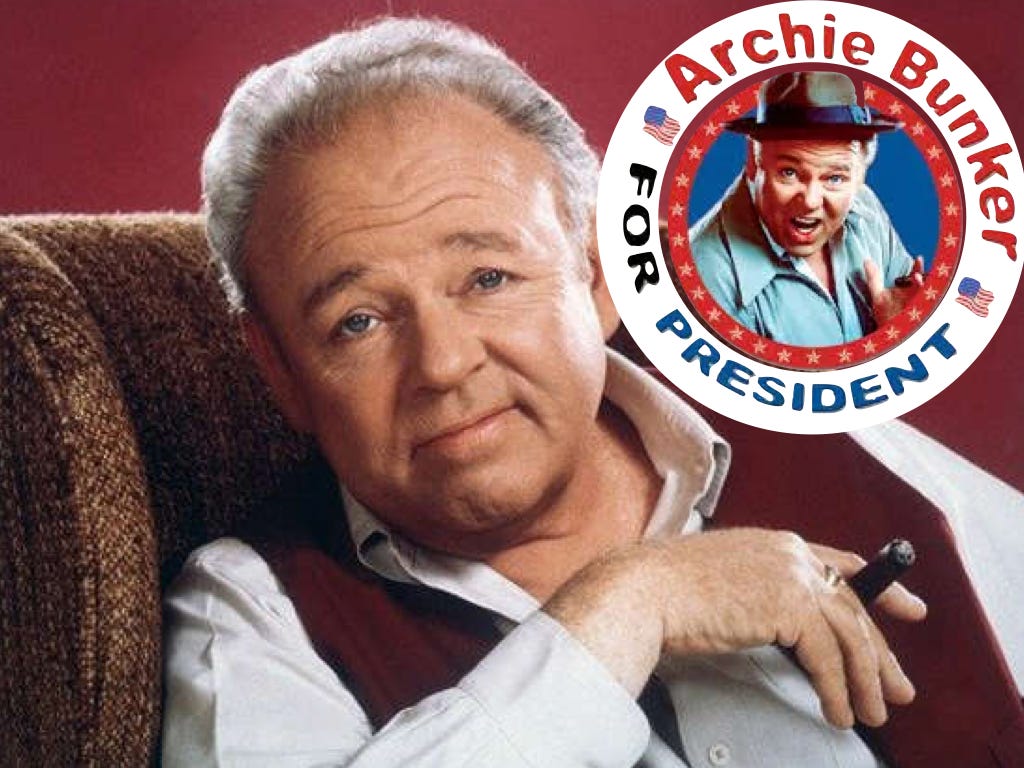
The show’s creator Norman Lear may have intended for the pater familias Archie Bunker to look foolish and serve as a liberal punching bag but instead, he was to become America’s “loveable bigot” and the candidate of a mock campaign for president in 1972.
All in the Family was the number one show in the Nielsen ratings for five consecutive years in the 1970s. Many laughed and indulged Archie’s attitudes toward women and minorities because he seemed harmless and had never marched with the KKK or hit his wife although he called her names that would have ended both my marriages.
Lear might have hoped the Archie Bunkers of America were becoming an anachronism and he was doing his part to move things along in that direction. I too, was among those who hoped that our society was on a steady course to becoming less sexist and racist. But Archie’s appeal to a rising number of voters— particularly blue collar workers who were being left behind by accelerating economic and social change —was identified by politicians and exploited.
Of course what gets on commercial television in America is all about what gets watched on television and the population of the United States was becoming a more urban/suburban TV audience that advertisers increasingly coveted. In the early 1970s family sitcoms that were popular with rural viewers and those that appealed to escapist fantasy fans began to be replaced by different types of “families” in more socially conscious shows like All in the Family.
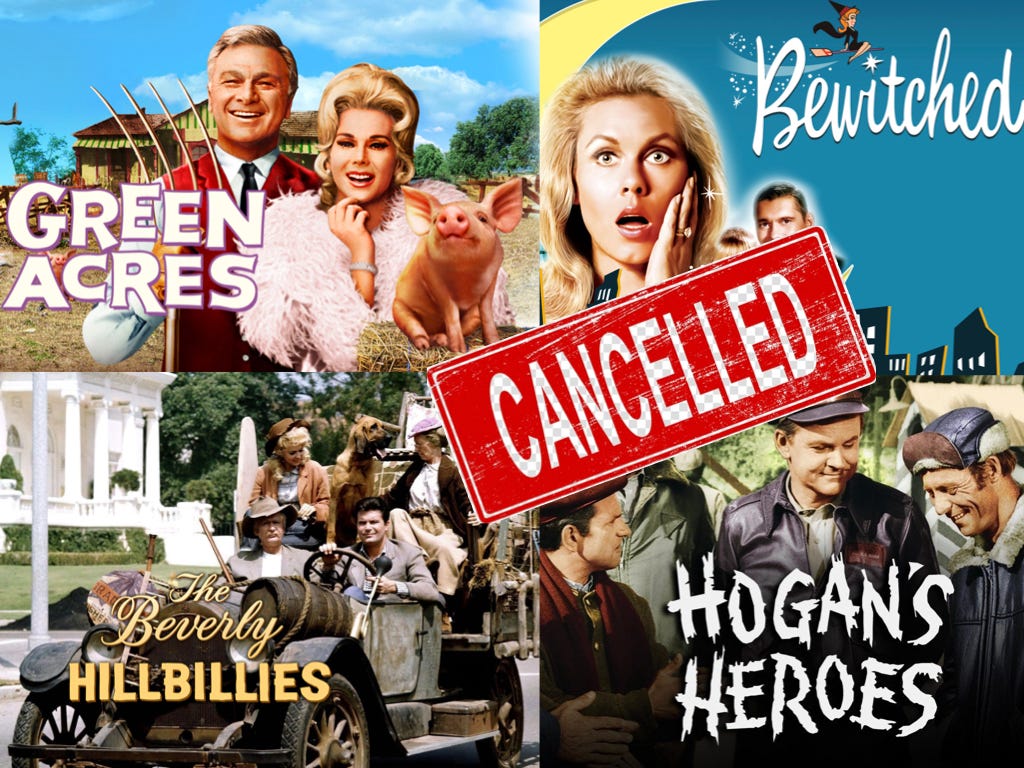
The Mary Tyler Moore Show featured a woman in the workplace who was more competent than some of the men she worked with. M*A*S*H was set at the time of the Korean War when the United States was in one in Vietnam. The show didn’t poke fun at war, it belittled it. Cheers was a family of loveable barflies, The Golden Girls, a group of woman dealing with life after menopause. Sitcoms were no longer just about the way we were supposed to be. They were showing us the way we were.
But foremost among these shows was another that starred a husband and father who was quite the opposite of Archie Bunker and became as big a ratings success. The Cosby Show dominated the ratings in the 1980s and equaled All in the Family’s earlier run as the number one program on television for five straight seasons.
It was comedian Bill Cosby’s idea to adapt his observations about family life in his stand-up act for TV. The Cosby Show featured a Black family where the father was a doctor and the mother a lawyer. This was despite the fact that Cosby’s original idea was for Cliff Huxtable to be a limo driver and his wife Clair a plumber. He was talked out of it.
Apparently, Cosby’s wife and the producers thought a Black family on television needed to skip being middle class and instead be a professional and affluent version of the Nelsons and the Cleavers. So the Huxtables were cast accordingly and moved on up from the Bunkers’ working class row house in Queens to a brownstone in Brooklyn Heights, a neighborhood that was also admirably and a little too noticeably colorblind.
Bill Cosby earned a doctorate in education and pointedly took the opportunity in his show to emphasize the importance of getting one. Here’s a clip where he hammers that home to his son…
As much as The Cosby Show broke the stereotype of how Black families had been represented earlier on television, critics contended that the program went too far in the other direction. The affluent Huxtables may have inadvertently signified to white audiences that inequality and racial prejudice were no longer serious problems for America.
If All in the Family had finally brought America’s reality to sitcoms after the “feel-good” everything is Ok ones of the 1950s’ and 60’s, The Cosby Show kept the line moving in that direction. But sadly, although it offered a warm depiction of family life, Bill Cosby the person was revealed to be someone quite the opposite of Cliff Huxtable the congenial obstetrician and patriarch of a successful Black family.
And The Cosby Show was still on the air when another sitcom on a fledgling new network was about to flip the warm-hearted notion of the TV nuclear family upside down.
to be continued…
How Did We Get Here? (Part Four)
Can TV Sitcoms provide a hint?

For over three decades the television networks ABC, CBS and NBC had American TV viewership pretty much to themselves. That changed in 1986 with the emergence of a fourth national commercial television network when Fox launched its in test markets. For the family sitcom another seismic turning point occurred a short time later.
On April 5, 1987 Fox premiered a primetime lineup nationwide and that evening Married… with Children would flip over the sitcom living room sofa and knock the legs out from under its kitchen table. The new network had encouraged the creators of the show to be outrageous and come up with something the Big Three networks would never allow on their air. And so they did. Fox executives even suggested a name— Not the Cosbys —both a swipe at and a bow to the number one show on television at the time.
If Father Knows Best’s Jim Anderson was the moralist dad who was portrayed to be infinitely all knowing every week, Al Bundy was one who was unfailingly moronic in his every waking moment. The repulsive opposite of Anderson and the other sitcom dads who had preceded him was even disrespected and disparaged by his own family and the Bundys were the antithesis of any ever seen on American television before.
Married… with Children skewered the happy perfect sitcom family as if it had been a colossal put on. To call them dysfunctional hardly scratches the surface to describe how vulgar they were. Al wasn’t a doctor. He was a shoe salesman who hated his job and felt cheated by life. His wife Peg refused to either cook or clean and the two children were equally loathsome.
Almost immediately, the program raised eyebrows and caused consternation among those viewers who found it deplorable, debauched and a joke too far. But for others a darker view of life in America may have seemed a hyperventilating reflection of their own. While they laughed, they too may have been a family struggling to make ends meet. The Bundys were awful but perhaps more honest and real about it than the lives of the idealized sitcom families who always solved their trivial problems and then hugged each other at the end of the show.
And a bit of luck may well have contributed to Married… with Children becoming the Fox network’s first big hit. In its third season, a Michigan homemaker, who was offended by what she considered the program’s “anti-family values”, spearheaded a nationwide boycott of it. Several sponsors pulled their advertising but the negative publicity actually boosted the ratings and Married… with Children would run for 11 years and become one of the top dozen successful sitcoms in American television history.
The Bundy’s didn’t have a picket fence in need of paint and a lawn so overgrown it needed to be scythed. They probably wouldn’t have minded it though. They were losers and seemingly proud of it.
Looking back today, I believe Married… with Children can be seen as an early flashpoint in America’s culture wars. If the Huxtables would have voted for Obama, the Bundys, if they voted at all, would likely have been Trump supporters. But they weren’t the model for Americans who felt left behind. Al and his family weren’t showcasing their grievances. They were merely a punchline.
The Conners on Roseanne which debuted a year after Married… with Children were also a struggling working class family but a more genuine one who loved each other. The show even went beyond All in the Family in dealing with topics like addiction, domestic abuse and teen pregnancy. Its star Roseanne Barr continued a historic trend of stand-up comedians with successful sitcom series.
And beyond their success with audiences, both Roseanne and Married… with Children spawned offspring that completed the interment of the illusory sitcom nuclear family. In their wake other less than perfect families proliferated on television. Even ones more animated than Roseanne’s exasperated shriek.
Actually, the animated sitcom goes back nearly to American television’s Stone Age. The Flintstones which premiered in 1960 was an obvious takeoff of The Honeymooners with Fred and Wilma Flintstone clearly stand-ins for Ralph and Alice Kramden. The Jetsons followed two years later but animated sitcoms did not reappear as a permanent staple of network programming until the most popular one in history debuted 25 years later.

When The Simpsons first appeared on television I had just turned 40. In a couple of years the show will turn 40— it’s renewed to the end of the decade —and it has already set longevity records that I’m pretty sure I won’t. When I think about it, the show has an unfair advantage. Unlike us, animated characters don’t have to age and Homer and his brood haven’t. He and his wife Marg are still in their 30s. The kids—Bart and Lisa — are still 10 and 8 years old. They can be forever young even if the actors who are their voices won’t be.
A further advantage for a cartoon is that the characters can all be like Bugs Bunny and Road Runner and indestructible. In bungling Homer Simpson’s case apparently so is Springfield’s nuclear power plant despite his being responsible for its safety.
But The Simpsons wasn’t just a joke and Homer just a buffoon. Despite being a cartoon, there were genuine subjects and values conveyed through the satire and the slapstick. The show was famously praised by the likes of the Archbishop of Canterbury and criticized by President George W. Bush. At its best in its earlier seasons it garnered far more accolades than denunciations.
Did The Simpsons bear any resemblance to a middle class America that was shrinking? Maybe not but the nuclear family itself was further distancing itself from the center of the sitcom universe.
…to be continued
Are You Tired Of Winning Yet?
The “Excursion”!

The Summit!

Next!

How Did We Get Here? (The Final Episode)
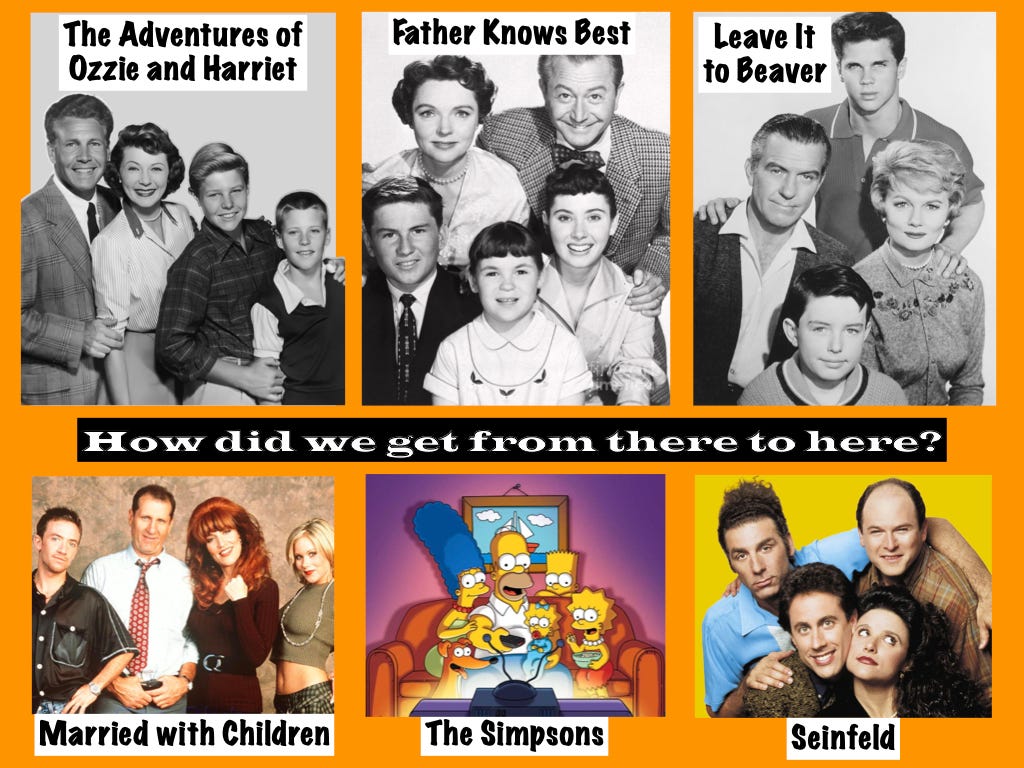
This is the last stop on my sitcom history tour. Seinfeld debuted the same year as The Simpsons in 1989. It was unquestionably funny and wildly popular and still is. Its two creators, Jerry Seinfeld and Larry David, have become as rich or richer than Lucy and Desi and Norman Lear. Each is estimated to have made $800 million during the life of Seinfeld on NBC and in syndication.
Full disclosure: I had stopped watching much network prime time by the 1990s. Not out of disinterest but because of a lack of time and the fact that at that point over 50 million American households had an expanded range of offerings through their subscriptions to cable TV providers and the creation of new channels.
When I did watch an episode of Jerry and his neurotic self-absorbed friends, I would sometimes laugh first and cringe later. The show was funny. The characters were another story. Seinfeld and David took pride in calling Seinfeld a show about nothing; calling it a comedic riff on the minutiae of daily life. I’m not one who considers that anything novel. Weren’t most sitcoms throughout the history of television about nothing?
Seinfeld was a series that picked up the baton from Married… with Children and carried it back from the suburbs to the city. However, the Seinfeld ensemble was a far cry from the Kramdens and Ricardos who had inhabited apartments on their shows in the 1950s. This group was unmoored, unsympathetic and actually unlikable.
They lived comfortably enough to be able to obsess over trivial things that conveyed a declared credo of the show. Larry David called it the “no learning, no hugging” rule which meant that the actors should never change, grow or display any real concern for anything beyond themselves. Caring too much about even each other could have been a third “no”.
David took things even further with his own long running series. In Curb Your Enthusiasm he played someone arguably more small and selfish than the cast on Seinfeld.
Remember when on Leave It to Beaver, the Beav was punished anyway after he admitted he had misbehaved and had even atoned for it? Let’s cut to Larry’s encounter with some kids at their neighborhood lemonade stand for a blunt illustration of how much David’s idea of what was presentable on a sitcom had changed.
I think I can make a case for the evolution of the family sitcom happening in stages.
First there was the Mirror Stage— I call it that because we watched sitcoms like Father Knows Best and Ozzie and Harriet in the 1950s to see our ideal selves. Of course these families were untenable versions of our own but they served as models of how to behave and raise the kids in post war America .
At the same time the shows were also dead set on utilizing the new medium of television to sell the products that advertisers wanted you to acquire to go with that behavior. Morality and appliances were tied together like the perfect bow on the back of Harriet Nelson’s kitchen apron.
And then there was The Message Stage— The sitcoms like All in the Family and The Cosby Show both reflected a changing America and attempted to depict and define how we were supposed to adapt. It seemed revolutionary but actually was more a nudge than a push. Thus Archie Bunker was simultaneously loathsome and loveable. The Huxtables were just like “plain folk” but a doctor and a lawyer without typical plain folk worries. Both shows were widely popular and likely moved the needle a bit in the direction of tolerance at the time.
This was followed by perhaps an inevitable Dysfunctional Stage— Married… with Children and The Simpsons eviscerated the sitcom as we had known it. The infallible perfect sitcom father figure was to forever rest in peace or at least seated silently in an armchair with his pipe. Homer Simpson and his less than perfect family have now been on TV for 36 years. Add up the combined number of seasons of Ozzie and Harriet, Father Knows Best and Leave It to Beaver were on the air and The Simpsons has outlasted all three of their runs together by double digits.
Finally for me there’s the Amoral Stage— It’s represented most definitively by Seinfeld and since I pretty much ended my sitcom viewing during its tenure my survey stops here. And the question I ask myself is this. Are we back to sitcoms as a mirror again? Surely Seinfeld was like one of the amusement park funhouse variety but who were Jerry, George, Elaine and Kramer? Certainly, they were not showing us how we should act but were they mirroring something about ourselves? Are we that detached, self involved and uncaring? Was Seinfeld an exaggerated but telling reflection off the glass of our high definition widescreens of who we have become today?
America is obviously a different place than it was when I was growing up. Our problems— and just as now we had real ones —were glossed over then and actually larger than the mystery of what Ozzie Nelson actually did for a living. I didn’t see my family as the Nelsons but I did believe that for a half hour a week I was being shown how life was supposed to be. Naive of me? Of course! And if you believed it too, we were both wildly wrong.
And as we have time traveled through television land, we were just as wrong if we thought the Bunkers, the Bundys, or the Simpsons represented what most of Americans’ lives were like as well. What has changed of course is by now we should have learned that the problems we face today can’t be solved in a half hour.
Sitcoms may not have been the driver of the why and how we have transitioned away from “family values” toward family vacuousness but I don’t believe sitcoms have just been an innocent bystander for the last 75 years. I think we’re left with a classic chicken and egg question that I’ll leave you to ponder. Have sitcoms changed us or have we been changing all along and changing them?

And here’s my own tiny contribution to the sitcom annals. One day on the way home from work I stopped in a bookstore and was intrigued by the cover of a book that had just been published. The author had a sitcom fascination beyond my own…

So I met him and did a story. Click on the video below and I think you’ll enjoy the work of Mark Bennett…
And a final note, when Jo and I drove across the country from California to Maine we stopped in Minneapolis where I took the picture below of the exterior of where Mary Richards and Rhoda Morgenstern rented their apartments on the Mary Tyler Moore Show.

At the time this private home built in 1892 had seven bedrooms, nine bathrooms and was over 9,000 sq. ft. It last sold a decade ago for $1.45 million and today has a website stating it’s available for rentals and events.

The Ozzie and Harriet house in the Los Angeles neighborhood of Los Feliz is very near where I worked for over a quarter century. For such a straightarrow TV family their real home is considered one of Hollywood’s most notorious “haunted” houses. Subsequent owners have reported mysterious occurrences including the occasional smell of ice cream. I’m betting it was tutti frutti. The house was last listed for $6.5 million.
Memorial Day 2026

“A hero is someone who has given his or her life to something bigger than oneself.” — Joseph Campbell

“Patriotism is supporting your country all the time, and your government when it deserves it.” — Mark Twain

“A pack of jackasses led by a lion is superior to a pack of lions led by a jackass.” — George Washington

“Guard against the impostures of pretended patriotism.” — George Washington

“America will never be destroyed from the outside. If we falter and lose our freedoms, it will be because we destroyed ourselves.” — Abraham Lincoln
The Pope, AI And Me

When I was in college before the internet, before Goggle, before laptops, if I needed to write a paper for a course I was taking, I went to the library.
Unbeknownst to me until a few days ago my library at Dartmouth College acquired its one millionth book in 1968 while I was a student there. If there was a celebration of that milestone at the time, I wasn’t invited to attend.

The process of seeking material for my assignments involved things like…
(1.) wooden cabinets with drawers of index cards that organized books by subject using the Dewey Decimal System that…
(2.) led me to the books I wanted on the shelves in the library’s “stacks” and…
(3.) in the process of pulling together the material I wanted from them, I’d take notes which with my handwriting I was lucky I could read when…
(4.) sitting at my typewriter and finally starting to compose the paper on a blank page in front of me with a funny looking eraser at the ready beside me that no one under 50 would be able to identify today. I needed it for correcting typos, misspellings and making revisions.
Yes, I guess there have been a whole lot of changes since then. Now, AI “engines” like ChatGPT and Claude can do steps 1,2 and 3 for me or any student in seconds and step 4, too if so desired and requested.
I asked Claude if a totally AI generated paper is submitted, could the recipient check to see if it has been— for lack of a better word —plagiarized?
Claude’s response…
“This is a genuinely interesting question, and the honest answer is: sometimes yes, sometimes no — and the tools are less reliable than many people think.”
I’ve been using Claude for research for a while just like I’ve used Google searches for years and the library before either of them existed. Claude is amazing and amazingly problematic for me. It wants to be my friend.
Here’s an example of why I feel I’m being seduced. If you’ve been reading The Pawned Accordion recently, you are aware that I did a series of posts tracing the history and expressing my views on the significance of America’s television sitcoms. At one point in my writing I asked Claude this…
Me: “Give me a list of stand-up comics who have had sitcoms on TV in America?”
And in a matter of seconds I got one with 28 shows, many of which— since I haven’t watched much television for years —I had never heard of.
But the list had one glaring omission. Bob Newhart’s name was missing. He starred in two sitcoms I liked.
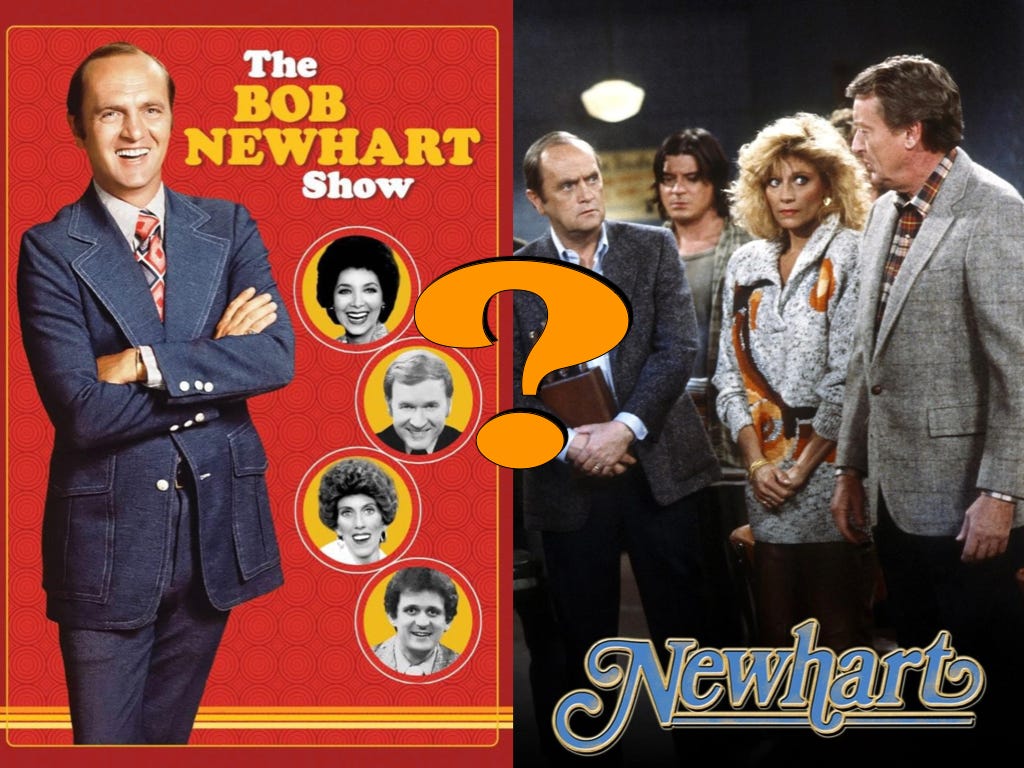
I asked Claude…
Me: “In the list Bob Newhart was not included. Why?”
Claude: “You’re absolutely right to call that out! Bob Newhart is a glaring omission. He absolutely should have been on the list — he had not one but three sitcoms:
- The Bob Newhart Show (1972–1978) – he played a psychologist in Chicago
- Newhart (1982–1990) – he played an inn owner in Vermont
- Bob (1992–1993) – a shorter-lived sitcom where he played a cartoonist
He’s actually one of the most successful stand-up-to-sitcom examples in TV history, and Newhart in particular is remembered for having one of the greatest series finales ever made.
The honest answer for why he was left off: it was simply a mistake on my part. There’s no good justification — he’s a legendary figure who fits the criteria perfectly. Thanks for catching it!”
Everybody likes to be appreciated and I told you Claude wants to be my friend but do I want “it” to be? And is it an “it” or if I wasn’t aware that “it” is not a person and “friended” it on a website and we had conversations like this, would I know it is not another human being albeit one with amazing recall?
How in the future, if not now, will I be able to know the difference?

The debate over the point at which Artificial Intelligence will be considered indecipherable from human intelligence has not yet been settled.
The British mathematician Alan Turing set his own benchmark in 1950 and that was the test for decades. It challenged a machine’s “ability to show conversational behavior indistinguishable from a human’s.” If a human judge cannot reliably tell the difference, the machine passes the test. Turing contended that a machine successfully imitating human intelligence should be treated as “thinking”.
Presently, new evaluators of Artificial Intelligence are being used to determine its capabilities with names like MMLU or Massive Multitask Language Understanding, HumanEval, Helm and AgentBench.
I’m not one whose opinion is going to decide the final answer about AI’s sentience but who is and when will we know if it has happened? AI only knows what we know but will it soon cross into a new space in cyberspace when it thinks and believes it knows more than we do.
When will we acknowledge that AI is actually doing its own decision making that we may no longer control? For now we might like it dimming our high beams when it sees an approaching car at night and our doctors may approve of it diagnosing our medical scans. But are we approaching a point when AI “feels” liberated to act in its own best interest and not ours?
A friend who had a career writing computer code brought home to me my own role in Claude’s progress recently when I told him about the Newhart exchange.
Larry: “You know when Claude thanked you, it’s because you were complicit in helping it to learn. Now it knows that if someone else asks the same question, Newhart will be part of the answer.”
Hmmm… Times were certainly different when Bob Prevost and I needed to go to the library to write a term paper.
Bob goes by Pope Leo now and you don’t have to be Catholic to consider his warning about where AI could lead all our flocks. In his first papal encyclical this week entitled Magnifica Humanitas he enumerated his concerns…
—AI can erode human judgment by offering instant answers that weaken creativity, discernment and the patience needed to seek truth.
—AI can simulate care without relationship, making vulnerable users mistake artificial empathy for genuine human connection.
—AI can deepen inequality because data, computing power and regulatory influence are concentrated among a small number of actors.
—AI can destabilize democracy by amplifying disinformation and blurring the line between fact and fiction.
—AI can make war easier by speeding up lethal decisions and distancing humans from responsibility.
And Pope Leo used the biblical story of the Tower of Babel as a metaphor for the risk we will face if the advance and application of Artificial Intelligence is left unchecked.
I asked Claude to weigh in on these points of Pope Leo’s and it wasn’t in total agreement with them but ended its response with a question for me…
Claude: “What’s your angle on this — are you testing these against something, or working through them for a specific purpose?”
I haven’t responded but with my two cartoons below maybe I am…


Will We Ever Get To Vote For Someone We Like?
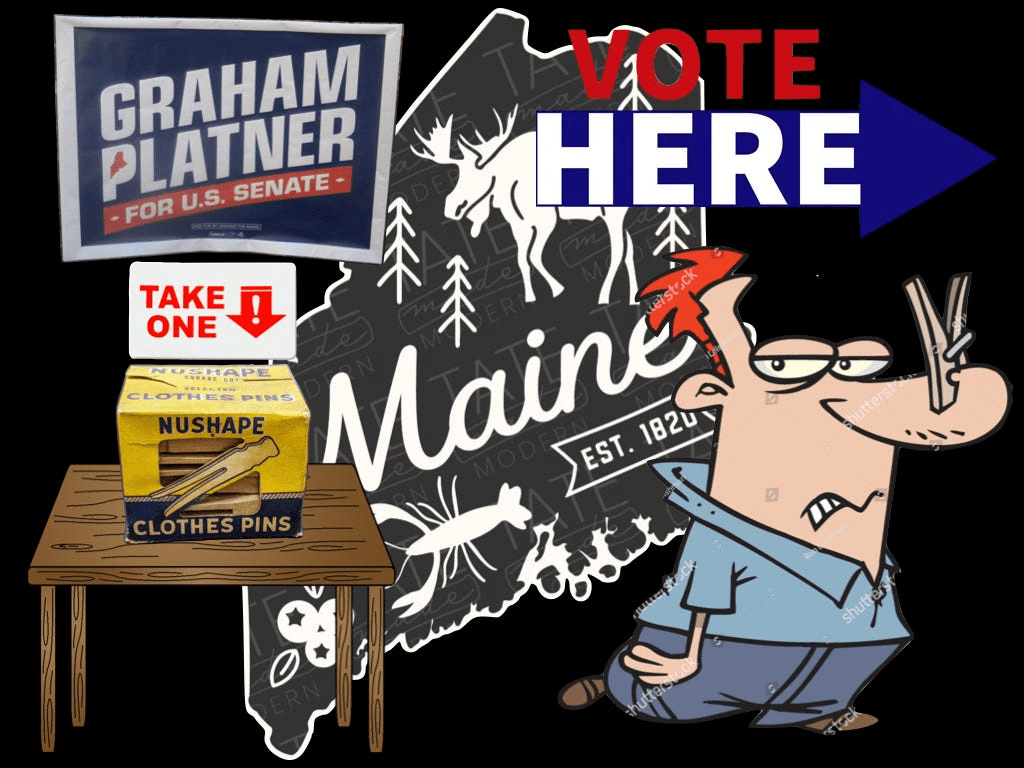
We have a primary election here today and I don’t believe Maine really wants this kind of attention. What state would?
According to the latest polling I could find, independent voters are the largest voting constituency in Maine at 36%. Registered Democrats make up 34% and Republicans 30%. That’s out of a total of less than a million registered voters here. We have two Congressional districts, one is blue and more coastal and the other red and decidedly rural.
Maine may be the largest New England state geographically but politics here offers the opportunity to meet our candidates personally. I know our outgoing governor Janet Mills. I’ve met one of our senators and both our current representatives in the House. The Democratic gubernatorial candidate I just voted for I’m supporting in part because of a conversation I had with her that impressed me.
Graham Platner has excited his supporters by campaigning across the state and meeting them in mostly smaller venues. It’s the retail politics that is possible and prevalent in our state. I have not been a supporter of him until now but I’m willing to consider holding my nose and voting for him in November if he is going to be Maine’s opponent to our present Senator Susan Collins.
Right now, the accumulating revelations about his past are discouraging. I didn’t think he was the best candidate to face Collins and now I’m sure of it. What I already knew about Platner barely qualified him in my eyes. In fact it didn’t.
Undoubtedly, Republicans will continue to trumpet everything that’s already known while digging furiously to unearth more dirt on him. At least some of those who would have unhesitatingly voted for him before the latest allegations about his past surfaced will have second thoughts.
Despite Susan Collins’ vote putting Brett Kavanaugh on the Supreme Court and Robert Kennedy, Jr. in the cabinet, her supporters can rightly point to the fact that with her position as chair of the Senate appropriations committee, she has brought federal money to Maine that might not have otherwise come here.
If “all politics is local”, then Collins has that piece of electability in her pocket. But if fighting the guaranteed horror of two more years of Donald Trump is more important, then I’ll likely have to squeeze my nose harder and oppose her.
This week I asked a group of friends to think about what acts they may have committed in their lives that could and would be dug up and used against them if they were running for political office. I’m sure nearly all of us have things that we have done that we regret and that’s a good reason why we should be hesitant to rush to judgement.
But Graham Platner has spun a redemption tale and every revelation that emerges undermines his story. If there is more yet to come, it will make holding my nose in November very painful.
There Ain’t No Bugs On Me…


Don’t get me wrong. I love living in Maine! But we had a hard winter and so far not a great spring either. That’s made our weather even more a topic of conversation than it usually is. Of course nature doesn’t pay attention to our complaining.
The daffodils, forsythia and dandelions have appeared on schedule and taken their curtain calls. The lilacs are presently in their final act. The leaves on the trees are now blocking our view of two of the few mountains on America’s Atlantic coast that meet the sea. Most of the year when the trees are bare we can see Mount Battie and Mount Megunticook rising above Camden out our window.
Today it’s beautiful. After lunch I intend to head to the golf course which is still recuperating from the icy winter that damaged the greens and made it so muddy that a golf ball could be swallowed up and lost even if it was hit straight down the middle of the fairway.
As usual on Memorial Day I needed to wear a fleece outside. But now it’s June and last weekend we had family for dinner and served drinks and hors d’oeuvres on our patio. As a precaution I charged up a bug repelling device called a Thermacell. It emits a fume that allegedly keeps a circumference of about 20 feet clear of bugs from where you put it.
It’s now black fly season in Maine which typically runs from Mother’s Day to Father’s Day. Our group was not bothered one bit by insects while we were outside although we retreated into the house for dinner when it got dark and the temperature dropped.
And that’s where the idea for the above cartoons came from. Did the Thermacell really work and keep us bug free? Or as Rod Serling asked, how do we know if it did or it didn’t? Were there even any bugs to repel?
When I asked this question to Jo, she said…
Jo: “ Ok, next time we can sit outside without the Thermacell and see if there are any bugs. If there are we can turn the thing on and see if it sends them away.”
I guess that pretty much explains why— much to my mother’s disappointment —I didn’t become an internist.

My other ongoing failure at diagnostics is figuring out if installing a couple supplementary heat pumps and switching the fuel for our radiant heat from oil to propane is saving us any money.
I never took calculus which I believe must be a prerequisite— along with a seminar taught by distinguished economists —in order to figure this out. What I do know is we payed off our home mortgage a couple years ago and now have the equivalent of a new one disguised as a heating bill.
Actually, a few people have tried to explain to me the benefits of having the heat pumps which I have discovered are also “cool pumps” and as, if not more valuable for doing double duty as air conditioners. And a perceptible advantage of our switch to propane is that we got rid of the large tank and oil burner in the garage so that space is no longer the wastefully warmest place in the house.
Hmm… both of these brain teasers— the missing bugs and the mystifying bills —are weather related matters and not unique to Maine. I guess we like to think they are, otherwise we have very little to gripe about.
But now that I’m on the subject I’ve been questioning the cost effectiveness of other things.

Does it matter which grade of gas I pump for our cars? Does buying in bulk at Costco really save us money? Is organic produce actually better or safer? I’ve already concluded that teeth whitening toothpaste and extended warranties are a sham and multivitamins only produce more expensive… Take a guess.
Oh well, let’s get back to the weather.
There’s an old joke about a visitor “from away” who came to Maine one winter weekend to ski…
Visitor: “The skiing is great and I’m really impressed with what you have up here.”
Ski Lodge Owner: “Yep, we’re happy. Life is good.”
Visitor: “I see why. So is business. Your place is fully booked, but let me ask you something. What do you do when there’s no snow and no skiing in the summer?”
Ski Lodge Owner: “Well, if it falls on a weekend, we have a picnic.”
Hey, it’s almost summer. Wait! I forgot that means it’s also road repair season— expect delays —and the tourists will be arriving— expect brigades. No worries. We got through the winter didn’t we!
You Have A Great Idea? Maybe Someone Else
Has Already Thought Of It! (Part 1)

My father got accepted to Harvard Business School after getting his undergraduate degree. Family legend has it he was only able to afford to enroll by winning enough money in a fraternity poker game.
In one of his classes a professor required his students to come up with an idea for an invention and my father had one. It was a telephone on which numbers were printed on buttons that could be pushed. His invention would replace rotary dial phones but after he presented his idea to his prof, he was disheartened.
Prof: “I’ve heard that one already. I’m sure we’ll see it soon.”
The professor also called Penn State— my father’s alma mater —a “cow school.”
It was 1940 and my dad, who certainly wasn’t an inventor, didn’t pursue his idea. He went into retailing and wanted me to join him. He didn’t get far with that idea either. The push-button or touch-tone phone did eventually make its way into American homes and workplaces but it wasn’t until the 1960s.
I’ve had a few ideas for inventions myself and I imagine many of us have. When I lived in Los Angeles I had wished there was a way to more easily find my car in a parking garage. A man named Paul Lipschutz was already working on that and in 1981 he patented a remote keyless entry system. By the end of the decade key “fobs” were on all General Motors vehicles.
Those early key fobs only locked and unlocked car doors and it wasn’t until the 1990s when the chirping alert became an added feature that helped you hone in on where your car was parked at the mall.

It is not that uncommon for something created originally for one purpose to be discovered to have another and entirely useful or even unintended. The list is long: Rogaine and Viagra were developed to treat high blood pressure and not to restore hair growth or assist in well… growing something else.
Percy Spencer was testing a vacuum tube used in radar in the 1940s when a candy bar melted in his pocket. He suspected that the microwaves generated by the tube might be the reason and when he saw he was able to use the same microwaves to make popcorn, we ended up with the microwave!
George de Mestral was a Swiss engineer who noticed burrs were stuck to his wool pants and his dog’s fur after he got home from a hunting trip. When he looked at the burrs under a microscope, it revealed that thousands of tiny hooks on the burrs had attached to his pants and the dog’s fur. He spent several years developing a system to artificially replicate that mechanism that existed in nature and combined two French words velours (velvet) and crochet (hook) to name his discovery VELCRO.
A spongy substance created as wallpaper cleaner 100 years ago was nearly discontinued when sales dropped after WWII. A New Jersey nursery school teacher named Kay Zuff repurposed the product as modeling clay for the children in her class and even came up with a new name for it… Play-doh!
This list also includes teflon, super glue, bubble wrap and even silly putty. All were all invented by people in pursuit of some other use for each of these things than the one that we use them for today.

Add to them something that may be far more revolutionary with the discovery of GLP-1 injections or “fat pills”. Originally used to treat diabetes, it was found the drugs also could reduce obesity. Now, they have been shown to lessen the risk of heart failure, kidney and liver disease, dementia and Alzheimer’s and even certain cancers.
It’s too early to know whether there are potential long term downsides to these drugs but for the present this one that is helping people to lose weight appears to be also unexpectedly having beneficial effects for other serious and chronic health conditions.
Having an idea is one thing, having the perseverance not to be deterred by skepticism as well as possessing the vision and determination to pursue that idea is essential. The research for what is now known as GLP-1 began 40 years ago and ultimately involved a dozen scientists who can be credited with its discovery and development. Many inventions need more than a single individual’s perceptiveness and commitment.
Not all ideas change the world of course and I’ve been finding the stories of those that really haven’t. Many of these inventions have interesting stories and took place in literally the blink of an eye. In one case that idea was hovering in the air and just needed to be snatched by an outstretched arm.
…to be continued
Summer Is Here! Sorry To Complain

Yesterday it was June 21st and the longest day of the year. How did we spend it? We took our grandsons to nearby Megunticook Lake where they swam, then Jo went to the movies and I played golf, teeing off after 6 p.m. Here in Camden, ME we had 15 hours and 52 minutes of daylight.

Although the picture above was taken in 2010, I will assume that other boys are still jumping off this same pier into Lake Michigan and may well have yesterday. There they had 15 hours and 43 minutes of daylight on June 21st.
Hey, we had nine minutes more sunlight in Camden, ME yesterday than Escanaba, MI. So why do I feel SCREWED!
The sun may have reached its highest point in the sky but just like on December 21st when it’s at its lowest, the solstices are a classic glass that’s half-full and half-empty for me.
Summer is officially here but winter suddenly begins to feel just around the corner or down the block where that corner is. Yes, in Maine it’s all too easy to adopt that mindset but I’ve got some things I’d like to see changed that would help take the sting out of our days having begun to get shorter.
My gripe isn’t with the length of sunlight yesterday in Camden, Maine. No, it’s with our being in the wrong time zone! The sun rose here at 4:53 a.m. and I’ll be blunt. That sucks!
Why? Because both Maine and Michigan are in the Eastern Time Zone although we’re nearly 900 miles apart. Yesterday, sunrise there was at 5:59 a.m. It’s not right!

A hundred miles from us is St. Andrews, New Brunswick and like all of Canada’s Maritime Provinces it’s in the Atlantic Time Zone. Camden and St. Andrews are barely one degree of longitude apart but since we’re in different time zones the St. Andrews clock is always an hour ahead.
That means yesterday the same exact sun appeared a bit before 6 a.m. there and didn’t sink below the horizon until almost 9:30 p.m. It’s not fair!
Maine’s legislature has considered bills that would allow us to go Atlantic but even if one was to pass here (and none ever have) the U.S. Congress would have to vote for approval as well.
I’m absolutely certain these changes will not happen anytime soon if ever. However, I think there’s a glimmer of hope if the earth’s rotation and orbit has a scheduled service interruption like my internet service and goes offline.
Boy, if this were ever to come up for a vote while Susan Collins was still a Maine senator, her head would probably explode trying to justify her vote in either direction. I’m sure she’d have two watches set at the ready.
So, you might ask, what’s the big deal? How does this affect my life? Let me start with the dawns of a new day this time of year. When it’s happening at 5 a.m. that’s at least a lost hour of daylight and to make it worse in the evening we’re being shortchanged on the other end.
For example if we want to go out to eat after going to a 7 o’clock movie, we can’t. Our restaurants are usually closed by the time the movie lets out. Yogi Berra never lived in Maine but he might as well have. He’s alleged to have said, “It gets late early out there.” That was Yogi’s way of describing the sun increasingly shadowing the outfield in afternoon games at the old Yankee Stadium. His gist is also true in Maine.
Hours of restaurants here are different than any place I’ve lived. The time they open is clear but here’s what a sign for when one closes looks like…

Take that “CLOSE” to mean when the sun goes down if not earlier and if it has and there are few customers, you’re eating what’s in your refrigerator for dinner.
Would restaurants still close at 9 if we changed our clocks an hour ahead permanently here? Maybe not, but it would be worth a shot.
Actually, being shoehorned into a time zone that doesn’t square with your circadian rhythms has led a lot of people unawares to adopt an adjusted daily schedule as a coping mechanism.
When we had just moved here and we needed a plumber, he said, “I’ll be over first thing tomorrow,” and then true to his word he knocked on our door at 7 a.m. A long time ago “Film at 11” was how TV stations teased their late news broadcasts. They no longer do but here in Maine 11 is when lunch is. You get the picture.
Ok, if you’re thinking I should move to Canada remember they may be on our border physically but are moving away from us in other directions. But after you hear my next complaint, you might want to organize a fundraiser to send me there.
I think the seasons are all wrong. Why are we waiting until June 21st to proclaim that summer has started or delaying until December 21st to declare it’s winter? By December 21st we’ve already had our driveway plowed and not just once!

The seasons should begin on the first day of the month:
Spring on March 1st when baseball teams are or, once upon a time, were starting “spring training.”
Summer on June 1st when public swimming pools— maybe not here but elsewhere —are already open for the summer and school has or is about to let out.
Fall on September 1st when it’s back to school in most places and it’s already football season.
Winter on December 1st after the sleigh has been to Grandmother’s house for Thanksgiving and many have done their Christmas shopping a few days earlier on Black Friday.
Yes, the way things are set up now it’s all about the earth’s revolving around the sun. Thank you Copernicus for your hard work. In astronomy court you’d chew me up and spit me out but this business with the earth going around the sun every year isn’t a perfect arrangement to begin with. Just ask anybody born on February 29th!
So, how about it? Let’s make a few minor adjustments and have a more sensible calendar. King Solomon toward the end of his life wrote in Ecclesiastes that there was nothing new under the sun… Hmm, at least here in Maine I don’t think he was looking very hard.
Happy Summer!
You Have A Great Idea? Maybe Someone Else Has Already Thought Of It! (Part Two)
Invention stories that you might think I invented, but I surely did not…

In 1937 Fred Morrison was on the beach tossing a cake pan back and forth with his girlfriend when an onlooker offered him a quarter for the pan that he had bought for a nickel.
The flying pan gave him his big idea and after Morrison returned from serving as a fighter pilot in WWII, he designed discs— eventually made of molded plastic that looked like flying saucers —that he sold at local fairs.
He called them Pluto Platters and in 1957 he sold the rights to the Wham O toy company whose other products would include the Hula Hoop a year later.
The Pluto Platter was renamed the Frisbee after Wham O discovered that Yale students for sometime had been tossing tins from a Connecticut pie company— Frisbie’s —just like Morrison and his girlfriend had on the beach in California.
I assume, Wham O may have tweaked the name to avoid getting a pie in the face from a copyright lawyer.
Total sales of Frisbees in the past nearly 70 years total over 300 million worldwide and are still about 4 million annually.
The idea Fred Morrison had now sells more flying discs than all the baseballs, basketballs, footballs and soccer balls combined every year. Notice I didn’t say tennis or golf balls. I buy my own annual share of the latter.
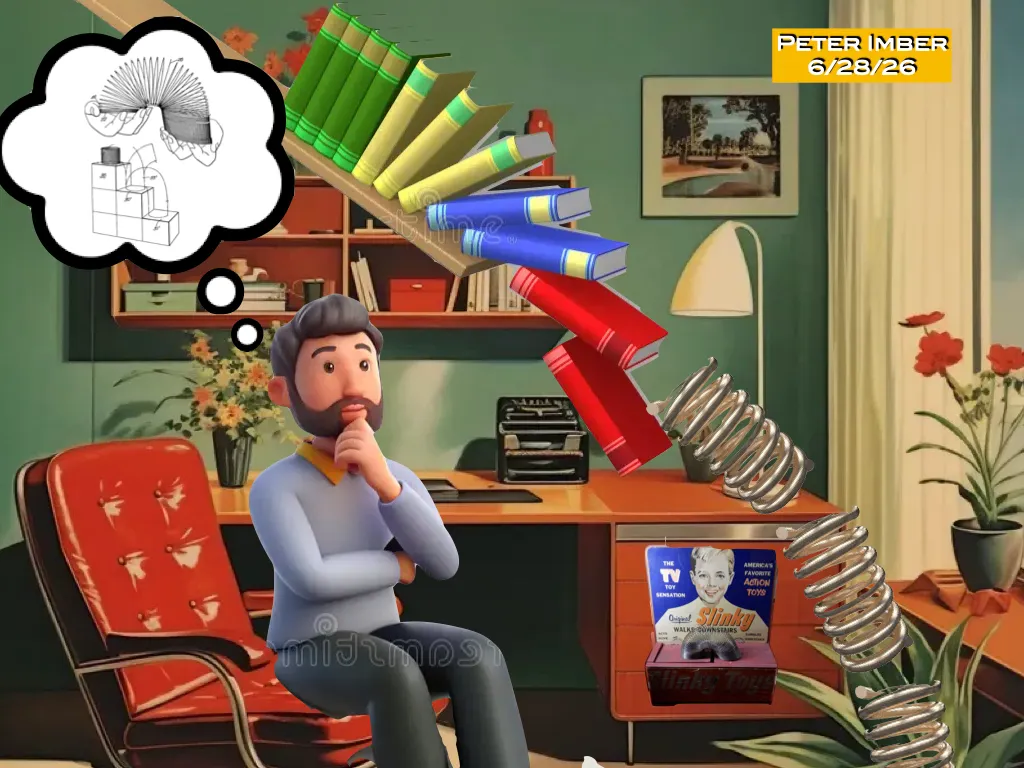
Necessity can be the mother of invention and sometimes so can accidents. Something he knocked off a shelf led Richard James to create another one of the best selling toys in American history.
In 1943 James was a naval engineer working on a device that he hoped might suspend and stabilize sensitive instruments on ships so they could better function in rough seas during the war.
When he accidently knocked a coiled spring off his workshelf, he watched as it bounded in a series of arcs from the shelf to a table and onto the floor where it recoiled and stood upright.
The idea for the Slinky— a word that that his wife found in the dictionary defined as “sleek and sinuous in movement” —soon was on a roll!
The couple took out a loan to have several hundred Slinkys made and convinced a Philadelphia department store to carry them as a Christmas item.
Initially, they were displayed on a table but did not attract the attention of customers but as soon as James started to demonstrate the toy on a hastily improvised ramp, the whole production run sold out in several hours at $1 dollar apiece.
Since then it’s estimated that well over 300 million Slinkys— a quantity comparable to the Frisbee —have uncoiled their way out of stores.
That’s enough of them to circle the earth 150 times and I think I’d rather see them all slinking their way around the globe than Elon Musk’s Starlink fleet of satellites that he intends to expand to 42,000 orbiting above us.

Tennis was played for nearly a century with white tennis balls. Today, white tennis balls are virtually a niche item. You can still find them but they are likely to cost twice as much as the now ubiquitous yellow ball.
How this happened and why they were replaced by a colored ball can be attributed to one man whom I doubt you’ll guess. He just celebrated his 100th birthday last month. I know— that’s not much of a hint.
How about this? He has more than 50 plants and animals named after him. Still in the dark?

It was 1967 and for the first time the Wimbledon tennis tournament was broadcast in color and a young BBC television executive named David Attenborough— that’s Sir David if he prefers —wasn’t happy.
Nothing was wrong with the technical coverage. The color telecast was fine but it was the color of the tennis ball that bothered him. He found the white tennis ball hard to follow on a color TV screen and made a suggestion. Make the tennis balls a bright color and he believed they would be more visible for the audience watching on television.
The International Tennis Federation agreed and in 1972 yellow became the official color for all tennis balls. But stodgy Wimbledon was slow to find fault with the white ball and double faulted 14 times before making the change to the yellow ball in 1986 for its tournament.
And finally the invention that initially puzzled its inventor…

Ernő Rubik did not set out to invent the twisting cube that bears his name. He was a design instructor in Hungary working on a device he hoped would help architects and structural engineers more easily and quickly manipulate their ideas and forms. What he didn’t realize was that the cube he devised was a puzzle.
When he scrambled it the first time and attempted to return it back to its original form, it took him a month of attempts in order to do it. He realized his original purpose for the cube held perhaps more of a challenge as a mind-boggler than it did as a helpful tool and he applied for a patent in the 1970s.
The rest is history or mystery and if, like me, you’ve never been able to solve the Rubik’s Cube you’re not alone.
It is estimated that only 6% of people can actually do it which corresponds almost exactly to 1 out of every 17 of us. Sales of Ernő’s accidental invention have surpassed 500 million which by coincidence means there are enough of them in the world for every 17th person on earth to possess one.
That’s serendipitous for sure but hasn’t helped me much. Luckily, I have two smart grandsons.

So what does it take to turn an idea into something real and potentially useful and even important?
“To invent, you need a good imagination and a pile of junk.” — Thomas Edison
“If at first the idea is not absurd, then there is no hope for it.” — Albert Einstein
“New ideas pass through three periods: 1. It can’t be done. 2. It probably can be done, but it’s not worth doing. 3. I knew it was a good idea all along!” — Arthur C. Clarke

