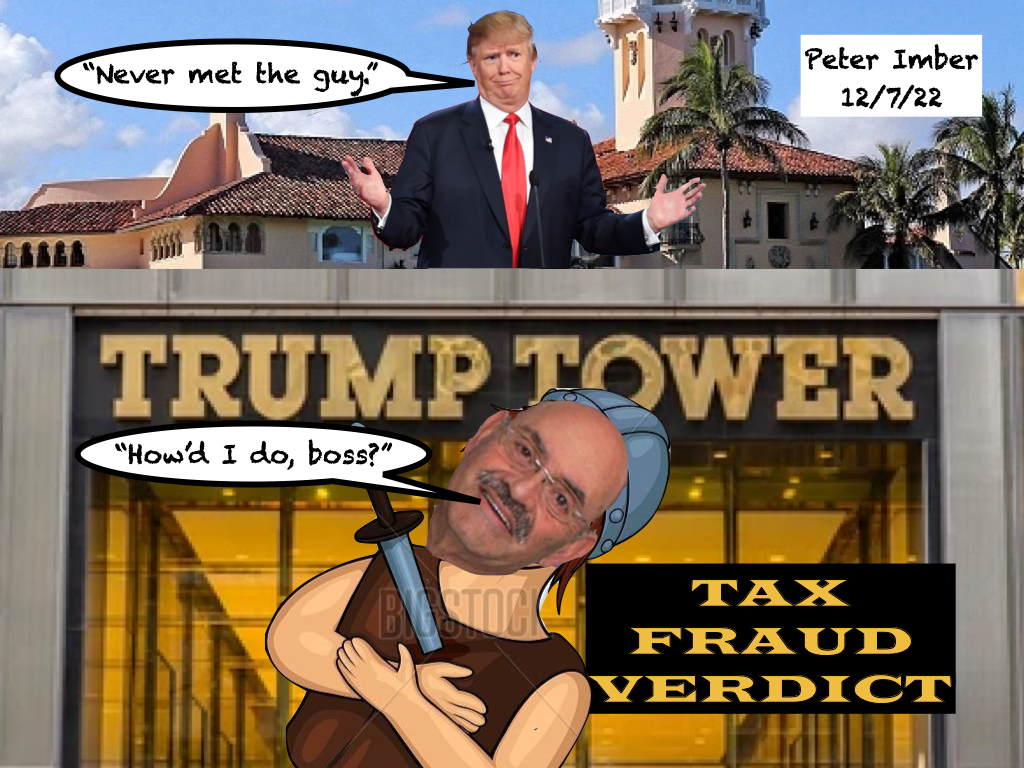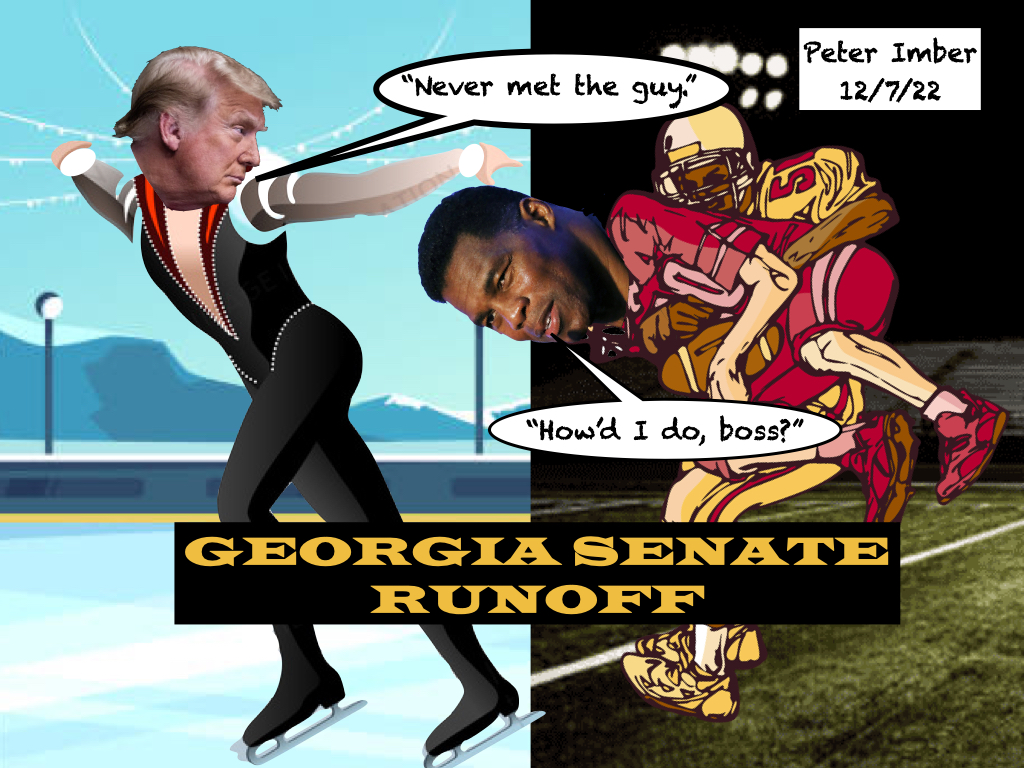
Homemade Cartoons for November 2022

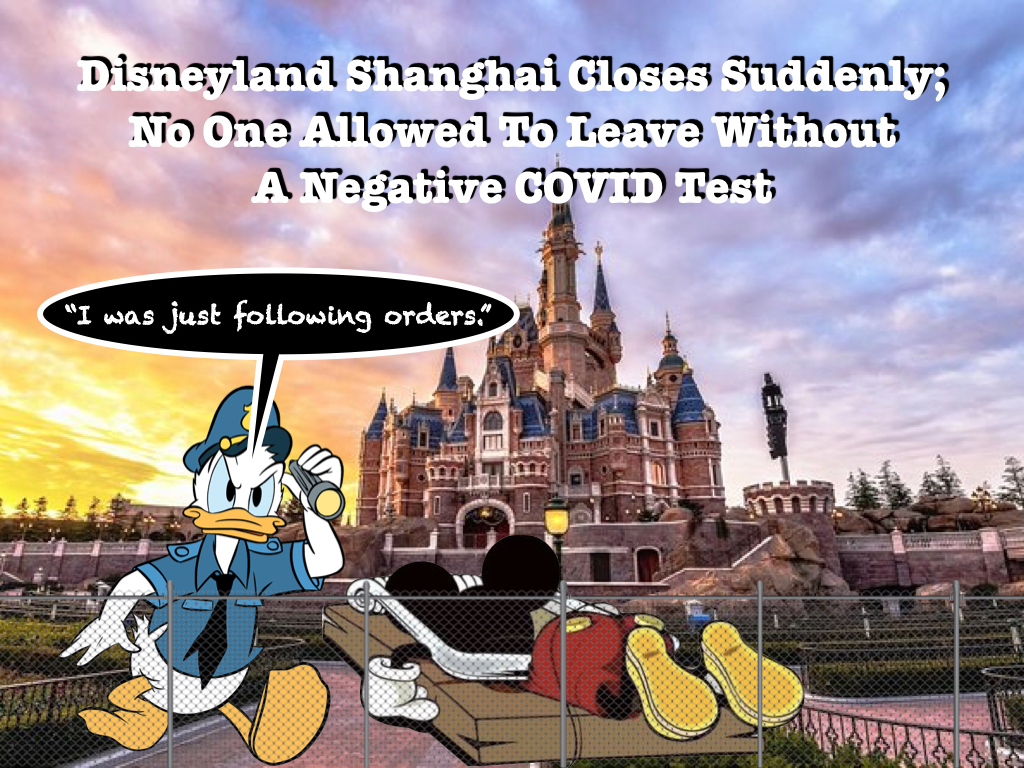
Becoming trapped in the self proclaimed “Happiest Place on Earth” really happened on Monday in China. Apparently, a recent visitor to Disneyland in Shanghai tested positive for COVID and when word reached the park the gates were promptly shut and no one was allowed to leave until having a negative COVID test. Mobilizing and testing an estimated 20,000 visitors and workers was done swiftly and when everyone reportedly was cleared their detention ended after only a few hours.

During the confinement the park’s rides continued to operate and while any dreams of sleeping overnight with Sleeping Beauty didn’t get realized, goofing off with Goofy likely was possible.

Now, let me ask you a question. What do you think the response in either of America’s Disney parks would have been if a similar action had been taken by the management? Would 20,000 of us have been calm and compliant? 

Americans have been divided since the beginning of the pandemic over how seriously to deal with COVID and millions ducked sensible measures that might have prevented many thousands of deaths. I can only imagine the reaction in Anaheim or Orlando if the gates of those parks had been shut and visitors told, “Nobody gets out of here until we test you!”

The authoritarian screws are tightly fastened in China. Xi Jinping is positioning himself to be its dictator for life. His uncompromising zero-COVID edict that has at times locked down vast swaths of the country’s population may not be popular but has been virtually unopposed. Protest is anathema in China. Its citizens get very little uncensored information on which to judge their government’s activities and cruel consequences if they oppose it.

In our country on the other hand our freedom of information has now been thoroughly corrupted by misinformation and the ease by which it has been spread and astonishingly believed. Nobody I know would call today’s China a democracy. The sad thing is that it’s getting harder to call what we are evolving to be in the United States the democracy we used to know either.

One of the more popular rides at all the Disneylands around the world is Pirates of the Caribbean. The attraction has inspired five movies that have grossed $3.7 billion. At Disneyland in Shanghai the ride’s name has been amended to include Battle for the Sunken Treasure.

Seems to me that change is appropriate to make at America’s parks as well. It’s a battle we should have seen coming and I only hope we can wage successfully.

—————–

It’s November in Midcoast Maine and today the temperature is in the 40s. That’s seasonally appropriate. But yesterday, according to the thermometer that’s outside the window by my desk, the temperature here reached 70 degrees.

This past weekend it hit 75 in Portland which was the all-time record high in November for the state. My golf course has already closed for the season but it’s been strange realizing that winter is on the way while raking leaves in shorts and a t-shirt.

There are way too many things to be anxious about these days and although having lunch outside on our patio Monday felt like a gift, I know it’s a gift horse. The earth is heating up and our country, if not our species, seems to be melting down.

Over the weekend I took our grandsons to a high school production of the musical Mamma Mia. Afterward the ten year old said he enjoyed it. When I asked the six year old if he’d been bored, he said, “Only for an hour.” For me it was sweet and inspiring to see a bunch of teenagers dance and sing their hearts out but I wondered if they saw the future as fearlessly and unlimited as I had at their age.

My generation thought we were going to change the world. We have but not in the ways many of us expected and hoped for. I just returned from voting. The polling place in the Camden firehouse was crowded. Climate Change wasn’t on the ballot but democracy as we believe we know it most likely was.

—————–

I had just arrived in Israel in 1972 and expected to stay six months which would turn into seven years. The country was still celebrating its surprisingly decisive victory in the Six Day War that had occurred five years earlier. Most Israelis felt their future existence had been secured but of course in 1973 the Yom Kippur War demolished their optimism and bruised their self confidence.

That September I watched the 1972 Olympics one night with a group of kibbutz members. The games were being held in Munich and a few days later 11 members of the Israeli team would be murdered. My Hebrew was nearly non-existent at this point and when the announcer started screaming during a swimming qualifying heat, I was confused. Israel’s entrant wasn’t even close to the lead. I turned to the person beside me and asked…

Me: “What’s he screaming about?”

Kibbutznik: “He’s saying, ‘She’s not last!. She’s not last!'”

While the results of yesterday’s midterm elections may not be something to scream hysterically about too loudly, they are certainly something to be thankful for. My cartoons today represent three of my own takeaways that I think we can celebrate…

Up here Paul LePage is still the ex-governor of Maine and I’m betting will return to Florida and reestablish residency like he did after he termed out four years ago. Florida of course has no state individual income tax and why would anyone who’d held the state’s highest office stay here and support it afterward

Florida governor Ron DeSantis seems to be the big Republican winner yesterday and although you can never count Donald Trump out, his statement about the candidates he endorsed that, “I think if they win, I should get all the credit, and if they lose, I should not be blamed at all,” is epitaph worthy. He wasn’t joking. I guess when you play with fire you should make sure you keep your coattails from igniting. However, trading Trump for DeSantis is likely to be a devil’s bargain.

And disagreement and anger over the Supreme Court’s striking down Roe v. Wade was made clear at the polls across the country where it could be expressed, although in Montana a ballot measure that would impose criminal penalties on health care providers is too close to call. Bottom line though is that we’re still stuck with the makeup and decisions of this Supreme Court for a long time to come.

So, last night wasn’t a red wave but it isn’t all blue skies ahead either. The United States is still a dangerously divided country but what could have happened to make things worse last night didn’t and I’ll drink to that.

——————

It often surprises me that when I think of an idea for a cartoon, I end up learning something I didn’t know and what was just an idea for a joke turns more serious. An hourglass having to fill up with sand in the desert was going to be a lighthearted comment on the price of gas these days. That led me to discovering that there are different types and grades of sand and something else that I had no inkling about… The earth is running out of it!

Sand is mined more than any other mineral. Sand is the second most used resource by humans after water. Construction uses the most sand for concrete, cement and glass and it takes 18,000 tons of it to build a mile of highway and 200 tons for the average single family house. How much sand is used in the world in a year? How about 55 billion tons, enough to build a wall 90 feet high and 90 feet wide around the circumference of the planet.

So, why are we using it up? A wide range of things require sand that I hadn’t realized. Take fracking where sand is injected into rock to fracture it. Take the phone in your pocket which is one quarter silica– yes, that’s why it’s called Silicon Valley –which comes from sand. But the biggest reason we’re running out of sand is simply because there are so many more of us and we’re building housing and infrastructure at a pace that’s never occurred before in human history.

Oh well, another thing to keep me up at night. But then again there may be one absurd benefit of climate change here. Hey, as more of the earth becomes parched and less inhabitable, I assume we’ll at least have more sand.

—————–
extra.001.jpeg

Oh, I got plenty of nothing

Just pennies is what’s left for me
I sold the car, I hocked the jewels, I smashed the big TV

Folks with plenty of crypto
They got a shock still in store
Soon they gonna be sellingThen they sure gonna be yelling

When they’re not gonna be rich no more
That’s for sure!

Don’t need a lock on my door

Look inside you’ll see

Not even a rug on the floor
But that’s Ok with me
Cause the things that I prized
Like the yacht that’s capsized
I’m no longer the leasee!

Oh, I got left with a penny
Ain’t nothing left for you to see
I’ll get along, still got my bong
Got grass that’s not my lawn

No use complaining…
Got my grass, got a stash, got my bong!

With apologies to the Gershwin brothers and DuBose Heyward who wrote the first draft of the lyrics for I’ve Got Plenty of Nothing as well as the novel Porgy on which the opera was based.

Here’s a fine rendition…

—————–
“What goes up must come down.”

That phrase above is now 200 years old and originated as a description of gravity. It’s also used when talking about other things than watching what happens when a ball gets tossed in the air. Take the stock market, PLEASE!

In 2021 the gains in the S&P 500 (up 27%), the Dow Jones Industrial Average (up 19%) and the Nasdaq Composite (up 21%) made me think my investments were attached to helium balloons. This year, contrary to what I reported the other day, there apparently is enough sand still left in the world to have weighed down and thrown my own stocks and bonds off a pier in cement shoes.

“Those who don’t study history are doomed to repeat it…

Yet those who do study history are doomed to stand by helplessly while everyone else repeats it.”
–Tom Toro

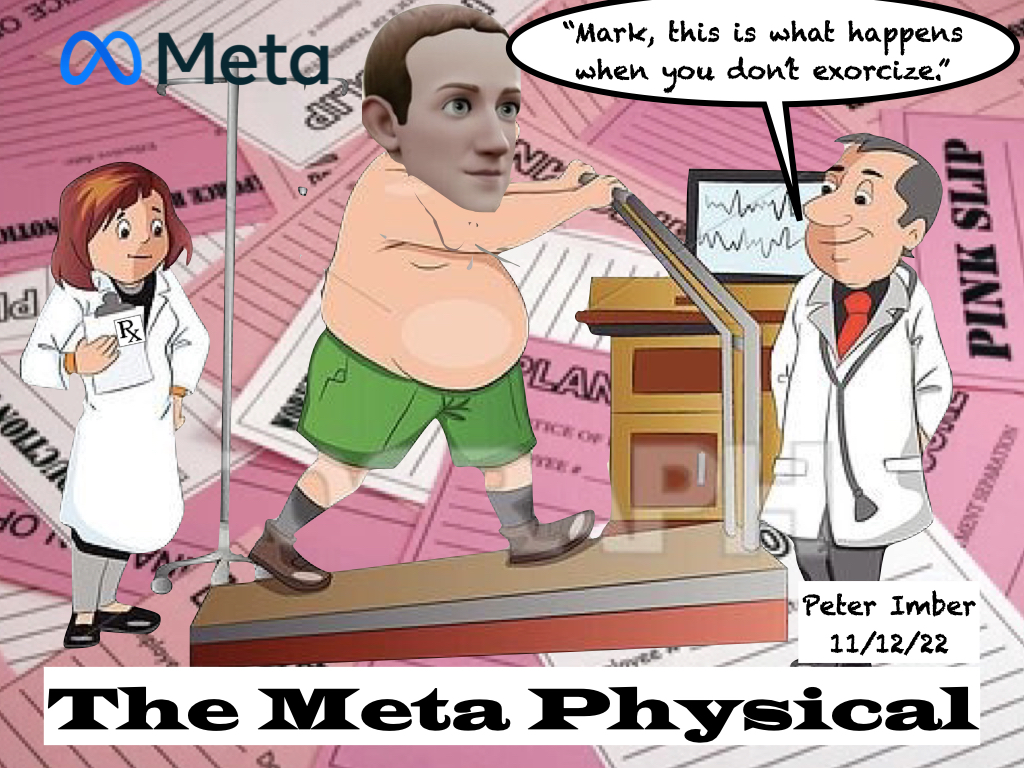
A rerun of the dotcom bubble that burst 20 years ago was bound to re-happen (my word) and once highflying tech and internet companies that are not Apple are un-perking (my word again). No more free drycleaning and take home meals at Meta. The company’s stock has lost nearly 80% of its value since January. That makes Meta the biggest loser of 2022 on all of Wall Street. Call it an about face for Facebook or maybe simply Mark Zuckerberg’s bad bet on virtual reality versus reality.

I for one don’t think the future of the universe is tied to that of the metaverse. I don’t know where I might be going when it’s that time but I doubt I’ll be wearing goggles or a mask to get taken there.

I’m obviously hoping for a stock market rebound in 2023. Any recovery however, will likely be without those helium balloons lifting our investments back into the sky. It turns out that at the moment there’s a worldwide helium shortage that’s been exacerbated by the war in Ukraine. Russia is a major producer of helium that the United States counts on when supplies of it are tight. Instead of being our safety net, Russia is now a “nyet” exporter!

A shortage of helium isn’t a laughing matter. Doctors are worried about a scarcity of helium because without its liquid form that’s used in magnetic resonance imaging machines the MRIs can’t function. A single MRI needs over 450 gallons of liquid helium— the coldest element on earth —to be able to keep its magnets cool so it can work.

But fear not if you’re worried about the giant helium inflated balloons in the Macy’s Thanksgiving Day Parade in a few weeks. Although there will be half as many of them as in years past, Snoopy, Smokey the Bear and even the Pillsbury Doughboy will be pumped up and lighter than air as usual.

—————–

All Things Reconsidered or Why a Tesla Isn’t Called an Edison

In Conversation with Thomas Edison and Elon Musk

Moderated by Mark Twain

Twain: Welcome! Suffice it to say, and what I say will suffice… I am sitting here with two of America’s great inventors. You two have never met before and I’m sure you have a lot to discuss with one another.

Edison:Yes, we do! Mr. Musk, I understand you are a great admirer of mine.

Musk: As I’ve said, you brought your stuff to market and made your inventions accessible to the world…

Edison:Then why the hell did you name your car after that schmuck TESLA?

Musk:Actually Mr. Edison, I had to buy the name from this fellow in Sacramento who was using it for his company called Tesla Motors. Cost me $75,000. If he hadn’t sold it to me I was going to name my electric car the Faraday…

Edison:Michael Faraday, the Brit! He never even saw a car in his life. He was dead before there were any.

Musk: That’s right, but he was the one who had more to do with the invention of the first electric motor than either of us. More to the point, the motors in my cars use alternating current– AC –you worked primarily with direct current– DC.

Edison: That’s correct.

Musk: And didn’t Nickola Tesla at one point work for you?

Edison: Yes, but not for very long…

Musk: And didn’tyou offer him a lot of money if he could redesign your direct current motors and make them more efficient?

Edison: I might have joked about it.

Musk: But Tesla did come up with a better design and you stiffed him!

Edison: Tesla was from Serbia. He didn’t understand American humor.

Musk: Well Thomas, I guess he had the last laugh because Westinghouse bought his alternating current patents and Tesla was paid a fortune.

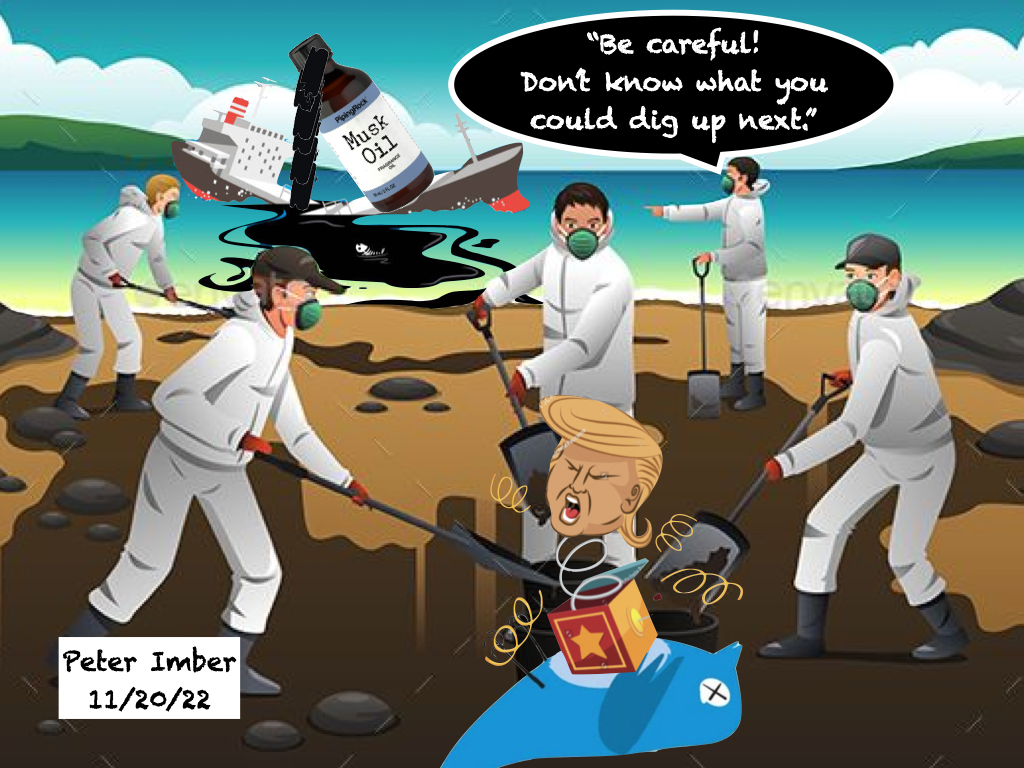
Edison: Quite right, Elon, and then he lost it all like you’re on a path to do yourself with purchases of things you know nothing about like Twitter. (Edison singing) nah, nah, nah, tweet, tweet, tweet, goodbye…

Musk: At least I’ve never electrocuted dogs and cats to try to smear my rival’s discoveries… And the elephant!

Edison: The pachyderm’s electrocution wasn’t my doing. I believe alternating current is a dangerous form of electricity that can kill people.

Musk: Yes, you would know. You’re the one who invented the electric chair but didn’t want anyone to find out…

Twain: Gentleman, gentlemen STOP! It is better to keep your mouths closed and let people think you are both fools– I mean assholes –than to open them any further and remove all doubt.

And mercifully that’s all we have time for.

Editor’s note: All of the above information is true. The invective is my own. 

—————–

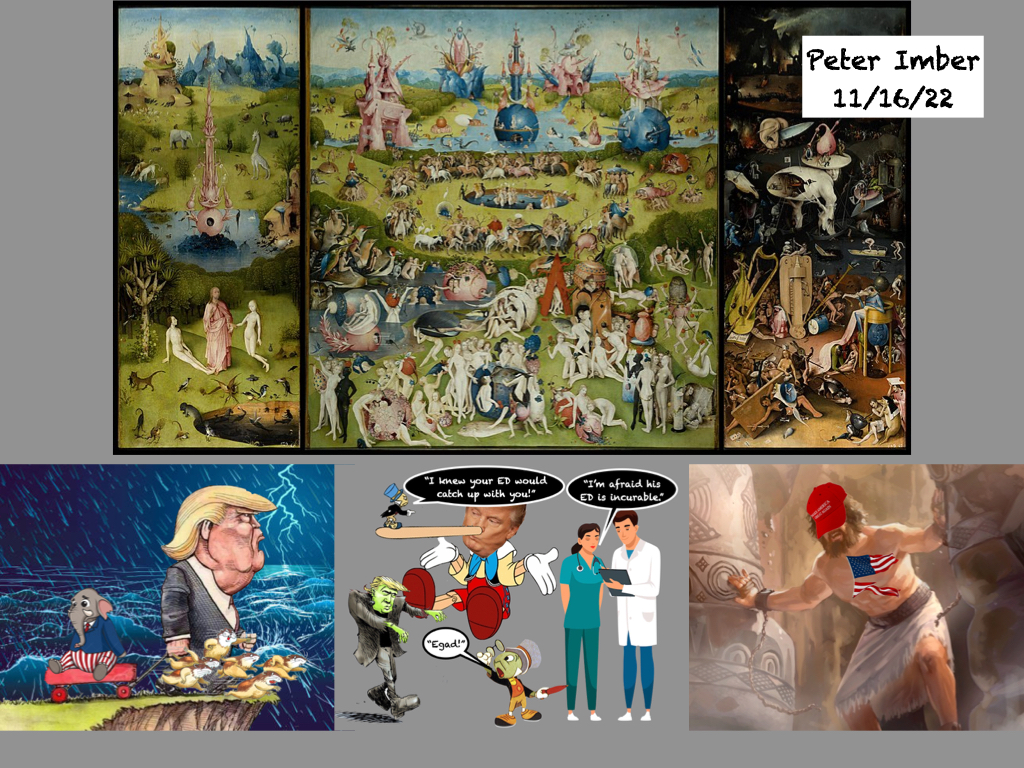
I’ve offered a triptych today and borrowing from Hieronymus Bosch’s The Garden of Earthly Delights, I’ve filled my panels with visions of an American political landscape now that Donald Trump has officially launched his Make America Cringe Again campaign for president.

In Bosch’s work paradise, represented by Adam and Eve in Eden before the fall, is the left panel and hell, full of fire and sharp objects, is on the right. One art historian interprets the middle panel with its nudity and frolic to represent an “unspoilt pre-moral existence” while another observer describes it as “life without consequence.”

My only connection to Bosch is our dishwasher but at this time in our country’s history paradise just might perversely be Trump as the Republican candidate for president redux or even better, Trump not getting the nomination and running independently out of hubris. Hell of course would be having Trump win. I don’t know what Bosch had between his ears but in his hell he inserted a knife there.

I didn’t watch Trump’s announcement but I’ve read it was long and reportedly even he seemed bored delivering it. Apparently, at no point did he claim the 2020 election was stolen from him (For now at least he’s accepting he’s a loser.) and his trotting out his other tried and untrue grievances was so lethargic even Fox News didn’t stick with him for the duration.

Trump’s die hard supporters will likely never abandon him but the campaign train is leaving the station with one formerly fellow traveler waving goodbye. His daughter Ivanka simultaneously released a statement yesterday that she’s done with politics and didn’t attend her father’s speech last evening. That must have hurt the Don-ald.

No political figure in our history has ever exploited the dark side of America more successfully and consequentially than Donald Trump. He’s back and now we will see who still has his.

My favorite cartoonist was Mad Magazine’s Don Martin. One of my favorite cartoon stories of his was about a guy who rose to fame by having things dropped on his head– heavy things. At the peak of his success he played filled stadiums and had the Queen Mary bounced off his skull. But eventually his unique talent waned and in Martin’s last frame the man is shown crumbling to the floor under a chintzy banner that locates him in Sheboygan. A plate emptied of creamed spinach lies by his side.

Let art imitate life!

—————–
BREAKING NEWS!

And this was heard in the House of Representatives a few moments ago

Kevin… You’re in heaven
But I think you know this isn’t what you seek
And I don’t think that the nastiness has peaked
I’m out, you’re in too bad it’s lookin’ bleak

Kevin… It ain’t heaven
And the creeps that are your caucus through the week
Will not vanish and will make you want to shriek
I’m out, you’re in too bad it’s lookin’ bleak

Oh, I hope you have been counting
And you realize you’re weak
But if you cross that slither-ing Jordan
You’re really up the creek

It’s no picnic in green pastures
The still waters don’t run deep
And if her name is Marjorie
Well, she’s all yours!

With apologies to Irving Berlin who wrote Cheek to Cheek, Fred Astaire who sang it in the movie Top Hat in 1935 and Ginger Rogers who I bet could sing it backwards.

Too bad for the “King of Beers.” Budweiser paid $75 million for the rights to be the only seller of alcohol to fans in the stands at the World Cup in Qatar. Less than two days before the games begin the Emir has reneged on the deal. Now, all those in attendance will be sitting soberly through the matches and the only bottoms up will be when they get up from their seats. But all is not lost. I found this headline from five years ago in the Daily Mail…

Forget Petrol! Vehicles Could Run on Renewable Fuel Made From BEER by 2022

Here’s the link…

https://www.dailymail.co.uk/sciencetech/article-5151381/Vehicles-run-fuel-BEER-2022.html

I don’t drink a lot of beer but I do have memories from drinking too much of it. The first time I ever got inebriated I got kicked out of a drive-in movie for scaling a fence in front of the projector and making an obscene hand gesture. That’s probably sharing more than you want to know…

Beer advertising slogans of the past are lodged forever in my head. One beer company even has two– “The beer that made Milwaukee famous!” and “If you’re out of Schlitz, you’re out of beer!” 

And then there’s…

“When you see the three-ring-sign, ask the man for Ballantine”

“Schaefer is the one beer to have when you’re having more than one”

Or this one…

“If you’ve got the time, we’ve got the beer!”

Do you know which beer’s tagline this was? Why don’t we have a contest? I’ll list some slogans minus a word or two and we’ll see if you can complete them and name their beers. Ready?

“Brewed with pure ___ ___ spring water.”

“You never forget your first ___.”

“Stay ___ my friends.”

“___ for beer”

“A whole lot can happen out of the ___.”

“___ never forget.”

Yes, they got tougher as the list got longer.

My favorite sentence ever about beer was uttered in an episode of the Britcom Keeping Up Appearances. If you’ve never seen the series, it’s about a social climber who never misses an opportunity to try to forget where she came from and her two sisters who never miss an opportunity to remind her. One of their husbands is particularly good at it.

In one episode that character is seated in his customary pose in front of the “telly” with a bag of “crisps” in hand when with as much dismay as he can muster he declares, “I’m surrounded by no beer!” I wonder if he plans to watch the World Cup?

—————–

As Musk Meddles Twitter Teeters

One of my favorite things about writing for print has always been composing headlines. It’s fun to have fun but obviously, a headline’s purpose is to get you to read what comes under it.

Sometimes though, after you see the headline you don’t need to…

Big Rig Carrying Fruit Crashes on Freeway, Creates Jam

Red Tape Holds Up New Bridge

Head of Iraq Seeks More Arms

Man Accused of Killing Lawyer Gets New Attorney

Students Cook and Serve Grandparents

Crematory Plans Put on Back Burner

Sisters Reunited after 20 Years in Checkout Line at Supermarket

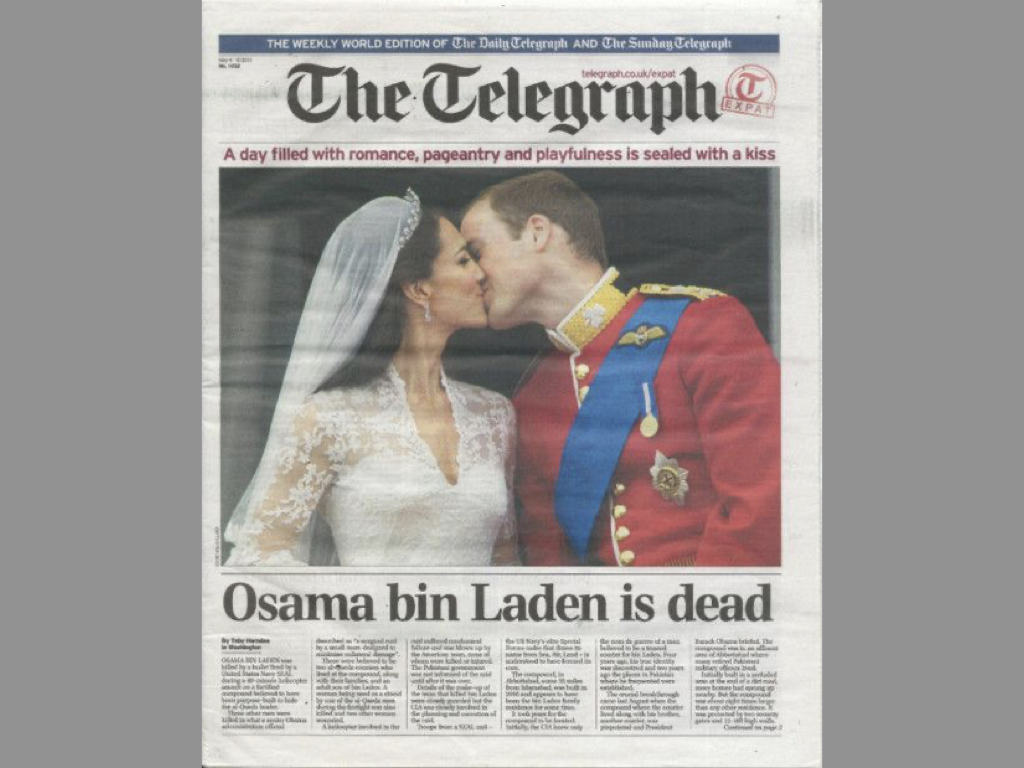
And sometimes a headline is fine but where it’s placed…

Yes, this unfortunate timing really happened and Will and Kate delayed their honeymoon.

—————–

Nearly 50 million turkeys will make the ultimate sacrifice for their country this week and although Benjamin Franklin isn’t personally responsible for putting us in such a fowl mood every Thanksgiving, he did accuse our nation’s national bird– the bald eagle –of being “of bad moral character” compared to the more “respectable” turkey.

Franklin deemed turkeys “birds of courage and true natives of America.” Hmm… sounds like Ben may have wanted first dibs on the Trump-shtick at his own Thanksgiving table.

Yes, we’ll be having turkey as always at our home and it will be wonderful to be with a dozen others around the table in the “life goes on despite COVID and all the other bad stuff” era. I’ll be the designated carver and it’s become a lot easier task for me since we bought an electric knife.

I’m the kid in my high school biology class who screwed up the dissection of a fish so badly that the teacher, upon seeing my lack of discernible surgical skill, told me to get out my math homework.

I’ve always assumed that the bird turkey and the country Turkey have about as much to do with each other as grease as in elbow, and Greece as in the Acropolis. Guess what? I was wrong. I’ve found a couple theories attempting to explain the connection between turkey and Turkey and both seem to… well, be winging it. 

One claims that, while the bird is indiginous to North America, it somehow got named a turkey when it first ended up in London markets in the 16th century. The British back then were claiming and naming lots of things that arrived from anywhere were from Turkey– Turkey rugs, Turkey flour — even if they weren’t.

Another explanation that seems a bit more plausible is that a bird like a turkey that was native to Africa entered Europe by way of trade with the Ottoman Empire and was also christened to be a turkey.

But there’s a problem. The Turkish word for turkey isn’t turkey, it’s Hindi! In Turkish that’s the word for India. And what does India have to do with turkey? I have no idea but the Turks have an ally on this one in Israel. The word for turkey– the bird –in Hebrew is hodu which is also the word in Hebrew for India. Are you still with me?

If you’ve read enough of my stuff by now, you’ll understand why after concluding that a turkey is not from turkey nor India I asked myself this question– Why is India ink called India ink? Turns out that attribution also has a blotched history. This type of ink had been used in China for centuries before getting the India prefix.

It appears, even though it was shipped to them from China, the Brits failed world geography again. France corrected their mistake—l’ encre de Chine is India ink in French. 

One needs to keep abreast of these things. 

And here’s something to think about when your carver dissects and offers up your own Thanksgiving bird. It’s become a tradition for American presidents to pardon a pair of turkeys every November. In fact the ceremonial clemency for this year is scheduled to take place today at the White House. I’m not sure though how scrupulously anybody has ever followed up afterward to see whether or not the chosen birds might have ended up merely as lame ducks who termed out terminally.

I do know of one period of time when the emancipated duo got the royal treatment. For five years the pardoned turkeys were flown first class to Disneyland and Disney World and honored with parades down Main Street until the Magic Kingdoms axed– pardon me — the practice in 2010.

One of my cousin’s sons, who worked for United Airlines at the time, told me that Disney had to buy up the entire first class cabin for transporting the turkeys. I forgot to ask him what was served for the inflight meal.

—————–

Our bird spent the night in the driveway in the back of our station wagon along with the mashed potatoes and the stuffing. They were all there this morning and obviously missed the gravy train out of here…

Hope you have a wonderful gathering with family and friends today! And here’s a blessing from Ralph Waldo Emerson that I happened upon…

“This is my wish for you: Comfort on difficult days, smiles when sadness intrudes, rainbows to follow the clouds, laughter to kiss your lips, sunsets to warm your heart, hugs when spirits sag, beauty for your eyes to see, friendships to brighten your being, faith so that you can believe, confidence for when you doubt, courage to know yourself, patience to accept the truth, Love to complete your life.”

—————–
Our mailbox is empty

The one beside the road

But the one that’s here in front of me

Is way past overload

Why is this day different

And what does it forbode

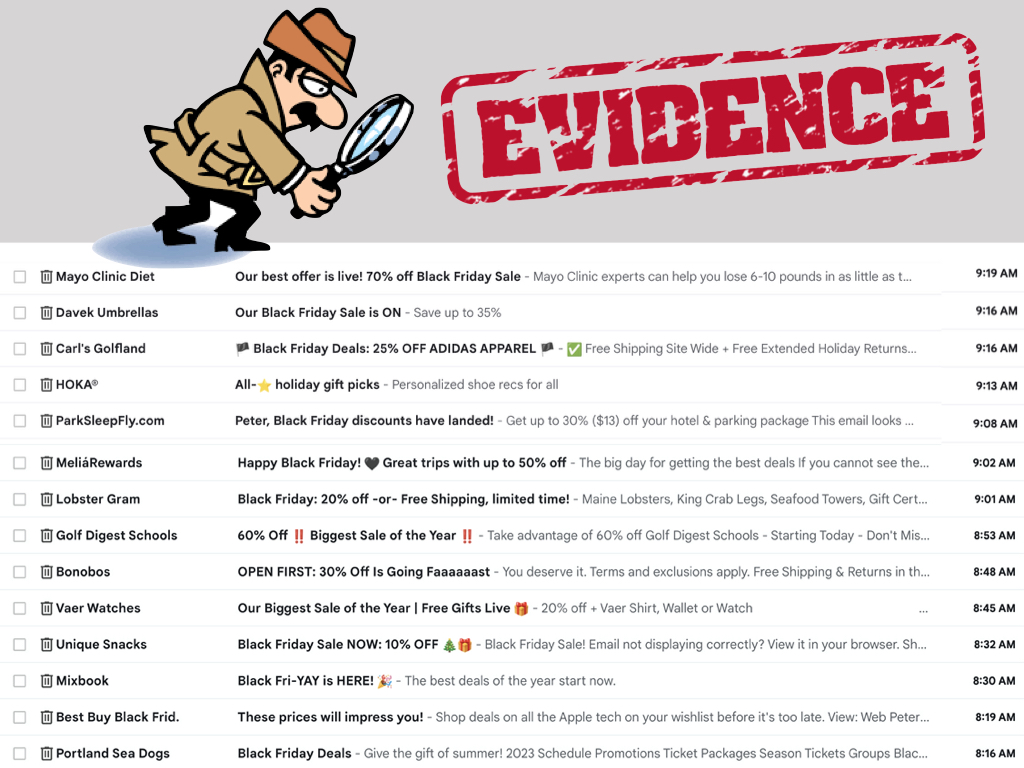
Yes, it’s only Black Friday

Cyber Monday’s still on hold

I vow not to buy a thing

But lest this solemn pledge erode

I’ve stashed all my credit cards

In the empty mailbox by the road

A polemic disguised as a poem by Peter Imber

—————–
So, I wondered when the World Cup ends with its final match the week before Christmas if its venues in Qatar would be left to be ravaged by the sands of time. And I’ve pondered if that be the case, whether or not thousands of years from now the stadiums’ original purpose will become a mystery like Stonehenge was until a British professor presented convincing evidence that the rocks placed in a field 5,000 years ago charted accurately that we on our planet have a 365 and a quarter day annual voyage around the sun.

I’m willing to bet I’m not the only one of you who has thought to yourself what is Qatar going to do with the soccer stadiums it built to host the World Cup when the event is over? Are these structures going to be just left standing and serve as a monument to the power of oil wealth and the greed of the FIFA executives who took bribes so that Qatar was awarded the games 12 years ago?

Of course not? The Qataris have money and they have plans. But here’s a number I’ve unearthed about the stadiums’ cost. When broken down for a single game played in each of the venues that have been constructed, a single day’s use for one match has a cost of $357 million. Yes, you read that correctly. And how many games will be played in the month-long competition? The answer is 64. So, what’s the total that Qatar spent on its eight venues alone? Divided up equally it works out to $1.25 billion apiece.

Architecturally, I think some of the stadiums appear stunning but up against the $220 billion Qatar is estimated to have spent on everything to put it’s country’s best foot beyond football forward, the whole endeavor’s price tag is staggering.

So, what is to become of the stadiums? One– Khalifa –already existed and was erected nearly 50 years ago. It was refurbished and will be the only one to remain in its present form. Another will become a sports facility for Qatari university students. Two others will become the home venues for the country’s best soccer clubs.

This World Cup’s largest capacity stadium– Lusail has room for 80,000 spectators. –will be repurposed with its seats removed so that shops and cafes will replace them and its upper decks transformed into housing. The second largest stadium– Al Bayt is the one shaped like a tent. –will be converted into a hotel and shopping center.

But the most interesting venue called Stadium 974 will be disassembled and vanish completely. Stadium 974 is the first “temporary” stadium ever used in the World Cup and is composed of 974 shipping containers. 974 is also Qatar’s international dialing code– I guess if you can have a play on words, you can have a play on numbers.

So, should we be critical of Qatar’s extravagance in the name of football? Take a look at this picture…

It’s an abandoned venue that was used in the 2004 Olympic Games held in Athens. I guess not every country cares what happens after hosting the main event. Ancient stadiums built in Greece over 2,000 years ago are in better shape.

Qatar’s oil is predicted to run out only centuries from now if it maintains its current extraction level. Its stadiums might well last longer than our species.

—————–
My one– Ok, all modesty aside, I actually had a couple brief shining moments in a college classroom. One was in freshman English when my professor challenged us to find a single passage in Mark Twain’s The Innocents Abroad in which Twain wasn’t being sarcastic or cynical. I did!

While attending an opera in Italy, Twain was appalled and quite forcefully chided an audience’s mocking of an aging diva. Definitely, a side of Twain not often displayed. My professor looked a bit startled when I revealed my discovery and to this day I think that maybe until that moment he hadn’t thought there was an example to be found.

But there was another passage in the book Twain wrote while in the Holy Land that has never been very far away from my consciousness…

The priests tried to show us, through a small screen, a fragment of the genuine Pillar of Flagellation, to which Christ was bound when they scourged him. But we could not see it, because it was dark inside the screen. However, a baton is kept here, which the pilgrim thrusts through a hole in the screen, and then he no longer doubts that the true Pillar of Flagellation is in there. He can not have any excuse to doubt it, for he can feel it with the stick. He can feel it as distinctly as he could feel anything.

And that, dear readers, sums up my attitude toward bitcoin and crypto currency and a few other things I either find incomprehensible or unknowable. Most everything I can’t see or understand I’m unlikely to invest my time, belief or money in. I think of myself as a curious person but then “curious” has a couple of meanings and you might be thinking of the one I’m not.

I don’t know who was the first to utter the sentence “If it sounds too good to be true, then it probably isn’t” but that’s my credo and I’m sticking to it come hell or high water.

Hmmm… and there’s a phrase that unfortunately now appears to be prophetic. Words are really something aren’t they!

—————–

Homemade Cartoons for October 2022

“Two things only the people anxiously desire — bread and circuses.”

As Rome declined the government kept the populace happy by distributing free food and staging huge spectacles. Sadly, I’m afraid in America today we have updated that strategy and substituted beer and football.

From Axios Sports this morning…

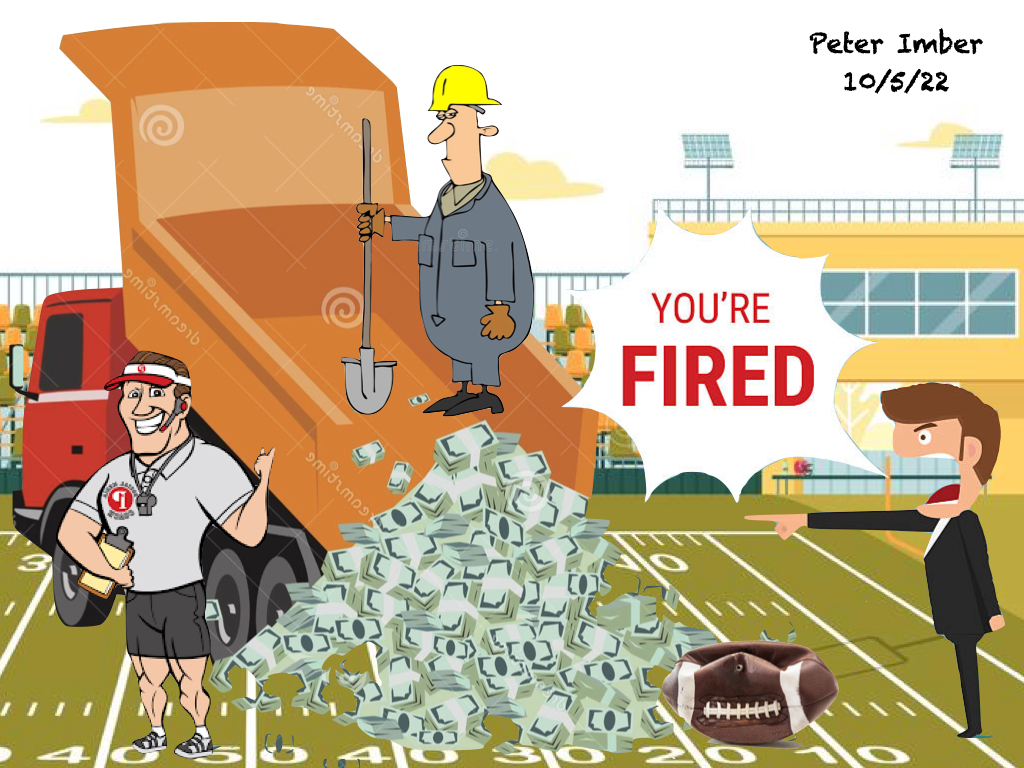
Five universities that have fired their coaches this season and owe them a total of $56.7 million in buyout money.

  • Nebraska ($15 million buyout)
  • Colorado ($11.4 million buyout)
  • Georgia Tech ($11.3 million buyout)
  • Wisconsin ($11 million buyout)
  • Arizona State ($8 million buyout)

Over the past decade, public universities have spent $530 million to fire college football coaches, per the Knight Commission on Intercollegiate Athletics.

Amazing amounts of money to pay coaches to go away, but schools have the cash from lucrative TV deals and rich boosters willing to write checks to be able to afford it and even act without hesitation or contrition.

Nebraska could have saved itself $8 million on their coach’s buyout if they waited 20 days to fire him. They decided it wasn’t worth it.

—————–

What can I say? I’ve never laughed myself to bed but it may just be the time to start doing so.

—————–

—————–

Homemade Cartoons for August 2022

When I was a boy

World was better spot

What was so was so

What was not was not

Now I am a man;

World have changed a lot

Some things nearly so

Others nearly not

–Rodgers and Hammerstein’s The King and I

So, why can’t the two Chinas just recognize each other? Mainland China is 267 times as large as Taiwan. But despite the fact that one geographically looks like it’s spitting out a seed that’s the other, the situation seems more perilous today with the threat that Big China could invade Little China looming larger right now because of Vladimir Putin’s aggression in Ukraine.

Would the United States intervene and support Taiwan if that were to happen? Does the fact that the largest company making computer chips in the world is located in Taiwan make any difference in that determination?

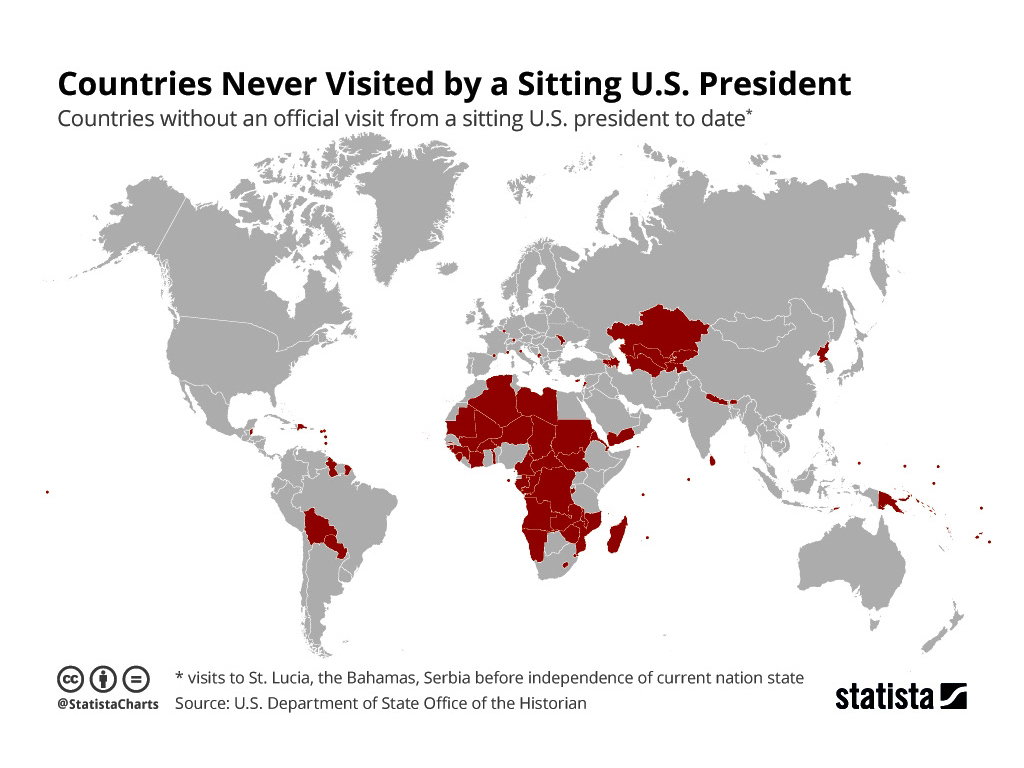
Yul Brynner in The King and I saw the world as a puzzlement. I think I see it more like a board game and Nancy Pelosi just passed Go but may have landed on Chance. But her stop in Taipei got me thinking about where American and other world leaders go and don’t go or haven’t ever gone. For instance believe it or not but no pope ever traveled to Jerusalem until Paul VI spent one day in the city in 1964.

It turns out that there are over 80 countries that a sitting U.S. President has never visited while in office. Luxembourg, Bolivia and the Dominican Republic are three of them. Many of the others are in Africa.

Speaker Pelosi’s visit to Taiwan was the first of a high ranking elected American official in 25 years. Want to guess who was the last before her? I won’t leave you in suspense. It was former Speaker of the House Newt Gingrich in 1997 and I don’t believe anything changed in the two China calculus afterward.
But obviously visits by world leaders can be important and lead to change that has great impact. This year marks the 50th anniversary of Richard Nixon’s visit to China– the first sitting American president to do so. And years earlier Dwight Eisenhower was the only president to ever go to Taiwan while in office.
Eisenhower’s visit caused Big China to shell islands controlled by Little China. I’m old enough to remember John F. Kennedy and Nixon squaring off on Quemoy and Matsu in one of their debates in 1960.
So, will Speaker Pelosi’s stop in Taiwan have unintended repercussions?

There are times I almost think
I am not sure of what I absolutely know
Very often find confusion
In conclusion I concluded long ago
In my head are many facts
That, as a student, I have studied to procure
In my head are many facts
Of which I wish I was more certain I was sure!

—————–

“If all economists were laid end to end, they would still not reach a conclusion”
– G.B. Shaw

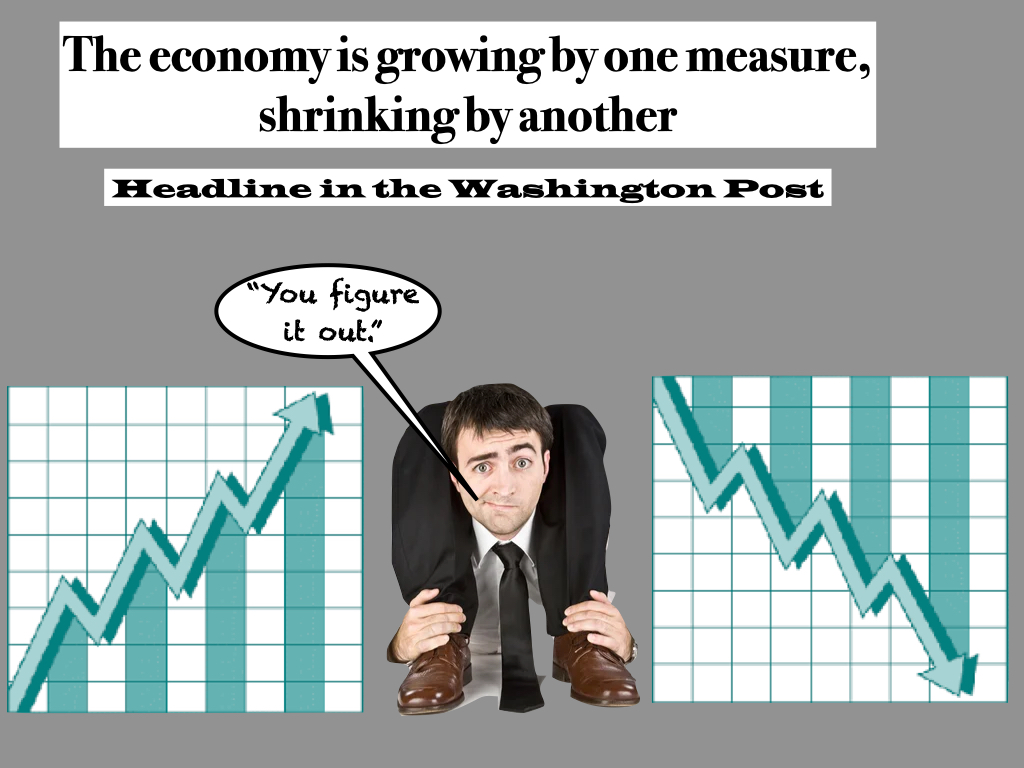
When I worked on my high school and college newspapers I loved writing headlines. Of course the purpose of a headline is kind of obvious– it should tell you that an article is about this and attempt to get you to want to read it. It’s information and it’s also seduction. It can be straight or it can be witty and it can also on occasion be confusing, nonsensical or stupid.

So, after my friend Vic pointed out the headline from the Washington Post about the current state of our economy I realized this headline was both straight and stupid.

I took one economics course in college. In high school I had a quarter of home economics, if that also counts. We made aprons and baked a cake. The girls had to take shop and made plastic knives and got addicted to shellac– just kidding.

My most outrageous headlines were composed the summer in college when I was part of a team that put out a weekly newspaper tied to a summer arts festival at Dartmouth.

My friend John and I collaborated to create doozies like this one for a concert performed by the Philadelphia String Quartet– Philly Filly Fiddler, Three Beau Combine to Spiel Spicy Space Age Sonorities.

Believe it or not we weren’t fired!

Headlines are still part of journalism on the internet of course but it isn’t the same reading them there. The demise of printed newspapers has me both nostalgic and distressed. Sure, it’s convenient to just type or swipe and instantly have the news but I miss the sound of the thump the rolled up Reading Times and Reading Eagle made when the paperboy tossed them onto our front porch. When there was no thump the paper could be found in the bushes. And I miss more than that. Jo and I agree that we would go back and be happy to return to pre internet days if that were to ever happen. I guess we’re showing our age and just want these nightmarish times to end.

Of course then I’d have to find another “hobby” to replace my cartoon meanderings. But I’d also likely be dead by now without the medical advances that have made us Boomers the generation that keeps ordering coffee and dessert and won’t leave the table.

But back to headlines. I did get in trouble for one in my earliest effort in journalism. I got kicked off my high school cross country team for hiding under a bridge with another teammate instead of running the training loop with the others. I wasn’t bitter, I just wanted to be allowed to practice shooting basketballs instead of running five miles a day. Didn’t work out but afterward as sports editor of the school newspaper I topped an article about my ex-team with “Cross Country Crushed.”

On this day nearly six decades later I offer an apology to Steve, Wes, Bucky and whoever else was a real runner at the time.

So, just for fun I found some headlines that aren’t insulting to anyone other than those who composed them. They seem to be authentic as they were shown as they appeared in actual newspapers none of which likely exist anymore…Homicide Victims Rarely Talk to the Police

Breathing Oxygen Linked to Staying Alive
China Using the Ocean to Hide Its Submarines
Diana Was Still Alive Hours before She Died
Federal Agents Raid Gun Shop and Find Weapons
Broken Air Conditioners Lead to Hot Homes
Survey Finds Fewer Deer after Hunt
Meteorite May Have Come from Outer Space
Miracle Drug Kills Fifth Person
World Bank Says the Poor Need More Money
A Majority of Americans– 4 in 10 –Say “We Hate Math!”
Statistics Show Tenn Pregnancy Drops Off after Age 25
Marijuana Issue Sent to a Joint CommissionStudents Cook and Serve Parents
Prisoner Serving Life Sentence Faces More Time
Body Found Dead in Cemetery

Republicans Turned Off by Size of Obama’s Package
Tiger Woods Plays with His Own Balls

—————–

Nothing can spin the wheels of justice more slowly than corporations and rich people. In America since 2010 they’re actually one and the same thanks to the United States Supreme Court and its decision in Citizens United v. Federal Elec­tion Commis­sion. Sad to say that Donald Trump would likely be a Heisman Trophy winner if he were a football player for his broken field running through the Halls of Justice.

Oh, here and there he may have gotten a five yard penalty but it sure seems like most of the time his blockers– Trump is always on the offensive even when he’s the defendant –do just that and steamroll over the system that allows him to continue to carry the ball and stiff arm his opponents when he should have been flat out ejected from the game many times before now.One thing’s for sure, when you have money you get to be on an unlevel playing field.

So, let’s skip to the halftime show and one of those irreverent college bands. What musical accompaniment could  they play when Trump’s being deposed or questioned under oath? Of course I can think of a few… There’s Silence is Golden, Our Lips Are Sealed and then there’s one I wish would someday fill the stadium at the end of the fray– The Party’s Over.

And how about an additional tribute to accompany all those in Trump’s orbit who have pledged their allegiance and ignored the law and morality to take a knee for the most divisive, disreputable and destructive figure in America’s political if not all its history. A tune for them? Strike up the band with Jailhouse Rock.

So, here’s hoping against hope that Merick Garland has the goods, although for the GOP and Trumpers I can’t even imagine what they or it might be.And here’s a final song for these “strange” times with apologies to composer Bo Diddley and the duo of Mickey and Sylvia. Do you remember their 1950s hit? Most of my Boomer recipients of these offerings probably will…

Jusss…tice, hmm hmm

Justice is strange, hmm hmm

Lot of people take it for a gameOnce you avoid it you learn a bag of tricks , yeah, yeah

After you’ve beat it you ignore the next writ

Many people don’t understand, no no

They think justice is gonna be at hand, no no

But smart lawyers find holes like cheese that’s Swiss

A rich dirty rat can get his case dismissed!

Yes, Bo Diddley wrote Love is Strange in 1956 and Mickey and Sylvia recorded it later that year and it reached number #1 on Billboard magazine’s R&B chart in 1957. Here’s a link to them singing it on television…

https://www.youtube.com/watch?v=3DbyAdxp4DQ&ab_channel=WarrenTesoro

To my surprise it turns out that there have been a ton of covers of Love is Strange including by Buddy Holly, the Everly Brothers, Peaches and Herb, and Kenny Rogers with Dolly Parton.

—————–

With apologies to Lennon and McCartney…

I’ll always know how much I owe you

You’ll always know how much I’ve shared 

Listen

Do you want to know some secrets?

Do you promise not to tell?

Whoa, oh, oh

Closer

And I’ll be very clear

I’ve stolen the whole schmear

If they catch me “oy vey iz mir”

Whoa, oh, oh

I’ve known the secrets for a year or four

Nobody knows they’re just behind this door

If you help get me reelected

I will steal some more

Listen

We’ve got to keep this secret

You have to promise not to tell

Otherwise I’m in a cell

Whoa, oh, oh

Nixon said, “I am not a crook!

The Plumbers never got the things that I took

I’m still the GOP’s favorite guy

They wouldn’t even care if I was a spy.

Closer

Let me whisper in your ear

About someone who I fear

Let’s make DeSantis disappear 

Ooh-ooh-ooh ooh-ooh

Ooh-ooh-ooh ooh-ooh

Ooh-ooh-ooh ooh-ooh

—————–

It’s somewhat hot again here in Maine and walking 18 holes on the golf course today was a chore by the end of my round. I remember reading recently that what’s considered Maine winter will contract on each end by as much as two weeks in the next couple decades.

In the past few years I’ve considered Maine an escape state as climate change seems to be impacting the world more noticeably and quickly than most of us want to believe. Maine had had a net population gain. More people are coming than leaving which is not the way things were for a long time.

Whether the threat of climate change and what it means for our species also has anything to do with so many people turning against truth and science, the rise of authoritarian governments, senseless violence and the myriad of other problems that have perhaps always plagued mankind but seemed less of a threat to the future of humanity I do not know.

But now I see Maine becoming what I’ll call a refuge state. A place to come where sanity and civility as well as the environment are still largely intact. Of course we have a guy running for governor who claims he was Trump before Trump and he will undoubtedly get the support of our fellow citizens who are enraptured at whatever the center of the MAGA universe launches into orbit.

Sadly, even tragically, our polarized paralyzed state still allows all of us to have something in common– disillusionment with that state of the country!

In the meantime the icecaps are shrinking, fire and drought are increasing and I think the best thing for me to try to do at the moment is attempt to make you laugh…

Well, did I?

And tell your friends or tell me if you know anyone who might like to get my cartoons.

—————–

Above was an actual headline today in my morning news feed. The follow up…

CDC data show U.S. life expectancy dropped by nearly 2 years on average from 2019 to 2020, driven in large part by the COVID-19 pandemic; New York experienced the largest drop (3 years).

Marijuana and hallucinogen use in young U.S. adults spiked significantly in 2021 compared to 5 or 10 years ago, reaching historic highs, according to the Monitoring the Future panel study.

And despite the state of the world which it appears more of us are now escaping from a bit earlier or avoiding thinking about at an increasing rate while still here on earth– Have you noticed the number of cannabis stores that have popped up in the past year or so? –I still hear the echo of Dean Vernon Wormer’s advice to Kent “Flounder” Dorfman in Animal House almost a half century ago…

“Fat, drunk and stupid is no way to go through life, son.”

I’m overweight, yes. I drink a little more than I should perhaps, yes. But I don’t believe I’m stupid although I wonder more and more if Dean Wormer was wrong on that one.

—————–

My friend Arthur sent me the pun about putting together a cabinet in Sweden and so today’s cartoon is just embellishing it with appreciation and thanks to him. But I do have an Ikea story that accompanied a cartoon that I sent out almost two years ago…

When we moved into our house here in Maine I put together the last piece of Ikea furniture I ever will. It’s the desk I’m sitting at right now and it’s fine except for the drawer just below my right hand that I’m using to type these words with.

I’ve assembled a lot of Ikea stuff in my life and I do actually admire their instructions which stand out because they use only pictures and no words. The desk however had FOURTEEN PAGES OF PICTURES! I was doing so well until…

I had actually finished putting the desk together and about to load up its two drawers with my stuff. The one on the left side pulled out easily but the one on the right got stuck less than halfway. Way less than half way. Hmmm…

I discovered I had put one screw in the wrong place but I couldn’t reach it now to unscrew it. I started to remove screws in other places. It didn’t help. Somehow, some way the screw I had screwed up must have been screwed in much earlier in the assemblage.

I kept disassembling. The desk was no longer upright it was resting sideways on my knees as I continued to reverse all work I had done and then it DROPPED!

If you’ve ever put together a piece of Ikea furniture, then you are familiar with the little pegs that you insert that join the larger pieces together. The correct name for them is dowels. My dropping the desk sheared off a bunch of them. I was angry and that gave way quickly to despondency.

What had been my innocent mistake that I had taken responsibility for making now needed a scapegoat. I blamed Ikea and Volvo and Abba and all of Sweden. I asked myself what would Henrik Ibsen do? Yeah, I know he’s Norwegian. 

I was mentally treading water in order not to sink further into depression. My mind, working like it does, suggested I write a play with a title– “The Dowel House.” This wasn’t helping.

I left the desk on its side for two days while I fumed and considered my options. I could call Ikea and order parts; I could hire someone more competent than I to take over; I could pick up where I left off and just put the damn thing back together as best I could and live with a gimpy drawer.

I chose the last option and have pulled out that drawer just now– for the first six inches it’s fine after that it’s a tug.The Japanese have a tradition of revering broken things called kintsugi. It goes back 500 years. I don’t feel any special reverence for this drawer and nothing from Ikea is going to last 50 years but for now and forever I’m fine with my desk.

I have reprised this story because today I had another “Don’t do it yourself!” moment involving a towel rack in the bathroom. We’ve had problems with this rack since we inherited it when we moved into this house 12 years ago. At even the most surgical attempt to hang a washcloth let alone a towel on its brushed nickel rods they would drop on the floor. 

The sound when that happened was all but identical to that of the bell of a San Francisco cable car. We’d forget to warn guests about this and of course they’d usually be nude when this occurred and speechless. I’d yell through the door, “Don’t worry about it!” but afterward would refasten the rods for the next person who would be momentarily humiliated.

So, yesterday I bought a replacement towel rack. I don’t need to go into great detail of what happened when I tried to install it myself. I’ll just say what you already may have surmised– I totally screwed it up.

But there’s a happy ending. We’ve had a terrific contractor do major work for us over the years and during that time he and his two man crew have become our friends. Donny, a master carpenter came over and you can’t even see my misguided drilling.

Me:  “Thanks so much. You did that very easily.”

Donny: “I think I’ve done a few more of these than you, Peter.”

I grew up in Pennsylvania and 40 years ago the phrase “You’ve got a friend in Pennsylvania” was imprinted on state license plates to promote tourism. Nice phrase and I still have great friends there but although I wasn’t born in Maine and will forever be “from away” I can’t see living anywhere else.

Enjoy the Scotch Donny!

And here’s a link to the sound of the bell of a cable car that might bring back memories but not whet your appetite…

—————–

With all the secret stuff I took no one’s surprised I’m that dumb

The Feds got the goods and you think maybe this time I’m done
But it’s a real good bet that there’s still more to come

I can’t finish messing with the song lyrics to The Best Is Yet To Come. Sorry, Frank Sinatra…

I can’t get past thinking what the Republicans would be doing if a Democrat president had been caught with top secret documents in his or her cellar. Oh, wait haven’t some of the GOP claimed Obama has documents stashed in his house? And have they accused him yet of pushing Ivana Trump down her staircase?

I’m afraid the lyrics I should be honoring are from a song first recorded by the Weavers in 1949 and below is a link to the group singing it at a reunion concert in 1980.

It’s title: Wasn’t that a time?

—————–

Homemade Cartoons for July 2022

The recent Supreme Court rulings are more than disheartening. The United States Constitution may have been written on paper with a quill pen but since then man has invented and utilized erasers, Wite-Out, word processors and I’m afraid, as in the case of Roe v. Wade, bungee cords.

I’m saddened by all the decisions I’ve included in my cartoon but one in particular I relate to from personal experience and am worried will only be expanded upon to put kids in a situation I had to endure so long ago. A situation that I thought America had resolved.

When I attended public school growing up in Pennsylvania we had daily Bible readings. Each of us was expected to read aloud to the entire class a passage from the Bible selected by our teacher. Often mine was from the New Testament. We recited the Lord’s Prayer every morning as well. Neither was my Bible or my prayer. I’m Jewish and I didn’t like doing either but never protested. I wasn’t yet a teenager.

Exactly 50 years ago this past June the United States Supreme Court– the Warren Court –decided in Engel v. Vitale that a prayer approved by the New York Board of Regents for use in schools violated the First Amendment by constituting an establishment of religion. The next year, in Abington School District v. Schempp, the Court disallowed Bible readings in public schools as well.
By then I was in high school but not before another incident involving religion took place that really bothered me. We Jews were a small group and one of us organized something less than a protest but more than complying with the status quo.

Our high school had an annual Easter assembly and the crucifixion of Christ was front and center with a large cross positioned on the stage. Liz– the daughter of a rabbi –got our principal to agree to permit Jewish students who wanted to absent themselves to have a study hall instead of attending the assembly.
Everything was fine until the high school guidance counselor peeked in the classroom where we were sitting. I remember she frowned at us and then said,  “We’ve never had any trouble with you people before.”

I’ve never forgotten that moment and I’ve never forgotten the times growing up I was called a “dirty Jew” and even once was asked why I didn’t have horns. The recognition by our public institutions of a majority religion means others are more likely to become the other.

And I’ll go further. For me freedom of religion in America has always meant there should be freedom from religion. Last week’s Supreme Court ruling that a public high school football coach should be permitted to pray on the field privately after games but not be allowed to turn this practice into leading prayers with his team may seem benign, however I fear this is the beginning of a return to the past when others were made to feel like the other like I was long ago.

It’s telling that the Court’s recent decisions were announced after a fence was erected around the Supreme Court building and by issuing PDFs and not with an in-person ceremony. Maybe the Justices’ feel a little bit like the chagrined people in the Southwest Airlines commercials who just “Wanna get away!” But I doubt it.

—————–

“Live so that when your children think of fairness, caring, and integrity, they think of you.”

–H. Jackson Brown, Jr.

American Presidential Insight through the Centuries

“I hope I shall possess firmness and virtue enough to maintain what I consider the most enviable of all titles, the character of an honest man.”

–George Washington

“I am a firm believer in the people. If given the truth, they can be depended upon to meet any national crisis. The great point is to bring them the real facts.”

–Abraham Lincoln

“The point in history at which we stand is full of promise and danger. The world will either move forward toward unity and widely shared prosperity or it will move apart.”

–Franklin D. Roosevelt

“And when you’re a star, they let you do it. You can do anything. Grab ’em by the pussy. You can do anything.”

–Donald Trump

—————–

I admire beautiful cars. Ferraris, Lamborghinis, Maseratis and if you have the money to spend on one, I’m sure there’s an argument to be made that you aren’t just purchasing a car, but a work of art as well.

The average fuel economy for a car today is roughly 25 mpg and the aforementioned luxury cars do about 5 miles a gallon less. That in and of itself doesn’t seem like a big deal but fossil fueled vehicles may likely become fossils themselves as climate change makes many of us consider abandoning them for all electric ones like Teslas, Nissan’s Leaf and Chevrolet’s Bolt.

Jo and I have owned a Toyota Prius for 8 years and love it. Despite the fact that it’s a hybrid, which means we still visit the gas station every 400 hundred miles or so, it gets nearly 50 mpg and in nearly 140,000 miles of driving has only had oil changes and one brake job. We’ll likely get another. We don’t have a garage that we can park a car in and during winter that’s a problem for the battery of an electric vehicle.

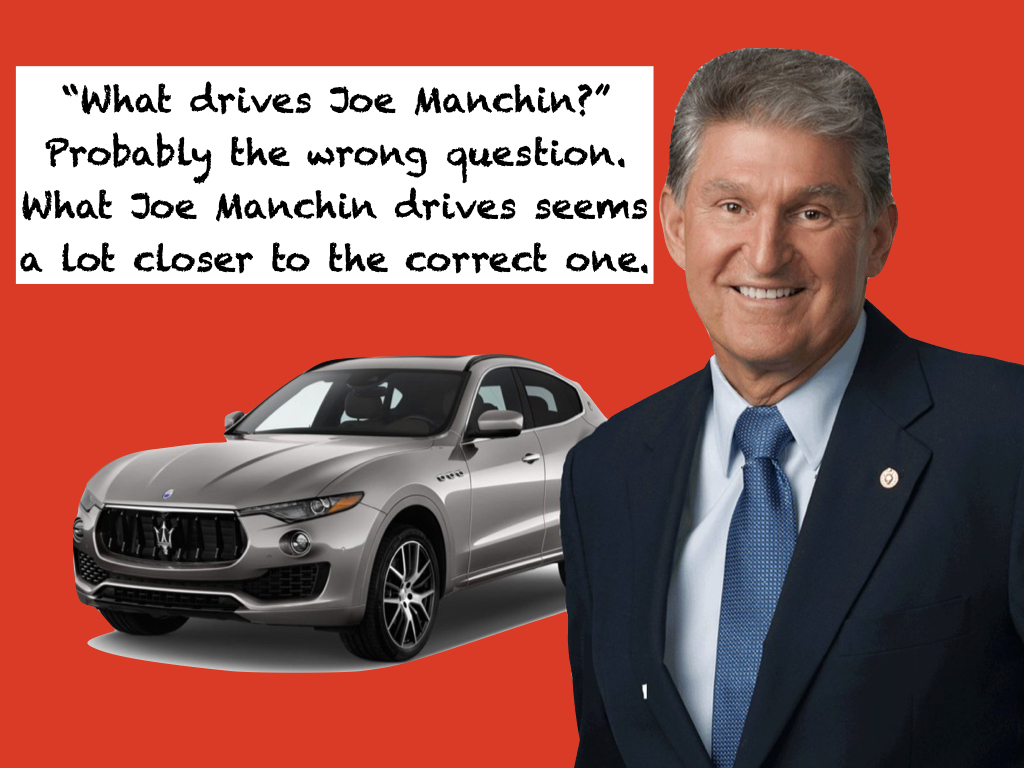
Luxury cars aren’t necessarily a prime target of environmental activists but last year the driver of one was. In November Senator Joe Manchin was walking from his houseboat on the Potomac River where he stays when he’s in D.C. and not home in West Virginia into a nearby parking garage and was surrounded by protestors as he climbed into his car.

Security guards cleared his path and he quickly drove away but the senator who as an elected Democrat has done the most to obstruct the Biden administration from taking meaningful action to tackle climate change and a host of other challenges facing the country has shown that he’d rather drive his Maserati Levante than even a hard bargain.

Manchin would no doubt be happy to put coal in everybody’s Christmas stockings, but he doesn’t realize that in the history books he may be remembered as the Grinch Who Stole America’s Future.

—————–

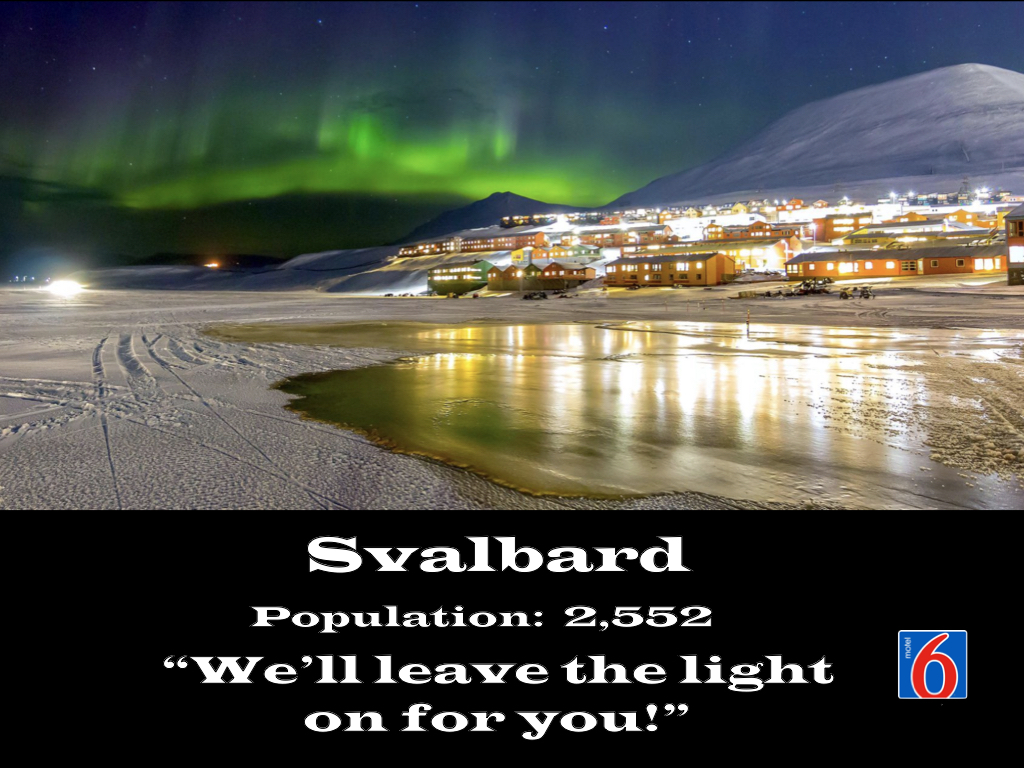
Everyone may live and work in Svalbard indefinitely regardless of their country of citizenship.

The Svalbard Treaty grants treaty nationals equal right of abode as Norwegian nationals. Non-treaty nationals may live and work indefinitely visa-free as well.

It has been a chosen policy so far that we haven’t made any difference between the treaty citizens and those from outside the treaty.”

The Governor of Svalbard

Box 633

9171 Longyearbyen

Summer Hours: Monday–Friday 10 am to 2pm

Telephone 79 02 43 00

I’d never heard of Svalbard until I googled “the easiest countries to move to from the United States.” It topped the list I found followed by Mexico, Portugal, Ecuador and Malta.

I didn’t think anybody I know had ever heard of Svalbard either but when I mentioned it to a friend of mine who is a skilled and experienced sailor, he had. Svalbard is about as far north in the Arctic Circle that can be sailed to and therefore during its near total daylight stretch in summer some people do.

Did you know that in nine states in America there are more cows than people? In Svalbard substitute polar bears for cows and because the residents are actually outnumbered, it’s illegal to leave town there without a gun. We see cows and think milk. Polar bears see us and think food.

One might surmise that a lot of NRA members might possibly want to move to Svalbard where they would never have to leave their AR-15s at home but over two thirds of the place is covered in ice and the two top states in America where there are the most guns in homes are Texas and Florida. Can’t see Ted Cruz– Svalbard is way too cold literally for him –or Ron DeSantis– he’s too cold figuratively for Svalbard –living there.

One other thing about Svalbard, it’s illegal to die there. Yes, that’s right, if you fall ill or are near death, you’re flown out to Norway proper. There is one graveyard but it hasn’t been used for burials for decades after scientists found that bodies already interned were perfectly preserved. They hadn’t decomposed because of the permafrost being so close to ground level.

So, if Svalbard isn’t your cup of chai, where might be the next easiest place to move?After Mexico, where it is estimated that nearly 900,000 Americans already live either part time or as expatriates who have renounced their U.S. citizenship, we have Portugal.

If you’reable to prove your connection to ancestors who fled Portugal due to religious persecution in the 16th century, you can now acquire Portuguese citizenship. So far nearly 60,000 Jews have been granted penitent and permanent citizenship there with another 80,000 pending applications.

Americans seeking second passports for a less expensive retirement and just plain less stressful and simpler living somewhere else seems to be trending.

Add the “just in case” scenario where Donald Trump returns to the presidency and totally obliterates life as we knew it in the United States before he was elected the first time and lots of us might be channeling Blanche DuBois and depending on the kindness of strangers. So, here are some more choices for an accelerated exile…

Ecuador is considered the country with the lowest cost of living and decent quality of life and their currency is ours– they use American dollars.

Malta has a “Golden Visa” where you invest a certain amount of money in government bonds or simply make a nonrefundable contribution and buy a house and you’re in.

Spain has something similar and if you teach English you can even get a government stipend.

There’s South Korea and Australia and of course Canada… I was curious about what it takes to become a Canadian resident or citizen and googled to a site that looked official and then filled out what was asked of me… I’m 75, no longer work and have an indolent cancer but voila! Hey, it looks like there’s room for me anyway! Here’s what happened next…

I didn’t feel this recruited since I got three letters from colleges when I was captain of my high school basketball team sixty years ago. But my optimism was quickly quashed. Up front each number wanted a thousand dollars to start the process.

Statistics on how many Americans today live outside the country part time or have actually given up their citizenship and are expatriates are only estimates but it’s accurate to say that the numbers have increased since 2016.

Svalbard wouldn’t be my first choice but if indeed you wanna get away, they’ll leave the light on for you.

—————–

Homemade Cartoons for June 2022

I had the privilege today to be with my grandchildren at a baseball game– their first. The Hartford Yard Goats– yes that’s correct –defeated the Portland Sea Dogs 6-2.

How much did the boys– ages 6 and almost 10 –enjoy the game? I’m not sure but after the final out there was a special opportunity for them and hundreds of other children to run the bases inside the stadium.

We adults lined up with them and there was no impatience, no cutting in line and everybody knew they were going to get their turn. Race, religion, wealth made no difference, everybody knew they were going to get their turn. There was no talk of politics, nor abortion or gun control. I didn’t see a MAGA hat or hear a “Let’s go Brandon.” Neither was there a mention of Black Lives Matter or LGBTQ rights.

As I stood there watching the kids circling the basepaths I had an insight as to why this was such a moment of respite from a world I no longer feel optimistic about. It was the kids! All of us who had brought them or their parents into this world were putting them first. We were happy to be seeing them having fun, to know that they were safe and glad that we were able to give them this memory and to be giving it to ourselves as well.

And then I had an epiphany. If doing something this simple for our kids made us feel we were doing something right, why shouldn’t we have those responsible for making decisions that will impact our kids’ present as well as their future have to make those decisions in front of their kids and grandkids?

Yes, I mean if a member of Congress wants to vote for or against sane gun laws, then have them do it with their youngest offspring sitting on their lap. If they want to vote for or against important policies to deal with climate change, then do it with those who will be most impacted right there with them. I dare any one of them to explain why kids shouldn’t get to be part of this– get to see and hear the reasoning and decision making up close. Might some be embarrassed to have to reveal their priorities to their progeny?

Or maybe our politicians should have to run the bases and if their kids can beat their elders around to home plate, then the youngsters should be allowed to cast the votes!

—————–


“The problems of deafness are deeper and more complex, if not more important, than those of blindness. Deafness is a much worse misfortune. For it means the loss of the most vital stimulus–the sound of the voice that brings language, sets thoughts astir and keeps us in the intellectual company of man.”

— Helen Keller in a letter to Dr. James Love in 1910

In the late 16th and early 17th centuries, Thomas Hobson worked as a licensed carrier of passengers, letters, and parcels between Cambridge and London, England. He kept horses for this purpose and rented them to university students when he wasn’t using them. Of course, the students always wanted their favorite mounts, and consequently a few of Hobson’s horses became overworked. To correct the situation, Hobson began a strict rotation system, giving each customer the choice of taking the horse nearest the stable door or none at all. This rule became known as Hobson’s choice, and soon people were using that term to mean “no choice at all” in all kinds of situations.

–From the Merriam-Webster Dictionary

I listen to music a lot and for no particular reason this morning I thought about whether not being able to hear or not being able to see would be the heavier burden for me. Finding Helen Keller’s opinion today has cinched the choice. I’d want to hear even though it’s indeed the ultimate Hobson’s choice.

I don’t consider myself a spiritual person but music and what it can cause me to feel is the strongest piece of evidence that can be used against me defending my self assessment of remaining devoid of spirituality.

Music is a form of nourishment and refuge for me in the sense that it makes  life both worth living and enduring. Obviously, events in our country and the world today seem to be leading us more toward darkness than light. It’s no great insight on my part that in these times it’s important to cherish and cling tightly to the things we love and the values we hold.

If you’ve been a reader of mine since the beginning of the COVID era in 2020, you know I collect stories like someone else might collect stamps or coins. I call them stories but they’re memories and I guess I’m lucky enough to have a good memory but here’s a fresh one from this week.

On his 6th birthday last March– our younger grandson and I were both born on St. Patrick’s Day but 69 years apart –I bought him a pocket size transistor radio. He was fascinated by mine and how you could pull out its antenna and turn its dials to instantly survey oldies music, sports talk and gospel preaching. About a week ago Harvey heard a commercial on his radio…

Harvey: “Mom, there’s a store in Rockland that has everything you need for Father’s Day!”

And yes, Mom and Harvey went there and I don’t know what they got but I’ve heard it was everything they needed for Father’s Day.

I used to listen to music on my Zenith transistor radio with a leather case or my parents’ Magnavox console with a built-in phonograph. Now, I download it from Apple and find it on YouTube. Here are three pieces I listened to this morning. And yes, I would rather be blind than not be able to listen to them…

—————–

“Let’s leave aside the stories of Trump’s emotional derangement, such as his throwing food like a bratty toddler. It isn’t an actual violation of the Constitution to be a whiny, immature jerk.”

— Tom Nichols writing in today’s The Atlantic Daily

Below is a link to a list compiled by a publication I never heard of until today– McSweeney’s Internet Tendency. It’s a publishing house founded nearly 25 years ago by the author Dave Eggers. There are over a thousand instances of statements and acts by Donald Trump on this list for you to judge for yourself  that have been compiled chronologically by seven writers entitled… 

LEST WE FORGET THE HORRORS: A CATALOG OF TRUMP’S WORST CRUELTIES, COLLUSIONS, CORRUPTIONS, AND CRIMES

They start in 2011 with his false claims about President Barack Obama’s nationality and education and end with his late night pardons to Steve Bannon and his other allies on the last full day of his presidency and his leaving the White House the next day without attending President Joe Biden’s inauguration.

In between are chronicled the horrors committed by Donald Trump the private citizen and President Donald Trump, who may not yet be considered the worst American president in history (James Buchanan seems to be the leader so far in the clubhouse.) but the final accounting is still a wreck in progress.Dayenu is a song that is part of the holiday of Passover– the sort of Jewish Thanksgiving that celebrates Moses leading the Jewish people out of slavery in Egypt to the promised land of Israel

. The Hebrew word dayenu means “it would have been enough for us” and in this case for God to have just granted the Jews their freedom from Pharaoh but the song has many additional stanzas enumerating the other gifts God gave the Jews. At the conclusion of the mention of each of them we say in unison dayenu!

When you start reading the history of deplorable, immoral and illegal things Trump has done as both a citizen and a serving president, feel free to utter dayenu. So many of them would have disqualified him from even running for office in a time not so long ago. What the hell has happened to our country?

https://www.mcsweeneys.net/articles/the-complete-listing-atrocities-1-1-056

“We now know what we need to know about Trump. These revelations should also convince millions of people who were willing to give Trump a second chance to rule that he is too mentally unstable ever to be allowed again near the machinery of government…

— Tom Nichols writing in today’s The Atlantic Daily

DAYENU!

—————–

Homemade Cartoons for May 2022

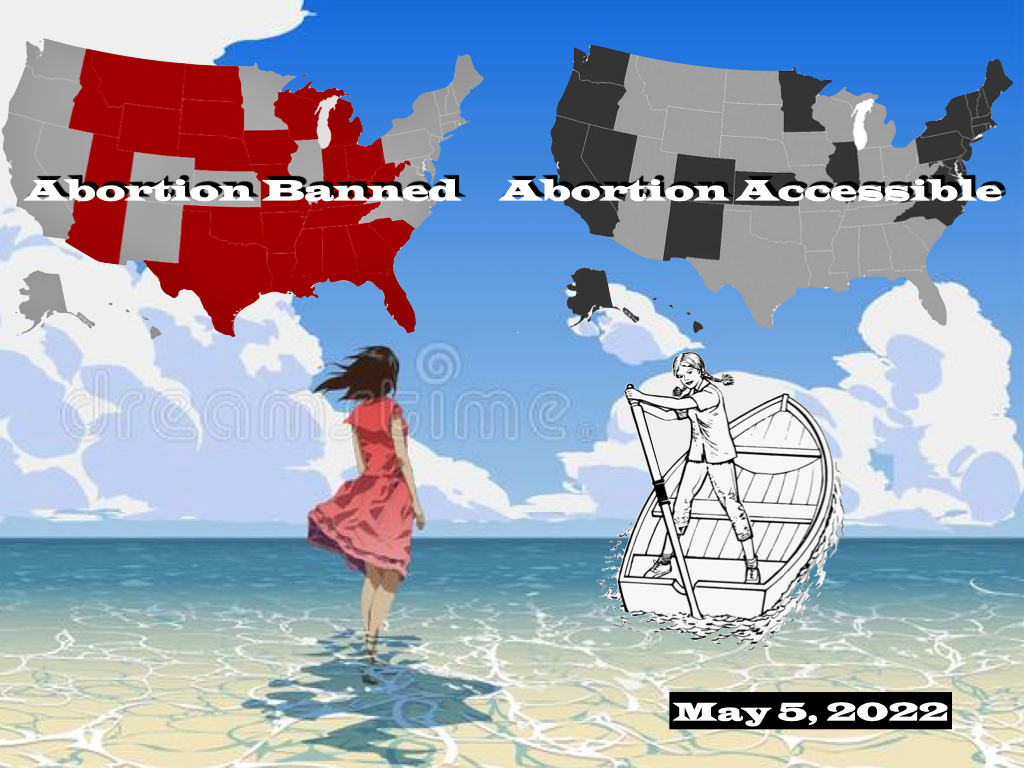
“Noting that Roe v. Wade was decided 45 years ago, and reaffirmed 19 years later in Planned Parenthood v. Casey, I asked Judge Kavanaugh whether the passage of time is relevant to following precedent. He said decisions become part of our legal framework with the passage of time and that honoring precedent is essential to maintaining public confidence.” — Susan Collins in her speech explaining her decision to cote for the confirmation of Brett Kavanaugh to the U.S. Supreme Court on October 5, 2018


“Here is the trap you are in…. And it’s not my trap—I haven’t trapped you. Because abortions are illegal, women who need and want them have no choice in the matter, and you—because you know how to perform them—have no choice, either. What has been violated here is your freedom of choice, and every woman’s freedom of choice, too. If abortion was legal, a woman would have a choice—and so would you. You could feel free not to do it because someone else would. But the way it is, you’re trapped. Women are trapped. Women are victims, and so are you.”
                    ― John Irving, The Cider House Rules

—————–

I got it. And that’s despite four shots of Pfizer COVID vaccine and injections of the drug Evusheld which is given to immunocompromised people like me. I’m sure without those I’d be in a lot worse shape.

How bad is it? For me so far this is day four and I’m Ok. It’s sort of like a cold and the flu. I’m tired a lot, a little lightheaded and I carry a Keenex box with me wherever I move around the house.

If COVID were the chickenpox, we’d have parties and infect each other and be done with it. But it isn’t and the pandemic isn’t over. Maine has been one of the states that hasn’t had it too bad until now but that’s apparently no longer the case.

So, what’s worse than COVID at least for me so far? How about a million other things. Hey, and then there’s the axiom “What doesn’t kill me makes me stronger.”

Case in point… There’s a bent hinge on one of our screen doors. I called up the company that made it last week to inquire about purchasing a replacement. This morning I got an email informing me that the French screen doors we bought eleven years ago were discontinued as of last year. 

Their proposal is that I buy new ones which would cost over $2400. I was shocked and my blood started to simmer and as it was about to boil over I unscrewed the hinge and turned into Superman. Yes, I bent steel with my bare hands!

We’ll see how long my repair holds.

—————

Yes, I’m throwing the book at her!

Susan Collins calls the cops over polite abortion message chalked outside home

‘Intricately drawn’ message urging Republican senator to back reproductive rights bill was not a crime, police in Maine say.

—————–

If you have not yet met up in the ring with COVID 19, I hope you won’t. My own bout is now in the second round and I want to pass along my experience not as a warning but as information that might be useful. I also hope I won’t be a long hauler but I think from all we know at this point we are collectively in for the long haul with COVID for perhaps as long as we’re still around.

A drug called Paxlovid delivered what I thought was a knockout blow in the first round but the virus wasn’t apparently down for the count and is up off the canvas. I’m feeling better today and according to what I’ve been able to research that just may be the problem. Let me explain.

Paxlovid, developed by Pfizer, was given emergency use authorization last December by the FDA. It’s an antiviral drug meant for patients like me and probably you if you’re over 65. We’re at higher risk of serious disease and if in addition we are immunocompromised, it doesn’t matter how old we are. COVID is potentially a dangerous disease to contract.

Paxlovid’s effectiveness in keeping those for whom it is prescribed from being hospitalized is nearly 90%. That, in addition to the COVID vaccines, has been a game changer and especially for those of us with certain cancers and other serious health challenges.

But there are also rare instances where people who have taken Paxlovid– which consists of 6 pills daily over five days –have relapsed with the same symptoms they experienced initially and tested positive again for COVID after only a few days after testing negative. That is what’s happened with me, things were fine and then they weren’t.

Here’s my own timeline:

–Symptoms began on 5/6 and I tested positive on 5/7 and began Paxlovid that same day. My symptoms subsided and disappeared after three days.

–I tested negative on 5/12.

–My symptoms returned on 5/16 and I tested positive on 5/17 and have begun a second round of Paxlovid on the advice of my oncology team at Dana-Farber.

It needs to be noted that from the onset of symptoms for COVID there is a five day window for starting a Paxlovid course of treatment. After five days the virus will have replicated too much for the drug to have any effectiveness. At that point it’s all on your immune system and your COVID vaccines to wage the battle and for most people their immune system and the vaccines are up to the challenge.

COVID’s symptoms are varied. My own have been nasal congestion, sneezing, coughing, headache, lightheadedness and fatigue– similar to a bad cold, maybe more than like a virus since I haven’t had a fever.

So, why do I think Paxlovid, at least in my case, may have led to a relapse– in medicine it’s called a rebound –of my COVID? According tothe New England Journal of Medicine and the website Yale Medicine, the drug is so effective at knocking down the replication of the COVID virus that the “immune system didn’t have a chance to see the full extent of the virus, since Paxlovid suppressed replication early in disease.”

I guess some things are too good to be true and a few others might just be too good to even know when you’re through! I started with boxing and will end with basketball. I will rebound from my rebound and if there is anyone out there who has been sitting on the bench about COVID, get off of it and take your shots!


I wonder if George Calin might not have been a prophet if he had lived in the time of the Old Testament. He certainly made a career out of lambasting our foibles and absurdities. He spoke funny and often dirty to power. But it’s hard to make the case that he was speaking on God’s behalf. He didn’t believe in God.

Carlin didn’t believe in the present either and had a cute bit about. He would stand on the stage and turn to his right and say, “Hey, there’s the past.” Then he would turn quickly to his left and say, “And here’s the future.” While turning back and forth he’d add, “The past, the future. You see, we’re in either the past or the future. The present is an instant we can’t stay in. It’s one or the other.”

It’s sort of how I feel right now. The present has become pretty unbearable and the future is just downright scary. Ah, but we have the past to cherry pick. Sure, there were bad moments there too but more and more I cling to the good ones and especially the innocent and uncomplicated ones.

George Carlin died in 2008 but he already said he had checked out several years before. He’d given up on our species and as he gently put it,

“Humanity is circling the drain and I’m just going to sit back and watch it.”

He put his pessimism in a geological context and asserted that our claim that we are destroying the earth is foolish. 

“The earth was here way before we were and no matter what we do, I’m sure it will be here another billion years after we’re not.”

I’m sounding pretty dark and I apologize for greeting the weekend with my present thoughts — no, they’re in the past now until I add some new ones in the future.

But what has bothered me since the mass shooting in Buffalo is how used to these occurrences we have become and how we– our country –have done absolutely nothing that needs to be done to try and stop them.

I have written about this before. I covered the shooting in Colorado at Columbine High School in 1999. We stayed for two weeks which was too long  but how much news coverage is being devoted to Buffalo, especially in light of it being a hate crime? I guess thoughts and prayers don’t even rate air time any more.

There was a moment at Columbine that has stuck with me ever since. In the tragedy’s aftermath a spontaneous memorial grew from people who brought a few flowers to thousands of others who did and thousands more who came just to express their sorrow. As they hovered there you hardly heard a sound.

We did a story about this and one woman we interviewed said that what bothered her most was that the community knew by then how to do a memorial because there had already been so many that they’d seen elsewhere. That was in 1999 and nothing has changed. So it goes and sadly is likely to many more times.

My “cartoon” is a painting by an artist named Nahum Gutman. He was probably known better as a writer and illustrator of children’s books and I guess you can see that connection in his work here. I’d never heard of him until I visited a museum where his art is on permanent display in Israel. Art that I like is soothing and a refuge.

Music is the most powerful form of art for me. It can change my mood in ways like nothing else. Several years ago I discovered the music of Arnold Rosner. Rosner composed in virtual obscurity and he composed a lot. He died in 2013 alone, his body discovered only after a few days. The vast majority of his works went unperformed during his lifetime.

I’m attaching one. It’s called Gematria, which is a form of numerology that gives Hebrew letters numbers that practitioners of Jewish mysticism– Kabbalah –believe find hidden meanings to things. It’s conception dates back nearly 3,000 years.

The Rosner piece is both dramatic and romantic. He was influenced by composers Alan Hovhaness (dramatic) and Ralph Vaugh Williams (romantic).

Oh, and HBO is airing a two part special about George Carlin tonight and tomorrow at 8 p.m. Oops, that’s now.

—————–

The link at the bottom of the post is to Steve Kerr’s statement about yesterday’s school shooting. It’s worth listening to but those who actually have the responsibility to do something about changing anything will shut their ears and close their minds unless I’m totally naive enough to think that any of them have the courage to put saving lives ahead of holding on to their positions.

I’ve read about the shooter and apparently, he was bullied because of a speech impediment when he was younger and had a mother who was a drug user. He had a history of erratic and recent violent behavior and yet, when he turned 18 in Texas was able to purchase guns. And not just any guns, two were the equivalent of military assault weapons with large magazines.

I’m willing to bet that if sensible and merely reasonable gun permitting and registration laws had been in effect, this person would have been denied any gun. He should have been. Would he have been able to purchase one illegally? Sadly, that’s very likely. The estimate is that there are already 400 million guns privately owned in the United States. 

That genie is out of the bottle and its accomplices on the sidelines, in addition to Republican politicians, are the violent forms of entertainment– movies, video games –that studies have shown desensitize us to the real thing when it happens. Democrats in Hollywood and the video gaming industry, if any are even asked, will also hold up their heads and deny any of their own contributions to our metastasized societal cancer.

I remember reading a book titled Future Shock fifty years ago. Its author predicted that much of the world would be overwhelmed by too much change in too short a time. I for one believe that’s indeed happened but there was one example that Alvin Toffler gave that has morphed into something else.

Toffler predicted that there would be so much passenger air travel in the future that we’d get used to having a serious crash with substantial loss of life every couple of weeks. He was wrong. Flying in a plane is today significantly safer than driving your car. Mass shootings in America are what have become a weekly event.

Oh, and Governor Abbot and Senator Cruz? I’m guessing they won’t be going to comfort any of the families in Uvalde. They’re scheduled to appear at an NRA event in Houston on Friday. They’ll send their thoughts and prayers though. And double OH! These are the same men who call themselves pro life. I’m having a brain freeze trying to comprehend how that’s possible but I guess Jeb Bush said it all when he was running for president and asked that question after a school shooting in 2015. His answer, “Stuff happens.”

Please listen to Steve Kerr. You may need to unmute him by clicking on the tiny speaker on the right bottom of his screen…

https://sports.yahoo.com/steve-kerr-calls-on-congress-to-pass-gun-legislation-after-uvalde-school-shooting-when-are-we-going-to-do-something-002610445.html

—————–

I took this picture over the weekend. The sky does get to weigh in on what’s going on beneath it.

As I’ve mentioned before, my first job out of college was at CBS News in 1970 where I became the low man on the totem pole at the CBS Evening News with Walter Cronkite. News people, myself included, are cynics, at least that’s my observation but I submit the following as evidence.

On holiday weekends 50 years ago and as far as I know still today, the American Automobile Association would predict how many of us might be traveling in their cars. The AAA called it a travel advisory. At the CBS Evening News the number was wagered on. Well, not exactly. On a holiday weekend we bet on how many traffic deaths there would be. It was called the “Blood Pool. “Cynical, callous? Yes! I rest my case about me and my brethern.

Contributing to the number of those deaths was the fact that, although in 1968 federal law had mandated that seatbelts be required in all new cars made in the United States, it wasn’t yet mandatory to wear them. It took until 1984 for any state to pass a law requiring their use. By the late 1980s fewer than a dozen states had passed mandatory seatbelt laws.

So, what if we had no seatbelt laws today? Do you think Trumper dominated states would pass them? I don’t believe I’m being cynical or callous to say not a chance. We were a different country then. But would traffic deaths skyrocket without seatbelt laws? Don’t answer that so fast. According to the National Highway Traffic Safety Commission, in 2020 51% of those in the United States killed in passenger car accidents were not wearing a seatbelt. That year seatbelts saved an estimated 15,000 lives and another 2,500 could have been saved if they had been used.

Unfortunately, we now have a pattern in our country of too often not doing what’s safe or sane and we pay mericessly and continually because of it.  Which could be the setup for a rant about gun control but no, it brings me next to the subject of a COVID memorial. There’s a movement to do this and I don’t doubt it’s well intentioned.

Over a million Americans have now died from COVID. But recent research by Brown University and Microsoft A1 Health concluded that since vaccines have become available over 300,000 COVID deaths could have been averted if their victims had gotten vaccinated.

Memorials are for people who died in wars or disasters in which those killed had no way of foreseeing or protecting themselves. A memorial for a third of this pandemic’s victims who could have avoided their own deaths by simply getting a shot in their arm is senseless. It’s foolish.

And when it comes to shots, the number of us in the nation who have been vaccinated is outnumbered by guns possessed by Americans by two to one. I don’t need to rant about how stupid we are not to have done or likely are not going to do to tackle this insanity but I’ll just add this. American exceptionalism sure looks a lot different to the rest of the world already so why not just go on arming ourselves with machine guns, not wearing seatbelts and build the COVID memorial.

Cynical, callous? Maybe, but more just angry and sad.

—————–

Homemade Cartoons for April 2022

Yes, It’s April Fools’ Day and wouldn’t it be nice if all of the problems in the world could be something we could make jokes about even if it were just for today.

Forget about it!

In the Ukrainian (for now) Black Sea port of Odessa, April Fools’ Day has been a local holiday for nearly 50 years. Since 1973 Humorina as it’s called is celebrated as a festival that includes a parade, street fairs and concerts. People dress up in costumes and after pulling off a prank warn their recipient, “It’s April the first, I trust nobody.” I assume that to the last part can be added, “And you shouldn’t either.”

Odessa certainly isn’t trusting its fate to anyone but themselves right now.  It’s Ukraine’s third largest city and one of the largest ports in the Black Sea region. Odessa’s capture by Russia would be a coveted jewel in the new Russian empire that Vladimir Putin has gone to war to construct.

Odessa’s citizens see the savaging of Mariupol, which is 300 miles away and has been completely encircled by Russian forces for over a month, as potentially their future fate. Much of the population of Odessa has left. Those still there sleep in their clothes. The city has been transformed into as much of a fortress as those who have remained can muster.

Anti-tank “hedgehogs”– metal I-beams that look like children’s jacks –fill the streets.

Odessa’s most iconic monuments are swathed in sandbags.

If you are a film history buff, it’s likely you know of one of Odessa’s landmarks. Battleship Potemkin is a movie that was made there by the Russian director Sergei Eisenstein to mark the anniversary of the Russian Revolution in 1905 that established the USSR. The film was so powerful that Nazi propaganda minister Joseph Goebbels allegedly said after his viewing, “Anyone who had no firm political conviction could become a Bolshevik after seeing it.”

In Battleship Potemkin there is a scene where the Tzar’s soldiers march down the giant stairs in Odessa that lead from the entrance to the city to the sea firing their weapons at anyone they encounter. Today, those few moments of film are known as the Odessa Steps Sequence and considered one of the most influential in the history of filmmaking.

The stairs were built in Odessa almost two centuries ago and are 40 feet wide, nearly 500 feet long and descend 70 feet. Originally, they were named the Primorsky– the word for maritime in Ukrainian –Stairs but during the Soviet era they became known as the Potemkin Stairs. After Ukrainian independence in 1991 their name reverted back to Primorsky. In the past on April Fool’s Day they have been a favorite site for pranks– a motorcyclist, a skier, even a taxi would bounce their way down. 

So far I have not been able to get any news of what it’s like in Odessa today. Unfortunately, that was until a few minutes ago when I learned that three Russian missiles launched from Crimea have struck buildings in Odessa and there are casualties. From this picture just now how can there not be.

On April Fools’ day in Odessa today there are no pranks or jokes, just destruction and death.

—————–

In an opinion piece he wrote a decade ago Calvin Trillin admitted he was envious of Tom Brokaw. No, Trillin had no desire to be a television news anchor. He was happy to write columns and books, but Brokaw had managed to, as Trillin put it, “slip a phrase into the language” and Trillin had yet to accomplish that feat.

The phrase in question was “the greatest generation”, the title of Brokaw’s 1998 book about Americans who had grown up during the Great Depression and went on to serve and fight in World War II. I’ve used Brokaw’s phrase many times myself and usually counterbalance it by saying I consider myself a member of the luckiest generation, those of us who grew up eating TV dinners and watching Ozzie and Harriet and who– or at least a great many of us –have had lives unburdened by economic hardship and uninterrupted by military service.

The phrase of Trillen’s that he himself thought had the best chance of becoming commonly used was one I am aware of but don’t believe I have ever uttered or heard of anyone other than Trillin mention. It’s his description of who most of us today call pundits and Trillin described more colorfully as “Sabbath gasbags.”

I think it’s obvious why Sabbath gasbags never caught on. For one thing the Sabbath, while it may be Sunday for Christians, for Jews it’s observed from Friday night to Saturday night and in Islam, since Allah never needs to rest, there is no one day that is considered a Sabbath although Friday is the most important for prayer.

And then there’s the word gasbags. The dictionary definition I’ve found gives two meanings– 1. a bag to hold gas which is an item I’ve never used or even seen and 2. a person who’s excessively talkative. When’s the last or the first time you ever called anyone a gasbag?

But as much as I have made my case for why Sabbath gasbags hasn’t made the cut as a colloquialism, I do approve of and agree with Trillin’s sentiment. He was describing the participants on America’s Sunday morning television news shows, which have grown over the years from NBC’s Meet the Press— which is as old as I am –, CBS’s Face the Nation, and ABC’s This Week to also include CNN’s State of the UnionFox News Sunday and other similar broadcasts on networks and cable channels throughout the day. And lest I forget there’s PBS’s Washington Week, which airs on Friday evening. Sabbath gasbags are everywhere now and not just on Sundays anymore.

Hey, sometimes these shows do make news when they become the stage for an intentional official announcement or an off the cuff embarrassing gaffe by somebody important. But usually, there’s also a round table (or whatever kind of table the invited journalists and experts are sitting at) where the conversation at any moment may devolve from insights to inanities and sometimes from politeness to polemics.

In more recent times the Sabbath gasbag has become a pundit for hire. They now have paid gigs. Some are more lucrative than others certainly. A Karl Rove or a David Axelrod can probably buy that second or third home with what Fox News and CNN pay them. Lesser stars in the pundit firmament probably have to settle for a remodeled kitchen.

In recent years there has been one job in particular that has been not just a path but a launching pad to a cable news gig– that’s having been a White House press secretary.

Two of George W. Bush’s– Dana Perino and Ari Fleischer are at Fox News.

All three of Barack Obama’s– Josh Earnest, Jay Carney and Roberts Gibbs are now “contributors” at NBC, MSNBC and CNN.

And three of Donald Trump’s press secretaries– I forget how many he had –landed media work which only goes to show that the fake news might not be all that fake when you’re on the take. Kayleigh McEnany and Sarah Sanders are at Fox News and Sean Spicer has a show on Newsmax where I imagine no matter how many viewers are tuning in it’s more than Obama would ever get.

Now, we’ve learned that Jen Psaki is negotiating to leave her press secretary’s post in the Biden administration for MSNBC. Will she get her own show or be on call 24/7 to punditize (my word) on Zoom from her bedroom? Will she become the most popular redhead on TV since Lucille Ball or will Rachel Maddow out her as a brunette?

Do we really need so many pundits?

A writer in the Washington Post once suggested pundits should have their own country and call it Punditstan and when it might reach a point– if it hasn’t already –that no further verbiage might be extracted from the mouths of its denizens, we will have reached peak punditry. My guess is we’ll run out of oil first.

So here’s my advice to Ms. Psaki and I swear I haven’t been drinking the beverage named for her…

Suckle up Jen Psaki, suckle up

You can spin Jen Psaki if you suckle up

Don’t dare feel regret, it’s what we expect

Just take the checks and suckle up

You’ll be swell Jen Psaki, you’ll be swell

You can spin Jen Psaki if you learn to yell

Master butting in and you’ll be in like Flynn

Hell, enjoy the din so suckle up, just suckle up

Suckle up Jen Psaki, suckle up

They have too to you Jen Psaki, they have suckled up

They’ll want your current fame

Until you’re a “What’s her name?”

And that’s the game Jen Psaki so you better suckle up

Buckle Down Winsocki is a song written by Ralph Blane and Hugh Martin for the 1941 Broadway musical Best Foot Forward. Winsocki is a fictitious boys’ military academy where chaos ensues after a Hollywood starlet accepts an invitation from a cadet to be his date for the prom.

In the 1943 movie version Lucille Ball plays the movie star. Before her move to television and I Love Lucy, Ball was known as the “Queen of the B’s” and an actress, who like the movies she made, had failed to make it big at the box office. As it turned out she was putting her talent on the wrong sized screen.

—————–

This evening is the first night of Passover– a commemoration of the Jews being led out of slavery in Egypt to the Promised Land. You may know the word Pesach which is the Hebrew word for the occasion and the word seder which is the Hebrew word for the ritual meal Jews gather together to eat to mark it.

Of all of the Jewish holidays Pesach with its seder is the most beloved and observed. About 70% of those of us who identify as being Jewish– religiously observant or not –will sit down around the world and take part in this tradition in some way, shape or form. It is the Jewish Thanksgiving or since Passover came first, Thanksgiving is the American Pesach.

Seder in Hebrew means order. It’s arranging things– putting things in order. The reason a seder is called a seder is because of the order of the 15 customary parts of the meal that some perform in full and others don’t at all and most of us carry out somewhere in between. The ceremonial four cups of wine are usually included in observances of any length.

The word seder is also used in contemporary Hebrew to describe structure and stability or to issue a request or demand like “order in the court!” When I was asked to try my hand at filling in as a teacher of English as a second language to a class of 4th graders on the kibbutz where I lived in the 1970s, I found myself frequently asking for “seder” in the classroom. As comedians say about unresponsive audiences in nightclubs, it was a tough room.

Pesachis all about the Old Testament account in the book of Exodus of events that took place some 3,000 years ago. Back then the Jews had been doing alright in Egypt. Joseph– son of Jacob –was even Pharaoh’s close confidant but when Joseph died and a new Pharaoh took over, he saw the Jews as a threat to his reign and enslaved them.

To be doubly sure that no Jew would again rise to a position of influence in Egypt, Pharaoh took things even further and ordered that all newborn Jewish males be drowned in the Nile River. However, one Jewish boy was saved by Pharaoh’s daughter and grew up to be Moses.

Moses saw that his people, the Jews– although I’m not sure who told him they were his people and I don’t think there is a clear answer to that question in the Bible –were enduring great hardship and suffering and after some prodding by God he challenged Pharaoh to– you know the words — let my people go. When Moses’ appeals failed, God took matters into his/her own hands and what came next would make a nuclear winter seem like a skiing vacation.

Here’s the list of horrors that began with the waters of the Nile turning to blood. God started by killing all the frogs in Egypt which may not seem like a huge deal but the stink afterward must have been awful. Next, everyone was infested with lice and herds of wild animals ran wild in Egypt’s cities and, I guess just because he/she could, God killed all the domestic animals as well.

At that point the stench must have been unbearable but if it weren’t enough, God infected everyone with boils and followed that up by slamming Egypt with a gigantic hail storm. Whatever crops growing in the fields that weren’t destroyed were then devoured by swarms of locusts. Like a late night TV commercial, God kept coming up with more ways to try to persuade Pharaoh to close the deal and free the Jews but none of these plagues or in Hebrew mah-kot worked. 

With nine down there was one more to go and finally, we get to the actual “pass over” part of the story. God has still not budged Pharaoh to free his/her people and so like a wrestler who is nearly pinned hopelessly one moment but able to put their opponent in a submission hold the next, God did to Pharaoh what Pharaoh had done to the Jews. At midnight on the 15th of the month of Nisan on the Hebrew calendar God administered the final blow. All the firstborn of Egypt were slain.

All except that is for the children of the Jews who had been alerted to what was coming and told to sacrifice a lamb and sprinkle its blood on their doors so that they would be “passed over.”

That did the trick and Pharaoh literally begged the Jews to leave the country which they did in a hurry and is where the legend of the unleavened bread– matzo — comes in. No time to let bread rise in the oven when you’re in a rush? Leave out the yeast.

I eat matzo year round so when in the Passover ritual we get to the part about the reasons why the seder night is different from all other nights of the year, it isn’t completely for me. I spread hummus on matzo, as well as cream cheese or a Greek fish roe called taramasalata most mornings. I have already stocked up at the supermarket on my supply of matzo that should get me through to Passover in 2023.

I think I’ve mentioned in the past that I actually took part in a Seder in Egypt the year I was in the regular Israeli army and stationed in the Sinai Desert not far from the Suez Canal which leads to the Red Sea that Moses parted so that the Jews could complete their escape. But I have two additional special Passover seder memories.

There’s a part of the tradition that calls for an extra glass of wine to be placed on the table for someone who is not physically present– the prophet Elijah. At a point in the service the children attending are asked to go open the door to the house so Elijah can come in and drink his cup of wine. Of course when the kids are out of sight one of the adults gulps down Elijah’s glass to prove that the prophet indeed showed up.

How this custom began or why this is done has led to different explanations by the sages through the centuries and both my favorite Passover remembrances involve the invisible guest Elijah who hopefully will have a chauffeur driving him on his millions of rounds tonight. 

When I was a kid I was banished once from our family seder and for good reason. I had chickenpox. I was feeling left out but saw an opportunity to participate that evening nevertheless. When it came time for my brother and our cousins to open the door for Elijah I bounded down the stairs covered in a bedsheet. I was met with howls of laughter but didn’t quite make it to the table before being chased back to my room.

The other story involves my daughter, who was at the time my son. She did me one better when he was about six. The moment came when the children were told to go open the door and mine opted not to join them.

Me: “Gil, why aren’t you getting up with the others?”

Gil: “Elijah’s going to drink the wine, right?”

Me: “Yes, that’s what he does.”

Gil: “Well, I want to stay here and see it happen.”

True story.

And so we celebrate Passover with the seder tonight on the 15th of Nisan and no, the Japanese car manufacturer that is almost spelled the same has no connection to the saga. That Nissan came about when the company took its Tokyo stock exchange abbreviation and adopted it as its name in the 1930s.

And by the way, the Passover seder and Good Friday are on the same day this year– one being determined by the Hebrew calendar and the latter by the first Sunday after the full moon that occurs on or after the spring equinox. If you got all of that you might be wondering how often that symmetry happens? Just looked it up– about 13% of the time.

Let’s drink to both! And a joyous Pesach and a happy Easter to all.

—————–

The term supply chain originated in a newspaper article at the turn of the 20th century but its early global examples go back further and include rum and slaves. Before that the production of food was our species’ most obvious and necessary supply chain.

My college required me to take some science classes and being shortsighted about the value of learning basic physics, chemistry, biology or mathematics, I looked for “guts”– courses that were easy and fulfilled the obligation. That’s how I ended up in a room with half the Dartmouth hockey team listening to lectures about the history of technology.

I needed to write a term paper and found a book titled Medieval Technology and Social Change and to this day I’m surprised by how well I remember it. As I’ve tried to show in today’s first cartoon, the Middle Ages was the period when man began to reach a point beyond subsistence farming and was able to provide others with surplus crops. That original agricultural supply chain is something we are embracing again and call “locally sourced food.”

This big leap forward in farming that literally nourished the Industrial Revolution was due to advances in agricultural technology that allowed enough food to be grown so that fewer farmers were needed to do it. Here’s the short list of those developments and you can call the first one earth shattering (or not). 

The invention of the iron plow made it possible to furrow arable but hard soils that had been impenetrable before and the harrow, a tool that was dragged over the plowed ground to prepare it for planting, led to greater crop yields. 

I wrote about Passover and the Book of Exodus last week but in addition to telling the story of the Jews escape from Egypt there is also a passage in Exodus about tilling… “Six years you shall sow your land and gather in its produce, but the seventh year you shall let it rest and lie fallow.”

The expanded practices of crop rotation and periodically leaving fields fallow–  this year happens to be one of them on the Hebrew calendar –so that their soils’ nutrients could regenerate became more widely adopted a millennia ago.  And the invention of the harness made it possible for horses to replace oxen as faster and more efficient draft animals and to be used for transporting crops for distribution.

More food produced allowed more people to move to villages that would become cities. Gutenberg’s invention of the printing press created books that spread knowledge more quickly and widely.  And in my Cliffs Notes reduction of history into as few sentences as possible the assembly line allowed us to drive onto the information highway from where we have been launched into cyberspace.

Perhaps the transitions from backbreaking labor on the land for thousands of years to mind numbing work in factories for centuries to the complaints blasting in your headset if you’re working in a company call center today haven’t been a great bargain for everybody. But our quest for knowledge, drive to invent and readiness to accept innovation are like a teenager with an insatiable appetite. They will not stop as long as the light in the refrigerator indicates it isn’t empty and supply chains still exist to keep refilling it. 

We have become an interdependent world and my realization of the risk involved struck me while I was producing the last piece I ever did with Peter Jennings. Shortly afterward he was diagnosed with the lung cancer he died from.

Jennings had a farm of his own and wanted me to find a story about agriculture that we would broadcast while he was anchoring World News Tonight from the West Coast. What I came up with was that California was losing its farm acreage to development because the land was more valuable to those who owned it if it were sold than if held onto for farming. The cause was simple. Food could be produced more cheaply around the world and imported here.

I found a Whole Foods store that illustrated the point. In the produce section the fruits and vegetables had little signs identifying the countries from where they had been grown. Whereas before I had thought nothing of it that I was eating a tomato from Mexico or a pear from Argentina, suddenly it seemed unsettling and I asked myself if this might become a security issue someday. Certainly, in the United States we could grow enough food to feed ourselves but were we or would we in the future?

Now, years later the stresses on the global supply chain are something that have impacted me and likely you as well. I have a list of what I’ve determined are my own supply chain issues:

–We ordered a sofa last September. We’ll hopefully have it by this June.

–I broke a door handle this winter and am still waiting for its replacement to be shipped.

–A guy backed into our station wagon a few months ago. The bumper needs to be replaced but the part has yet to be found by the body shop.

–I use a CPAP machine for my sleep apnea. It is no longer sending its required data to my doctor and I have been entitled to receive a replacement machine for over a year. There are none available.

These are what are rightly called “first world problems”– trivial in the scheme of things, embarrassing to mention in comparison to being trapped in or displaced from Ukraine, suffering from hunger in South Sudan, cowering in fear of gang violence in Honduras or being imprisoned anywhere for having the courage to speak truth to power.

Obviously, none of what is on my supply chain list is life threatening. None of these things are really even a major inconvenience for me. But what they do represent is a larger concern– an anxiety I feel –and it is not just that the supply and demand paradigm we probably all assumed was relatively seamless is now frayed and in disarray. No, it’s not just about couches, doorknobs and car parts. It’s about all the things that I’ve taken for granted or only worried about in an abstract way that I now believe are actually threatened and not working well if at all anymore.

That’s another list I haven’t committed to paper maybe because unlike my supply chain issues there are no phone numbers to call.

Here’s a link to the ABC News farm story I mentioned…

—————–

Never Say Gay Land

I know a state that’s anti-woke
And where math books are banned
A place that lets you start
Unlocking hate that’s in your heart
It’s Never Say Gay Land.

It might be full of crocs and Trumps

And long lines to vote they stand
Don’t let reason change your mind
That’s how suddenly you’ll find
Never Say Gay Land

You’ll have lots of leisure if you stay there

And no taxes from what I’ve been told
So once your address is made there
You won’t ever have to withhold

And it’s a place where guns are cheap
And you’ll always be so tanned
Just think of all the things
That DeSantis can still spring
Forever, in Never Say Gay Land

Never Never Land is a song from the Broadway musical Peter Pan which opened in 1954. The music was composed by Jule Styne and the lyrics written by Betty Comden and Adolph Green.

Here’s Mary Martin singing the original Broadway version of Never Never Land…https://www.youtube.com/watch?v=PuHixDALrAg

And an instrumental take played by Vince Guaraldi…

—————–

Why does every election in every country where free elections are still held make me nervous these days? Next question… 

So here are some others the election that just took place in France led me to wonder about.

How long did it take to build Notre Dame Cathedral?

Answer: 182 years from 1163 until 1345

How long did it take to build the Arc de Triomphe?

Answer: 30 years from 1806 until 1836

How long did it take to build the Eiffel Tower?

Answer: Two years, two months and five days from 1887 until 1889

It seems to me that the moral of this story is…

–Obviously, some prayers take centuries to be answered.

–Napoleon was too busy giving orders to his soldiers and change orders to his contractor to get work on the Arc completed in a timely manner. 

–Eiffel apparently must have known people in The Paris Building Permit and Code Enforcement Office.

I feel better now.

—————–

Homemade Cartoons for March 2022

Tonight is the State of the Union Address. Maybe I haven’t been paying attention in the past but it seems to me no president in my lifetime has had more on his plate than Joe Biden does right now.

My effort to write anything about the problems, the obstacles, the crises that the President faces has actually been made easy. Let the picture below be worth however many words I might have written to describe how I see the state of our union today.

Yes, the fence erected around the Capitol after January 6 last year has been reinstalled in advance of Biden’s speech tonight.

—————–

“Meine Ruh ist hin, Mein Herz ist schwer.”

“My peace is gone. My heart is heavy.”

— From Faust by Johann Wolfgang von Goethe

In the 7th grade German was the only foreign language taught by my school district in the Pennsylvania Dutch country. We learned the 23rd Psalm in German. I remember none of it except for “The Lord is my shepherd; I shall not want.” But later there was another German sentence that I was able to interpret when I heard it and it has stuck in my mind for decades. It’s the one I’ve quoted above from Goethe’s play Faust. Until now I had thought it was from a Heinrich Heine poem. We all sometimes make misassumptions.

In the past week it seems as if Aesop’s fable The Boy Who Cried Wolf  is playing out grotesquely in reverse. The United States repeatedly warned that Putin would attack Ukraine and yet when it happened it seemed like our country and Europe were surprised and caught off guard. It was as if as much as we had heard about the wolf being at the door, no one actually believed it was until it broke it down.


Goethe’s words are now my lament. My heart is heavy because the free world I believed I live in seems powerless, unable and unwilling to stop the bloodshed in Ukraine. I am discouraged by how tragic the divide is between the Ukrainians’ courage and our caution and dismayed by how our concern for them so outweighs the impact of our actions to deter Russia. Isolation of Putin and his country is comfortless consolation when his and its brutality remains unchecked.

It’s not a fair fight and we are like spectators at a sporting event supporting the underdog. The difference is of course that we are not cheering. We are shocked by each play and dreading the final outcome. We— at least I presume those of you who are reading this —are intensely following and contemplating the repercussions of this catastrophe because, unless you believe in miracles, it has already changed our world. For now and the indefinite future “unser ruh ist hin”— our peace is gone.

But the truth is even without Putin’s invasion of Ukraine there are a multitude of violent conflicts among and within countries around the globe that I am not even conscious of. Let me be the first to admit that I could not identify with certainty any of the flags that appear in my “cartoon” today.
The flags are beautiful and many of the nations they represent are all but unknown to me. What the flags don’t reveal is that they are stained with blood. Obviously, the situation in Ukraine is and will be— as we say in the news business —the lead for a long time. But once I checked this list out… 

https://en.wikipedia.org/wiki/List_of_ongoing_armed_conflicts

…it confirmed something I already think I knew.

At a time in the history of humanity when it is exponentially easier to connect the world and be individually connected to it than it was just over a century ago, it seems in other ways we are just as disconnected as we were before Marconi sent the first wireless transmission across an ocean in 1901. Admittedly, this does work both ways. Ukrainians are using their smartphones to communicate with each other to hopefully sustain their fight and morale.

We are focused on the war between Russia and Ukraine like we never were on our involvement in Afghanistan where there were 78,000 deaths in 2021. That conflict was out of sight and therefore out of mind. There were seldom stories on the evening news let alone live shots from the scene until America ineptly abandoned its mission there last summer.

It’s human nature that what doesn’t affect us very often hardly interests us. And maybe we are overwhelmed by how little capacity we have to absorb all that happens elsewhere which on any day we have access to learn. How many reports do we read in our online news digests about what’s going on in Myanmar or Yemen or Syria or Rwanda? My fear is that in time we may be just as uninterested in and unaware of the fate of Ukraine.

Franz Schubert was 17 years-old when he put Goethe’s words to music. I think his piece conveys the sorrow and disillusion of the character in Faust  it was composed for. Listening to it now and despite its musical beauty, I just feel horror.

“Gretchen am Spinnrade (Gretchen at the Spinning Wheel)

—————–

In 1969 I spent a day in Germany that I have suppressed. Dachau was the first concentration camp opened by the Nazis a month after Hitler became the chancellor of the Third Reich in 1933. Although thousands died in Dachau of disease, malnutrition and suicide none did in its gas chamber. The one built there was never used. Those who were to be gassed were sent elsewhere. Dachau was where the SS trained to run the extermination camps.

I was surprised later to discover that of the hundreds of photographs I took on my travels in Europe that summer I took none during my visit to Dachau that morning. And perhaps even more surprising, I have no recollection of what I saw there.

Dachau is a short distance from where I was staying in Munich and that same evening I went to see a play esentially, about the very Jews the Nazis and their collaborators murdered– Fiddler on the Roof performed in German. At the end of the show there was sustained applause from the large audience. I remember little else.

As a Jew, to have had those two experiences on the same day and recollect very little of either of them might be easily interpreted by a psychiatrist but that’s not something I need to spend the time or the money to learn. In fact I think it more valuable that my clouded recalling of that day has provoked other questions. Were these the same Germans who committed modern history’s greatest genocide just a quarter of a century earlier? And just how long is a country’s or the world’s memory?

Today Americans travel to Germany without fear or bitterness. Books about World War II and the Holocaust are still being written, movies about the war are still being made but I realize that when I was growing up, just a decade after World War II had ended, it might as well have been the Civil War. WWII was ancient history to me. My father landed on the beach in Normandy on D-Day Plus 1 but I never talked with him about it. I never got the details. I never asked to share his memory.

In 2014 Jo and I visited Japan. At one point we needed to find an ATM to withdraw money and didn’t know where the nearest post office or 7-Eleven was located. Post office ATMs and those in Japan’s 7-Elevens– Japan has way more 7-Elevens than anywhere else in the world –were the only places we could use our credit cards to get cash.

Despite the language barrier we were able to make clear to a woman in a small shop what we were trying to accomplish. She motioned for us to follow her and accompanied us all the way to a post office blocks away. She hadn’t bothered to lock up her store and smiled broadly at us as she turned around to head back to it. Nearly 70 years before America had dropped two atom bombs on her country.

I guess the world moves on and that’s a good thing because otherwise existence would become unbearable. Of course an intractable conflict like that between Israelis and Palestinians provides little supporting evidence.

We traveled throughout Japan– Tokyo, Kyoto, Osaka. I hadn’t prepared for Hiroshima. What’s left of the building in the picture at the top of this post was located near the epicenter of where the atomic bomb fell and is one of the few structures that were not completely obliterated by the blast. It’s believed that 66,000 people were killed almost instantly in Hiroshima on August 6, 1945. Three days later 39,000 more were killed when a second bomb was dropped on Nagasaki.

Near the domed ruin I photographed, Jo and I listened to an old man playing an upright piano. A piano tuner in Hiroshima about my age has restored six pianos that survived the bombing. He does the minimum amount of repair so that they may be played but also recognized as damaged.

I don’t know if the old man was using one of them but it was old and beat up. As we listened, a Japanese woman approached us with a petition calling for the elimination of nuclear weapons. After we signed we saw what I presume was a school field trip and I wish I had known what was being said to students at the moment I took the picture below…

We entered the Hiroshima Peace Memorial Museum and when memory is not possible, then maybe emotion takes its place. A kid’s tricycle was what brought me to tears. Rusted and disintegrating but obviously more haunting than the burnt out cars I would come upon when I covered wildfires in the West for ABC News, it was given to the museum 40 years after the war.

I’ve pasted a link below to a video that I recommend you watch to learn more about it and especially what purpose it may serve…


Soon all those who survived the Holocaust or the nuclear carnage in Hiroshima and Nagasaki will be dead. The world’s memory of these events will be entombed in books, or uploaded to the “digisphere” to be read or streamed. But even now for those of us who weren’t alive during those catastrophes or personally affected by the survivors we knew afterward, memory may have stopped running beside us and have become frozen in the distance behind us. I wonder if without it, without the experience of it, we are at all prepared for another global tragedy?

——————

For a while cell phones threw things into reverse for a lot of men. Remember when “My phone’s smaller than yours” was a thing? Ok, maybe you don’t but it was perhaps the first time in history men bragged about… Hmmm, let me put it this way. The first cell phones were as big as WWII walkie talkies and when they eventually became smaller than a banana and pocket size I think even Mae West would have been impressed.

That’s sure not how it is with yachts. Ever heard of the Azzam? It’s 590 feet long– the largest private yacht in the world and owned by the Emir of Abu Dhabi. The longest home run ever hit by a major league baseball player traveled 582 feet. And if you need another sports analogy, the Azzam is the length of two football fields.

In second place is the Eclipse which cost a billion dollars to build and is shorter than the Azzam by about the length of a bowling alley but that’s the least of its owner’s concerns these days. Roman Abramaovich is one of seven Russian individuals whose assets were frozen two days ago by the UK and in Abramovich’s case that includes his ownership of England’s Chelsea football club which he was already trying to sell.

Turns out there are a slew of websites that track the positions of the world’s mega yachts and at the moment Abramovich’s is sailing in the Caribbean to parts unknown. Over a dozen yachts owned by so-called Russian oligarchs have already been moved to remote ports that at present do not have sanctions that could allow for their seizure. A bunch of them have relocated to the UAE and the Maldives.

And here is the most interesting yacht repositioning of all of them. A yacht reportedly believed to belong to Vladimir Putin was moved from a German repair yard to a Russian port two weeks before the invasion of Ukraine began. Jo and I have been watching old episodes of Madam Secretary recently and I bet Tea Leoni would have picked up on that particular yacht’s relocation and maybe American intelligence actually did too.

So, we know what Russian oligarchs are– those who have benefited enormously  and gained a modicum of power and great wealth through their connections to Putin –but why are they called oligarchs?

The word Oligarch is from the Greek and oligarchy is a term that was used by Aristotle over 2,000 years ago to describe rule by the rich. Today a more commonly used word to describe that arrangement is plutocracy. The more I have tried to discern the difference between the two, the more blurred any clear distinction appears to be of one from the other.

But I have come across another concept that seems significant although discouraging. In the early 20th century sociologist Robert Michels developed the theory known as the “Iron Law of Oligarchy” which claims that all large organizations, including democracies, tend to turn into oligarchies.

Michels contended that the  necessary division of labor in large companies and governments leads to the establishment of a ruling class mostly concerned with protecting their own power which can reasonably be presumed to include their wealth.Michels held that the goal of representative democracy to eliminate elites was not possible, and that representative democracy actually serves to legitimize the rule of a particular elite and that elite inevitably becomes an oligarchy.

Russia has its oligarchs but is it an oligarchy? Well I guess so, if said oligarchy can also be an elite beholden and subservient to one person for its members’ rights and privileges with the condition that disloyalty to or the whim of that one person can cancel their oligarch status in a heartbeat. When it comes to Russia’s oligarchs Putin has been like a dog obedience trainer. He hasn’t eliminated the group and they can still remain useful to him, but only of course if they’re housebroken.

Will the Russian oligarchs, if they see their fortunes evaporate, turn against Vladimir Putin? I wouldn’t count on it. Russia today isn’t an oligarchy or a plutocracy. It’s a “Putinocracy.” Pundits, who we consider experts and humble observers like myself who are not, speculate continually these days on Putin’s motivations and his sanity but one thing we can agree on is that he is a ruthless and evil man.

I think it’s not been possible to call Russia an oligarchy for some time. Vladimir Putin has now been president or prime minister of his country for 22 years and has done so by being even something more. Putin is someone that Aristotle and Plato both wrote about– a tyrant –one they defined who ruled without law and by fear, using whatever cruel methods it took to stay in power against both his own people and others.

The sad evidence of the ancient Greeks’ assessment is part of our news cycle right now 24/7. I’ll be stunned if Putin’s attempt to subjugate Ukraine will be stopped before massive human carnage and immense material damage in that country. I’m already pessimistic about whether the free world will be able and willing to respond to any further Russian aggression if we don’t succeed in doing so now.

Sanctions may have closed Russia’s McDonald’s and sent the oligarchs’ mega yachts scurrying to Dubai for safe haven but the contrast of that with the millions of refugees fleeing Ukraine and crossing the border into Poland with a suitcase and a backpack has made me realize that I paid too little attention to Putin when he was destroying Chechnya and Syria.

Suddenly, the world faces the most challenges it ever has in my lifetime. So far we don’t seem to be doing very well.

—————–

“Well that didn’t take long,” said my wife Sunday. Jo really dislikes football but even she was aware that Tom Brady had announced that he was no longer part of the “Great Resignation.” 

Just a little over a month ago, Brady, acknowledged as the greatest quarterback in the history of professional football and holding records in almost every QB category, had announced his retirement at age 44. That’s awfully old to be playing a contact sport and especially football but another NFL player named George Blanda kept suiting up until he was 48. Maybe Brady now wants to break that record too.

To his credit, in his retirement announcement, Tom Brady didn’t use any of the cliches about wanting to spend more time with his family or pursue other interests or opportunities. He was actually candid about the possibility he might change his mind..

“What my days will look like will be a work-in-progress… I am going to take it day by day.”

Brady’s not an exception. Other athletes have said goodbye and then hello again. Another pro quarterback named Brett Farve even did it several times. Michael Jordan took a sabbatical of sorts and found it a lot harder to hit a baseball than a jump shot and then returned to the basketball court to win three more NBA championships.

I usually take the sign “Closing Forever” on a storefront  about as seriously as the words “Farewell Tour.” Am I too cynical? Those concert tickets you saved from Barbra Streisand’s or Garth Brooks’ supposedly last concerts in 2000? I rest my case.

But back to retirements and resignations. Politicians probably are at the top of the list for being the most disingenuous when leaving their jobs but fired executives are right behind them. Resigning their positions often comes about because of a scandal that they hope to cover up or a firing that was humiliating. But when either trot out the “spend more time with the family” excuse after decades of receiving entitlements in office or careers as a workaholic at their companies, it’s pretty certain that it’s breaking news to those at home.

Some people do quit with blunt honesty. Take for example Campbell Brown when she left CNN after her news show was cancelled…

“I could have said I am stepping down to spend more time with my children –which I truly want to do. Or that I am leaving to pursue other opportunities –which I also truly want to do –but the simple fact is that not enough people want to watch my program.” 

Or they leave us with a chuckle as did an executive named Andrew Mason…

“After four and a half intense and wonderful years as CEO of Groupon, I’ve decided that I’d like to spend more time with my family. Just kidding — I was fired today. If you’re wondering why… you haven’t been paying attention.”

And others discover they simply have been working at the wrong task…

“As long as I live under the capitalistic system, I expect to have my life influenced by the demands of moneyed people. But I will be damned if I propose to be at the beck and call of every itinerant scoundrel who has two cents to invest in a postage stamp. This, sir, is my resignation.” 

That one was a letter written in 1924 by a postmaster in Mississippi named William Faulkner.

I didn’t have to write a letter to resign or hold a press conference. I retired after I received a buyout offer of the remainder of my contract when ABC News reduced the unit’s size by 25% in 2010. The buyout was a gift since I had already decided I had had enough while standing soaking wet one night in a gale on a beach near Santa Barbara.

I was 63 when I realized that covering the news for television at times was a contact sport that I was too old to play anymore. Obviously, Tom Brady hasn’t yet seen the light at the end of the huddle. Good for him!

—————–

It’s St. Patrick’s and it’s my birthday. Yes, green is my favorite color and the color has followed me and I’ve followed it for much of my life– I went to a college whose sports teams are called The Big Green and I’ve rooted for the Boston Celtics since I was a teenager.

I think the only thing I have in common with St. Patrick is a problem with one of my knees. According to something I just read, Patrick had arthritis. But despite our coinciding birthdays there’s a story about why I am a Peter today despite some leaning on my parents to have had me be a Patrick. Even though I likely was present in the room when this happened I cannot be considered a credible witness.

My parents lived in Hartford where they had met before WWII and I was born there. It was March 17, 1947 and I was not nearly the only boy who came into the world at a hospital named St. Francis that day. That itself was no surprise at the beginning of the post war Baby Boom but in a Cathlolic hospital there was sort of a dilemma. All the other boys born that day were like me. We were all Jewish.

I guess it was a tradition at St. Francis that a baby boy– at least one –be named Partrick on St. Patrick’s Day but to my knowledge I’ve never met a Jewish male named Patrick and my parents and the other baby boys’ parents apparently hadn’t either. So, there was some lobbying taking place to break with one tradition to prolong another. No one would budge to fulfill the request. It got down to crunch time and as my mother put it…

“We told the nuns Peter was as far as we were willing to go.”

My parents didn’t go full Irish that day but they didn’t go full Issiah either. Today I am 75 and I am grateful and I am Peter.

I have probably told some of you how I view life as like the quarters of a basketball game– with a shout out to Villanova, my favorite college team as March Madness gets underway.

I have divided life into 20 year increments. At the end of the first quarter I was 20 and in college and thought I didn’t have a clue what I wanted to do when I got out. As it happens I was doing what I’m doing right now– writing and trying to be observant (God knows not religiously) and creative. As an editor on my college newspaper I had a column and I spent more time at that than on my classwork.

After I graduated and began the second quarter of life I left a job in television news in New York, went to Israel, got married, did the army and after being handed an opportunity to make videos, applied to film school and returned to America. By halftime when I was 40 I had a good job that would take me through to retirement, a nice house and time to golf once a week.

My career at ABC News was part of my entire third quarter, as was raising my son who in the past year became my daughter and it also became the end of my first marriage. By the start of the fourth quarter in 2007 I was old enough to be the parent of many of those who I was working with, I was living in a small apartment with someone who I still love as totally today as I did then and who is the luckiest single thing that has happened to me in my life.

So, 75 has me now closing in on the end of the final quarter here in Maine and worried about the world’s future much more than about my own. I’m hoping to stay out on the court into overtime and actually, I have something going for me to help possibly make it happen.

Jo, if I haven’t mentioned it already, is not a sports fan but she has a very uncanny ability to impact the outcome of almost any game or match I might be watching.

Jo: “When is this over?”

It can be a basketball or a baseball game or even a golf tournament.

Peter: “There’re just a couple _______ (select minutes, innings or holes) left.”

Invariably, there’s a tie and subsequent overtime, extra innings or a playoff.

I think if I were a betting person, I could leverage this into a trip overseas or at least a new set of golf clubs… But you know what? I’ve already hit the jackpot. I’m happy with things just the way they are. 75 feels real good.

—————–

I have no words.

—————–

War and death are on my mind. That’s not a “spoiler alert” these days.

Climate change and the pandemic are bad enough to be worrying about and we’re all vulnerable to the consequences of both of them, but the tragedy in Ukraine is different. I feel helpless.

Unlike global warming and the pandemic, the war could stop instantly. The rise of the seas and the spread of the virus won’t but neither of them have an unambiguous hero and villain who are occupying center stage and embodying the outcomes. This war does.

The simplicity of that fact and the roles being played by Zelinsky and Putin might make for compelling fiction, but the suffering and destruction are too horrible to be a backdrop for a novel or the scenery on a stage or screen. Maybe in the future metaverse war will become a bloodless game but as long as we still have reality it isn’t.

Events in Ukraine have led me to think about how frequent there has been war during my lifetime— war that I was shielded from when it was reported in newspapers, war that I can now see and hear and yet still be shielded from as it actually takes place on television and the internet.

For those who are combatants or refugees the memories of war are never forgotten. For those who are its victims, many of them leave only their memory to those who knew them. Some time ago I discovered two men who left more. The two were composers who died as soldiers in World War I. 

Rarely does a piece of music stir me immediately. The lament movement in From the Scottish Highlandsdidwhen I first heard it played. The story of the composer that I learned afterward made it more extraordinary. He was a Scotsman named Cecil Coles. Look carefully at today’s “cartoon” and you’ll see that the cover page of a score he wrote is bloodstained.

Coles sent that draft of his work from the Western Front in France in late 1917 to his mentor Gustav Holst. You might know of Holst and his orchestral suite The Planets. A few months later in 1918 Sergeant Cecil Coles was killed by sniper fire while attempting to rescue casualties. He was 29.

Coles’ Wikipedia page is as incomplete as his life was. He and his music remained all but unknown until 2002 when the album Music from Behind the Lines was initially released. Until then, not only were there no recordings of Coles’ music, there was almost none to record.

His daughter, who knew very little about her father, began researching him late in her own life and discovered a cardboard box at a school in England that contained virtually all of his compositions.

I bought the album CD years ago and over the weekend found that its music, which I had imported to my iTunes library, had gone missing from it. Fortunately, I still have the CD and I have listened to it again. As if I needed the reminder, I know that all the things I have entrusted to be preserved in hard drives, servers and clouds are likely as ephemeral as life itself.

There is another English composer who was killed in World War I, and his story is just as tragic as Cecil Coles’. George Butterworth was a close friend of Ralph Vaughn Williams, a central figure in English music in the early part of the 20th century, and Butterworth himself had already been recognized as a promising talent when he joined the British Army at the outbreak of the war.

Lieutenant Butterworth was wounded in the Battle of the Somme and awarded the Military Cross in July of 1916. He never received it. A month later he was shot through the head at the age of 31. His brigade commander only learned upon his death that Butterworth had been a composer and wrote to his family that, “He was a brilliant musician in times of peace and an equally brilliant soldier in times of stress.”

The ironic part of this story is my mistaken impression of a piece of George Butterworth’s when I had listened to it for the first time. Butterworth composed a song cycle for a series of poems by A.E. Housman known together as The Shropshire Lad. Among themwasone that’s a conversation between a dead man and his living friend. Housman had written the poem titled Is my team ploughing in 1896. Butterworth composed the music for it to be sung to in 1911. 

Despite all evidence to the contrary, I assumed the two young men in Is my team ploughing were one who had died in the war and the other who had not. Perhaps both Housman and Butterworth were prescient but it is a chilling coincidence that this is one of Butterworth’s works that he left us.

I’ve never fought in a war but I have been terribly close to one– the 1973 Yom Kippur War. Five men on the kibbutz in Israel where I lived at that time were killed. I knew them all, their wives and children, their parents and friends.

War may not always be pointless but it is never victimless and humanity has not reached the end of fighting war or counting up its victims. Our species has had many achievements and successes. We have invented and created great things. We have cured and eradicated diseases that once shortened lives. We have not come close to figuring out how to eliminate the hate and evil that still causes lives to be ended by wars.    

I haven’t been able to upload the Coles’ piece From the Scottish Highlands from my CD to YouTube but I have found another one in its place. Below are links to short pieces by Cecil Coles and George Butterworth…

Verlaine Song No. 1/ From Four Verlaine Songs, Music by Cecil Coles

Is my team ploughing/ a Poem by A.E. Housman, Music by George Butterworth

Is my team ploughing?

by A.E. Housman

“Is my team ploughing,

That I was used to drive

And hear the harness jingle

When I was man alive?”

Ay, the horses trample,

The harness jingles now;

No change though you lie under

The land you used to plough.

“Is my girl happy,

That I thought hard to leave,

And has she tired of weeping

As she lies down at eve?”

Ay, she lies down lightly,

She lies not down to weep:

Your girl is well contented.

Be still, my lad, and sleep.

“Is my friend hearty,

Now I am thin and pine,

And has he found to sleep in

A better bed than mine?”

Yes, lad, I lie easy,

I lie as lads would choose;

I cheer a dead man’s sweetheart,

Never ask me whose.

from A Shropshire Lad

—————–

Jo has told me that my “office” in our house looks a lot like the office I had when I was working for ABC News. She’s right.

On either side of my desk where I’m seated are the two bulletin boards tacked full of memories that I had on my wall in Los Angeles. On one, among the overlapping things devoted to my work experiences, there’s an O.J. Simpson criminal trial parking pass and next it a note from Mike Wallace who voiced a script I wrote for a documentary about a South African judge who challenged and helped undermine aparthteid. In one corner is a yellow pin shaped like a hand with a raised index finger and outstretched thumb which I brought back from the People Power Revolution in the Philippines in 1986.

The other bulletin board is full of personal stuff. There’s a receipt from an Italian eating club in Pennsylvania called the Saint Marco Society that allowed me to inherit my parents’ membership after they died and a ticket from a performance by the late Ricky Jay, the amazing sleight of hand magician. On the upper left is the scorecard from the lowest round of golf I have ever shot that’s signed by Ely Callaway whose company’s clubs I used to do it. Every item on both boards has a story. I collect stories.

Jo has pointed out that I’m more or less up here still doing what I used to do for a living– looking for more stories. Again, she’s right.

Sometimes the spark for a story or these days a “cartoon” just comes out of nowhere. This time I don’t even remember where the nowhere came from, but despite the horror and carnage of the war in Ukraine that deserve all the coverage they are receiving, here’s a story within the story that I think has a context worthy of being reported and I expect eventually might be.

Across the city of Kyiv are approximately 170 murals that have been created since 2014. Many were done by artists from around the world as well as Ukrainians. None were funded by the government. When it comes to most geopolitics I have a short memory if I have any at all, and I needed to read up on what is now called the Maidan Uprising which began in Ukraine in late 2013 and resulted in a change of government after considerable bloodshed a few months later.

If the war raging in Ukraine now is the movie, the Maidan Uprising was the movie preview. In 2013 Ukraine was about to sign an agreement bringing it closer politically and economically to the European Union when at the last minute the country’s president– Viktor Yanukovych –bowed to Russian pressure and backed out.

By February of 2014 protests over Yankukovich’s capitulation to Vladimir Putin’s threats had turned violent and dozens were killed and hundreds more were wounded when government forces attempted to clear Kyiv’s central square known as the Maidan and quash other demonstrations taking place around the country.

Despite the casualties the will of the Ukrainian people to rule themselves and continue on their trajectory toward the West was not halted. Yanukovych’s authority crumbled quickly and a few weeks later he fled to avoid impeachment. He currently lives in exile in Russia.

Of course there is more to this snapshot of events and perhaps it’s more accurate to compare Russia’s present war on Ukraine to a movie sequel. Ostensibly, fighting has been going on in that region for eight years. A month after Yanukovych’s departure in 2014 Russia invaded and annexed Crimea which had been part of Ukraine. Peace has not been a feature of life in Ukraine for a long time.

The proliferation of art on the walls of buildings in Kyiv that began after Maidan and Crimea was in response to those turbulent events and the murals represent and express many different things– Ukrainian history and folklore, tributes to those who have given their lives in Ukraine’s quest to keep its freedom, but the theme of many of these works is simple. It’s an aspiration for what’s been so far so illusory– a desire for peace.

I’ve taken liberties with the murals I’ve pasted below. I’ve cut them out using Apple’s Keynote software application and surrounded them with images of the current war’s physical damage and human despair.

I have no idea how many or if any of the murals have been hit by artillery or rockets at this point. While millions have fled and many more millions have remained and are huddled in shelters, the murals of course have no protection. As such they share the fate of Ukrainians who are vulnerable. However, there is one significant difference. The murals are defenseless, the brave Ukrainian people who are fighting have shown the world that they are not.

The Rebirth by Alexy Kislov and Jullien Mallan

Singing Girl by Sasha Korban

Rise Up in the Dirt by BKFoxx

Freedom by Alex Maxiov

The Rebuild by Finton Magee

—————–


If I say the name Oscar, what do you think of first? Any of the guys pictured here? I doubt it but they’re all Oscars and whoever can supply their full names must like to forage on the internet for arcane stuff like me. I’m sure someone will get right on it… Deborah, Barbara? I used to post these kinds of puzzles on Facebook and those two women were champs at solving them. 

The story goes that the Oscar on millions of minds tonight got its nickname from someone who remarked that she thought the statuette looked like her uncle. I didn’t know until I looked this up that the first Academy Awards ceremony was held in 1929. It wasn’t on radio and there wasn’t yet television and here’s the most amazing fact– it lasted 15 minutes!

At that first “Oscars” the statue handed out hadn’t been given a name. That only happened about a decade later and another surprising feature of that first Academy Awards that had also changed by then was that the winners didn’t know they had won an Oscar until their names were called. At that first ceremony the winners had already been announced three months earlier. Talk about giving away the ending! Maybe that explains why in 1929 the whole deal only took 15 minutes.

I haven’t watched an Academy Awards telecast in years. I haven’t seen but a few of the movies nominated for best picture this year but once I had a lot of fun at Oscar time. At ABC News I would find a story to do about a nominated film, someone connected with it or just something that I wanted to know and it would be broadcast on the evening of the Oscars.

I got to walk around inside the actual Spruce Goose, Howard Hughes’ wooden airplane that was the main inanimate character of The Aviator. The original plane is in a museum in Oregon and in the fuselage there are still pieces of beach balls that had filled it when Hughes piloted its only flight in 1947 for all of 30 seconds. Hughes was afraid his gooses would be cooked and he and it would sink when they hit the water. The inflated beach balls were intended to keep them both afloat.

After I saw the movie Brokeback Mountain I went looking for the real one. A rancher in Wyoming claimed it was to be seen from out his window. Although he told us we were looking right at, it we weren’t and the movie, although it was set in the state, had actually been filmed in the Canadian Rockies.

There was a movie theater in the nearby small town and it hadn’t yet shown the film. I gathered a group of about two dozen locals and we asked them on camera if someone had seen Brokeback Mountain anyway and not a hand was raised. We asked them if any of them would see it and its story about two gay cowboys if it eventually came to their town’s theater and got the same response.

I don’t remember much from the interview we did with the married couple who made Little Miss Sunshine except that they mentioned they had been on the radio program Fresh Air and felt the host Terry Gross hadn’t done much preparation. Afterward I wondered what they may have said about me and my correspondent Brian Rooney.

For a story about the couple– Michael McKean and Annette O’ Toole –who wrote the song A Kiss at the End of the Rainbow for the mockumentary A Mighty Wind we got them to sing their composition for us. They did so quite beautifully but sadly, didn’t win for Best Song that year.

But if we’re mentioning not winning then there was no one like Kevin O’Connell who, when we told his story, had been nominated 20 times for an Oscar for sound mixing and had never won. And yes, he had written acceptance speeches every time. I’m happy to report that a few years later on his 21st try he got one!

So below are links to each of these stories. If you do happen to watch tonight’s Academy Awards and find it slow going, they might be a pleasant diversion…

The Spruce Goose

Searching for Brokeback Mountain

Little Miss Sunshine

Kiss at the End of the Rainbow

All Time Oscar Loser

—————–

Homemade Cartoons for February 2022

In case you’ve been living under a rock and cut off from the world– Whoa! Wait a second. I’ll start over.

In case you haven’t heard, Sarah Palin made news over the weekend for dining out at multiple New York restaurants after testing positive and not isolating for having COVID-19. She’s since sounded repentant…“I strongly encourage everyone to use common sense to avoid spreading this and every other virus out there.”

But of course there’s more to this. and prior to her own infection she had proclaimed… “It’ll be over my dead body that I’ll have to get a shot. I will not do it. I won’t do it, and they better not touch my kids, either.”

And there’s little doubt in my mind that she’ll ever get vaccinated now which is weirdly honorable in this upside down time in American history. Some, like the governors of Texas and Florida, have done everything within and perhaps beyond their power to help insure that others won’t have to be vaccinated or masked and prevented from spreading the virus to those around them if and when they do become infected. But of course they themselves are fully vaccinated and in the case of Texas Governor Greg Abbott, who got COVID, he was immediately treated with the monoclonal antibody drug Regeneron that is in short supply.

I’ve never met Sarah Palin but in the summer of 2008 after she was picked by John McCain to be his Republican vice presidential running mate I was sent to Alaska and interviewed some of the people who had. Upon landing we learned that Palin’s 17-year-old daughter Bristol was pregnant and unmarried. Including that development in our story, took time away from what was supposed to be a profile of her mother but there’s a moment in the piece where Barack Obama, the Democratic candidate makes it clear that the Palin family news would not become a campaign issue for him.

How times have changed. How sadly times have changed.
Here’s a link to my story from Alaska…

https://www.youtube.com/watch?v=YNxi6TEflP8&ab_channel=PeterImber

And I’m not letting Sarah Palin off the hook for eating out with COVID and getting caught. So here’s a song with apologies to the Gershwin brothers and DuBose Heyward…

Oh, I got plenty of chutzpah

And chutzpah’s plenty for me

I got no shots, got no masks

Got no empathy

The folks there eatin’ the penne

Left their masks at the door

No one’s threatenin’ to swab ’em

While they’re sittin’ there eatin’ more

I’m sure…

I’ll get no jab of vaccine

Fill up my chablis

You can jump up and down and scream

That’s Ok with me

Cause if somebody dies

I’ll just shout it’s all lies

You wait and see

Oh, I got plenty of chutzpah

And chutzpahs plenty for me

I got my gall, got my throng

Got the Bering Sea the whole day long

No use disdaining

Got my gall, got my throng

Got my throng

“I Got Plenty o’ Nuttin’ was composed in 1934 for Porgy and Bess. The song has been described as, “The cheerful acceptance of poverty as freedom from worldly cares.” I guess I haven’t met enough poor people yet to have encountered one who I could have imagined singing this number with a smile on his or her face.

—————–

I’m looking out my window this morning and in Maine overnight we acquired more of something that wasn’t made in China– an additional few inches of snow. That’s not news but it is ironic since the Chinese are hosting the Winter Olympics which begin today and for the first time in the history of the winter games not a single snowflake will have been supplied by mother nature.

Yes, 100% of the snow where competitions will be held in the next two weeks near Beijing has been man-made and it has taken 49 million gallons of water, 130 fan-operated generators and 290 snow making cannons that have been turned on non-stop since last December. It’s quite a technological feat and I’ll just say that it’s got to rank as possibly the greatest snow job of all time.

Ok, I’ll also say that there’s ample evidence that man’s ability to change his climate, is going to run headlong into our climate continuing to change on its own and sooner than we’d like to believe– Changing to the point where skiing on fresh powder in Park City or hitting a golf ball off lush grass in Palm Springs might be something our children will only be able to tell their grandchildren stories about.

It’s predicted that by mid-century nine of the locations around the world that have hosted past Winter Olympics will not be reliably cold enough to do so again and a short time after that virtually none of the places where the games have been held previously will be able to do that if global warming remains on its current trajectory,

I wasn’t much interested in math as a student but I wasn’t bad at it either. The difference between arithmetic and exponential growth is a concept that I grasp but wonder if the world does. Global warming isn’t like increasing a kid’s allowance by a dollar a year. If it were a kid’s allowance, it would eventually bankrupt you by the time he or she finished college.

But the reason for environmentalists having such dire outlooks about the planet is that they understand the definition of exponential.

Here’s a quote I found…

“A lack of appreciation for what exponential increase really means leads society to be disastrously sluggish in acting on crucial issues. I am utterly convinced that most of the great environmental struggles will be either won or lost in the next decade. And by the next century it will be too late.” 

Thomas Lovejoy, an ecologist and conservation biologist who coined the term “biological diversity” spoke these words in 1989 and was referring to the decade of the 1990s. Lovejoy died this past Christmas Day.

—————–

Some of television’s famous artifacts are in the Smithsonian– The Lone Ranger’s mask, Dick Clark’s lectern, Archie and Edith Bunker’s chairs –but one item that appears to be lost forever is the “applause-o-meter” that was used to pick the winner on Queen for a Day.

The program ran from 1956 until 1964 and should have been called Desperate Housewives. Looking back now, I’d nominate it for being arguably the creepiest thing ever on American TV. The women contestants were often in dire straits; in need of something as basic as the next month’s rent or as crucial as life changing medical care for a child. While describing their adversities, they often broke down sobbing as they competed with one another to seek the most sympathy.

The show’s climax had the camera trained on each contestant’s face as host Jack Bailey summarized their plights. Then came the aforementioned applause-o-meter. After Bailey reprised each story the meter’s needle was shown bending on the screen as an audience of 1,000 in the Moulin Rouge nightclub in Los Angeles applauded and determined which heart wrenching tale merited the help requested. The most frenzied clapping usually could be identified without ever having to look at the applause-o-meter.

Pomp was added to circumstance when the winner was robed, crowned, handed a bundle of roses, seated on a throne and for good measure Sir Edward Elgar’s Pomp and Circumstance was played in the background during her coronation.

I wasn’t old enough to appreciate how surreal it was that a Queen for a Day– whose husband might have just died in an accident leaving her with young children and nearly destitute –while being granted her most fervent wish, was simultaneously awarded a lot of other stuff from the show’s sponsors. Things like new flatware and a dishwasher plus a set of Samsonite luggage and a trip to see the hottest act in Las Vegas. She may not have been made whole, let alone authentically royal, but hopefully, the new Queen was at least given enough coin of the realm to play the slots.

America doesn’t have hereditary royalty that extends back a thousand years but there are those who say we have flirted with the idea– the Kennedys, the Bushs, the Clintons. Hey, we’ve had a John, a William and two Georges who’ve been our recent presidents and of course our previous one was the man who would be king. We don’t say they’re royal families but we do call them dynasties as well as other names.

And America has on occasion anointed our own. The golfer Arnold Palmer was “The King”, Aretha Franklin “The Queen of Soul.” But like the commercials for an investment firm where actor John Houseman would proclaim “They earned it.”

Many of us here follow the British monarchy closely as if it were a soap opera. There’s Charles, the future king in perpetual waiting and Andrew, the pitiful prince in permanent purgatory. The Harry and Meghan show is on hiatus but William and Kate are a hit and have been renewed for the next half century. If they all didn’t exist, Hollywood would have to make them up, complete with petty slights and coldblooded back stabbings. Hollywood’s good at that sort of thing especially off screen.

I know this is a long way round to get to Queen Elizabeth II and the fact that over the weekend marked 70 years since she ascended to her throne without a new sewing machine or an all expenses paid vacation in Hawaii. Her 70th anniversary is certainly a reminder of the miles she’s toured and the remarkable number of royal twists of the wrist she’s endured in the service of her queendom.

I’ve done the math and Elizabeth has now been Queen of England for over 25,570 days. She’s the longest reigning British monarch ever and if she lives until May 28, 2024, she’ll become the longest living monarch of any sovereign state in history surpassing Louis XIV of France.

The Queen has even outlived royally named ocean liners– the Queen Mary and both the QE1 and QE2. All three were built, operated and retired in her lifetime. And just as the sun still never sets on all 14 British territories at once, it also doesn’t ever totally obscure Elizabeth’s image which presently appears on the coins or banknotes of 35 different countries.

But there’s a feat of Queen Elizabeth’s that amazes me more than her physical longevity. From the start of her reign in 1952 it wasn’t until 2018– 65 years –that she gave her first media interview. That may be the record for the longest time someone whose life is on continual public display has kept their mouth shut. 

For her to have remained above any fray and England’s beloved Queen for 70 years that turned out to be a wise and necessary decision.To have been chosen as television’s Queen for a Day in America it would have been clearly impossible.

—————–

In 1957 the Jewish New Year– Rosh Hashanah — occured on October 5th. One day earlier a metal sphere the size of a basketball was launched into orbit around the earth by the Soviet Union. I was 10 years old and I remember this event from 67 years ago because of something I overheard a friend of my father say to him at services in our synagogue…

“Along with everything on earth should the rabbi bless Sputnik?”

The friend was joking but the Russian achievement was a shock to America. Now, the Soviets not only dominated a group of European nations and had “satellites” on the ground but one of theirs was also flying above us in outer space. Suddenly, science classes became a top priority for schools across the United States. Within a year President Eisenhower created NASA so we could catch up.

I don’t actually remember ever watching from beginning to end a single episode of a TV show called Watch Mr. Wizard but millions of kids did. Don Herbert was the creator and host of the weekly program which ran from 1951 until 1965. Child actors would participate in conducting science experiments with Herbert that looked complicated but could usually be performed at home without blowing up the house.

Herbert’s Watch Mr. Wizard shows undoubtedly led many young Baby Boomers to get interested in the sciences and technology and pursue careers in those fields. He is today considered an unsung hero.

“Herbert’s techniques and performances helped create the United States’ first generation of homegrown rocket scientists just in time to respond to Sputnik. He sent us to the moon. He changed the world.”  — Bill Nye, The Science Guy

Well, I’m feeling a little bit like a Mr. Wizard these days. No, I’ve never been accused of being a rocket scientist but if Don Herbert was dispensing scientific knowledge, my role recently has been somewhere between that of museum curator and history teacher.

A highlight of my week is when our two grandsons visit us after school. One is nine and the other about to turn six. He and I actually have birthdays on the same day– St. Patrick’s Day.

For a month now when the boys arrive the younger one heads straight for my desk and retrieves an old and very basic pocket calculator. 

“Ask me a question,” he says and we do addition and subtraction problems and keep moving forward with mastering the functions of this tool which is only a few years younger than that first Sputnik.

And it turns out that without having realized it before, my office is full of things that to a six year old might seem like a visit to Jurassic Park where I’m the tour guide. I have some old film cameras and a few transistor radios. Harvey was thrilled to learn how to use a battery tester and put in new ones when we discovered some of the batteries needed replacement. Finding random stations on the radio was like playing a new “audio” game.

I explained that the cameras require film which needs to be developed and printed and that I didn’t have any and if I did, the resulting photographs would be anything but instantaneous. I’m not sure he grasped that. When I was Harvey’s age my grandfather told me about a horse and cart delivering ice to his house when he was young and I still have trouble imagining what life was like for him.

My Webster’s Dictionary and Roget’s Thesaurus, which I’ve carried more or less around the world with me since high school, were also a revelation. I’m guessing that’s because they look old and worn and what people get out these days when they need to know a word is not a book. A folding wooden yardstick or even a New York City subway token can be objects of discussion and fascination at least for a few minutes to someone who has never seen either before.

It’s both amazing and somewhat sad to me that all of the stuff I’ve mentioned with the exception of the yardstick and the subway token is now accessible quite readily in a smartphone. No more typewriters, phonographs, slide rules or even clocks fill college dorm rooms anymore. The things I’ve kept may be obsolete, but I’m wondering if in the future, anybody will want or even remember any of them?

At times I’ve thought about selling this stuff that I have but never use on eBay but I haven’t. Now, I think I know why. The cameras and radios, the old dictionary and thesaurus are a link with my family history and my own. The original Arnold Palmer designed golf putter that I bought for my father as a present for $5 in 1962 sells for about $1,000 dollars today if it’s in decent condition but it’s not going anywhere despite golf technology having passed it by decades ago.

I guess I do have a museum of sorts of “ancient” artifacts and may be imparting knowledge no longer useful to my grandson but maybe there’s something simple and practical that I can teach him that requires no batteries and no megabytes and will stand the test of time. Yes, I think I’ve got it…

“Hey, Harvey. Today, I’m going to show you how to get crumbs off of a tablecloth using a dinner knife.”

—————–

“The Russian threat to invade Ukraine should concern every person on Earth. If it again becomes normative for powerful countries to wolf down their weaker neighbours, it would affect the way people all over the world feel and behave.”

— Yuval Noah Harari

“Tragically, the Western leaders and diplomats who are right now trying to stave off a Russian invasion of Ukraine still think they live in a world where rules matter, where diplomatic protocol is useful, where polite speech is valued. All of them think that when they go to Russia, they are talking to people whose minds can be changed by argument or debate. They think the Russian elite cares about things like its “reputation.” It does not.”

— Anne Applebaum

“Americans are going to look at Ukraine and say: ‘That doesn’t look like a country I’m willing to die for,’ and rightfully so. So where does it end?”

— Andrew Lohsen

—————–

“It’s not enough to succeed, others must fail.”I don’t remember the last time I watched the Olympics– summer or winter –and I guess I’m not the only one. Television viewership for the current games from China is only half of what it was for the last Winter Olympics held in South Korea four years ago. NBC is on track to be broadcasting the least watched Olympics– summer or winter –in history.

Although last Sunday’s Super Bowl ratings increased by 6% from 2021, the overall audience numbers for broadcast television have been dropping like a rock for years. Of course there’s a lot more to choose from through your television screen these days.

Forty years ago the average home got about a dozen channels. Now, it’s hundreds and that’s not counting the streaming services like Netflix and Hulu and how much they have altered our viewing habits. And how many of us watch a lot of programs live anymore? Even sports broadcasts I record so I can skip the commercials.

The time is long gone since the CBS Evening News had 30 million people tune in every night and its anchorman Walter Cronkite was considered the “Most trusted man in America”?– In my opinion one was connected to the other –But that’s not what I want to dwell on at the moment.

No, let me ask a question for those of you either viewing all, some or none of the Olympics from China. Name me any of the athletes competing from any country?

Ok, I can name only two– The U.S. skier Mikaela Shiffrin and the Russian figure skater Kamila Valieva. Next question– Does that make me a sadist?

Shiffrin was predicted to win multiple medals in women’s skiing but so far has been a DNF (Did Not Finish) in three events and placed ninth in another. Her comment after falling yesterday, “”Right now, I just feel like a joke.”

Kamila Valieva’s implosion was under a different microscope and I mean that literally. Not only was she favored to win the gold in women’s figure skating but even if she had, her achievement would have been tainted forever. It was Winston Churchhill who said that Russia was a riddle wrapped in a mystery inside an enigma, but I think his observation can be expanded to include the International Olympic Committee or whoever permitted Valieva to compete.

In a process only the historically and notoriously corrupt IOC can unravel for me Valieva, who tested positive for a banned substance before the games, was allowed to skate anyway. One reason given was that she was only 15 and therefore denying her the opportunity would be damaging to her mental health. That explanation and any others for how and why this happened needs to include a contortionist for me to have even a faint chance of comprehending it.

Now, the fact that Valieva had a disastrous performance, falling twice and failing to medal, begs the question of whether or not a 15 year old’s psyche was more impacted by her having skated than if she had not. I won’t dwell further on the unfortunate circumstances. No, it’s the coverage of these athletes’ failures that is at once regrettable but also inevitable.

The quote at the top of this page— “It’s not enough to succeed, others must fail.” —I believed until now must have originated in Hollywood or Wall Street but according to the website the Quote Investigator may have been uttered first by no less than W. Somerset Maugham, Iris Murdoch, Gore Vidal, David Merrick, Larry Ellison and a few others including Genghis Khan. I guess a quote attributed to this many people kinda bolsters its validity.

I cannot fathom taking pleasure in Mikaela Shiffrin’s misfortunes, but I know from my career in the television news business that a story about the unexpected is more interesting, even more riveting than the opposite and especially when it’s major misfortune right there for all the world to see.

If Shiffrin had won all her races, no doubt she would have been celebrated as an American Olympic hero. Some have criticized NBC’s lengthy focus on her washouts and visible anguish. I didn’t see the broadcast and so it’s not fair for me to judge if the coverage was over the top but I do know from the still photographs I’ve seen of her sitting on the slopes with her head in her hands that, while viewers may or may not have been feeling Shiffrin’s pain, NBC’s Olympics production team was thinking, “This is great television!”

The same of course can be said about Kamila Valieva and apparently, the cameras showing every second of her calamitous routine and her tears and despair afterward. Said one of the NBC commentators– “The people around her should have kept her away from this, shielded her from this, kept her from competing here.”

No, they didn’t and I doubt very much they would if they had it to do all over again. When it comes to the Olympics Shakespeare was wrong. All the world isn’t a stage, it’s an audience and when you fall off that stage that the world is watching, you are truly alone.

—————–

Menahem Golan was born in 1929 in Tiberias on the western shore of the Sea of Galilee. It can also be conjectured that he was born a half century too late.

In 1981 when I was a film student at UCLA I made a documentary about Golan, who two years earlier purchased an American movie studio with his cousin and had arrived in Los Angeles from Israel to run it. If Marlon Brando in On the Waterfront bemoaned that he “could have been a contender,” I contend that if Menahem Golan had come to Hollywood in its early days, he might have been a Louis B. Mayer or a Samuel Goldwyn– a Hollywood mogul like some of the other Jewish immigrants who became them. 

The studio Golan bought was Cannon Films and had been started by two twenty year-olds in the mid 1960s. Cannon made low budget movies that were correspondingly low grossers at the box office. But in 1970 Cannon had a hit starring Peter Boyle as a bigoted working class Joe– the movie’s title was Joe –who goes on a murderous rampage to rid the world of hippie drug dealers. Despite the violence Joe got favorable reviews.

By the end of the 70s the money that Joe had brought in for the studio ran out and Golan and his cousin Yoram Globus, who were making films in Israel, seized the opportunity to buy it. Quickly, the two of them became known in Hollywood as the Go-Go Boys for Cannon’s prolific output of movies mostly from scripts no major studio would touch and also for their business “discussions” which I had heard sometimes got overheated. “They throw chairs!” was what I was told.

I was a lot more excited than apprehensive when my request to be allowed to spend a week with a camera in the Cannon offices on Hollywood Boulevard was granted with the proviso that I wouldn’t be allowed to record or even be present when Golan and Globus “discussed” business. That didn’t turn out to be a problem. I had plenty of access and there was hardly a dull moment. I never did hear the sound of furniture being tossed against the walls.

Menahem was the creative side with his own aspirations to one day direct a serious film that both critics and movie audiences would admire. He had one in mind and told me he planned to make a screen version of Issac Bashiva Singer’s The Magician of Lublin. He eventually did and the New York Times reviewer wrote …

“The director evidently expended so much attention to laying on ersatz atmosphere that he didn’t have time to explain to the cast what the story was about.”

Yoram was the business end and I got to see enough of the two cousins’ interactions to realize that they were more like brothers to the point where Menahem told me on camera that they signed each other’s names on checks.

Golan liked my documentary and offered me a job. My goal at UCLA had been to become a feature film editor and I could have left film school and started at the bottom at Cannon and still wonder what might have happened if I had. But I have no regrets.

My documentary (I’ve placed a link to it at the bottom of this post.) was well received at UCLA and never seen anywhere else. As the format for videotape and then digital media changed, I made updated copies of Menahem Golan in Hollywood so that I could still be able to view it on whatever device made that possible and that turned out to be fortuitous.

Jo and I moved to Maine from California in 2010 and I was at my local golf course a year later when I got a phone call from Israel. Producers there were making a documentary about Golan, who by then had returned home and had found out from UCLA– which keeps records of such things –that I had made mine 30 years earlier. During the conversation it was clear to me that I had material from a time in Menahem’s career that they didn’t and I agreed to send them a copy and did so but inserted my name in large letters on the screen of every frame.

Three years went by and I hadn’t heard a word and had all but forgotten about the initial phone call when I got another and just happened to be on the golf course again.

The voice on the other end of the call said…

Producer: “We’re just wrapping up the editing of our documentary about Menahem Golan which will be shown at the Cannes Film Festival and want to offer you $200 to be able to use some of your footage.”

Me: “How much footage do you want to use?”

Producer: “Nine minutes.”

Me: Choking sound

I didn’t know how long their documentary was going to be but I was sure it wasn’t Gone with the Wind which runs three and a half hours. My own doc was under 40 minutes. Nine minutes, most likely, was a substantial chunk of what they had put together. They wanted to have rights to use almost a quarter of my work for less than I could even buy a new driver to put in my golf bag. I told them to call back with a more realistic offer but at the same time I was so insulted I realized later I had learned something invaluable.

I remembered how much purchasing archival film material cost from my own having purchased it during my career as a producer at ABC News and got even more annoyed. In fact I got so mad I didn’t care if I sold any of my documentary at all. I decided I would charge $5,000 for each minute that I’d provide, which actually wasn’t an exorbitant amount.

On the next phone call– this time I wasn’t at the golf course –I detected choking on the other end of the line when I made my $5,000 a minute proposal. Over the course of more phone calls I was called unreasonable, crazy and even ungrateful…

“Menahem Golan gave you your start.”

More time passed and I have to believe it included some serious recutting in an edit room in Tel Aviv. In the end the amount of footage I sold was less than nine minutes. It was, however, enough to cash the check and buy a new Pruis.

When it comes to bargaining I had never been and still am not what I think is a good haggler. But from this experience I learned a secret of good negotiators. I hadn’t budged because I honestly didn’t care if I won or not. The best negotiators may care about the outcome but can act convincingly as if they don’t and are ready to walk away. That’s how you play hardball. I don’t know who said this first about sincerity but I guess it’s true that if you can fake that, you’ve got it made.

Oh, and shortly after receiving my first check I got another. A producer in Australia was making his own documentary about Golan and Globus and Cannon Films. He got in touch with me, too and I offered him the same deal. It turned out to be a small one. He only bought enough footage for me and Jo to buy new blinds for every window in our house.

Menahem Golan in Hollywood

—————–

“For, in the final analysis, our most basic common link is that we all inhabit this small planet. We all breathe the same air. We all cherish our children’s future. And we are all mortal.”

If you want to know the who, the why and the when of this quote it will be revealed at the bottom of the post. Let me just add that if a year from now these words might be uttered again in a similar context, the world will have done well.We Baby Boomers are a legacy of the planet’s last world war. Russia’s invasion of Ukraine hopefully, will not result in a new one after which a baby boom might not even be possible, but then I never thought when I was 16 years-old that an American president could be assasinated.
I never imagined that when I was 54 two skyscrapers in Manhattan could be pierced by hijacked planes and brought down by Islamist terrorists.
I never believed that when I was 69 the internet and social media would be used by conspiracy theorists, hate mongers and our enemies to help elect a deficient and delusional man as our chief executive. And I never conceived that four years later our nation’s Capitol would be assaulted by our own citizens at his urging.
The development of the atom bomb ended World War II and remarkably, the most devasting weapon ever developed by humanity has not been used anywhere on the globe since. 

Not surprisingly, nuclear weapons and the threat of “mutually assured destruction”– the acronym is MAD –have also been the greatest deterrent to another world war.

Despite diplomatic efforts to eliminate or at least reduce these arsenals, Russia is still believed to have roughly 1500 nuclear warheads mounted and ready on bombers and missles and the United States nearly the same number.

Yesterday, Vladimir Putin made what sounded like a threat that if any country interferes militarily with his current attack on Ukraine, the danger of a nuclear option may become a clear and present one.

“To anyone who would consider interfering from the outside– if you do, you will face consequences greater than any you have faced in history.”

–Vladimir Putin

Until only recently many both outside and within Ukraine thought Russia was bluffing about invading. Of course they have now been proven wrong. Are we naive to think that Putin is bluffing about using nukes or that he has no desire to conquer the former Russian satellites in Eastern Europe that are now members of NATO?

In my lifetime the United States has chosen its wars poorly– Vietnam, Iraq, Afghanistan. I believe these were all civil wars and we chose a side. Our mistake was, among others, in thinking we could build democracies in places where they hadn’t existed before. And that our way of life would be attractive and inspiring enough that, notwithstanding the corrupt leaders we backed, in time we would guide those countries to create something better for themselves.

We were convinced our aims were laudable and justified but our aim was poor.

These misadventures have been more damaging to our nation’s psyche than its pride. The criticism that we “squandered our blood and treasure” is a terribly inadequate description of what transpired.

What we’ve lost over the last half century are many thousands of young lives and their potential. What we’ve wasted are trillions of dollars that could have supported public education, money that could have provided more expansive health care, money that could have been targeted for training for those left behind as American jobs were lost overseas and technology made others obsolete. And imagine the headstart we might have had for combating climate change then, now and in the future.

I believe many in the country have now lost their resolve and desire as individuals to sacrifice for others or even act in their own best interests. The pandemic’s unnecessary toll has made that sadly apparent. Such a divided national mentality that now exists will undoubtedly influence how we as a waning “superpower” choose to conduct our foreign policy. Even if we make better decisions in the future, the fallout from Donald Trump’s presidency has diminished our country’s standing in the eyes of our allies and left them unsure of our reliability.

Putin’s likely usurpation of Ukraine will be a tragedy that the rest of the world will watch happen with its hands more or less folded behind its backs. The current administration has already stated our reasons: Ukraine is not a member of NATO so we have no obligation to intervene with our military, sanctions imposed on Russia must be given the time to work and now there is also another reason that President Biden dare not speak. Putin has played the nuclear blackmail card.

What makes Ukraine’s fate so significant however, is that unlike the situations America went to war over in Vietnam, Iraq and Afghanistan, Ukraine was striving on its own to be a democracy. The organization Freedom House does annual surveys of 210 countries in the world measuring how much freedom their citizens have. They assess people’s access to all types of rights from the right to run for office and vote to civil rights from freedom of expression to equality before the law.

Here are some current rankings out of a possible top score of 100 for a country where freedoms reign:

Sweden 100

United States 83

Ukraine 61

Russia 19

The number for Ukraine of course was before yesterday’s invasion. It would be miraculous if by next year it hasn’t plummeted. The question is whether the war begun by Russia will be long and bloody or short and decisive? If you hear somebody tell you that they know which, they don’t.

Oh, and the quote at the top? It was from a commencement address given by President John F. Kennedy in 1963 eight months after the resolution of America’s most ominous nuclear showdown to date with Russia that we now call the Cuban Missile Crisis. Russia pulled its nukes out of Cuba and the United States in turn removed its own from Turkey but only after reaching the brink of catastrophe. Leaders on both sides were shaken and shortly afterward began talks on nuclear arms control.

I’ve posted a link to a recording of the portion of President Kennedy’s speech where the quote occurs. It might make you feel hopeful about what’s possible even in a dark hour or it may leave you despondent about what is happening in Ukraine and what the outcome might be.

For me Kennedy’s eloquence is as striking as his message. 

—————–

Homemade Cartoons for January 2022

I know I procrastinate but I made myself a New Year’s resolution that I would write something really special– Which means I have ’til December, right?
–Catherine O’Hara

—————–


The Meta Verse

This coming June will mark 100 years since Robert Frost wrote “Stopping by the Woods on a Snowy Evening.” Frost had been up all night working on a different poem and stepped outside at dawn. He claimed later that what is one of his most celebrated works came to him then as if he were hallucinating and took him very little time to complete.

So, a couple of things. Frost wrote a poem about looking at snow in June when there was no snow to be seen and although his inspiration happened when he went outside at daybreak, “Stopping by the Woods…” takes place in the evening.

So what? My point is simple. Frost, of course, used his memory and imagination to create the poem and we use ours to enjoy and admire what he composed. When it comes to the four seasons– although in Maine one of them is barely discernible –and a daily morning and evening, we’ve all experienced them so we’re on the same page, at least I still hope so. But what about things you are told exist and find you have trouble trying to imagine and have no frame of reference to help you to do that?

That’s how I’m feeling about what’s called the “metaverse.” I know we’re now living today in an America divided into two different realities that we can easily distinguish. One is where I reside and I’m assuming all of you who get my posts also do. The other, which is often called an “alternate reality” but really should be called out continually from the top of our lungs a poisoned one, scares the hell out of me and makes me feel paralyzed to contemplate its ascendancy.
Can you reason with people living in a different reality than you with “alternate facts” peddled by fear and hate mongers? If you think you know how, please tell me and tell the world!

And now, to my dismay, I’m feeling more and more that a third reality is on the rise and it’s one I increasingly can’t even comprehend. Every definition for the evolving so-called metaverse that I’ve searched for differs from the other– a digital reality, an augmented reality, a virtual reality –so take your pick.

The metaverse claims to be both real and unreal at the same time and I have a lot of trouble trying to understand if you’re supposed to want to invest in or spend money there, how that’s sensible. Can things exist that don’t exist? Oh sure, you can buy a Tesla and other real things with Bitcoin but what about things that may only exist in the metaverse?

What is hot at the moment are places in the metaverse like “Decentraland” where you can buy real estate– or would it be unreal estate? You’ll need a “digital wallet” to make the transaction and I’m not sure you can build on the property you purchase yet. However, “Metaverse Motors” is about to open shop. You’ll need a “metamask” to check out what’s available on the lot. Want to take a virtual Ferrari for a test drive? I’m not sure if there are any roads for that yet either. People are spending money for this. I’m not making any of this up.

I bet if Albert Einstein were alive he might have been able to explain all this to me but there’s no Einstein around and I’m certainly no Einstein, although I once met one of his great grandsons. He was in my kid’s high school class and yes, he was good at math.

My confusion may have started with my awareness of “Bitcoin” as an alternative currency. I’ve seen physical images of Bitcoins and they look like the chocolate coins or what’s called “gelt” that Jewish kids play a game called “dreidel” with at Hanukkah. Playing dreidel on a heated surface is ill advised though– the gelt melts. It appears that getting in on the gold rush for Bitcoin and “mining” for it with your computer uses up so much electricity that we all could be heading for a meltdown.

I’ve learned that Bitcoin is created, distributed, traded and stored– it doesn’t appear to be edible –in a system known as blockchain. I gather that it’s some kind of all purpose mint, bank, trading post and vault but not one with machinery, tellers, branch stores or security guards. Apparently, it does have a virtual safe where all your Bitcoin accumulates and the combination you are given to get into it for a withdrawal is so complex and long that if you lose it, you lose everything you’ve stashed away in there. Hey, I can’t even remember the combination for my locker at the Y.

Then there are “NFT”s which stands for non-fungible tokens and can’t be inserted in a turnstile at a New York City subway station but are being used to buy and sell art– digital art that I’m not clear goes on a wall or an iPhone. Some of these pieces have sold for the equivalent of many millions of real dollars or Bitcoins but I’m not certain which and maybe it’s neither. That’s because most NFTs also rely on blockchain but a different cryptocurrency called “Ethereum.”

Here’s how Ethereum works according to one of its proponents:

“Ethereum is different from Bitcoin in that the network can perform computations as part of the mining process. This basic computational capability turns a store of value and medium of exchange into a decentralized global computing engine and openly verifiable data store.”

Yeah, that’s truly helpful for my understanding. But getting back to Robert Frost, if his time were this time, maybe he would have been among the poets using blockchain and NFTs as the way to publish. There’s now a way in the metaverse for doing just that with your meta verse– what else? –formerly known as poetry. You can have your meta verse purchased as an “original” metaverse manuscript and the buyer will allegedly have the only one in the universe.

NFTS, Ethereum, blockchain… Yes, I guess I’m bewildered as well as skeptical. I find the world is real enough as it is. Two realities are already one too many. I’m going to sit the metaverse out. Why do I need to become a Bitcoin miner? I’m content to occasionally be a devourer of my own supply of chocolate coins. I can always purchase more of them for me and more for Hanukkah gelt for our grandsons with dollar bills or a plastic card in my pocket. As far as I know neither of them are into Bitcoin. The nine year old just opened a bank account– a real one.

—————–


I took this picture on March 18, 2015 which makes it pre-Trump, pre-COVID and an eternity ago. In March of 2015 I never imagined we’d be burdened with the enormity of the challenges our country and the world face in 2022. On the first anniversary of an assault on our nation’s Capitol this day should be one of the most solemn and shared in our country’s history. I doubt it will be.

A professional football coach named John Madden died last week and a moment of silence was observed at all of last weekend’s NFL games. There won’t be a national moment of silence today that I’ve heard about.

A television personality named Betty White died last week and her fans placed flowers on her star on the Hollywood Walk of Fame. Security concerns will likely preclude that there will be flowers placed on the steps of the Capitol today by the public.

President Biden will speak today and I doubt his broadcast will garner an audience even remotely close to the one that annually watches the Super Bowl. And I’ll be shocked if he will be praised or even awarded respect by his political opposition– a group that was equally endangered when the rioters stormed their chambers.

One of Betty White’s celebrity friends paid tribute to her by saying, “The world is different now.” A year ago a mob was stirred up and emboldened by the President of the United States. Although it failed to stop the democratic election of his successor, it delivered a blow to an already wounded nation that has not begun to recover or even been able to address it.

The so-called “insurrection” is still a raging infection that has afflicted our politics, our electoral process, our physical well being and our concern for one another. Our world is different now.

If our history turns further in the dark direction we have been heading, perhaps the photograph I took in 2015 that seemed at the time to be ironic and innocent can be considered prescient.

Today, as I look at the photograph I see it differently. In it the person dressed as the Statue of Liberty is at the ferry terminal where you board to visit the real deal. People’s backs are turned away from her. There’s a guy whose back isn’t but his head is down and he’s looking at his phone.

Nobody in the picture notices the Statue of Liberty and the person in the costume looks weary to me, looks lost behind its mask’s frozen gaze. I know I’m attaching meaning to my photograph that I wouldn’t have seven years ago but I stare at it now and ask myself what future that Statue of Liberty could possibly have been imagining for us?

Give me your tired, your poor,
Your huddled masses yearning to breathe free,The wretched refuse of your teeming shore.Send these, the homeless, tempest-tossed to me,I lift my lamp beside the golden door!

Emma Lazarus wrote the words inscribed on the base of the Statue of Liberty in 1883. Once they were considered our national credo. How many of us, if asked, would agree with that today?We have taken our democracy for granted and now there’s a great risk it may be taken from us. In March of 2015 I would never have imagined this was possible.

—————–

Well, week one of 2022 is done and I’ve finished my annual sort out– learned the term from watching the great British sitcom As Time Goes By –of the room I spend the most time in my house other than the bedroom.

Do you know what the two most important things are in my house? For me it’s a no brainer– one is the mattress I sleep on and the other the chair I sit in in front of my desktop computer.

My office is back together but all my sorting only produced two waste baskets full of stuff to throw out and a five pound pile of papers to be shredded. I have to face it; I don’t really sort. I shift. I move stuff around and as time goes by I won’t know where most of it is anyway and just repeat the process again next year and reacquaint myself with all the things I couldn’t find or didn’t need.
And right now life in general looks a lot like last year and most of the year before. COVID is still hovering in place and many of us are doing the same.

What did Yogi Berra say? “It’s Déjà vu all over again!” 

And what did Neil Young say? “Don’t let it bring you down. It’s only castles burning.”

And what do I say? Well, let me steal a little from Irving Berlin…

There may be trouble ahead

But while there’s caffeine and vaccine

And Biden’s agenda may yet advance

Let’s give the country a chance

Before we boomers are dead

Before our kids ask us to pay the bill

And while we still have our manse

Let’s give the country a chance

Soon, we may be eating prunes

Asking someone to lift our spoons and then…

There may be hard knocks ahead

So grab your flashlight and hang tight

Let’s make the best of the circumstance

We’ll give the country a chance

And if you really want to see  someone– John Cameron Swayze –turn lemons into lemonade click on the link…

—————–

As I look out my window, the temperature is zero degrees Fahrenheit which is -18 celsius if one prefers to feel colder. This morning I’m about as far away from playing golf here in Maine as I can be. Hey, but in three months and more appropriately dressed for ice fishing, I’ll be golfing again. I know there are only a few of you who share my addiction, but today’s cartoon is as much about the late John Updike and the day I spent on the golf course with him nearly 30 years ago as it is about golf.

A while back a high school classmate asked me to write about my day with Updike at his home course, the Myopia Hunt Club in South Hamilton MA, for a journal he edits devoted to the history of the county in Pennsylvania where I grew up. Updike was born and raised in Shillington and was perhaps the most famous person from Berks County until Taylor Swift started singing songs about how miserable a time she had at her high school in Wyomissing.

I’ve pasted my article below and if you’re interested to learn that John Updike and O.J. Simpson nearly had a head on collision of sorts and how I resorted to playing what I call the “Imber card”, please read on. 

A Good Walk Remembered

 Golf has spawned as many books on how to play it as any sport I can think of and among the writers who have attempted to explain why so many of us love such a difficult game is John Updike. Updike once described the ups and downs of a round of golf as being like islands of ecstasy in a sea of misery and I won’t disagree. In my opinion he wrote as well as anyone ever has about the mysterious allure of golf and in my office at home here in Maine there’s a frame on the wall with three postcards Updike wrote to me in 1994 that chronicle my getting him to play golf for television.

The initial correspondence represents a courtship on my part and a dance on his. I was a producer for ABC News and wanted to convince Nightline to let me do an entire program about golf. Nightline’s anchor Ted Koppel was not much of a sports fan but ABC broadcast the U.S. Open golf tournament back then in 1994 and at night, after the first two rounds of the event, a highlights package the network aired delayed the time Nightlineregularly began.

Koppel was not pleased about having his show forced to defer to golf for even fifteen minutes and my pitch was, “If you can’t beat ‘em, join ‘em.” I reasoned that since golfers would already be watching the Open highlights, a Nightlinedevoted to their sport might keep them tuned in. Koppel’s staff bought the idea, although I don’t think he was at all enthused. I knew I had better come up with something special. This was Nightlineafter all and it was the class act at ABC News.

So I found three amateur golfers to profile who had unique stories to tell about their passion for the game and had lined up quick commitments to participate from two of them. One was Eli Callaway who had revolutionized the marketing of golf equipment with his best selling Big Bertha driver. The other was a bank president from New Orleans named Pat Browne who was the best totally blind golfer who ever lived.   

John Updike was to be my third act. I greatly admired his occasional essays about the game in golf magazines and knew he was a golf fanatic like me. I contacted his publisher and shortly afterward the first of his typed postcards arrived.

“Dear Mr. Imber:” it began, “Your thoughts and mine on golf agree in every regard… If you could come to this area, I’d be happy to talk with a camera.” 

That was great news of course but then a couple sentences further on Updike demurred.

“Or we could skip it – there are so many mightier presences in golf than my own.”

Updike and I did share some common opinions on how the game should be best enjoyed. He was a walker like I am, riding in a cart was out of the question for him and so were caddies. Updike carried his own bag, having written once that  a caddy handing him a club for every shot would be like someone over his shoulder handing him a different pencil for every sentence he wrote. Certainly, he sounded interested in doing my Nightline project and I was confident I’d get him to sign on. I hadn’t even used the “Imber card.”

I grew up outside of Reading, PA as did Updike. My grandfather and his brother had a store downtown that bore the family name. That John Updike might know who I was if I reminded him wasn’t because of the store, however. It was a bit more intimate than that. My father’s brother Irving was a physician in Reading and just happened to have been Updike’s father’s doctor. My uncle was known to be an outstanding internist but in Updike’s first novel, The Poorhouse Fair, there is a less than flattering description of the fictional interior of a doctor’s office that was detailed enough that it upset its real life decorator who also happened to be my aunt.

At this point communicating with John Updike progressed to using the telephone and it was time to pull out the “Imber card.” As soon as I mentioned my uncle, the doctor, Updike agreed to do an interview. There was just one last obstacle to negotiate. He’d do it but didn’t want to be shown actually playing golf. For me and for television that was a major problem since I needed to enhance at least some of what he had to say with video of him in action. In the end he relented… “How can I turn down Dr. Imber’s nephew.”

As someone once said, “It’s never over until it’s over,” and on the day my crew and I arrived at his golf club north of Boston John Updike announced that he only had an hour to spend on the shoot, admonishing us that…“I’m still a working writer after all.”

Fortunately, once we got started out on the golf course his reserve vanished. Updike turned out to be a total ham and gave us more great material than I could have dreamed of. After lofting a shot into a pond he turned to the camera and asked, “I hope you got all of that.”

Later when looking for a ball in the woods he found instead a piece of broken glass and shuddered theatrically as he examined it before tossing it away. And when at last he hit his best shot of the day he proclaimed with as much irony as exhilaration, “By jingo, there is life after death!”

When I reminded him that we had used up our one hour of his time, he merely asked me if we should continue so I would have what I needed. Any earlier hesitation had turned into total and exuberant cooperation.

I had at first considered doing a straight interview with him but instead asked Updike to read my favorite short essay of his titled The Bliss of Golf.I feel it’s the equivalent of a hymn to the sport and its splendor as well as a lament on the anguish its mere mortal acolytes more often endure. While he was seated comfortably on the lawn in front of the clubhouse and about to begin reading, a gust of wind blew over one of the metal stands and heavy lights we were using, almost striking him in the head. That explained why a few days later Postcard #2 arrived and began…

“Dear Peter Imber: That was fun, especially catching the light pole in an instant of Harry-Angstrom-like reflex.”

Updike’s mention of his most recurring character “Rabbit” Angstrom brought back a memory of my own. I had been an extra in the movie of Rabbit Run that was shot on location in Reading years before. At the time my father and I had played golf with the movie Rabbit, the actor James Caan.

Like any golfer you’ll meet, Updike also filled me in on the state of his game.

“I finally broke 90 yesterday on the Myopia Links and have high hopes for the rest of the season. If I am ever in Berks County with my golf clubs, I will give your father a call.” 

That was an offer I’m sure my dad, who played golf well into his 80s, would never have refused.

I traveled to the ABC News offices in Washington to put my golf show together. I would have four days to work there and edit my three golfers’ stories to be ready for broadcast on the Friday night of the U.S. Open. In the television news business that was just enough time to complete a polished version of a half hour show like mine. But there had been an horrific double murder in Los Angeles the previous week and on Wednesday my golf program was moved up a night so that Nightline could use Friday to air its first reporting on what was quickly becoming the most sensational news event in years.

The rescheduling tightened my deadline but would prove to be an exceptionally lucky break. My show aired Thursday night and was well received by my peers. It was to be among my favorite pieces of work I did at ABC News.

Postcard #3 was dated the day after the broadcast and read…

Dear Peter:

I underestimated how late the show runs and my taping ended when I plunked the ball in the water. So could I accept your offer and you send me a tape? My wife and stepson loved it, and the interweave of images and words was very artful. But I did look my age, and moved as if underwater. Good thing it wasn’t on Friday night; Juice’s Last Ride would have ousted it from the airwaves.

Best,

John

I had already returned to my base in Los Angeles on that Friday. The helicopter shots of O.J. Simpson’s white Bronco making its surreal freeway journey filled nearly every television screen in the country that evening. Updike was right, the golf program would have never made it.

For me the O.J. Simpson story was what I would be assigned to work on exclusively for the next year. It was a grueling challenge and as I would think back on what a pleasure it had been to spend a day with John Updike on the links, I’d remember that just like golf the news business had its islands of ecstasy in a sea of misery.

Updike published a collection of his golf stories and essays titled Golf Dreams two years laterin 1996. I don’t know if that was his plan before making his television golfing debut. If I helped prompt him to do it, that afternoon with him on the golf course ranks easily as my greatest contribution to the game.

Here’s a link to the Nightline segment…

—————–

I’ve had this cartoon in the queue for a while and what I thought I should write to accompany it has taken me a while to figure out. Above are two famous quotes that in my view sum up how I see the dividing line between America’s two political parties today.

For a long time I’ve felt that the fight over which side gets to make the rules for America hasn’t been a fair one. Let’s put it this way. As I see it, the Republicans are attacking with flamethrowers while the Democrats are defending themselves with water pistols.

That was the original idea to go with the cartoon but it’s sure led me down a different path from where I thought I’d be going. Perhaps my concept was overly simplistic and historically inaccurate to begin with– both sides try to bend things to their advantage when it’s their opportunity to do so. And anyway, if you’re reading this, it’s likely you’ve had more than enough commentary about overheated partisanship and the resulting dysfunction we’re living with to leave you either bored, frustrated, angry, depressed or numb– pick any combination of the above and your order also includes egg roll and fried rice.

So, the more I looked at the cartoon, the more I became unable to commit myself to writing anything to go with it until yesterday when I decided to research the origin of the quotes in my cartoon themselves and was surprised at what I discovered.

I had always assumed that Grantland Rice’s words were referring to playing by the rules in sports. Rice was of course a sports writer and the most noted and prolific one of the early 20th century. He’s estimated to have written over 20,000 columns which when one does the math, add up to nearly 70,000,000 words.

Rice also published three books of poetry and this most referenced sentence of his– “It’s not whether you win or lose, it’s how you play the game.” –is contained within his poem Alumnus Football. When I read it I realized it wasn’t really about football or sports at all. It’s about displaying tenacity on the field of life. See what you think?

http://runalot.blogspot.com/2007/12/alumnus-football-by-grantland-rice.html

And how about famed football coach Vince Lombardi’s mantra “Winning isn’t everything; it’s the only thing.” Well, right off the bat I learned that Lombardi wasn’t the original author of what’s regarded as his motivational modus operandi. Another football coach named Red Sanders used the phrase first and it appeared in a Los Angeles newspaper article in 1949 after Sanders’ UCLA team lost to arch rival USC.

Lombardi actually claimed to James Michener in a book Michener authored entitled Sports in America that he’d been misquoted and that what he said or meant to say was “Winning isn’t everything. The will to win is the only thing.” 

He’s not the only sports figure who has had a quote become forever inseparable from him that is apparently not totally accurate. Baseball manager Leo Durocher acquired his nickname “Leo the lip” for his run ins with umpires and he’s light years behind Yogi Berra in any ranking of the most quoted figures in the history of the sport or any sport.

“Nice guys finish Last” is Durocher’s contribution to the quote Hall of Fame but there’s a bit of a twist. The story goes that his New York Giants were mired in next to last place in the National League in 1946. In conversation with Brooklyn Dodgers announcer Red Barber, Durocher was ridiculing his team’s performance when Barber jokingly teased, “Leo, come on be a nice guy.” To which Durocher replied, “Nice guy? The nice guys over there (pointing at his club) are in seventh place.”

Ok, the National League back then consisted of eight teams so that’s awfully close to “Nice guys finish last.” Durocher’s autobiography uses that as its title and in it he misquotes himself, which may be a swing and a miss but not a called strike three in my book.

Quotes or misquotes and even when there’s mistaken lineage seem to have a tendency to take on a life of their own. Oh sure, they can be taken out of context and sometimes that’s of little importance or consequence but sometimes there are lasting reverberations.

Yeah, I thought I was going to stay clear of politics but when I write it’s like building a road in unsurveyed wilderness sometimes and I guess I just came upon a rock ledge that needs to be dynamited.

At the top of my list of the most damaging quotes by an American about America in American history has for a long time been this one…

“Government is not the solution to our problem, government is the problem.”

— President Ronald Reagan (January 20, 1981)

Yes, that’s right out of Reagan’s first inaugural address– a man assuming the presidency apparently making it clear that he’s disdainful of the government he’s just sworn to administer. At least that’s what I thought until I did a little research about Reagan’s declaration which has become one of his most cited pronouncements.

The quote is arguably taken out of context. Reagan was referring to shrinking government spending and regulations– the cornerstones of what became known as Reaganomics and what I believe were the bedrock of Republican policy until Donald Trump became president and poisoned and disgraced whatever remained of Republican policy. Reagan’s remark in 1960 wasn’t calling for dismantling the entire government but what it came to mean for many Americans over time has been something different and destructive and so, it might as well have.

Ronald Reagan’s “Government is the problem” could be claimed then to have meant something more innocuous but through the years the kindling he lit with it is now a firestorm. And as we now know too well, rhetoric can fan flames that become next to impossible to put out. Trust and respect for Congress, the Presidency and government agencies are at or near all time lows and in a 1986 press conference Reagan threw what, looking back now, was another log on the fire…

“The nine most terrifying words in the English language are: I’m from the government, and I’m here to help.”

According to the quote “experts”– The Yale Book of Quotations and quoteinvestigator.com/ –Reagan was by no means the first person to mock government with this description. Its first use most likely appeared in Reader’s Digest a decade earlier.

Gee, I really have strayed away from my starting line. But let me circle back with one more quote.

Whenever I’m in New York, I try to walk by the Seagram Building on Park Avenue. It was designed by the architect Ludwig Mies van der Rohe and constructed in the 1950s. It’s set back from the street which allows you to take it in more fully. It’s simple, it’s elegant and it speaks to me like a favorite symphony or painting. It also embodies an aphorism that Van der Rohe liked to use– “Less is more.”

Mies Van der Rohe is also connected to an expression that is well known and frequently uttered– “The devil is in the details.” And yes, as you may have guessed by now that’s not what he said if he ever said it at all. I have to wonder how van der Rohe would react if he found out how this most lasting association with him beyond his architecture was, shall we say, remodeled?

What was actually said by whoever said it wasn’t invoking Satan in the basement. No, the original quote got turned upside down. It was “God is in the detail” and thus specified a different stickler for meticulousness– The one who resides in the penthouse.

Ok, that’s enough and I’ll let someone else have the last quote…

“Leave God alone. He has enough problems.”

— Elie Wiesel

—————–

Down under the Novak Djokovic saga appears to be over. The winner of nine Australian Open tennis titles won’t have the opportunity to win this year’s championship. Three quarters of Australians polled believe Djokovic, who refuses to get a COVID vaccination, should have been banned from playing and agree with their Federal Court’s decision that canceled his visa to enter the country for a second time in 11 days.

As of two weeks ago a little less than half of the people in Serbia have been fully vaccinated so in his own home country, although he may be in the majority, it’s still a close call. Serbia is on the list of places our own CDC recommends Americans avoid. 

Sports has a way of stoking national passions and Serbia’s president, Aleksandar Vucic spurred his country’s outrage by decrying Australia’s decision disqualifying its premier athlete as harassment and his treatment while in limbo there “Orwellian.” 

After my last post I probably shouldn’t be attributing quotes to anybody but the Serbian president set himself up for this one.

“Serious sport has nothing to do with fair play. It is bound up with hatred, jealousy, boastfulness, disregard of all rules and sadistic pleasure in witnessing violence: in other words it is war minus the shooting.”
–George Orwell in The Sporting Spirit (1945)

Those are strong words indeed, but I don’t think war is imminent. Serbia and Australia are 8,500 miles apart and Serbia is landlocked while Australia’s aircraft carrier is only big enough to land a helicopter. However, El Salvador and Honduras, which you can drive between in a little over three hours, did go to war for four days in 1969 after playing a disputed soccer match….

But back to Novak. Djokovic is not your ordinary anti-vaxxer if there is such a category. According to multiple sources, he has held unconventional if not wildly strange views for years when it comes to science, medicine and healing.
For instance he claims he discovered he was gluten intolerant 12 years ago after he held a slice of white bread on his stomach and noticed a weakness in one of his arms. Two years ago he claimed that molecules in water react to human emotions and polluted water can be cleansed by talking to it. Will power is one thing, nonsensical beliefs in mind over matter are another.

That’s not to say many outstanding athletes haven’t been superstitious– Serena Williams would wear the same socks during every match she won in a tennis tournament, Arguably the best basketball player of all time, Michael Jordan had his University of North Carolina college shorts under his team’s in every game he played as a professional. But my own favorite is baseball’s Wade Boggs. Boggs recorded 3,010 hits in his big league career and ate chicken before each and every one of them. He appeared in 2,432 games. I’ll take a wild guess that in the 18 seasons he played he racked up more battered fowl than batted foul balls.

But back to Novak Djokovic and the difference between superstitions and beliefs. I’m neither a theologian nor a philosopher but it seems to me that Wade Boggs’ chicken habit was harmless. He wasn’t pushing his chicken dinner ritual on anyone else, although he did author a cookbook titled Fowl Tips. 

Djokovic’s beliefs about detoxifying water, the healing powers of magnetic fields generated by Bosnian pyramids and his well documented mistrust of conventional science and medicine, capped by his refusal to be vaccinated against COVID-19 can be judged– at least by me –as a misguided parallel universe of his own creation. The danger in this is apparent when others who look up to him make his mindset their own.

There are four so-called Grand Slam tournaments in tennis. The Australian Open is the first of the season and is followed by the French Open, then Wimbledon in England and lastly, the United States Open. If COVID is still a clear and present danger to public health at the time they are scheduled, I wonder how each country will deal with Djokovic if he remains unvaccinated?

A few days ago the French parliament voted overwhelmingly to require all who attend sports events to be vaccinated against COVID-19, including the participants. That tournament will be held in May. The U.S. Open is played in New York in early September. If COVID is still rampant and Novak Djokovic still unvaccinated, he could be spending more time in court again than on one.

—————–

“If voting changed anything, they’d make it illegal.”–Emma Goldman

—————–

“Who hears music feels his solitude peopled at once.” — Robert Browning

“Music was invented to confirm human loneliness.”— Lawrence Durrell

“I don’t know anything about music. In my lineyou don’t have to.”— Elvis Presley

I’ve put together a short playlist of music that I hope you’ll find pleasing. Just click on the link below…

https://www.youtube.com/playlist?list=PLxoRxwG_idkWhWIb4jZ-6b3On_dUZKyue

The pieces in order…

Le Roi s’amuse, Scene du bal: I. Gaillarde. Moderato ben Marcato (2:57)

Composer: Léo Delibes

Sarabande pour Dulcinée — from Don Quichotte (3:38)
Composer: Jacques Ibert

Piano Concerto No. 1 in A Minor: II. Intermezzo – Andante espressivo (4:30) Composer: Dora Bright

Clarity (3:19)Composer: Oliver Davis

Below is a reprise of something I wrote last year about my enthusiasm for classical music and subsequent comeuppance in the 8th grade when I should have been “allegro non troppo” about showing it.

Music Schooled

I can’t carry a tune or even make one out and I have a story to prove it which shouldn’t surprise anyone who has been receiving my cartoons and commentary at this point.

As I write right I’m listening to WQXR– a classical music radio station in New York City. I have listened to it a lot and a lot more since last March. It’s an aural security blanket, a reminder that the world hasn’t yet descended into total darkness.

I love classical music and the credit for that goes to my father and the Food Fair supermarket. In the late 1950s somebody had the idea that the greatest classical music could be widely marketed and I mean marketed literally. A collection called “The Basic Library of the World’s Greatest Music” totaling 24 records was sold at supermarket chains nationwide. The cost was originally less than a dollar an album.

My father purchased the set of all 24 incrementally, which I guess means he made at least two dozen shopping trips to the Food Fair that my mother didn’t. I don’t remember ever being encouraged to listen to the records but when I began to I was hooked, especially by the romantic selections like Rimsky Korsakov’s Scheherazade and Dvorak’s New World Symphony.

Each album came with a booklet that included information about the music and a short biography of the composer. This well of information would eventually provide me with a well deserved lesson in humility.

In my 8th grade music class, part of the state mandated curriculum was an introduction to classical music and our teacher played some of the same pieces that I had already heard at home– remember when phonograph/radio consoles were a piece of furniture?

Anyway, I couldn’t help myself and when the teacher would tell us about a work and its composer that I had already listened to and read about, I chimed in with something I knew that she hadn’t mentioned. I even compounded my smart aleckey-ness by volunteering to do reports on a few composers I particularly liked.

At the end of the school year we took the state mandated final exam. It counted for half our grade and, I believe to this day, was a weird way to evaluate what we had learned. The teacher sat down at the piano and our task was to determine if the scales she played were ascending or descending. I couldn’t hear any difference. I really couldn’t.

At our last class she was about to read out each of our final grades, but there was a pause before she began and I knew what was coming after she said this…“Not everyone this year who did the most work, did well on the listening test which as you know makes up half your final grade.”

She started announcing them. There were a lot of A’s– we were the so-called accelerated group –but then she got to me…“Peter, D on the final, B- for the year.”

I was sitting in the back of the room and at that moment a lot of heads turned toward me with big grins on their faces. I had earned them and I still see them.

Later in life I came to realize what was a huge embarrassment at the time had a silver lining. I figure it this way. Why did I love classical music perhaps more than the other kids? Easy– I hear it differently!

A final note…At college I discovered I had an unusual musical ability that might be my ears compensating for their inability to distinguish when a pianist’s hands are moving to the left or to the right. 

The college radio station held a contest and its premise was simple; a popular song was played backwards and the first person who was able to identify it won.

In quick succession I was the prize winner three straight times before I was banned from further participation. My rewards, by the way, were record albums. All three were soundtracks from Elvis Presely movies.

And for those of you who have listened and read this far, here’s a favorite short work from Bruno Bozzetto. It’s a piece of animation set to music from a film titled Allegro non troppo which he created in the 1970s.

I think it sums up the naked cynicism and hypocrisy of those today who have encouraged so many not to get vaccinated against COVID-19 while they themselves are… Bozzetto’s cartoon may have been prescient except for its ending. He was an optimist…

https://www.youtube.com/watch?v=MXm9SyD1Oos

—————–

“No matter how cynical you become, it’s never enough to keep up.”— Lily Tomlin


I was going to leave it at that with Lily having the last word but then I read a column by Linda Greenhouse in the New York Times that described Stephen Breyer this way…

“Although the labels often affixed to Justice Breyer are “pragmatist” and “seeker of compromise,” it has always seemed to me that these, while not inaccurate, miss the mark. They discount the passion beneath the man’s cool and urbane persona, passion that I think stems from his early encounter with a court that understood the Constitution as an engine of progress.”

Those last seven words speak volumes to me and made me rethink my cartoon might be something more than just an attempt to be witty by playing on Breyer’s name and Joel Chandler Harris’sfabled briar patch.
The Disney movie Song of the South, based on Harris’s Uncle Remus stories was withdrawn from release two decades ago and the film had even created controversy when it premiered in 1946. The mainstream press reviews were mostly effusive…

“Topnotch Disney—and delightful” — Time Magazine

But the black press was divided…

“Song of the South will prove of inestimable goodwill in the furthering of interracial relations.” — The Pittsburgh Courier

“As vicious a piece of propaganda for white supremacy as Hollywood ever produced.” — The Afro American

I saw Song of the South as a kid and had no idea that it might have been viewed as defamatory. In the 1950s I watched the TV sitcom Amos ‘n Andy and was oblivious to any denigration of black Americans and the offense they might have taken at being portrayed as negative stereotypes on television.

My awareness and sensitivity evolved and so did most of the country’s and we have the Supreme Court to thank for that. Brown v. Board of Education Topeka in 1954reversed the legality of “separate but equal” that had been established by Plessy v. Ferguson in 1896. Later, other decisions by the Court made racial discrimination in commerce and marriage unconstitional as well. The Court and the country evolved.

Stephen Breyer’s retirement in my estimation is worthy of an unqualified “job well done.” I share the belief that the Constitution has been and needs to be an engine of progress. I also share the fear that the Court that Justice Breyer is leaving won’t be seen as abiding by that conviction in the years ahead by a majority of Americans.

—————–

“You know those little snow globes that you shake up? I always thought my brain was sort of like that. You know, where you just give it a shake and watch what comes out and shake it again. It’s like that.”
— Gary Larson

I agree, Gary. And right now here in Maine there’s a whole lot of shakin’ goin’ on!

—————–