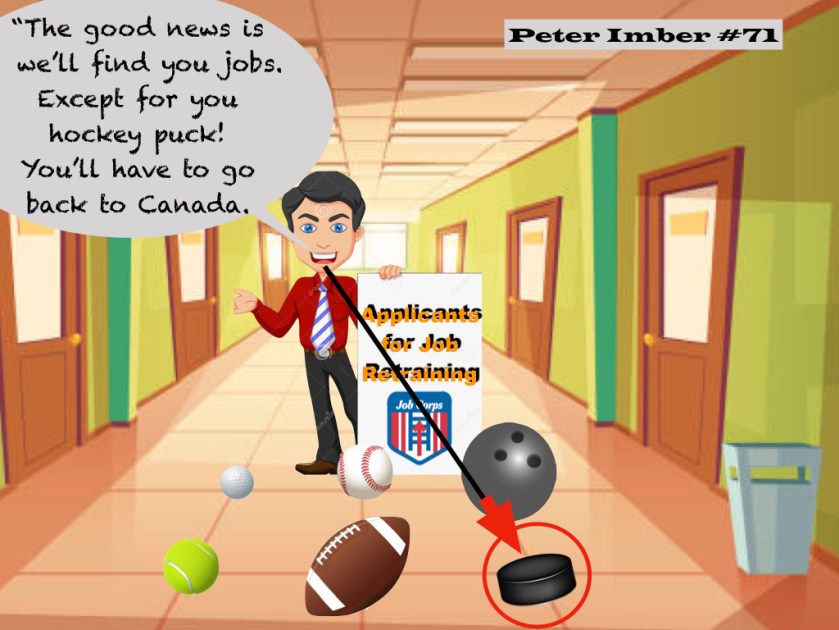



More Cartoons in the Time of COVID-19 for June 2020

My Cartoons.001

It’s graduation time and undoubtedly the strangest one in our lifetimes. I’ve seen pictures of graduations being held at drive-ins and speedways. The most unique one I’ve found was at UC Berkeley and you might want to check it out…
It was online by way of a video game and you could create an avatar of yourself and be in attendance. For students graduating this year not being able to have this experience together will be a different kind of life long memory.
I don’t know if I’m typical or just cynical but from my own three graduations I don’t remember any of the commencement speakers offering me any advice that I took. In fact it wasn’t until years later that a piece of advice hit me that really stuck.
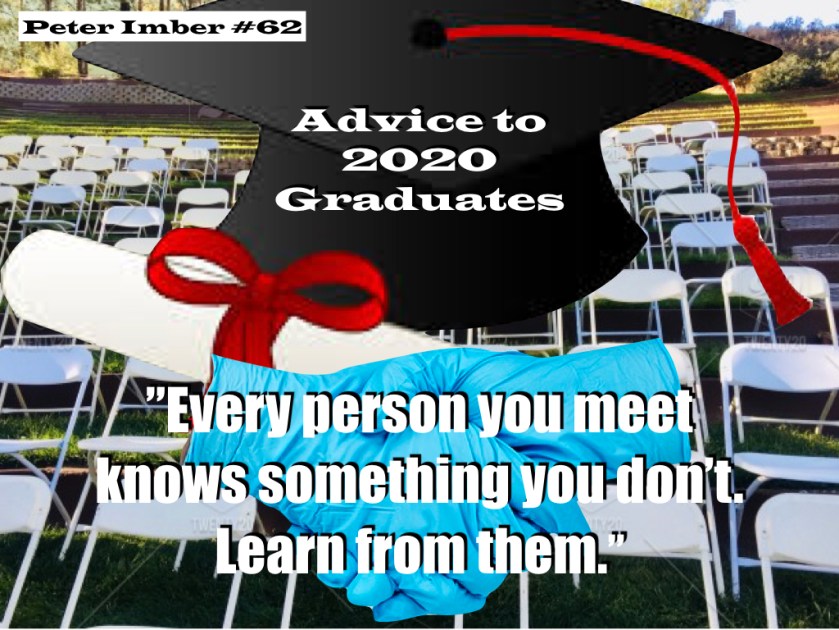
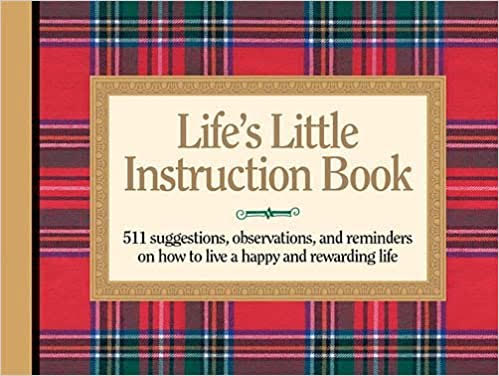
The quote above in today’s Homemade Cartoon is from H. Jackson Brown, Jr. (not to be mistaken with the singer Jackson Browne). In 1991 Brown published “Life’s Little Instruction Book.” It became the first book to ever be the number one best seller on the New York Times list in both hardback and paperback simultaneously.
image
The genesis of what turned into a phenomenon was Brown’s son going off to college. Life’s Little Instruction Book was a father’s words of wisdom for a son to take with him. I read it and one of the over 500 instructions on how to live a happy and rewarding life has been something I believe I have faithfully adhered to ever since. Here it is:
” When complimented a sincere thank you is the only response.
Oh, I admit there have been times I would have liked to have gloated and said more than this and other times when the compliment I thought I deserved wasn’t enough of one to please me. Hey, but once I got used to saying just thank you it became easy.
My father, like me, loved golf and played the game into his 80s. He was good and as he got older he played well enough to accomplish a feat most golfers can only dream about. In his late 70s he scored his age. He was 76 and shot a 76. Doing better than a score of 80 in golf is an achievement that fewer than 5% who play the game ever accomplish at any age. My father’s golf game in his last years was truly the exception. In fact one day after he hit a particularly nice tee shot I saw a much younger onlooker get down on his knees in supplication and beseech the golf gods “Please, let this be me.”
But when I got out on the golf course with my father during those final years there was something that bothered me. My father didn’t know how to receive a compliment. Whenever a fellow golfer praised a shot my dad hit the reaction that met it was a shrug of his shoulders accompanied by a muttered “almost” or “getting b.”
So, one day I confronted him with my displeasure and recited H. Jackson Brown, Jrs. compliment protocol. My father looked at me like I was crazy and said nothing and the issue never came up again. It stayed unresolved with me until several years after he died and, still puzzled by my father’s behavior, I had an insight into what I think might have been going on.
For my father golf wasn’t just about being able to play. No, I think it was more of a journey. And I don’t mean it was a quest for the unattainable in golf or just about anything else– perfection. Ben Hogan, one of the greatest players of all time, claimed he only hit a few shots a round he was happy with. No, it may simply have been a journey my father didn’t want to see end and maybe by displaying gratitude for praise late in his life he would have been acknowledging that the journey was coming to an end. I wouldn’t call my father a student of the game but he sure didn’t want to graduate!
As psychoanalysis that’s worth the money you paid to read it. And perhaps Life’s Little Instruction Book’s advice on handling compliments doesn’t apply to golf anyway. Where my father might have subconsciously equated golf with mortality, his son sees golf, at least at the outset of each round I play, as a moment when I’m inexplicably the most optimistic about life.
“Today’s the day,” I always pronounce to myself as I’m on the tee ready to hit my first shot and despite the inevitability with which that conviction is always crushed in my own way I don’t want to graduate either.
—————–
image
I have no words to accompany the cartoon today.
–Peter
—————–
image
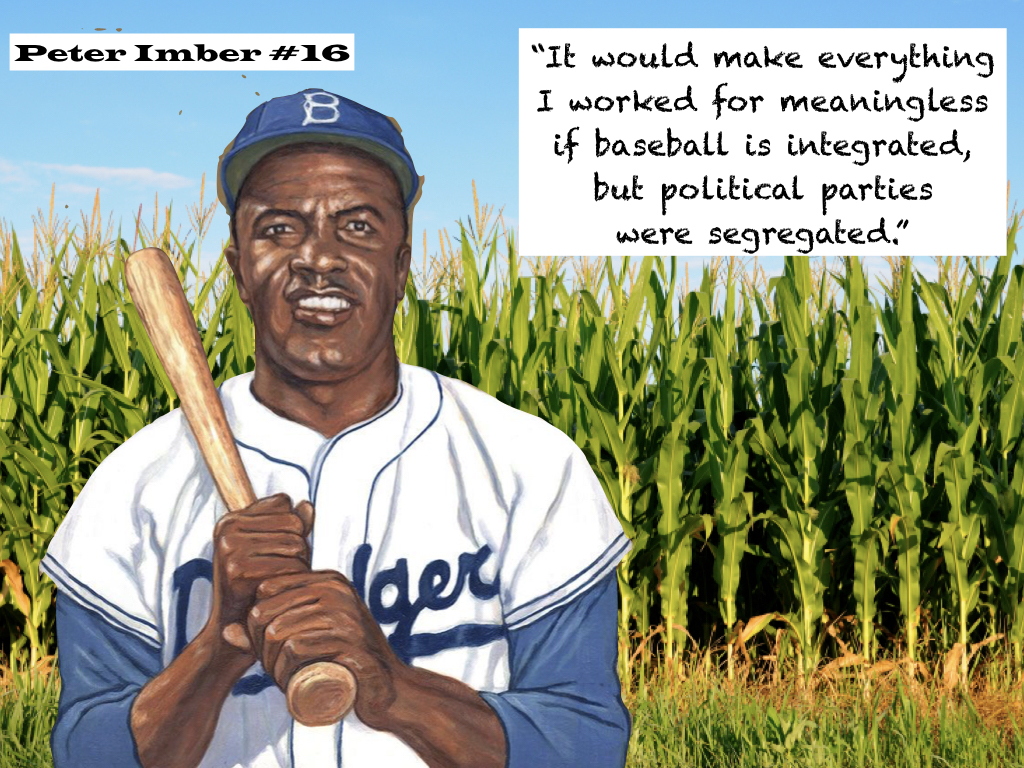
“My Administration has done more for the Black Community than any President since Abraham Lincoln.”
— Donald Trump
“I would rather be a little nobody, than to be an evil somebody.” — Abraham Lincoln
—————–

My Cartoons for June.001

“Why are all the angels white?
Why ain’t there no black angels?”
— Muhammad Ali
——-
My Cartoons for June.001
Given America’s current state of affairs why not hold a national party convention at an affair motel? And if the Republican party needs a place where its candidate for president would be showered with praise where else would be better than the Bates Motel?
Psycho was not one of my favorite movies by a long shot but I am a big Alfred Hitchcock fan. Not of the man, I’m talking about his movies. I’ve read enough about him to know he was an odd human being and more likely a twisted one.
I took a walk a couple days ago with David, a talented artist friend of mine, and at one point I mentioned one of my favorite descriptions of humanity, a sweeping generalization that despite that, I think, is hard to refute. Here it is: EVERYBODY’S NORMAL UNTIL YOU GET TO KNOW THEM.
David laughed. We have a lot in common, including a love of crummy Chinese takeout like the kind we both ate most every Sunday night as kids. We grew up in Jewish families. It’s a tradition. David added a neat insight that I think applies to Hitchcock and many other people we call geniuses. Because someone has a special talent at one thing we tend to give them way more credit than they might deserve for having a wealth of wisdom about a host of other things.
Hitchcock was a brilliant filmmaker and from his very early films he put the “matic” in cinematic. I believe no one has used the medium and told stories on the big screen better than he did. How do I back that up with so many other great directors and in light of the fact that, although nominated for the Best Director Academy Award five times, Hitchcock never won?
Here’s my argument. In Hitchcock films there are virtually no wasted moments. Oh, I suppose you might point out that Doris Day singing “Que Sera Sera” in The Man Who Knew Too Much wasn’t necessary but that wasn’t an artistic decision; it was a business deal breaker. To land Jimmy Stewart in the lead role, Hitch had to hire Day and give her a song to perform in the movie. Ironically, she didn’t even want to sing what ended up being the hit tune she’s most remembered for. She thought the song was too childish.
But I digress. Getting back to what I mean by there being nothing wasted in Hitchcock films, I believe nearly every moment, every action in them has a purpose and moves the story forward. Equally notable, unlike so many other suspense movies, in Hitchcock’s there is never anything hidden from the audience that requires a scene tagged on after the climax. You know, a denouement where a character in the last few minutes of the film has to tie up the loose ends that you weren’t given enough information about to be able to figure out for yourself.
So, what does this have to do with today’s cartoon? I guess nothing. But I’ll add this that might put a point on my friend’s observation that being a genius at one thing doesn’t always mean you can use that gift effectively in all instances.
Hitchcock came to America from England in 1939 and the first film he made in Hollywood— Rebecca —won his only Best Picture Oscar in 1940. During World War ll Hitch offered his services to his homeland and made two short films in French that were intended to be smuggled to the French Resistance and used to boost morale.
The films Bon Voyage and Aventure Malgache turned out to be so “Hitchcockian” that they were useless as propaganda. They were considered so unsuitable for achieving their intended purpose that they were apparently never shown outside of a screening room. The British Ministry of Information sealed them in a vault until they were finally released some 50 years later in the 1990s. Hardly anyone knew they even existed and Hitchcock never talked about them.
Being a former film student when I learned this I saw my own mystery story to be done and got to do it for Good Morning America.
Still, despite his eccentricities and deficiencies Hitchcock made some of my favorite films. He liked to use iconic settings like the Statue of Liberty in Saboteur, the Jefferson Memorial in Strangers on a Train and Mt Rushmore in North by Northwest. Hitch also wanted to do a scene in Disneyland for a film that was never made and would have been titled The Blind Man. Walt Disney would have no part of it, however. He had just seen Psycho and called it “disgusting.”
At Universal Studios in Hollywood a recreation of Psycho’s Bates Motel is still one of the most popular stops on the studio’s backlot tour. That leads me to wonder if Norman Bates would have been a Trump supporter?
—————–
My Cartoons for June.001
At what point do you get to call yourself a Mainer? Well, if you know Maine, then you know this isn’t even a question for discussion or debate. If you weren’t born in Maine, you can’t call yourself a Mainer EVER! Mainers even have a term for those of us who came here but will never be granted full Mainehood. We’re from AWAY.
Shortly after I moved here something happened that I wasn’t happy about and when I complained I had the hard truth about my status thrown in my face like ice water. “You wouldn’t understand, you’re from away!” said someone who wasn’t.
There’s a story I heard about a man who had a farm on the Maine border with New Hampshire and had been born there and lived there his whole life. When a new map survey of the state was done it was discovered that the man’s farm was actually not in Maine and thus he had been from away his entire life.
Since he was in his 90s his neighbors and community didn’t quite know how to break the news to him. Fearing he might not be able to handle such a shock, a whole team was assembled of local officials and medical personnel including a psychiatrist and EMTs with an ambulance.
On the appointed day the team appeared at the farm and as gently as possible informed the old man of how the changes to the new state map meant he was no longer one of them.
To their complete surprise he wasn’t outwardly upset one bit. In fact he appeared relieved. After a pause a member of what I guess you could call the unwelcoming committee spoke up.
“May I speak for all of us and say how glad we are that you are dealing with this so well. We were very worried.”
The farmer replied, “Are you kidding? I couldn’t have taken another one of those Maine winters.”
Maine does have a substantial population of what are called “summer people”, just as Florida can claim to have a lot of Maine snowbirds who leave here when the leaves are falling and return when they grow back in spring so fast by the way it feels as if they’re in a microwave.
COVID-19 doesn’t appear to be stopping many of those who spend only part of the year here from returning for this summer. Maine’s a good place to be right now. In fact it’s a very good place to be always but especially during a pandemic.
As much as I love Maine I think I know my place and am pretty careful about how I display my own restricted Maine identity. I may have Maine license plates and pay Maine income and property tax and sometimes I may even describe something as “wicked” but there’s only one authentic Mainer in our house and that’s my wife Jo.
—————–
My Cartoons for June.001
There will likely be as many books written about Donald Trump’s time in the White House as there have been about Franklin Delano Roosevelt’s– let me amend that immediately and predict more. But there’s a gap in the descriptions of the two gigantic enough to make the Grand Canyon look like a crack in the sidewalk. Very simply, although both have been presidents during perilous times, one grew and the other shrank in response to the crises they faced.
A list of the titles of books about Roosevelt, I think, is ample proof that I’m right. Here are a few:
Champion of Freedom
Roosevelt: The Soldier of Freedom
A First-Class Temperament: The Emergence of Franklin Roosevelt
The Defining Moment: FDR’s Hundred Days and the Triumph of Hope.
Here are a few written about the Trump White House so far:
Trumpocracy: The Corruption of the American Republic
It’s Even Worse Than You Think: What the Trump Administration Is Doing to America
Fear: Trump in the White House
A Very Stable Genius
Full disclosure, there are also pro Trump books with titles like:
The Russia Hoax
Liars, Leakers and Liberals
Killing the Deep State
The Faith of Donald J. Trump
As William Barr has reminded us, ultimately history is written by the winners, but there’s one particular book about Trump that resonates the most for me. It’s written by a sports writer named Rick Reilly. The title is Commander in Cheat: How Golf Explains Donald Trump.
The author interviewed caddies and pros who have played golf with Trump who describe how his cheating and lying are as pervasive on the golf course as anyplace else. One critic called the book “amusing if it wasn’t so alarming.”
If you’ve been reading my daily offerings, then you know I play golf. Golf to me is unrequited love but I’m happy to be performing in my own long running show as the constantly jilted lover. Golf is also probably the best litmus test of character of any sport I know. In golf you, the player, are also your own referee.
Let me explain. Cheating at golf can take place in many ways. The most obvious is giving yourself a score that’s lower than what you made. The more subtle is improving your ball’s lie in the rough which is forbidden.
I don’t cheat at golf! If I sound self righteous about it, that’s fine. Golf is a game of honor. If you are your own honest referee you can’t argue or disagree with him, you can only dishonor yourself if you do.
Years ago a writer played a round with Trump for an earlier article about Trump’s relationship with golf. Trump called him after it was published and had only one complaint.
Trump: “The only thing that was missing was that you didn’t mention I shot a 71.”
Writer: “Donald, that’s because you didn’t shoot a 71.”
Stories about Trump’s cheating are legendary and one pro even remarked,
“You’ve heard so much about it, it’s almost like you want to witness it so you can tell the stories.”
The professional golfers who play on occasion with Trump sully the game as well as their reputations. Trump is an embarrassment to golf. I only wish that his golf was the only thing that he dishonors.
—————–
My Cartoons for June.001
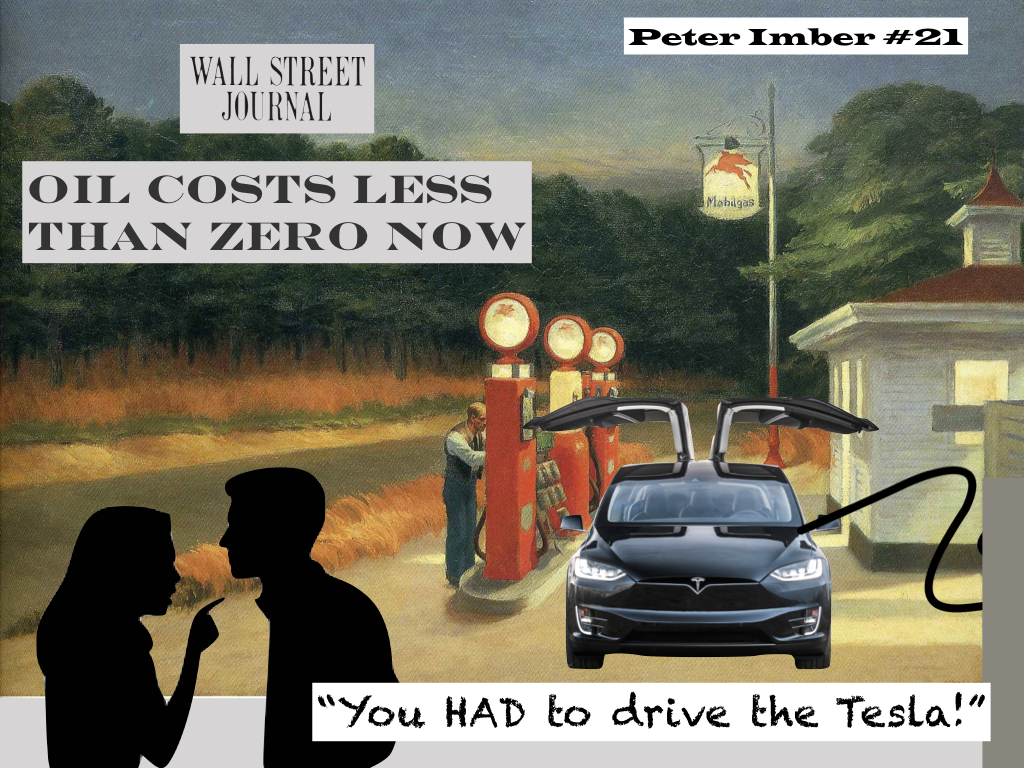
One of the nicer things about living in Maine is stress free driving. I have had several years here when I don’t think I even used my horn once and now, during the first few months of being COVID-19 conscious, I have had a few weeks where I didn’t use a car at all. Our auto insurance provider sent us a $34 check to thank us. That’s two tanks of gas I don’t need right now.
I’m at that point in life where you actually think to yourself, “How many more cars am I going to buy?” We own a Pruis and a Volvo. I like both of them. With the exception of a VW Rabbit, since the 1990s I’ve only owned Toyotas and Volvos. I guess I’ve never seen car buying as a patriotic act.
So when we do buy that next car what will it be? On our last trip to Los Angeles, just before the pandemic was to cancel any future travel plans indefinitely, I noticed that Teslas seemed to be everywhere. Not too long ago the Pruis was the top selling car in California. I don’t know if the Tesla will become as popular but it appears to be making inroads. Could it possibly be our next car?
Maine would seem to be at a disadvantage when talking about all electric automobiles. Cold weather saps their batteries a lot faster and if you’re using the car’s heater, the distance you’ll get on a charge is almost cut in half.
Nevertheless charging stations are proliferating here — L.L. Bean’s flagship store has 16, the most in the state — but using them for your Tesla is not free unless you find one installed by Tesla itself. Insuring a Tesla is also expensive but here Maine actually has the advantage. The yearly premium for a Tesla Model S in Michigan is over $4,000, In Maine it’s less than half of that. Still it’s not cheap.
Ok then, here’s the big question. Will I save money long term driving a Tesla rather than a Pruis? Will the money I’m no longer paying for gas be significantly less than the cost and inconvenience of charging a Tesla’s battery every 300 or so miles? And is there an actual way to create that comparison between a Pruis and a Tesla? I know I get close to 50 miles per gallon with a Pruis, what’s the equivalent for a Tesla?
I wasn’t surprised that this very question has been batted around on the internet like a piñata and also not at all shocked that the answers I found were all incomprehensible. Here’s an example from “aman with a plan”:
“Because the price of gas and electricity is fluid, I like to do MPGe using the energy-equivalency. One kilowatt hour of energy is 3,600,000 Joules. One gallon of gasoline holds approximately 130,000,000 Joules in potential energy, however, the most efficient internal combustion engines in the world are only about 50% efficient, with the average vehicle ICE in the 20% range.

A Tesla Model 3 travels approximately 4.13 miles on one kilowatt hour, or 871k Joules per mile. A 50% efficient ICE will have a theoretical 65,000,000 Joules of energy on one gallon of gas, capable of travelling about 75 miles at the same Joules per mile. A 20% efficient ICE will have a theoretical 26,000,000 Joules of energy on one gallon of gas, capable of travelling about 30 miles at the same Joules per mile. This makes a gallon of gas roughly equivalent to 7.3 kilowatt hours on a Tesla when considering an average ICE, or 18.2 kilowatt hours when considering the most efficient ICE in the world today.

So use the following formula.  If you traveled X miles on Y kilowatt hours of energy, then your MPGe is between [X / (Y / 7.3)] and [X / (Y / 18.2)] based on the equivalent energy used. However, at current pricing of approximately $3 per gallon and $0.15 per kilowatt hour, the 7.3 kWH is 64% less expensive while the 18.2 kWH is 9% less expensive. For an average ICE, factoring in pricing, you travel, on the dollar equivalent of one gallon of gas, about 174% further with a Tesla Model 3. Which is where the 105MPGe comes from. If energy was priced similarly, and ICE were more efficient, that gap would be much closer.”

So, Tesla wins? Or do I just need to get more ice for my Pruis? It’s usually found in a freezer in front of the checkout counters at the supermarket but we’re making as few trips there as possible right now.

So, I guess I’m not not ready to get a Tesla. At least at this point I certainly don’t see hocking the family Joules for one.

—————–

image


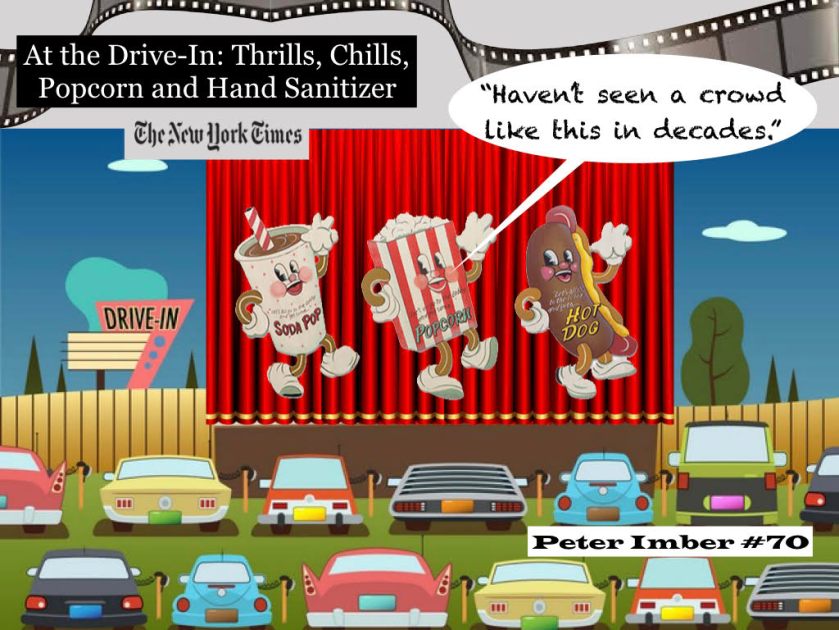
“You can fool all the people some of the time and some of the people all the time, but you cannot fool all the people all the time.”

— attributed to Abraham Lincoln

and in other words

“If It’s Tuesday, It’s Kibbutz Movie Night!”

Whether Abraham Lincoln said this about what fools we mortals are or are not the truth of the observation is indisputable for me. I have personal experience. Only for this story I will substitute the word “please” in place of “fool.”

In the 1970s I was responsible for picking a weekly movie for a village of 500 people. It was on the kibbutz in Israel where I lived for seven years. Tuesday night was movie night and we screened a 16mm print in the communal dining hall in the winter and outside on the lawn in the summer.

A list of movies available for rental for all the small communities in Israel was updated every few months and scheduling your preferences required making a trip to Tel Aviv as quickly as you could to get in the queue for the newest releases. On those occasions the tiny office of the distributor was besieged by representatives from villages like mine which were desperate for entertainment.

I lived on Kibbutz Gat, 45 miles south of Tel Aviv, about the same distance southwest from Jerusalem and less than 15 miles from the Mediterranean Sea– Israel, if you didn’t know, is a small country.

In Israel in the 1970s movies were pretty much it for seeing moving images on a screen. The country had only one television channel and my kibbutz had only a half dozen televisions so radio was mostly all there was for broadcast media and culture from the outside world unless you went into one of the kibbutz bomb shelters where the TVs were. The weekly movie was a big deal.

I had arrived in 1972 and hadn’t done my army service yet when the Yom Kippur War occurred the following year. Overnight I became one of the few men left on the kibbutz under the age of 50.

For several months I milked the dairy herd’s 200 cows twice a day and became the designated projectionist for our weekly movie which during the war expanded to twice a week. The films were a diversion from stress and uncertainty and most of all shock and mourning. During this time five men from the kibbutz were killed in combat.

In the fall of 1974 I began my own military obligation and after being posted to an artillery battery not far from the Suez Canal I was able to use my movie projection skills one night to get out of guard duty. Turns out I was the only one in my unit able to mount an anamorphic lens to make Barbra Streisand appear zoftig (voluptuously plump in Yiddish) instead of ridiculously skinny for our watching a cinemascope print of Hello Dolly.

I returned to the kibbutz after completing my regular service– my battery gave me a ballpoint pen inscribed with “From Battery Gimmel” as a going away present –and was drafted again to be the movie night majordomo. As the one choosing the movies for the kibbutz, I discovered it was a privilege not without a price and best described by another Yiddish word that usually applies more to the unhappy twists and turns of life than innocent projectionists… That word is TZURIS!

I found two definitions under tzuris in my Yiddish–English dictionary.

1. Daughter pregnant with child of an unemployed bartender.

2. Son loses his job and moves back home.

It was seldom that somebody on the kibbutz didn’t complain to me about my movie selections.  Full disclosure… I admit I scheduled movies I wanted to see after reading Pauline Kael’s New Yorker reviews– my parents bundled their issues into monthly care packages to me that also included cans of tuna fish. Sometimes I indulged myself even further and ordered a movie I just wanted to see again.

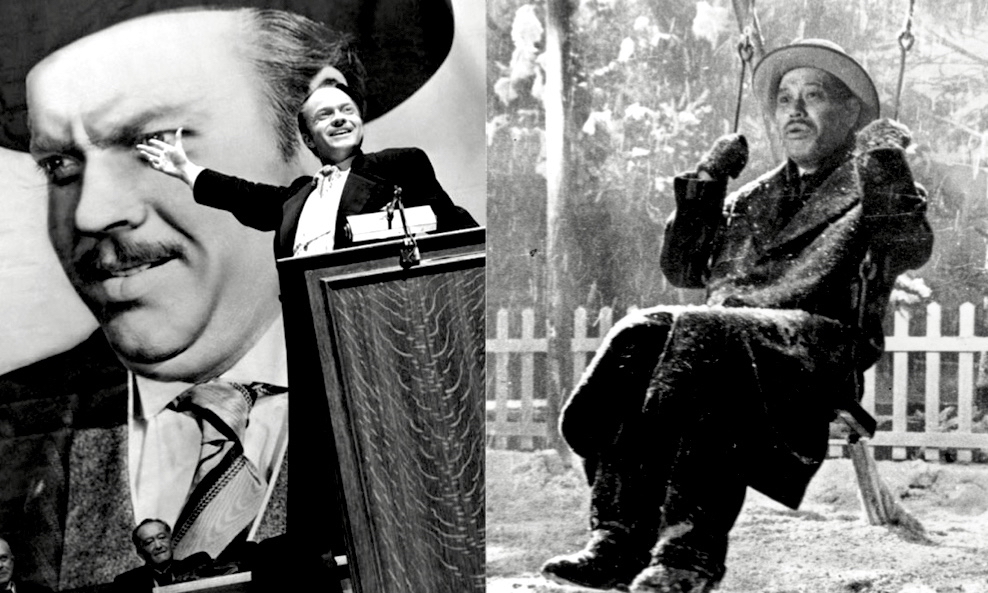
Such was the case with Citizen Kane. I knew I was taking a risk with a film from that far back in the past but since I still consider Orson Welles’ masterpiece the best American film ever made, I went for it and believed it had been a success after one kibbutz member began talking to me effusively about how much he had enjoyed it.

Him: “Who was that guy who played Kane?”

Me: “That was Orson Wells and he was the director. It was his first movie.”

Him: “Amazing! What a genius!”

I was happy the film pleased this man. His name was Zvi Nahor and he worked as a bus driver with Israel’s largest bus company. Zvi was also an accomplished photographer who always took his camera with him and some of his best shots were taken from his bus driver’s perch.

Just as Zvi finished praising Kane another member of the kibbutz came up to me nearly as excited.

“Why did you bring us a black and white movie? Weren’t there any color ones available?” He stomped off without waiting for a response.

Well, in the land of the Bible praising Kane and raising Cain comes with the territory and yes, you most certainly cannot please all of the people all of the time. So why try! (Visualize me standing with my palms turned upward and my lips pressed together tightly.)

Below is a picture of Zvi Nahor and several of his photographs. He kept snapping into his 90s.

image

—————–

My Cartoons for June.001

Hey, professional bowling is back! Happened over the weekend but I’ll spare you the details. Professional golf starts up again tomorrow but without any fans on the course to bounce errant shots off. Basketball and hockey plan to go right to their post season playoffs sometime during the summer. The NFL expects to play its normal season. But what about baseball?
At the moment it looks more and more likely there isn’t going to be a Major League season this year. It’s not so much about COVID-19 at this point. It’s about money. The players have made it clear that the only sacrifices they are willing to make will be the usual ones they perform on the field– bunts and fly balls that advance a runner –and being asked to give up a chunk of their paychecks in order to get back out there will keep them dug in in the dugout.
In the spring an older man’s fancy turns to baseball, at least mine does. I enjoy hearing all the birds outside my window but until now I was willing to trade the cardinals and orioles with feathers for their namesakes with bats and gloves. I wanted to be listening to baseball games. I pay $20 annually to have access to the radio broadcasts of any game anytime I want by way of something called MLB Audio. It’s been a tremendous bargain.
But guess what? I don’t really care anymore. I think I’ve moved on. I doubt I’ll be watching the golf tournament this weekend. Maybe if it rains I might but otherwise I’ll be playing golf myself. The NBA’s return to action won’t interest me and the NFL lost me quite a while ago.
I do care about hockey because my son is the organist for the Anaheim Ducks and obviously, he’s not working. But to the Ducks credit when the regular season was suspended they kept him and all their other employees on the payroll through the date it would have ended.
So, how has not having professional sports changed my life? Well, not much. I’ve discovered that without sports to watch or listen to I’m not missing them. They have been surprisingly easy to live without just as giving up pretzels and beer for the sake of losing weight has been.
I wonder if I’m in the minority here? I know I’m what’s called a fair-weather fan. My teams are the Celtics and the Dodgers and when either of them is riding atop the standings I’m all in and when they’re not doing well life goes on without them.
But I just remembered something and it seems important. Two years ago I met up with my son in Arizona and we spent a week together watching spring training games. Half of the Major League teams train there and the other half do so in Florida.
We went to two games every day and in the span of that week managed to see every team based in Arizona play except one. It was a great time and if it’s part of the game for a hitter to occasionally strike out, it’s also part of baseball for fans in the stands to strike up random conversations with each other and we did.
And here’s what I realized then and recall now. Two years ago the country was as polarized as it is today but politics never came up with anyone we talked to. The baseball stadium was like a DMZ or a No Fly Zone. We were strangers who brought only our own connections to the game we love to the ballpark. All our rhetorical guns had been left at the gate. The difference between being part of a team’s fan base and a member of a politician’s political base could not have been more apparent.
“Remember how the Indians pitcher Herb Score’s career was cut short when he was hit in the eye by a line drive?”
“How about that baseball card of Reds slugger Ted Kluszewski in a sleeveless jersey?”
We shared favorite memories and not strident opinions. For as long as a game took to play we experienced a unity that felt good even if I suspected it would surely have been over after the last out had we lingered longer in each other’s company.
Could it be that sports venues are the only places left where all of us can still gather and have this? Where we can feel comfortable and unthreatened together. Maybe we all need to go to more baseball games. But I forgot. Doesn’t look like we’re going to have any baseball to go to this summer.
—————–
My Cartoons for June.001
As the pallbearers lifted his coffin at Harry Houdini’s funeral one of them, legend has it, asked the others a question– “Do you think he’s really still in here?”
Houdini was the most celebrated escape artist of his time and arguably of all time. He could free himself from handcuffs and leg irons after being nailed into a crate and submerged under water or disentangle from a straitjacket while being suspended upside down from a crane. Once he nearly died after being buried in a pit of earth six feet deep and barely clawed his way out.
Unlike Donald Trump, Houdini rarely attempted to make things disappear. The notable exception took place in 1918 when he performed an illusion that convinced 5,000 people that a 6,000 pound elephant had vanished from off the stage in front of their eyes.
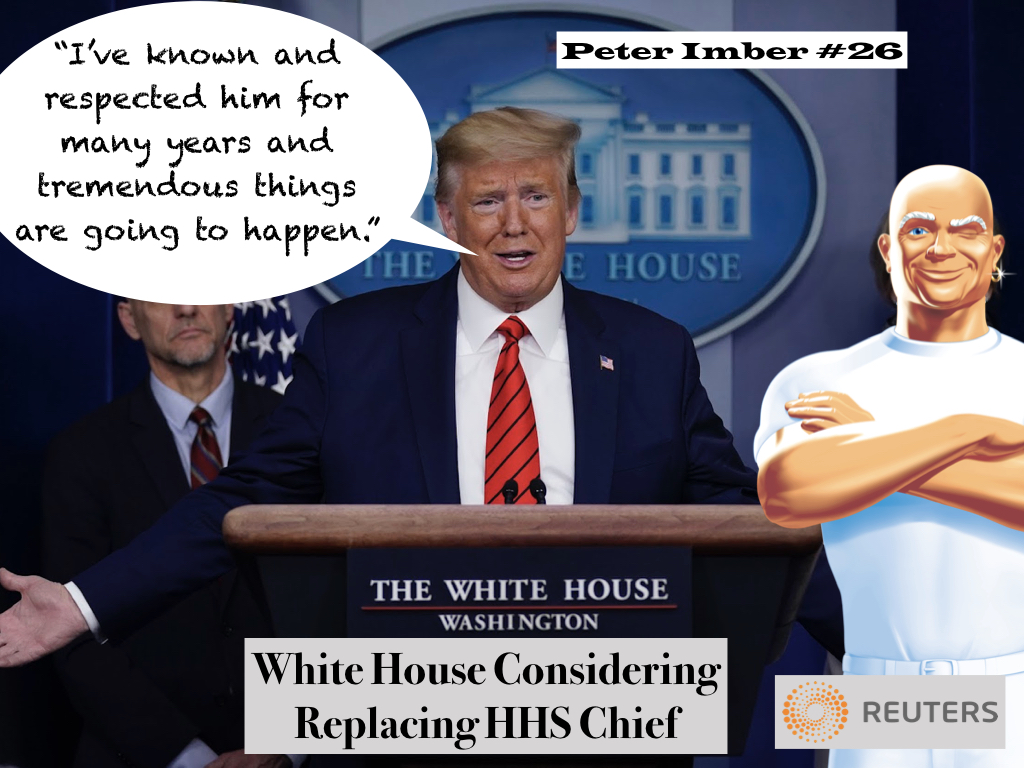
Anthony Fauci is by no means an escape artist but he is indeed a survivor and has been a medical advisor to every U.S. president since Ronald Reagan. But Dr. Fauci did not foresee that the threat to America from COVID-19 was dire from the outset and in February stated that he believed the country was at low risk for us contracting the virus then. He qualified his view by also saying that his assessment could change.
That initial opinion, taken out of context, has since been used to attempt to explain away the tragic fiasco that has been our federal government’s response to the pandemic. Nevertheless when things spun out of control Dr. Fauci became the nation’s most trusted voice during that period when President Trump held nearly 50 briefings on the coronavirus.
Fauci walked a tightrope, having at times to correct the President’s misstatements and was a much needed honest and sobering presence in the room. Fauci’s popularity soared. It was a safe bet that Trump would eventually push him out of camera range and he did.
As more and more places and individuals relax their pandemic protections, the news that the virus is on the rise in 22 states is being drowned out by a White House no longer showing concern and has also been eclipsed by another dreadful event– the death of George Floyd.
To Fauci’s credit, unlike others who have contradicted this president and been shunted, the doctor is continuing to speak out and a couple days ago told a group of biotech executives that COVID-19 has been his worst nightmare come true.
“In a period of four months it has devastated the whole world and it isn’t over yet… Where is it going to end? We’re still at the beginning of really understanding,” he warned.
If Houdini were still around I think many of us would ask him to totally unshackle Dr. Fauci and restore his non political briefings with Dr. Deborah Birx unaccompanied this time by Donald Trump. And there may soon be growing support for a second request of Houdini. That vanishing act he performed in 1918? There are plenty of eligible elephants in Washington, D.C. if he were to choose to revive it.
—————–
My Cartoons for June.001
(I started off wanting to write something about Bob Dylan but you’ll see my train of thought sort of derailed.)
Bob Dylan and the Beatles happened at about the same time in my life. It was 1963. Dylan’s second album with “Blowin’ in the Wind” was released in May and  The Beatles “I Want to Hold Your Hand” that December. In between President Kennedy was assassinated. We’ve had tumultuous years before in America.
I was surprised to discover that the Beatles last live concert together was in 1966. Bob Dylan on the other hand is still performing what he calls his “Never Ending Tour.” It’s been going on since 1988. His 3,000th show was in 2019 and he had a 25 date North American tour scheduled for this summer that has been canceled.
By the way Dylan turns 80 next year… I wonder if he ever closes a concert with “Knockin’ on Heaven’s Door?” I doubt he’d think that was funny. Actually, it isn’t but I sure as hell can’t tell if he has a sense of humor. In fact to me he’s pretty much how Winston Churchill described Russia– a riddle wrapped in a mystery inside an enigma.
But I am in awe of his energy. No way I could handle his schedule and I’m only 73. I retired in 2010 when ABC News cut its staff by a quarter and all of us with contracts were offered buyouts. I jumped at mine and was out the door. Jo and I had planned ahead and drove across the country to a house we had bought the previous year here in Maine. (As I said at the beginning I would take an off ramp at some point from Dylan and exit Highway 61.)
For me retirement has been fabulous. Although I am sitting on my ass writing this, I don’t think I can be accused of having done too much of that for the last 10 years. I admit I do love spending time in the room I have commandeered in our house. In fact if you were to see the current setup and a picture of my office at ABC, you’d probably say, as Jo has, that they look awfully similar. The coffee is better here.
During the first few years of my retirement I’d occasionally meet other men who were contemplating their own and would ask me how I was enjoying mine. I would make the same speech to each of them.
“Retirement is like summer camp,” I’d say. “But there are two differences. The first is that when the bugle sounds Reveille in the morning, if you’re still in bed, you can go back to sleep. The second is when you’re having fun at whatever it is that you’re doing, nobody is going to blow a whistle and tell you that you have to go to the arts and crafts building and make an ashtray for your parents.”
Some of these men I met definitely seemed anxious about the prospect of having new found time on their hands and expressed their concern that they wouldn’t have enough to do and be bored if not depressed. It took me several of these encounters to realize I was not being helpful with my summer camp analogy.
So, I started asking the questions instead of the other way around.
“Do you love what you do?” I’d say.
And if they said yes, I followed up with…
“And can you still do it?”
And if they said yes, I had my answer and hoped they had theirs. I ended the interrogation with…
“Then why stop?”
In a way I haven’t. My old job wasn’t really much like what I’m spending time doing now but a good chunk of now does rhyme with then.
One other thing about getting older. I had a grandmother who lived in Florida. She was my favorite grandparent because she knew the way to my heart was through my stomach. When I was in college she’d bake me knishes and send them through the mail.
We couldn’t have a refrigerator or a hot plate in our dorm back in the 1960s but winters in Hanover, NH provided me with substitutes for both– a window ledge and a radiator were all I needed. I’d open the window, grab a knish, put it on a plate atop the radiator and voilà! I didn’t share my grandmother’s knishes with anybody or maybe it was just that nobody asked me to.
I learned a valuable piece of information from her near the end of her life. She was in her 80’s in a retirement facility and when I’d visit I’d bring her favorite lunch with me– a Burger King Whopper and a can of Budweiser. One time as she was enjoying both she looked up and said, “You know, I know I’m old, but in my head I still feel the same as I did when I was young.”
At the time I didn’t know how that was possible but I hope you’re all as lucky as she and I and can say you too think you’re forever young. I imagine Bob Dylan must and he wrote a song with that title and another, as a friend reminded me the other day, with a lyric that appears to have been a self fulfilling prophecy… “I was so much older then I’m younger than that now.”
—————–
My Cartoons for June.001
A supermarket, a friend’s backyard, a dentist’s chair… as we learn to walk through our lives anew we’re like teetering infants who may have consciousness of the risks they’re taking when they first try to be upright but go for it anyway. For the present my footing is unsteady and it’s going to be difficult for me to know when to go back to what used to be just easy and automatic.
Now, we all will weigh risks with many of the decisions we make… eating in a restaurant, getting a haircut, going to the gym. Nobody can claim to know for how long we will have to endure this and with our knowledge of COVID-19 still so piecemeal our risk taking at times may surely seem like we’re throwing dice or spinning a wheel of fortune.
However, some of these decisions will be made for us. Consider the salad bar. Ever hear of Soup Plantation? It was a chain of all-you-can-eat buffet style restaurants that originated in Southern California. I went to one once and gorged on the most calorie laden and unhealthy stuff that was offered. I probably took a cursory look at the salad bar– I am assuming there was one — and moved on quickly to the fried chicken. As a result of COVID-19, Soup Plantation closed all of its 97 locations last month forever and the buffet as an American institution has been badly buffeted if not sunk.
Gluttonous style eating has been a tradition in the United States since the 1950s when the first all-you-can-eat restaurants started popping up. When I was very young when we went out to eat the place my parents often took me was the Crystal, the most popular restaurant in Reading, PA. The proprietors were smart about getting kids to want to come there. If you hadn’t made a scene and cleaned your plate you got to go pick out something from the Crystal’s “Treasure Chest.”
Inside it were puzzles and little toys and even before I ever had my first glove I remember choosing a package of baseball cards– the first I ever had and wish I still did. I think I got Ted Williams’ card. I suspect there are millions of baby boomer men who claim their mothers threw out their baseball cards. I do.
The Crystal ran a buffet on the weekends. They called it a smorgasbord which is Scandanavian. The owners were Greek. The food was totally American. It was an all-you-can deal until it wasn’t.
If you remember my earlier mention that Reading is the 10th most obese city in America, you shouldn’t be surprised that it didn’t take long for the words “all you can eat” to spread like soft butter throughout town and before you could say to the guy carving the roast beef, “I’ll tell you when to stop,” the Crystal was being eaten alive!
Even though I was very young I witnessed the aftermath of the decision that turned the Crystal smorgasbord into one stop chomping. I remember watching a man walking back to his table with his arms encircling his plate. The food he had piled on it was so high that it was only prevented from falling on the floor by his forearms and shirtsleeves wrapped tightly around it. Before he had a chance to wear it on his face he wore it on his clothes. Images like that last a lifetime in one’s head.
So, add to the rising toll on society created by the pandemic all-you-can-eat food eateries and perhaps even the healthier serve yourself options like salad bars. I expect they too, are endangered despite the sneeze guards and likely to disappear as collateral damage or if you prefer, be abandoned to decay into romaine ruins.
—————–
My Cartoons for June.001
I’ve never understood why so many Americans are so captivated by the British monarchy. What’s the attraction? To me they are like a diorama– a frozen museum exhibit behind glass. A few of the miniature figures in the case do actually move. They cut ribbons and unveil plaques and of course there are the royal wavers who are part of the display and have to have their batteries replaced daily.
But what if we could get a real look behind the royal curtain and see the House of Windsor when they weren’t at “work”? See the inside stuff like when Charles’s toothpaste is put on his brush for him and the Queen’s new shoes are broken in by someone for her. That’s certainly a duty where one has to be on their toes. Oh, did you know she always travels with a supply of her own blood?
Well, we’re in luck. Barbara Walters has just wrapped up her last special and she really means it this time. I can’t tell you about all the interviewees except for one. It’s Queen Elizabeth ll and only appropriate that these two longest running acts in show business should make a final curtsy together.
Here’s a transcript of a portion I just happened to get my hands on after washing them most assiduously of course:

Barbara: “Liz, so how’s biz?”

Queen Elizabeth: “Don’t ask! But you did and let me tell you between dealing with my son Andy’s frivoling and my grandson Harry’s sniveling I’ve had it. And then Charles was under COVID for a bit– a good place for him actually…
B: “Yes, and I must ask the question on everybody’s lips, might you consider abdicating? Your son Charles has been waiting…”

Q: “Let me stop you there. Does he look like an heir? He’s lost most of his hair and I’m not going anywhere. He won’t get my chair.”
B: “You sound like Danny Kaye in The Court Jester. So, it’s William and Kate who will get the estate and the chalice from the palace…”
Q: “You started it Babs! But when I die, and that’s not happening until Chucky is gone… You know I have a will. That is, I mean a living Will.”
B: “How about your hats? Do you think you might leave a few for Meghan?
Q: “Meghan who?”
B: “Come on Elizabeth, let’s not be bitchy.”
Q: “Bitchy, Barbara? Are we talking about corgis or American gold diggers?”
B: “So, you think Meghan Markle married for money? She was already a TV star and she loved your grandson.”
Q: “LOVE! Who marries for love? Do you think I did? Look, we don’t want to end up like the reign in Spain. We have a public who have to find us endlessly fascinating so sometimes we do have to let them be privy to a little drama. After all, we’re not just stiff upper lips, but we only lift the curtain when we choose to.”
B: “So, we, your public, don’t really know all that’s going on inside the walls of Buckingham Palace?”
Q: “Are you serious? Just between you and me we make the Playboy Mansion look like a nunnery and that’s the Pope’s own opinion.”
A: “That’s shocking but maybe not, you are in a heir raising business. So, tell me something blue that we don’t know how about you.”

Q: “Well, I love my corgis and discovered that so does Stormy Daniels. She’s quite an actress you know.”
—————–
My Cartoons for June.001
When my son was small he had a friend over one day who asked to call his parents. In our den we still had a rotary phone and I watched him push his index finger down on the holes for the numbers and saw the baffled look on his face when nothing happened. I hadn’t realized he’d never seen or used an old phone before.
That was a good laugh but a short time later I wasn’t laughing when my son had another friend over and they went to use our turntable. I heard an awful noise and rushed to the source. I hadn’t yet taught my son how to use a record player and the boys had pressed the stylus down onto the disc with enough force so that it barely moved but was crying out in pain.
Neither the rotary phone nor the phonograph will likely be something anybody will need to know how to use ever again. The saying ‘Everything old is new again” makes sense perhaps if you mean fashion but not if you’re talking about technology. Burberry trench coats will probably be around forever but the Blackberry phone is dead and buried.
A kid growing up today will never hear the sound of a dial tone or that made by the keys of a typewriter unless he knows Tom Hanks who has a collection of 250 of them.
The list of stuff that was simply part of our lives years ago but is obsolete and foreign to those much younger than we Boomers is long. Here are just a few things that I doubt most kids today will ever do or even know about…
–Play an audio cassette or a CD
–Buy a roll of film or maybe ever look at a photo album
Put a VHS tape into or record anything on a VCR
–Use a pay phone, remember phone numbers or have a phone book
–Rely on a printed map or road atlas
–Send a fax
–Lick a stamp
Of course there are some upsides, too. They’ll never have to use carbon or Liquid Paper. And they’ll never buy an album for just one song and discover the rest of them suck!
While looking into what’s gone and forgotten for those much younger than I, I found something called the Mindset List. It originated 13 years ago when four professors at Beloit College published a compendium of things they believed shaped the values and world view and formed the reference points for that fall’s entering freshmen class.
Here’s a paragraph from the one that was written in 2016 for the class of 2020:
“In their lifetimes they have always had eBay and iMacs, and India and Pakistan have always had the bomb. The Sopranos and SpongeBob SquarePants have always been part of popular culture, Gretzky and Elway have always been retired, and Vladimir Putin has always been in charge in the Kremlin.”
Coming across the Mindset List made me understand what I should have all along. When I was growing up there were plenty of things that had been part of my parents’ lives that I too, probably never saw or knew about. As a kid we still had a milkman but there was no ice man. There were no horses delivering anything. I vaguely remember we had a party line and that there were still telegrams but soon we had a phone number–54064 –and a television set. When did we stop calling them sets? And I played 78 records which lasted for at most five minutes a side.
I have old letters and photographs of my own and some of my parents in boxes in our attic. It’s easy enough to read and look at them. They’re always there in the same form as they always have been from the time they were written or printed. Full disclosure –some of my typed college term papers have faded to the point that I couldn’t turn them in if I had to today.
I have saved thousands of emails and pictures that magically all fit in my desktop computer and allegedly, also exist in a server who knows where. That repository is called a “cloud” but it isn’t drifting across the sky and my letters and pictures are only accessible as inconceivable amounts of zeros and ones inside a hard drive and not from a box in the attic. 
Who is ever going to want to go through all this stuff? I won’t. I’ve tried and been  overwhelmed by the task. I doubt very much anybody else will want to take it on. I started this musing with “Everything old is new again.” How about an update? “Everything more might be actually less.”
—————–
My Cartoons for June.001
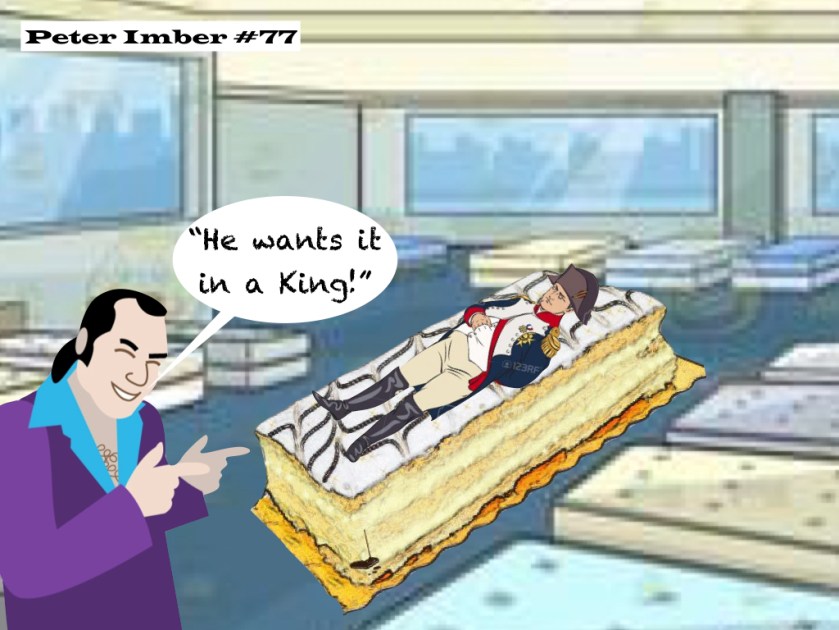
There’s a myth about Napoleon and sleep. Historians have contended that he slept only four hours a night but an alleged quote of his seems to contradict this. How much sleep did he actually think was necessary?
“Six hours for a man, seven for a woman and eight for a fool.”
Donald Trump, who may think he’s Napoleon, claims he only sleeps four hours a night. Of course he could be lying and has somebody else tweeting for him around the clock to make it appear that he’s awake when he isn’t. Remember he cheats at golf! However, it wouldn’t be surprising that in this instance he may actually be telling the truth. There have been other world leaders who were nearly sleepless in the saddle including Margaret Thatcher and Bill Clinton.
But then there’s also Albert Einstein, who slept 10 hours at night and took a nap in the afternoon. So, I guess there’s a certain amount of relativity one should consider when equating sleep with energy. Of course there’s also the middle of the road approach espoused by Benjamin Franklin who we assume packed it in early and rose with the sun. 
 
I’m not commuting by car to work anymore unless you want to count a few days a week back and forth to the golf course and that’s only during Maine’s all too short of a season. But commuting aside, for 26 years I worked at least 50 hours a week so let me subtract vacation time and do a little math… The figure I come up with is about eight years of actual time that I spent at work during my career at ABC News. 
 
That seems like a big number but let me throw another one at you. If I live to be 80, I will likely have spent 33 years in bed– 26 of them actually asleep and another 7 trying to be.
 
This information by the way was gathered by a British organization called the Sleep Matters Club that used 15 sources to compile it.
 
So, what’s the most important thing in my house besides my wife? It’s a no brainer, it’s our mattress. We didn’t mess around when we bought it. We went to a store with a big selection we could try out and I believe we picked a winner.
Once many years ago I and some friends settled for a loser, four of them. It was on the Upper West Side of Manhattan. The four of us signed on to share an apartment together soon after graduating from college. We each brought our own stuff but two items none of us had were a bed and a mattress.
 
The landlord noticed this and said he had a landlord friend who just so happened to want to dispose of four beds with mattresses. The building was nearby and we found out it was owned by television game show host Gene Rayburn. Remember The Match Game?
 
One look at what we were being offered and it was apparent why Rayburn wanted to get rid of the mattresses. They were stuffed with straw. I had never seen one before. I had no idea they even still existed except maybe inside recreations of colonial homes at a tourist attraction like Old Sturbridge Village. Hey, we were pretty desperate so we hauled them back to our place and for a few months all was well.
We did our laundry at a laundromat on Columbus Ave. and a few times I found that my clothes were so hot out of the dryer I had to juggle them on my way back to the apartment. My roommates were experiencing the same thing.
One night I was returning from playing basketball at a nearby Y and as I rounded the corner from Amsterdam Ave. onto our street, I saw fire trucks in the distance. I started to run when it became clear they were outside our building and arrived just in time to see a couple of firemen dragging a smoking mattress out the front door. It only took another moment to figure out what had happened when another fireman brought out a pile of burnt clothing.
One of us had returned from the laundromat earlier that evening and thrown his hot clothes on his bed. He’d gone out right afterward and no other incendiary device other than his socks and underwear was needed for his mattress to smolder and eventually ignite.
 
The smoke damage was extensive. My own clothes went through dry cleaning four times. For years afterward my books and records smelled like they’d been cured in a smokehouse. Upon recalling this now I wonder if Gene Rayburn ever found out that his mattress turned into roughage flambé and a version of the Match Game that didn’t require any matches.
 
And that Napoleon puff pastry… No one is sure if it was originally connected to the Emperor. It may have been named after the city of Naples and first created there. And Napoleon’s mattress? It was likely made of straw and it turns out they are still in use today. And I thought mine was the last straw.
—————–
My Cartoons for June.001
In my opinion it’s too early to know how much the world will remain changed by COVID-19 after the pandemic is behind us. I’m making the assumption that someday it will be.
 
Will masks become a permanent part of our wardrobe? Will we never shake hands or hug again? Will millions in the workforce continue working remotely and will those of us who are retired ever travel as freely as we did before?

Add to the list of things that have changed for now due to the virus the dropping of the requirement by an increasing number of colleges for applicants to take admissions tests– the College Boards. I took them over 50 years ago. It’s safe to assume if you went to college, you did too.

I prepared for them. Does anybody else remember “vocabulary cards?” It was not far fetched back then to believe that your life might be determined by four hours or however long it took on a single Saturday to do the verbal and math sections and the optional tests called “achievements.”

At prep school I was very lucky to have a man I revered as my basketball coach and history teacher who always seemed to do the right thing at the right time. In the fall of our senior year we were about to take a test in his class that would determine much of the last grade the colleges we were applying to would see.

Some of us felt that weight heavily and Mr. Williams realizing that said this to us:

“I know that you think this test is important but in the scheme of things, many years from now, it will not be important in your lives at all.”

I’ve never forgotten that timely piece of wisdom. The words have stuck in my head ever since and the real tests in life have been both ones I could prepare for and others for which I couldn’t. Some I know I’ve passed and others I feel I’ve failed. But I do know this, Mr. Williams was right about THAT history test half a century ago.

I did a little digging and found a statistic that surprises me. Fewer than 50 schools of higher education in America have acceptance rates of less than 20 percent. Certainly, if you want to go to college, there is a college out there waiting for you. Many of them.

And I found something else. PrepScholar is an online tutoring company and recently published a list of the SAT scores of well known successful people which they claim they were able to find through their own research. Take it for what it’s worth but here are some scores from a time when a 1600 was perfect in the combined verbal and math.

Let’s’ start from the low end:

1032 Bill Clinton

1080 Scarlett Johannson

1200 Derek Jeter

1206 George W. Bush

1300+ Stephen King

1400+ Natalie Portman

1580 Bill O’Reilly

1590 Bill Gates

So, maybe the college boards are toast or maybe if we return to life as we used to know it, they’ll be back in a new reimagined form. But as you can see from the list of people above they don’t seem to have made a hell of a lot of difference in the lives of two American presidents or I bet any of the others.

To paraphrase the boxing philosopher Rocky Balboa: “It ain’t about how high you score, it’s about how you keep moving forward no matter what the score.”

—————–


My Cartoons for June.002

There’s a whole lot of shakin’ goin’ on and although it’s too early to know how in the end it will all shake out George Floyd’s death in Minneapolis has already created change at the supermarket. Aunt Jemima is being retired at age 130 and Uncle Ben, now in his 80s, is likely to join her soon in the emancipation of the shelves. No doubt that some celebrate this news as long overdue, others will call it political correctness run amuck and still others are ambivalent or just confused.
I found an article yesterday that divided biased behavior into stages beginning as prejudice, leading to bigotry and finally ending up as racism. I’m not sure I understand how to make those distinctions as a continuum but in explaining the meaning of my cartoon today I want to add what I think is a basic form of perpetuation of all three– obliviousness.
Here’s a little history that hopefully, makes my point clearer. What’s the most listened to program in the history of radio? No, it’s not the Grand Ole Opry, nor is it Rush Limbaugh. How about two white men playing two black men on a show that ran for 30 years from the 1920s until the 1950s and was so popular that movie theaters scheduled their show times around it and department stores piped it in over loudspeakers so their customers wouldn’t stop shopping and go home not to miss it?
It was Amos ‘n’ Andy and it could not have painted a much more derogatory picture of African Americans as being lazy, stupid and duplicitous. Yes, these traits are shared across all humanity but on a canvas that was entirely black they were indisputably racist cliches.
At the time even the black community wasn’t united in their feelings about Amos ‘n’ Andy’s portrayal of itself. Back in the day when there were black newspapers, the Pittsburgh Courier appealed to the FCC to have the show pulled while the Chicago Defender invited the white actors who portrayed Amos ‘n’ Andy to a picnic with thousands of black children.
In 1946 Disney’s animated movie Song of the South was released to acclaim by most reviewers and Zippity-Doo-Dah won the Oscar that year for best original song. But there were those who immediately considered the film demeaning to blacks and as one critic wrote “a nostalgic valentine to a past that never existed.” Disney has not shown or sold Song of the South in the United States since 1986 although at the Disney parks you’ll still find Br’er Rabbit but without Uncle Remus.
The point I’m trying to make is simply we may fail to consider the fact that what is entertaining to one group can be offensive to another that sees our enjoyment or passivity as being at their expense and hurtful.
Until recently I was oblivious to the effect statues of Confederate generals have on those whose ancestors were slaves. Aunt Jemima was just a symbol that meant pancakes, just as Uncle Ben meant rice. Aunt Jemima looked happy, Uncle Ben dignified. I didn’t readily recognize the historical baggage by their feet in the kitchen that others have always seen.
A few years ago I saw the Book of Mormon which is currently the 14th longest running show in Broadway history. It’s a satire about the Mormon church but I didn’t laugh and I love to laugh. To me it wasn’t funny. I sat there asking myself why Mormons aren’t outraged by this show. However, the audience loved it and I also began to wonder if I was simply not grasping something they were. For me what began as irreverent comedy quickly degenerated into offensive defamation.
I guess Mormons are just good sports about being mocked. And to give credit where credit is due The Church of Jesus Christ of the Latter-Day Saints turned the other cheek while also turning lemons into lemonade and using the seeds to plant a new grove. The slogan they came up with in response was genius marketing.
“You’ve seen the play, now read the book!”
That made me laugh!
—————–
My Cartoons for June.001
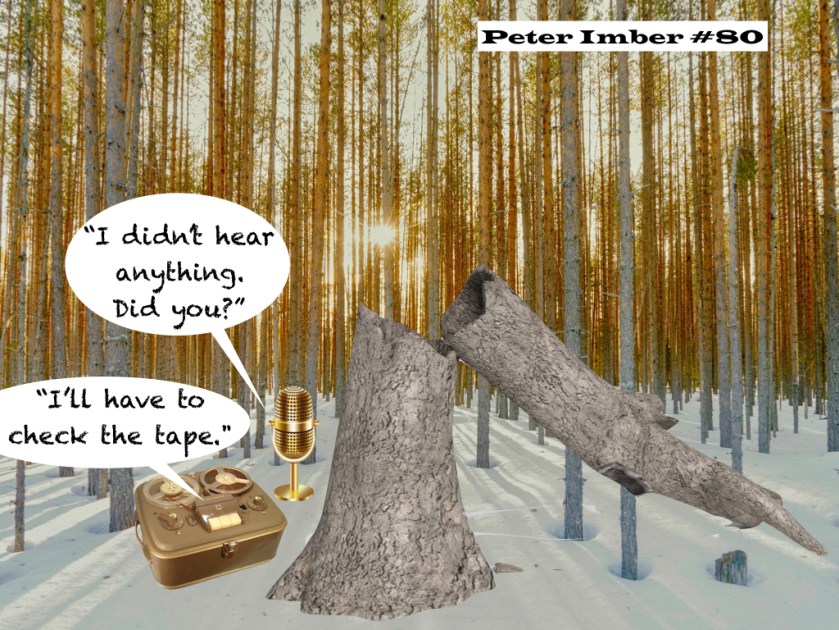
“When a tree falls in the forest and nobody’s around to hear it does it make a sound?”
That’s what the cartoon today was about but when I created it, but I had no idea what I wanted to say to accompany it. I thought maybe I’d explore the tree/sound question and quickly discovered that this was above my pay grade both as science and philosophy. However, during my cursory Google search for an answer I was reminded of what I heard someone say years ago about the internet
 “It’s like a library after a strong earthquake, all the books are off the shelves and open on the floor. There’s no Dewey Decimal system. There’s no card catalogue. It’s chaos.”
I’m not aware if either of those two library research tools of the past even exist anymore but I do know about strong earthquakes so let’s go with that. I lived through one in 1994. It was a 6.7 and called the Northridge Earthquake. Like hurricanes large tremblors get names.
Our house in Sherman Oaks, CA was 11 miles from the epicenter but we lived on the San Fernando Valley side of the Santa Monica Mountains and the seismic waves bounced back off them and collided with those still coming from Northridge– think of a pair of geologic cymbals in the hands of Heracles.
My earthquake experiences prior to this had been the side to side shaking that can sound like the oft alluded to freight train and that’s scary enough. But this was way different. The sound was something I’ve never heard before or since.
It was the middle of the night and all electrical power went off instantly. I was able to jump out of bed but when I tried to move I couldn’t. Our house was convulsing up and down and being sledgehammered into the ground. All I could do was try to keep my balance. It was totally dark and for the 30 seconds or so that the blows were delivered I felt totally powerless and to this day remain aware and respectful that when mother nature is at the wheel she doesn’t take directions from us.
Unbelievably, my five year old son slept through the quake. When it was over the floor in his room in the back corner of the house was tilted four inches lower than the floor at our front door.
We had an “earthquake closet” with food and water, sleeping bags and a tent. I also had a crowbar under the bed in the event a door was jammed and we’d have been trapped. This was all suggested standard preparedness in California so we were ready.
Within the first half hour we had pitched the tent in the backyard. Since the ambient light of Los Angeles was totally absent for the first and only time during the 31 years I lived there, the man-made diffusion filter that normally hides all but the brightest objects in the sky was gone. Suddenly, we could have been stargazing in the Sahara.
After a sizable earthquake there are going to be either aftershocks or something worse– the feared and, we’re told, inevitable Big One! I lay down inside the tent for a moment and with my head on the ground I listened to the earth below me vibrating and humming– vibrating almost like a mattress you put quarters in at a cheap motel and humming exactly like a tuning fork against your ear.
In all the accounts of earthquakes I’ve ever seen or read, I don’t remember this ever being described. After clearing the bricks off our driveway from what had been my neighbor’s chimney I headed to work with no traffic lights to wait at.
Our house had indeed sunk and luckily we had earthquake insurance because we had serious structural damage. Claims adjusters flew in and worked in rotation which meant once you got through going over everything with one adjustor he or she went home and you started the process pretty much all over again with a new one.
It took over two years but in the end our insurance company did well by us. The house was leveled. I mean it was made level again and the foundation was buttressed with reinforced concrete columns poured deep in the ground. When the Big One arrives some day the wood structure might crack and shatter but I doubt the foundation will notice.
I started with an analogy about the internet and then weighed in on the Richter Scale and now while I’m rewinding the tape let me ask if you ever have this happen to you. You sit down at your desktop or with your tablet or smartphone with the intent to find out something specific on Google and before you know it you’re somewhere in the next galaxy. Happens to me all the time.
So, back to the tree falling in the forest with no one there. Does it make a sound? Here’s my conclusion. If I were to do the experiment and put a tape recorder with a microphone in the forest, I bet the tree would fall on both of them and the tape would be unsalvageable.
Sorry, I couldn’t have been more help on this one.
—————–
My Cartoons for June.001
Emergency Room Physician
“Now death is our greeter as we walk in to work … sometimes we see it walk in the door, other times it is wheeled in.” —Dr. Jay Kaplan
 
Trump Supporter
“I thought he (Trump) was going to do good things. He’s not hurting the people he needs to be hurting.” —Crystal Minton
—————–
My Cartoons for June.001

The sun reaches its highest point in the sky of the year today and the glass half empty guy says winter is just around the corner. Of course in Maine it’s all too easy to think like that but I’ve got some things I’d like to see changed that would help take the sting out of our days getting shorter.

I’m absolutely certain these changes will not now nor likely ever happen in the future. However, perhaps there’s hope if the earth’s rotation and orbit decide, like my internet service sometimes, to go offline.

Here’s what I’m griping about. In Camden, Maine this morning on the longest day of the year the sun rose at 4:53 a.m. and will set this evening at 8:24 p.m. I’ll be blunt. That sucks! Why? Because tonight in Isle Royale National Park in Michigan the sun goes down at 9:59 p.m.– over an hour and a half later. Both my location and the one in Michigan are in the Eastern Time Zone although we’re over 800 miles apart. It’s not right!

A hundred miles from us is St. Andrews, New Brunswick and like all of Canada’s Maritime Provinces it’s in the Atlantic Time Zone. Camden and St. Andrews are barely one degree of longitude apart but since we’re in different time zones the St. Andrews clock is always an hour ahead. That means that today the same exact sun appeared a bit before 6 a.m. there and this evening won’t sink below the horizon until almost 9:30 p.m. It’s not fair!

Maine’s legislature has had bills proposed that would allow us to go Atlantic but even if they were to pass here (and they never have) the U.S. Congress would have to vote its approval as well.

Boy, if Susan Collins is still a Maine senator and this were to have to be decided in Washington, her head would probably explode trying to justify her vote in either direction after Mitch McConnell let her know how she’d need to be setting her watch.

So, you might ask, what’s the big deal? How does this affect my life? Let me start with the dawns of a new day this time of year. When it’s happening at 5 a.m. that’s at least a lost hour in my opinion and to make it worse in the evening we’re being shortchanged on the other end. For example if we wanted to go out to eat (which we won’t right now) after a movie (which we can’t right now) pretty much all our restaurants are closed by 9 p.m.

Actually, being shoehorned into a time zone that doesn’t square with your circadian rhythms has led a lot of people to adopt a daily schedule they might not even be aware of is a coping mechanism. When we had just moved here and we needed a plumber, he said, “I’ll be over first thing in the morning,” and then true to his word knocked on our door at 7 a.m. Newsfilm isn’t at 11 here, lunch is.

Ok, if you’re thinking I should move to Canada remember the border is still closed but after you hear my next complaint, you might want to organize a fundraiser to send me there.

I think the seasons are all wrong. Why are we waiting until June 21st to proclaim that summer has started or delaying until December 21st to declare its winter? It was over 80 degrees at our house this weekend. By December 21st we’ve already had our driveway plowed and not just once!

The seasons should begin on the first day of the month– Spring on March 1st when baseball teams are or, once upon a time, were having “spring training.” Summer needs to start on June 1st when public swimming pools are already open, Fall on September 1st when it’s back to school and Winter on December 1st after the sleigh has already been to Grandfather’s house for Thanksgiving.

Yes, the way things are set up now it’s all about the earth’s orbiting around the sun and thank you Copernicus for your hard work. In astronomy court you’d chew me up and spit me but this business with the earth going around the sun every year isn’t a perfect arrangement to begin with. Just ask anybody born on February 29th.

So, how about it? Let’s make a few minor adjustments and have a more sensible calendar. King Solomon toward the end of his life wrote in Ecclesiastes that there was nothing new under the sun. I don’t think he was looking very hard.

Happy Summer Solstice!

—————–


My Cartoons for June.001

Is there anybody who can honestly say our president has done a good job dealing with the pandemic? I know my distribution list for my cartoons and opinions is, with few exceptions, those of you generally in agreement with my own thinking. That’s intentional. I just won’t engage anymore with people who believe that Donald Trump is competent to lead the nation through a crisis. For me it would be like talking to a member of the Flat Earth Society but exponentially more painful.

New Zealand and Taiwan have done well at containing COVID-19 for example. America has not. Leadership or the lack thereof has made a difference in outcomes everywhere.

Brazil might be considered an exception. There, President Jair Bolsonaro actually believed his countrymen were magically immune to the virus and has done nothing so far to indicate that he cares that over a million Brazilians have proven that they’re not. Bolsonaro is committing something akin to a war crime against his own nation.

But we have our own problem right here and now and I’ve put three quotes together that make me both angry and sad. See what you think and notice the dates when each of them occurred.

March 23, 2020

“From midnight tonight, we bunker down for four weeks to try and stop the virus in its tracks, to break the chain…Every move you then make is a risk to someone else. That is how we must all collectively think… That’s why the joy of physically visiting other family, children, grandchildren, friends, neighbors is on hold. Because we’re all now putting each other first. And that is what we as a nation do so well.”

— Jacinda Ardern

Prime Minister of New Zealand

April 16, 2020

“Upon the discovery of the first infected person in Taiwan on January 21st, we undertook rigorous investigative efforts to track travel and contact history for every patient, helping to isolate and contain the contagion before a mass community outbreak was possible.”

—  Tsai Ing-Wen

President of Taiwan

June 20, 2020

“We’ve tested now, 25 million people. It’s probably 20 million people more than anybody else. Germany’s done a lot, South Korea’s done a lot. They call me, they say the job you’re doing — here’s the bad part, when you… when you do testing to that extent, you’re going to find more people, you’re going to find more cases.So, I said to my people, slow the testing down, please. They test and they test. We had tests that people don’t know what’s going on. We got tests. We got another one over here, the young man’s 10 years old. He’s got the sniffles.”

— Donald Trump

President of the United States of America

It’s way too early in the day to have a drink.


My Cartoons for June.001

Let Us Now Praise Black Composers
How about a concert today! If you play all the links I’ve interspersed with my concert notes, the music is less than 15 minutes long in total. Just one tip, YouTube may run short ads when you click on each link and after each piece of music finishes YouTube will keep playing other stuff so just close out of YouTube after each selection. I hope you’ll want to give a listen.
The best thing about music is that there is always something I’ve never heard before that blows me away when I discover it. This is true of any kind of music but since I listen to WQXR out of New York a lot I’m introduced to the occasional classical work that I’m grateful to the station for introducing me to. Classical music composers have been predominantly white European or of European heritage men. Just take the list of them under B for example: Bach, Beethoven, Brahams, Bartok, Britten, Bernstein… But there are others that, if you’re lucky enough to find their works, it can be like receiving a gift.
When I was a kid and bought my first record album, the entire inventory for purchase at the music store in my town was on a single table. The album by the way was The Everly Brothers Greatest Hits and I still have it but without a phonograph to play it on. Listening to Rock and Roll was easy when I was young. We had Top Forty radio stations from everywhere and I still remember their DJs like Dick Biondi in Buffalo and Arnie “Woo-Woo” Ginsburg in Boston.
But I had an experience when I was a teenager in a Howard Johnson’s on the Pennsylvania Turnpike that obsessed me for years. It was a piece of classical music that played in the background while I was probably eating a meal of HoJo’s fried clams.
Over 40 years later the tune I had never identified still remained in my head until one day while in the car in Los Angeles I heard it again. It was from an opera composed by Georges Bizet called The Pearlfishers and below is a link to the recording I came across all those years later…
length: 3:33
Fortunately, we now live in a time when pretty much all music ever composed and recorded is available somewhere and I want to share three short classical pieces today that I love by three black composers along with some notes about each of them.
Samuel Coleridge-Taylor was born in London in 1875 to a white English mother and a black African father. He was named after the poet although his father’s surname was Taylor. Daniel Taylor had returned to Africa after completing medical studies in London without knowing that his son’s mother was pregnant. His birth parents never married.
As a teenager Coleridge-Taylor studied at the Royal College of Music and by his early twenties he was earning a reputation as a composer. In 1904 on his first visit to the United States he was a guest of President Theodore Roosevelt at the White House, an honor accorded to very few blacks at the time. He died of pneumonia at the age of 37. The link below is to a waltz he composed in 1903.
length: 2:23
William Grant Still was born in Mississippi in 1895 and grew up in Little Rock, the son of two teachers. He started violin lessons as a teen but taught himself to play a half dozen other instruments. Like many mothers, his wanted him to attend medical school but after college he won a scholarship to the Oberlin Conservatory of Music.
After serving in the Navy in World War l he went to Harlem and joined W.C. Handy’s band and later played with the bands of Artie Shaw and Paul Whiteman.
In the 1930s he began composing his own music and became the first African American to have his work performed by a major American orchestra. In 1936 Still became the first black American to conduct a major American orchestra when he led the Los Angele Philharmonic in a program of his own compositions at the Hollywood Bowl.
A link below is to a piece from his tone poem Wood Notes which premiered in 1948.
length: 4:22
I had no idea that Duke Ellington had ever composed classical music and it was not on my radar or playlist until hearing the piece that is the finale of today’s concert. Ellington’s body of work is prodigious and The River Suite was actually commissioned as a score for ballet in 1970 for the Alvin Ailey Dance Company.
The section of The River that the link below will take you to feels to me like a spiritual transformed into the symphonic. I’ve come across someone who makes this point better than I can in comparing George Gershwin and the Duke.
“Gershwin approached jazz from the perspective of classical music, while Ellington approached classical music from the perspective of jazz.”
length: 4:21
Hope you enjoyed the show!
—————–
My Cartoons for June.002
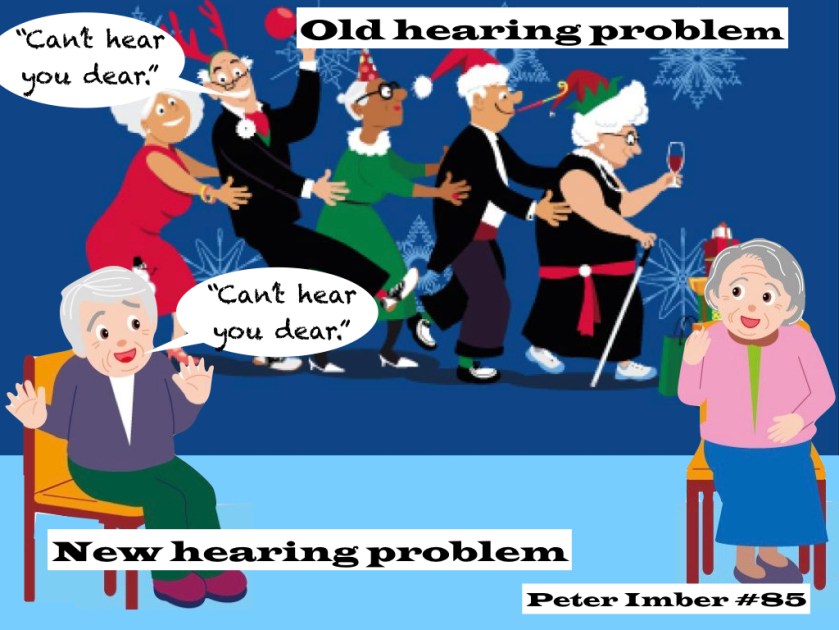
Nobody told me. I thought hearing loss was not being able to hear, like being fated to wear a pair of ear plugs that make everything sound fainter and fainter as we get older and older. Now, I know it’s not that. I can still hear you talking just fine when we’re alone in the same room, it’s just that I can’t always make out what you’re saying and if we’re in a crowd, forget it.
Cocktail parties are painful and closed captioning is getting closer to being a requirement if I want to understand what’s being said on a TV or movie screen. I never knew how many actors slur their words.

I did a hearing test a few years ago. I’m a candidate for hearing aids but haven’t filed to run yet. I think my biggest hesitation about getting them is that I might lose them.

A lot of us probably damaged our hearing a long time ago listening to “our music.” I don’t believe I did. I wasn’t into loud bars or rock concerts. I never owned an album by Deep Purple who I discovered used speakers so loud and so powerful that people were knocked unconscious at one of their concerts when they stood too close to them.

But who knows? Apparently, the damage can also be done by what seem to be almost innocuous activities– operating a leaf blower, riding a motorcycle, Fourth of July firecrackers, the New York subways… Listening to music that’s louder than 100 decibels apparently, is still the main culprit.

A few years ago I was in an Apple store and had this conversation with a young sales guy.

Me: “How does music sound through the speaker in this desktop?”

Him: “Really nice and you won’t even need separate external speakers to crank things up. I get all the volume I want at home just from the computer.”

Me: “You know, my generation listened to loud music and many of us are paying the price for that now with hearing loss.”

Him: “Yeah, I’m not worried. By the time I’m your age I’m sure there will be an invention or a cure.”

Me: “You might not want to count on that.”

This conversation really happened and that guy’s faith in a future that will fix things for him seemed astounding to me. But hey, I get it. When the history of our times is written statins and viagra should surely get a mention. In significant ways science and medicine have prolonged the functioning of important parts of us and even come up with spare ones to replace some of those that no longer work.

But back to deafness. It’s well known that Beethoven continued composing some of his best work after he could no longer hear. The story goes that at the premiere of his 9th Symphony, because he conducted the work himself, he had to be turned around to see the audience’s applause.

Beethoven’s hearing loss started when he was in his mid-20s. It’s unlikely it was due to his behavior. But here’s a statistic about the Rock and Roll Hall of Fame that might or might not surprise you. It’s believed that over half of the inductees are hearing impaired and that list includes Brian Wilson, Neil Young, Pete Townsend, Phil Collins and Eric Clapton.

Says Clapton: “It was my own doing– being irresponsible and thinking I was invincible.”

Yes, invincible, infallible and innocent. All I can say is good luck to the guy in the Apple store. I hope my advice won’t have fallen on deaf ears.

—————–
My Cartoons for June.001.jpeg
The Urban Dictionary isn’t your Merriam-Webster’s. It was founded by a guy named Aaron Peckham in 1999. He created his website when he was a computer science student and it was intended to be a parody of what he considered “stuffy” actual dictionaries that he believed “take themselves too seriously.”


It’s what can be defined as a “crowdsourced” or open collaboration where anyone can contribute to adding to it with their own definitions for words, especially slang. It’s to a dictionary as wikipedia is to an encyclopedia. And if there were still College Boards, the analogy above could be the answer to a question on the SATs today that I don’t think anyone could have seen coming half a century ago.

Peckham by the way is said to be worth $100 million from the Urban Dictionary and wants no venture funding or IPO and is not looking for his brainchild to be acquired. He’s already rich and happy the way things are. He’s no bozo.

And so I looked for the Urban Dictionary definition of bozo for a reason that will become clear in a second and here’s what I found…

Bozo is a name that references someone who has failed to achieve any level of formal education and is easily led and influenced by anyone who appears sympathetic. Bozos will, because of their lack of understanding of the english language, try to engage in conversation, but in almost all cases, will become irritated and abusive due to not understanding what is being said to them. Bozos will make up stories about their achievements, but everyone knows that they are just fabrications. Bozos are not smart enough to know that their lies have been discovered and will continue on prosecuting the lie.

Well, that certainly is close to describing one bozo who I am increasingly depressed reading about, but the original Bozo the Clown wasn’t a horrible human being who was incompetent, hateful, corrupt and a pathological liar… Whoa, let’s hold off on the last one for a moment.

Years ago I was asked to do a story about Bozo the Clown. The ABC News shows knew I liked to do almost anything that was off the wall.

We’d gotten a press release about Bozo celebrating his 50th year in show business and the quirky ABC News overnight broadcast, watched mainly by insomniacs and the incarcerated, wanted a piece for its show.

The late Larry Harmon was the man who developed and owned the Bozo the Clown empire, which he licensed to many local television stations around the country and the world, each then hiring their own actor to play Bozo. By the late 1960s Harmon had Bozo shows airing in nearly every major U.S. television market.

Harmon’s autobiography is titled “The Man behind the Nose” even though he rarely dressed up as the clown he so successfully marketed. I interviewed him at his office in Los Angeles on Hollywood Blvd. Ironically, for someone so legendary in the entertainment business neither Harmon nor Bozo have a star honoring them on that street’s Hollywood Walk of Fame but that’s another story.

When we finished the interview Harmon made the rest of my assignment very easy by offering me a large box of tapes with an amazing variety of Bozo milestones– Bozo on safari in Africa, Bozo riding an elephant in India, Bozo with the Pope at the Vatican, Bozo floating weightless while training with the astronauts… And in the box was also a printout with a timeline of Bozo’s many additional accomplishments, but as I looked at it back in my office something else leaped off the page.

Now, I knew Larry Harmon hadn’t been the original Bozo the Clown and had purchased the rights to a character who already existed. But what I didn’t know and what the timeline let slip was that Bozo the Clown wasn’t 50 at all. He was at that moment actually only 47!

Harmon, it appeared, was behaving the opposite of a Little League baseball team claiming that one of their players was younger than he actually was. That team, if they won anything, would have been disqualified and it looked like Bozo’s 50th birthday tribute might have to be put on hold.

I phoned Harmon to clear things up.

“Larry, I think we have a problem. According to the information you’ve given me, Bozo isn’t really 50 this year,” I said in a gotcha voice.

There was a long silence on the other end of the line and then Harmon spoke, “So?”

I did the story.

If you want to see it go to the link below…

https://www.youtube.com/watch?v=LZVYGe1P9pc

—————–


My Cartoons for June.001.jpegAs the co-creator of Seinfeld Larry David is now richer than God after mega syndication deals for its 180 episodes have made both him and Jerry Seinfeld the wealthiest comedians on earth.

David’s own subsequent series Curb Your Enthusiasm has now aired 100 episodes on HBO so his comic vitriol is still potent along with his earning power. David plays– and there is no better word for it in any language –a schmuck and his show, as befits our times, is both cringe and binge worthy.
Everything David’s character, whose nameis Larry David, touches turns to whatever the opposite of gold is, so imagining him being asked to update the Ten Commandments is unimaginable but then again God works in mysterious ways.
You would have thought God has had HBO for an eternity but it was only recently that he started watching Curb after being led into temptation when a year of free HBO was offered by a new internet streaming service that’s taking on Amazon. It’s called Jordan and it is tiny. I’ve rafted its namesake and trust me Michael would not need to row his boat ashore for you. You could just wade. It is neither deep nor wide and would barely be on the map if it was in Maine. Anyway, the Lord ditched his cable subscription and unlike some others he has never looked back.
God, just like Orson Welles used to say in the commercials he did for Paul Masson about his wine, doesn’t normally meet with anybody before it’s time but he had some things to talk about with Larry David recently.
God: “Larry, let me get this off my chest. Why are you such a schmuck?”
David: “Some people might differ with you. I gave one of my kidneys to Richard Lewis. I think that makes me a mensch.”
God: “That wasn’t for real, Larry. That was on the show.”
David: “Ok then, let’s talk about real! The Bible says Moses didn’t eat or drink for forty days? That’s for real? Noah had three sons when he was 500 years old? You think? Jonah used a whale as an Airbnb? Are you serious?
God: “Ok, Ok! Look, we both have had to punch up a script …uh, scripture from time to time. I admit I haven’t always had “A-team” writers.”
David: “And how did you ever greenlight the Book of Job? What a downer, although it could have been written about me. I know you didn’t have antidepressants at the time but holy…
God: “You were going to say Moses, right?”
David: “I was going to say John Bolton.”
God: “Larry, I’ve come to you because I need your help. I’m afraid I may have gone overboard with what I’ve done to the world and especially the United States. I have inflicted a plague upon the earth, as if a lunatic American president wasn’t enough already.”
David: “Really, you’re admitting this? You sure have screwed things up but why have you chosen me? If you have things to confess, why not find a Catholic?”
God: “I could do a Hail Mary pass but I’m trying to renegotiate my child support. No, what I want is for you to give me something, some fresh material I can use to make things up to everyone. I know there are Americans who are very happy with me, others not so much, but there’s a lot of undecideds and my poll numbers are going down…”
David: “So, you want someone like Kellyanne Conway. She’s good at making up stuff, almost as good as her boss.”
God: It’s enough that I have to deal with her and her husband every night. Talk about a marriage made in hell. You know that Ann Coulter was the one who introduced them to each other? (That’s actually true.) Maybe Ann will find someone as repulsive as she is. That would be polemic justice. But I’ve come to you and I’ll pay. I know you can’t be had for a psalm… So won’t you please, please help me!
David: “Good for you. You’re into the Beatles! Ask one of them.
God: “I expected Paul up here yesterday, butmaybe you know somebody else…”
David (after texting George Carlin): “I think I got it. How about adding a new commandment?
God: “Great! What should it be?”
David: “Thou shalt keep thy religion to thyself.”
—————–
My Cartoons for June.001.jpeg
Comedian Paul Lynde is remembered as the man who was in the center square on television’s Hollywood Squares. It was a quiz show version of tic tac toe and Lynde’s one-liners were the best things on the program and allowed him to hold down that most tactical middle position for 15 years.
But there came a point when he had had enough and he quit after complaining that he felt “boxed in.” Honest, he said that! Proof that I’m not the only one who has double entendred his way through life.
 
If tomorrow the Supreme Court were to be cast as a version of the Hollywood Squares, Chief Justice John Roberts would undoubtedly occupy the center square, not just because he’s the chief justice but because he has shown himself to be the man in the middle on the Court.

I don’t think Roberts feels at all boxed in but he realizes that with a sharply divided court he stands on the fulcrum with enormous power and sobering responsibility to tip decisions that affirm, alter or negate the laws of America. He was the swing vote on the Affordable Care Act twice and this month on the court’s decision on DACA. For siding with the Court’s liberals a lot of Republicans may now want to box his ears.

The nine sitting justices fill my faux Hollywood Squares set easily ideologically. I’ve arranged them in a game that can only be decided by the center square and seated the Chief Justice there where he has shown he belongs. He’s not Paul Lynde cracking jokes but I hope I continue to feel that we’re lucky to have Roberts there and that he can’t be counted on to be either an X or an O every time.
John Roberts is still considered a conservative, just as Associate Justice Neil Gorsuch, a Trump appointee, is. Gorsuch just sent the same message that he can’t be taken for granted either, writing the majority opinion in a decision that defended gay and trangender workers against discrimination. There’s both a good and a less good side to having a lifetime judicial appointment but ideally, the independence it affords sets men and women free from political pressures once they become federal judges.
Supreme Court appointees have defied the exprections of those who appointed them before. In my lifetime another chief justice, Earl Warren, is the most notable example. Appointed by President Dwight Eisenhower in 1953, he came to the court a Republican with a conservative history.
During World War ll Warren supported Franklin Roosevelt’s decision to round up  Japanese Americans and put them in concentration camps. But a year after Warren became chief justice he wrote the unanimous opinion in Brown v. Board of Education that ended “separate but equal” and led to the desegregation of the country’s public schools.
The “Warren Court” then went on to make a series of rulings that expanded civil rights, equal representation– “one man, one vote” –, due process and the rights of defendants. It has been speculated that Earl Warren felt guilt over his position on Japanese internment during the war and who among us hasn’t changed a belief or opinion as a result of personal experience? I know I have.
A memorable instance for me where this happened was in a college classroom and because of a course coincidentally, on U.S. constitutional law. Vincent Starzinger was a legend at Dartmouth. He dressed immaculately and the length of each of his classes was the amount of time it took for him to smoke a cigar.
He covered the most consequential decisions made in the history of the Court and it was the only instance I ever took amphetamines– at the time the college infirmary was dispensing them to anyone on campus who claimed they had trouble sleeping –before a final. I was never great at memorization and the pills helped me arrange all the cases I needed to know in my head. 
The exam however, was not about dates and names, it was a series of essay questions to make me use what I’d learned and and especially, apply my own opinions about the meaning and significance of particular Supreme Court cases.
I remember at some point as I was filling my bluebook I said to myself there was no way before taking this course that I could have imagined I’d be writing what I was. No, Starzinger hadn’t brainwashed me. He had challenged me to think and draw conclusions on my own that have shaped my views on important issues from that time forward. I had received a gift from a gifted teacher. Call it the gift of open mindedness.
Anyone who took a class with Vincent Starzinger would most likely agree with me. There are not many Vincent Starzingers and certainly it seems like there may be a paucity of them today. Despite the lesson I learned from him, there are still things I’m not very or even at all open minded about. Let’s take the one right in front of our faces– masks in the time of COVID-19.
Donald Trump’s politicization of a matter of public health and the nation’s well being would have been inconceivable conduct for a president only a few years ago. His denial of the seriousness of the pandemic and refusal to set an example by performing even the personal act of wearing a mask to combat the spread of the virus has made our situation worse.
Those Americans who have now interpreted sensible and necessary steps to protect themselves and the rest of us as an affront to their personal liberty is a tragic consequence of Trump’s arrogance and ineptitude. Certainly, it’s been true that there will always be people who believe they have a right to any opinion, no matter what it is. But wearing or not wearing a mask in public being turned into a measure of allegiance to himself by Trump is incomprehensibly small and closed minded.
I’m not sure even Vincent Starzinger could have made a scratch in the thin skin of Donald Trump but I bet he would have pitied him.
—————–
My Cartoons for June.001.jpeg
Could it be that Alexa Seary has for the moment the most implausible name in the world? Yes, this is a real person born way before Amazon and Apple offered us virtual assistants to handle a whole bunch of tasks we used to think nothing of doing ourselves.
Alexa Seary was a college student three years ago when a British tabloid claimed her life was a “waking nightmare.” And yes, she was teased– “Hey, Alexa-s” and “Hey, Siri-s” were being directed at her by simpletons who thought that was funny, but from the news story one might have believed she was at her wit’s end. She kept her wits and her name, got her degree and has a job today as a marketing specialist for an FM station in New Jersey.
Meanwhile, Amazon’s Alexa celebrated her fifth birthday last year and so did 4,250 other Alexas in America according to the Social Security Administration. Apple’s Siri is omnipresent on its devices but is a much less popular name for real people and only 20 girls were named Siri In America in 2018. Let’s hope social security will still be around for them when these human Alexas and Siris turn 66 in 2080.
 
Siri only recently made her presence felt in our house. After I discovered that Apple no longer supported its iPod and I couldn’t add or delete anything I had stored on it, I needed to find a new way to play music through a speaker in our living room. So, this past winter I bought Apple’s HomePod which has no buttons or remote and only responds to someone’s voice commanding it with a “Hey, Siri” triggering whatever one wishes it to do. “Hey Siri, play Happy Together by the Turtles.” 
 
From the outset Jo was uncomfortable with Siri’s presence in the house. Since I was fine with it we were unhappy together with our new roomie. Then an incident one afternoon this past February, B.C. (Before COVID) changed my mind.
 
We had a power outage. Unlike most, it had nothing to do with the weather. Outside it was sunny and still but it was also winter and cold. Not knowing for how long we wouldn’t have electricity Jo and I sat in our living room to take advantage of the light coming through the most windowed part of the house. Without power we had no heat either and after an hour we began to feel it receding.
We started talking about our choices if the outage were to continue. We sat with our backs to the fireplace and our obvious first option with wood stacked both nearby and outside. But we also discussed going to a hotel, the not inexpensive but more convenient alternative.
Our iPhones still worked and just then mine alerted me to a message on its screen. It read “Here are some hotels near you.” Siri or Apple or our government or who knows who else must have been listening to our conversation. If this was supposed to be a helpful suggestion for us, it was not just an unwelcome one, it was totally creepy.
But have I done anything about it now that I know our house is bugged? It’s months later and I haven’t except to take an inventory of all the devices that could possibly be listening, transmitting and recording our conversations.
Aside from our iPhones and the Home Pod, we have a Nest camera with a microphone (that’s a company now owned by Google) in my office upstairs that I put a thermometer in front of when we’re away to be able to check that our heat is on. The rest of the time Nest sees me sitting at my desk and hears me on the phone and yes, can hear my keystrokes when I type. Am I forgetting anything? Two iMacs, two iPads– they all have microphones and cameras, too and there’s the Roku…
I thought I cut the cord when I got rid of cable and switched to YouTube TV? I guess not. The cord appears to be wireless and ubiquitous.
I don’t believe I’m over gadgeted. I don’t make my morning coffee from bed. I can’t start the car from inside the house. I gave my Fitbit away after it once interrupted my golf swing. But I accept that there is something that I indeed am. I’ve become dependent on this stuff and I don’t know if I can give it up. So, will I start asking Jo to go outside to talk about things we might not want anyone else to hear? Will I pat down my friends for their devices when they come over if and when we ever get to have guests in our house again?
Actually, I don’t think I like where all this technology that’s supposed to make our lives better is heading. I’m thinking I might be happier if the name Alexa Seary wouldn’t have provoked what I’ve just written and she was just another person I had never heard of living in New Jersey.
—————–
image
I have been pairing unlikely things together for a long time. If you’ve been getting these cartoons, I think they’re ample proof to back up my claim and if the cartoons up to now haven’t shown that, then this might do the trick. When I was a videotape editor I once took a beautiful song and edited it together with the most powerfully destructive imagery man has ever devised.
In 1983 Willie Nelson released an album titled Without a Song. The title track was written as a show tune in 1929 for a play that closed after barely a month on Broadway.
Years ago when I was a videotape editor I had finished cutting a story in which we used footage from an atom bomb test conducted in the Nevada desert in the 1950s. Willie’s recording of the song was certainly not part of it but I had just heard it and thought the film of the destruction of a faux community with houses, vehicles and trees built to be obliterated by the nuclear test might just work in a macabre sort of way with the music. So, I put the footage and the song together and to my surprise the result felt much more mournful than jarring.
I don’t remember if I ever showed the finished piece to anyone. I regret that I didn’t save it to show you now.
I don’t remember ever doing a “Duck and Cover” drill in school. You would expect that if I had spent time cowering under my desk, it would be imprinted in my brain but no, can’t find it there. I remember fire drills though. In elementary school we slid down giant enclosed tubes attached to the inside walls of our classrooms. A teacher would catch us outside at the bottom. That was cool.
I do remember that there was a nuclear fallout shelter in our city park for years that could fit about 50 people out of a population of 100,000. I’d say that level of not even halfhearted preparedness to a perceived catastrophe is a fair comparison to the magnitude of the mess we’re in with COVID-19.
In the late 1950s, as the Cold War intensified, some Americans– I cannot find any estimated numbers of how many –built their own fallout shelters in their homes.
A story in the Washington Post at the time attempted to impart some commonsense about most fallout shelters then being constructed and particularly those that were designated for the general public to rely on.
“Most will be cold, unpleasant cellar space with bad ventilation and even worse sanitation.”
0-1.png
But in a few instances sitting out a nuclear war might have been almost an elegant experience. Take Chase Manhattan Bank. Underneath their headquarters they constructed an elaborate shelter that was on five floors. And to make the wait after the blast a bit more tolerable the bank spent over $50,000 stocking it with gourmet food items in 1950s dollars.
The sad truth is in the event of a large scale nuclear attack if you aren’t barbecued yourself in the blast, advice on what to do if you survive is not exactly confidence inducing even today. According to the FEMA website i just checked, while the mushroom cloud dissipates overhead you should strip off your clothes, take a shower and listen to the radio for further instructions. Have you tried to purchase a transistor radio recently? When you search for one it will likely be advertised using the word vintage.
At present the threat of global annihilation has expanded from nulear holocaust to also include global extinction from climate change, global hunger from overpopulation and global confinement because of the pandemic which some of us are taking more seriously than others right now.
The world’s billionaires are ahead of the rest of us as usual in preparing for all or any of the above scenarios. Even before Trump was in the White House with its own secure hideaway that he is now familiar with, sales of high end custom built doomsday bunkers were rising. And these are not your father’s basement or backyard fallout shelter.
Bill Gates is rumored to have bunkers at all his properties and other one-percenters have ones large enough to house their families and essential staff.  They’re stocked with a year’s worth of food and hydroponic gardens to grow more and equipped with power and water purification systems, air filtration and doubtless other survivalist things.
0
And then there’s another level which may not be an apocalypse metropolis but certainly offers more conveniences than Noah’s Ark.
Near South Dakota’s Black Hills is Vivos xPoint which is being developed as an underground community that could be inhabited by 5,000 people. The site once was an army munitions depot and each of the nearly 600 bunkers that used to house artillery shells and bombs can be purchased and converted into living space. There will be a theater, classrooms, gym, spa and medical clinic for all to share.
The same company is also building a super high end facility in Germany with residences ranging in size from 2,500 to 5,000 square feet. Buyers will renovate their unit to their own needs and tastes. You can opt to have a screening room or a private pool and the complex will have a tram system to whisk you to its own restaurants and other amenities. All the comforts of home, I suppose, when you really have to forget that you ever had one.
As for Jo and me, we don’t have a cellar but we do have a transistor radio and come doomsday I’ll be sure to get my clothes off and into the shower and then wait for FEMA’s instructions.
Here’s a link to Willie Nelson singing Without a Song minus any fallout.

More Cartoons in the Time of COVID-19 for May 2020

This is the second month’s collection of my Homemade Cartoons. I started adding an afterword/commentary to them recently so I have included those as well from Homemade Cartoon #40 and on…

My Cartoons.001

New post on pawnedaccordionMore Cartoons in the Time of COVID-19 for May 2020by Peter ImberThis is the second month’s collection of my Homemade Cartoons. I started adding an afterword/commentary to them recently so I have included those as well from Homemade Cartoon #40 and on…My Cartoons.001My Cartoons.002My Cartoons.003My Cartoons.004My Cartoons.005My Cartoons.006My Cartoons.007My Cartoons.008My Cartoons.009My Cartoons.010Since today is Homemade Cartoon #40 I believe a Noah’s Ark reference is appropriate and bittersweet. Noah only had to shelter in place for 40 days.You may or may not know that in Kentucky there is a 500 foot long virtual Noah’s Ark that opened for visitors four years ago. Frankly, I don’t know what’s more unsafe a contemporary cruise ship or an ancient ark with seven– YES SEVEN –pairs of bats! Check out Genesis. It’s not just bats, the ark actually appears to have been significantly overbooked.https://arkencounter.com/blog/2016/06/23/how-many-bats-were-on-noahs-ark/And by the way the late Hunter S. Thompson, the gonzo journalist, is credited with popularizing “batshit crazy” as a more endearing way of saying that something or someone is nuts.—————–My Cartoons.011“Emperor penguins are as vulnerable and important a symbolfor the effects of climate change in Antarcticaas polar bears are for the Arctic.” –Franz Lanting
https://www.nationalgeographic.com/animals/2020/02/chinstrap-penguins-climate-change-antarctica/Under the heading Most Obscure Holidays is Penguin Awareness Day. We missed it already this year but I’m certain we won’t next year. Why? Because it’s on January 20th and depending on who we elect as our president in November his or her inauguration will take place that same day at high noon.—————–My Cartoons.012“May: This is one of the peculiarly dangerous months to speculate in stocks. The others are July, January, September, April, November, October, March, June, December, August and February.” — Mark Twain—————–My Cartoons.013What exactly is ‘doubling your bubble?’ It’s households picking one other household to interact with, and each of those households may then interact only with the other. They can visit with each other and be in each other’s home, share meals together, and I presume do shopping for and recreate with each other.And what could go wrong? Well, let’s say you’re elderly parents and you have several children with families that include all your grandchildren. If you pick one of your kids to double bubble with, are you hurting the feelings of the others? I’m sure there is a hornet’s nest of potentially uncomfortable scenarios that can be imagined but being Canadians don’t they have an advantage? Aren’t they supposed to be nicer than we Americans? That’s what I’ve always heard.So, I did a little looking into the question and came up with something that may help arrive at an answer. A couple years ago Bryor Snefjella, a PhD student at McMaster University in Ontario published a study that analyzed 40 million tweets over a one year period from both Canadians and Americans and concluded that “it might be the case that we construct our national identities via our linguistic choices.”How’s that? Well, here’s what he found. Words most represented in American tweets were more negative and words represented in Canadian tweets were more positive. Mr. Snefjella wasn’t even looking for this. He was initially studying differences in our dialects but found that even the tweeted emojis reflected this same divide between being naughty or nice. Just look at the two word clouds. Each represents the top 250 words tweeted by Americans and Canadians. The larger the word in the cloud the more times it appeared in tweets by those on either side of the border.Here’s America…image002 And here’s Canada…image003The difference is striking, no? And it would be easy to sum up Snefjella’s work by simply calling it Great Shit.But there’s a caveat. The study relied on tweets tweeted (when you say that out loud it sounds like the name of a Looney Tunes character or a deceased Belgian harmonica virtuoso) from February 2015 to February 2016 which of course was a year that saw the rise and election of Donald Trump as President of the United States.No matter. In any event it’s kind of clear which country’s populous was and probably still is happier.—————–My Cartoons.014Although paper originated in China in the second century B.C., the first recorded use of paper for cleansing is from the 6th century in medieval China, discovered in the texts of scholar Yen Chih-Thui. In 589 A.D, he wrote:“Paper on which there are quotations or commentaries from the Five Classics or the names of sages, I dare not use for toilet purposes.”And for your book group’s next meeting how about a dive into excrement in the Late Middle Ages. Yes, it’s a book…Sacred Filth and Chaucer’s Fecopoetics by Susan Signe MorrisonAnd here’s praise to convince those skeptics… “Morrison’s study offers an engagingly written book that makes a convincing case for the cultural significance of the medieval fecal and that elucidates Chaucer’s poetry in thoughtful ways.” — The Medieval ReviewOr if you are thinking of springing a surprise, you can just tell them that this will be a read that will keep them on the edge of their seats.—————–My Cartoons.015Hey Groucho, social distancing as a means of safeguarding you or us from you has been around longer than you might think. As added protection we might be using masks right now but in the Victorian era enormous skirts inadvertently may have actually helped prevent the spread of smallpox and cholera. “Crinolinemania” –the fashion craze of the day– however, had a down side. Women actually burned to death if their giant hoop skirts caught fire. Still, this trendy style served another valuable purpose by keeping unwanted male attention at more than arm’s length pretty effortlessly.imageWill we see fashion adapt in our time of COVID-19?  Well, yesterday Adobe’s Digital Economy Index, which tracks more than 100 million product varieties online showed that pajama sales spiked 143% in April from March!Hey Groucho, and remember what you said about PJs in Animal Crackers?“One morning I shot an elephant in my pajamas. How he got into my pajamas, I’ll never know.”—————–My Cartoons.016THE FRENCH LAUNDRYWe just started doing takeout on weekends and are lucky to have some really good options here in Midcoast Maine. So far it’s been Thai and pizza both of which are takeout standards for us. We do have a nearby KFC where a bucket of fried chicken is $14.99. The closest P.F. Chang’s is in Boston and their Kung Pao Shrimp would be $15.95. I know I could enjoy both but the takeout I’d really like to sample is 3,254 miles away from us at a place called the French Laundry.Thomas Keller opened his restaurant in Yountville, CA in 1994. The building had once been a French steam laundry, hence the name, and one would be hard pressed to find an eating establishment that’s been awarded more honors. It’s rated three Michelin stars since 2006 and been praised for being the Best Restaurant in the World by the late Anthony Bourdain among others.Now, in pre pandemic times a meal at the French Laundry would have cost you over $300 and perhaps as much as $600 a person for its prix fixe menu with or without wine pairings. Want to bring your own bottle? Fine, but the amount charged to you for drinking it will be $150.So, now in the time of COVID-19 with restaurants being kicked to the curb what’s happening at the French Laundry? Well, below is the takeout offering from Thomas Keller for last evening:Screen Shot 2020-05-14 at 6.42.11 PM$23 WITH REHEATING INSTRUCTIONS INCLUDED!!! Looks like a gastronomic giveaway, no? Ok, not enough perhaps to jump in the car and drive coast to coast but could I have that delivered?Jo and I once had a pastrami sandwich sent Next Day Air as a birthday present for her father from Langer’s Deli in Los Angles to Rockland, ME. The cost was a $100. Expensive? Yes. Money well spent? You bet. He loved it. But record setting? Not even close.According to the Guinness Book of World Records (Who else?) in 2006 Niko Apostolakis in Wellington, New Zealand had a pizza flown to him from Madrid, Spain, a distance of 12,347 miles as the crow flies. For its trouble the crow got the anchovies.Untitled.001-2—————–My Cartoons.017LET’S GET AWAY FROM IT ALL(with apologies to songwriters Tom Adair and Matt Dennis)You say that you’re such a big shotWhy can’t you just make a call Let’s sign a contract so we can go get packedLet’s get away from it allLet’s make the drive wearing pampersNo need to stop at a mallBut maybe Sag Harbor, you sure need a barberLet’s get away from it allWe’ll travel ’round along the SoundWe’ll check out each estateAnd act discreet but so eliteAs we our needs dictate Make sure you take your ViagraF___ me! Manhattan’s a pall Let’s leave our cage, dearIt’s all the rage, dearLet’s get away from it allCreating a parody of a song is fun and it can be a brutal vehicle for satire. This particular tune came to mind right away after reading the Times article. I certainly don’t have it in for New Yorkers. I was one for a couple years after college but the article is just such easy pickins.  You know, long ago I thought that I’d still be listening to Stairway to Heaven as I got closer to climbing it but ever since we moved to Maine my musical preferences have been the Big Bands, Sinatra, Fitzgerald– the so called Great American Songbook. It certainly must reflect this stage of life. If I were to try to dance to Purple Haze now, I’d risk turning purple.  Close to where I grew up in Pennsylvania was the Sunnybrook Ballroom in Pottstown. My father told me about going there to hear Benny Goodman and Glenn Miller back in the 1930s. When he talked about it I could imagine him as a young man and I sensed the energy and excitement he must have felt. But that doesn’t explain why I’m listening to his music these days and not my own. I don’t need to know why. I’m very happy time traveling.  And so this was a nice opportunity to take my newfound affinity for the old standards a step further. And there’s one lyric in my parody in particular that I want to point out. It’s this one:  “And act discreet but so eliteas we our needs dictate.”  The great song “Body and Soul” has this: “My life a wreck you’re makingYou know I’m yours for just the taking.””MY LIFE A WRECK YOU’RE MAKING?”Whenever I hear Frank Sinatra sing that I break into a smile. And I just discovered that many native American languages place the verb at the end of a sentence and because they do they’re called “verb-final” languages.And I thought it was only Yiddish where this kind of thing you did!Here’s a link to Sinatra singing “Let’s Get Away From It All” with Tommy Dorsey and his orchestra…https://www.youtube.com/watch?v=ez1EnoV1ACI—————–My Cartoons.018Referencing historical touchstones to fit the moment is a given when something as huge as a pandemic happens. COVID-19 has been compared to Pearl Harbor as an act of war that we must respond to and repel and it’s been called a Sputnik like event that should wake us up to seize the opportunity to fix what’s broken.But there are also cultural touchstones that are part of our heritage and The Wizard of Oz is larger than a mere stone and more like a boulder in that hierarchy. For 40 years it was shown annually on network television except for 1963 after the assassination of President Kennedy. Knowing the flaws of each of Dorothy’s fellow travelers might as well be included on a basic American civics test. So, it didn’t surprise me that when I Googled the movie and coronavirus just now I got a list of articles with headings like these:The Message Of The Wizard Of Oz Is Fit For A Pandemic
The COVID-19 Pandemic: A Reverse Wizard Of Oz?Coronavirus, Donald Trump, And The Wizard Of Oz Presidency
A Wizard Of Oz Virus: The COVID-19 Hoax
A jumble of different perspectives and as is the rule and hardly ever the exception anymore a reflection of our politics and divisions.My own story about The Wizard of Oz is a short non partisan one. It took almost 70 years for the midgets who played the Munchkins to get their own star on the Hollywood Walk of Fame. I got to cover that event and to meet and interview seven of the nine Munchins who were still alive in 2007. They were delightful and sang for us as if they had just stepped off their sound stage.Why did it take so long for them to be given this honor that was routinely bought by movie studios to promote their stars? I never received a satisfactory answer but the Munchkin actors I met were thrilled to be immortalized on a piece of the sidewalk that day.A total of 124 actors played Munchkins in The Wizard of Oz. The last surviving one, Jerry Maren, who was there for the ceremony, died in 2018 at the age of 98.”We finally got recognized,” Maren said. “You know, after everybody else died, they said, ‘Who’s left?'”And by the way the Munchkins never got screen credits and the dog who played Toto made more than twice the weekly salary each of them were payed for their work. There’s always interesting stuff to be discovered when you go behind the curtain…Here’s a link to that piece I produced for Good Morning: America:https://www.youtube.com/watch?v=vkAnKZgvJDw—————–My Cartoons.019 Lysol Timeline                              1889– First Lysol brand antiseptic disinfectant introduced in 1889 to help end a cholera epidemic in Germany.1911– Poisoning by drinking Lysol was the most common means of suicide in Australia and New York.1918– During the Spanish flu pandemic Lysol disinfectant was used effectively against the influenza virus. Newspaper advertisements called for using Lysol to clean anything that came in contact with patients. Late 1920s– Lysol was marketed as a famine hygiene product for vaginal douching. Its makers claimed that a diluted Lysol solution prevented infections. This Lysol solution was also used as a means of birth control. Post-coital douching became a popular method of preventing pregnancy at that time.1962– Lysol Disinfectant Spray by way of aerosol application is made available.2020– A package of Lysol disinfecting wipes that usually cost $14 is priced at $220 on Amazon.Warhol’s Soup CansIn 1962 Andy Warhol’s Campbell’s soup cans paintings went on display in a gallery in Los Angeles. Warhol had painted each of the 32 varieties of Campbell’s soup available at the time and the asking price for each individual painting was $100. Only five of the paintings sold including one– Tomato –that was bought by actor and art collector Dennis Hopper.Warhol was to paint the individual cans numerous times and silkscreened them as a group which became their most iconic representation. In 1996 all 32 of the stand alones were purchased by the Museum of Modern Art (MoMA) for $15 million or $468,750 a can. “Mmm Mmm Good” but Warhol had died almost a decade earlier.John GnagyAnybody remember a television show on Saturday mornings in the early 1950s called “Learn to Draw” with John Gnagy? I do and I watched the 15 minute lessons Gnagy gave every week but never learned to draw at all. If my elementary school art teacher were still alive she’d back me up. Seeing Gnagy so easily turn a blank page into a sailboat or a row of telephone poles to me was like watching a magician.Others who tuned in overcame any awe they may have felt and used his lessons to take their first step toward careers as artists working at Marvel and Disney. Andy Warhol claimed he learned to draw from watching the show. Gnagy never earned much from the television series but his Learn to Draw kits and books sold in the millions.Here’s a link to a Learn to Draw TV program from the 50s…https://www.youtube.com/watch?v=wQyXzwJRUN4&t=39s—————–My Cartoons.020I am a big Buster Keaton fan and at the end of one of his short films, The Boat, his character is lost on the water and his wife asks, “Where are we?” He responds with the name of the boat they’re in and says, “Damfino.” That’s the answer for how long I’ll be doing these.Each of us is experiencing the pandemic in our own way and my coping mechanism turns out to be staying busy doing stuff like this and looking at our isolation as an opportunity rather than adversity.We all have our own unique story that we’ve lived which has formed us and through these cartoons I guess I’ve been telling mine. If you know someone who might like receiving them give them my email:peter.imber@gmail.comand I’ll subscribe them.PeterFor this 50th cartoon I’ve attached a link to a song that I love by the late Steve Goodman titled “Door Number Three.” It’s about “Let’s Make a Deal.”If you’re from Chicago or a Cubs fan, you’ve likely heard of Goodman. His song “Go, Cubs, Go” is played after every game the team wins at Wrigley Field. His most famous song is “City of New Orleans” which Arlo Guthrie was the first to record but has been covered by many others.Goodman lived with leukemia for the entire length of his recording career and gave himself the nickname Cool Hand Leuk. He died in 1984 at the age of 36.Here’s the link to Goodman singing “Door Number Three”:https://www.youtube.com/watch?v=fyB39D6x7YYAnd here’s my own up close and personal moment of game show infamy…How I Failed As A Game Show ContestantI moved to Los Angeles in 1979 to go to film school at UCLA. I managed a 16 unit apartment building and worked part time at a Radio Shack. I also tried out for a game show. There was an audition and a test of some kind. I must have passed because I got a call afterward offering me the chance to be a contestant.The show was called The Cross-Wits and, like probably all of these programs, a week’s worth of them was taped in a single day. I showed up, waited my turn and then it was lights, camera and ultimately, not enough action. Let me explain.How the game itself was played isn’t important. The celebrity I was paired with isn’t important either. I mean that literally. I’d never heard of her and I’m pretty sure you haven’t either. Anyway, I won the first game and from the point of view of the producers of the show you can be sure they wish I hadn’t.You see after my win the announcer rattled off the list of what I had won. There was a lot of stuff. I don’t even remember all of it but in the loot were umbrellas, a clothes iron, an undercarriage sealant for my car, coupons for a soft drink and the big kahuna, a combination electric range and oven with a built in microwave.Now, the apartment I got for free as manager of my building included appliances and my utilities. As the grand prize was being described, I’m thinking what the hell am I going to do with a range and oven I don’t need? And in that moment the fact that just about every house and apartment in Southern California is hooked up to natural gas also crossed my mind. Nobody has electric!I don’t think I frowned but I certainly wasn’t jumping up and down nor displaying the pro forma “I am one lucky shit” grin. Suddenly, there was the show’s producer standing beside the camera that was aimed at me. He put a finger of each hand in the sides of his mouth and stretched it. I didn’t react. He then rocked his body side to side as he continued imploring me to be jubilant. I still didn’t take the bait.I didn’t win another game that day but signed a form for my prizes afterward which turned out to be a “shoot me if I ever do this again” move. Now, I had to pay taxes on what I thought I was receiving gratis. In short order I discovered that applying the undercarriage sealant on my relatively new car would void its warranty and that my local supermarket was unhappy because my coupons for Welch’s carbonated strawberry soda were mega and I wiped out the store’s entire supply of the stuff every time I used one.The umbrellas and the clothes iron were fine but the grand prize turned out to be a giant headache. First, I had no place to put it. A combination range, stove and microwave would last just a few hours if left standing alone in its box outside in my carport. Then a lucky break– a friend who had a garage agreed to let me store it there while I put an ad in the newspaper offering it for sale. That was my only lucky break.I ran the ad for over a month spending well over $150. There were no takers. I finally gave the thing away to a charity and got a tax deduction that I remember being less than the taxes I payed on my windfall and the fruitless ads .And one other thing. When my appearance on the Cross-Wits aired one afternoon a month later and reached the moment where I failed miserably to act like a euphoric winner you never saw me. Instead you saw pictures of the junk I won that I wished I hadn’t. I had been edited out and relegated to the dustbin of game show history.Here’s another tune from Steve Goodman that I think you’ll agree fits my tale of game show woe pretty perfectly…https://www.youtube.com/watch?v=s81r8SzEuPY—————–My Cartoons.001I guess you might call this one an inside joke…That’s a play on words, a pun. Yeah, you didn’t want to be reminded of that. So, why do so many people grimace and moan when they see or hear a pun? Don’t they realize how little work goes into making them?I don’t know when or why I began punning but I proudly pun and because I experience the slings and arrows of outrage on occasion from those who look upon this type of wordplay as my affliction and their misfortune. I happen to think a lot of it is feigned — fake boos. But maybe I’m kidding myself.I think for me punning is almost an involuntary reflex. My mind just goes there. I can’t shut it down. I PUN therefore I AM and I will continue to pun wherever I am. Now, there is a difference between smart puns and dumb puns and maybe it’s like knowing the difference between good wine and cheap wine. For many of us that requires education and experience.The source of humor is actually nothing to laugh about. A legendary professor of mine in film school, a man named Howard Suber, summarized it this way. “Show me a happy comedian and I’ll show you someone on the way down.” Case in point… I just read an article that contended that now that Jerry Seinfeld is nearly a billionaire he isn’t funny anymore.I don’t want to over analyze “funny” but I just looked this up and someone has compiled a list of the nine types of humor they think exist:1. Physical or slapstick2. Self-deprecating3. Surreal or absurd4. Improvisational5. Droll or deadpan6. Observational7. Potty or bathroom8. Dark or gallows9. PunsSo, physical comedy is first and puns are last. Hmmm… You know I actually had an experience that combined the two once. I went to this comedy club in LA where Chevy Chase was doing a standup act or in his case a fall down one. But that night he didn’t show up and another guy came out and was terrible and even worse he was doing a lot of stupid puns.A stranger at the next table heard me being critical and complaining that this wasn’t at all what I had come to see. He was smiling. In fact he was glowing when he said to me about the performer, “He ain’t Chevy. He’s my brother.”Got ya!—————–My Cartoons.002 Donald Trump, you might already know, is the first president in 120 years not to have a dog in the White House. Last year he explained why at a rally in El Paso.“I wouldn’t mind having one, honestly, but I don’t have any time. How would I look walking a dog on the White House lawn?”Human perhaps?Hey, it is his prerogative but maybe his son would like to have one? My family had a dog when I was growing up. She, a diva-like French poodle, was intended to be “the boys’ dog.” She quickly became our mother’s dog and I swear they used to play double solitaire together.Anyway, I’ve come up with a little poem, a doggerel if you will, that won’t make me poet laureate but could provoke a few barks from 1600 Pennsylvania Ave. and maybe some howls from the rest of you….I’m not a cat fanIn fact I can’t standThat cats could care less that I’m thereBut dogs I adoreMy faith they restoreWe’re both needy and that’s totally fairI’m happy to petThey’re happy to getMy reward is the pleasure they feelSuch a simple exchangeA cinch to arrangeIt is the true Art of the Deal—————– My Cartoons.003When I think of travel and especially air travel these days and in the future I think of a show tune. You know, from Oliver– “Who will buy…” I’m not at all sure when I will purchase a ticket and get on an airplane again. Flying had become enough of a horror show before COVID-19 and add the potential for psychological distress to the certainty of physical discomfort and there are officially no more friendly skies.And here’s the late great John Candy in a scene from Planes, Trains and Automobiles to sort of make the point that despite everything the skies can still be overly friendly, too…What’s notable about this bit is that it wasn’t in the final cut of the film. John Hughes, the director, left it out and apparently had shot enough footage to have made a three hour movie.., Talk about overbooking!https://www.youtube.com/watch?v=ztbHu8PMMzU —————–My Cartoons.004When in the past had you ever heard the word zoom used? For me only two things come to mind. One is a zoom lens for a camera and the other Jackie Gleason’s The Honeymooners when ZOOM! was part of Ralph Kramden’s rants threatening Alice with physical violence.If he had followed through, it would have had her reaching the moon ahead of Neil Armstrong. How that was acceptable in comedy and on television in the 1950s seems absolutely unbelievable and crazy today.So, where does this word zoom come from? Well, it appears it’s either from the Dutch or German zoomen or the Finnish zoomata. It’s an onomatopoeia– I had to spell that word correctly to get out of the 8th grade. This is the first time I’ve done it since. Zoom is an attempt to mimic the sound of something humming or whizzing by you.Investigator that I am I looked into whether there might be a deeper meaning for zoom. Couldn’t find anything so I employed a Kabbalistic approach– a form of Jewish mysticism that has attracted dabblers from Madonna to Marla Maples.Kabbalah uses letters and numbers to explain the universe. I wasn’t traveling that far so I stuck with just the letters. Hmmm… so, when you drop the first two letters of zoom you are left with om. Now, I thought I’m on to something. Was there possibly some transcendental connection? Yes! Who can deny that we in the West often zoom when we’d be better off if we’d slow down and om.I have been doing my own daily yoga routine for months now and although I’m not perceiving any spiritual awakening my body and my back in particular are very grateful that I chose this path. With the pandemic I’ve experienced, I guess, both the zoom boom and an om boon.However, I’m afraid I’m close to being Zoomed out at this point. Zoom fatigue has set in. But two last things about the burgeoning company Zoom that’s become as indispensable to many others as… well, toilet paper. First, according to Glassdoor, which evaluates such things, in 2019 Zoom was the second best place to work in the United States. I guess so. If ever there was a company where you could just call it in…And where did the company’s name come from. It took a bit of digging but I found that out. One of the early employees took it from a book he read to his kids…81MzUBidRfL —————–My Cartoons.005We’re a big country and many of us don’t have someone to remember who lost his life in a war, let alone fought in one. So what do we think of first when we hear the words Memorial Day? Little wonder that it’s a picnic or a shopping opportunity.I’m an admirer of the sculptor Claes Oldenburg. I just checked and he’s still alive and in his nineties. My absolute favorite thing of his is an idea for a sculpture that he never created. Back in the 1960s Oldenburg did a series of drawings that he called “Colossal Monuments.” One of them was a war memorial. I’m inserting a rendering he made of it below…image002-2It was to be a giant block of concrete as high as the buildings that surrounded it that would have been placed in the middle of the intersection of Canal St. and Broadway in Manhattan. Oldenburg would have had the names of “war heroes” carved in it.Was Oldenburg making a serious anti-war statement with his idea to disrupt New York City traffic permanently in one place? Was his intent to have people curse being inconvenienced and war simultaneously? As far fetched as it seemed Oldenburg’s conception for this memorial made sense to me when I saw his drawing for the first time. Afterward I figured it was more like a satirical aside.Since then I’ve been to the Vietnam War Memorial in Washington and was quite moved. I knew people killed in that war that I myself didn’t have to go to– nobody who was a close friend but high school and college classmates whose names I could find on the wall. Seeing all the names of those who had died was a jolt. The Vietnam War Memorial is a destination you don’t just happen upon. You know where it is and why you’ve come to see it even if you don’t know how you are going to react..In retrospect I think plugging up Canal St. and Broadway would have made a powerful war memorial but it would have needed to be a temporary obstruction and constantly moved to someplace else without any advance notice. That way it might have pissed you off when you suddenly encountered it for two reasons and you could have blamed both the traffic and all wars for your being late.Our public reminders of the cost of wars are mostly way too polite. So, what should we think of today on our nation’s Memorial Day? For a start how about this? Let’s not call it a holiday. It’s not a celebration. It’s an observance. Memorial Day is the one day a year set aside to actually remember and think about those who died in America’s wars and didn’t get to grow old and be here for the picnics and the sales.—————–My Cartoons.006About ten years ago I remember coming across a bizarre story. A study was published that had found that nearly nine out of ten bills circulating in the United States were tainted with traces of cocaine. Of course it wasn’t enough of the drug that you had any chance of getting high if you tried to snort your money but jeez! Drug dealers were obviously not laundering their cash with Tide.So, here we are with a current fear of contamination from just about anything and it’s potentially worse than getting busted. Can you get COVID-19 from merely touching money? The thought is that the risk is extremely low but like so many things about the pandemic many people, both buyers and sellers, are not taking any chances and using or accepting only credit cards and digital/electronic means for transactions. We were already moving on. The tag line in a credit card commercial “What’s in your wallet?” is asking about your plastic and not your Washingtons, Lincolns, Hamiltons, Jacksons or other members of this all boys club.I certainly haven’t had a need to use much cash since March and the only bills I have left are all twenties. As far as I know there are no ATM’s that dispense anything other than twenties even if I wanted smaller denominations but this lack of currency diversity really hasn’t caused any problems for me. It seems likely that COVID-19 will accelerate the demise of cash and certainly the $1 bill and even its more valued brethren may become about as useful as pennies, nickels and dimes.For now just as hands aren’t touching hands, bills don’t seem to be changing hands much either. I hope the ones tainted with cocaine have been in detox and recovery by now. I guess there’s not enough access to testing for the others. They’re in a lockdown just like us.—————–imageI’m going to brag! I have lost a lot of weight so far since COVID-19 altered so many things about our lives. Was the pandemic my inspiration to do this? Well, it certainly provided a helpful setting. It’s a hell of lot easier to focus on dieting when you don’t have a lot of the usual temptations and distractions.I am still overweight but I’m not done and getting this far hasn’t been as hard as I expected. I’ve really stepped up exercising and Jo has been making us meals that adhere to the curb the carbs approach prescribed by a dietitian I consulted.Sure, it’s on me that I got fat in the first place but you see I didn’t come from a roughage neighborhood. I grew up in the pretzel and potato chip center of the universe– the Pennsylvania Dutch Country. The airport in Reading, PA had to adapt to the fact that the residents of Berks County are heavy– and I don’t mean frequent –travelers. How did the airport adjust? Well, I haven’t measured but I’ve been told that the runway is now as wide as it is long!But seriously, if you’ve had your medical specimens sent anywhere by way of Quest Diagnostics’ fleet of airplanes, guess where their home airport is? Being located at the Reading Airport probably saves a bunch of flights. The emergency room at Reading Hospital is the 10th busiest in the country with 135,000 ER visits a year. A ranking by Gallup-Healthways called the “Well-Being Index” ranked the city as having the 10th highest percentage of obese people in the nation so there’s the evidence that if you’re overweight in Reading your heart is probably in the right place.When I was growing up Reading called itself the “Pretzel Capital of the World” and a traditional grade school field trip was to a Bachman’s pretzel factory. Downtown on the main street there were soft pretzel vendors pushing their wares and their carts into the 1960s. I’d pay a nickel and hope I was getting one that had been made that same day but even the day olds were pretty good.In the summer at our public swimming pool pretzel rods along with frozen Milky Ways were the best sellers at the snack bar. The application of a generous line of mustard on the pretzel rod was as de rigueur as the pool’s medallion patch your mother sewed on your bathing suit.As far as I’m concerned the best pretzel you can buy today is still made in Reading. The brand is called Unique and they’ve even made their way to some of the smaller markets where we live in Maine.But I was always more of a potato chip guy and the Pennsylvania Dutch Country seemed to have as many potato chip companies as startups in Silicon Valley. And yes, I do have a favorite– Diffenbach’s. Like all the best chips, they only have three ingredients all of which are deemed life threatening: potatoes, 100% lard shortening and salt. When you eat these chips your skin gets greasy enough to slip out of handcuffs. However, the websiteFooducate.com gives Diffenbach’s chips a passing grade, a D+. In Reading food is pass/fail.My best friend Ken sends me bags of Diffenbach’s every year for my birthday. I now have two in our pantry. When I hit my target weight I’ll open one. Until then I intend to remain alive.THE BEST PRETZELS(11 oz. bag 1210 calories)imageTHE BEST CHIPS!(8 oz. bag has 1,217 calories)imageThere’s one supermarket in Reading that actually has two entire aisles for pretzels and potato chips. One is for the national brands. The other is for the local ones. In Reading “shop until you drop” is not uttered lightheartedly.—————–imageI’ve just realized that I’ve never attempted to yodel. I don’t even try to sing either. I can’t carry a tune or even make one out and I have a story to prove it which shouldn’t surprise anyone who has been receiving my cartoons and commentary at this point.As I write right now I’m listening to WQXR– a classical music radio station in New York City. I listen to it a lot and a lot more since March. It’s soothing, a reminder that the world hasn’t yet descended into total darkness.I love classical music and the credit for that goes to my father and the Food Fair supermarket. In the late 1950s somebody had the idea that the greatest classical music could be widely marketed and I mean marketed literally. A collection called “The Basic Library of the World’s Greatest Music” totaling 24 records was sold at supermarket chains nationwide. The cost was originally less than a dollar an album.My father purchased the set of all 24 incrementally, which I guess means he made at least two dozen shopping trips to the Food Fair that my mother didn’t. I don’t remember ever being encouraged to listen to the records but when I started to I was hooked, especially by the romantic offerings like Rimsky Korsakov’s Scheherazade and Dvorak’s New World Symphony.Each album came with a booklet that included information about the music and short biographies of the composers. This well of information would eventually provide me with a well deserved lesson in humility.In my 8th grade music class part of the state mandated curriculum was an introduction to classical music and our teacher played some of the same pieces that I had already heard at home– remember when record player/radio consoles were a piece of furniture?Anyway, I couldn’t help myself and when our teacher would tell us about a work and its composer that I had read about, I chimed in with something I knew that she hadn’t mentioned. I even compounded my smart aleckeyness by volunteering to do reports on a few composers I particularly liked.At the end of the school year we took the state mandated final exam. It counted for half our grade and was a weird way to evaluate what we had learned. The teacher sat down at the piano and our task was to determine if the scales she played were ascending or descending. I couldn’t hear any difference. I really couldn’t.At our last class she was about to read out each of our final grades. but there was a pause before she began and I knew what was coming after she said this…”Not everyone this year who did the most work, did well on the final which as you know makes up half your final grade.”She started announcing them. There were a lot of A’s– we were the so-called accelerated group –but then she got to me…”Peter, D on the final, B- for the year.”I sat in the back of the room and at that moment a lot of heads turned toward me with big grins on their faces. I had earned them.Later in life I came to realize what was a huge embarrassment at the time had a silver lining. I figure it this way. Why did I love classical music more than the other kids? Easy– I hear it differently!Below is what those record albums in the World’s Greatest Music series looked like. I saw on Amazon you can purchase the whole set for $100 but of course you need a turntable hooked up to an amplifier and speakers to play them. Who has that stuff any more?image—————–imageWhen I was a kid and needed a haircut my mother gave me two bucks and I rode my bike a couple miles to the barbershop. The barber was an Italian immigrant named George who worked alone. If I had to wait, it was Ok. George always had a stack of great comic books.I have one wonderful memory about getting my hair cut that goes back over 50 years. My last two years of high school were at a boarding school north of Boston where we were required to see the barber every month. He set up in a dormitory basement and appointments were scheduled every 15 minutes. A couple of mine early on just happened to be at 8 p.m. when the radio the barber brought with him was tuned to a station in New York City. “The Theme from Studio X” played and for the rest of those two years I made sure my monthly haircuts were always at 8 so I could hear it.I think I may have been the only kid in the school who looked forward to getting his hair cut. I loved that music. Thanks to the internet and YouTube “The Theme from Studio X” and I were reunited a number of years ago. It’s quite dramatic. Take a listen.https://www.youtube.com/watch?v=NACuHamGh_gI’ve never paid a lot of attention to my hair and before the pandemic there hadn’t been a lot of it to pay attention to. I was a welcome client at my local barber shop because I always got a buzzcut– the number one clipper attachment blade –which left me just short of having my head shaved. I was in and out of the chair in less than 10 minutes. In baseball there’s a term called “keep the line moving” when there’s a rally happening and the batter up is exhorted to get the next hit. In my barbershop I was a clutch hitter with a .400 average.So, I haven’t had a haircut since February and I’m actually quite pleased to see that my hair, when given the chance, does still grow enough to warrant a trim. In fact yesterday I ordered a barber’s scissors made of Japanese stainless steel no less. I’m not planning on using it on myself by myself. Certainly not! I’d likely perform a double Van Gogh if I tried. Jo is willing to cut my hair although I am now a bit concerned about her experience and skill level after she said, “Maybe there’s a video?”I haven’t even considered entering my barbershop– add hair salons and barbershops and those who work in them to the list of things that may have been badly hurt and possibly changed forever by COVID-19. I’ve found an interview with a Boston barber who expressed his remorse about his new normal.“I’ve run my shop like it’s 1950 for so long. It was walk-ins only. We’ve never taken appointments. Part of the ambiance of the place is the people that are in there, and the banter that goes back and forth, and guys just hanging out. I think we’ll survive and be alright, but the identity of my shop has been completely stripped from me. I worked so long and hard making this a neighborhood staple. Now it’s a men’s salon by appointment only, where a masked man cuts your hair, and that’s all it’s gonna be.”Barbershops and beauty parlors were places in communities where men and women lingered to joke and gossip and connect. Even before the pandemic that banter had no doubt been reduced. Smartphones replaced it.  Random conversations seemed to be less common. Now, are robotic haircuts so we won’t even talk with a barber or hairdresser what lie ahead? Howdy Doody will never cut my hair but will going to the barbershop in the future be like sitting in a silent peanut gallery? Hope not.—————–imageThe puzzle book series “Where’s Waldo” was called “Where’s Wally” in Britain where the books were authored and first published in the 1980s. The Wally/Waldo books have sold over 50 million copies world wide.One of them was banned for a while in parts of the United States when something held offensive was uncovered. Waldo’s creator, Martin Handford, had drawn a beach scene with a topless woman sunbather. Once he found out about the censors he participated in a coverup.But where’s Biden? Did you find him in the sushi? I’ve been calling him the designated driver candidate– the guy who didn’t drink at the party and is entrusted with getting those who did home safely. I’m not sure however, if the country can wait for that ride home. The present holder of the keys to the nation’s fate doesn’t drink but the only thing he drives is a golf cart and he won’t let us see if he’s even capable of handling that. Biden needs to get moving. Sheltering in the basement may be a safe place to be when there’s a tornado warning but the country’s on fire now.   I can’t think of anything more to say about Joe other than the future of the United States will be determined by who wins the next presidential election and if I have to risk my health to vote for him I’ll do it. I try not to think about what happens if he loses.But let’s move on to sushi.I confess I am a sushi snob. Here in Vacationland I live in crustacean land where the lobster roll is king and the spicy tuna roll is an outlier and I really haven’t found sushi that compares with what I’m used to.
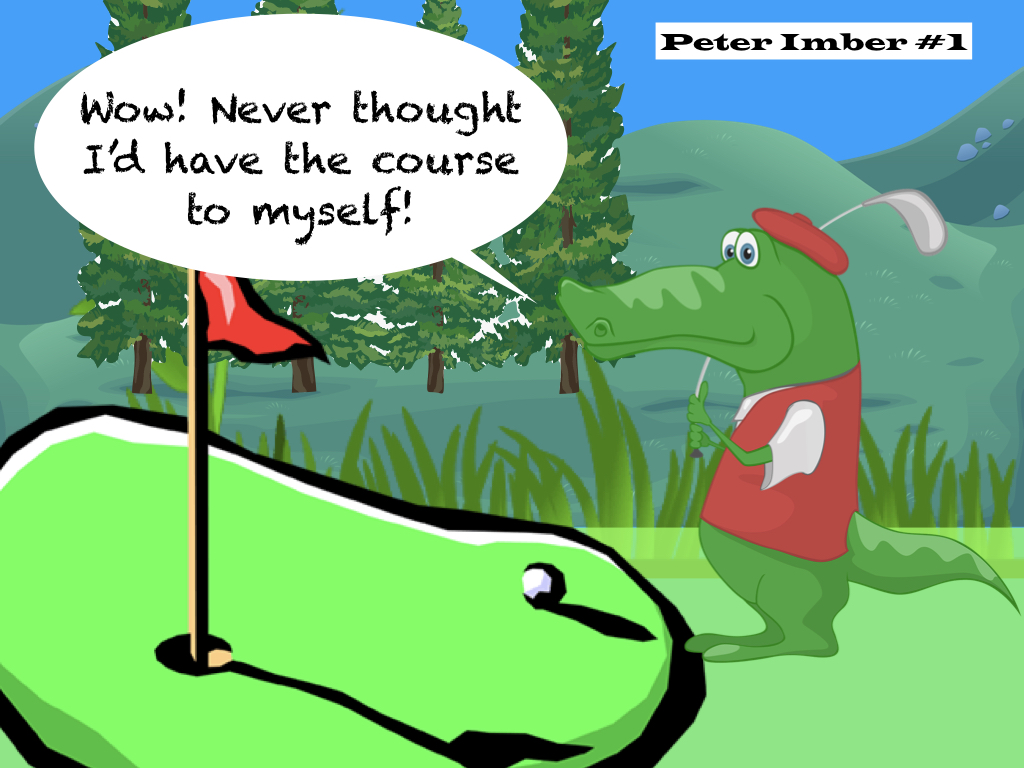
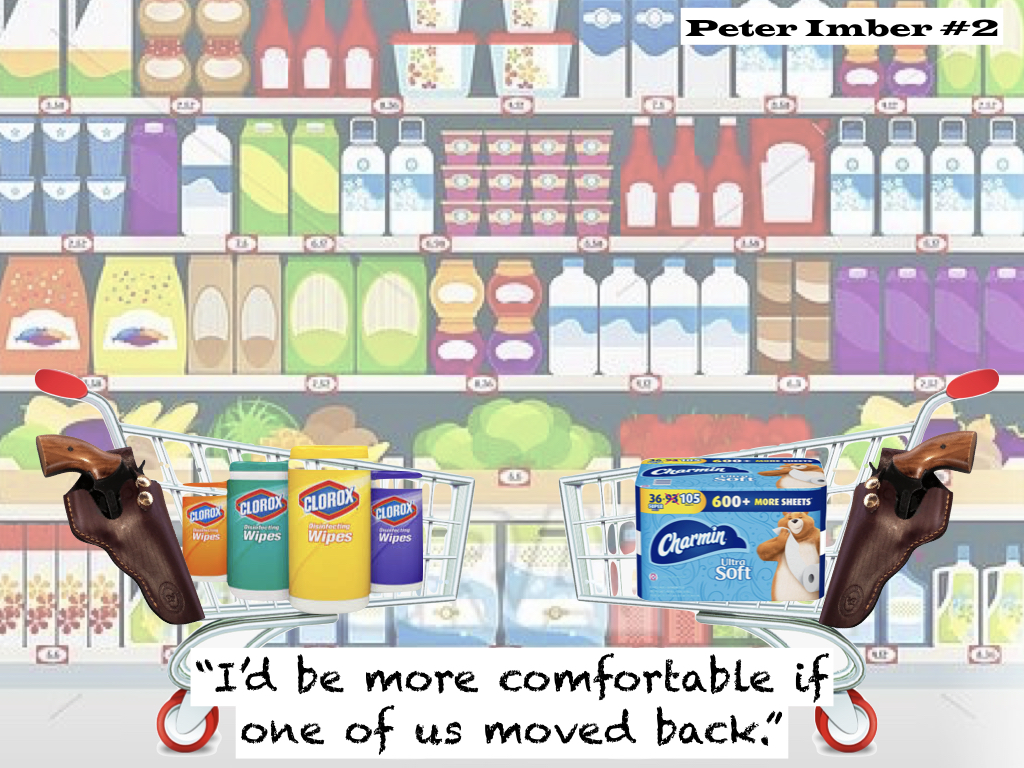
Cartoons in the Time of COVID-19 for April 2020

It was the best of times; It was the worst of times. — A Tale of Two Cities by Charles Dickens

What a revoltin’ development this is! — Chester A. Riley in The Life of Riley

So, how are you doing?  It’s May 1, 2020 and a hell of lot different than a year ago. Here in Maine it’s spring in the manner that Maine has spring. It’s still pretty cold, it’s muddy but what’s supposed to grow is starting to do that despite the lack of a human welcoming committee.

Those of us retired like I and my wife are pretty much sheltering in place. The most risky adventure we or I should say my wife makes is a biweekly shopping trip to a supermarket. Other supplies and occasional take out meals are picked up curbside.

We know we’re lucky! I am completely aware that being born in America as part of the Baby Boom generation I’ve been lucky for 73 years so far. But this is a time of misfortune for my country and without further amplification of my own opinions why beyond the pandemic I’ll get to the point.

“What did you do during the pandemic?” I doubt I’ll live so long to be asked the question by someone who didn’t live through it their self. But if I were asked I’d say, “You know, I created cartoons.”

So here’s my output for the month of April. I intend to keep doing these every day until life returns to normal. When will that be? I think I have a lot of cartoons to create!

Cartoons for April 1 through 30My Cartoons.001My Cartoons.002My Cartoons.003My Cartoons.004My Cartoons.005My Cartoons.006My Cartoons.007My Cartoons.008My Cartoons.009My Cartoons.010My Cartoons.011My Cartoons.012My Cartoons.013My Cartoons.014My Cartoons.015My Cartoons.016April 15 was Jackie Robinson Day, baseball’s annual tribute to him that marks the day in 1947 when Robinson became the first black to integrate the major leagues. I got to see Robinson play for the Brooklyn Dodgers in Ebbets Field when I was a kid and he had to leave that game after colliding into the wall chasing a foul ball.
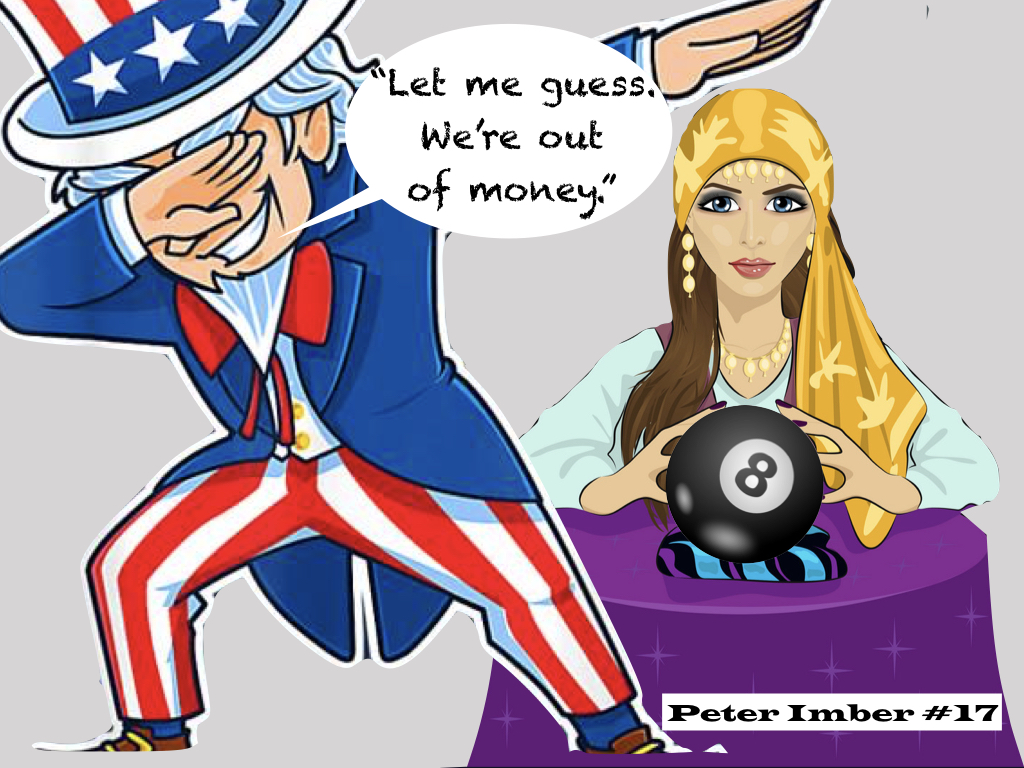
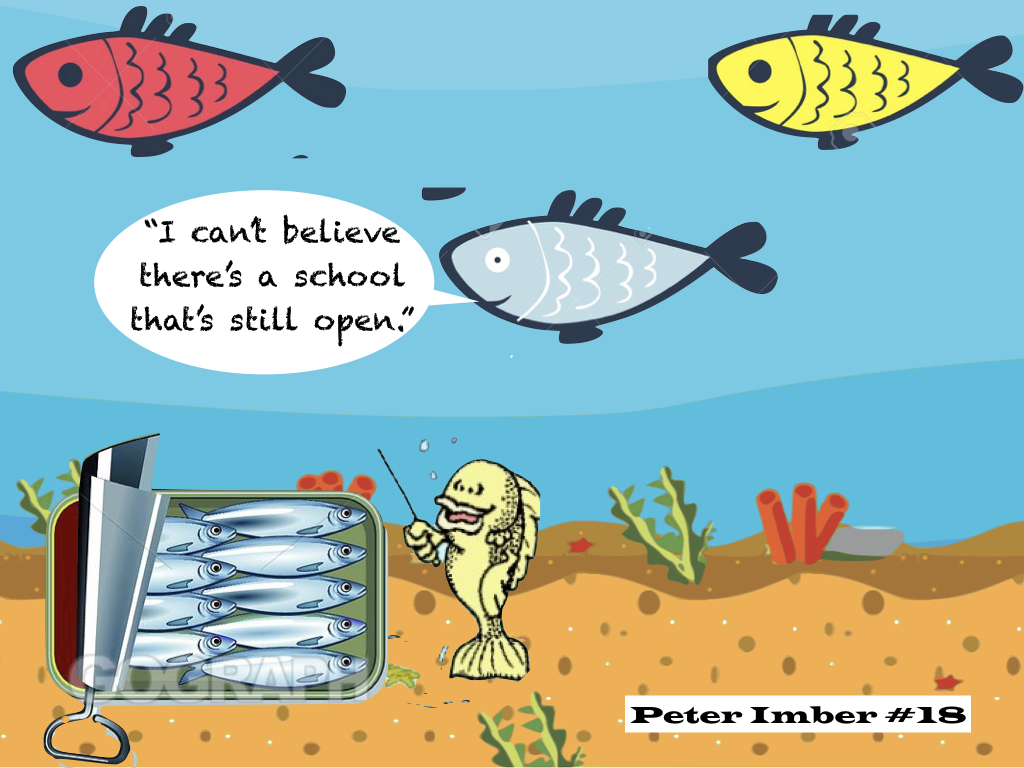
The game was against the Chicago Cubs and their Hall of Fame shortstop Ernie Banks hit the winning home run. Some 40 years later I met Banks in Los Angeles.

Ernie Banks was famous for his love of baseball and a quote that encapsulated that. “Let’s play two,” is what he would say, meaning his desire was to play a double header and not just a single game. That day in LA he also displayed a fantastic memory after I told him I’d seen him hit the game winning homer on the night Jackie Robinson was injured in Brooklyn so many years ago. He thought for just a moment and then looking me in the eye said, “Yeah, I remember that game.” I have no doubt that he did.

Normally, baseball season would be well underway and I miss it. But I miss even more the example of courage and integrity that was the life of Jackie Robinson. 

—————–

My Cartoons.017My Cartoons.018My Cartoons.019My Cartoons.020My Cartoons.021My Cartoons.022My Cartoons.023My Cartoons.024My Cartoons.025My Cartoons.026My Cartoons.027My Cartoons.028My Cartoons.029My Cartoons.030


The Day the News Changed

It was a phone call from an ABC World News Tonight senior producer in New York that did it although It began routinely.

“Hey, we want you to do a story about bears.,” he said.

“Great,” I said. “What’s the story?”

That’s often how I got assignments. My bosses in New York had read or seen something somewhere and now they wanted me to turn it into a story for us, but in the next instant everything felt as if it had changed.

“Find one!” he said.

Let me explain. I worked in the Los Angeles Bureau of ABC News from 1983 until 2010 and until that day in the spring of 2001 had produced hundreds of stories for all the ABC News broadcasts

I had been instructed to find them before but invariably they’d been connected to some larger event happening in the country or the world at that moment like “Get an interview with someone who claims to have been sexually abused by a priest,” or “Show us what it takes to purchase an assault weapon.”

I didn’t ever recall being told to find a story on something as unrelated as bears to anything else newsworthy going on in the world that I could think of. So I asked.

“Why bears?”

And was told.

“Because bears are hot. Our research and our focus groups are telling us that people want to see and hear about bears right now.”

So, I took my marching orders and discovered that bears were indeed the flavor of the month on Madison Ave. They were taking a star turn in advertising and especially on television in commercials.

I did the story and at a ranch where wild animals are rented out for the movies even discovered how you get a bear to charge after an actor on the screen— just drag a dead chicken on a rope in front of it and run like hell.

And what I also realized was that in my world of television news journalism it was no longer going to be a bunch of mostly white men with newspaper backgrounds deciding every night what viewers ought to know. From then until I retired what we thought viewers wanted to know became just as, if not more, important.

How did it happen? There are a bunch of reasons. One big one would be the swallowing of the three formerly independent television network companies along with their news divisions by larger corporate entities in the 1980s.

The famous quote by CBS’s William Paley, “You guys cover the news, I’ve got Jack Benny to make money for me,” no longer applied after that. Network news once viewed as a flagship symbol and excused as a financial loss leader was now expected to pay its own way and become a profit maker as well.

When Disney bought ABC in 1996 I became just another “cast member” as Disney employees are addressed in official communications. I thought of myself as a journalist but in Disney’s eyes I believe I might as well have been dressed up as Snow White roaming about Fantasyland.

The fragmentation of television from how we had grown up with it preceded the rise of the internet and with competition from alternative news channels— CNN was the first in 1980 — network television news had begun its decline which has only accelerated.

At the peak of Walter Cronkite’s popularity in the 1970s he averaged nearly 40 million viewers an evening. Today, all three network evening newscasts combined garner only half that number of viewers in an entire week.

Eyeballs— read that ratings —became everything. Good Morning America and the Today Show, considered parts of their networks’ news divisions, almost stopped doing news but got better ratings than Peter Jennings or Tom Brokaw did in the evening. The morning shows became where the money was made and where it was spent.

When I had started at ABC I never had to do a budget for a story. I even flew on chartered Learjets to breaking news events like school shootings and natural disasters. Increased competition, diminished viewership followed by the impact of the internet with its immediacy and its addictive hold turned us in the TV news kingdom from princes into paupers in what seemed like the blink of an eye.

The jets disappeared. When I produced for Peter Jennings when he came to the West Coast a New York retinue, including his own makeup lady no longer accompanied him. By the end I had to itemize and account for everything I was going to need to spend before I was allowed to spend anything that wasn’t for breaking news.

In the last years of my career I traveled much less even when breaking news happened. There just weren’t enough eyeballs anymore to justify an advertiser paying hundreds of thousands of dollars for a nightly commercial and so we became a little like farmers paid not to grow anything. One of our bureau chiefs even tried to get rid of our coffee machine to save money.

Understand that hard news could be hard. Trying to get people to talk to a camera who had lost loved ones in an airplane crash or all their earthly possessions in a wildfire was not pleasant duty. The pressure to put together a story in just a few hours was enormous and with what we had left at our disposal and also with what became added on to our plate it didn’t just become harder it was also less fulfilling.

We were given new responsibilities that along with the budget cuts further eroded our ability to actually cover the news. We were filing our news for multiple “platforms.” Our correspondents became tethered to satellite trucks so they could be shown live on the scene at any moment. And if the truck wasn’t there they were asked to go live on their cell phones. They didn’t get to report what they saw as much as just what they heard. The technology that provided instant coverage made us hostages to it. Pictures and human emotions are a big part of what TV news provides best and trying to serve all platforms simultaneously— the network, the affiliate stations, radio, the webcast and website —sacrificed our gathering them.

But what’s gone missing most from network news is the depth and the craft we were once empowered to pursue and avail ouselves of to produce it. Are there exceptions? Sure, 60 Minutes is one. It has survived and thrived because it exemplifies the line in the commercial where Orson Wells crooned the words, “We will serve no wine before its time.” 60 Minutes rarely airs a story until it’s the best that it can be. And beyond broadcast media there are many more good independent documentaries being made today that are filling the space that network news has abandoned.

Most television news has continued to deteriorate both quantitatively and qualitatively. Survey after survey now show that people, especially younger people, get their news online. We may still look at a screen but it’s not on a TV we tuned in to watch at 6:30 p.m. It’s in our pockets and purses and available whenever we want it.

I need to confess that the thing I loved most to do during my career wasn’t hard news. Many of my favorite stories often began with the same introduction from the anchorperson— “Finally, tonight…” We called them show closers and they were about things that were more “Gee whiz!” and not “Oh, my God!” There was the guy in Canada who had cornered virtually all the remaining slide rules in the world, and the lightbulb in a firehouse in California that has burned continuously for over a hundred years. I loved finding and sharing these.

I got John Updike to play golf for me as part of an entire show on my beloved sport I produced for Nightline. I had the author Tom Wolfe ask me during an interview if there was anyway I could show the outrageous socks he was wearing on television. I met the surviving Munchkins from the Wizard of Oz. I had a great ride.

My favorite stories were best when I had the best people working with me —video shot by a skilled cameraman, an editor who could cut it together so it turned a great script by a correspondent into something better. My work was collaborative. “The best idea wins” was my philosophy.

In an age of short attention spans, easy access to video from “citizen journalists” as a substitute for being there yourself the opportunity to do the best work possible is rare now. In today’s “spend as little as you can” environment the talent I was able to utilize to do my stories would not likely be available and, even worse, appreciated by those curating the news and counting the beans. The bar isn’t just lower I fear it may be falling to the ground. Our country’s news infrastructure has been hallowed out. It’s more than sad, it’s happening at a time when we need the best journalism to be louder and more pervasive, not silenced and less available.

If I sound bitter, I’m not. Perhaps I’m merely feeling what countless before me have felt about their jobs after they had finished doing them, that their work and workplace had changed almost beyond recognition from what they remembered when they had begun. And it’s hard not to argue that we baby boomers experienced more change in our lifetimes than we could have imagined. But maybe I’ll get one last assignment.

“Hey, we want you to do a story about the future.”

“So, what’s the story?”

“Well, the future seems uncertain.”

“Hmmm, tell me how it turns out.”

Send in the bears…

All I Want for Christmas Is My Moo Shu Pork

next-to-the-last-supper-jewish-chinese-food-christmas

This Christmas day I’m picking my sister-in-law up at the airport. She has insisted that upon her arrival I take her to a Chinese restaurant so she can buy takeout to bring for dinner for everyone else at our home.

Yes, it’s true of all the restaurants likely to be open on Christmas the odds are heavily weighted that they’ll be Chinese and yes, it’s also true that of all the customers buying and eating Chinese food on Christmas the odds are also heavily weighted that they’ll be Jewish. We are. So, you can accompany the rest of what I’m about to write with Zero Mostel wailing Tradition from Fiddler on the Roof. But how did this happen?

My favorite explanation for why Jews eat Chinese on Christmas and at many other times during the year involves a debate between two old men.

“Chinese culture is at least 4,000 years old and we are the civilization that has been in the world the longest,” said Zhang.

“I’m sorry but the Jews have been around for over 5,000 years so we have been here at least a 1,000 more,” replied Abraham.

“Ok”, said Zhang. “But if that’s true, I need you to answer one question.”

“So, ask.”

“What did your people eat to survive for that extra 1,000 years?”

The real answer is actually pretty logical. In the early 20th century Jews and Chinese were the two largest non Christian immigrant peoples in America. Many from both groups lived in close proximity especially in urban centers like New York and Philadelphia. For Jews Chinese restaurants were conveniently located and affordable and— and this was most important —they didn’t use dairy products.

Jews who keep kosher won’t eat dairy and meat at the same time— that’s the most defining feature of the kosher laws which also rule out shrimp, clams and lobster —but if the wontons had pork filling, they sure resembled kreplach (dumplings) from the old country and hey, does God have X-ray vision? Many Jews were becoming flexible in their new country. Many still kept kosher in their homes but weren’t going to ask about what might be in the fried rice when they ate out.

As Jews moved to the suburbs Chinese restaurants moved with them and I grew up eating takeout from the only Chinese restaurant in Reading, PA on nearly every Sunday night. In fact a woman I know who grew up orthodox and kosher told me her family had four sets of dishes. One was for dairy, one for meat, one especially for the week of Passover and a fourth for their weekly Chinese. I’ve known more than a few Jews who will fearlessly eat bacon for breakfast at home but are terrified by the thought of ham in their refrigerators. Bacon is a threshold that can be crossed. Ham is a bridge too far.

The matter of Jews and Christmas, however is more complex than just food. Take the issue of having or not having a Christmas tree. The founder of Zionism himself, Theodore Herzl, lived in Austria and had a Christmas tree in his house and this was before anybody thought of calling it a Hanukkah bush. After the chief rabbi of Vienna once came to visit him during the holidays he is alleged to have written in his diary, “I hope the rabbi doesn’t think less of me because of this. Then again what do I care what he thinks?” Herzl was a secular Jew like the majority of Jews in the United States today.

Untitled.001

And herein lies the question, is having a tree or sitting on Santa’s lap an indication of Jews’ security or insecurity in their identity? Is it a sign of assimilation that’s harmless or harmful. I’m not sure many of us grapple with divining the answers. We do what feels right and that can be different for everyone. As a kid I got to sit on Santa’s lap but my son never did. My parents didn’t have a tree but instead scattered blue and silver ball ornaments meant to hang from a tree in bowls around our house. As a parent myself there were no Christmas decorations. As I said we all do what feels right.

In the meantime many of us can give the same answer that Supreme Court Associate Justice Elena Kagan did when asked at her confirmation hearing where she had spent Christmas.

“You know, like all Jews, I was probably at a Chinese restaurant.”

Why I Love Holiday Affair

Let me admit right off the bat that I prefer to watch movies that have happy endings. Sure, there are exceptions. My favorite film is one and so is my next favorite.

Ikiru, in English “To Live” and directed by Akira Kurosawa, is the story of a man confronted with his own imminent mortality and how he chooses to spend his remaining time on earth and Citizen Kane is Orson Wells’ tour de force that chronicles the rise and fall of an egomaniac— Neither pass for feel good movies. Neither would be a likely choice to snuggle up with Christmas eve.

Ikiru:Kane.001

Since my wife Jo and I have moved to Maine in 2010 Holiday Affair has been the movie I’ve asked her to watch with me every December 24th. The night before Christmas is my favorite night of the year actually. Nobody’s out and nothing is open. I sense a stillness  and peace like at no other time. 

Holiday Affair is, no surprise, a Christmas movie and Turner Classic Movies has to be the reason it pops up now on some lists of favorites in the genre. Come December it’s shown a number of times but when it was released in 1949 it was less than a success. In fact it lost $300,000 for its studio, RKO, which in today’s dollars is over three million.

The plot is cute and uncomplicated. A war widow with a young son played by Janet Leigh, a decade before her shocking demise in Alfred Hitchcock’s Psycho, has not been able to move forward with her life. Wendell Corey plays a lawyer who wants to marry her but can’t get past being the patient boyfriend who is unable to exorcize the ghost of her dead husband. Robert Mitchum in an role twist for him isn’t the tough guy but a nice guy also trying to make his way after the war and when he and Leigh meet in the deparmaent store toy department where he works the sparks fly and you know what’s going to happen.

Holiday-Affair-1949-Christmas-movie-Robert-Mitchum-Janet-Leigh

I’ve never teared up watching Holiday Affair. The end of Frank Capra’s It’s a Wonderful Life does that for me. It hasn’t ever caused me to laugh out loud like Jean Shepard’s A Christmas Movie. But what it does do is make me think that in the post war years of the 40s and early 50s America must have been full of hope and optimism and as well as the desire to get back to normal. There seemed to be a bright future and it was possible to chase dreams.

Corey’s character wanted to take Leigh and her son from the big city to the suburbs and a house with a yard. It would have been a safe life. Mitchum on the other hand wanted to take a risk. He was saving his money with a goal of designing and building boats.

I grew up in one of those newly minted suburbs. The houses weren’t Pete Seeger’s “Little Boxes.” They were well built and are still standing. The neighborhood was full of kids and parents never supervised our pickup games of whatever sport was in season.

My father, unhappy that with his Harvard Business School education his father and uncle still wouldn’t listen to him, bought into and then bought outright someone else’s business and grew it. My mother volunteered and became the county head of the March of Dimes. I wasn’t coerced into eating TV Diners and watching Ozzie and Harriet, I wanted to.

If I sound guilty of romanticizing so be it. I was lucky to be a kid then. I’ve been pretty lucky all along. Most of my generation has. Did I chase my dreams? Yes, I think I did.

The final scene of Holiday Affair is on a train leaving the east coast for the west with Mitchum, Leigh and the boy on board on their way to the future to pursue their dreams. That was a happy ending. That’s maybe why I love the movie because I got to have one and wish the world were really like that for everyone else.


Life Almost After Facebook

So here I am at the Maine Mall. My wife is shopping and a guy and his wife were sitting next to me and just got up a minute ago.

I wasn’t intentionally eaves dropping and could only hear the husband’s half of their conversation. It mostly went like this…

“Yep, yep… yep, yep.”

It’s actually a good feeling to just be here and not worrying about buying anybody anything.

Of the seven of us sitting here six of us are using our phones. Social interaction may be transpiring but not among us. I’m trying to imagine what this same “waiting around” environment might have been like 50 years ago. Would we all have been just as alone with our thoughts back then instead of our phones like now?

Straight in front of me is the Apple store. It’s long and narrow with large tables with small things propped up on them. Fifty years ago it would have looked very strange, maybe like a Russian supermarket with almost no food. The place has a sort of Maitre ‘d/traffic officer stationed in its center. I’m reminded of Jacques Tati’s film Playtime. He opened that film by tricking the audience into thinking people were sitting dolefully in silence in a hospital but when the camera pulls back you see it’s actually an airport.

Playtime-Jacques-Tati-01PHOTO-1

Here’s Tati  in another scene from Playtime which he directed and starred in 51 years ago showing that he was most prescient in seeing how modern society was moving even then toward “alone together.” Tati would have had even more fun with our world today. So would have Buster Keaton.

My Nightmare on Penn Street

Reading 5

There was a time when downtown Reading, Pennsylvania had everything. Of course I’m thinking of long long ago when it also helped to be a kid to believe that.

Reading’s Penn Street was like a theme park to me back then in the 1950s. I grew up in a post WWll suburb of the city and could ride the bus downtown by myself and not worry that my mother would call the police to form a search party.

As soon as I hopped off, I’d head for the soft pretzel cart in Penn Square and the vendor with the horn-rimmed glasses and a smile who hardly ever said a word. His pretzels cost a nickel apiece and some days were fresher than others.

Occasionally, I came downtown to fold cardboard boxes at Imber’s— my grandfather’s store. At a nickel a box he vastly overpaid me. Mostly my trips were just to have fun and wander into the “Five and Dimes”— Woolworths and Kresge’s —the shiny precursors to today’s dull discount stores.

From baseball gloves at Kagan’s to Boy Scout uniforms at Croll and Keck, Penn Street was the place that had something for everyone and offered special attractions for me unlikely to be found anywhere today.

Take the fluoroscope at Farr’s shoe store at 5th and Penn, a tool intended to show how the store’s shoes fit. This was a device that allowed you to look down and actually see the bones in your feet as you stood under its beam in your new penny loafers.

Turned out that it was as unsafe as it was entertaining, maybe as bad as having a load of X-Rays at once but who knew? And who sued years later after they found out?

reading 1

The only escalator in town was at Pomeroy’s, Reading’s multi story department store. It was wooden and wonderful to ride. Unlike today’s smooth metal stairways, it bumped and shook as its moving stairs made their orbits between floors. When its stairs flattened out and disappeared there was a gap large enough between the moving wood and the stationary terminus that you could fit your hand in it if you didn’t know any better. One boy I went to school with did just that and lost pieces of several fingers. If it had happened today, I bet he might not have had to work a day in his life.

And there was the treasure chest at the Crystal, the biggest restaurant in town. What a smart bit of marketing by the owners who filled a trunk full of small rewards for kids who had urged their parents to bring them to eat there. I got my first baseball cards out of the Crystal’s “Treasure Chest,” including an early one of the great Red Sox slugger Ted Williams. Too bad I have no idea what I did with it.

A kid could entertain himself up and down Penn Street. You could watch the trains as they squealed across the tracks that crossed at 7th and Penn eating a Coney Island hot dog while waiting to get a haircut if the barber let you.

9b135181b876bb0e66b0ad1f2187fa2b

But some of my best times downtown as well as what turned out to be my worst were at the movies. Reading once had its fair share of movie palaces with the names of that era—Astor, Embassy, Loews and Warner. All are now gone along with the experience that came from buying a ticket to a grand theater as well as a movie.

And there was also the Park which was off limits to kids. If Penn Street had everything from A to Zeswitz— the music store where I bought my first record albums —then the Park Theater covered X. It was Reading’s home to the final years of burlesque as well as the early ones of Bridgett Bardot and later unadulterated very adult rated porn.

My first memories of going to the movies include “Mr. Roberts” starring Henry Fonda and Jack Lemon and “Guys and Dolls” with Marlon Brando and Frank Sinatra. My parents took me. But what they never heard about was the time I missed a day of 6th grade to go to the movies without them.

Two friends of mine talked me into it although I can’t claim it took much more than asking me if I wanted to join them. We were all Jewish and it was a minor Jewish holiday and so obscure and insignificant an observance that only the most devout regulars at Kesher Zion synagogue showed up for morning prayer joined by us, three kids playing hooky.

Our absence from school and appearance at the service was a sham. We were on our way to a double feature. On the theater marquee was a pairing that wasn’t exactly biblical. We had skipped class and bluffed God to watch “Frankenstein” and “Dracula” and I’m talking the classic hall of fame horror genre versions starring Boris Karloff and Bela Lugosi. Scary movies indeed!

Untitled.001

That night as I lay in bed I knew falling asleep would be tough. Frankenstein and Dracula were either going to show up in my dreams or in my bedroom and I was powerless to choose. I was grateful for the street light down on the corner. At least I wasn’t totally in the dark. But suddenly a shadow streaked across my bedroom wall and I couldn’t move. I almost couldn’t breathe. Several more times the shadow seemed to lunge at me until I realized that it was created by each car that passed along the street outside my window. Nevertheless I was spooked for days.

Yes, I paid for more than just the two movies that day and I’ve never dared to watch either of them again. This particular wayward adventure downtown will always remain my Nightmare on Penn Street.


Sharp Dressed Man

If clothes make the man, then I have never made it. Not that I didn’t have the opportunity. My father was a retailer–women’s ready-to-wear. My mother was fashionable and fashion conscious. Both my parents always dressed well. Our home movies show me in a camel hair coat as a toddler. I puked all over it on my first road trip. That could not have been premeditated but it did foreshadow my relationship with clothes for most of my life.

After college where nobody seemed to care about what they wore I lived on a kibbutz for seven years where even white collar job holders often wore blue collar work clothing– blue shirts, blue pants and black work boots. My entire kibbutz wardrobe could have fit in a shopping bag.

Afterward during my career in television news I was based in Los Angeles where Levi’s and sports shirts were almost de rigueur at the office and in the field and I happily followed suit so to speak. Costco became my outfitter and just how much so was apparent one day in a phone call to a Costco executive I wanted to arrange an interview with. I told him I was a Costco member.

PNGPIX-COM-Costco-Wholesale-Logo-PNG-Transparent

“How many things are you wearing right now that you bought from us?” he asked.

“Hey, my pants, my underwear, my socks, my watch… maybe my shirt,” I answered. Yeah, I was a walking advertisement for the brand.

My colleague at ABC News Brian Rooney was my polar opposite when it came to apparel. Of course he was also an on camera correspondent and I was an off camera producer so how he looked really mattered but how I looked eventually must have mattered to him, too. It started with shoes after I was diagnosed with a foot injury called plantar fasciitis. The orthopedist’s office had another description for it– “Topsiders Disease”, named after the shoes I had been wearing for years that had no arch and as a result had likely inflamed mine. “You’ll never regret buying good shoes,” Rooney advised me at the time.

The next day he came into my office and threw a piece of paper in front of me with a more comprehensive set of guidelines. Its title was “Peter Imber Dress Code” and although it didn’t instantly change my life, it did immediately change my footwear buying habits. I purchased my first $200 pair of shoes. They were for golf and at the time the most comfortable shoes I had ever owned.

IMG_4851

I left Costco behind in 2010 when my wife Jo and I moved to Maine. Actually, Costco left us behind as well since the closest one to where we live now is about a four hour drive. But when one retailing door closes another one opens and in Maine that’s abundantly clear which one. Maine’s state tree is the pine. Maine’s state clothes tree is L.L. Bean and quickly, I was all in. Free shipping, a generous return/replace policy and a flagship store open 24/7, what’s not to like?

ll-bean-logo

L.L. Bean had it all. Shirts and pants and sweaters… But was I again falling into my previous Costco mode? So, at my wife’s urging I branched out. I bought a pair of dress khakis from Orvis that I even dry-clean. I have a beautiful shirt and tie from Brooks Brothers and three handsome sweaters purchased at Bloomingdale’s. As for shoes, I buy Ecco and Merrell and just discovered Hoka. I value comfort and quality now and pay for it. And I own not one but two parkas from The North Face. Wearing the same parka six months of the year gets boring even for me. Have I finally evolved as someone with a sense of or at least an appreciation for style?

Hmm… I guess I’m not all the way there yet. Yesterday, my wife pointed out and not for the first time that I have an abundance, no make that a preponderance of plaid and stripped shirts hanging in my closet. So, there’s work yet left to be done and before coming up here to my computer I realized my clothing choices may just have narrowed once again.

As I write this I am wearing what might be called the “Full Carhartt”– sweatshirt, jeans, socks… And yes, I’m quite comfortable. The wind is whipping and it’s cold outside.

I guess for now, if I’m not a fashionista, I’m at least a Fashion Nor’easter!

carhartt-logo1133

Why I Wasn’t an English Major

dartmouth-tie-001

Oh teachers are my lessons done?

I cannot do another one.

They laughed and laughed and said,

Well child, are your lessons done?

                             –Leonard Cohen

The summer before entering Dartmouth College my class was sent books to read in advance of our matriculation. One was by José Ortega y Gasset, the other I don’t remember. I do remember that I didn’t read either one so the lecture about them upon our arrival in Hanover was wasted on me.

Quickly though, I discovered that Dartmouth was not a place where I could blow through assignments and skate by. My professors were demanding and my classmates smart and during my four years I remember only one student who I felt didn’t have the brains to be there.

Maybe I’m being harsh about him but it was after midnight night in rural Virginia when he bridged a car in which I was a passenger on a railroad track. Missing the turn was forgivable and fortunately, there was a bar adjacent to our predicament and its customers streamed out to help lift our vehicle back on the road we had strayed from.

As we got back in the car the good and drunk samaritans started banging on the hood demanding money.

“What should I do?” asked our driver. “I can’t run over them.”

“No, but you can back the fuck up and get the hell out of here!”

I’m not sure I was the first to shout this but you get the picture.

That close call occurred during the spring of my sophomore year. I was on the golf team and we were on our spring trip having worked our way north from South Carolina. A place called Fripp Island had been our starting point. It was a newly completed golf course and had all the hazards you tried to avoid and an extra one that seemed more like a matter of life and death.

In addition to the usual sand traps and ponds there were alligators and our rounds took longer to complete since when we spotted a gator on the fairway none of us knew how to ask it to let us play through.

The final match of our tour was at the University of Maryland. I was playing as last man on our team but I ended up paired against Maryland’s best golfer who was being punished for showing up late. He was mad about that and in golf, unlike football, anger is not usually going to work to your advantage.

I had a great day. The Maryland number one had a bad one and I beat him. That night my teammates and I celebrated and I vaguely remember at one point making a hazy trip to the men’s room.

When I arrived back in Hanover I was faced with a decision I had to make. In order to enroll in the fall I needed to declare a major. I had considered sociology but a baffling encounter with a department professor who assigned us Jane Jacobs’ The Death and Life of Great American Cities to read squelched that idea.

It was a Tuesday when she announced that we were supposed to have it read by Friday– all 458 pages. I approached her after class.

“Professor, I’m not sure I can read the book that fast.”

“Look, let me tell you something,” she said. “Most people only have one idea they’re trying to get across. If they’re great they might have two and if they have three they get the Nobel Prize.”

She was out the door while finishing her last sentence and I decided that I’d explore a different subject for a major.

And so it was shortly after our return from the golf trip that I walked across the Dartmouth Green to the English Department offices. The afternoon tea at Sanborn House was for prospective English majors and I had put on a jacket and tie for the occasion that I presumed was expected if not required. If I had been holding my tea cup and saucer correctly, I might have avoided what happened next.

As I listened and nodded while circulating around the room in front of the nattily dressed professors of the department I soon became aware that none were making consistent eye contact with me. They were more focused on the center of my chest. As soon as I lowered my head to see why, I understood the attraction. It was my tie– The same tie I had worn into the men’s room the night after my big win on the golf course.

Puke does not exactly enhance a repp tie and in seconds I concluded that English was not going to be the best choice for my concentration of studies either during the next two years.

When we returned to school that fall I still hadn’t made up my mind about a major. History seemed an option and I went to the bookstore to see what courses I would be signing up for but while checking them out I saw a class on Africa that was being taught by a government professor who I had liked… Yep, in that instant I became a government major.

After graduation when I went looking for my first job I was asked by an interviewer what I had studied in college. I told him the story I’ve just related here, vomit stained tie and all… He almost hired me!