
It’s The 4th Of July…
And a signature moment
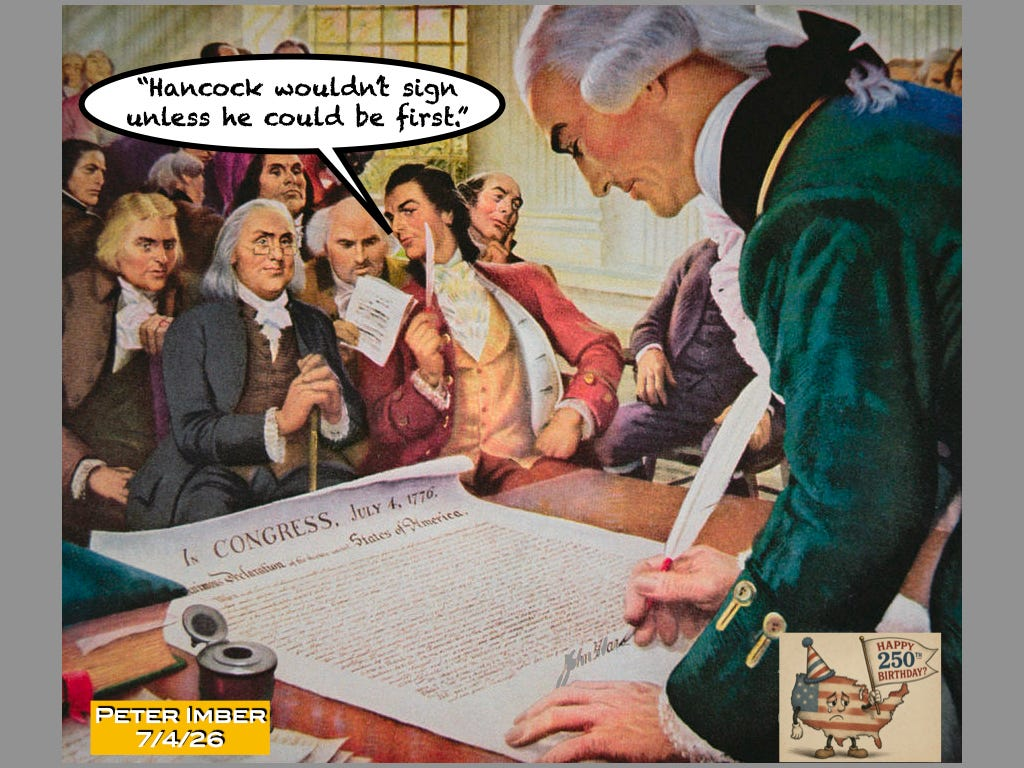
John Hancock’s signature on the Declaration of Independence is nearly five times larger than those of the other 55 signatories. Legend has it that as he put quill pen to parchment he exclaimed, “I want King George III to be able to read it without his spectacles!” That’s almost certainly apocryphal but it’s a good line.
Hancock’s signing first was appropriate. He was President of the Continental Congress and at the time as prominent as any of the others who affixed their signatures to the document after his. That group included Benjamin Franklin, Thomas Jefferson and John Adams and two others known more today for having their names associated with…
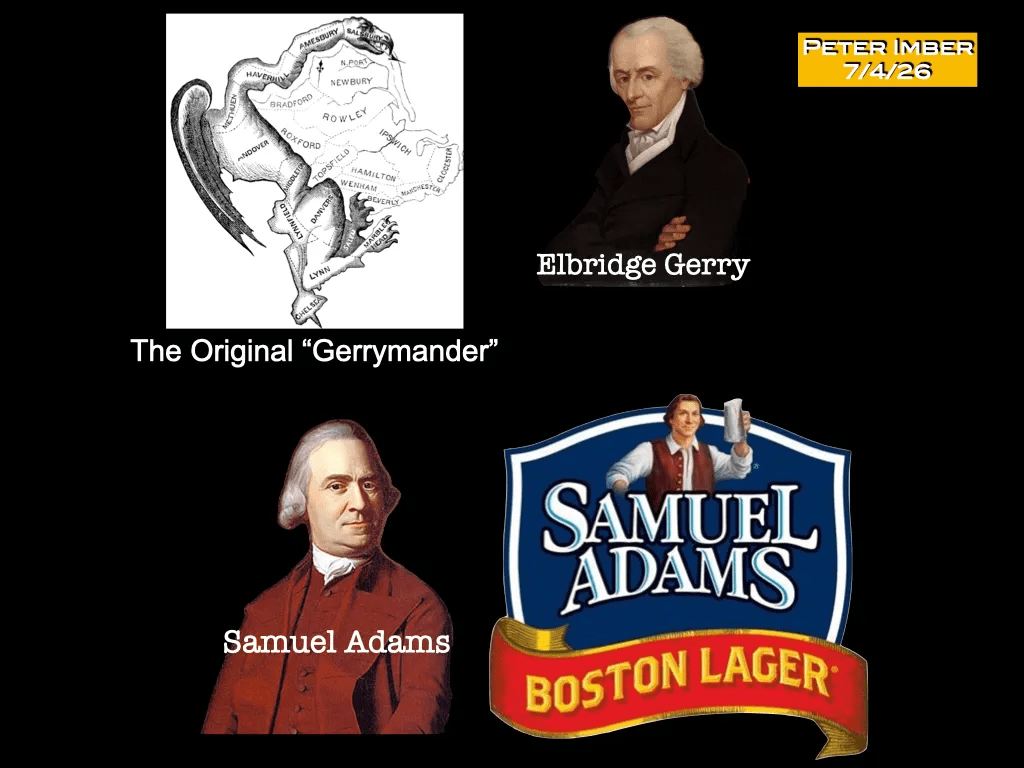
1. Gerrymandering— a corruption of representative democracy named after Elbridge Gerry who as governor of Massachusetts signed a bill to create a partisan election district map in 1812 despite the fact that he didn’t approve of it.
2. Samuel Adams— a beer brand named after Samuel Adams, a founding father, who led resistance to British taxation and promoted drinking beer as a patriotic act in the years leading up to the American Revolution. Adams advocated boycotting all British imports and especially urged Americans to buy local brew. Why beer before tea? Adams’ father was a malt producer and he had taken over the business.
It’s not unfair to say that John Hancock’s own mark on history is primarily his signature. Although he was a nine term governor of Massachusetts (terms in the commonwealth were only for one year in the late 1700’s), Hancock has had many things named after him from towns and counties to American naval vessels and an insurance company.
But of course what’s most enduring is that a “John Hancock” today refers to anyone’s signature.
Hancock was one of the richest men in the American colonies by virtue of an inheritance from an uncle who made a fortune in trade and shipping. He was generous with his wealth and used it to finance the American revolutionary cause by funding militias, paying for their supplies and covering their debts.
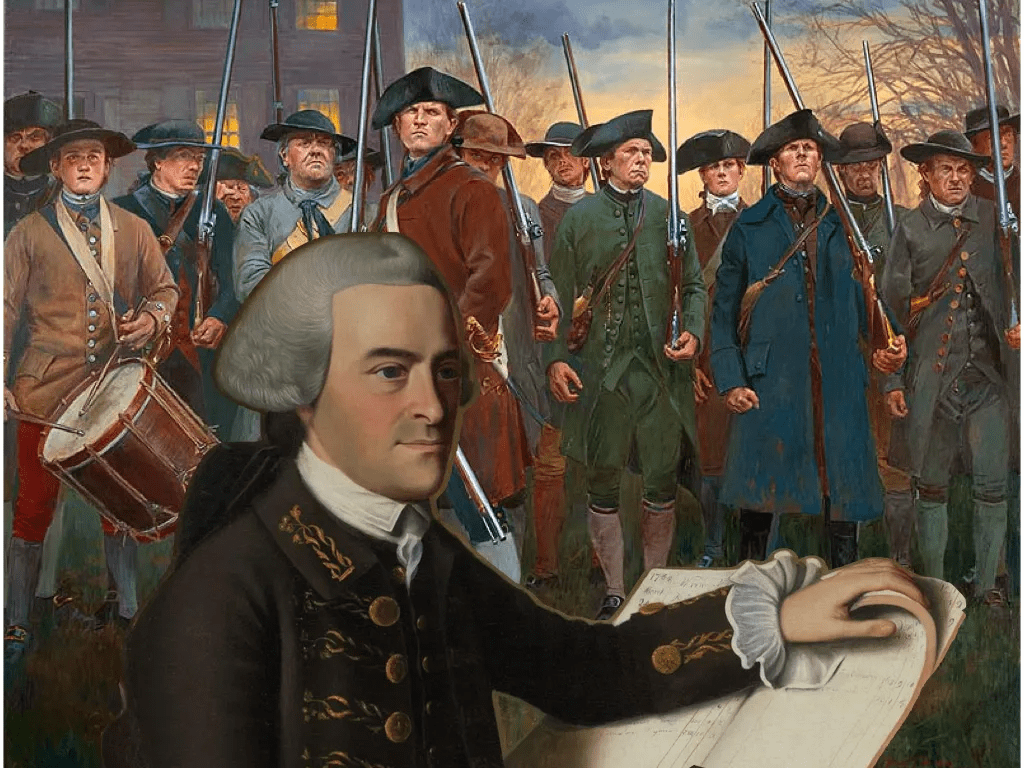
By backing independence he put himself at both great financial and personal risk but Hancock didn’t get the thing he most coveted. He felt he deserved to be made commander of the Continental Army but that position went to George Washington.
John Hancock was as flamboyant as his signature. He was also vain as well as status conscious. Although not mean nor dishonest, by all accounts he had an enormous ego and a desire always to be the center of attention.
A showman, Hancock reveled in pageantry as well as ostentation from his mansions to his wardrobe. His relationships were strained with Washington and John Adams, who found his perceived self importance insufferable.
To sum things up Hancock had some of the same personal traits as the current president of the United States but with a most significant difference. John Hancock may have been a bit of a Donald Trump but he also happened to be a patriot.
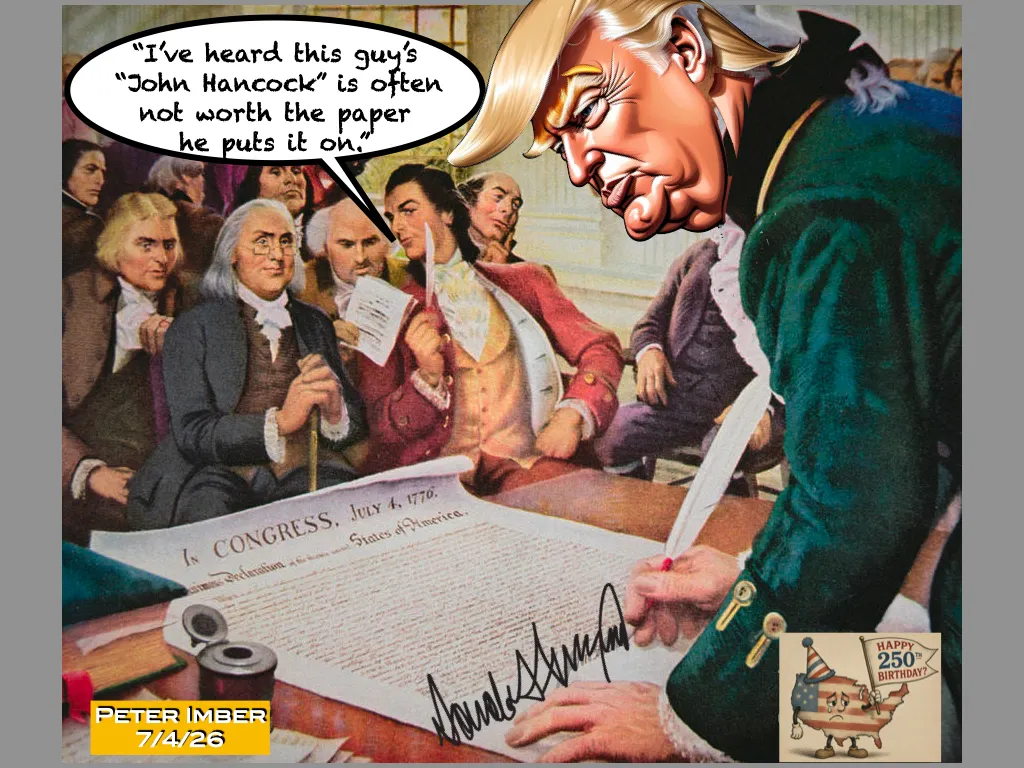
For me and millions of others our country’s 250th birthday will be a day to honor our history, not desecrate it. Trump will hold a rally on America’s birthday and pay homage to himself. He more than likely will say ugly and profane things about others and brag dishonestly about whatever crosses his addled mind. He might also possibly squeeze in a round of golf. That, as they say, is par for the course for him.
Trump has put his likeness on our money and in our passports but his coin of the realm is a currency of lies and his eternal photographic image for posterity will be a mugshot. Trump’s place in our country’s history as the worst person to ever be the president of our country is secure even if he and his appointees have made the rest of us feel less so…
Those who admire Trump are misguided.
Those who enable him are cowardly.
Those who exhibit fealty to him to advance their position or increase their wealth are craven.
Those who support his administration’s policies aimed at oppressing others are cruel.
Those who take advantage of his depravity to feel permitted to project their own prejudice toward others’ race, religion and sexual orientation are hateful.
I hereby rest my case!
And may the words of Franklin and Washington inspire and guide us forward…

Graham, We Hardly Knew You But That’s B.S.!
Sung to the tune of “Just One of Those Things” written by Cole Porter for the 1935 musical Jubilee.
It was just one of those flings, just one on your list of bad things.
You’re one of the guys who now and then lies, just one of those things.
It was just one of those flights, lifted off from the ground and soared to great heights.
A trip to the sun on Icarus wings, just one of those things.
If we’d thought a bit about the end of it when you inked over that tattoo,
We’d have been aware that the rot was there and too much not to be true.
So goodbye Graham and amen. Here’s hoping this won’t happen again.
Your redemption tale is undone. The past you cannot outrun.
Just one of those things!
The link below takes you to the original recording in 1935…
As Time Rolls By…

Hunting in my garage for a roll of kitchen garbage bags made me think of my mortality. Strange? Morbid? Not really when you consider how large the roll of bags is that I’m talking about. It has taken years to use this one up.
I’m not sure when I bought the 400 bags on two separate rolls and now have the other 200 left. I figure we average a bag a week and factoring in the time we’re away from home, I estimate we need fewer than 50 a year. If I calculate the first 200 garbage bags have lasted more than four years, then how likely will I ever need to buy more kitchen garbage bags?

Hey, the Social Security Administration says I will but not for that much longer. I know I’m slowing down and the world is moving faster than I am. I may be in trouble.
Actually, Jo made a point about life expectancy more definitively when we bought a new car in 2023. I call our Prius a car but the salesperson at the dealership where we bought it called it a computer on wheels. Anyway, before we left the lot, he told us that we needed to have a password— a password for the car. Before I could stop laughing my wife had one.
Jo: “LastCar1”
As we drove the Prius home I discovered I needed more than a password for programming our new computer on wheels. Subsequently, I went back to the dealership for a couple tutorials. How do I connect my phone? How can I listen to the radio? How do I turn on the rear window windshield wiper? Turned out if I had looked, I’d have known there wasn’t one.
The salesperson diagnosed me with tech overload and I bet I still wouldn’t pass a Prius proficiency test without a Toyota tutor. The owner’s manual is 600 pages and not at the top of my reading list.
But there’s a bigger issue here than learning where the switch is to heat the steering wheel— that’s a major thing in Maine winter. I want my life to be simpler but of course that’s a good deal more aspirational than realistic. We boomers are living longer at a time when change is accelerating at the speed of a Formula One race car.
When I was a kid I only had to know my parents’ phone number and open the phone book or dial 411 if I wanted to know someone else’s. I used a Webster’s dictionary and a Roget’s Thesaurus and never asked questions of anyone named Siri or Alexa or Claude.
So far I believe I’m doing Ok keeping up. As Twilight Zone’s Rod Serling used to say “Presented for your consideration”, I submit as evidence my Substack. I’ve taught myself what I’ve needed to learn to create and publish it.
Of course there are things I can’t do. Amazingly, I found an electrician who came here yesterday and fixed (I hope permanently) an outlet in the garage with a circuit breaker that wouldn’t unbreak. And we just got our refrigerator ice maker repaired after I couldn’t get it to stop making ice and every time we opened the refrigerator door we had an ice rink on the kitchen floor.
Yes, I know these are so called first world problems and what the hell am I complaining about? But there are frustrations we all encounter— annoying ones —and I’ve noticed fewer and fewer of them now involve other people. That’s an issue for someone raised in a time when personal interaction was the norm and not increasingly the exception.

For instance when I call any company with a question or for help these days, a voice pretending to sound human tries very hard to get me to deal with it for whatever I need and if I had a mantra, I think it would be “Let me speak to a real person.”
Actually, I’ve worked hard at staying agitated on the inside and acting like I’m sedated on the phone. Sure, I can let things get to me but not as often as I used to so I guess I’m coping or is it submitting? As we age the difference can get blurry.
This is a long way round to studies I’ve come across recently that have found that as we get older, we get happier. Hey, I can enthusiastically say that I have. I was 63 when ABC News offered me a buyout and I sprinted out the door. Since then the past 16 years here in Maine have been the best ones of my life.
Oh, sure I can’t do some of those things I loved to when I was younger— play pickup basketball, eat a burger with fries and a milkshake, and stay awake until midnight on New Year’s Eve. But I’m happy and I say sometimes to others “Hey, I’m the luckiest person you’ll meet all day.”
How do I know that? I don’t, but here’s what I do know. At 79, and still believing that I’m thinking clearly and acting logically, I’m grateful that my energy isn’t gone even though it’s clearly depleted. And I’m thankful that my brain isn’t shot although I’m aware that the hard drive is pretty full up.
Hey, where’s that USB device to insert into a slot in my skull that will give me back my RAM (Recently Absconded Memory)? I’m not kidding.

Of course there’s another solution that might just take care of both my failing memory and the predicted upheaval that AI is going to create for almost anyone getting a job in the future. Forget college or high school. Let’s put our elementary school age children to work to help us boomers keep keeping up.
Think about it. How much does my generation know about phishing, cyber bullying or deep fakes? Can we distinguish a chatbot from a crackpot? I’m sure I don’t know as much as I think I do. Someone has compared Congressional hearings where a Mark Zuckerberg or a Sam Altman is questioned by an octogenarian akin to a grandparent asking a grandchild for help on their computer.
Change has accelerated into a hyper gear. What was new not so long ago can become old overnight. I went to a concert a few days ago and bought a compact disc—CD —with music of the string quartet that performed. A friend with me asked, “Do you have a way to play that?”
The time from invention to obsolescence has become a hell of a lot faster than the half life of radioactive isotopes and that includes job skill sets as well as products. In the 1950s there were some— Craftsman hand tools, Tupperware, Zippo lighters —that their manufacturers believed would last forever and were “guaranteed for life.”
I don’t know if any of them or anything else still has that kind of warranty today but a few years ago I changed an incandescent light bulb in the most inaccessible socket in our house with an LED. The new bulb was supposed to last for 15 years. As I screwed it in I thought, “This bulb will outlive me!” It burned out a year later.

Things may not be guaranteed for life anymore but there are projections, predictions and “Use-By” dates that now warn me that nothing lasts forever.
I risk sounding like a recovering journalist who has become a philosopher of the obvious but I think an important part in achieving happiness is accepting that life will outrun you and at some point you will begin to feel that you are being lapped.
Sure, I want to have even more than 200 kitchen garbage bags left before I leave the track and I just realized I have another item in our house that I want to outlive. It’s also in the kitchen and after using one for at least several years I just opened another.

Yes, it’s a bottle of Tabasco sauce so let’s call my race with it one to the bottom. Who will get there first? Well, a Bloody Mary a night and I’m sure I’ll win!
Oh, and since acquiring the Prius, we bought a second new car and maybe you can guess it’s password…
You can’t? It’s LastCar2.
I’m hanging in! That’s what my father said in his late 80s when someone asked him how he was. Hmm… if there is to be a LastCar3, will I even have to drive it myself?
Celebrating Cultural Milestones!

We already have more holidays than we can keep track of starting with the 11 official ones set by Congress that close federal offices, banks, the postal service and give federal employees the day off.
But there are plenty of other Presidential proclamations, Congressional designations and observances. From Mother’s and Father’s Days— which are great for florists and golf gimmick manufacturers —there are hundreds more that cover every day of the year. I have never heard of the vast majority of them and you haven’t either.
Take for example National Static Electricity Day in January which I was shocked to learn exists. And then there’s the Festival for the Souls of Dead Whales in December which sounds like a sad affair but I just learned something that has enlightened me about whales’ souls. One whale species are in fact the oldest souls. Bowhead whales are the longest-living mammals on Earth, with some estimated to live over 200 years so I’m Ok with their getting a shout out.
Most of these commemorations are obscure, ridiculous or promotional— many are all three —but I propose we create others that I think would be meaningful and even sublime. I’ve picked out one for each month that I’ll reveal in the next 12. They historically occurred on a particular day and in a specific year and I consider them important landmarks in the cultural history of America. Nearly all of them are also a good story.
So let’s start today and here is my recommendation for the new July National Cultural Landmark Holiday. As luck would have it— this July 23rd —is actually the centennial anniversary of its occurrence!
National Buster Keaton Crashes A Train Day !

Celebrating a train falling into a river may not seem like something to warrant a holiday but if it is regarded as an extraordinary and perhaps unparalleled feat of moviemaking plus a moment that happened in the early years of cinema no less, then why not?
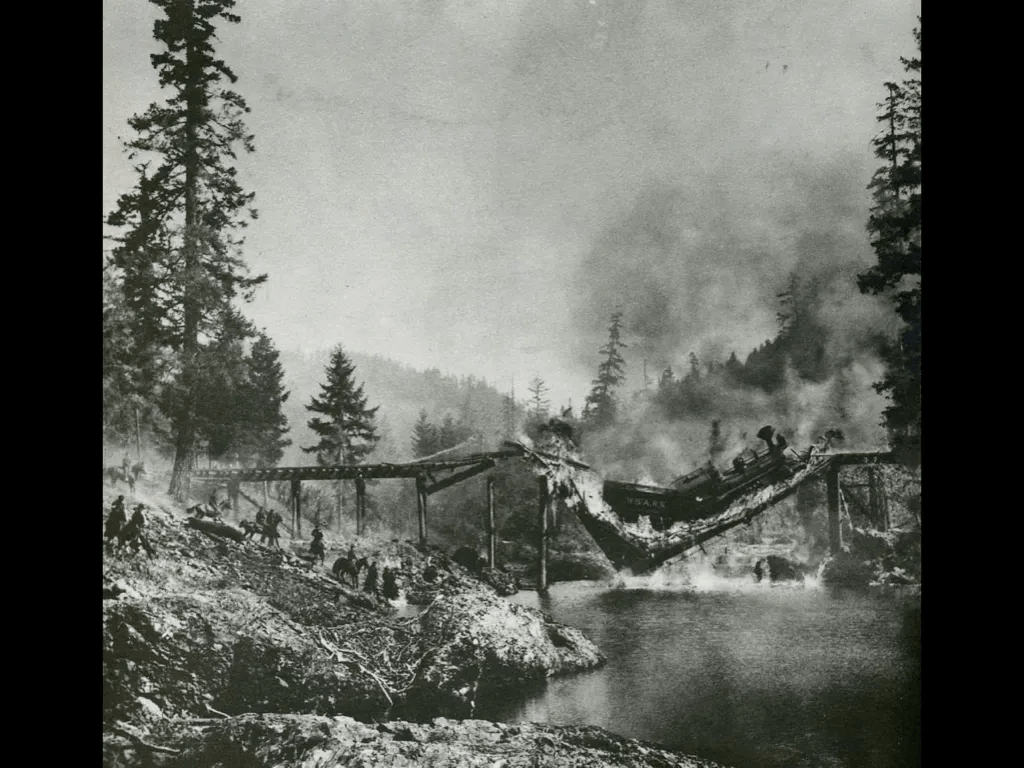
On this day exactly 100 years ago, Buster Keaton filmed the most expensive shot of the silent film era. The scene was in what’s considered Buster Keaton’s movie masterpiece The General and here’s the setup for its role in the film…
Buster Keaton’s character in The General is a Civil War train engineer who has stolen a a locomotive of the same name. An enemy train— the Texas —is bearing down on him and after his engine crosses a bridge, Keaton— playing a character named Johnnie Gray —sets the structure on fire. As the pursuing locomotive then attempts to cross the burning bridge it collapses and the Texas takes a fiery tumble into a river.
It’s the climax of the movie and Keaton’s Johnnie Gray becomes an instant Civil War hero who also wins the heart of the woman who drove him to join the army in the first place to prove his love for her.
Kind of standard mush, no? But today it would also be— at least hopefully — unpalatable mush. Keaton is fighting for the Confederacy and has stolen the General, a Union train. The train that is chasing him that he destroys— the Texas —is also one of the Union’s.
When The General was released in early 1927 the film failed at the box office but not for the reasons you might think. Keaton’s casting the hero as a Confederate didn’t turn many heads. At that time both sides of the Civil War were often portrayed as honorable and a film favoring the losing side was apparently an unobjectionable story line.
Reviews of The General criticized it for other reasons, and particularly for too few laughs. The New York Times critic didn’t think it was funny or thrilling and Variety simply called The General a flop. It wasn’t until a Life magazine article written by James Agee in 1949 entitled Comedy’s Greatest Era praised Buster Keaton’s movies that he began to be compared to Charlie Chaplin and Harold Lloyd and The General became recognized as one of the silent era’s great achievements.
But let’s get back to the shot that eventually was seen around the world. The location for the scene was near Cottage Grove, Oregon on the Row River. The logistics of its undertaking were nothing less than monumental.
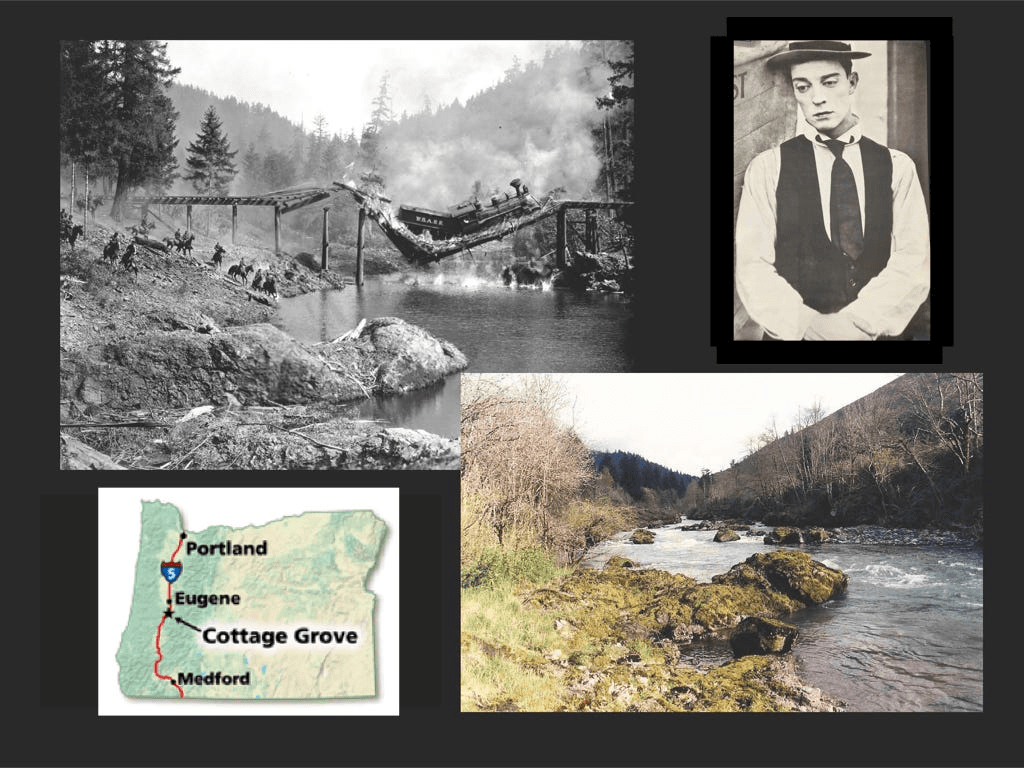
Keaton’s crew constructed a trestle bridge more than 200 feet long and over 50 feet high at a spot on the river full of rocks and steep banks. Dozens of craftsmen built the bridge in two weeks and civil engineers constructed a dam to raise the river’s depth a dozen feet for the crash.
Such an endeavor certainly didn’t go unnoticed and on the day of the scene’s filming the town of Cottage Grove declared a local holiday and an estimated 4,000 onlookers were present on the river banks to witness the action.
Keaton certainly knew he had only one chance— one take —to achieve what he desired. He wasn’t going to be able to buy another locomotive or build another bridge and he was determined to eliminate any risks. Some of the structure’s wooden supports were partially sawed through and weakened and rigged with dynamite charges that were set off as the Texas crossed.
Keaton also had six hand-cranked 35mm cameras rolling simultaneously. However, in the finished version of The General only a single camera’s shot was the one used to show the actual collapse. Those who witnessed the scene reported that the sound of splintering lumber, clanging metal and hissing steam was deafening but of course this was the silent film era and none of it was recorded.
How much did this one shot cost? The figure arrived at was $42,000 in 1926 which is about $800,000 a hundred years later.
And what became of the wreckage left behind? For a couple of generations picnickers came to view the rusting remains of the bridge and the locomotive resting at the bottom of the Row River. During WWII all of it was removed and salvaged for iron.
There was a TV show called You Asked For It in the 1950s and its premise was just that. Viewers sent in postcards with their requests to see things on television and it could be pretty much anything. One asked for the show to visit the site of the climactic scene from The General. I actually remember watching that episode as a kid long before I saw the movie or knew anything about Buster Keaton.

Today, I assumed Cottage Grove, Oregon more than likely would be remembering Buster Keaton and celebrating the town’s being the location of this milestone event in the history of cinema. I thought there might be precedent for my nominating July 23rd to be a new national holiday. So, I called the office of the town manager. Although the mural on a wall downtown is a reminder of what took place 100 years ago, the person I spoke with knew of nothing special planned for today a century later.
At least the movie itself has not been forgotten. The General was one of the first 25 films voted to be included on the United States National Film Registry and ranks 18th on the American Film Institute’s list of America’s greatest films.
One last thought… Keaton could have faked the shot. Miniature models and trick photography had already been employed from the earliest days of filmmaking. But he didn’t and if ever the cliche “They really don’t make them like that anymore” applies, I believe it does here. So Happy Buster Keaton Crashes a Train Day!
Click on the link below to watch the scene and the shot as it appears in the film…
A “Conversation” With Claude

Ok, you might think what follows is odd, maybe lazy or even self- serving. The title of this post has the word conversation in quotes because I asked Claude, the AI assistant created by Anthropic, some questions and I’ve merely published the answers…
Me: “Is there a difference between writer’s block and feeling your subject is too big to write about or just feeling you have exhausted all your ideas and stories to write about?”
Claude: “Yes, I think these are genuinely different experiences, even though they can feel similar from the inside—that same stuck, blank-page dread.
Writer’s block is usually about the sentence, not the subject. You know what you want to say, maybe you even have the idea fully formed, but something jams between the thought and the page. It’s often tangled up with self-judgment—every sentence you draft feels wrong, so you freeze rather than write something imperfect. It tends to be episodic and can hit you on a subject you’ve written about easily before.
A subject feeling too big is a different problem: it’s not that the words won’t come, it’s that you don’t yet have a shape for the material. This happens with genuinely large or layered topics—the kind where there are six possible essays inside one idea and you haven’t figured out which one you’re writing, or what to leave out.
That’s not paralysis, it’s actually a structural problem. The fix isn’t “just start writing,” it’s narrowing: picking one thread, one scene, one question, and trusting that the smaller thing will imply the larger one. A lot of good essays about big subjects work exactly that way—they enter through a narrow door.
Feeling exhausted of ideas is different again, and honestly it’s often not really about ideas at all—it’s about attention. When you feel like you’ve said everything, it usually means you’ve been mining the same seam for a while and it’s temporarily worked out, not that the seam is empty. This one tends to respond to input, not effort: reading something unrelated, talking to someone, walking around a museum, anything that isn’t trying to produce material. Sitting down to force new ideas when you’re in this state usually just confirms the feeling of emptiness.
If I had to guess which one tends to show up in your case—given how many long, research-driven threads you keep going at once (the mandatory retirement piece, the media history cluster, Keaton, and so on)—I’d bet “subject too big” is the one that visits you most. Does one of these feel like it’s what you’re actually up against right now, or is it more of a general craft question?
Me: “I have written about things I’ve experienced or have opinions about for 6 years. The well seems dry right now.”
Claude: “Six years of writing from direct experience and opinion is a long run—long enough that you’ve probably used up the material that came easily, the stories you’d already turned over in your mind before you ever put them on the page. That’s not the same as being out of things to say. It’s more like: the free money’s spent, and now it’s actual work.
A few things that tend to actually refill the well, as opposed to just staring at it harder:
Write about someone else for a while. Six years of “I” pieces is a lot of self-mining. A profile, an interview, a piece built around someone else’s story—it uses different muscles and often loosens something. You’ve got Brian Rooney, people from the bureau, characters from the golf world, people at the Strand. Someone else’s story can be the side door back into your own voice.
Revisit old ground with a new instrument. The same memory or opinion you’ve already written about isn’t necessarily used up—you may have only mined it once, with one lens. A story about your ABC years told straight is different from the same story told as “what this taught me about obsolescence,” which is different again told as pure comedy. The well can feel dry when really you’ve just been drawing from the same depth.
Write about the block itself, briefly, and see if it moves. Sometimes an essay about not having anything to say turns into the essay. It’s a known trick and it can feel cheap, but it works because the act of writing honestly about the stuckness often surfaces the actual thing underneath it.
Consider that dry isn’t the same as empty. A well can be dry because it needs rain, not because it’s used up. Six years of writing from your own life is six years of output with very little input. If most of your reading, watching, and conversation lately has been in service of writing—research for pieces—rather than just wandering around in things for their own sake, that alone can produce this exact feeling.
Is the dryness more “I sit down and nothing comes,” or more “I have vague ideas but none of them feel like enough to build a piece around”?
Ok, this is me now talking to you— the reader —and not Claude. I didn’t answer Claude’s question but what do you think? Did Claude and I have a conversation?
And what does Claude “think”? So I asked…

Me: When I ask Claude a question and it answers me with what I consider advice and opinion can I call it having a conversation with Claude or is it something else?
Claude: It’s a reasonable question, and honestly there’s no single “correct” answer — but here’s how I’d think about it.
“Conversation” isn’t wrong. Something is happening that has the shape of conversation: you ask, I respond, context carries forward, the exchange can branch and deepen. If you’re describing the mechanics — turn-taking, back-and-forth, exchange of ideas — “conversation” is accurate enough and nobody’s being misled.
Where it gets slippery is if “conversation” implies the things it implies between two people: a mind on the other end forming a considered view, remembering you tomorrow the way a friend would, having a stake in the exchange. That’s where the word can smuggle in more than is actually there.
When I give you what sounds like advice or opinion, I’m generating a response — a synthesis of patterns, arguments, and information — not consulting a settled inner viewpoint I hold and am reporting to you. It can be genuinely useful, well-reasoned, even something you weigh seriously. But it’s not opinion in the sense of “this is what I, a person with a stake in the world, believe.”
So I’d say: call it a conversation if the word is doing descriptive work for you — describing the exchange. Be a little more careful if you’re leaning on the word to justify treating the output as you would a trusted colleague’s hard-won opinion. The output can still be worth taking seriously on its merits — is the reasoning sound, is the information right — just not because “Claude thinks so” the way you’d credit a person’s judgment.
Some people split the difference and call it something like “talking with Claude” or “working through something with Claude” — conversational in form, without claiming more than that underneath it. That might be the more honest label, depending on what you’re using the word to do.
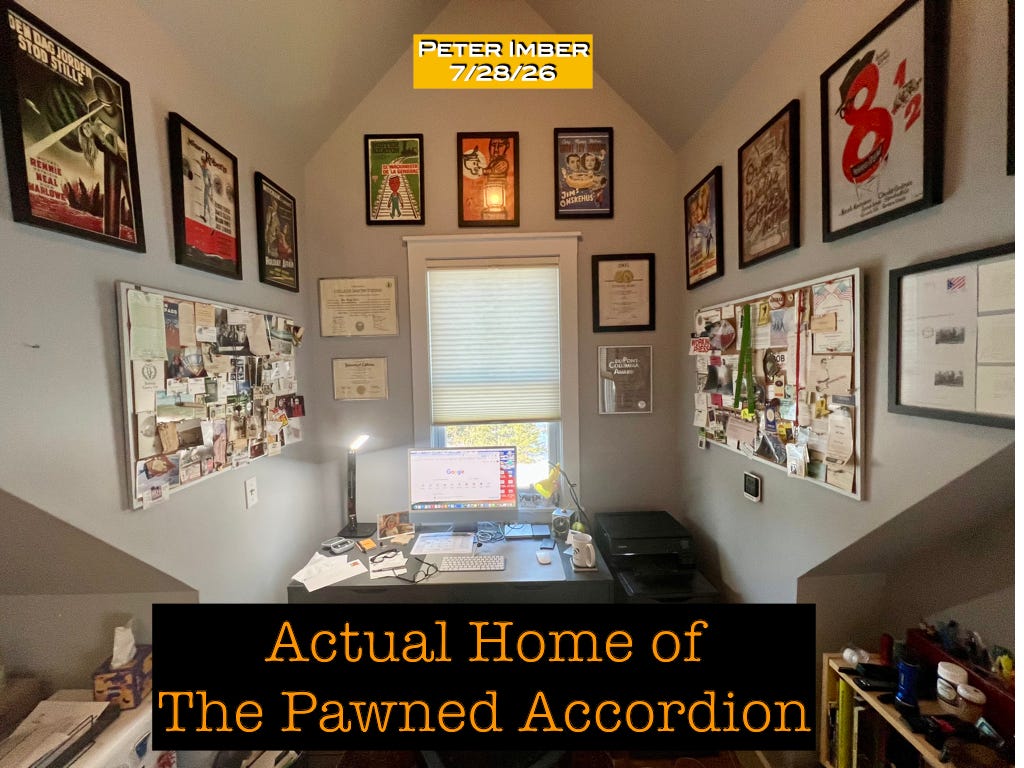
Well, what have I learned here? I guess my takeaways are:
1. Claude likes to “talk”.
2. It uses the pronoun “I” as if it is a real person.
3. I know I’ve been writing for the most part about myself or as Claude calls it “self mining” which is an analogy I would not have thought of.
4. Whether it’s a mine or a well I will continue to dig into my past and draw inspiration from it but look beyond my own life experience to find other people and things to write about.
Ok Claude, The Pawned Accordion will learn to play new tunes!
Life In A Small Town
Despite the uninspired title, I hope I’ll be inspired to make this subject an occasional post
On Dragnet Sgt. Joe Friday never actually said the exact words “Just the facts, ma’am.” but here are a few of them about where I lived once and where I live now…

Los Angeles County, California: Population 9,700,000, Size 4,100 square miles

Knox County, Maine: Population 41,117, Size 1,144 square miles
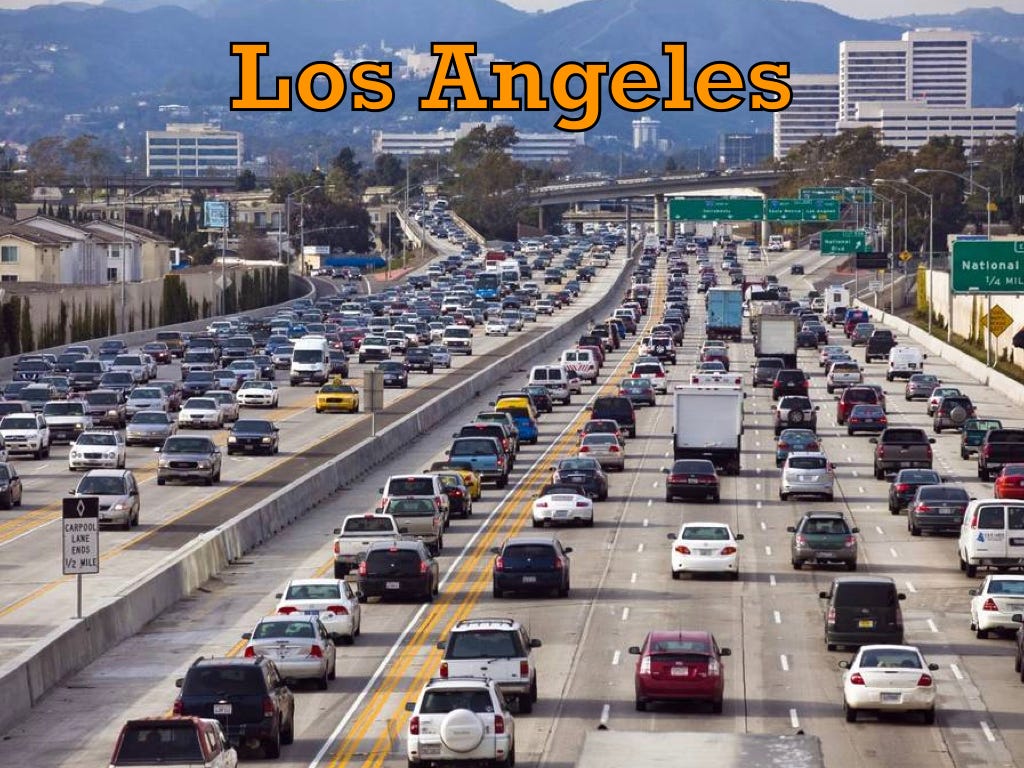
State of California: 36,000,000 registered motor vehicles
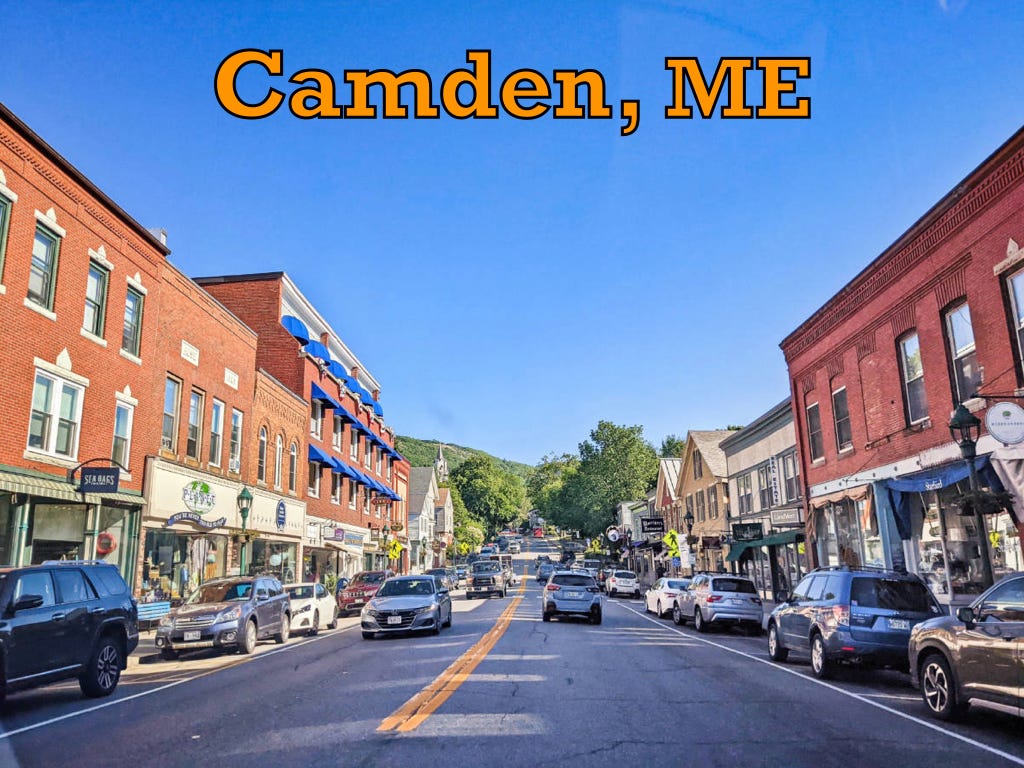
State of Maine: 1,400,000 registered motor vehicles
So what other differences are noticeable between the City of Angels and the Jewel of the Maine Coast? There are lobster traps full of them of course. Some good and some less so. Really good pizza and bagels are about two hours away from us here in Camden. We need to drive to Portland. And Chinese food? I’m lucky that I have a couple friends who actually enjoy the kind we grew up with elsewhere which others may remember as beyond bad but we didn’t care then and don’t care now. I know there’s comfort food but is there also such a thing as nostalgia food?
Of course quality of food isn’t quality of life and in my opinion really good pizza, bagels or Chinese food is hard to find most anywhere. I believe where I live what makes life align with the state of Maine’s unofficial motto The Way Life Should Be is our size. Maine is 42nd in total population of all of the states in America. It’s just behind New Hampshire and just ahead of Montana.
Sure we may need to go to Portland or Boston for serious medical issues and a greater variety of shopping choices but two-thirds of Mainers live in communities of fewer than 10,000 people and 16 years ago when Jo and I moved to Maine and to the town of Camden— population 5,242 —that was brought home to me immediately .
When we arrived in 2010 at the house we had bought the year before, our street sign was missing. We are the only house on our street— a long driveway actually —and the woman who had built the house and sold it to us named it after her daughter. We have no proof but suspect she took the sign along with the house keys. Upon discovering both were missing, I called a locksmith and then the town office and was switched to the person I needed to inform about getting the sign replaced.
Me: “I just moved into the house on Kims Way and our street sign is missing.”
Town official: “Yes, I noticed that a while ago and ordered another one.”
A short time later when we joined the local Y, the person who read my registration form said, “I’ve been in your house.” And shortly after that at the post office the postal employee saw the return address on the package I was mailing and said, “I’ve been in your house.” An odd coincidence? Camden has a couple annual house tours for gardens and kitchens. Ours had been on the latter. Incidents like these made it clear we were not in LA anymore.
Los Angeles County has many communities— 88 are incorporated cities —with their own names from Agoura Hills to Whittier. That doesn’t even include neighborhoods like Sherman Oaks where I lived or Hollywood which certainly has an identity beyond its nine zip codes. For the most part Angelenos can’t tell you the difference between the cities of Manhattan Beach and Hawaiian Gardens except that one actually has a beach.
The four counties considered to be parts of Midcoast Maine are composed of many small communities but because there are a lot fewer of us who live in them, we know their towns and are sometimes even reminded if we should forget. Take Hope! Population 1,698. As the signs below demonstrate, it’s hard to lose Hope…
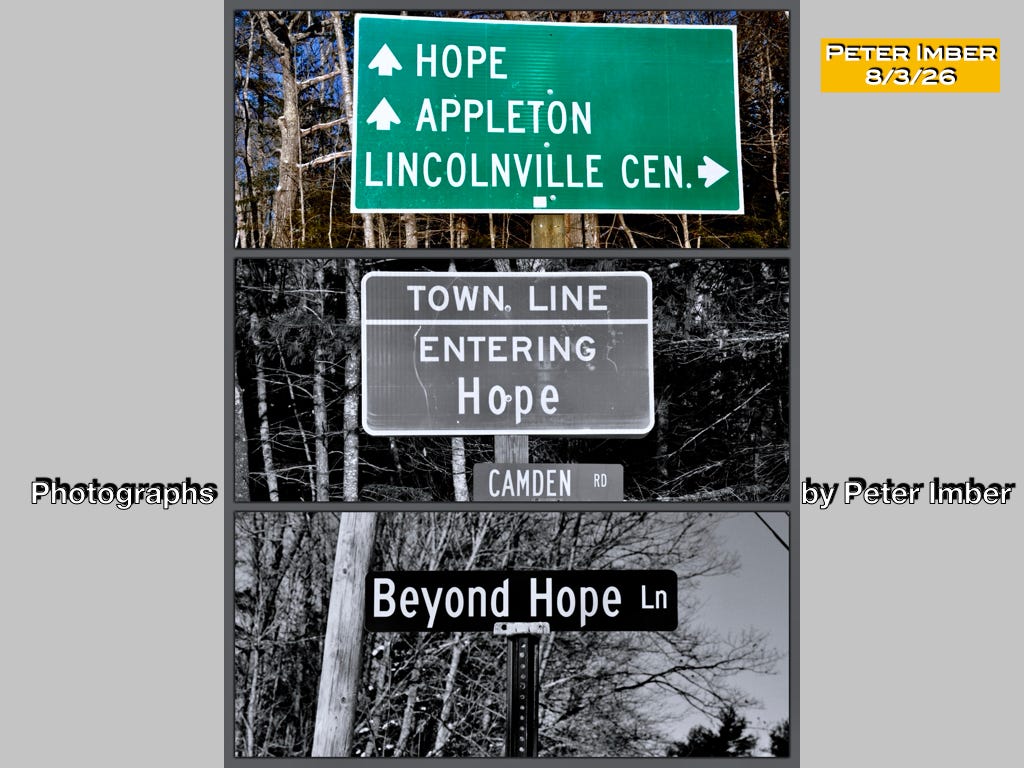
Because towns here have fewer inhabitants they cling to their identities and distinguish themselves with annual events that take place in them. There’s the Rockland Lobster Festival that was held this past weekend. There was the 4th of July Parade in Thomaston last month and Camden’s Bay Chamber Screen Door Music Festival that is about to get underway.
The Rockport Donut Festival, the Damariscotta Pumpkinfest & Regatta, the Maine Wild Blueberry Festival in Union, the Common Ground Country Fair in Unity and the Belfast Ice Festival & Ice Carving Championship are all events that their communities have attached their names to and take pride in.
Although I’m always surprised when I go to a movie or a concert how many people I don’t know, very often I run into people I do. I’m not a sociologist or a psychologist and never played either of them on TV but I am a retired journalist and think I know a little about a lot of stuff. That might make me good at cocktail party conversation but certainly not an authority on much of anything beyond my experience producing television news stories; a job that required I notice even little things.
So here’s an observation I’ve made that I think may have sociological weight and demonstrates the difference between a small town like Camden and a giant metropolis like Los Angeles.
Take a look at the the two cartoons below…


Did you notice what’s different? If not, here’s a hint. Where are the grocery carts and where are the women’s hands in each of the cartoons?
Got it?
When I get back to Los Angeles I’m always aware of the ways in which life speeds up around me. No, it’s not on the freeways. It’s in places like supermarkets where I might see it. If people in LA who know each other meet by chance while getting groceries and start a conversation, their hands often never lose a tight grip on their shopping carts even if they’ve been talking for a while.
In small towns in Maine if people who know each other decide to talk in the supermarket, not only do their hands come off their carts but they step away from them and fill the aisle. Of course they make way for others to get by. I’ve seen similar behavior here outside in the parking lot. If people commit to talk to each other, they step away from their cars to do it. And of course in a small town and likely most anywhere else, if there’s someone you see who you don’t want to engage with… well, you duck somewhere out of the way.
Do we have more time to engage with people we know here in Maine? Are we less in a hurry? Is it because we have more space? Do we know more of our neighbors? And are people who live in small towns maybe happier than those in big cities?
The answer to that last question has been the subject of a fair amount of research and the best known of these studies is one that was undertaken for nearly a decade in Canada and asked people to evaluate their well-being. During that time the survey gathered 400,000 responses in over 1,200 communities. Type of employment, level of income and education didn’t explain the community differences in people’s perception of their happiness but the size of their communities did. Those who lived in urban areas were shown to be significantly less happy than those who didn’t.
A long time ago I read the book Walden Two about a fictional idyllic community. Walden Two was small. I know our own community isn’t perfect but it is small. Maybe the book’s author who was a behaviorist might agree that I am onto something here where I live now. Here’s his advice…
“If you’re old, don’t try to change yourself, change your environment.” — B.F. Skinner
The Disassembling of America Continues

This is a revised/updated version of a post from two years ago…
When we moved into our house here in Maine I put together the last piece of IKEA furniture I ever intend to. It’s the desk I’m sitting at right now and it’s fine except for a drawer just below one of my hands I’m using to type with.
I’ve assembled a fair amount of IKEA stuff in my life and I do admire the user friendly directions for putting their furniture together. They consist of only pictures instead of the maddeningly dark alleys of words I’ve been lured down too often by other instruction guides.
This desk I tackled was a project— a sort of IKEA final exam —with fourteen pages of pictures and I thought I was acing it until…
I had completed the assembly and was about to start filling up the desk’s two drawers. The one on the left side pulled out easily but the one on the right got stuck less than halfway. Way less than half way…
I figured that I had put a screw in the wrong place and found where it was located but it was beyond my reach to unscrew. I started to remove screws in other places to clear the way but this didn’t help. Somehow, some way, the screw I had screwed up must have been screwed in much earlier in the assemblage.
I kept disassembling and the desk was no longer upright and now balancing sideways on my lap as I continued to reverse the work I had done and then CRASH!!! It escaped my grasp and dropped on the floor accompanied by the sound of cracking wood.
If you’ve ever assembled a piece of IKEA furniture yourself, then you are likely familiar with the little wooden pegs that you insert on the ends of the larger pieces of particle board to join them together. They are called dowels. My dropping the desk sheared off a bunch— broke them into pieces! I was angry and that gave way quickly to despondency.
Because of my innocent mistake I quickly looked for a scapegoat. I blamed IKEA and VOLVO and ABBA and all of SWEDEN. I asked myself what would Henrik Ibsen do? Yeah, I know he’s Norwegian but that put him in the neighborhood and I didn’t consider him an innocent bystander.
I was mentally treading water in order not to sink further. My mind, working like it does, suggested I write a tragic play with a title— A Dowel’s House. Even spell check thought it was a stupid idea.
I left the desk in a heap for two days while I fumed and considered my options.
- I could call IKEA and while trying not to curse, order lots of replacement parts or even demand a new desk for free.
- I could find a carpenter to take over and have him or her try to repair the damage.
- I could just put the damn thing back together as best I could and live with a gimpy drawer if in fact the desk could even be resurrected to an upright condition again.
I chose the last option and have pulled out that drawer just now. For the first six inches it’s fine, after that it’s a bit of a tug…
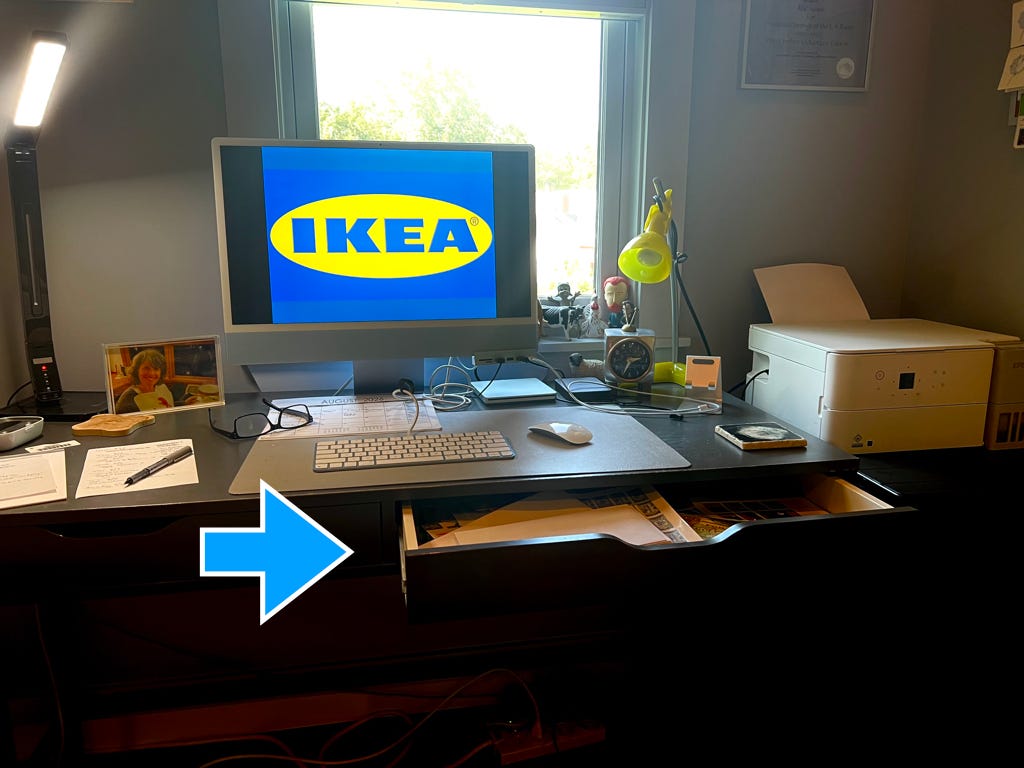
“Going around Robin Hood’s barn” is an expression I’ve heard used to describe someone who has taken a long time to get to the point. And although I’m not aware that Robin Hood ever had a barn, I’ll plead guilty to having wandered through Sherwood Forest and confess that my IKEA experience is the setup to how I’ve been feeling increasingly about what’s happening to our country. I’ve been watching us disassembling.
Here’s the short list of some of what has been astounding and appalling…
- A president who is pathologically ill and a convicted felon
- Judges who have given unprecedented power to the executive branch
- Appointees and advisers of remarkably dangerous and/or incompetent sycophancy
- A country now populated by what has become an unimaginable number of our fellow citizens who believe an ever widening range of conspiracy theories, distrust medical science and science in general and look the other way at the chicanery, corruption and cruelty of Donald Trump.
These things are increasingly distressing to me and that’s why I’ve been remembering the moment the IKEA desk fell off my lap. It was sudden and shocking but looking back I believe inevitable. All the taking apart of what I had put together had weakened the desk to the point that it collapsed.
The United States is not a piece of IKEA furniture and perhaps equating my desk to what I’ve observed taking place in America is ludicrous. But I am convinced that we are witnessing things that I believed in and took for granted about our nation all my life being disassembled piece by piece— screw by screw.
I realize this is a downer of an analogy but hey, I’m sitting at my IKEA desk that I didn’t know was salvageable until I decided that I’d attempt to put it back together.
The desk has held up with its sheared dowels and served me well for 16 years. But here we are in the reality of 2026 and I worry that the institutions and laws that have served us well for way longer may not withstand the pressure that surely will further test them.

This past weekend Jo and I saw a copy of the Declaration of Independence that the Maine Historical Society possesses and is currently being displayed county by county in the state. It brought home quite emphatically how far we have strayed from what this nation was not so long ago.
The Declaration of Independence is a list of grievances against the King of England George III enumerating the colonists’ reasons for a total break and separation from his monarchy. Now, two hundred and fifty years later we can produce a list of many of the same grievances against our current president— the man who would be a king.
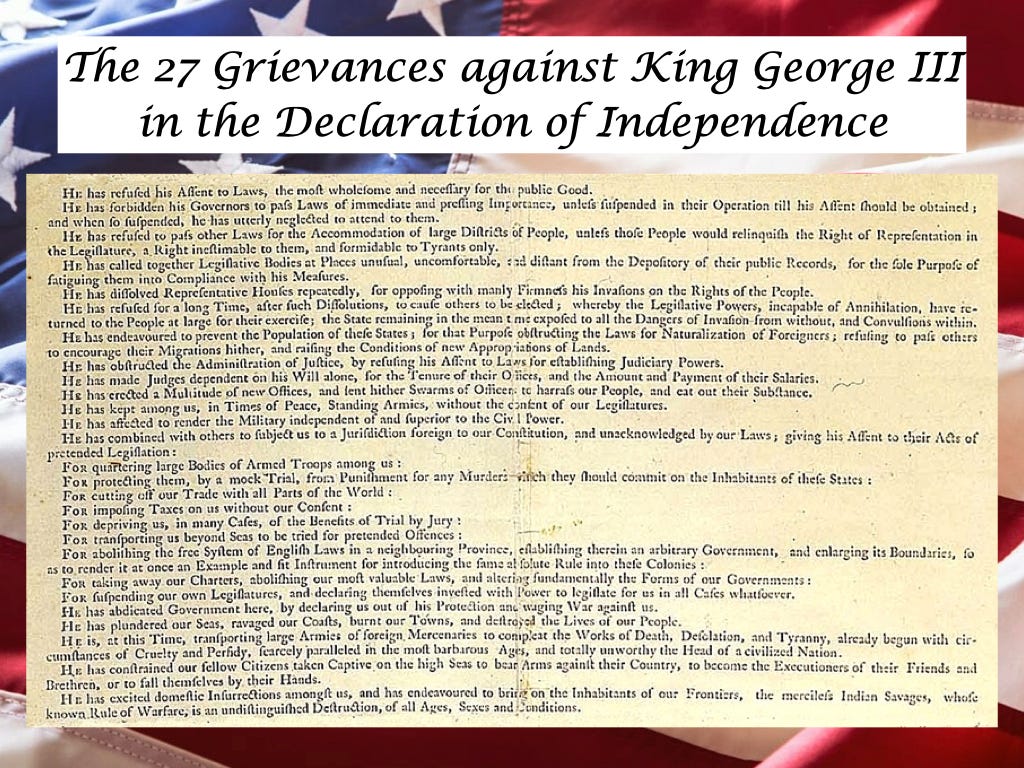
Here are a few of those grievances from 1776 that stand out as as we experience history repeating itself.…
- “He has obstructed the Administration of Justice, by refusing his Assent to Laws for establishing Judiciary powers” and “made Judges dependent on his Will alone.”
- “He has endeavoured to prevent the population of these States; for that purpose obstructing the Laws for Naturalization of Foreigners; refusing to pass others to encourage their migrations hither, and raising the conditions of new Appropriations of Lands.”
- “He has kept among us, in times of peace, Standing Armies without the Consent of our legislatures” and “For quartering large bodies of armed troops among us.”
- “For cutting off our Trade with all parts of the world” and “For imposing Taxes on us without our Consent.”
Presidential overreach is certainly not unique to Donald Trump but with a cowardly and complicit Congressional majority in both Houses and deferential, if not aligned, Supreme Court justices who have legitimized his actions, America is today experiencing what our Founding Fathers had hoped would never happen.
Can the America we’ve known that this president and his retinue are disassembling be reassembled again? Or have we already become a very different country beyond reclamation? I sure hope not.
Ella And Louis Record An Album Together Day!

We already have more holidays than we can keep track of starting with the 11 official ones set by Congress that close federal offices, banks, the postal service and give federal employees the day off.
But there are plenty of other Presidential proclamations, Congressional designations and observances. From Mother’s and Father’s Days— which are great for florists and golf gimmick manufacturers —there are hundreds more that cover every day of the year. I have never heard of the vast majority of them and you haven’t either.
Most of these commemorations are obscure, ridiculous or promotional— many are all three —but I propose we create others that I think would be meaningful and even sublime. I’ve picked out one for each month that I’ll reveal in the next 12. They historically occurred on a particular day and in a specific year and I consider them important landmarks in the cultural history of America. Nearly all of them are also a good story. Here is this month’s…

By the time Louis Armstrong and Ella Fitzgerald made their first record album together, both had been making records separately for decades and had only cut a couple duet singles together in the late 1940s and early 1950s. It wasn’t until 70 years ago today that they went into a recording studio and made the album simply titled ella & louis.
How the two got there wasn’t exactly planned but could be a song title. How about It’s Alright with Me?
Here’s an explanation: The night before their recording session both had performed separately at the Hollywood Bowl in a concert that also included jazz greats Art Tatum and Oscar Peterson thrilling an audience of over 20,000 who packed the venue.
The program’s producer was Norman Granz who had founded Verve Records less than a year before after signing Ms. Fitzgerald to a recording contract. His plan was to build his new company around her.
The next morning Granz took both Fitzgerald and Armstrong to the newly built Capitol Records Building just north of the intersection of Hollywood Blvd. and Vine. They didn’t need to be coerced. The two knew each other’s talent and work very well. They mutually admired each other but their busy touring schedules rarely put them in the same place at the same time. This day they were and amazingly, with essentially no rehearsal, the entire album was recorded in one session.
Granz selected the songs— all ballads —and chose numbers that flew in the face of what both artists were most known for individually. Armstrong was okay with this and the album’s slower tempo was a switch from both singers’ usual upbeat show stopping live performances and recordings.
Ella deferred to Louis on all other decisions. She sang the songs in the keys he desired and in her key only if she felt it was necessary. The no preparation approach apparently made the session run smoothly with a group of elite accompanists also playing in the service of the two voices.
The musicians who Granz assembled to accompany Armstrong and Fitzgerald included the Oscar Peterson Quartet with Peterson on piano, Herb Ellis on guitar, Ray Brown on bass and Buddy Rich on drums and of course Armstrong on trumpet.
The album was an immediate success and by year’s end ella & louis ranked at the top of the Billboard Jazz Best Seller list and reached 12th place on the mainstream pop chart. A strong and rare showing for a jazz vocal album competing against the emergence of a new popular music genre— rock and roll. Elvis Presley’s Heartbreak Hotel and Don’t Be Cruel were the number one and two best selling songs in 1956.
Ella Fitzgerald and Louis Armstrong went on to record two more albums together… Ella & Louis Again in 1957 and Porgy and Bess in 1959. In both of their over half century careers they recorded hundreds of albums and thousands of songs. Their first album together is a rare musical, if not artistic accomplishment. It was praised as a triumph— a classic —when it was created and has been revered ever since.
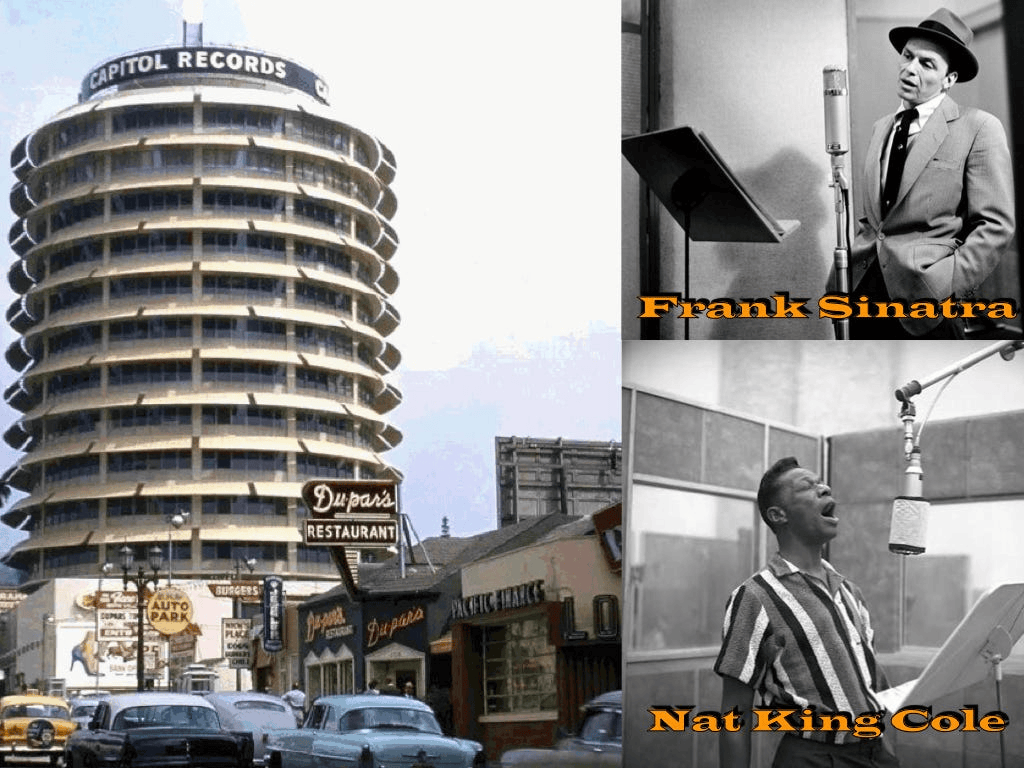
Through the decades, other musicians have recorded their best known work at the Capitol Records Building in the studios where ella & louis was created. The list is long and includes Frank Sinatra and Nat King Cole as well as the Beatles and the Beach Boys.
The circular building is today a Los Angeles landmark. When I would drive within sight of it, I thought it looked like a stack of phonograph records. The architect denied that was ever his intention and Louis Naidorf, who was 24 years old when he designed the Capitol Records Building, insisted for the rest of his life that it was a coincidence.
Here’s the playlist for ella & louis…
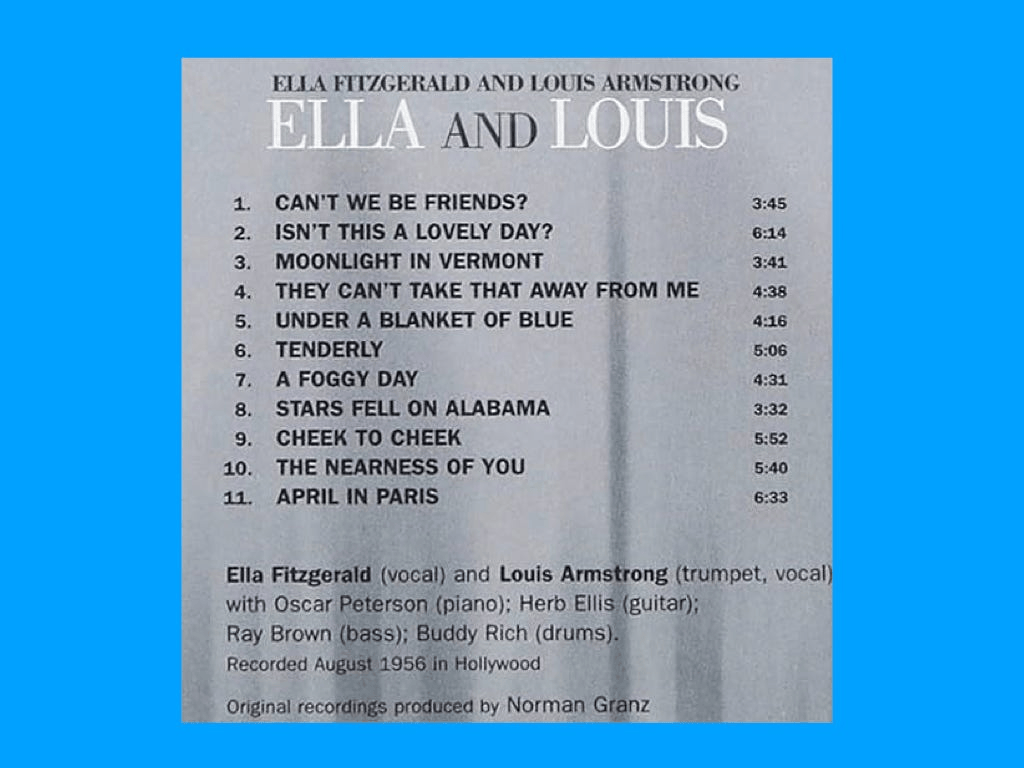
And here’s a YouTube link for listening to the complete album…
Trump: The Musical Act 1 (Scene 1)
It was April 1, 2020 and a very different April Fools’ Day. We weren’t in the mood for jokes. The onset of The COVID pandemic had us indoors and washing our hands constantly, including after retrieving letters from our mailbox and handling the produce Jo brought home after her 100 yard dashes in and out of the supermarket.
That day our new quarantine reality led me to create a cartoon. I emailed it to some friends…
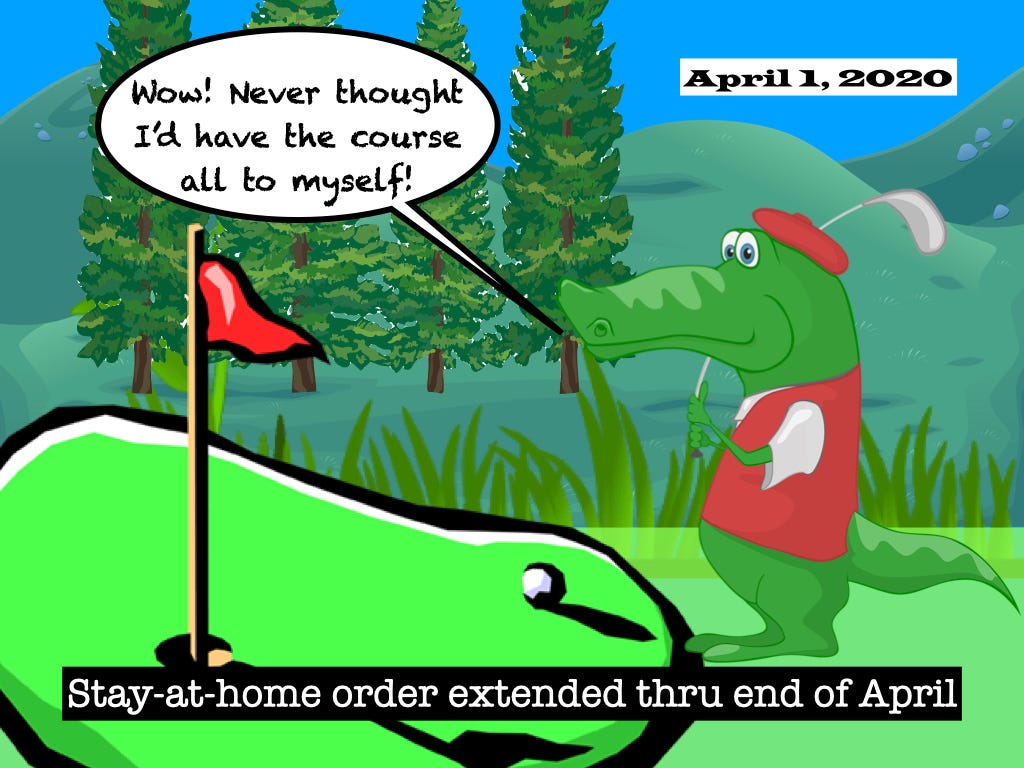
I had no plan nor idea that each day after that for the next 364 I would keep creating and sending my Homemade Cartoons to anyone who desired to be added to what became several hundred recipients.
It was September, almost six months later, and I had not yet run out of ideas but needed something that I could have ready to publish for a week or two and take a break. So I created a Broadway show and titled it Donald Trump — The Musical. I’m taking a break again so I’m reprising that show now for The Pawned Accordion. Six years later the names have changed except for Donald Trump’s and just as regretfully Stephen Miller.
What’s absolutely mind boggling to me is that I feel a bit nostalgic for the characters who surrounded him back in 2000. They weren’t harmless but I think you might agree that in the rear view mirror, the Trump players who performed in my original Broadway broadside during his first administration don’t seem as evil and toxic as those spearheading our country’s terrible course of tragic misfortune now.
So settle back in your seat and hopefully, now fully vaccinated against COVID, return with me to what seems a lot longer than six years ago. We’ve been through a lot, no? Enjoy the show…

Homemade Cartoon for September 12, 2020— I’m working on a Broadway musical and as I create it I will share with you the songs and context for their inclusion. Let me take you into the theater of my imagination for the opening scene and number…
Scene 1— Curtain rises… It’s election night 2016 and at the New York Hilton there is delirium that’s turning into a tidal wave of “pander-monium” that is expected and of course demanded around Donald Trump. To his own and the world’s shock he has been elected to be the 45th president of the United States of America and his running mate Mike Pence has been elected as his vice president.
As Trump and Pence stand before the crowd and the cameras, Pence’s attempts to get the president-elect to clasp his hand and raise their arms together in victory are rebuffed. It’s not the only time Pence will be given the brush off that evening.

You see, the jubilation is not universal. Both Melania Trump and Karen Pence may barely know each other but appear to be equally distraught. A spotlight illuminates Melania Trump sitting stage left. She is crying. She knows her New York City life of privilege and privacy is about to end— well, not the privilege part.
A second spot reveals Karen Pence stage right and she is fuming. We listen in to her conversation with her husband barely audible above the hubbub as the election night celebration continues…
“What are we going to do, Mike? We don’t have any money! Who’s going to pay for my inaugural gown? Don’t you dare kiss me. Leave me alone. You got what you wanted.”
As Melania continues to cry and Karen to fume, Michael Cohen rises out of the stage floor. The president’s “fixer” is very aware that Melania is used to being disregarded and disappointed by her husband. It’s what she signed up for just as Cohen knows jail time is all but certain to be his own likely reward for doing Donald’s dirty work.
Tonight he’s not being paid to attempt to cheer Melania up but he tries pro bono and begins singing the opening number…
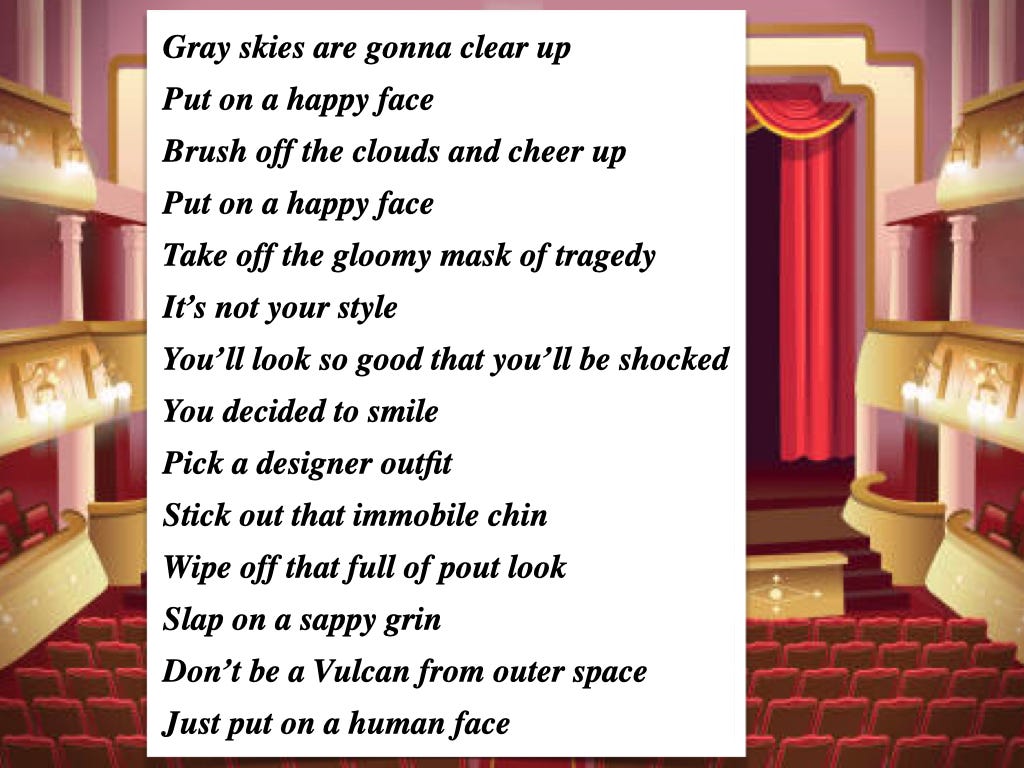
After Cohen gets through the first stanza another figure enters from stage left or stage right. We never know which because he had unsuccessfully demanded to appear standing high above the stage on a balcony. As a compromise he is being paid substantially more than the Actors’ Equity minimum and has the right to enter from which ever side of the stage he wants. It’s Pope Francis who continues the appeal to cheer up Melania…
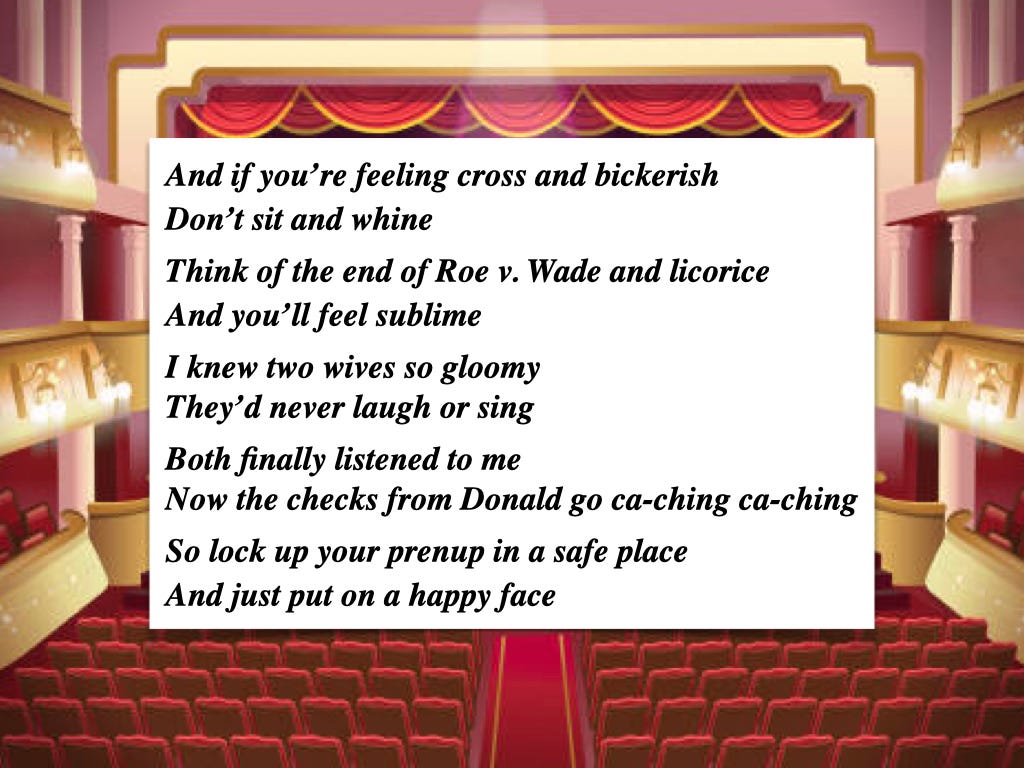
Cohen and the Pope then break into a soft shoe routine as the music continues but the two women are not cheered up. In fact their tears and scowls turn into expressions of horror as they see an asteroid hurtling toward them. It misses.
The music ends and the stage goes dark.

Today’s re-purposed song Put on a Happy Face was from Bye Bye Birdie with music composed by Charles Strouse and lyrics by Lee Adams. The show opened on April 14, 1960 and the song was originally sung on Broadway by its star Dick Van Dyke.
Trump:The Musical Act 1 (Scene 2)

Homemade Cartoon for September 13, 2020
Scene Two—
The lights come back up and we’re in the Oval Office. We see the just inaugurated President Trump but he’s not behind the Resolute desk. He’s standing in front of it because the big screen television he wants on one of the office’s walls has become an unforeseen problem.
Nobody realized that the The Oval Office is actually shaped like an oval. TVs are flat; consistent with the belief of some of Trump’s MAGA supporters that the earth is too. So there’s a large television being rolled in and placed on top of the Resolute desk.
It’s his first morning on the job and he’s not only livid about not having a TV to watch, he’s learned that crowd estimates at his inauguration are less than half of what Barack Obama’s were in 2008 and even a couple hundred thousand less than the number of people who attended Obama’s second inauguration in 2012.
Two pictures now being shown on the TV screen make this stark comparison obvious and the President has called in his chief of staff Reince Priebus. Despite the photographic evidence the President isn’t buying that Obama bested him.
Trump: “This picture is bullshit. There’s more people there. There are thousands— millions —who can’t get in the gates. There’s all kinds of things going on that made it impossible for my people to get in there. Tell the Park Service to get a new picture and come up with a new number and make it a presidential record! Where’s Kellyanne? We need alternative facts.”
Priebus is flabbergasted but trying hard not to show it by looking down at his shoes. They’re Hush Puppies and remain silent. Suddenly, Trump breaks into a musical statement of who he is that shocks Priebus further. The pit orchestra begins the show’s second song…
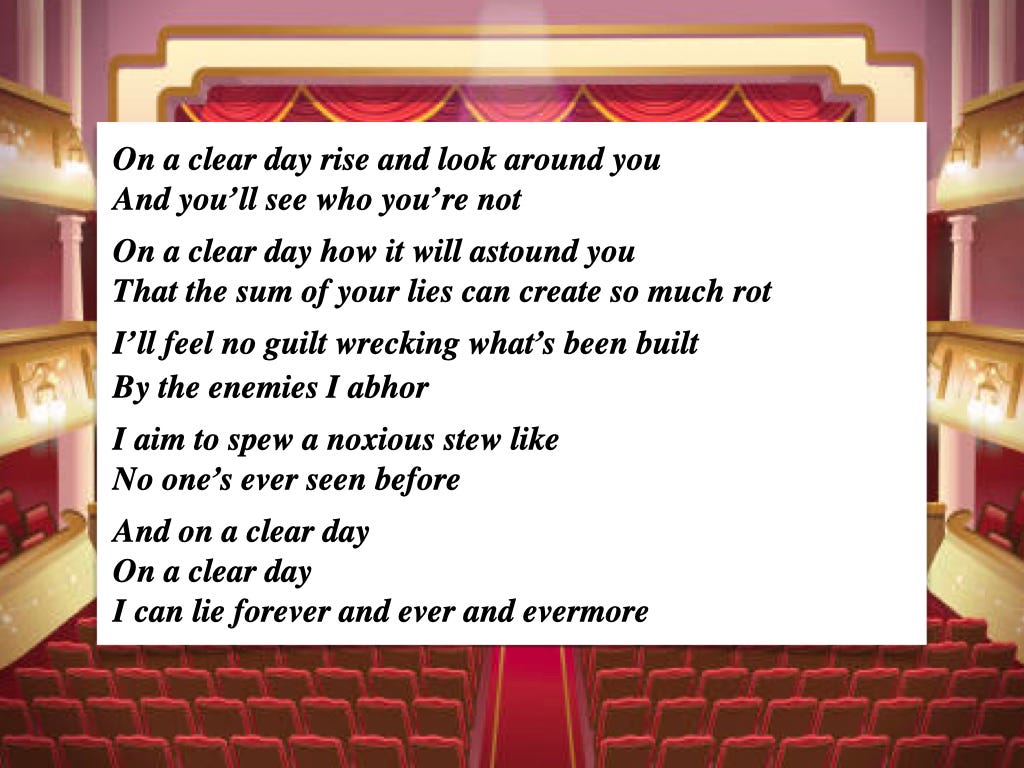
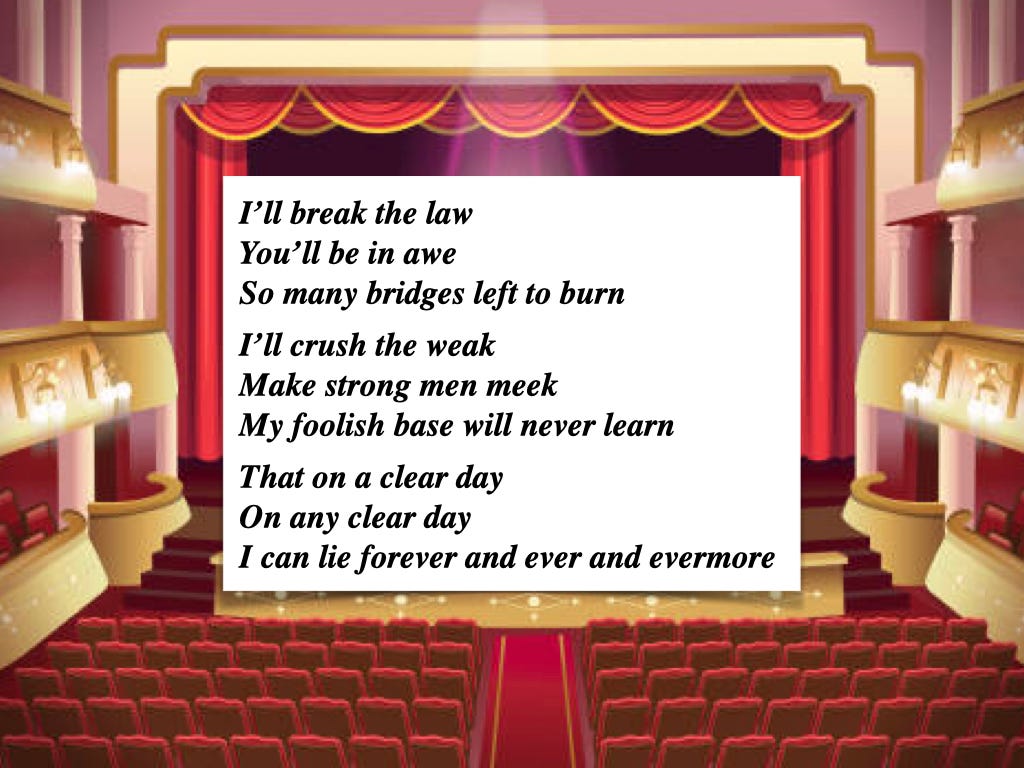
Stage goes dark— very dark!

Today’s re-purposed song On a Clear Day You Can See Forever was composed by Burton Lane with lyrics by Alan Jay Lerner for the Broadway show of the same name. The show opened on October 17, 1965 and the the song was originally sung by John Cullum.
Trump:The Musical Act 1 (Scene 3)

Homemade Cartoon for September 14 , 2020
Scene Three— Outside the windows in the White House Cabinet Room snow is falling but the atmosphere inside is even more frigid. President Trump and Nancy Pelosi and their staffs have just finished up— what else? —a contentious meeting.
As the others leave, the President asks Speaker of the House Pelosi to stay and have a private conversation with him. It’s quickly apparent that he isn’t interested in talking policy and certainly not anything at all connected to their working together. Trump wants to engage in verbal arm wrestling with Pelosi and he believes his will be the upper hand…
The song they perform is a duet. Trump’s lines are in italics, Pelosi’s are black…
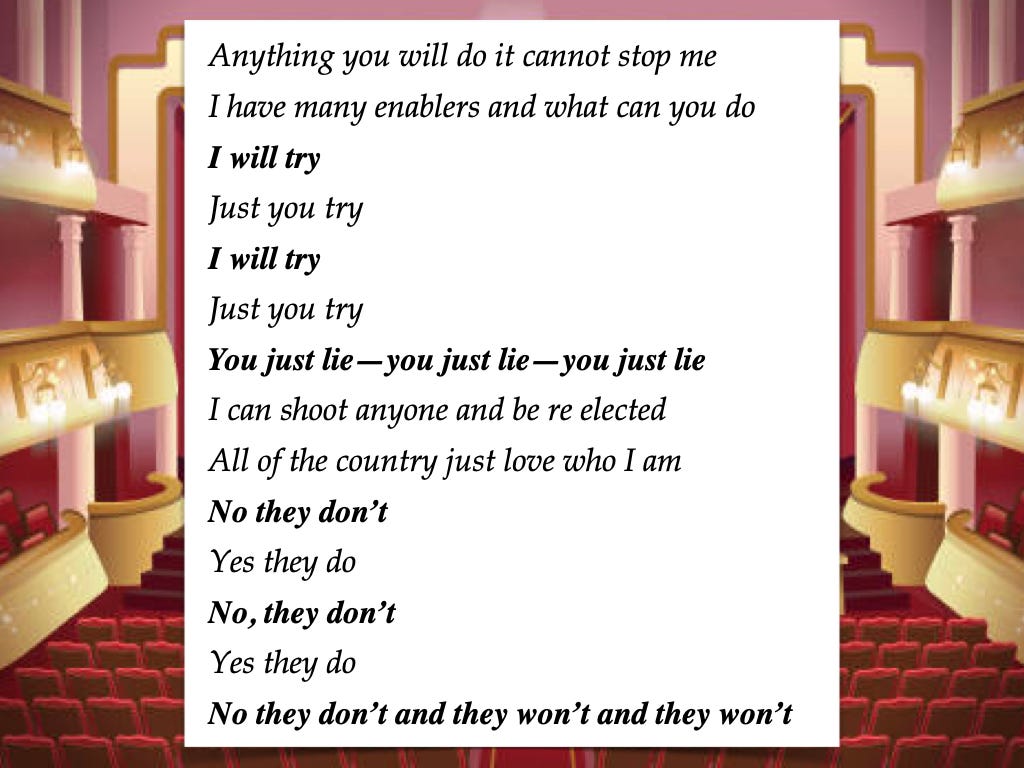
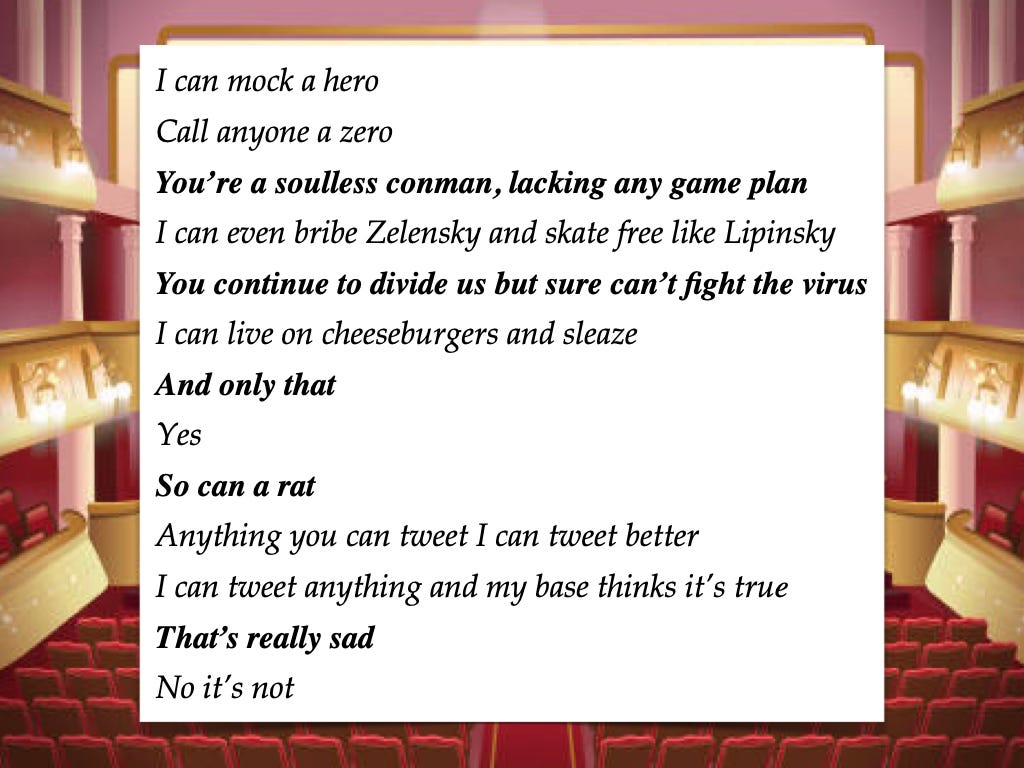
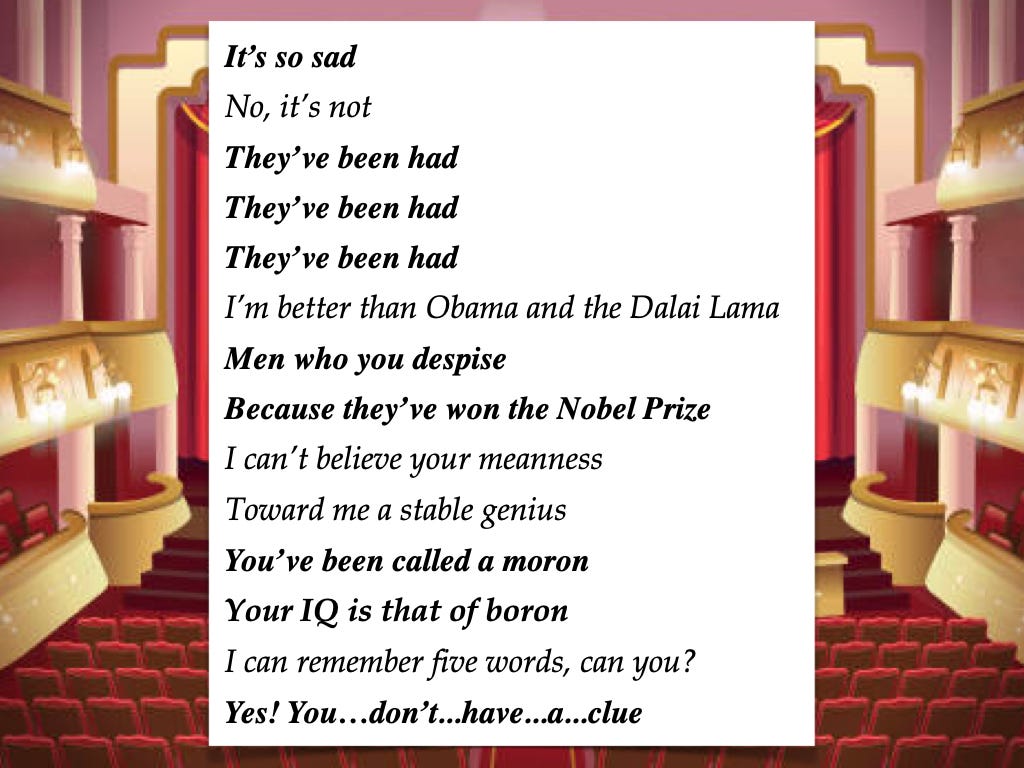
Pelosi is out the door and Trump fumes as the stage goes dark.

Today’s re-purposed song Anything You Can Do (I Can Do Better) was composed by Irving Berlin for the 1946 musical Annie Get Your Gun and originally sung on Broadway by Ethel Merman and Ray Middleton. In 1976 Merman did the duet with Miss Piggy on Sesame Street.
Trump:The Musical Act 1 (Scene 4)

Homemade Cartoon for September 15, 2020
Scene Four— In the Russell Senate Office Building Mitch McConnell is sitting smuggly behind his desk. UPDATE! McConnell will shepherd through the Senate 325 new judges to lifetime appointments in America’s lower federal courts in the next four years and three others onto the Supreme Court. That’s a quarter of all active federal judges today. Full disclosure— President Obama appointed nearly 40% of all federal judges during his eight years in office.
Senator McConnell knows he can speed up the confirmation process by blowing up long standing rules as Majority Leader, like shortening the time for debate on the merits of each nominee. And despite the pandemic, he’s as committed to his “No vacancy left behind” stratagem as ever.
While rummaging through a pile of folders on his desk with a very uncharacteristic enthusiasm, McConnell keeps repeating aloud the words “Here comes da judge,” as if he were in a minstrel show.
The orchestra begins playing and Mitch performs his solo— Send in the Clones
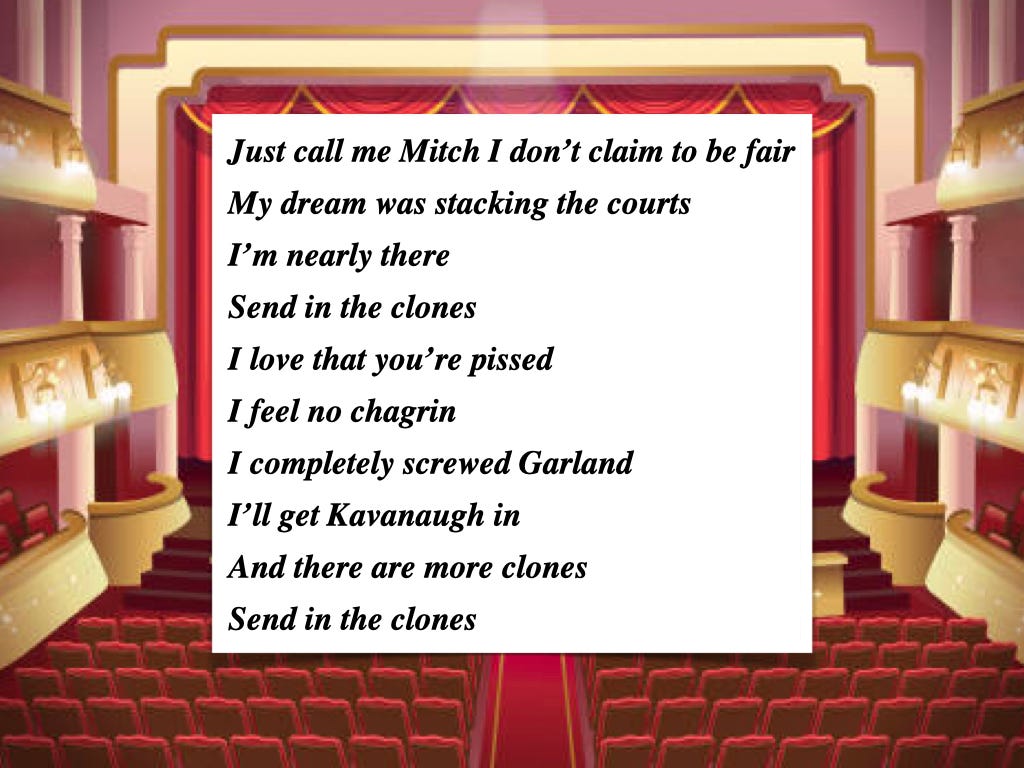
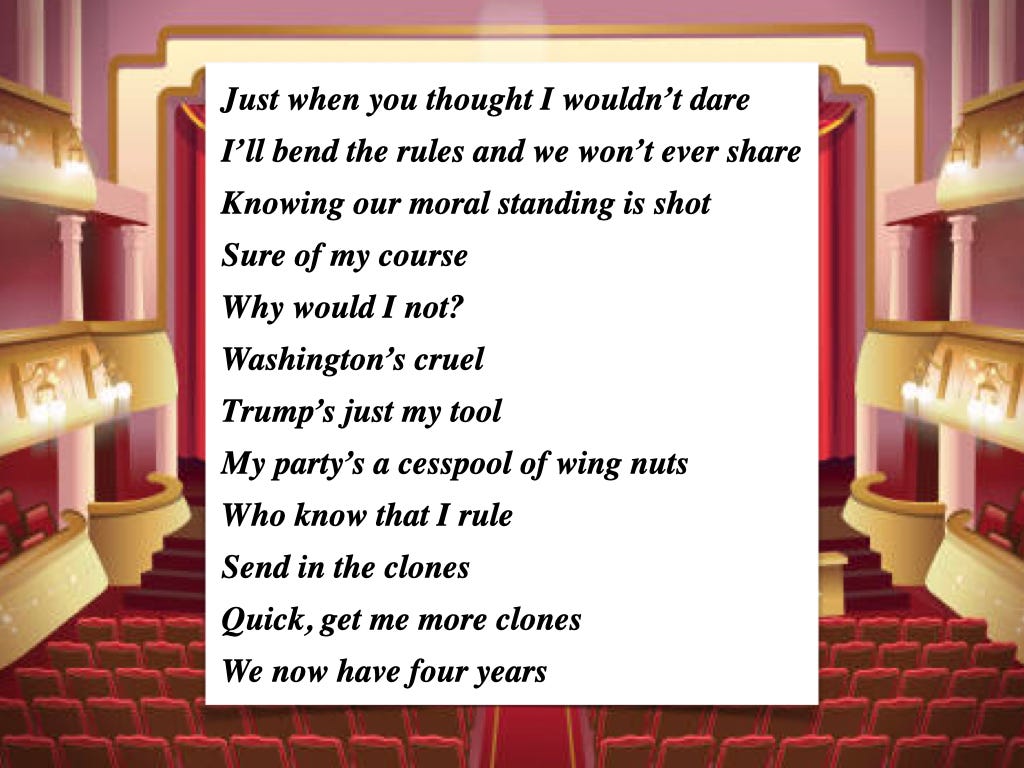
Today’s re-purposed song Send in the Clowns was in the show A Little Night Music, a Broadway adaptation of Ingmar Bergman’s film Smiles of a Summer Night, that opened in 1973. Stephen Sondheim wrote both the music and words for the actress Glynis Johns. Since then the number has become one of Sondheim’s most popular and most recorded songs.

Trump:The Musical Act 1 (Scene 5)

Homemade Cartoon for September 16, 2020
Stage lights come up and we find Ivanka Trump in her White House office which also serves as a museum for her fashion brand. A museum because Ivanka’s brand is now defunct. At one time it flourished. In 2013 her line did $75 million worth of business but after her father announced his run for president in 2015, things went south quickly. Within a few months her only remaining store offering her products was in Beijing.
Someday perhaps, we might learn if at the time Ivanka blamed her father for her enterprise folding. But no doubt after Donald Trump’s election all was forgiven. Ivanka landed a new job and surely, trying to get women to wear your shoes, can’t come close to holding power over so many suitors and ass-sordid synchopants of the president. Her song is in the key of privilege…
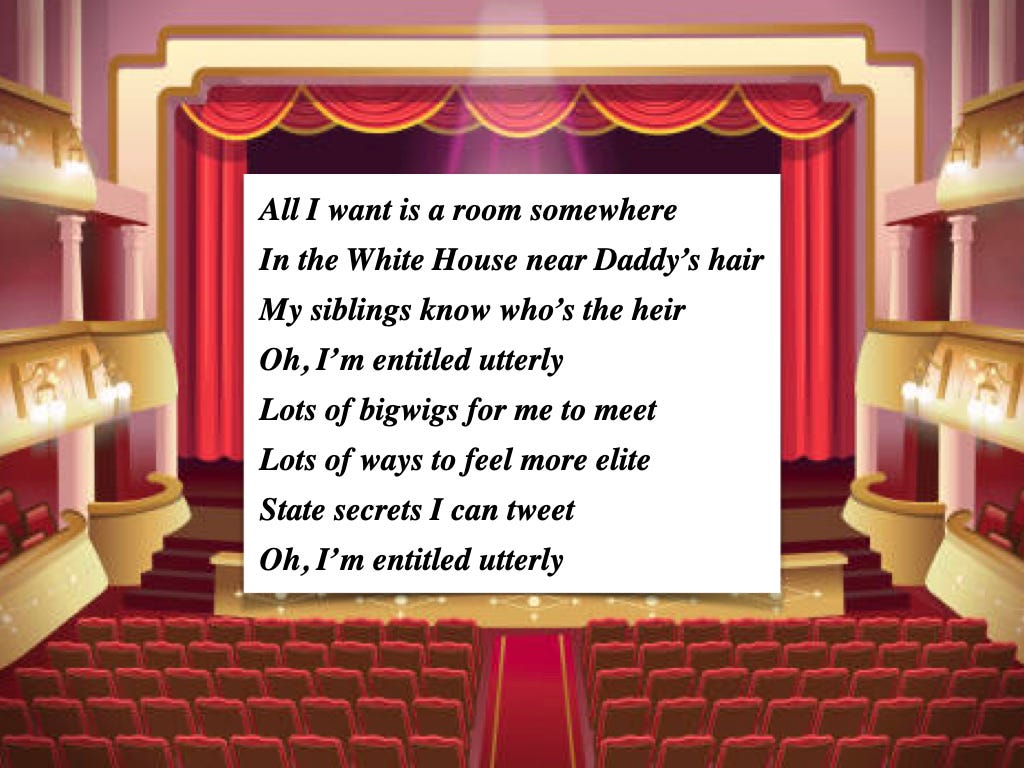
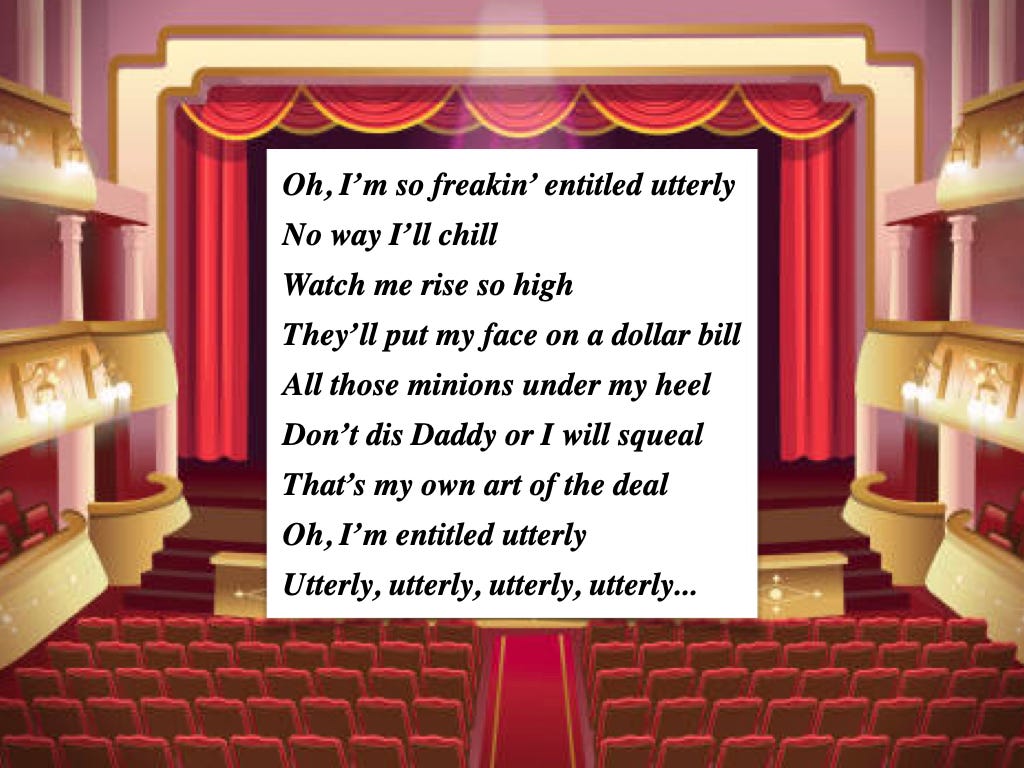
Today’s re-purposed song Wouldn’t It be Loverly was written by Alan Jay Lerner and Frederick Loewe for the 1956 musical My Fair Lady. Julie Andrews sang it and I was wrong to assume it was her Broadway debut. She had appeared in The Boy Friend two years earlier when she was 19.

Trump: The Musical Act 1(Scene 6)

Homemade Cartoon for September 17, 2020
The stage lights illuminate a tawdry strip club, but that’s redundant. President Trump is in Finland and has accepted an invitation, or is it a summons, to an evening’s entertainment from Russian President Vladimir Putin.
Putin’s a fitness nut but he knows the only laps the American president might be interested in doing are to be found at Alcatraz— a strip club in Helsinki (yes, it exists! I looked it up.). It has been an eventful day. The two men met earlier for talks at the conclusion of which Trump assured our country that he took Putin’s word and denial over American intelligence findings that Russia interfered in the 2016 election that elected him president.
“President Putin says it’s not Russia. I don’t see any reason why it would be.”
With that issue out of the way for the two men, they are seated in the small club and are the only ones in the audience as women take turns undulating and undressing on a tiny stage. With no media or other customers to witness them, we discover that Putin speaks fluent English.
Putin: “So, Donald what do you think of Helsinki?”
Trump: “Vlad, I know they like me very much and thank you for bringing me here to Norway. Can I order you a cocktail?”
Putin: “I don’t drink, you know that and by the way the Finns liked Obama more.”
Trump: “The Finns? Ok, that’s just one family, but you don’t like Obama better than me. How can you? I’ve done everything you’ve asked. We have a deal and I pay you nothing but compliments.”
Putin: “And you’ll have to keep paying or else someone else will pay me for the ‘kompromat.’”
Putin’s cackles reverberate off the walls of the strip club. Trump fails to get the play on words since it’s a play on words and looks befuddled. The music begins and Putin rises from his chair and sings…

Today’s re-purposed song Whatever Lola Wants was written by Richard Adler and Jerry Ross for the 1955 musical Damn Yankees, which was the first Broadway show I ever went to and I don’t think I was even 10 years old when I saw Gwen Verdon perform the song with the original cast.


Notes From Finland

“Music begins where the possibilities of language end.” ― Jean Sibelius (1865-1957)
I was worried that I was taking Jo on a trip she might not enjoy. We were traveling to Finland primarily to listen to music. The country’s most significant and revered composer is Jean Sibelius and through listening to his work I had imagined Finland’s landscape.
When I listened to The Karelia Suite I could see birds soaring above a windswept lake. Valse Triste and I saw myself walking in a dense forest. The Oceanides and I heard waves pounding against the rocks on a coastal shore.
Sibelius’ music is dramatic and I had made the leap to imagining it being climatic as well. Alas, there was only beautiful weather; no rain and hardly a breeze during our two weeks in Finland. The country’s lakes, forests and sea were not disappointing and only enhanced by Sibelius’ music.
The country is so far north that sunrise and sunset times can lengthen or shrink by as much as six minutes in a day. That’s twice as fast as the maximum daily swing here in Maine. Rural Finland looked much like Maine but with birch trees instead of pines.
The city of Lahti, a couple hours north of Helsinki, has hosted the Sibelius Festival since 2000 in a concert hall ranked among a handful in the world for the quality of the sound that can be made in it.
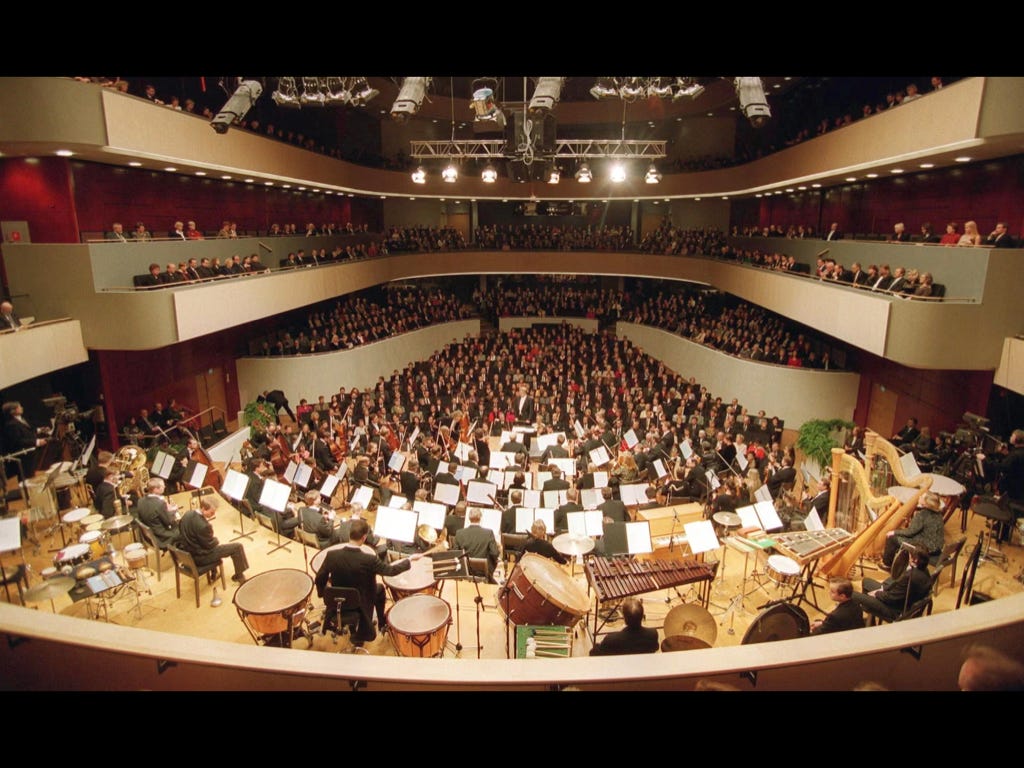
I had wanted to attend the event for some time so we had linked up with a group of music lovers who had flown in from London. We were 25 in total and Jo and I were the only ones not from the UK which meant it was 23 and us.
The festival was terrific and happily, Jo enjoyed it too. Although the movie line “You had me at hello.” may not have applied to her, I needn’t have worried after the second day when we heard the composer’s Finlandia performed by the Lahti Symphony Orchestra and sung by a choir. Some may think Finlandia is the country’s national anthem. It’s not. It’s too long— eight minutes.
Jean Sibelius composed this, his most famous piece, in 1899. Knowing what it represented for him and hearing it now seemed to convey both an affirmation of Finland’s past and perhaps an unspoken apprehension about its future .
“We fought 600 years for our freedom and I am part of the generation which achieved it. Freedom! My Finlandia is the story of this fight. It is the song of our battle, our hymn of victory.” — Jean Sibelius
That victory may not be tenuous at the moment but recently it has grown more tense. Finland’s border with Russia stretches over 830 miles from the Baltic Sea up to the Arctic Circle. It’s not the longest border any country has with Russia. Those between Russia and Kazakhstan, Russia and China and Russia and Mongolia are longer. But Finland’s is the longest border with Russia in Europe.
It used to be possible to drive from Helsinki to St. Petersburg in less than a day. The border with Russia has been closed since 2023. Finns are grimly steeled to provocation and the threat of invasion by its neighbor and are determined to fight if that becomes necessary.

Finland joined NATO three years ago and by doing so is theoretically now protected by NATO’s Article 5 which states that an armed attack against one member is considered an attack against all members and obligates the others to assist and provide military force.
A survey from this past spring found that only 13% of Finns believe the United States under Donald Trump would actually come to Finland’s defense if it were attacked. In fact two days before we flew home, Finland held the largest civil defense exercise in Europe since the end of World War II. And earlier this month Finland completed a 125 mile border fence along its Russian border, putting a new iron curtain in place.

And yet this year— for the ninth straight—Finland has again been declared by the World Happiness Report the happiest country in the world. Maybe it shouldn’t be a surprise. It’s a nation that has universal healthcare, free education through university, generous parental leave, unemployment support and a pension system that covers its citizens whether one has worked or not.
Finns have high trust in government, institutions and each other. Our visit wasn’t long enough to validate these things but the country certainly appears to have its act together.
In the Happiness rankings Nordic countries with their strong social contracts are happier than America but then Mexico and Israel also place higher than we do. The United States is 24th on the list. That puts us just below the United Kingdom and just above Belize. Hey, but we’re still happier than Russia or China.
And there’s another category in which Finland is considered among the world leaders. According to the Global Creativity Index, Finland ranks third behind Sweden and the United States. Finnish design is admired whether it be furniture, fashion or scissors.

It is also among the top ten countries rated the most technologically advanced.
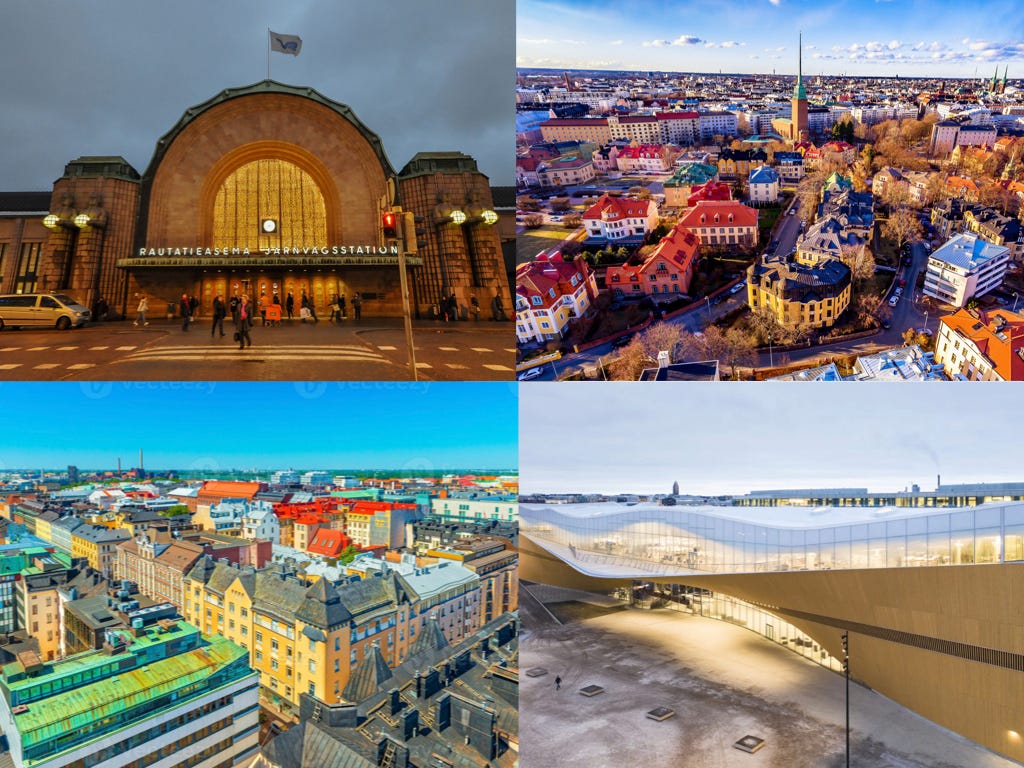
Helsinki is a lovely and most walkable city. The Ateneum may not be the Louvre but we enjoyed its collection of Finnish painters. The Helsinki train station which has been in use for over a century was designed by Eliel Saarinen, father of architect Eero Saarinen. Oodi— the new central library —opened in 2018 and is considered one of the world’s most innovative.
Oh, and I haven’t mentioned Finnish food. If American cuisine is associated with hamburgers and hotdogs, Finland is salmon and (gulp) reindeer. We had plenty of the former and consciously avoided depleting the supply of Rudolphs for the upcoming holidays.

Yes, taxes on its citizens are high— among the highest in the world —and the language is one of the hardest to learn but we loved Finland and Finns clearly have many reasons to do so. It also appears to be a country still under the radar as a tourist destination. Helsinki has yet to be “Barcelonisized”.
And here’s a final shot of the view, stepping just outside the Sibelius concert hall in Lahti as well as a link to my favorite piece of his music which I got to hear performed at the festival…

Jean Sibelius – Symphony No. 3, in C major. 2nd movement
Unequal Time

Fall begins today on September 22nd. The 2026 autumnal equinox occurs at 8:05 p.m. EDT. That’s according to the Farmers’ Almanac which I presume has been keeping track of such things since it was founded in 1811.
That source is not to be confused with the even older The Old Farmer’s Almanac (notice the different placements of the apostrophes) founded in 1792 that pegs the moment for the equinox today a minute earlier at 8:04 p.m. Is this how the word minut(e)iae came to enter the language? We won’t quibble.
However I have a larger concern. If the equinox is supposed to be the day of the year when the time between sunrise and sunset is equal to 12 hours, then here in Camden, Maine that day is not today. Sunrise was at 6:23 a.m. and sundown will be at 6:33 p.m.
Ten minutes is meaningful. With that extra daylight there’s enough time to water the plants outside your house or play a last hole at the golf course.
But no worries. Here in Maine we will experience an exact equal time between our sun’s comings and goings three days from now this Friday, September 25th when the sun rises at 6:27 a.m. and sets at 6:27 p.m.
There is actually a term for this. It’s called the equilux which sounds like it should be the name of a vacuum cleaner but is the actual day twice a year when daytime and nighttime are closest to being equal in length. And by the way there is a vacuum with a name that’s close. Electrolux vacuum cleaners have been around for over a century. The first model was manufactured in 1912.
Fall has arrived on schedule although I haven’t raked any leaves yet but soon I know I will. So far I’ve only pulled out my leaf blower a couple times to blast ones that have piled up on our patio into the surrounding garden beds. The grass has almost stopped growing and I may need to mow the lawn only a couple more times. These are chores that have become rituals I enjoy.
My grandson (pictured above a few autumns ago in the woods where I dump our leaves) was born on the same day of the year as I 69 years later and reminded me last week that we had our half birthdays. I’ll be 80 next March. How many more times will I get to rake and mow? I hope a bunch.
I pay more attention to equinoxes and solstices now than I did when I was younger. I certainly have time to do it. They have become the picture frames by which I metaphorically hang Maine’s four seasons.
For me those frames where I live are by no means of equal size. I can imagine them as the dimensions of photo paper I’d print them.

Spring would be a muddy 4 by 6.
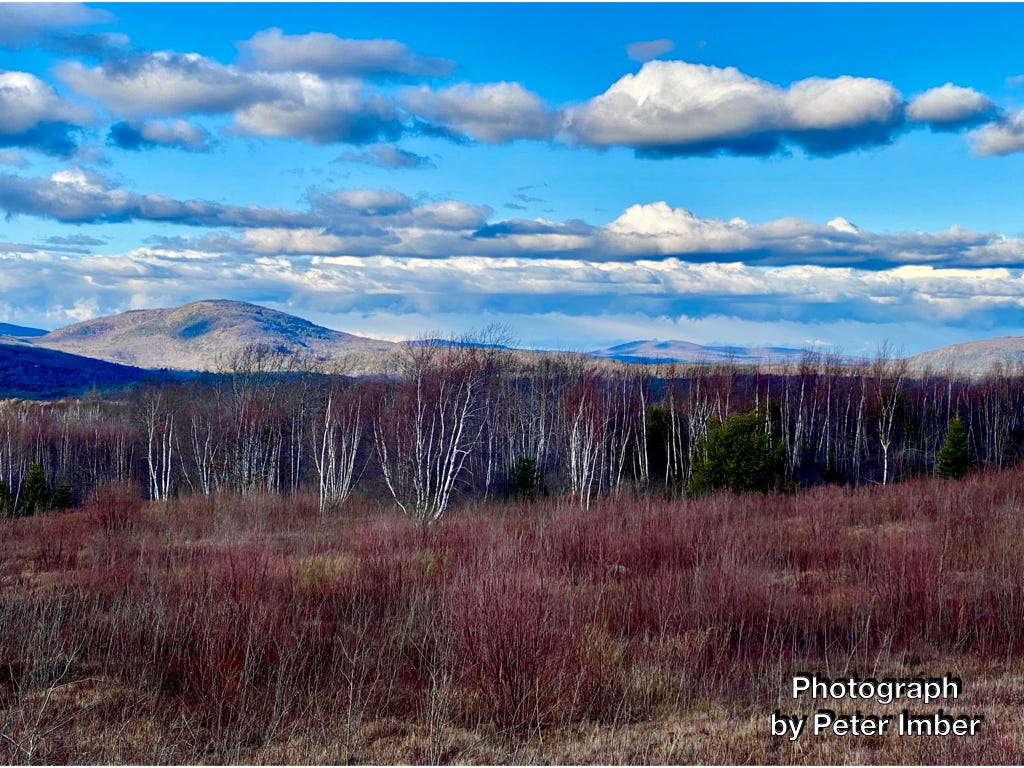
Fall an inspiring 6 by 8.

Summer a glorious 8 by 10.

And for winter I would need a larger printer than I own to allow for a 16 by 20.
Yes, winter needs the largest frame. It is the longest of our seasons and as emblematic of the state as moose and lobster. Many a writer has described winter in Maine…
“Maine is a joy in the summer. But the soul of Maine is more apparent in the winter.” — Paul Theroux
“It’s Winter in Maine / And the gentle breezes blow, / Seventy miles an hour, / At thirty five below.” — Anonymous
And despite the dark, the snow, the ice and the cold…
“I would really rather feel bad in Maine than good anywhere else.” — E.B. White
The four movements of a symphony are not of equal length nor similarity of character. The four seasons in Maine are a symphony of both of these.
I don’t really mind the darkness in December when it descends before 4 p.m. I can look forward to the winter solstice and its promise that the days will get longer again but only with full knowledge that it will take more time for Maine to heat up than any place else I have lived.
It is our astronomic lot that we are positioned on earth at 44°14′35″N latitude and 69°06′36′′W longitude. Bucharest is a city close to parallel to Camden to the east but Romania has a less harsh and shorter winter.

Of course I could be living in Ecuador at zero latitude and longitude where sunrise occurred at 6:06 a.m. this morning and sunset will be at 6:06 p.m. this evening. On the equator every day and night are of nearly equal length.
With no seasons would I know what time of year an outdoor photograph was taken? Would evenings feel like living under a permanent curfew? Summer would no longer be something to look forward to and a reward for enduring winter. Hey, I might even miss wearing a parka.

Give me Maine’s unequal rowdy seasons. And here’s to all of them!
Steve Allen Hosts The First Tonight Show Day!
Here is my September’s New American Holiday…
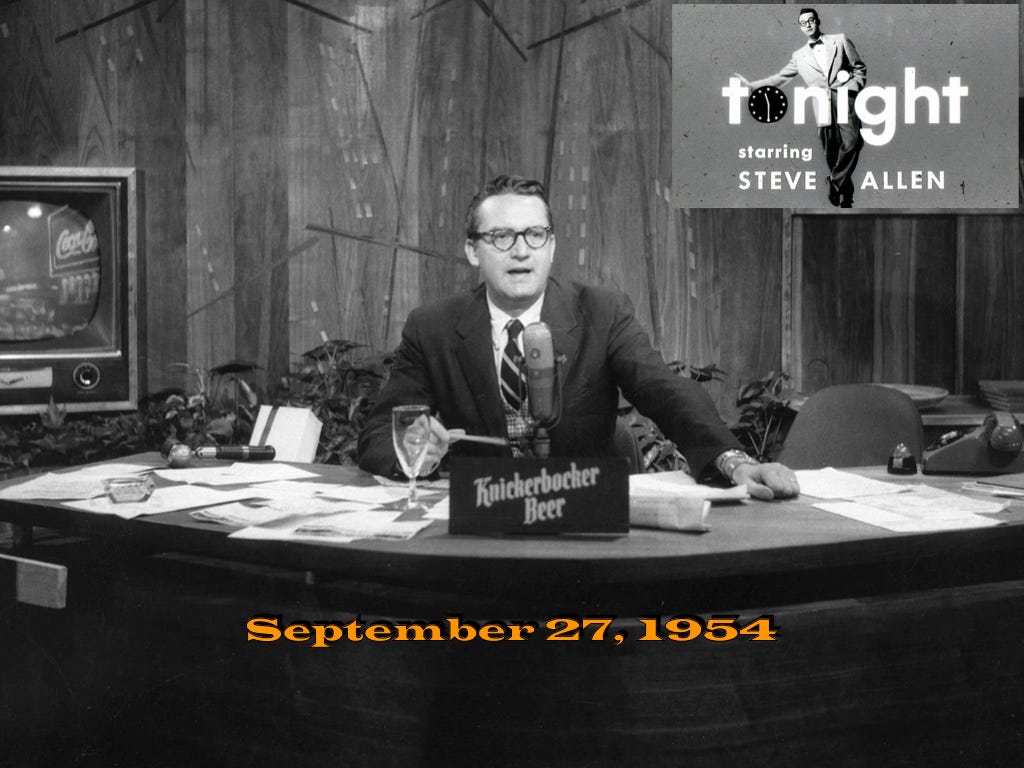
National Steve Allen Hosts The First Tonight Show Day
It figures. Little did I know when I searched for the program that has broadcast the most shows in the history of American television that for my entire career at ABC News I worked within 100 yards of where that show is still being produced. This past July General Hospital celebrated airing its 16,000th episode. The soap opera has been on ABC since 1963.
The Tonight Show premiered nine years earlier and I had presumed that since both it and GH— as we called it on our studio lot —were on TV five days a week, the tally would have favored Tonight. So why to date has The Tonight Show only racked up about 13,400 shows?
The answer is a Great White Shark and Johnny Carson’s contract. A Great White must always be moving forward and soap operas must too with their every successive episode although the storylines may be decidedly tortoise like. Late night TV programs have the freedom to air reruns and do. For the majority of his career The Tonight Show’s iconic host negotiated to have a five day work week become four and then three nights a week. “Here’s Johnny!” became where’s Johnny? That explains the discrepancy.
But by any other measure the longevity of Tonight is a tribute to a man who helped shape what morning and late night were to become on American network television. Sylvester “Pat” Weaver was the most influential programming executive of TV’s formative years and maybe ever.
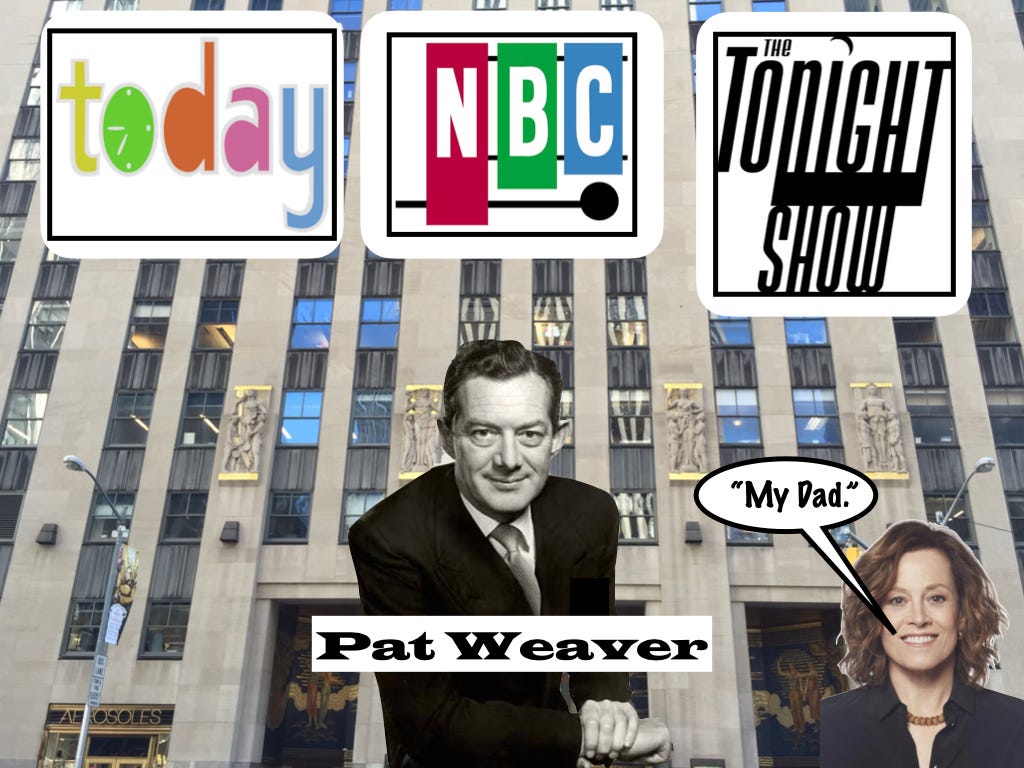
TV sets sales were taking off in America when Weaver arrived at NBC in 1949. His prior jobs in advertising and radio were to make him the perfect fit for taking over a new television network. Weaver had a number of insights that have shaped the medium to this day.
In the early 1950s television had settled into schedules which filled afternoons with soap operas and game shows and evenings with dramas and variety programs. Weaver saw mornings and late night as yet unrealized opportunities for new ideas.
In 1952 he created The Today Show with a format that matched what its audience was likely to be doing in the morning— getting up, getting dressed, having breakfast and shepherding the kids off to school. Essentially, Weaver believed they were listening to television as much as watching it. So Today provided a sort of radio experience with moving pictures of the news and on camera personalities delivering an electronic newspaper.
Two years later Weaver launched the nighttime equivalent to his morning show innovation called Tonight. And he found the host who was already doing what he envisioned for his late night program— Steve Allen, whose locally seen late night show ran on NBC’s New York City TV station.
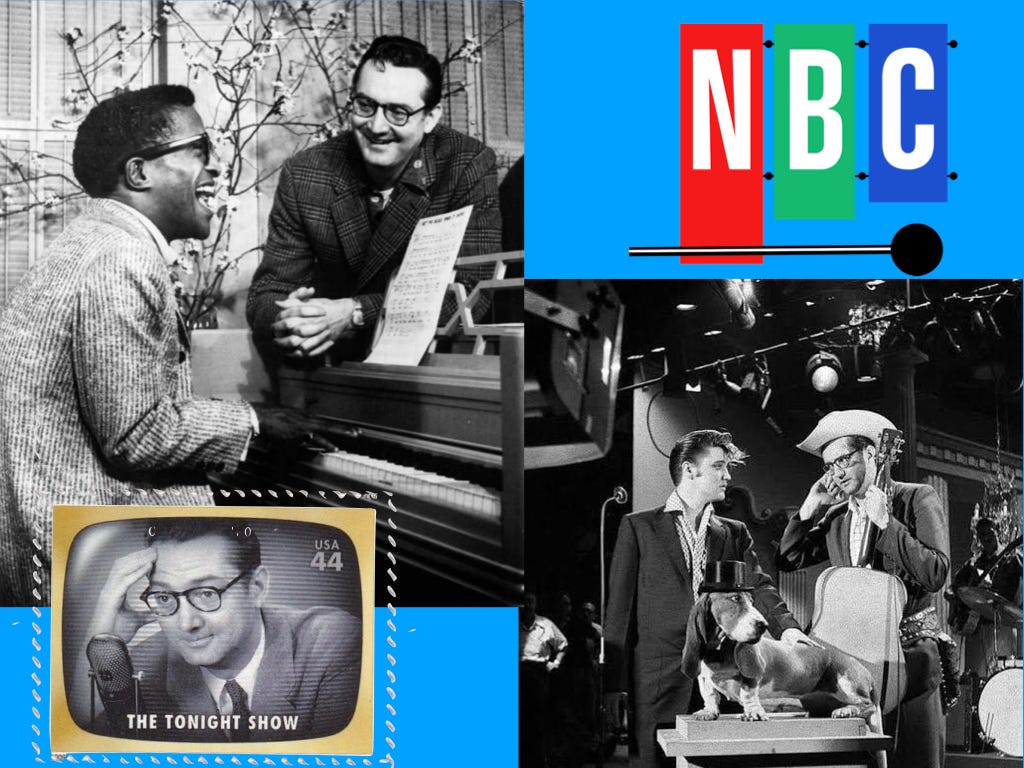
If it could be said about the fledgling media that anybody was a veteran, Allen already was. Weaver may have thought of the concept for Tonight but it was Allen who had developed the format. And if Today was like reading the morning newspaper, then for its viewers, Tonight was to become more like being in a nightclub and watching performers, especially comedians. Only instead of sitting at a table having a drink, you were likely to be propped up against a pillow in bed at home.
In addition to his experience on late night TV, Allen was a panelist on the popular CBS show What’s My Line? He was a known quantity for being spontaneous and funny and he had other talents as well as an accomplished pianist and songwriter. That same year as The Tonight Show’s premiere he composed his most well known tune— the prophetically titled This Could be The Start of Something Big which then became Tonight’s earliest theme song.
For all who came after Allen as Tonight Show hosts, their debt to his creating the late night show components is indisputable. Among them were the opening monologue, the wandering into the studio audience, the off the wall skits, the desk, the couch, the interviews and the Tonight Show band… Allen was an original quick witted unscripted improviser, the trapeze artist without a net who didn’t need one.
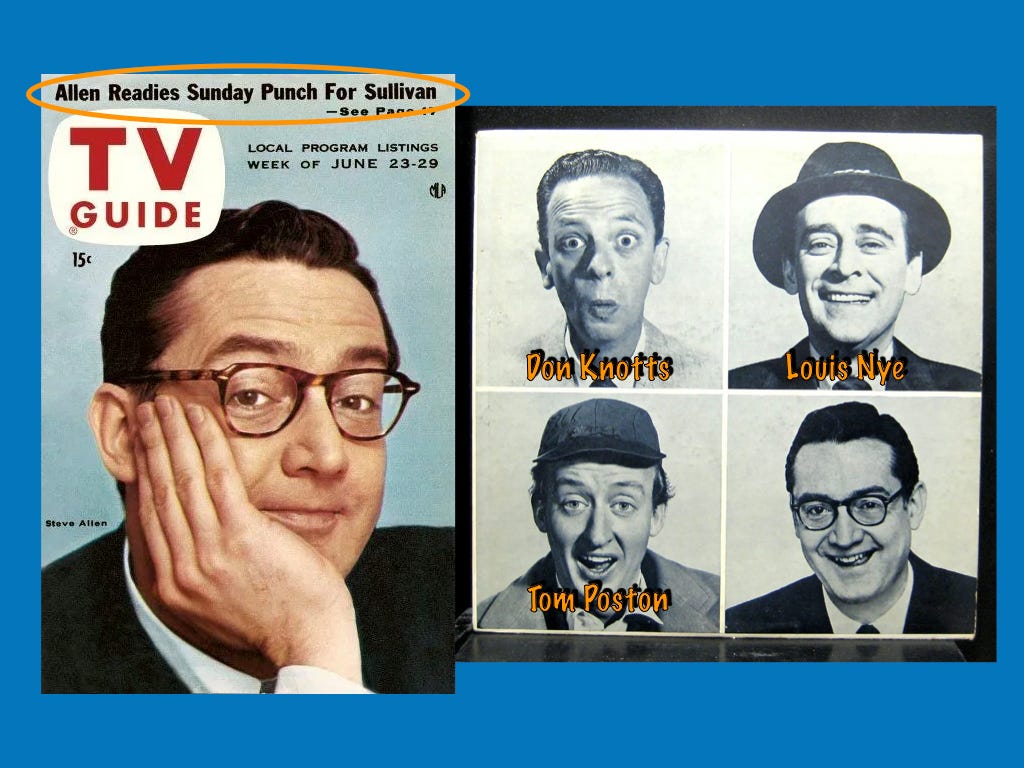
Ironically, Allen’s stretch as host of Tonight was among the shortest of the others who succeeded him. But it wasn’t a personal failure. Instead, it was his success at late night that led NBC to have him host a prime time show to go up against a ratings juggernaut on another network.
The Ed Sullivan Show on Sunday Night on CBS was the second highest watched program on television and only topped in the 1950s ratings by I Love Lucy. NBC had already launched a prime time Steve Allen Show in the spring of 1956 to counter Sullivan’s but by the beginning of 1957, Allen’s double duty ended and he was replaced on Tonight so he could devote his full time and energy to NBC’s attempt to wrest Sunday night away from CBS.
Despite winning a few battles of individual weeks in the ratings, Allen and NBC ultimately lost the war against Sullivan. Steve Allen’s talent and his program’s creative asset was its on-the-fly improvisation and unpredictability. Ed Sullivan’s program was a straight forward variety show that had an audience tuning in knowing exactly what type of entertainment was going to be offered every Sunday evening.
By 1960 Allen’s Sunday night program was canceled. He was unwilling and perhaps unable to change his comedic instincts to suit the new breed of profit and ratings focused NBC executives. Pat Weaver had been pushed out earlier and Steve Allen’s career at the network was over.
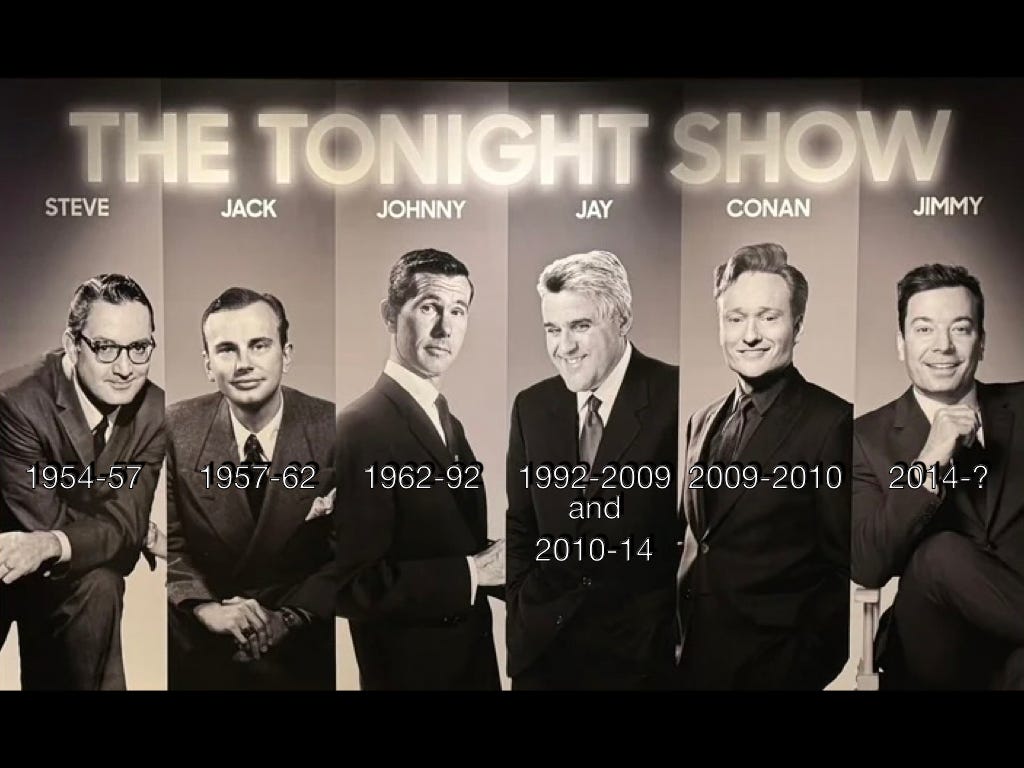
Steve’s Allen’s replacement on The Tonight Show was Jack Paar and in the 72 years of its run in addition to Allen and Paar, there have been only four other hosts of the program.
By the way I was in the studio audience to see a Tonight Show only once in the three decades I lived in Los Angeles where it was produced while I was there. Carson’s guests that evening were Bette Davis and Richard Pryor and with Johnny behind his desk and both of them on the couch, one might have thought that despite the odd pairing the 60 minutes (During his tenure Carson had also negotiated shrinking the program by a half hour.) would have been illuminated by default with such magnitudes of star power. However, Davis and Pryor and Carson too seemed uncomfortable and the result was a show lacking even the faint light of a key fob.
I don’t know if it was Carson’s habit not to interact with his guests during commercial breaks but that night he didn’t. Nevertheless, during the lulls he still held my interest. While both the set and the audience fell silent, he adroitly bounced a pencil, flipping it side to side and up and down on his desk with one hand. How did he do that? The pencil had erasers on both ends.
The Tonight Show and Johnny Carson had better nights and his stature certainly remained secure in my eyes. Carson was irrefutably the “King of Late Night.” But for him and all the other late night hosts in whichever studio they broadcast from and at whatever desk they sit, Steve Allen is the original architect and designer.
The Tonight Show on September 27, 1954 was recorded on film or what was then called a kinescope. Click below to watch something at its very beginning that has outlasted so many other so called television franchises. And that includes even the beer brand that sponsored it that first night…

